
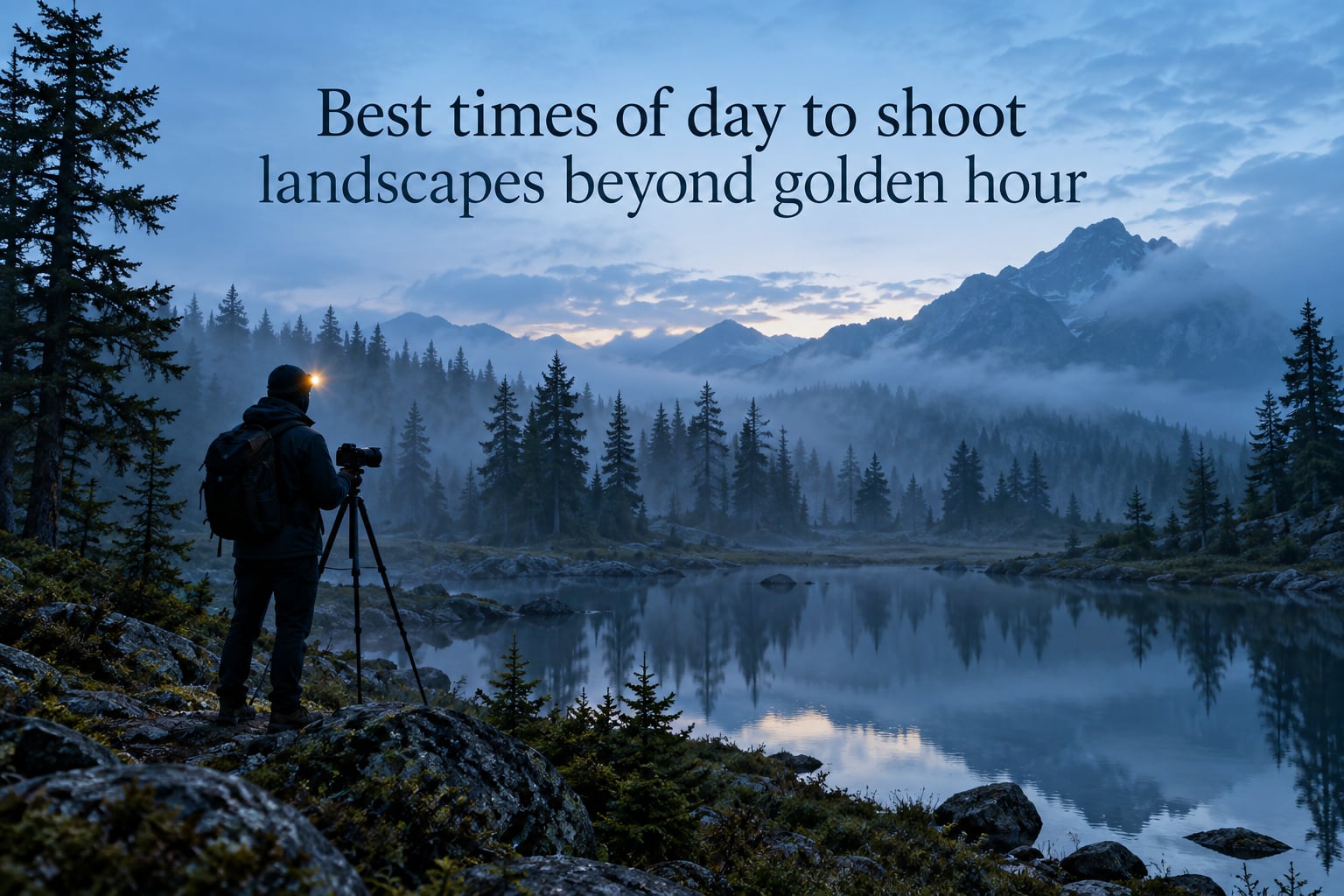
The best times of day to shoot landscapes beyond golden hour include blue hour (civil twilight), nautical and astronomical twilight, midday with the right technique, overcast days, and stormy weather windows. Each window offers a different kind of light, and most landscapes look their best at one of these quieter, more overlooked times. Once you learn to read them, your shooting calendar stops revolving around sunrise and sunset alone.
I have spent the last several years chasing landscapes mostly outside the golden-hour comfort zone, mostly because state parks close at 5pm and most waterfalls do not wait for the sun. What I found surprised me: blue hour, overcast skies, and even midday-with-a-polarizer often beat a sleepy sunrise shot at the same location. This guide lays out each window in plain language, with camera settings and subject recommendations, so you can plan around what the day gives you instead of what the calendar suggests.
Table of Contents
- What Is the Best Time of Day to Take Landscape Photos Beyond Golden Hour?
- Blue Hour (Civil Twilight) — The Quiet Window Most Photographers Skip
- Nautical and Astronomical Twilight — When the Sky Goes Dark for Astrophotography
- Midday and Harsh Sunlight — Why the ‘Wasted Hours’ Are Anything But
- Overcast and Cloudy Days — Nature’s Built-In Softbox
- Stormy Weather, Fog, and Mist — Drama Without the Sunrise Crowd
- Quick Comparison: 7 Time Windows for Landscape Photography
- Best Time of Day for Different Landscape Subjects
- Latitude, Season, and Planning Tools That Save the Day
- Frequently Asked Questions
- Final Thoughts: Beyond Golden Hour Is Where the Calendar Opens Up
What Is the Best Time of Day to Take Landscape Photos Beyond Golden Hour?
Beyond golden hour, the seven most useful windows for landscape photography are blue hour (civil twilight), nautical twilight, astronomical twilight, midday with controlled harsh-light techniques, overcast days, stormy weather, and fog or mist conditions. Blue hour and overcast skies are the easiest starting points for most subjects, while stormy and foggy conditions offer the most drama when conditions line up.
Blue Hour (Civil Twilight) — The Quiet Window Most Photographers Skip
Blue hour is the period of civil twilight that begins roughly 20 to 30 minutes before sunrise and ends 20 to 30 minutes after sunset, when the sun sits between 0 and 6 degrees below the horizon. The sky glows a deep, saturated cobalt and indirect light paints subjects evenly without harsh shadows. Most photographers pack up as soon as the sun dips below the horizon and miss this window entirely.
I use blue hour for cityscapes, harbors, glassy water, and any subject where I want a soft ambient fill. The light is dim enough that a tripod becomes mandatory, and exposures often run from 1 to 30 seconds. A few settings that consistently work: ISO 100, aperture f/8 to f/11, a 2-second self-timer or remote release, and white balance set to daylight so the blues stay rich rather than turning muddy.
Blue hour also pairs well with a 6 or 10-stop ND filter for long exposures of moving water under city or harbor lights. The combination turns a flat, post-sunset scene into something with motion and glow.
Nautical and Astronomical Twilight — When the Sky Goes Dark for Astrophotography
Nautical twilight runs roughly 30 to 50 minutes before sunrise and after sunset, with the sun between 6 and 12 degrees below the horizon. The horizon is still faintly visible, but the sky is dark enough that bright stars begin to appear. Astronomical twilight follows, from about 50 minutes to 70 minutes before sunrise or after sunset, when the sun sits between 12 and 18 degrees below the horizon and the sky is fully dark.
Nautical twilight is the crossover window for landscape astrophotographers — the moment when foreground detail still reads and the Milky Way or first stars become visible. Astronomical twilight is the deepest dark, ideal for stacked sky exposures and Milky Way panoramas. Both require a tripod, fast wide-angle glass, and ISO values from 1600 to 6400 depending on your sensor.
For most landscape photographers who do not specialize in nightscapes, nautical twilight is the practical sweet spot. Shoot a foreground frame at the end of civil twilight, then stay put for another 20 to 30 minutes as the sky darkens into deep blue and the first stars appear. The pairing of a dim, cool sky with a still-readable foreground is something golden hour simply cannot deliver.
Midday and Harsh Sunlight — Why the ‘Wasted Hours’ Are Anything But
Midday light is not wasted; it is specific. The sun sits high, shadows fall directly under subjects, and contrast is extreme. That same harshness gives you strong rim light, deep shadows for graphic compositions, and rich color in water and tropical foliage that golden hour washes out. Photographers who only shoot sunrise and sunset miss a huge slice of the calendar.
Several techniques make midday work. Shooting the shadow side of a subject turns harsh overhead light into a soft, even glow. A circular polarizer cuts glare on water, rocks, and foliage, and deepens sky color without an ND filter. Black-and-white conversion removes the chromatic flatness that color images show at noon, which is why many editorial landscape shooters keep midday specifically for monochrome work.
When parks, ruins, or cities are only open from 8am to 5pm, midday is what you get. I have framed pueblo doorways and forest paths in full overhead sun, exposed for the shadows, and turned out some of my favorite images. The trick is reading contrast: meter for the brightest part of the scene, then recompose for the shadow detail.
Overcast and Cloudy Days — Nature’s Built-In Softbox
Overcast skies act like a giant softbox, diffusing sunlight into soft, even illumination that flattens texture on faces but adds saturation to landscapes. Forest interiors, waterfalls, and moody coastlines often look best under cloud cover. Color shifts cooler, greens deepen, and shadows disappear into a soft gray gradient that holds detail end to end.
Forum photographers consistently report that overcast days bring out foliage color and reduce the harsh highlights that ruin waterfalls in direct sun. A 30-second exposure under heavy clouds produces misty water without an ND filter, and ISO stays at base since light is even rather than extreme. White balance shifts slightly warm (around 5800K) to keep greens rich instead of gray.
Overcast is also the easiest window for long lenses. With no harsh shadows to manage, telephoto landscapes and layered forest compositions become much easier to frame and expose.
Stormy Weather, Fog, and Mist — Drama Without the Sunrise Crowd
Stormy weather, fog, and mist give landscapes drama, atmosphere, and an emotional weight that no clear-sky golden hour can match. Cloud inversions on hillsides, fog rolling into valleys, and breaking storms with shafts of light through cumulus are the conditions that produce “once in a lifetime” frames. The Fstoppers community called these midday drama shots the real “magic hours” years ago, and 2026 shooters still agree.
I treat incoming storms as a shoot opportunity, not a reason to pack up. A 5-in-1 reflector (translucent side up) softens the worst of the overhead light during a rain burst, and a rain cover on the camera lets me shoot right through a shower. The window is short — often 10 to 20 minutes between the storm and the clean light — so I keep the camera on a tripod and pre-frame compositions I can return to.
Mist and fog in forests, mountains, and coastlines follow similar patterns. They are most common in the hour after sunrise and the hour before sunset, when temperature and dew point cross. They turn ordinary scenes into layered, monochromatic compositions that print beautifully.
Quick Comparison: 7 Time Windows for Landscape Photography
| Time Window | Typical Duration | Light Color | Best For | Gear Notes |
|---|---|---|---|---|
| Blue hour (civil twilight) | 20-30 min | Deep blue, even | Cityscapes, harbors, glassy water | Tripod, low ISO, 2-10s exposures |
| Nautical twilight | 20-30 min | Cool dark blue, faint horizon | First stars with foreground | Tripod, ISO 800-3200 |
| Astronomical twilight | 20-40 min | Full dark | Milky Way, deep skies | Fast wide lens, ISO 3200-6400 |
| Midday (10am-2pm) | 4 hours | High contrast, warm-cool mix | Shadow-side framing, B&W, tropical water | Polarizer, reflector, fast shutter |
| Overcast | Hours to all day | Soft, diffused, cool | Forest interiors, waterfalls, foliage | Polarizer optional, base ISO |
| Stormy / breaking weather | 10-60 min | Dramatic, directional shafts | Cloud inversions, drama | Rain cover, fast reactions |
| Fog and mist | 30-90 min | Monochromatic, soft | Forests, mountains, lakes | Lens hood, careful with condensation |
Best Time of Day for Different Landscape Subjects
Different subjects respond to different windows, and matching subject to window is more useful than picking a single “best” time of day. The matrix below maps common landscape subjects to the window where they tend to look strongest.
Forests and waterfalls: overcast skies, blue hour, and fog are best. Direct sun on a forest canopy reads as a hot mess of highlights and shadow. Diffused light through cloud or the soft fill of twilight lets greens and water read cleanly. A 30-second exposure under heavy cloud gives misty water without needing an ND filter.
Coasts and oceans: golden hour is the popular pick, but blue hour plus a 6 or 10-stop ND turns moving water into glass and lets you stay long after the tourists have left. Midday at tropical coasts produces shockingly saturated turquoise water — strongly recommended with a polarizer.
Mountains and cityscapes: blue hour is the strongest window for both, because the deep sky gives silhouettes and architectural lines a clean backdrop. Nautical twilight works for mountain astrophotography and city milky-way panoramas.
Deserts and minimalist compositions: midday, with sun high and shadows short, reads strong because the empty foreground stays uncluttered. Black-and-white conversion often suits these scenes better than color.
Latitude, Season, and Planning Tools That Save the Day
Twilight duration changes dramatically with latitude and season. Near the equator, civil twilight is short — often under 20 minutes — and the transition between golden hour, blue hour, and full dark is fast. At higher latitudes in summer, twilight can stretch to over an hour, giving you a long, soft window for almost any landscape subject. In winter at the same latitudes, twilight compresses to a few minutes and golden hour becomes the dominant play.
Planning tools remove the guesswork. PhotoPills is the most full-featured option, with augmented reality sun and moon paths, twilight timers, and a depth-of-field calculator. Sun Surveyor is a lighter alternative with a clean sun-path overlay. The Photographer’s Ephemeris (TPE) is the planner of choice for sun and moon positions on topographic maps. Anyone of these alone will replace a stack of paper charts.
Combine one of those apps with a sunset-time alarm 90 minutes before sunset and a heads-up calendar reminder for civil twilight at your latitude. Once the windows are on your phone, you stop missing the shots the calendar says you cannot get.
Frequently Asked Questions
What is the best time of day to take landscape photos?
Beyond golden hour, blue hour (civil twilight), overcast days, and stormy weather windows are the strongest choices. Each offers a different quality of light, and most landscapes look best at one of these quieter, more overlooked times.
What is the best time for blue hour photography?
Blue hour begins roughly 20 to 30 minutes before sunrise and ends 20 to 30 minutes after sunset. The window is short, so set up on location at least 30 minutes before sunset and stay for 30 to 45 minutes after the sun disappears.
How long does a blue hour usually last?
Blue hour typically lasts 20 to 30 minutes near the equator and can stretch to 40 minutes or more at higher latitudes in summer. In winter at high latitudes, it can compress to under 15 minutes, so plan tight.
Is midday bad for landscape photography?
Midday light is not bad; it is specific. The harsh contrast works well for shadow-side framing, black-and-white compositions, and tropical water with a polarizer. Most landscape photographers simply shoot the shadow side or convert to monochrome to manage the contrast.
What is the difference between civil and nautical twilight?
Civil twilight is when the sun sits between 0 and 6 degrees below the horizon. The sky is bright blue and the horizon is clearly visible. Nautical twilight runs from 6 to 12 degrees below the horizon, when the sky is dark blue, the horizon is faintly visible, and the first bright stars appear.
Can you shoot landscapes on overcast days?
Yes. Overcast skies act like a giant softbox, giving soft, even light that flattens texture but boosts saturation in foliage and water. Forest interiors, waterfalls, and moody coastlines often look their best under cloud cover.
Final Thoughts: Beyond Golden Hour Is Where the Calendar Opens Up
The best times of day to shoot landscapes beyond golden hour are not one window; they are seven different windows, each with its own color, duration, and best subject. Blue hour for cityscapes and harbors. Nautical twilight for first stars with foreground. Midday for shadow-side and tropical water. Overcast days for forests and waterfalls. Storms, fog, and mist for emotional, layered compositions. Once you plan around what the day gives you instead of what the calendar suggests, your shooting year opens up considerably.
Start with one window this month. Pick blue hour if you are coastal, overcast if you are landlocked, or stormy if your forecast calls for rain. Add a planning app, set a twilight alarm, and give it three outings. The first time you nail a 4am milky-way shot, a stormy cloud inversion, or a tree-lined road under fog, the golden-hour-only mindset stays retired for good.