
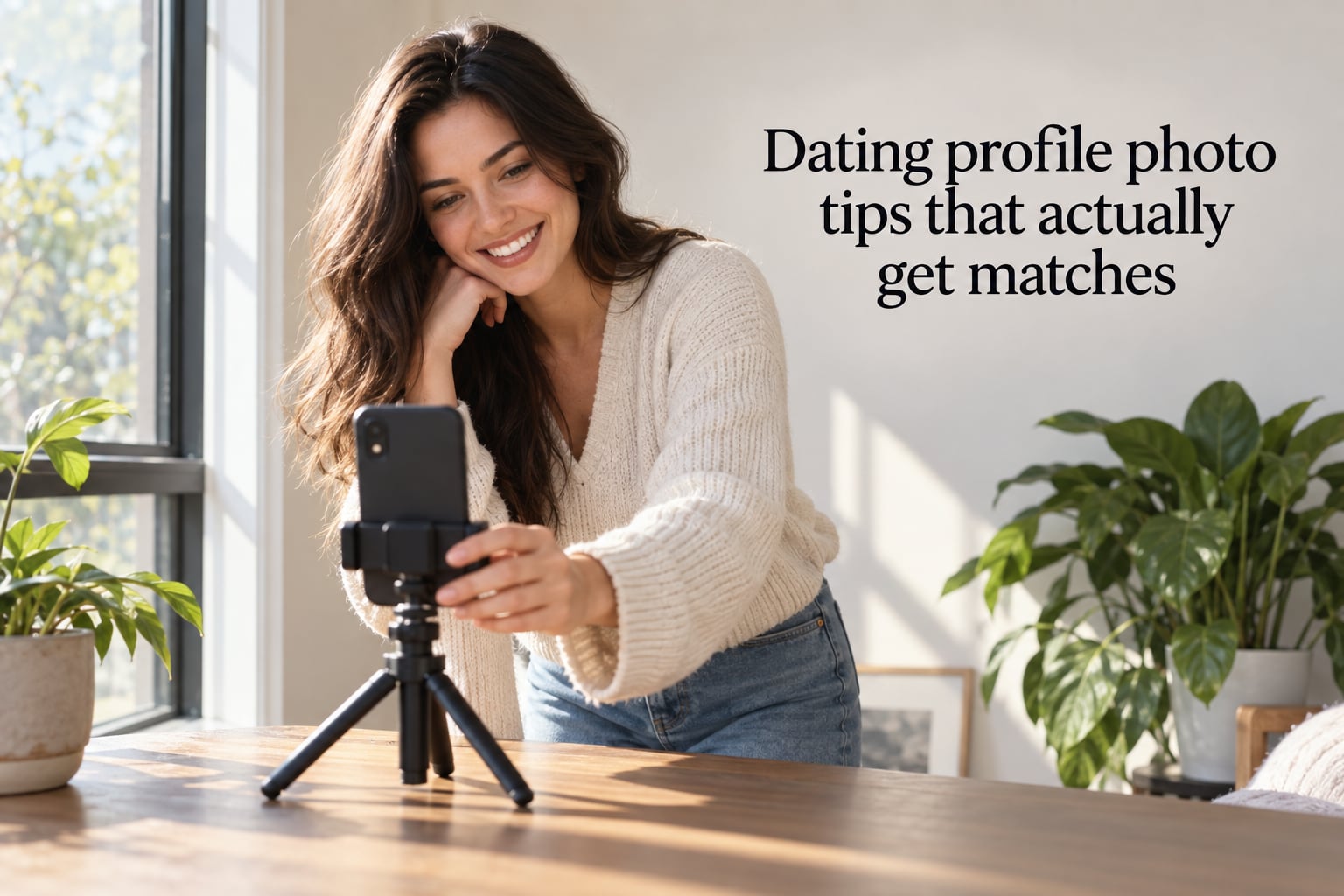
Dating profile photo tips that actually get matches come down to five things: a clear headshot with eye contact, one full-body photo, a real smile, an activity or lifestyle shot, and one social proof photo. Profiles are judged in under three seconds, and the first photo decides most swipe decisions before your bio is ever read.
I have spent 2026 helping singles and couples show up well on camera, and the patterns are consistent. Photofeeler data, Hinge’s own studies, and thousands of real swipes all point to the same handful of habits. I will walk you through the exact photos to include, how to take them at home without a photographer, the mistakes that quietly kill match rates, and how to A/B test your way into better results this season.
Table of Contents
- The 5 Photo Types Your Dating Profile Needs
- How to Nail Your First Photo (Headshot)
- Lighting, Background, and Setting
- The DIY At-Home Photo Method (No Photographer Needed)
- Common Dating Profile Photo Mistakes to Avoid
- Photo Order, App Differences, and A/B Testing
- Men vs Women: Subtle Differences That Matter
- Frequently Asked Questions
- Final Thoughts
The 5 Photo Types Your Dating Profile Needs
The strongest dating profiles use four to six photos, and each one has a specific job. Skip one and you leave signal on the table. Use the same photo twice and you waste a slot.
1. The headshot (your first photo). A close, well-lit portrait where your eyes are visible and looking at the camera. This is your gatekeeper – it decides the swipe.
2. The full-body photo. A photo taken from head to toe in natural light. It removes uncertainty about how you actually look today, which is the single biggest source of mismatched expectations.
3. The real smile. A photo where your eyes are engaged, not just your mouth. A genuine smile signals warmth and approachability.
4. The activity or lifestyle shot. You doing something you genuinely enjoy – hiking, cooking, playing an instrument, walking a dog. This is your conversation starter.
5. The social proof photo (optional). One group photo where you are clearly identifiable. It signals you have a life and people in it. Keep it to one slot, never more.
Quick tip: Photofeeler data shows users reliably misjudge which of their own photos scores highest. The one you think is your best is rarely the one strangers rate the best. Always validate.
How to Nail Your First Photo (Headshot)
Your first photo is the highest-leverage image in your entire profile. A clear headshot with natural light and direct eye contact will outperform a dramatic travel shot every time on the swipe grid.
What kind of dating profile picture is most attractive? A close, well-lit portrait where your face fills about 60-70% of the frame, your eyes are visible, and you have a relaxed, natural expression. No sunglasses, no hats, no filters.
Three rules that almost never fail:
- Face a window. The diffused light wraps around your features and removes harsh shadows.
- Use the back camera, not the selfie camera. Selfie lenses distort facial proportions at close range.
- Smile with your eyes. A Duchenne smile – where the muscles around your eyes crinkle – reads as genuine. A mouth-only smile reads as posed.
Camera height matters too. Hold the phone at eye level or have someone shoot from slightly above. Low angles distort the jaw and chin. Slightly above eye level is the most flattering angle for almost every face shape.
Lighting, Background, and Setting
Natural light is the single biggest upgrade you can make to your dating photos. It is free, it is flattering, and it is the reason professional photographers shoot outdoors whenever they can.
The best window is a large one facing north or east, because the light is soft and consistent. Sit or stand about three to four feet back so the light falls evenly on your face. Avoid overhead lighting and bare bulbs – they cast unflattering shadows under the eyes and nose.
Golden hour – the hour after sunrise or before sunset – gives warm, directional light that flatters skin tones and adds depth. If you have any outdoor photo in your lineup, golden hour is when to take it. Hinge’s own data found travel and outdoor photos boost likes by roughly 30%, yet only about 3% of men include them.
For backgrounds, keep it simple. A clean wall, a leafy park, a coffee shop, a street with soft architectural lines. Avoid cluttered rooms, bathroom mirrors, and bedroom settings – they read as low-effort and can send the wrong signal entirely.
The DIY At-Home Photo Method (No Photographer Needed)
Most of the best dating profile photos can be taken at home with a smartphone, a cheap tripod, and 30 minutes. You do not need a photographer friend or an expensive session. Here is the exact five-step method I recommend.
Step 1: Set up across from a window. Find a large window with soft, indirect light. Face the window so the light falls on your face. The rest of the room should be behind you.
Step 2: Mount your phone on a tripod. A $15 tabletop tripod works fine. Frame the shot at eye level with your face filling the upper third of the frame. Use the back camera, never the front selfie lens.
Step 3: Use a 3 or 10 second timer. Most phones let you set a self-timer. Press the shutter, get into position, and let it fire. Take 20-30 shots in slightly different poses and expressions.
Step 4: Edit lightly. Bump exposure slightly, raise shadows a touch, and warm the white balance. Stop there. Heavy editing and filters are the fastest way to lose trust – one survey found 73% of online daters want filters banned entirely.
Step 5: Score your favorites. Upload your top picks to a feedback tool like Photofeeler and ask for ratings on attractiveness, trustworthiness, and intelligence. Choose the highest scorers, not the ones you personally like.
This method takes one afternoon and produces photos that match or beat most paid photo sessions from five years ago.
Common Dating Profile Photo Mistakes to Avoid
The list of don’ts matters as much as the list of dos, because most low-match profiles fail in predictable ways. Here are the mistakes I see over and over.
Filters and heavy editing. Anything that smooths skin, reshapes jawlines, or alters your real coloring will backfire. People can tell, and the match who shows up will not look like the photo.
Bathroom mirror selfies. The lighting is harsh, the background is a bathroom, and the pose reads as low-effort. Use the tripod method instead – it takes the same amount of time.
Group photo confusion. Never use a group photo as your first image, and limit group shots to one slot. If a match cannot tell which person you are in two seconds, you have already lost.
Old photos. If the photo is more than two years old, your hair, weight, or style no longer match. Be honest about what you look like today.
Shirtless or gym selfies. For men especially, these are among the fastest left-swipes women report. Save the gym photos for the activity slot, fully clothed.
Selfies in the car. The lighting is uneven, the angle is unflattering, and the seatbelt across the chest adds nothing. The window-light method takes the same five minutes with far better results.
What to avoid in a profile picture, in one line: anything you would not want a match to see in person when you show up for the date.
Photo Order, App Differences, and A/B Testing
Photo order is one of the most underestimated levers in dating apps. The first slot is your gatekeeper; the second slot is the tiebreaker; the last slot often becomes the conversation opener.
Use this order as a starting point:
- Clear headshot with eye contact (the gatekeeper).
- Full-body photo in natural light (removes uncertainty).
- Activity or lifestyle shot (conversation starter).
- Real smile, eyes engaged (warmth signal).
- Optional social proof group photo (one only).
App differences matter too. On Hinge, prompts reward lifestyle and activity photos because they pair with text. On Tinder, the swipe grid rewards a strong headshot first. On Bumble, where women message first, your second and third photos often determine whether she does. Match your photo order to the format, not to a single template.
A/B testing is how the top users keep improving. Swap your first photo every two to three weeks, track match rate changes, and keep what works. A simple spreadsheet is enough. Refresh the entire lineup every six months, or whenever your look changes meaningfully.
Men vs Women: Subtle Differences That Matter
The core principles – natural light, real smile, eye contact, full-body visibility – apply across the board. A few details do skew differently by audience.
For men, the biggest gains usually come from removing shirtless and gym selfies, adding a real smile with eye engagement, and including one full-body photo. Hinge’s data consistently shows men who smile with teeth and show their full body in one photo get a measurable lift in matches.
For women, the biggest gains usually come from dropping heavy filters, choosing one lifestyle photo that shows a real interest, and ensuring the headshot does not look overly posed. Relaxed and approachable reads better than polished and distant.
Both audiences underrate pet photos. If you have a dog, cat, or other photogenic animal, one photo of you together reliably raises response rates. It signals warmth and routine, two things people actively look for.
Frequently Asked Questions
What is the 3-3-3 rule for dating?
The 3-3-3 rule is a guideline for keeping your dating profile interesting: aim for 3 photos of your face, 3 full-body or activity photos, and 3 lines of bio prompt that each show a different facet of your personality. It is a starting structure, not a hard rule.
What is the 3-3-3 rule on Tinder?
On Tinder, the 3-3-3 rule usually refers to photo variety: 3 close-up portraits, 3 full-body or activity shots, and 3 distinct environments or outfits. Variety signals an interesting life and keeps the swipe grid from looking repetitive.
How many photos should I have on my dating profile?
Aim for 4 to 6 photos. Fewer than 4 looks low-effort and gives matches little to evaluate. More than 6 leads to decision fatigue and dilutes your strongest images. Quality and variety matter more than raw count.
Should the first photo be your best?
Yes. The first photo should be your strongest clear headshot with eye contact and a genuine smile. It is the only photo every match will see before deciding to swipe, so it carries the most weight in your match rate.
Can I use the same photos on different dating apps?
You can reuse photos, but reorder them to fit each app’s format. Hinge rewards lifestyle photos paired with prompts, Tinder rewards a strong headshot first, and Bumble rewards photos that suggest warmth since women message first.
Final Thoughts
Dating profile photo tips that actually get matches are simpler than most guides make them. Clear headshot. Full-body photo. Real smile. One activity shot. One optional social proof photo. Natural light, eye contact, and zero filters. That core formula works on Tinder, Hinge, and Bumble in 2026 just as it has for years.
Take an afternoon this week, set up across from a window, and shoot 30 frames. Score your top picks with a tool like Photofeeler. Refresh your lineup every six months. Your future matches are waiting.