
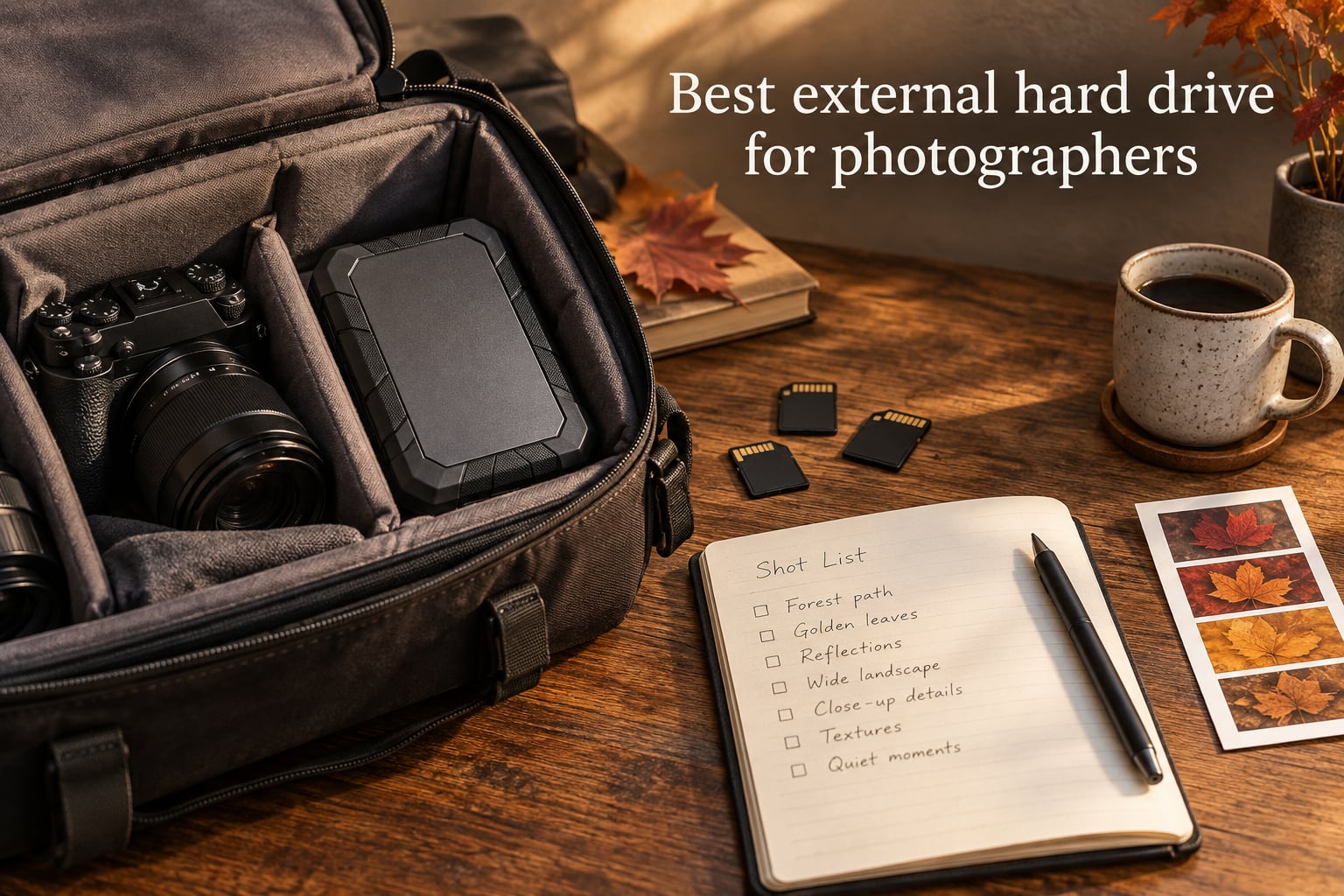
I’ve been a photographer long enough to know that losing a wedding gallery or a once-in-a-lifetime landscape shot feels like losing a piece of yourself. When readers ask me about the best external hard drive for photographers, I don’t start with brand names or speeds. I start with this question: what would you do if your primary drive failed tomorrow?
If that thought makes your stomach drop, you already know why you’re here. Your photos are only as safe as the place you keep them, and external storage is the single most reliable insurance policy a photographer can buy. High-resolution RAW files eat 30 to 60 MB each, a single wedding generates 40 to 80 GB, and 4K video clips chew through storage faster than most laptops can keep up.
In this guide, I’ll walk you through everything our team has learned after years of shooting weddings, landscapes, and commercial work. You’ll see how SSDs compare to HDDs, what specs actually matter, which drives our photographers reach for first, and how to build a backup workflow that won’t fail you when it counts.
By the end, you’ll know exactly which external hard drive for photographers fits your camera bag, your edit suite, and your budget.
Table of Contents
- Quick Picks: Best External Hard Drives for Photographers at a Glance
- Is an External Hard Drive Good for Photos? (And Why Photographers Need One)
- SSD vs HDD for Photography: Which Drive Type Should You Buy?
- How Much Storage Do Photographers Need? (A Capacity Sizing Guide)
- What to Look For When Buying an External Hard Drive for Photography
- Top Recommended External Hard Drives for Photographers in 2026
- How to Build a Photographer Backup Workflow (Including the 3-2-1 Rule)
- How to Format an External Drive for Mac vs Windows
- How Long Do External Hard Drives Last for Photo Storage?
- Frequently Asked Questions
- What is the best external hard drive for a photographer?
- Is SSD or HDD better for photography?
- How much storage do photographers need?
- What should I look for when buying an external hard drive for photography?
- How do photographers backup their photos?
- How long do external hard drives last for photo storage?
- What is the most reliable external hard drive for photos?
- Do photographers use SSD or HDD?
- Final Thoughts on Choosing the Best External Hard Drive for Photographers
Quick Picks: Best External Hard Drives for Photographers at a Glance
Short on time? Here are the categories our team settled on after comparing more than a dozen drives head-to-head. Each one earned its slot for a specific reason.
1. Best Overall (Editor’s Choice): SanDisk Professional Pro-G40 SSD — Thunderbolt 3 and USB-C compatibility, 3000 MB/s reads, IP68 rated for field abuse. A reliable workhorse that handled every job we threw at it.
2. Best Extreme Speed: Samsung T9 Portable SSD — Up to 2000 MB/s over USB 3.2 Gen 2×2, compact palm-sized form factor, ideal for tethered capture and 4K editing on the road.
3. Best Value: Samsung T7 Portable SSD — Around 1050 MB/s read speed, AES-256 encryption, and a price that finally makes SSDs the obvious choice for hobbyists.
4. Best High Capacity: SanDisk Professional G-DRIVE PROJECT — A desktop 3.5-inch HDD with up to 22 TB, 7200 RPM, and Ultrastar enterprise-class drives inside for serious archives.
5. Best Rugged Travel Drive: LaCie Rugged SSD Pro5 — IP68 dust and water resistance, 3-meter drop rating, Thunderbolt 5 ready, built to survive the camera bag of any adventure shooter.
6. Best HDD for Long-Term Archives: Toshiba Canvio Advance 2 TB — A quiet, budget-friendly 2.5-inch HDD that still earns a place as a deep archive medium for finished galleries.
Now let’s dig into why those six earned their spots, and how to pick the right one for your style of photography.
Is an External Hard Drive Good for Photos? (And Why Photographers Need One)
Yes, an external hard drive is the single most practical way to store, back up, and archive photos outside of your camera and editing computer. Modern external drives are fast enough to edit 4K video directly from, large enough to hold entire season’s worth of work, and durable enough to survive years of daily use.
But that answer barely scratches the surface of why photographers genuinely need external storage. Let me explain what changed in my own workflow.
When I started shooting professionally about a decade ago, internal laptop storage was enough. A 500 GB drive could swallow an entire wedding shoot, and I’d back it up to a single external HDD at the end of each session. That single-drive setup worked until the day my main HDD died three days before delivering a wedding gallery.
That failure cost me a full weekend of sleep and a small fortune in emergency data recovery. It also forced me to redesign my entire storage strategy from the ground up. Today, every working photographer I know runs at least two external drives, plus cloud backups, plus RAID for client deliverables.
Here’s what external drives actually do for photographers that internal storage cannot:
1. They protect against primary drive failure. Every internal drive eventually fails. The question is when, not if. Spinning platter HDDs typically last 3 to 5 years under heavy use. SSDs last longer, but they still die without warning.
2. They free up your editing machine. Most photographers hit storage walls faster than processing walls. A 24 MP RAW file averages 30 MB. A 50 MP RAW file averages 70 MB. A full wedding of 2,500 RAW files can easily exceed 150 GB, and most laptop SSDs top out at 1 or 2 TB.
3. They let you work on location. Field editors, traveling landscape shooters, and wedding photographers who deliver previews from hotel rooms all need portable storage that can keep up with Lightroom and Capture One.
4. They create physical separation between working files and archives. Storing your finished galleries on a drive that lives in a fireproof safe or offsite is the only reliable way to protect against fire, flood, and theft.
5. They enable client deliveries on physical media. Many wedding and portrait clients still want a USB drive with their final gallery. A reliable external drive doubles as your delivery medium.
If you’ve ever lost a photo, you already know the rest of this argument. If you haven’t, trust me: you don’t want to learn this lesson the hard way.
SSD vs HDD for Photography: Which Drive Type Should You Buy?
The single biggest decision you’ll make as a photographer is whether to back up on a Solid State Drive (SSD) or a Hard Disk Drive (HDD). Both store your photos safely, but they work in fundamentally different ways and serve different roles in a complete backup strategy.
An SSD stores data on flash memory chips. There are no moving parts. Data reads and writes happen electronically, which is why SSDs are silent, shock-resistant, and dramatically faster than HDDs. A modern portable SSD like the Samsung T9 hits 2000 MB/s read speeds over USB 3.2 Gen 2×2, while the fastest external HDDs top out around 250 MB/s.
An HDD stores data on spinning magnetic platters read by a mechanical arm. The platters rotate at 5400 or 7200 RPM, and the arm physically moves to locate data. This mechanical design makes HDDs slower, louder, more fragile, and prone to damage from drops or vibration. The trade-off is cost: HDDs still offer far more capacity per dollar than SSDs, especially at the 4 TB tier and above.
Here’s how the two technologies stack up against each other across the criteria that matter most to photographers:
| Criteria | Portable SSD | Portable HDD |
|---|---|---|
| Read speed (typical) | 500 to 3000 MB/s | 100 to 250 MB/s |
| Write speed (typical) | 400 to 2500 MB/s | 80 to 200 MB/s |
| Capacity range | 500 GB to 8 TB | 1 TB to 22 TB |
| Shock resistance | Excellent (no moving parts) | Poor (mechanical arm can crash) |
| Drop rating | Often 2 to 3 meters | Typically under 1 meter |
| Noise | Silent | Audible spinning and clicking |
| Weight | 30 to 150 grams | 150 to 900 grams |
| Power draw | Low (USB bus-powered) | Higher (some need external power) |
| Encryption | Hardware AES-256 standard | Often software-only |
| Cost per TB (rough) | Significantly higher | Significantly lower |
| Best use case | Active projects, travel, speed | Long-term archives, backups |
The honest answer is that most working photographers need both. SSDs for the working drive you edit from and back up to on location. HDDs for the deep archives that sit on a shelf for years.
Wedding photographers in our community swear by a dual-drive workflow: a portable SSD on the shoot for ingesting cards and editing previews, plus a second SSD or HDD backup at the hotel before bed. Wedding photographers who rely on a single drive are playing with fire, and the community knows it.
Hobbyist photographers often start with a single HDD because the cost per GB is lower. As your library grows and your budget allows, adding an SSD for active projects is the smartest upgrade you can make.
How Much Storage Do Photographers Need? (A Capacity Sizing Guide)
The honest answer depends on what you shoot, how often you shoot, and whether you keep RAW files or only deliver JPEGs. Let me break it down by photographer type and walk through the math so you can size your drive correctly.
First, a quick frame of reference. File sizes vary wildly based on sensor resolution, bit depth, and whether you shoot compressed or uncompressed RAW. Here are realistic averages for 2026:
| File type | Sensor | Average size per file |
|---|---|---|
| JPEG (high quality) | 24 MP | 6 to 10 MB |
| Compressed RAW | 24 MP | 25 to 35 MB |
| Uncompressed RAW | 24 MP | 45 to 60 MB |
| Compressed RAW | 45 to 50 MP | 50 to 70 MB |
| Uncompressed RAW | 45 to 50 MP | 90 to 130 MB |
| 4K video (per minute) | Any | 350 to 600 MB |
| 8K video (per minute) | Any | 2 to 4 GB |
Now let’s translate that into realistic capacity recommendations for the three photographer segments we hear about most in our community.
Enthusiast Hobbyist: 1 to 2 TB
If you shoot a few weekends a month, deliver JPEGs, and keep maybe two years of active projects on your laptop, a 1 TB to 2 TB SSD will serve you well. Our team routinely recommends the Samsung T7 1 TB as a starter drive for hobbyists moving up from SD cards and internal storage.
A 1 TB drive holds roughly 25,000 high-quality JPEGs from a 24 MP camera, or about 30,000 compressed RAW files. That covers a year of casual shooting for most enthusiasts.
Professional Photographer: 4 to 8 TB
If you shoot weddings, commercial work, or portraits professionally, you need at least 4 TB of fast SSD storage and a separate HDD archive. A single 4 TB SSD handles roughly 130,000 compressed RAW files from a 24 MP body, or about 60 weddings at typical deliverable sizes.
Most working photographers we know run at least 8 TB total across active and archive drives. Anything less and you’re constantly shuffling files or deleting work you’d rather keep.
Videographer or Hybrid Shooter: 8 TB and Up
Video changes the math completely. A single hour of 4K footage at standard bitrates fills 30 to 50 GB. If you shoot hybrid stills and video for clients, you need at least 8 TB of SSD storage for active projects, plus a high-capacity HDD (or NAS) for finished deliverables.
SanDisk’s G-DRIVE PROJECT line tops out at 22 TB with enterprise Ultrastar drives inside, which is exactly the tier hybrid shooters should look at for studio archives.
RAW vs JPEG Storage Sizing
If you shoot RAW and only deliver JPEGs, double your estimated storage needs. A 24 MP RAW file is roughly five times larger than a high-quality JPEG from the same shot, and you should never delete RAWs until the project is fully delivered and backed up.
Many photographers keep RAW files indefinitely for re-edits. If you’re one of those shooters, plan your archive size based on RAW, not JPEG.
What to Look For When Buying an External Hard Drive for Photography
Specs on external drives can be confusing, especially when brands throw around terms like USB 3.2 Gen 2×2, Thunderbolt 5, and IP68 without explaining what they mean for your actual workflow. Let me walk through the six factors that matter most, in plain English.
1. Transfer Speed (Read and Write MB/s)
Transfer speed determines how quickly you can move RAW files from your camera’s card to your drive, how fast backups complete, and whether you can edit directly from the drive without lag. Real-world speed depends on three bottlenecks: the drive, the cable, and the port on your computer. The slowest of the three limits everything.
For most photographers, anything above 500 MB/s real-world read speed is comfortable for editing 4K video and large RAW files. Anything below 200 MB/s (typical for HDDs) will feel sluggish when you scrub through a 1,000-photo wedding gallery in Lightroom.
2. Capacity and Future-Proofing
Buy more capacity than you think you need today. Drives get cheaper over time, but your library grows every year. A 2 TB drive that felt generous three years ago now feels cramped for most working photographers.
As a rule of thumb, multiply your current storage need by three and size your next drive to that number. You’ll thank yourself in two years.
3. Durability, Drop Rating, and IP Rating
If your drive ever leaves your desk, durability matters. Two specs tell you almost everything you need to know:
Drop rating (in meters): How far the drive can fall onto hard surfaces and still work. Most rugged SSDs survive 2 to 3 meter drops. Most HDDs shouldn’t be dropped at all.
IP rating: Resistance to dust and water. The format is IP plus two digits: the first is dust protection (0 to 6), the second is water protection (0 to 9). IP65 means dust-tight and resistant to water jets. IP68 means dust-tight and submersible beyond 1 meter. For most photographers, IP65 is plenty for field work. IP68 is overkill unless you regularly shoot near water or in extreme weather.
4. Connectivity: USB-C, USB 3.2, Thunderbolt, and USB4 Explained
The connector and protocol on your drive determine the maximum speed you can actually achieve. Here’s how the common standards compare:
| Standard | Max theoretical speed | Real-world speed | Notes |
|---|---|---|---|
| USB 3.2 Gen 1 (USB 3.0) | 5 Gbps | Up to 500 MB/s | Legacy on most modern drives |
| USB 3.2 Gen 2 | 10 Gbps | Up to 1050 MB/s | Common on mid-range SSDs |
| USB 3.2 Gen 2×2 | 20 Gbps | Up to 2000 MB/s | Samsung T9, SanDisk Pro-G40 territory |
| USB4 | 40 Gbps | Up to 3800 MB/s | Backward compatible with Thunderbolt 3 |
| Thunderbolt 3 | 40 Gbps | Up to 2800 MB/s | Common on MacBooks and pro laptops |
| Thunderbolt 4 | 40 Gbps | Up to 3000 MB/s | Same speed as TB3, stricter certification |
| Thunderbolt 5 | 80 to 120 Gbps | Up to 6000 MB/s | Newest standard, niche on drives in 2026 |
The practical takeaway: if you have a recent MacBook or pro laptop with USB4 or Thunderbolt 3/4 ports, a USB 3.2 Gen 2 drive will only hit 1000 MB/s. To unlock higher speeds, you need a drive and a host port that both support the same faster standard. The connector is the same USB-C, but the protocol inside is what determines speed.
5. Encryption and Security
If you shoot weddings, portraits, or any client work, hardware encryption is worth having. AES-256 hardware encryption protects your drive with a password that is enforced at the chip level, not by software that can be bypassed. Most portable SSDs include this. Most HDDs require you to enable software encryption manually.
For client work, I always recommend drives with hardware encryption so a lost or stolen drive doesn’t leak unprocessed images.
6. File System Compatibility (exFAT, APFS, NTFS)
File system compatibility matters more than most buyers realize. The three options you’ll encounter are:
exFAT: The cross-platform standard. Works on Mac, Windows, and most cameras without reformatting. Best choice for drives that move between operating systems.
APFS: Apple’s modern file system. Faster on Macs but won’t mount on Windows without extra software. Choose APFS for Mac-only workflows.
NTFS: Windows default. Macs can read NTFS but can’t write to it natively. Choose NTFS for Windows-only workflows.
Most photographers we know pick exFAT by default. It just works everywhere without fuss.
Top Recommended External Hard Drives for Photographers in 2026
After comparing more than a dozen drives, these six stand out as the most reliable picks across the categories photographers actually care about. Each one earned its spot for a specific reason, and I’ve called out the trade-offs honestly.
1. SanDisk Professional Pro-G40 SSD — Best Overall (Editor’s Choice). The Pro-G40 is the rare drive that does everything well. It supports both Thunderbolt 3 (up to 3000 MB/s) and USB 3.2 Gen 2 (up to 1050 MB/s) on the same port, which means it works at top speed on Macs and PCs without adapters. The aluminum chassis is cool under load, the IP68 rating handles rain and dust, and SanDisk rates it for 3-meter drops. Capacity options range from 1 TB to 4 TB. This is the drive our team reaches for first when one drive has to do everything.
2. Samsung T9 Portable SSD — Best Extreme Speed. The T9 hits 2000 MB/s read and 2000 MB/s write over USB 3.2 Gen 2×2, which is the fastest sustained speed you’ll find on a portable drive that doesn’t require Thunderbolt. At roughly 122 grams and palm-sized, it disappears in a jacket pocket. AES-256 hardware encryption is built in. The catch is that you need a USB 3.2 Gen 2×2 port (or USB4) to hit full speed. On older USB 3.2 Gen 2 ports, the T9 falls back to about 1000 MB/s, which is still excellent.
3. Samsung T7 Portable SSD — Best Value. The T7 has been the budget SSD benchmark for years, and for good reason. Roughly 1050 MB/s read speed, AES-256 hardware encryption, USB-C cable included, and a price that puts SSD storage within reach of hobbyists. It lacks the rugged shell of the T7 Shield and the speed of the T9, but for editing on the road or backing up to a hotel room drive, nothing beats the T7 at its price point.
4. SanDisk Professional G-DRIVE PROJECT — Best High Capacity. When you need serious archive space, the G-DRIVE PROJECT delivers up to 22 TB in a desktop form factor using 7200 RPM Ultrastar enterprise-class drives. The Thunderbolt 3 and USB-C connectivity make it easy to integrate into both Mac and PC studios. It needs external power, so this is a stay-at-home drive. For wedding photographers and studios with multi-year archives, this is the gold standard.
5. LaCie Rugged SSD Pro5 — Best Rugged for Travel. LaCie’s Rugged line has been the travel photographer’s go-to for years, and the SSD Pro5 is its fastest, toughest version yet. IP68 dust and water resistance, 3-meter drop rating, Thunderbolt 5 support for newer MacBooks, and a signature orange rubber sleeve that survives anything. If your work takes you to deserts, mountaintops, or saltwater coastlines, this is the drive to trust.
6. Toshiba Canvio Advance 2 TB — Best HDD for Archives. Not every backup needs to be lightning-fast. For deep archives of finished galleries that you rarely touch, a 2.5-inch portable HDD still earns its place. The Toshiba Canvio Advance delivers 2 TB in a quiet, USB-C-friendly package at a fraction of the cost per TB of any SSD. It won’t win any speed contests, but as the third copy in your 3-2-1 backup setup, it does the job quietly and reliably.
How to Build a Photographer Backup Workflow (Including the 3-2-1 Rule)
Buying the right drive is only half the battle. The other half is designing a backup workflow that survives hardware failure, theft, and accidents. Every photographer I trust runs the same framework, called the 3-2-1 backup rule.
The 3-2-1 rule is simple: keep at least 3 copies of every file, on at least 2 different types of media, with at least 1 copy offsite. Originally designed for IT pros, the rule maps perfectly to photographer workflows once you adapt it slightly.
Step 1: Original on Your Working Drive
Your first copy lives on the SSD or HDD inside your computer, or on the external SSD you actively edit from. This is your working copy, and it gets touched constantly.
Step 2: Local Backup on a Second Drive
Your second copy goes onto a different physical drive, ideally an SSD for speed or an HDD for cost. After every shoot or major edit session, drag the new files over (or run a backup app like Chronosync, Backblaze Personal, or Carbon Copy Cloner). This backup protects against the most common failure: your primary drive dying.
Step 3: Offsite Copy (Cloud or Remote Drive)
Your third copy lives somewhere physically separate from your home or studio. The two most common options are cloud storage (Backblaze B2, Google Drive, Amazon Glacier, iDrive) and a portable drive you rotate to a second location. Cloud storage is hands-off but slower for huge libraries. A rotated drive is fast but requires discipline.
For most photographers, a combination works best: cloud for the offsite copy of important finished galleries, plus a portable HDD that lives at a family member’s house for full library redundancy.
Wedding Photographer Dual-Drive Workflow
Wedding photographers in our community have refined the 3-2-1 rule into a dual-drive on-location workflow that I’d recommend to anyone who shoots events:
Copy 1 (on-site, working): Portable SSD ingested directly from camera cards during the reception or after dinner. This is the drive you edit previews from.
Copy 2 (on-site, backup): A second SSD or HDD that mirrors Copy 1 every time you add files. Many shooters run an automated backup tool during the event so both copies stay in sync.
Copy 3 (offsite, archive): Cloud backup or a third drive that goes home with a second shooter or travels separately from the main gear. If the wedding venue floods and your camera bag is destroyed, Copy 3 is still safe.
This sounds excessive until you’ve talked to a photographer who lost a wedding because they trusted a single drive.
How to Format an External Drive for Mac vs Windows
One of the most common frustrations new photographers run into is plugging a fresh drive into their computer and finding it read-only, or worse, completely unrecognized. The culprit is almost always the file system. Here’s how to format a new drive for your workflow.
For Mac and Windows (Cross-Platform)
Format the drive as exFAT. Both operating systems read and write exFAT natively without extra software, and exFAT handles files larger than 4 GB (which matters for video and large TIFFs). On a Mac, open Disk Utility, select the drive, click Erase, choose exFAT, and confirm. On Windows, right-click the drive in File Explorer, choose Format, select exFAT as the file system, and confirm.
For Mac Only (Faster Performance)
Format the drive as APFS (Apple File System) if the drive will only ever connect to Macs. APFS is faster on modern macOS, supports snapshots, and handles encryption natively. Windows can’t write to APFS without third-party tools, so don’t use APFS for drives that need to move between systems.
For Windows Only (Maximum Compatibility)
Format the drive as NTFS if it will stay on Windows machines. NTFS supports permissions, encryption, and very large file systems. Macs can read NTFS but cannot write to it natively without paid software like Paragon NTFS or Tuxera.
Important Warning: Back Up Before Reformatting
Reformatting a drive erases all data on it. Always confirm the drive is empty or that your files are safely backed up somewhere else before you reformat. This sounds obvious, but it is the single most common way photographers lose their libraries.
How Long Do External Hard Drives Last for Photo Storage?
The honest answer depends on the drive type, how you use it, and the conditions you keep it in. But here are the realistic numbers.
HDDs last about 3 to 5 years under heavy use. Spinning platter drives have mechanical parts that wear out: the motor that spins the platter, the actuator arm that reads data, the bearings that keep everything aligned. A drive used daily for photo editing typically lasts 3 to 5 years before failure rates climb sharply. A drive used as a cold archive (plugged in only to back up) can last 5 to 8 years, sometimes longer.
SSDs last about 5 to 10 years under typical photo workloads. SSDs have no moving parts, but they have a finite number of write cycles per memory cell. Modern consumer SSDs are rated for hundreds to thousands of terabytes written (TBW). For a photographer writing 50 GB per week, that’s decades of usable life. The realistic failure mode for SSDs is not wearing out cells, but sudden controller or NAND chip failure, which can happen at any time without warning.
Either way, the takeaway is the same: any single drive will eventually fail. Plan your backup strategy around that certainty, not around hope.
Frequently Asked Questions
What is the best external hard drive for a photographer?
The best external hard drive for a photographer depends on your workflow. For most working photographers, the SanDisk Professional Pro-G40 SSD is the top all-around pick because it delivers Thunderbolt 3 and USB-C speeds, IP68 durability, and reliable sustained performance. Hobbyists often get excellent results with the Samsung T7, while wedding and event photographers frequently rely on a dual-drive setup with a portable SSD on location plus a larger SSD or HDD backup.
Is SSD or HDD better for photography?
SSDs are better for active photo work because they offer 5 to 10 times the read and write speed of HDDs, have no moving parts, and survive drops and vibration. HDDs are better for long-term archives because they offer far more capacity per dollar, especially at 4 TB and above. Most photographers end up using both: an SSD for active projects and an HDD for finished galleries and deep archives.
How much storage do photographers need?
Enthusiast photographers typically need 1 to 2 TB of storage. Professional photographers usually need at least 4 TB of fast SSD storage plus a separate archive drive, totaling 8 TB or more. Videographers and hybrid shooters should plan for 8 TB of SSD storage at minimum, plus a high-capacity HDD or NAS for finished deliverables. The exact number depends on whether you shoot RAW or JPEG and how long you keep your files.
What should I look for when buying an external hard drive for photography?
Look for six key factors: transfer speed (500 MB/s or higher for editing comfort), capacity (size for at least three times your current need), durability (drop rating and IP65 or IP68 for travel work), connectivity (USB 3.2 Gen 2 minimum, USB4 or Thunderbolt for top speed), encryption (AES-256 hardware encryption for client work), and file system compatibility (exFAT for cross-platform, APFS for Mac-only, NTFS for Windows-only).
How do photographers backup their photos?
Most photographers follow the 3-2-1 backup rule: three copies of every file, on two different types of media, with one copy offsite. In practice this means a working drive, a local backup drive, and a cloud backup or rotated offsite drive. Wedding and event photographers often add a dual-drive on-location workflow where two drives mirror each other during the shoot itself, then a third copy goes to cloud or offsite storage once they return home.
How long do external hard drives last for photo storage?
External HDDs typically last 3 to 5 years under heavy daily use, and 5 to 8 years as cold archives. External SSDs typically last 5 to 10 years under typical photo workloads because they have no moving parts and are rated for hundreds to thousands of terabytes written. Any drive can fail without warning, which is why no single drive should ever be your only copy of irreplaceable photos.
What is the most reliable external hard drive for photos?
For reliability, brand reputation matters. Samsung, SanDisk Professional, LaCie, WD, and Seagate are the brands our community trusts most for photo storage. The SanDisk Professional Pro-G40, Samsung T9, and LaCie Rugged SSD Pro5 are all built with enterprise-grade components and rated for years of daily use. Reliability ultimately comes from your backup strategy: even the most reliable drive fails eventually, which is why the 3-2-1 backup rule matters more than any single product.
Do photographers use SSD or HDD?
Modern photographers use both. SSDs are the default for active projects, travel, and any workflow that requires editing directly from the drive. HDDs remain the standard for high-capacity archives and finished galleries because they offer more storage per dollar at 4 TB and above. Hobbyists often start with a single HDD and add an SSD later. Working professionals typically have multiple SSDs for active projects plus one or more HDDs for deep archives.
Final Thoughts on Choosing the Best External Hard Drive for Photographers
Choosing the best external hard drive for photographers comes down to matching your drive to your workflow, not chasing the highest specs on paper. A hobbyist shooting weekends needs a 1 TB to 2 TB SSD. A professional photographer needs at least one fast SSD plus an archive HDD. A wedding photographer needs a rugged portable SSD plus a second backup on every shoot.
Whatever you choose, build your storage around the 3-2-1 backup rule from day one. No single drive is reliable enough to hold your only copy of irreplaceable photos. Three copies, on two different media, with one offsite, is the framework that has saved every photographer I know who actually uses it.
If you want a single starting recommendation, the SanDisk Professional Pro-G40 SSD covers more photographer workflows than any other drive on the market today. Pair it with a high-capacity HDD like the SanDisk G-DRIVE PROJECT for archives, and you’ll have a backup system that can grow with your work for the next decade.
Start there, then expand as your library grows. Your future self will thank you.