
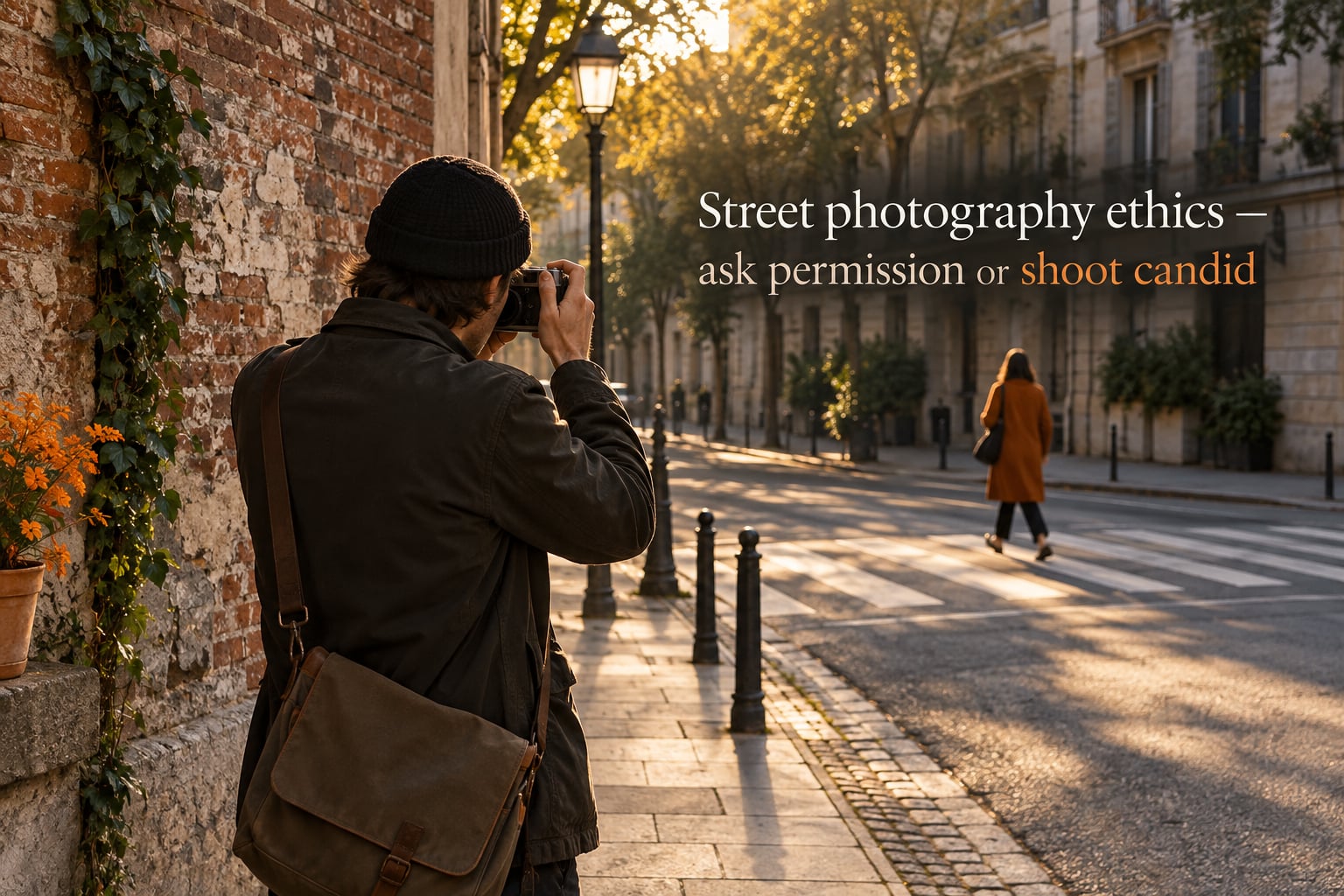
Street photography ethics is the moral framework that guides a photographer’s decisions about when to ask for permission and when to shoot candidly in public, balancing freedom of expression with a subject’s right to privacy and dignity. The short answer to the question street photography ethics — ask permission or shoot candid? Neither, always. The honest answer lives on a spectrum, and this guide will walk you through it.
I’ve been shooting street photography for years, and I still hesitate before every frame. In this guide, our team breaks down the legal reality, the ethical questions, the cultural sensitivities, and the practical scripts that turn a tense moment on the sidewalk into a respectful encounter. By the end, you’ll have a personal decision framework you can use anywhere — from a subway platform in Tokyo to a festival in Mexico City.
Table of Contents
- The Quick Verdict
- What Are Street Photography Ethics?
- Legal vs Ethical: Why the Difference Matters
- Street Photography Laws by Country (Snapshot)
- When Asking Permission Is the Right Call
- When Shooting Candid Is Acceptable
- How to Ask for a Street Portrait: The Exact Script
- Photographing Vulnerable Subjects
- Cultural and Religious Sensitivities
- How to Handle Confrontation and Delete Requests
- Posting Ethics: Tagging, Geotagging, and Captions
- Building Your Own Ethical Framework
- Street Photography Ethics vs Portrait Photography Ethics
- Body-Language Cues: When Someone Has Noticed You
- Common Mistakes to Avoid in Street Photography
- Famous Street Photographers and How They Approached Consent
- Frequently Asked Questions
- What are the ethical considerations in street photography?
- Is it illegal to take candid photos of people?
- Is it necessary to ask for permission from a person who is part of a street photography shot?
- When should a street photographer ask permission?
- How do I handle a confrontation while doing street photography?
- What are common mistakes to avoid in street photography?
- Conclusion
The Quick Verdict
There is no single right answer. The strongest street photographers treat ethics as a spectrum, not a binary switch. They ask for permission when the subject is the frame, and they shoot candid when the subject is part of a larger scene. The mistake is treating either approach as a rule.
- Ask permission when the person is the subject of the frame — close portraits, children, vulnerable people, anyone in a private or sacred space.
- Shoot candid when the person is one element of a wider scene — crowd motion, decisive moments, public events, fleeting gestures.
- Always delete if the subject asks, even when you are legally in the right.
That is the entire article in three lines. Everything below explains why those three lines work, and how to apply them in the field.
What Are Street Photography Ethics?
Street photography ethics is the moral framework that guides a photographer’s decisions about when to ask for permission and when to shoot candidly in public. It sits on top of the law, which sets the floor, and below your own conscience, which sets the ceiling. The floor says, “You usually can photograph here.” The ceiling says, “But should you?”
Ethics covers the gray zone where the law is silent. In most Western democracies, you can legally photograph almost anyone in a public space. That legal right does not erase the ethical duty to consider the subject’s dignity, vulnerability, cultural context, and reasonable expectation of privacy.
The two pillars of street photography ethics are consent and consequence. Consent asks whether the subject understands and agrees to the image. Consequence asks what happens to the subject after the shutter clicks — where the photo ends up, who recognizes them, and how it might affect their life.
Legal vs Ethical: Why the Difference Matters
Many beginners assume that legal = ethical. The two are not the same. Knowing the difference saves you from both legal trouble and the more common mistake of being technically right but morally careless.
Legal Rights (the floor)
In most of the United States, the United Kingdom, and many other countries, you have a legal right to photograph people in public spaces. This right is rooted in freedom of expression and freedom of the press. If you are standing on a public sidewalk, you can usually photograph whatever is in front of you.
Ethical Duties (the ceiling)
Legally allowed does not mean ethically wise. A homeless person can be photographed without consent under US law, but doing so for Instagram likes can still be exploitative. A child can be photographed in a public park, but doing so without the parent’s awareness can feel predatory even when it’s legal.
Where the Two Disagree
The gap between legal and ethical is widest in three situations: vulnerable subjects (homeless, children, mourners, intoxicated people), sacred or culturally protected spaces (temples, ceremonies, traditional communities), and post-publication harm (tagged strangers, geotagged homes, viral posts that the subject never agreed to).
When the law says yes but your gut says pause, the right answer is to pause. The law will not protect your reputation or your subject’s dignity. Only your judgment will.
Street Photography Laws by Country (Snapshot)
Laws shift fast, and they vary by jurisdiction, but this snapshot covers the countries most street photographers work in. Always check the current local rules before you fly.
| Country | Public-Space Photography | Key Limits |
|---|---|---|
| United States | Generally allowed in public spaces | No expectation of privacy on a sidewalk; restricted on private property, in restrooms, and where security rules apply |
| United Kingdom | Allowed on public streets | Section 8 of the Data Protection Act only covers truly private settings; police and security may demand the camera under the Criminal Justice Act 2001 in certain areas |
| France | Allowed in public, but tighter privacy rules | Article 9 of the Civil Code protects the right to one’s image; face-blurring is common in published street work |
| Germany | “Panorama freedom” (Panoramafreiheit) for public scenes | Individuals who are the main subject of a photo have a right to consent under the Kunsturhebergesetz (KUG) |
| Hungary | Allowed in public | The 2015 Civil Code strengthened personality rights; portraits of identifiable people require consent for any use beyond news |
| Japan | Allowed in public, with cultural soft-restrictions | No formal law against photographing strangers, though train companies and some temples post their own rules |
The common thread is this: public spaces are generally fair game, but the moment a person becomes the subject of the frame — not just part of a wider scene — privacy and personality rights start to matter in most countries.
When Asking Permission Is the Right Call
There are clear situations where you should always walk up and ask. These are the cases where a candid frame crosses into something more intimate, more vulnerable, or more likely to embarrass the subject.
Five Situations Where You Should Always Ask
- Street portraits and environmental portraits. If the photo is about this one person, ask first. The “decisive moment” only works when the subject is incidental; once you isolate them, consent matters.
- Children and parents. Walk up to the parent, not the child. A quick “Hi, your kid has great style — mind if I take a portrait?” works in 90 percent of cases.
- People in distress. Someone crying on a bench, sleeping rough, or arguing with a partner is not candid material. Walk past.
- Sacred and ceremonial spaces. Temples, mosques, funerals, religious processions, traditional communities. Ask a community elder before raising the camera.
- Street performers and buskers. Most will say yes if you ask. Some will ask for a tip. A quick conversation turns a grab shot into collaboration.
The pattern in each of these is that the subject is the frame, not the background. Asking is not a legal requirement in most of these cases, but it converts a stranger into a participant. The resulting photo usually has more dignity, and you walk away without guilt.
When Shooting Candid Is Acceptable
Candid street photography is not unethical by default. It is the foundation of the genre and the only way to capture the decisive moments Henri Cartier-Bresson wrote about. The ethical line is whether the person is the subject or one element in a wider frame.
Five Situations Where Candid Works
- Crowd motion and mass scenes. A single face in a sea of commuters is incidental. The photo is about the place, the rhythm, the light.
- Decisive moments. A man leaping a puddle, a child chasing a balloon, two strangers meeting in a doorway. These exist only in the candid frame.
- Public-interest documentary work. Strikes, protests, parades, and street events where the act itself is the news.
- Architectural and street scenes. A figure passing through a courtyard, a shadow falling on a wall. The person adds scale, not identity.
- Environmental reportage. A taxi queue, a noodle shop, a morning market. The people are texture, not subjects.
The litmus test is simple: if the photo works equally well with a different face in that exact spot, the subject is incidental and candid is fine. If the photo only works because of this specific person’s expression, style, or story, you should have asked.
How to Ask for a Street Portrait: The Exact Script
The single biggest reason street photographers hesitate to ask is that they don’t know what to say. The freeze response is real, and it costs more shots than bad light ever will. Here is a script that works in most Western cities, adapted from how Eric Kim and other working street photographers approach strangers.
The Three-Sentence Asking Script
- Open with context. “Hey — I’m a street photographer, I’m working on a project about [city / neighborhood / theme].” This explains why a stranger with a camera is talking to you.
- Make the request simple. “I love your [jacket / hair / posture / expression]. Mind if I take a quick portrait of you right here?” Specific praise is more persuasive than a generic “I like your look.”
- Offer the trade. “If I get a good one, I’ll send you a copy. Want my email or your Instagram?” This converts the encounter into a transaction, which most people find easier to accept than a one-sided favor.
Most people say yes. Of the ones who say no, most say it politely. The rejection rate drops fast as you practice — what the community calls “rejection exposure therapy.” By the tenth stranger, the words flow without thinking. By the fiftieth, you don’t need the script anymore.
What to Do When They Say No
Smile, thank them for their time, and move on. Never argue, never explain, never push. A no is a complete sentence. The photographer’s reputation in the long run depends on how gracefully you handle rejection.
Photographing Vulnerable Subjects
Vulnerable subjects are the hardest ethical test in street photography. The law usually permits the shot. The ethics rarely do.
Homeless and Unhoused People
Most street photography ethics guides, including the ones published by experienced practitioners, recommend a personal rule: do not photograph the homeless for personal portfolios. The reason is not legal — it is dignity. A homeless person cannot meaningfully consent to being turned into art, and the resulting image usually serves the photographer’s career more than the subject’s.
If you do want to photograph someone sleeping rough, the ethical path is long-term engagement — returning to the same person, building trust, sharing prints, sometimes offering small help. This is closer to documentary work than street photography, and it deserves the time it takes.
Children
Children cannot consent. Their parents can, and often will if you approach respectfully. The street photography ethics rule of thumb is to walk up to the parent, not the child, and to back off the moment anyone looks uncomfortable. If you cannot tell whether a child is with a parent, the default is no shot.
Mourners, Intoxicated People, and Those in Distress
Anyone visibly grieving, drunk, or in emotional crisis deserves privacy even in a public space. The reasonable expectation of privacy extends to moments of visible vulnerability, regardless of what the law technically permits. Walk past.
Police, Security, and Authority Figures
You can usually photograph police in public. That does not mean it is always wise. In some jurisdictions, photographing certain operations can interfere with their work and create real risk for you. When in doubt, ask. When not in doubt, consider whether the photo serves the public interest or just your portfolio.
Cultural and Religious Sensitivities
Street photography ethics shifts sharply across cultures. What reads as a candid moment in Berlin can read as a serious insult in Varanasi. Cross-cultural etiquette is not optional for travel photographers.
Religious Sites
Buddhist temples, mosques, churches, and active religious sites often post their own rules. Look for signs, watch what other visitors do, and when in doubt, ask a community member. A polite gesture — removing shoes, covering your head, lowering the camera — goes further than any disclaimer you can write later.
Traditional Communities
Old Order Amish and Mennonite communities, indigenous tribes, and other traditional groups often have explicit rules about photography. In some Amish communities, photography is forbidden outright. Photographers who ignore the rule and apologize later are still part of the problem.
Funerals and Sacred Geography
The Ganges funeral ghats, Japanese memorial ceremonies, and Western wakes are not candid material. If you would not want a stranger to photograph you at your own parent’s funeral, do not photograph someone else’s.
How to Handle Confrontation and Delete Requests
At some point, every street photographer gets asked to delete a photo. It might be polite. It might be loud. Either way, the rule is the same: delete without argument.
If the Request Is Calm
Apologize, show the photo if they ask to see it, and delete it on the spot. Show them the delete. Most confrontations end here. People who feel heard rarely escalate.
If the Request Is Aggressive
Stay calm, do not raise your voice, do not reach for the camera in a way that could be misread as a grab. Say, “You’re right, I’ll delete it now” and show the screen going empty. Step away from the situation as soon as the delete is confirmed.
If You Are Physically Threatened
Hand over the camera or delete in front of them. Your gear is not worth your safety, and in most jurisdictions, the legal right to photograph is not worth a fistfight. Photograph any injuries after you are safe.
The Universal Norm
Across every forum thread and community guideline we reviewed, one rule comes up consistently: delete on request, without argument, even when you are legally in the right. Your portfolio does not outweigh another person’s dignity.
Posting Ethics: Tagging, Geotagging, and Captions
No competitor in our research covers this, and it is one of the fastest-growing ethical issues in street photography. What happens after the shutter click matters as much as what happens before it.
Tagging Strangers on Instagram
Most platforms let you tag a stranger in a photo. Most platforms do not let the stranger untag themselves easily. A photo that lives on your feed for a week with a tagged stranger can follow them for years through search engines and screenshots. Ask before tagging, even if you asked before pressing the shutter.
Geotagging Neighborhoods
Geotagging a small-town street scene can pinpoint someone’s home block. Geotagging a domestic-violence shelter, a halfway house, or a community under threat can put real people in real danger. Turn off precise geotagging for street work, or geotag at the city level only.
Captions That Mock the Subject
A caption like “look at this weirdo” turns a candid frame into public shaming. The photo may have been ethical at the moment of capture, but the caption makes the post unethical. Treat captions as part of the consent conversation.
Viral Posts and the Right to Be Forgotten
Once a candid street photo goes viral, the subject loses control of their image. By the time the post is deleted, screenshots have spread, search engines have indexed, and the subject has no practical way to make it disappear. The ethical duty is to think about this before you post, not after.
Building Your Own Ethical Framework
The strongest street photographers do not outsource their ethics to a guide like this one. They build their own framework, write it down, and revisit it when a hard case comes up. Here is a simple five-question permission decision tree you can use as a starting point.
The Permission Decision Tree
- Is the person the subject, or one element of the scene? If the photo works without their specific face, candid is fine.
- Is the person in a vulnerable state? Children, mourners, intoxicated people, the unhoused — pause or walk past.
- Is the space culturally or religiously protected? Temples, ceremonies, traditional communities — ask or stay outside.
- Will the photo be used commercially? Editorial use is usually fine without a model release; commercial use (ads, packaging, branded campaigns) almost always needs one.
- Will the subject be identifiable in the final image? Face visible, name tagged, location precise, caption specific — ask first.
If you answer yes to two or more of those, ask. If you answer yes to three or more, walk away. The framework is not perfect, but it is yours, and that matters more than any external rule.
Street Photography Ethics vs Portrait Photography Ethics
The two genres share a camera and a city sidewalk, but their ethical weight sits differently. Portrait photography ethics is built around explicit consent — a signed model release, a negotiated session, a clear understanding of how the image will be used. Street photography ethics is built around implied consent — the photographer is present, the subject is public, and the understanding is loose.
The mistake is to import one frame into the other. Treating street subjects like portrait clients removes the spontaneity that gives the genre its power. Treating portrait clients like street subjects removes the trust that gives portrait work its intimacy. Knowing which genre you are working in, moment to moment, is half the ethics.
Body-Language Cues: When Someone Has Noticed You
Street photographers learn to read body language in the half-second after the shutter click. A few signals matter.
- Direct eye contact with a hard jaw. Stop shooting, lower the camera, smile. Most of the time the moment passes.
- A hand raised in front of the lens. Stop immediately. The subject has revoked any implied consent.
- A phone raised to photograph you back. Acknowledge them with a smile and a wave. Often the photo they take of you ends the tension.
- A verbal “hey” or “stop.” Engage, apologize, and offer to delete. The encounter usually resolves in under a minute.
Reading these signals early lets you abort a frame before the moment turns into a confrontation. The best street photographers shoot fewer frames, but the ones they keep are clean.
Common Mistakes to Avoid in Street Photography
Across every forum thread and ethics guide we reviewed, the same mistakes come up again and again.
- Treating “legal” as a complete answer. Legal permission is the floor, not the ceiling.
- Shooting homeless subjects for portfolio work. The legal right does not erase the ethical weight.
- Arguing when asked to delete. Delete on request, every time.
- Photographing children without engaging the parent. Walk up to the adult, not the child.
- Tagging strangers or precise geotagging. The post lives longer than the encounter.
- Mocking captions on candid shots. The photo may have been ethical, the caption may not.
Famous Street Photographers and How They Approached Consent
It is a myth that the masters only shot candid. Henri Cartier-Bresson, often called the father of street photography, regularly asked before portraits. William Klein built entire projects on collaboration with his subjects. Diane Arbus asked for permission in most of her work, despite the confrontational image her portraits project. Bruce Davidson spent years earning the trust of a single New York gang before he ever made a frame.
Bruce Gilden is the high-profile exception — his flash-in-the-face approach is candid by design and divisive for that reason. But even Gilden has publicly said he wishes he had asked more often. The history of the genre supports both approaches. The ethics, in the end, are a personal choice the masters made frame by frame, the way you will too.
Frequently Asked Questions
What are the ethical considerations in street photography?
The core ethical considerations are consent, dignity, vulnerability, cultural context, and post-publication harm. Legal rights set the floor (you can usually photograph in public); ethical duties set the ceiling (you should still consider whether the subject has a reasonable expectation of privacy or is in a vulnerable state).
Is it illegal to take candid photos of people?
In most of the United States, the United Kingdom, and many other countries, candid photography in public spaces is legal. The main exceptions are private property, secure facilities, and countries with stronger personality rights such as France, Germany, and Hungary, where consent matters more for portraits.
Is it necessary to ask for permission from a person who is part of a street photography shot?
It depends on whether the person is the subject of the frame or one element in a wider scene. If the person is the subject, especially in a portrait or vulnerable situation, ask first. If the person is incidental to a crowd or decisive moment, candid is acceptable. Delete on request either way.
When should a street photographer ask permission?
Ask permission when the person is the main subject of the frame, when the subject is a child or vulnerable adult, when the location is sacred or culturally protected, when the photo will be used commercially, and when the subject will be identifiable in the final image. Walk up with a simple three-sentence script and accept any answer gracefully.
How do I handle a confrontation while doing street photography?
Stay calm, do not raise your voice, and offer to delete the photo on the spot. Show the screen going empty. If the person is physically threatening, hand over the camera or delete in front of them rather than escalate. Photograph any injuries only after you are safe.
What are common mistakes to avoid in street photography?
Common mistakes include treating legal permission as a complete answer, shooting homeless subjects for portfolio work, arguing when asked to delete, photographing children without engaging a parent, tagging strangers or geotagging precisely, and using mocking captions that turn a candid frame into public shaming.
Conclusion
Street photography ethics is not a binary choice between asking permission and shooting candid. It is a spectrum, and the strongest photographers move along that spectrum frame by frame. Ask when the subject is the frame. Shoot candid when the subject is part of a larger scene. Always delete when asked. Always think about what happens after the shutter clicks.
Pick one situation from this guide and try it this week. Practice the three-sentence asking script with a friendly stranger. Walk past a vulnerable scene without raising the camera. Apply the country-law snapshot before your next trip. The more you rehearse the ethics, the more natural they become — and the better your street photography will get.