
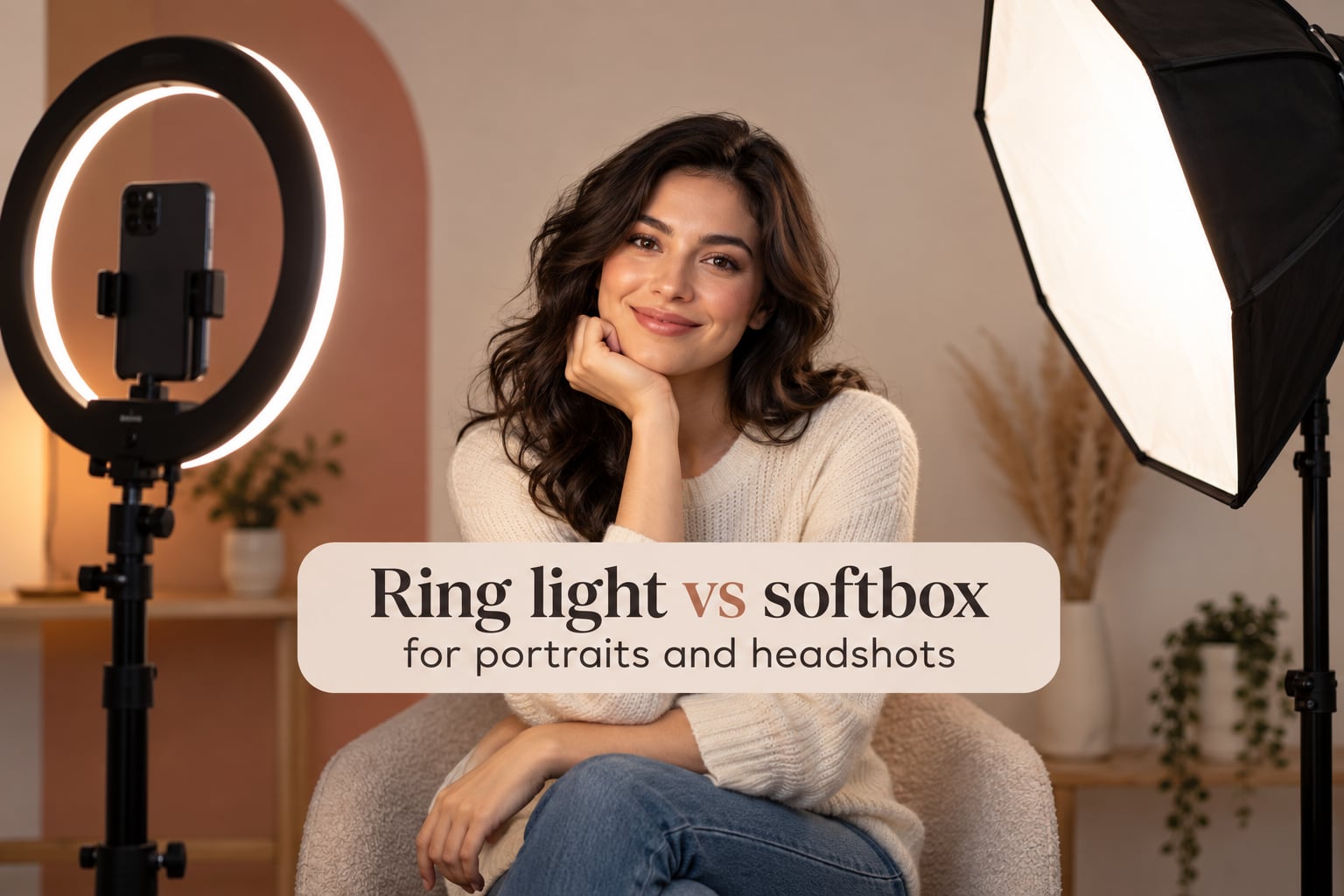
If you have ever searched “ring light vs softbox for portraits and headshots,” you have probably already seen the same two-paragraph answer copy-pasted across a dozen blogs. I wanted to write the version I actually wish I had read on day one — the one that explains why the light on your face looks the way it does, when each tool earns its place, and how to choose with confidence for your own photography.
I run a family portrait studio, so my frame of reference is real people in real sessions — squirmy toddlers, grandparents in glasses, newborns who sleep in two-minute windows, and business owners who need a clean headshot before a conference. The choice between a ring light and a softbox shapes every one of those sessions, and the answer is rarely “always one, never the other.” Let me walk you through the real differences.
Here is the short answer, the long answer, and a five-step decision framework you can use today.
Table of Contents
- Quick Answer: Ring Light vs Softbox for Portraits and Headshots
- What Is a Ring Light?
- What Is a Softbox?
- Light Direction, Quality, and Shadows
- Catchlights and Eye Reflections
- Ring Light vs Softbox: Use Cases
- Softbox Sizes, Shapes, and Strobe vs Continuous
- Color Temperature, CRI, and Skin Tone Accuracy
- Family, Child, and Newborn Headshots
- Glasses, Jewelry, and Shiny Surfaces
- Phone vs Camera Compatibility
- Beginner Mistakes with Ring Lights and Softboxes
- Hybrid Setups: When to Use Both Lights Together
- How to Choose: A 5-Step Decision Framework
- Frequently Asked Questions
- Are ring lights better for photography than softboxes?
- What kind of lighting is best for portrait pictures?
- Is ring light good for photoshoots?
- What is the most basic lighting setup for headshots?
- Do professional photographers ever use ring lights?
- What are common beginner mistakes when using a softbox?
- Is a ring light good for Zoom calls?
- What should I use instead of a ring light?
- The Verdict: Which Light Should You Buy?
Quick Answer: Ring Light vs Softbox for Portraits and Headshots
For portraits and headshots, a softbox is the better choice because its diffused, directional light sculpts the face, produces natural shadows, and renders skin tones accurately. A ring light produces flat, even, almost shadow-free light with a signature circular catchlight in the eyes — excellent for beauty tutorials, vlogs, and Zoom calls, but limiting for portraits where dimension matters.
| Feature | Ring Light | Softbox |
|---|---|---|
| Light quality | Even, flat, on-axis | Soft, directional, dimensional |
| Shadows on face | Minimal to none | Natural gradient, sculpting |
| Catchlight shape | Circular ring in eyes | Square, octagonal, or strip |
| Best for | Beauty, vlogs, Zoom, TikTok | Portraits, headshots, families, products |
| Glasses reflections | Often harsh and distracting | Can be angled off-frame |
| Multi-person lighting | Limited reach | Easier to feather across groups |
| Setup complexity | Plug-and-play | Stand, modifier, angle to dial in |
| Typical sizes | 10 to 22 inch diameter | 16 x 22 inch up to 48 inch octagon |
Use the table above as a quick reference, then keep reading for the deeper reasoning behind each row.
What Is a Ring Light?
A ring light is a circular LED fixture with a hollow center, designed so your camera lens or phone sits inside the ring. Light fires outward from hundreds of small diodes arranged in a circle, then wraps evenly around whatever is in front of it.
The defining trait is on-axis lighting — the light source and the lens share the same line of sight to the subject. That geometry is what produces the ring light’s signature effects: very few shadows on the face, evenly lit skin from forehead to chin, and a distinctive circular catchlight reflected in the subject’s eyes.
Ring lights usually come as a single integrated unit: a circular LED panel, a stand clamp or tripod mount, and often a phone holder built into the center. Most run on AC power; battery-powered versions exist for mobile creators. Sizes range from a 6-inch desk ring light to a 22-inch pro model.
Because the light comes from many small points distributed across a wide circle, it is technically “soft” in quality — but it is also “flat” because the source surrounds the lens. That is the trade-off the rest of this article keeps coming back to.
How a ring light produces light
Inside the ring, hundreds of small LEDs fire forward. Some units add a diffusion panel across the front; cheaper units leave the diodes exposed. The bigger and more diffused the ring, the softer the resulting light on a face. A 6-inch ring light at arm’s length will still produce harsh hotspots; an 18-inch diffused ring at 2 to 3 feet will give you noticeably softer skin.
What Is a Softbox?
A softbox is an enclosed fabric diffuser — square, rectangular, octagonal, or strip-shaped — attached to a light source (a strobe, a continuous LED, or a hot light). The light fires into the back of the box, bounces off the reflective interior, then passes through one or two layers of diffusion fabric before it reaches the subject.
The defining trait is directional soft light. A softbox is essentially a window you point at your subject. You control the angle, the distance, and the shape of the light, and the diffusion fabric turns a small hot bulb into a much larger, gentler source.
Most studio softboxes are used with a light stand and either a strobe head or a continuous LED panel mounted inside. Some kits use cheap speedlights; pros use monolights or continuous LEDs with high CRI ratings. The softbox itself is the modifier — the “soft” in softbox.
How a softbox produces light
Light hits the back wall of the softbox and spreads outward. It then passes through the front diffusion panel, which scatters it. The result is a soft, even beam that falls off gradually (we will get to “falloff” in a moment). Because the softbox has a definite front edge, it acts like a window: light comes from one direction, and shadow follows the geometry of your face rather than wrapping around it.
Light Direction, Quality, and Shadows
This is where the two lights diverge in a way that matters for portraits. Light direction determines shape. Light quality determines how forgiving the result is on skin.
Light direction
A ring light sits on the same axis as your lens. That means every part of the face that “sees” the lens also “sees” the ring. Wrinkles, pores, and blemishes get filled in from the front. Shadows under the chin, beside the nose, and in the eye sockets nearly disappear.
A softbox sits off to the side, typically 30 to 45 degrees off-axis from the subject. The side of the face turned toward the softbox is lit; the side turned away falls into shadow. That contrast is what creates the look people associate with “professional portraits.”
Light quality and falloff
Both lights can be soft in absolute terms. The difference is what that softness does to a face. Softbox softness is directional softness — gentle on the lit side, gradually darker on the shadow side. Ring light softness is wraparound softness — gentle everywhere, with very little contrast anywhere either.
Softboxes also obey the inverse square law more predictably. Move a softbox twice as far from your subject and you get one quarter of the light. Move a ring light twice as far and the geometry changes too — the ring becomes a smaller source relative to the face. That is why beginners often find their ring light sessions look “different” every time they change distance.
What shadows tell you
Shadows are not the enemy of a portrait. They are how a face becomes three-dimensional. A ring light, by design, suppresses most of those shadows, which is why portrait photographers describe its look as “flat” rather than “flattering.” A softbox uses shadows intentionally — feathered across the cheek, gathered under the jaw, defined along the nose — to make a face look like a face rather than a mask.
Catchlights and Eye Reflections
The catchlight — the bright reflection in your subject’s eyes — is one of the most recognizable signatures of a lighting setup, and it is also the easiest way to tell a ring light portrait from a softbox portrait at a glance.
The ring light catchlight
Because the light source is a circle, the catchlight in your subject’s eyes is also a circle. It is small, bright, and unmistakable. Beauty and makeup creators love this look because it reads as “fresh, awake, even” — it is the visual language of the beauty tutorial.
For headshots, the circular catchlight can read as a tell. Viewers who know lighting will see the ring and think “vlogger” or “Zoom call.” That is not always what you want for a corporate headshot or a senior portrait.
The softbox catchlight
A softbox produces a catchlight shaped like the modifier itself: a soft rectangle from a square or strip box, or a softly rounded shape from an octagonal softbox. Photographers call these “natural-looking” catchlights because your eye expects to see a window-shaped reflection in a real room.
If you want the best of both worlds, an octagonal softbox gives you a round-ish but soft-edged catchlight that is flattering on faces without reading as a “ring light portrait.”
Catchlight placement matters
Where the catchlight sits in the eye matters as much as its shape. Ring lights put the catchlight dead-center in the pupil because the light and lens share an axis. Softboxes let you aim the catchlight at the 10 o’clock or 2 o’clock position in the eye — the classic portrait placement that makes eyes look alert and engaged.
Ring Light vs Softbox: Use Cases
The right light depends on what you are shooting. Here is a practical guide, drawn from what I actually use in my studio and on location.
| Scenario | Best Choice | Why |
|---|---|---|
| Beauty tutorial / makeup | Ring light | Even skin, signature catchlight, no harsh shadows on the face |
| Solo YouTube / vlog | Ring light | Plug-and-play, on-camera, no setup |
| TikTok / short-form vertical video | Ring light | Phone mount built in, even light at arm’s length |
| Corporate headshot | Softbox | Dimensional light, natural catchlight, professional look |
| Family portrait (kids, parents, grandparents) | Softbox | Flattering on all ages and skin tones; easy to feather across a group |
| Newborn portrait | Softbox (large) | Wraparound softness on tiny features, no harsh hotspots |
| Senior portrait / graduation | Softbox | Dimensional light, flattering on a single subject, classic look |
| Product photography | Softbox (off-axis) | Reflection can be aimed off-frame; sharp gradient shows texture |
| Zoom / video calls | Ring light or small LED panel | Quick, even, no setup needed |
| Real estate / interior | Softbox or strobe with large modifier | Power and coverage for whole-room scenes |
When the ring light wins
The ring light wins when speed and simplicity matter more than dimension. Solo talking-head videos, makeup tutorials, product unboxings, and Zoom calls all benefit from the ring light’s no-fuss setup. If you can mount it on a desk tripod and clip in your phone, you are 30 seconds from shooting.
When the softbox wins
The softbox wins any time you want the subject to look three-dimensional. Portraits, headshots, family sessions, fashion, beauty editorials (yes, even beauty — high-end beauty work uses huge softboxes or beauty dishes), and product work all benefit from the softbox’s directional control.
Softbox Sizes, Shapes, and Strobe vs Continuous
If you decide a softbox is the right tool, the next question is what size and shape — and whether to use a strobe (flash) or a continuous LED.
Softbox shapes
Square or rectangular softbox (16 x 22 inch, 24 x 36 inch) — produces a rectangular catchlight and a controlled, slightly directional light. Workhorse shape for product and full-body work.
Octagonal softbox (36 inch, 48 inch, 60 inch) — produces a round-ish catchlight that flatters faces. The most popular shape for portrait and headshot work because the light wraps gently without being flat.
Strip softbox (12 x 36 inch, 14 x 50 inch) — narrow and tall. Used as a rim or hair light, or for full-body fashion shots where you want a controlled vertical strip of light.
Parabolic softbox (36 inch and up) — produces very even, very directional light. Used by pros who want maximum control and a beautiful, gradient catchlight. Heavier and pricier than standard octas.
Softbox size and room size
Here is a quick sizing guide for portraits:
- Single headshot in a small room: 24-inch octagon at 3 to 4 feet
- Family of 4 to 6 in a living room: 36-inch octagon at 4 to 5 feet
- Full body or group of 8+: 48-inch or larger octagon, or two softboxes feathered together
If your room is small (under 10 x 10 feet), start with a 24-inch softbox. Larger softboxes in small rooms bounce light off every wall and create flat, unflattering fill where you wanted shadow.
Strobe vs continuous LED
Strobes (flash) deliver a powerful burst of light for a fraction of a second. They let you shoot at low ISO, small aperture, and fast shutter speed — ideal for portraits where you want tack-sharp focus and creamy background blur.
Continuous LEDs stay on all the time. You see the light in real time, which makes them great for beginners, video, and on-location sessions where you cannot tether to a computer. The trade-off is power — a continuous LED has to put out enough light to match what a strobe does in a millisecond, which means bigger panels, more heat, and more cost at the high end.
For still portraits, I recommend a strobe. For video-first creators, a continuous LED panel or bi-color LED is the right call.
Color Temperature, CRI, and Skin Tone Accuracy
Color accuracy is one of the most overlooked differences between cheap and pro lighting — and it matters more for portraits than for almost anything else you shoot.
What CRI and TLCI mean
CRI (Color Rendering Index) measures how accurately a light source renders colors compared to natural daylight. A CRI of 95+ is considered excellent; below 90 and skin tones start looking muddy, greenish, or overly warm.
TLCI (Television Lighting Consistency Index) is the video version. If you are shooting video, look for TLCI of 95 or above.
Color temperature, expressed in Kelvin (K), tells you whether the light is warm (3200K, tungsten-balanced) or cool (5600K, daylight-balanced). Most modern LED panels are “bi-color,” meaning you can dial them anywhere from about 3200K to 5600K.
Why this matters for portraits
Skin tones are unforgiving. A light with low CRI can make a fair-skinned subject look pale and sickly, a deep-complexion subject look ashy, and everyone in between look slightly “off” in a way that is hard to pinpoint but easy to see.
Pro softboxes paired with strobes or high-CRI LEDs give you consistent, accurate skin tones across a session. Cheap ring lights, especially the small battery-powered models, can shift color as they heat up — your third hour of recording may not match your first.
From r/AskPhotography, beginners often complain that their ring light “looks fine for ten minutes and then everything turns orange.” That is the CRI/temperature drift problem.
Family, Child, and Newborn Headshots
This is the angle I want to lean into, because it is the audience our studio actually serves — and it is an angle none of the major comparison articles cover well.
Why softboxes win for family sessions
Family portraits have to flatter a wide range of ages, skin tones, and face shapes in a single frame. A softbox off to the side lets the light fall naturally across the group, creating subtle shadow that defines each face without flattening any of them.
A ring light in the middle of the group tends to even everyone out — which sounds like a feature until you realize it also kills the dimension that makes a family portrait feel like art rather than a snapshot.
Kids move — your light should not
Kids do not hold still. A softbox on a solid stand, dialed in before the session, means the lighting is consistent no matter how much the kids wiggle. A ring light on a desk clamp can drift as the subject moves around it, and you spend more time repositioning than shooting.
Newborns need soft, wraparound light
Newborn features are tiny and delicate. A large softbox (36 inches or more) at a moderate distance produces gentle, wraparound light that flatters curled hands, soft skin, and sleepy expressions. A ring light up close is too directional and can produce harsh highlights on the baby’s skin.
Glasses-wearing grandparents
About half the grandparents I photograph for family sessions wear glasses. With a ring light, you get a bright circular reflection in every lens — distracting and hard to fix in editing. With a softbox, you can angle the light just above the subject’s head and feather it down, so the glasses reflect the room rather than the light.
Glasses, Jewelry, and Shiny Surfaces
This deserves its own section because it is one of the most common frustrations I hear from portrait clients — and one of the biggest practical wins for softboxes over ring lights.
The ring light glasses problem
When a ring light is on-axis with the lens, every pair of glasses in the frame reflects the ring directly back. The result is two bright circles where the subject’s eyes should be — the eyes are still there, but the reflection dominates.
There are partial workarounds: tilt the glasses, raise the ring slightly above the lens, ask the subject to lower their chin. But all of them trade off the ring light’s main benefit (flat, even light) for the workarounds. By the time you have tilted and angled and adjusted, you might as well have used a softbox.
The softbox glasses solution
A softbox can be aimed high enough or off to the side enough that its image reflects up into the brow line or off to the temple, leaving the lens area clean. This is one of the simplest and most powerful reasons portrait studios use softboxes rather than ring lights.
Jewelry and glossy products
The same principle applies to anything shiny: earrings, watches, phones, glassware, perfume bottles. The reflection of your light source will appear in the surface. A softbox can be aimed off-frame entirely. A ring light, by definition, is in the frame.
From r/AskPhotography: “a softbox off-axis can have its reflection positioned off-frame entirely — a major practical advantage.” That is the sentence to remember when you are choosing lights for product or jewelry photography.
Phone vs Camera Compatibility
Both ring lights and softboxes work with phones and cameras, but the ergonomics differ.
Ring lights and phones
Most ring lights in the 10 to 18 inch range include a phone holder built into the center of the ring. You mount your phone, snap the ring on a desk tripod or floor stand, and you are shooting in under a minute. This is why ring lights are the default for TikTok, Instagram Reels, and YouTube Shorts creators.
Softboxes and phones
Softboxes do not have a built-in phone mount because the camera is supposed to be wherever you want it, not in the middle of the light. To use a softbox with a phone, you need a separate tripod for the phone and a separate stand for the softbox. Setup takes longer but gives you far more control.
For still photography with a real camera (DSLR, mirrorless, medium format), both options are equally compatible. The choice is about light quality, not the camera.
Beginner Mistakes with Ring Lights and Softboxes
I have made most of these mistakes myself. Here are the ones I see most often, with the fix for each.
Ring light mistakes
Mounting the ring light too close. A 6-inch desk ring light 6 inches from your face will produce harsh hotspots on the forehead and nose. Move it back 18 to 24 inches minimum, or upgrade to a larger ring (14 inch or 18 inch).
Shooting with the ring above eye level. Beginners often raise the ring to “avoid glare,” which puts the catchlight too high in the eyes and creates unflattering under-eye shadows. Keep the ring at lens height, or just above.
Using a low-CRI ring light for paid work. If you are photographing clients, skin tones have to be accurate. Spend the extra money on a CRI 95+ ring light, or switch to a softbox with a high-CRI LED panel.
Shooting in a room with mixed light sources. A ring light at 5600K in a room with tungsten lamps at 3200K will give you an orange color cast that no amount of editing fixes cleanly. Turn off the room lights or match the color temperatures.
Softbox mistakes
Placing the softbox directly in front of the face. Beginners treat the softbox like a bigger ring light and aim it straight at the subject. This flattens the face and wastes the modifier. Move the softbox 30 to 45 degrees off-axis, slightly above eye level, and angle it down.
Using a softbox that is too large for the room. A 48-inch softbox in an 8 x 8 room bounces off every wall and eliminates the shadows you were trying to create. Start with a 24-inch softbox in a small space.
Setting the softbox too far away. Inverse square law is unforgiving. A softbox at 8 feet produces one quarter of the light it does at 4 feet. For portraits, keep the softbox at 3 to 5 feet from the subject and adjust your strobe power to match.
Ignoring the back of the modifier. Light spills out the back and sides of every softbox. Spill light is wasted light that can also leak into your background. Use flag panels or barn doors to control spill, especially in tight spaces.
Forgetting to feather. “Feathering” means pointing the softbox past the subject so the edge of the light falls on them, not the center. The result is softer falloff and more pleasing shadow gradients. Aim the softbox at a spot 6 to 12 inches behind your subject and let the edge of the light do the work.
Hybrid Setups: When to Use Both Lights Together
You do not have to pick one. Many working photographers use both lights in the same session.
Softbox as key + ring as fill
This is the most common hybrid setup in beauty and fashion work. A softbox 45 degrees off to the side acts as the key light, sculpting the face. A ring light or smaller LED panel on the opposite side acts as fill, lifting the shadows just enough to keep detail in them. The ring light also contributes a soft circular catchlight that becomes part of the beauty look.
Ring light on-axis + softbox as rim
For YouTube creators who want the signature ring light catchlight but still want some dimension, a small softbox or LED panel placed behind the subject as a rim or hair light separates them from the background. The ring light handles the face, the rim light adds shape.
Two softboxes for family sessions
For a family of five or more, one softbox rarely covers everyone evenly. Two softboxes feathered across the group (one from each side, both pointed at the center of the group) give you even coverage while preserving shadow on each face. Add a third light or reflector from below for fill if you want to lift the shadows further.
Softbox key + natural window light
For lifestyle and in-home sessions, a single softbox on a stand can be combined with available window light. Use the softbox to shape the key, and let the window light contribute a soft fill from the side. This is a beautiful setup for newborn and family work in client homes.
How to Choose: A 5-Step Decision Framework
If you are still on the fence, walk through these five steps in order.
Step 1: Define your primary subject
Are you photographing one person at a time (headshots, seniors, maternity), groups (families, weddings, teams), or inanimate subjects (products, food, flat lays)? Solo portrait work favors softboxes. Group work demands larger softboxes or multiple lights. Product work almost always demands a softbox off-axis.
Step 2: Define your delivery medium
Is the final output a still photograph or a video? Still photography can use strobes for maximum power and shallow depth of field. Video requires continuous lighting, which narrows the softbox choice to LED panels rather than flash heads.
Step 3: Measure your room
Small room (under 10 x 10 feet): ring light or a small 24-inch softbox. Medium room (10 x 12 to 12 x 16): a 36-inch octagon is your friend. Large room or outdoor location: any size softbox, multiple lights, or strobes with battery packs.
Step 4: Consider your subjects
Glasses wearers, jewelry, glossy products, and reflective surfaces all push you toward a softbox. Solo talking-head video with no glasses pushes you toward a ring light. Mixed audiences (a family where one person wears glasses) lean softbox.
Step 5: Decide your budget and growth plan
A starter ring light is inexpensive and gets you shooting immediately. A starter softbox kit with a stand and a strobe costs more but pays you back in image quality. If you are starting out, my honest recommendation is to skip the ring light as your primary light and invest in a basic softbox kit — you will outgrow a ring light in months.
From r/AskPhotography: beginners buy ring lights first, then upgrade to softboxes once they see the flatness. Save yourself the step and start with the softbox.
Frequently Asked Questions
Are ring lights better for photography than softboxes?
No — for most photography, especially portraits and headshots, a softbox is better than a ring light. Softboxes produce directional, diffused light that sculpts the face, creates natural shadows, and renders skin tones accurately. Ring lights produce flat, even, on-axis light that is flattering for beauty tutorials and vlogs but tends to make portraits look one-dimensional and amateur.
What kind of lighting is best for portrait pictures?
Soft, directional lighting from a softbox (or large window) placed 30 to 45 degrees off-axis and slightly above eye level is best for portrait pictures. This setup creates a natural shadow gradient on the face, a flattering catchlight in the eyes, and accurate skin tones. For groups, use a larger softbox or two softboxes feathered across the subjects.
Is ring light good for photoshoots?
A ring light is good for photoshoots that prioritize even, flat, shadow-free light: beauty tutorials, makeup application, solo vlogs, TikToks, and quick headshots where the signature circular catchlight is part of the look. For traditional portraits, family sessions, or any work where dimension and skin tone accuracy matter, a softbox will give you better results.
What is the most basic lighting setup for headshots?
The most basic lighting setup for headshots is a single softbox placed 30 to 45 degrees off to one side of the subject, slightly above eye level, at a distance of 3 to 5 feet. Add a white reflector on the opposite side to bounce a small amount of light back into the shadows. This two-piece setup (light and reflector) is enough to produce professional-looking headshots in any room.
Do professional photographers ever use ring lights?
Yes — professional photographers use ring lights in specific situations: as a fill light in a multi-light setup, for beauty and makeup work where the circular catchlight is part of the look, for product photography of small shiny items, and for behind-the-scenes video content. However, professional portrait photographers almost never use a ring light as the primary or sole light source because it flattens the face.
What are common beginner mistakes when using a softbox?
The most common beginner mistakes when using a softbox are placing it directly in front of the subject (which flattens the face), setting it too far away (which reduces light power dramatically due to inverse square falloff), using a softbox that is too large for the room (which fills the space with bounced light and kills shadows), and forgetting to feather the light by aiming it past the subject.
Is a ring light good for Zoom calls?
Yes, a ring light is excellent for Zoom calls and other video meetings. The on-axis, even light flatters your features, hides blemishes, and lights your face consistently throughout the call. A 10 to 14 inch ring light on a desk clamp positioned at eye level is the most popular setup for video conferencing.
What should I use instead of a ring light?
Instead of a ring light, use a softbox for portraits and headshots, an LED panel for video and content creation, a beauty dish for fashion and beauty editorial work, or a window for natural light portraits. Each of these alternatives produces directional light that is more flattering on faces than the flat, on-axis light of a ring light.
The Verdict: Which Light Should You Buy?
For portraits and headshots, the softbox wins. The ring light has its place — beauty tutorials, vlogs, Zoom calls, behind-the-scenes video, and as a fill in a hybrid setup — but as your primary portrait light, a softbox will give you more flattering, more dimensional, more accurate results on every face you point it at.
If you are starting a portrait studio, beginning a family photography side business, or upgrading from phone snapshots to real headshots, invest in a single 36-inch octagonal softbox with a strobe head and a 5-foot stand. Add a white reflector for the opposite side, and you have a complete, professional lighting kit that fits in one bag.
If you shoot a lot of solo talking-head video for YouTube or social, keep the ring light on your desk — it is the right tool for that job. Just do not confuse “easy” with “good” when the goal is a portrait that looks three-dimensional.
And if you can, own both. The ring light for the work it does best, the softbox for everything else. That is the working photographer’s honest answer in 2026, and it has not changed in a decade of portrait sessions.
Whichever light you choose, dial it in, shoot a few test frames, and look at the catchlights and shadows. The light will tell you what it is doing. Once you see it, you will never go back.