
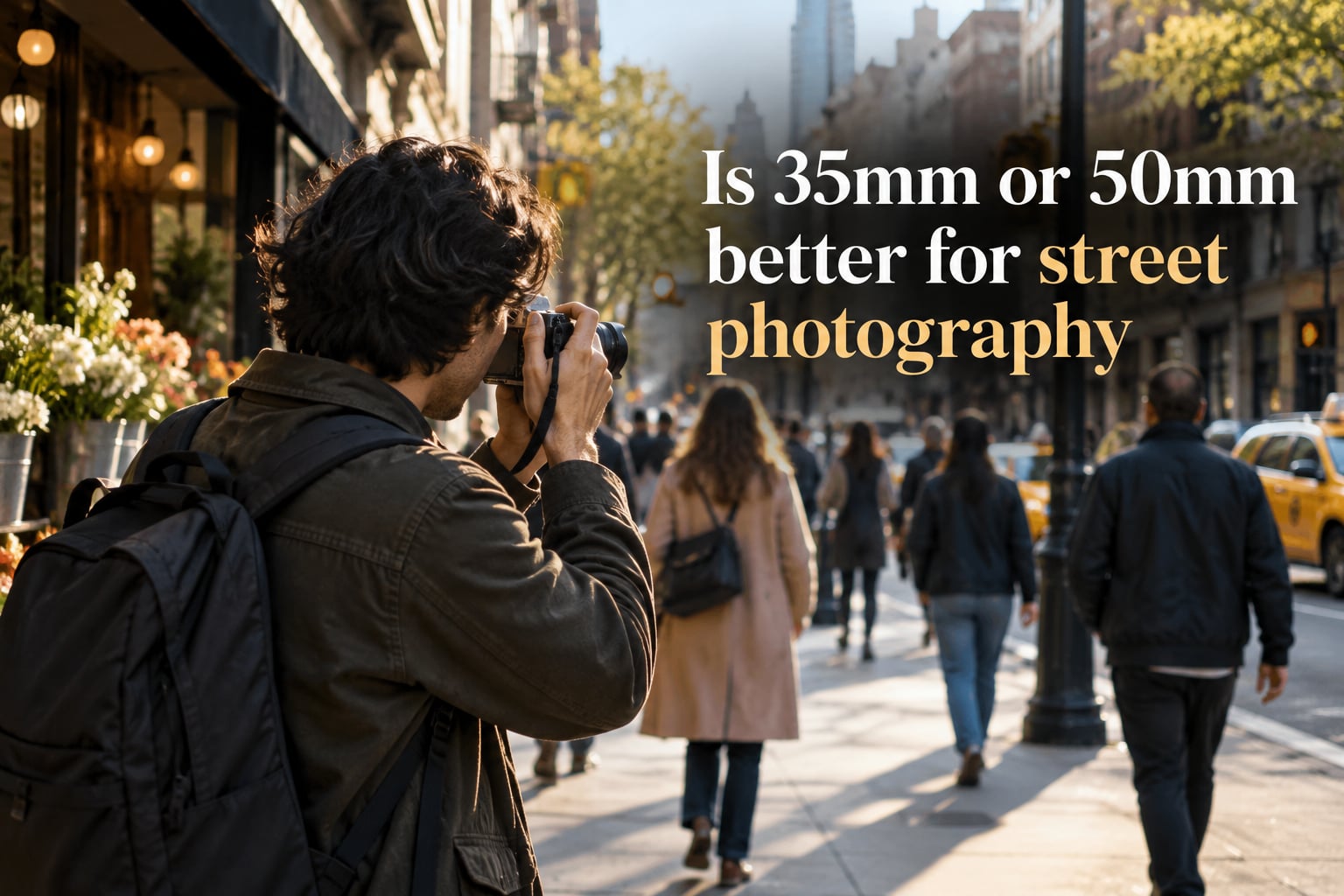
If you’ve spent more than ten minutes reading about street photography, you’ve hit the same debate everyone hits: 35mm vs 50mm street photography. Both are legendary prime lens focal lengths. Both have spawned entire careers. And both will teach you something the other one can’t.
I’ve shot street photography with both focal lengths on full-frame and crop-sensor bodies, in cities as dense as Tokyo and as quiet as my own neighborhood. Here’s the honest answer, the practical trade-offs, and the decision framework I wish someone had handed me on day one.
Table of Contents
- Quick Answer: Is 35mm or 50mm Better for Street Photography?
- Why Prime Lenses Beat Zooms for Street Photography
- The 35mm Focal Length: The Storyteller’s Lens
- The 50mm Focal Length: The Intimate, Natural Eye
- 35mm vs 50mm: Side-by-Side Comparison
- Crop Sensor vs Full-Frame: What Your Numbers Actually Mean
- When to Use 35mm vs 50mm in Real Street Conditions
- How to Choose Between 35mm and 50mm: A Short Decision Framework
- Master Photographers and the 35mm vs 50mm Tradition
- Common Beginner Pitfalls When Choosing a Street Lens
- Frequently Asked Questions
- Final Thoughts
Quick Answer: Is 35mm or 50mm Better for Street Photography?
Neither is objectively better. Pick 35mm if you want environmental context, want to get close to your subject, and like hip shooting. Pick 50mm if you want natural perspective, cleaner subject isolation, and a comfortable working distance from strangers.
The best lens for street photography is the one you’ll carry every day and actually use. Most working street photographers end up with both, but they shoot most of their decisive moments with whichever focal length matches the way they see.
Why Prime Lenses Beat Zooms for Street Photography
Almost every serious street photographer eventually settles on a single prime lens instead of a zoom. Here’s why.
Size and discretion. A 35mm f/2 or a 50mm f/1.8 is tiny compared to a 24-70mm f/2.8. Smaller lenses mean a smaller camera, which means people notice you less, which means more candid moments.
Speed. No zooming, no hunting for focus. With zone focusing pre-set, you raise the camera and the frame is already composed in your head. The decisive moment lives or dies by half a second.
Forced composition. A fixed focal length trains your eye. After a month with a 50mm, your brain starts framing 50mm scenes before you raise the camera. That fluency is what separates snapshots from street photography.
Faster apertures. Primes routinely open to f/1.8, f/1.4, or f/2. Most kit zooms stop at f/4 or f/5.6. That extra stop is the difference between a sharp shot at dusk and a blurry mess.
The 35mm Focal Length: The Storyteller’s Lens
A 35mm lens captures a roughly 63° field of view on full-frame. That’s wider than your natural vision, which is closer to 50mm, but not so wide that faces distort at the edges. It’s the sweet spot between immersion and context.
Environmental storytelling is what 35mm does best. You can include a person, the shopfront behind them, the puddle at their feet, and the bus rolling by. The frame becomes a small narrative. Henri Cartier-Bresson worked mostly at 50mm, but Garry Winogrand, Alex Webb, and Robert Frank built their visual language at 35mm because they wanted the world in the picture, not just the subject.
You can get close without crowding the subject. Standing 3 to 6 feet from someone at 35mm produces a frame that feels intimate but still shows where they are. That’s the working distance where most candid magic happens.
Layering falls into your lap. Foreground, midground, background – the wider field of view stacks them naturally. Webb’s famous Haitian and Cuban photographs lean hard on this. You can compose three planes at once without stepping back across a street.
Hip shooting works. Because the field of view is forgiving, aiming from the hip still produces a usable frame. The composition might wobble, but the subject is usually there. At 50mm, hip shots miss more often because the crop is tighter.
Zone focusing is generous at 35mm. Stop down to f/8 on a 35mm lens and pre-focus at 10 feet, and everything from about 6 feet to 20 feet stays sharp. That’s a huge depth of field – perfect for grabbing moments without refocusing.
The 50mm Focal Length: The Intimate, Natural Eye
A 50mm lens captures about 47° on full-frame. That angle happens to match what your eyes focus on in a scene – the rest of your peripheral vision is softer. Because of that, 50mm frames feel natural. Nothing stretches, nothing compresses, faces look like faces.
Subject isolation is effortless at 50mm. Open to f/1.8 or f/2 and the background melts. A single person crossing the street becomes the entire story. For street portraits – quick, friendly, on-the-fly portraits of strangers – this is the focal length most photographers pick. Vivian Maier often shot at 50mm on her Leica, and her portraits have that same quiet, undistorted intimacy.
Working distance is more comfortable. You frame the same person from 8 to 12 feet away instead of 3 to 6. For people who feel awkward getting close to strangers, 50mm removes that pressure. You can stay across the street and still fill the frame with someone walking past.
No facial distortion. At 35mm, if you shoot a tight headshot from 2 feet away, the nose starts to look larger than the ears. At 50mm from 6 feet, proportions hold. That’s why 50mm is the standard recommendation for portraits of any kind, including street portraits.
Low light and night street photography favor 50mm. A 50mm f/1.8 gathers roughly twice as much light as a 35mm f/2.8 at the same shutter speed. At night, in markets, in subway stations, that extra stop is the difference between a clean file and a noisy one. Several forum threads on r/streetphotography confirm the same pattern – many shooters carry 35mm by day and switch to 50mm at night.
Zone focusing is tighter at 50mm. Stop down to f/8 and pre-focus at 10 feet, and only about 8 to 13 feet stays sharp. Less forgiving than 35mm, but still very workable, especially with a smaller aperture like f/11 in daylight.
35mm vs 50mm: Side-by-Side Comparison
Here’s the same comparison at a glance, since no competitor article on this topic uses a true table.
| Attribute | 35mm | 50mm |
|---|---|---|
| Field of view (full-frame) | ~63° | ~47° |
| Best for | Environmental scenes, layering, getting close | Intimate portraits, subject isolation, natural perspective |
| Working distance | 3 to 6 feet from subject | 8 to 12 feet from subject |
| Depth of field at f/8, focused at 10 ft | ~6 to 20 ft in focus | ~8 to 13 ft in focus |
| Facial distortion on close portraits | Slight nose enlargement up close | Natural proportions |
| Hip shooting | Very forgiving | Less forgiving, tighter crop |
| Indoor / tight alleys | Easier – capture more of the scene | Cramped – hard to back up |
| Low light / night | Good with f/1.8 or f/2 | Excellent with f/1.4 or f/1.8 |
| Master tradition | Winogrand, Alex Webb, Robert Frank | Cartier-Bresson, Vivian Maier, many Leica rangefinder shooters |
| Beginner friendliness | Forgiving, easier to crop later | Forces precise framing |
Crop Sensor vs Full-Frame: What Your Numbers Actually Mean
If you shoot on a Fuji X-T5, a Canon R7, or a Nikon Z fc, the focal lengths above change. This trips up a lot of beginners.
APS-C crop sensors multiply the focal length by 1.5x (Nikon, Sony, Fuji) or 1.6x (Canon). So a 23mm lens on a Fuji is roughly equivalent to a 35mm lens on full-frame. A 35mm lens on the same Fuji behaves like a 50mm on full-frame. The depth of field and perspective also get a small boost from the smaller sensor, but for street photography purposes, the field-of-view change matters most.
Practical translations:
- Fuji / Nikon / Sony APS-C: 23mm = 35mm equivalent, 35mm = 50mm equivalent. Pick a Fuji 23mm f/2 for the 35mm look, or a Fuji 35mm f/2 for the 50mm look.
- Canon APS-C (1.6x crop): 22mm ≈ 35mm equivalent, 31mm ≈ 50mm equivalent.
- Micro Four Thirds (2x crop): 17mm ≈ 35mm, 25mm ≈ 50mm.
If you’re not sure which focal length you actually want, the simplest fix is to shoot your phone’s main lens (roughly 24-26mm equivalent) and crop the frame to simulate each. That gives you a gut-level preview before you spend any money.
When to Use 35mm vs 50mm in Real Street Conditions
Busy city centers and crowded markets. Reach for 35mm. The wider field of view swallows a whole crosswalk, a fruit stall, a bus stop full of people. 50mm in the same spot feels claustrophobic – you can only fit one or two faces in the frame and the rest of the story gets cut off.
Quiet streets, single subjects, contemplative moods. Reach for 50mm. A person walking alone, a window reflection, a stranger looking at their phone – 50mm frames these moments as small, still pictures rather than busy snapshots.
Indoor and tight spaces. 35mm wins. Subways, alleyways, cafes, museums – anywhere you can’t step back, the wider field of view is the only way to keep both your subject and their environment in the shot.
Night and low-light street. 50mm wins, usually. The wider apertures available on most 50mm primes (f/1.8, f/1.4) gather more light, and the slightly tighter framing means less noise in your final image because you’re filling more of the frame with your subject. That said, a fast 35mm f/1.4 closes the gap.
Travel photography with a mix of street and people. Either works. Many travelers default to 35mm because it doubles as a casual landscape and architecture lens.
How to Choose Between 35mm and 50mm: A Short Decision Framework
Run through these five questions. The answers usually point clearly to one focal length.
- Do you want the world in the frame, or just the subject? World = 35mm. Subject = 50mm.
- How do you feel about getting close to strangers? Comfortable at 3-6 feet = 35mm. Prefer 8-12 feet = 50mm.
- Where do you shoot most? Crowded cities and alleys = 35mm. Quieter neighborhoods and portraits = 50mm.
- Day or night, mostly? Mostly day = either. Mostly night = lean 50mm for the aperture.
- Do you already own a kit zoom? Set it to 35mm for a week, then 50mm for a week. Whichever week you forget the zoom is your answer.
The last point is worth its own emphasis. Almost every photographer who eventually settles on a focal length did it by committing to one focal length for a month instead of switching constantly. The Tokyo Forgeries blog calls this “learning it cold.” Switching lenses every other shoot trains your eye on nothing. Picking one prime and using it for 30 days trains your eye on a frame, and that fluency shows up in every photo after.
Master Photographers and the 35mm vs 50mm Tradition
Both focal lengths have deep roots, and knowing the tradition helps you decide which one fits your style.
The 50mm tradition. Henri Cartier-Bresson – the father of street photography and the inventor of the phrase “the decisive moment” – shot almost exclusively at 50mm on his Leica rangefinders. His black-and-white frames rely on natural perspective, careful composition, and a comfortable working distance. Vivian Maier worked in the same range, mostly at 50mm, often with a Leica iiic. Their pictures feel like quiet observations rather than confrontations.
The 35mm tradition. Garry Winogrand, who made roughly 2,500 rolls of street film a year, shot at 28mm and 35mm because he wanted the chaos of New York in the frame. Alex Webb, working in Haiti, Istanbul, and Mexico, builds layered color compositions that only work at 35mm or wider. Robert Frank’s “The Americans” – one of the most influential street photography books ever – was shot mostly at 35mm on a Leica. Their pictures feel like worlds, with people inside them.
There is no wrong lineage. Both schools produced some of the greatest photographs of the last century. The question is which one feels like home to you.
Common Beginner Pitfalls When Choosing a Street Lens
Before we close, a few traps worth naming.
Buying the cheapest 50mm f/1.8 (“nifty fifty”) and assuming it’s the universal answer. The nifty fifty is a great lens. But if your street style is environmental, you’ll feel cramped inside a week. Many beginner street photographers end up reselling the 50mm after a month and buying a 35mm – which means spending twice. Test before you commit.
Constantly switching between 35mm and 50mm in the field. Every lens swap costs you a moment. Pick one, leave the other at home, and shoot a full month with it.
Choosing by spec sheet instead of by feel. A slightly sharper lens with the “wrong” focal length will produce worse photos for you than a less-sharp lens that matches your eye. Focal length is a creative decision, not a technical one.
Ignoring crop-sensor equivalence. If you’re on a Fuji, that 35mm lens you bought “for street” is actually behaving like a 50mm. Know what your lens actually sees.
Frequently Asked Questions
Is 50mm lens good for street photography?
Yes, a 50mm lens is excellent for street photography, especially if you want natural-looking perspective, clean subject isolation, and a comfortable working distance from strangers. At f/1.8 or f/2, it also handles low-light street scenes very well. Many legendary street photographers, including Henri Cartier-Bresson and Vivian Maier, shot most of their work at 50mm.
When to use 35mm vs 50mm?
Use 35mm for crowded scenes, environmental storytelling, layering, indoor spaces, alleys, subways, and any time you want the world around your subject in the frame. Use 50mm for quieter streets, street portraits, subject isolation, low-light and night work, and any time you want a more natural, undistorted perspective. The 35mm is the wider, more forgiving choice; the 50mm is the tighter, more intimate choice.
What is the best lens size for street photography?
The two most popular lens sizes for street photography are 35mm and 50mm on full-frame, which correspond to roughly 23mm and 35mm on most APS-C cameras (Fuji, Sony, Nikon), or 22mm and 31mm on Canon APS-C. Pick 35mm for environmental scenes and getting close; pick 50mm for portraits and natural perspective. Both are correct choices – the best size is the one that matches how you see.
Which lens is better for taking pictures, 35mm or 55mm?
For most practical purposes, 55mm and 50mm behave almost identically on full-frame – both give you roughly 47 degrees of field of view, natural perspective, and good subject isolation. A 35mm gives you a noticeably wider frame (~63 degrees) that includes more of the environment. Pick 35mm for environmental storytelling and tight indoor spaces; pick 50mm (or 55mm) for portraits, isolation, and a more natural, eye-like view.
Final Thoughts
The 35mm vs 50mm street photography debate has no winner because it isn’t really a contest. Both focal lengths work, and the best one for you depends on the kind of pictures you want to make. Pick 35mm if you want to include the world around your subject. Pick 50mm if you want your subject alone, framed the way your eye sees them.
Whatever you pick, commit to it for a month. That’s where the real learning happens.