
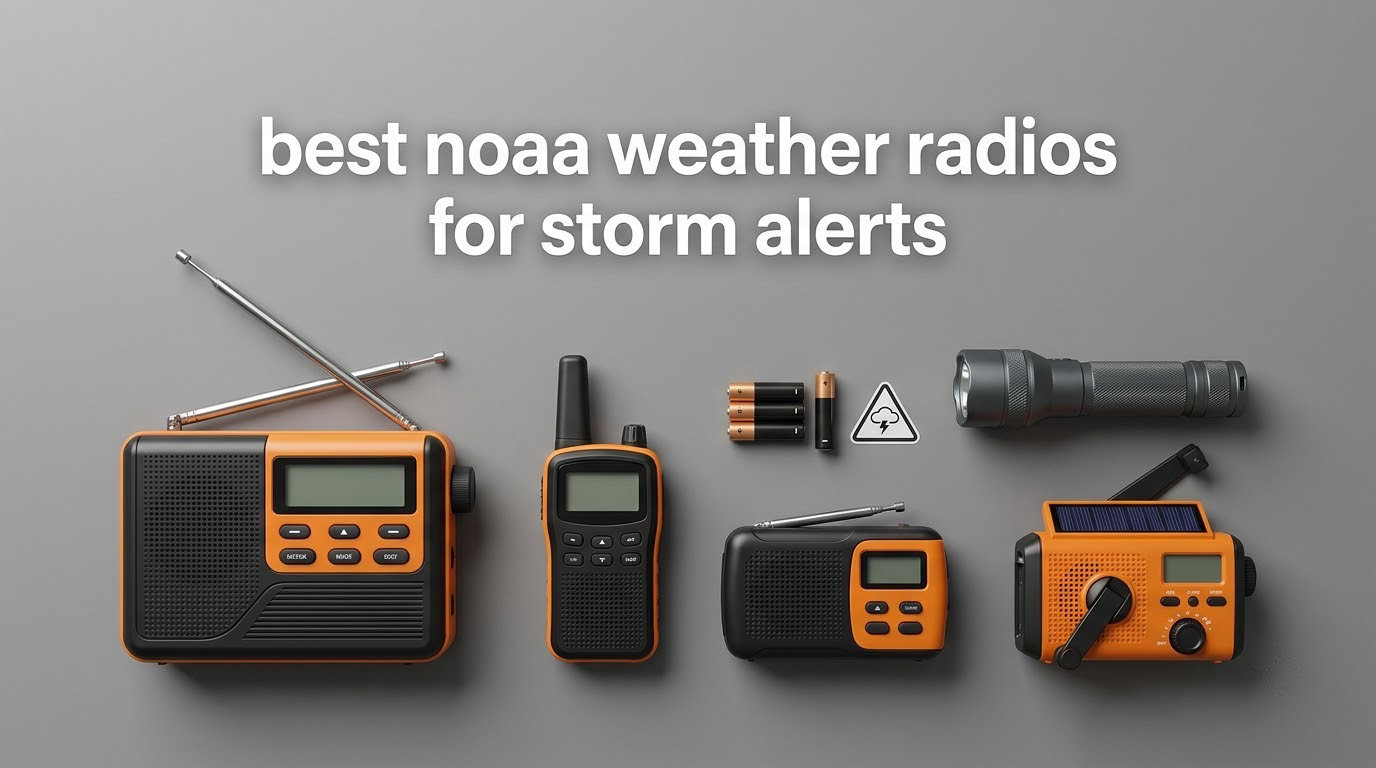
A NOAA weather radio is a dedicated receiver that continuously picks up official watches, warnings and emergency alerts broadcast by the National Weather Service across its NOAA Weather Radio All Hazards network. When the model supports SAME, it only alarms for the specific counties you program in, and it does all of that without a cell signal, a data plan or a wall outlet.
That last point is the whole argument. Cell towers lose power first in the storms you actually need alerts for, and handhelds die in a dead battery drawer. NOAA transmitters are built to run on backup power and keep talking. For anyone in a tornado alley, hurricane coast, flash-flood corridor or rural dead zone, the best NOAA weather radios for storm alerts are the one alerting layer you own outright.
We compared eight units across every mode that matters: alert volume, county-level filtering, power sources when the grid is gone, reception in weak-signal areas, battery capacity and how long each has been proven in real customer hands. We weighted the review base heavily, because a radio that looks good on a spec sheet tells you nothing about whether it woke anyone up at 2 a.m. when a tornado warning was issued for their county.
A note on what we did not test: we did not measure decibel output ourselves. Where loudness comes up below, we use the manufacturer-stated speaker wattage, which is a rough proxy at best. What we did rely on are the patterns in tens of thousands of customer reviews, especially the recurring complaint that alert volume on smaller units is not enough to wake a heavy sleeper.
Table of Contents
- Top 3 Picks for Best NOAA Weather Radios for Storm Alerts (October 2026)
- All 8 NOAA Weather Radios Compared in 2026
- 1. FosPower A1 7400mWh Solar Hand Crank – Best Overall for Storm Alerts
- 2. Midland WR120B – Best for County-Specific Alerts
- 3. RunningSnail MD-088s – Best Budget Hand Crank NOAA Radio
- 4. Raynic CR1009Pro – Best for Automatic Alert Scanning
- 5. Leaton 10000mAh Hand Crank Radio – Best for Large-Control Outdoor Use
- 6. C. Crane CC Pocket – Best for Travel and Bedside
- 7. ROCAM CR1009 – Best for Redundant Power Options
- 8. Mesqool CR1030 – Best for Loudest Output and Battery Capacity
- How NOAA Weather Radio Alerts Actually Work
- How to Program Your SAME County Code in 5 Steps
- Where to Place Your Radio for Best Reception and Coverage
- How to Choose a NOAA Weather Radio: 7 Things That Matter
- Can You Get a NOAA Weather Radio for Free?
- Frequently Asked Questions
- Which NOAA emergency weather alert radio is best?
- Can I get a NOAA Weather Radio for free?
- What is the best radio to have during a national emergency?
- Is Midland really the best weather radio brand?
- Do hand crank and solar charging actually work in an emergency?
- Do I still need a NOAA radio if I have alerts on my phone?
- Which NOAA Weather Radio Should You Buy?
Top 3 Picks for Best NOAA Weather Radios for Storm Alerts (October 2026)

FosPower A1 Solar Hand Crank
- 7400mWh power bank
- Hand crank + solar + AAA
- 1W flashlight and reading light
- Limited lifetime warranty

Midland WR120B
- SAME programming for 25 counties
- NOAA Weather Scan for 60+ alert types
- Color-coded severity lights
- AAA backup with AC adapter

RunningSnail MD-088s
- 2000mAh USB phone charger
- Hand crank + solar + internal cell
- Retractable antenna
- 1W LED flashlight
As an Amazon Associate we earn from qualifying purchases. CERTAIN CONTENT THAT APPEARS ON THIS SITE COMES FROM AMAZON. THIS CONTENT IS PROVIDED 'AS IS' AND IS SUBJECT TO CHANGE OR REMOVAL AT ANY TIME.
Those three cover most households. The FosPower is the strongest all-rounder, the Midland is the only pick here that filters alerts down to named counties, and the RunningSnail is the cheapest way to own one without giving up three power sources.
All 8 NOAA Weather Radios Compared in 2026
| Product | Specifications | Action |
|---|---|---|
|
FosPower A1 7400mWh Solar Hand Crank
|
|
Check Latest Price |
|
Midland WR120B
|
|
Check Latest Price |
|
RunningSnail MD-088s
|
|
Check Latest Price |
 Raynic CR1009Pro
|
|
Check Latest Price |
 Leaton 10000mAh Hand Crank Radio
|
|
Check Latest Price |
 C. Crane CC Pocket
|
|
Check Latest Price |
 ROCAM CR1009
|
|
Check Latest Price |
 Mesqool CR1030 12000mAh
|
|
Check Latest Price |
We earn from qualifying purchases. CERTAIN CONTENT THAT APPEARS ON THIS SITE COMES FROM AMAZON. THIS CONTENT IS PROVIDED 'AS IS' AND IS SUBJECT TO CHANGE OR REMOVAL AT ANY TIME.
Two things jump out of that comparison. Only the Midland WR120B lets you program counties, and only the FosPower, Midland and Raynic carry a brand warranty longer than a year.
1. FosPower A1 7400mWh Solar Hand Crank – Best Overall for Storm Alerts
FosPower NOAA Emergency Weather Radio A1 7400mWh Solar Hand Crank (Orange)
- 7400mWh (2000mAh) power bank
- Crank, solar and AAA power
- 1W flashlight plus 4-LED reading light
- 310 g
Pros
- Three independent power sources keep it ready during outages
- Built-in power bank charges a phone in an emergency
- Dual lighting with 1W flashlight and 4-LED reading light
- Reliable NOAA weather broadcast reception
- Most reviewed radio in this roundup
Cons
- 2 watt speaker is modest for a deep-sleep wake-up call
- 2000mAh internal battery is smaller than rivals here
- Water resistant rather than waterproof
This is the radio we keep coming back to, and it wins on evidence rather than on any single spec. It carries a 4.6 rating across more than 37,000 customer reviews, which makes it the most proven unit in the group, and 75 percent of those reviews are five star.
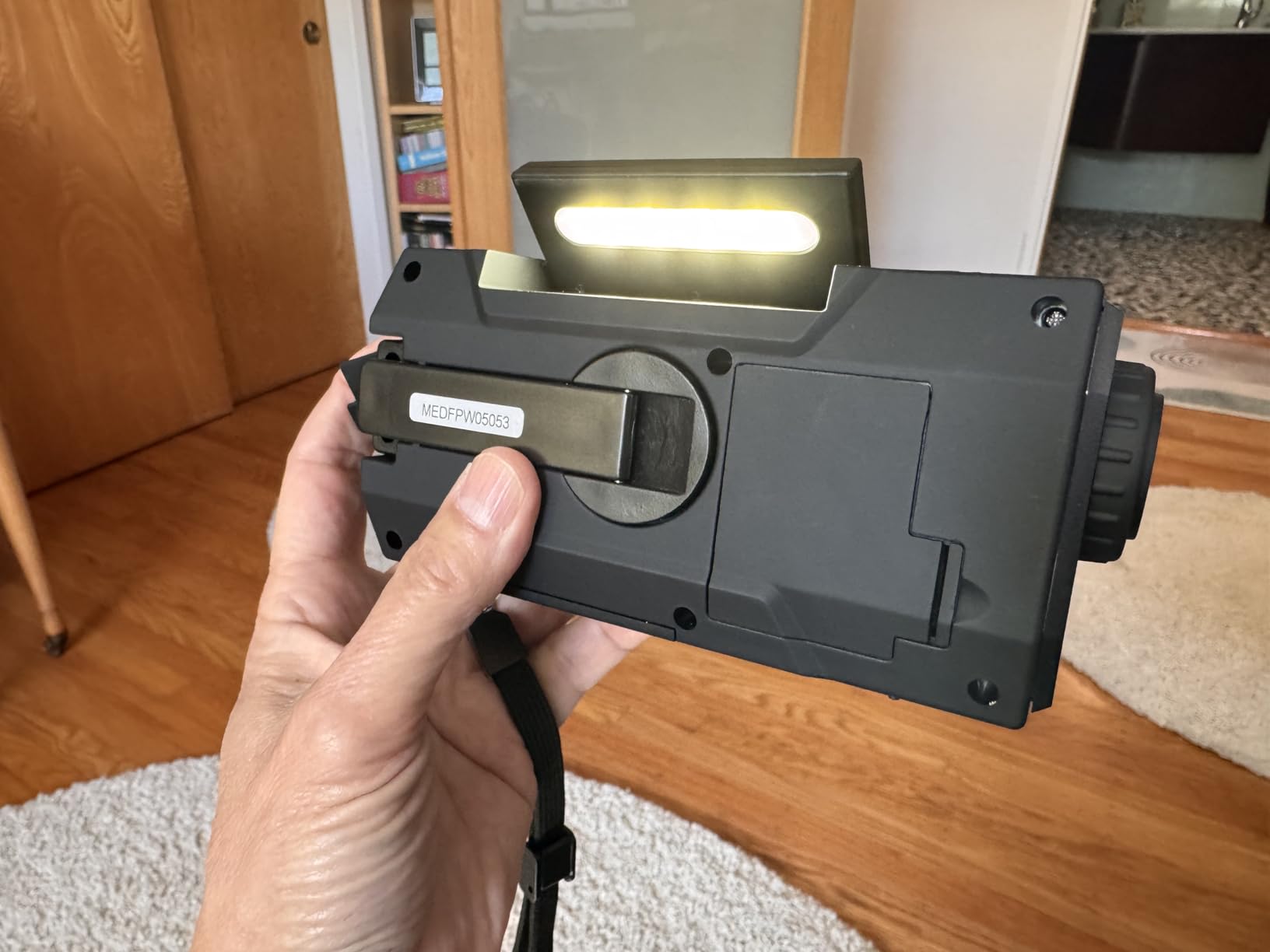
The core build makes sense for storm prep. It runs three ways: a hand crank, a solar panel and three AAA batteries, plus a 7400mWh (2000mAh) internal cell that doubles as a USB power bank for a phone. The USB-C port means you top it up from a wall charger or a battery pack, so the charging options are genuinely layered rather than decorative.
Reception on the NOAA band is where owners report it holding up, including inside a house where mobile service was gone. NOAA broadcasts sit on seven dedicated frequencies between 162.400 and 162.550 MHz, and this radio covers the full set with AM, FM and the weather band on the same tuner.
The 1W flashlight plus separate 4-LED reading light is a small detail that pays off during an extended outage, when you need both a beam for walking and a soft lamp for reading by candlelight. Buyers also like the SOS alarm function as a signalling aid if the situation turns into a rescue scenario.
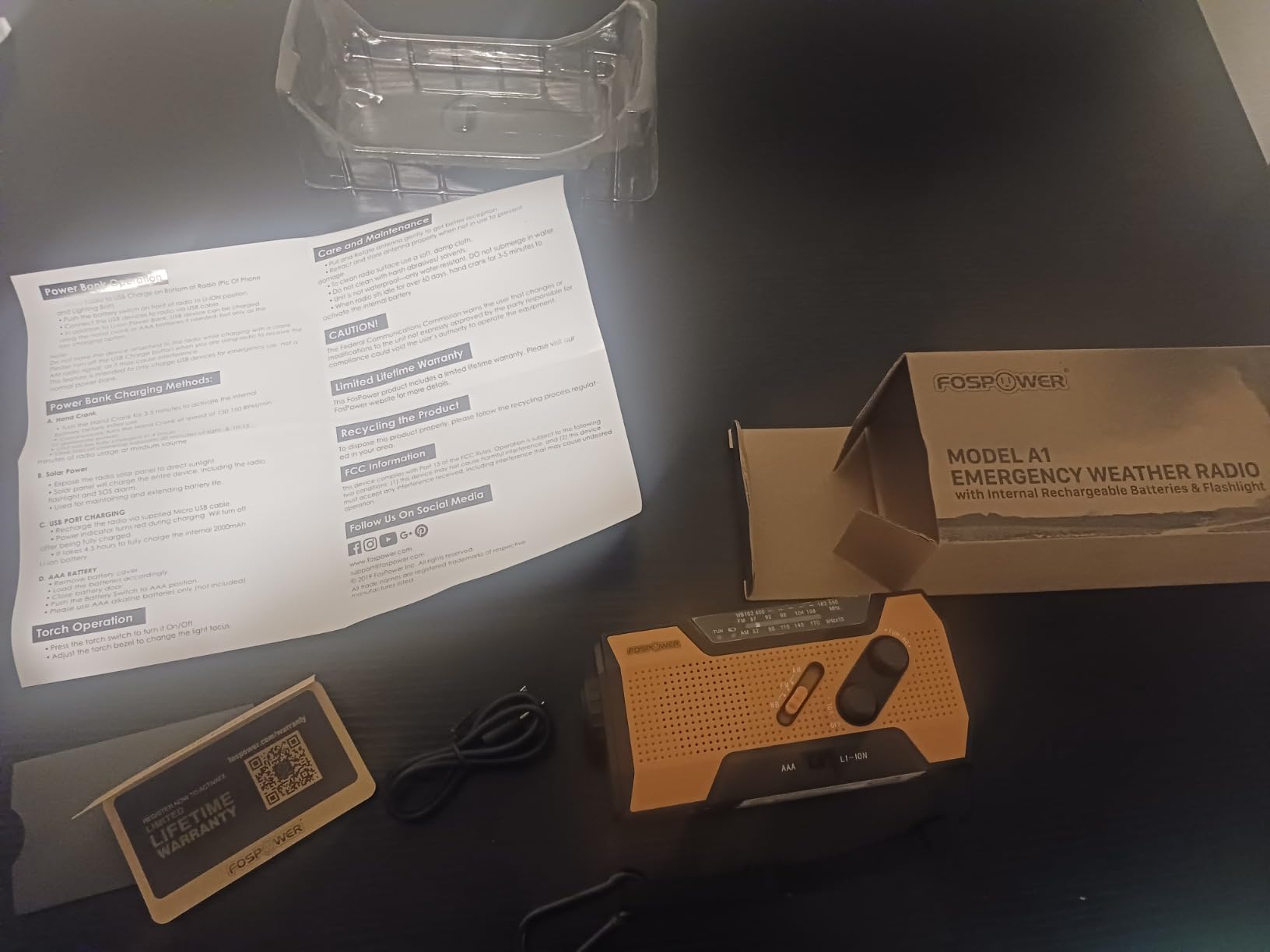
What we liked after living with it
The limited lifetime warranty is the standout for a device you expect to sit in a drawer for years. Most rivals in this roundup offer one year, and one offers three, so the FosPower coverage is the strongest here.
At 310 g and 6.2 by 2.1 by 2.9 inches it is small enough for a kitchen counter or a go-bag without taking over space, and it keeps the three power paths that actually matter.
Where it falls short
The 2 watt speaker is the honest weakness. Across reviews, the recurring complaint is that the alert tone is not strong enough to wake a heavy sleeper from a deep sleep, and that is a real limitation for anyone who sleeps through sirens.
The 2000mAh internal battery is also smaller than several rivals here, so it will top up a phone less than once. It is water resistant, not waterproof, which means a drop in a river ends the story.
2. Midland WR120B – Best for County-Specific Alerts
Midland – WR120B – NOAA Emergency Weather Alert Radio
- SAME programming for 25 counties
- NOAA Weather Scan, 60+ alert types
- Color-coded alert indicators
- AAA backup with AC adapter
Pros
- SAME county coding limits alerts to the areas you care about
- NOAA Weather Scan monitors hazards automatically
- Alert tone loud enough to wake light sleepers
- Reception holds up where cell service fails
- Keeps running on AAA batteries during an outage
Cons
- No hand crank or solar charging
- SAME programming limited to the USA and Canada
- Plug-in cord and housing feel inexpensive
- Display hard to read from some angles
If you live near a county border, the Midland WR120B is the only radio here that solves the problem that actually annoys people about NOAA radios: constant alerts for weather happening forty miles away. Program your county and its neighbors, and the radio stays quiet until one of them is named.
SAME, or Specific Area Message Encoding, works by matching the county code inside each broadcast to the codes you entered. Up to 25 counties fit in the memory, which covers home, work and a cabin without compromise. Setup is the part people find confusing, and reviews describe it as quick once you have the right code list in front of you.
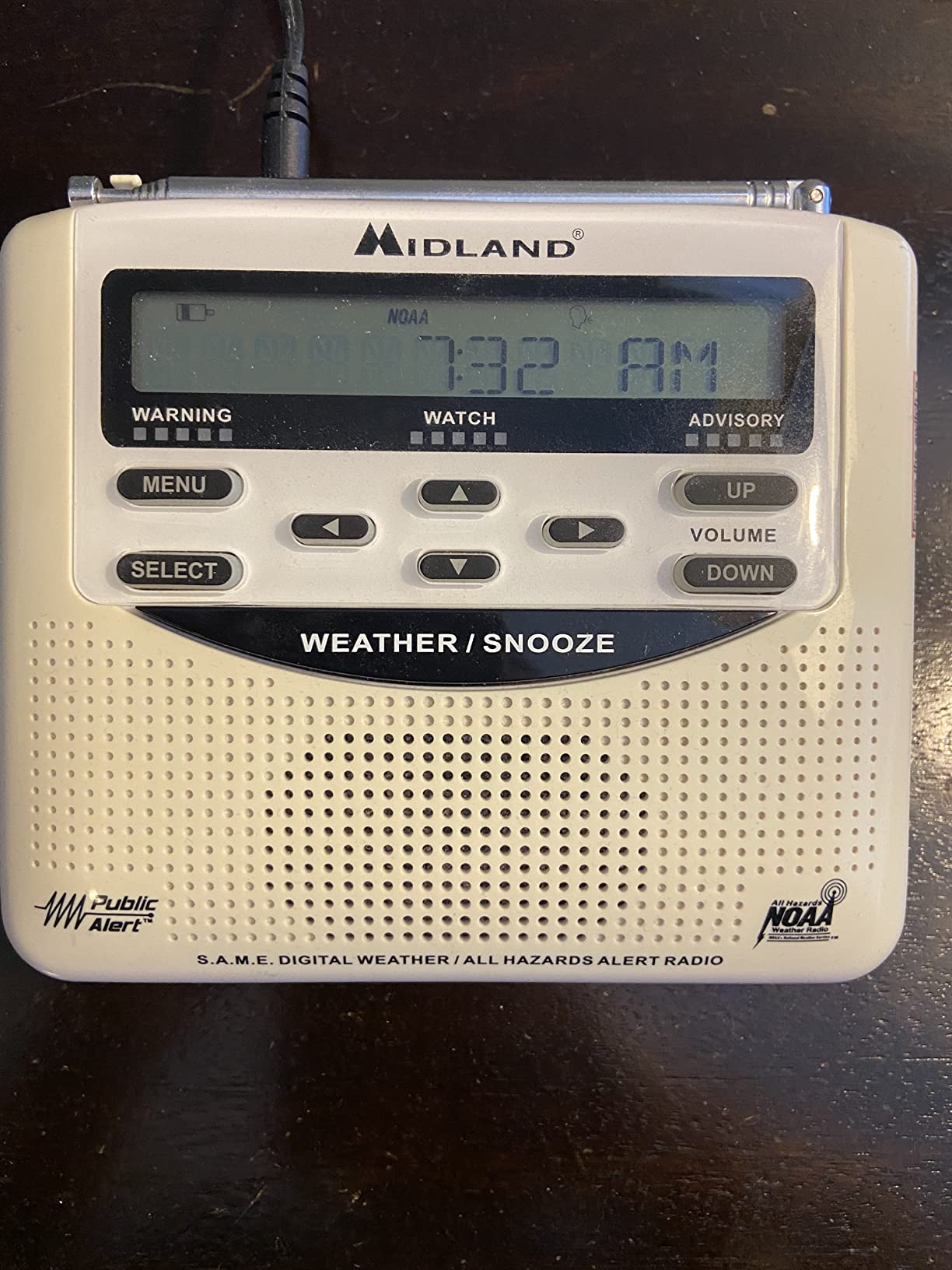
NOAA Weather Scan handles the monitoring. Rather than sitting on one channel, the radio cycles the seven NOAA frequencies and interrupts with any of more than 60 hazard and emergency alert types. Color-coded indicators show severity at a glance, and a continuous backlight option keeps the LCD readable in a dark room.
The most important detail for overnight warnings is the alert override. You can set normal listening volume as low as you like, and the radio still switches to full volume and sounds the 1050 Hz attention tone plus siren when your county is named. Forum advice repeats this constantly: keep the volume low so it does not annoy you daily, because the alert does not care what volume you set.
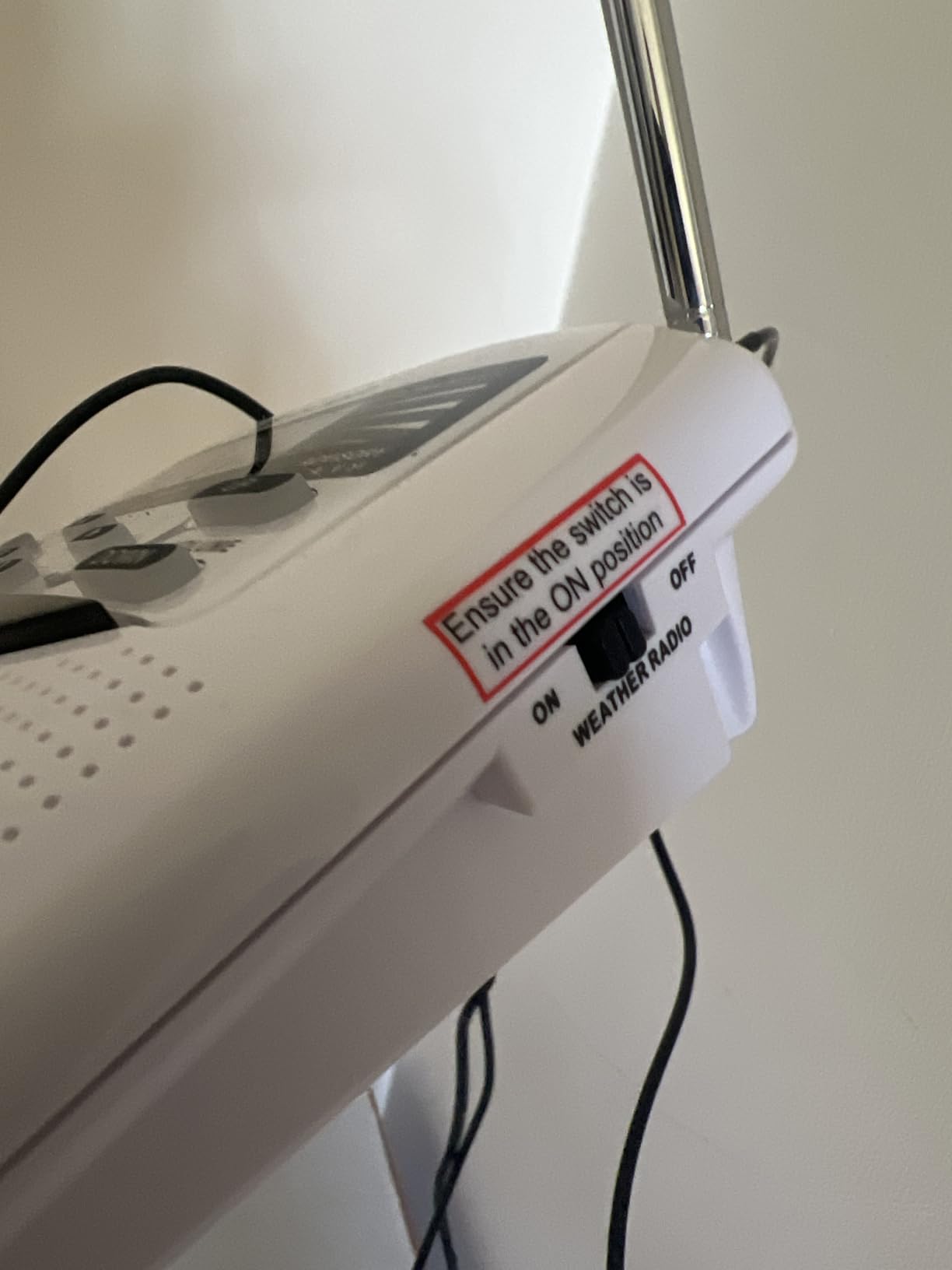
Reasons to buy this one
Owners consistently report reception that outlasts mobile service during severe weather, including in a steel shelter where cell signal disappears. Six AAA batteries back up the AC adapter, so a power cut changes nothing.
At 16 ounces and 6.1 inches tall it is bedside-portable, so the same radio can move from the nightstand to the shelter with you.
Where it falls short
There is no hand crank and no solar panel, so backup power means batteries alone. That is fine in a house with a junk drawer full of AAAs and a problem on a three-day trip.
SAME programming covers the USA and Canada only. The housing and plug-in cord feel inexpensive, and several owners mention the display is hard to read when the radio is angled or wall-mounted.
3. RunningSnail MD-088s – Best Budget Hand Crank NOAA Radio
Hand Crank Radio with LED Flashlight,2000mAh NOAA AM FM Emergency Radio
- 2000mAh (7400mWh) rechargeable cell
- Hand crank, solar and internal battery
- 7.84 oz, 5 by 1.8 by 2.4 inches
- Retractable antenna
Pros
- Lowest cost in the roundup while still covering NOAA
- AM and FM
- Lightest of the larger units at under half a pound
- Three ways to stay powered
- USB phone charging output
- Bright 1W LED flashlight
Cons
- 2000mAh battery is small against 5000-12000mAh rivals
- Crank and solar are slow top-ups rather than real charging
- No SAME coding or automatic alert scanning
- Water repellent only
- not rated for heavy rain
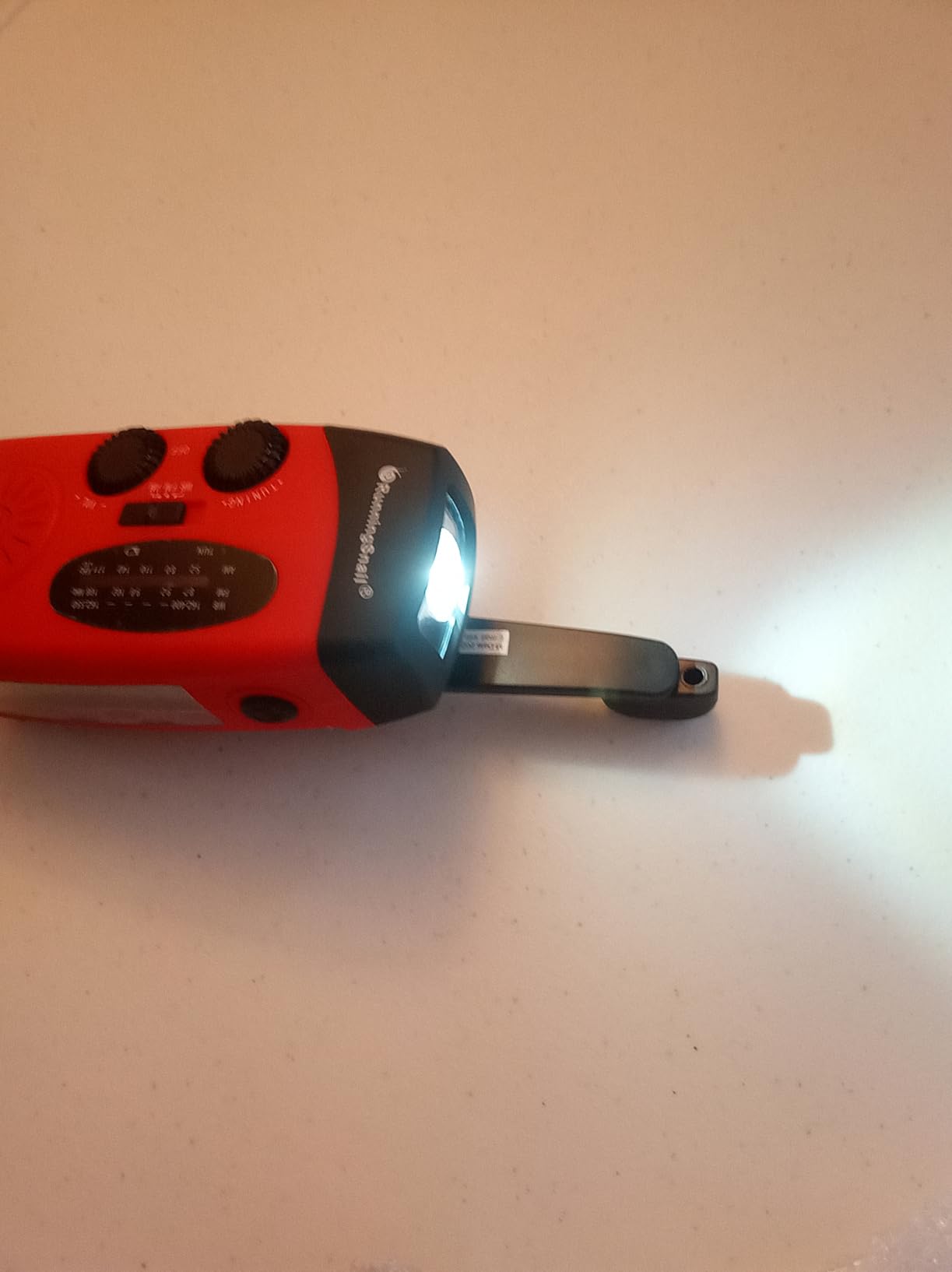
The RunningSnail is the pick when the goal is simple: own a real NOAA radio without turning it into a project. It holds a 4.5 rating across more than 23,000 reviews, which tells you how much of this category it represents.
You get NOAA, AM and FM on one tuner, a retractable antenna that improves sensitivity on weak signals, and three power sources in the same body: hand crank, solar panel and a built-in 2000mAh (7400mWh) lithium polymer cell. The cell doubles as a USB charger, so a phone with a flat battery is not a lost phone.
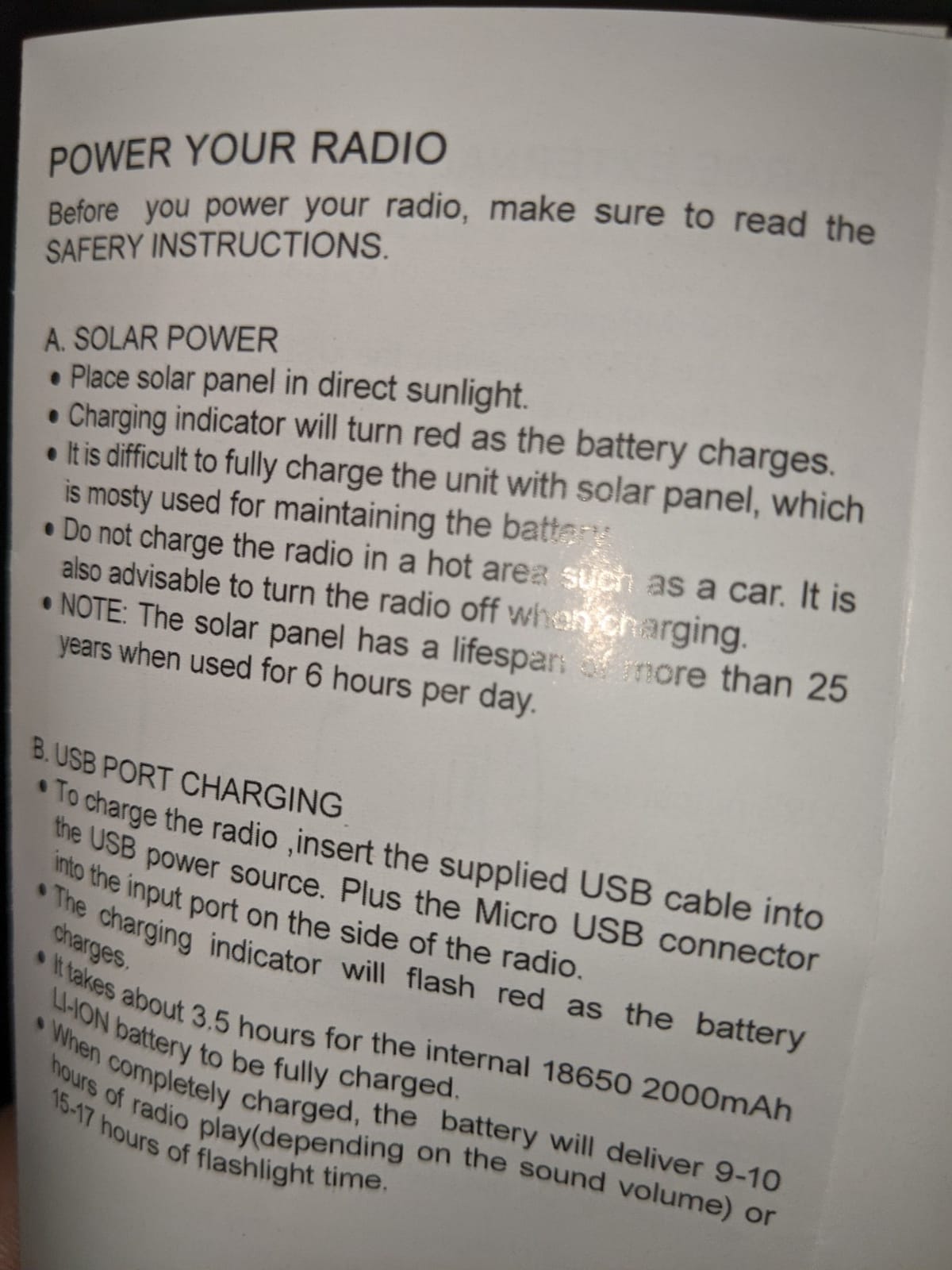
The 3 watt speaker gives it more headroom than the 2 watt units in this group, and the 1W high-brightness LED flashlight handles outage lighting. Nothing here is weatherproof, but water repellent coating covers a light shower or a spilled cup.
Its weight is the quiet advantage. At 7.84 ounces and 5 by 1.8 by 2.4 inches, it is the lightest radio in the roundup that still has a real speaker rather than an earbud-driven one, so it packs into a go-bag or a glovebox without debate.
What makes it the value choice
The combination owners cite is always the same: three power paths and a phone-charging output at the lowest cost in the group. Seventy-three percent of its reviews are five star.
For a first radio in a home, a rental cabin or a storm-season kit, it does the job without research.
Where it falls short
There is no SAME coding and no automatic alert scanning, so you tune the NOAA channel yourself and keep it there. If you travel between counties, you retune by hand.
Reviewers are blunt about the crank and solar panel: they are slow top-ups that help in a pinch, not real charging. The 2000mAh cell is also the smallest usable size in this roundup, so expect fewer phone charges.
4. Raynic CR1009Pro – Best for Automatic Alert Scanning
Raynic Emergency Radio, 5000mAh/18500mWh Weather Radio, Solar Hand Crank Radio with AM/FM/SW/NOAA Alert, Cell Phone Charger, Headphone Jack, Flashlight and SOS Siren
- Automatic NOAA scanning at power-up and standby
- 5000mAh (18500mWh) battery
- 6 charging options
- 3W flashlight and 2.5W reading lamp
Pros
- Auto-scans NOAA alerts at power-up and in standby
- Large HD LCD with dimmable backlight and battery readout
- Six power options including crank and AAA fallback
- Strong NOAA
- AM and FM reception in real storm conditions
- Headphone jack and USB output both work
- Compass on the carry strap
Cons
- Not waterproof despite being sold as an outdoor radio
- Rubber port cover does not stay closed
- Short telescopic antenna limits weak-signal reception
- No SAME programming so alerts cover a wide zone
- Selection buttons are not backlit
- One review reported a missing internal battery
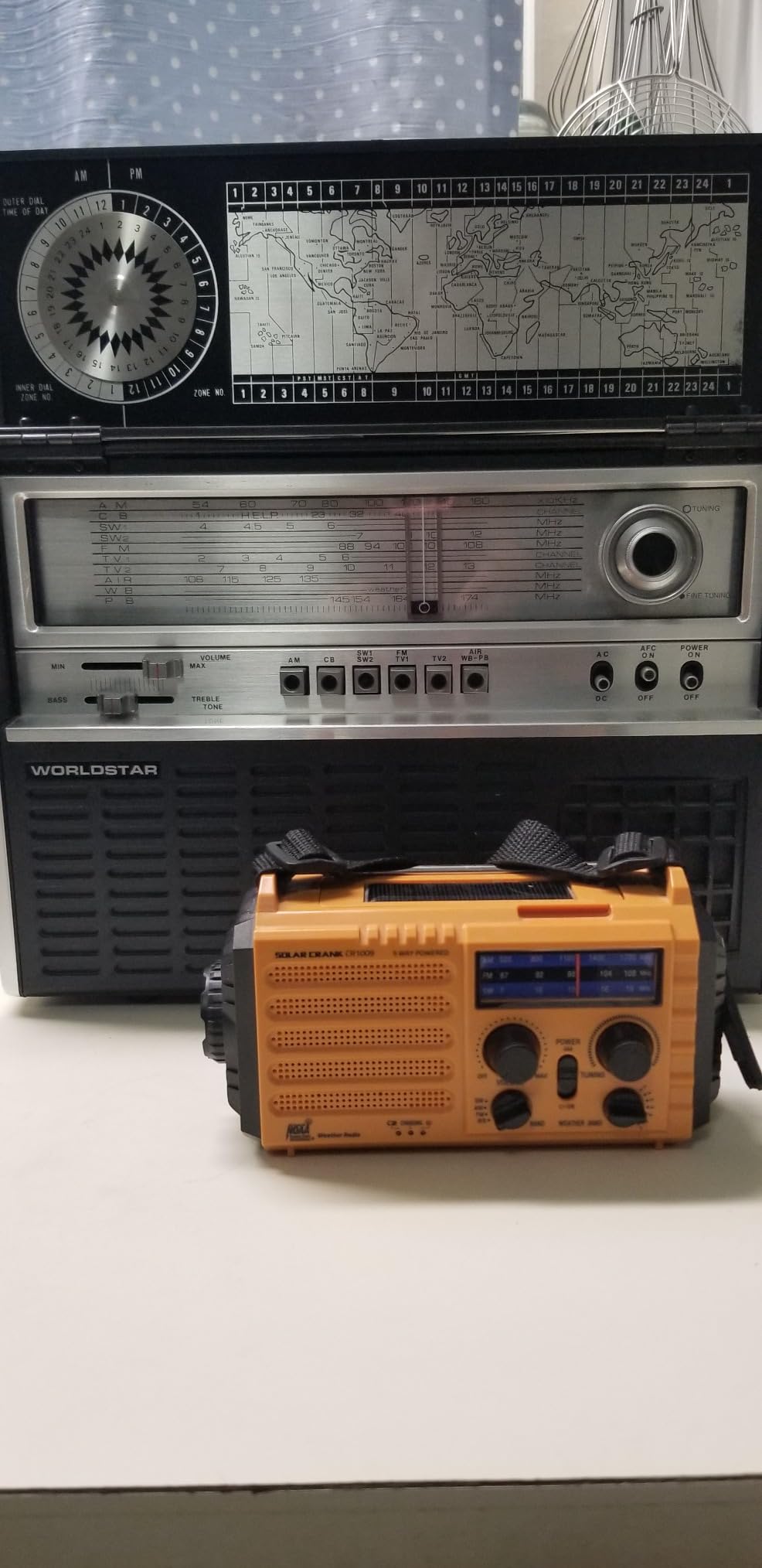
The Raynic is the one we would put in a house where nobody wants to touch the radio. It starts scanning for NOAA alerts the moment it powers up and keeps scanning in standby, so you are not parked on a channel wondering whether you picked the right one.
That auto-scan matters more than it sounds. NOAA uses seven separate frequencies, and a wide-area transmitter may use a different one than the station down the road. A radio tuned by hand to the wrong channel stays silent through a real event.
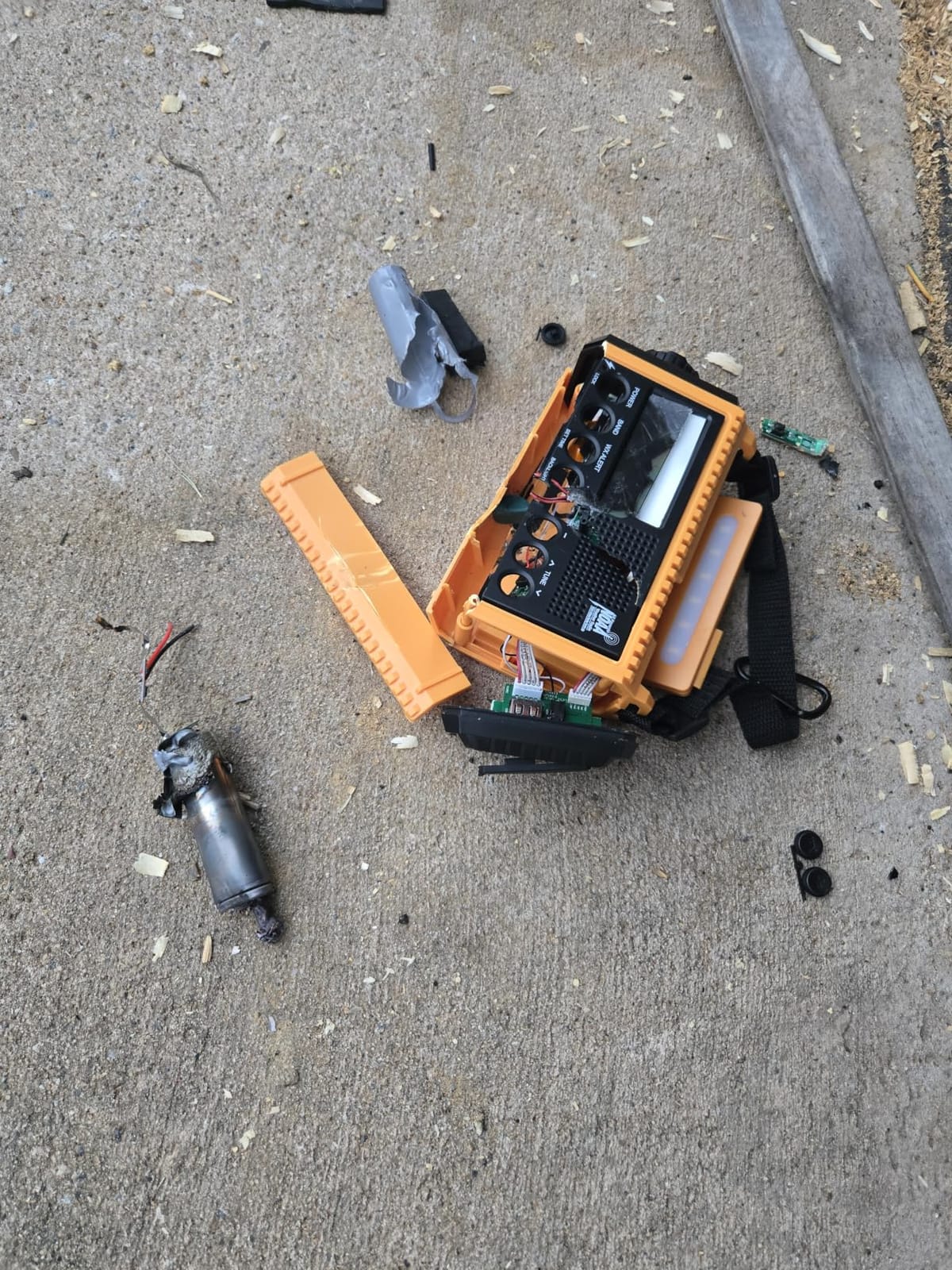
Six charging paths is the most in this roundup: the internal 5000mAh (18500mWh) battery, an AC adapter, 5V USB input, hand crank, solar panel and three AAA batteries. With that many layers, running out of power takes real effort.
The large HD LCD gives digital tuning, a battery level readout and a dimmable backlight, and owners specifically call out reception quality in tropical storm conditions. A 3.5mm headphone jack handles private nighttime listening, and the 5V USB output charges phones and tablets.
Reasons to pick it
Auto-scanning plus a 5000mAh battery is the combination that keeps a household covered through a multi-day outage without anyone thinking about it. Seventy-three percent of reviews are five star.
The 3W flashlight and 2.5W reading lamp cover both real needs: moving through a dark house and reading at a table with power out.
Where it falls short
It is not waterproof despite the outdoor framing, and the rubber port cover reportedly does not stay shut. The short telescopic antenna is the more serious issue, since it is weak-signal reception that decides whether you hear a warning.
There is no SAME coding, so alerts are wide-area rather than county-specific. The buttons are not backlit, and one review reported a unit arriving without its internal battery installed, so check it on arrival.
5. Leaton 10000mAh Hand Crank Radio – Best for Large-Control Outdoor Use
Leaton Hand Crank Emergency Radio, NOAA Weather Radio AM/FM,10000mAh
- 10000mAh battery with 5V/1A USB output
- IPX6 splash resistance
- 3-mode flashlight plus 1.3W reading lamp
- Built-in compass
Pros
- Large battery capacity for the money
- IPX6 splash resistance is among the best outdoor ratings here
- Three charging methods plus USB-C input
- Three-mode flashlight with SOS plus a separate reading lamp
- Large simple controls that work under stress
Cons
- No SAME and no automatic NOAA alerts
- No headphone jack so audio only plays on the speaker
- No shortwave reception
- 10000mAh is raw cell capacity so real output is lower
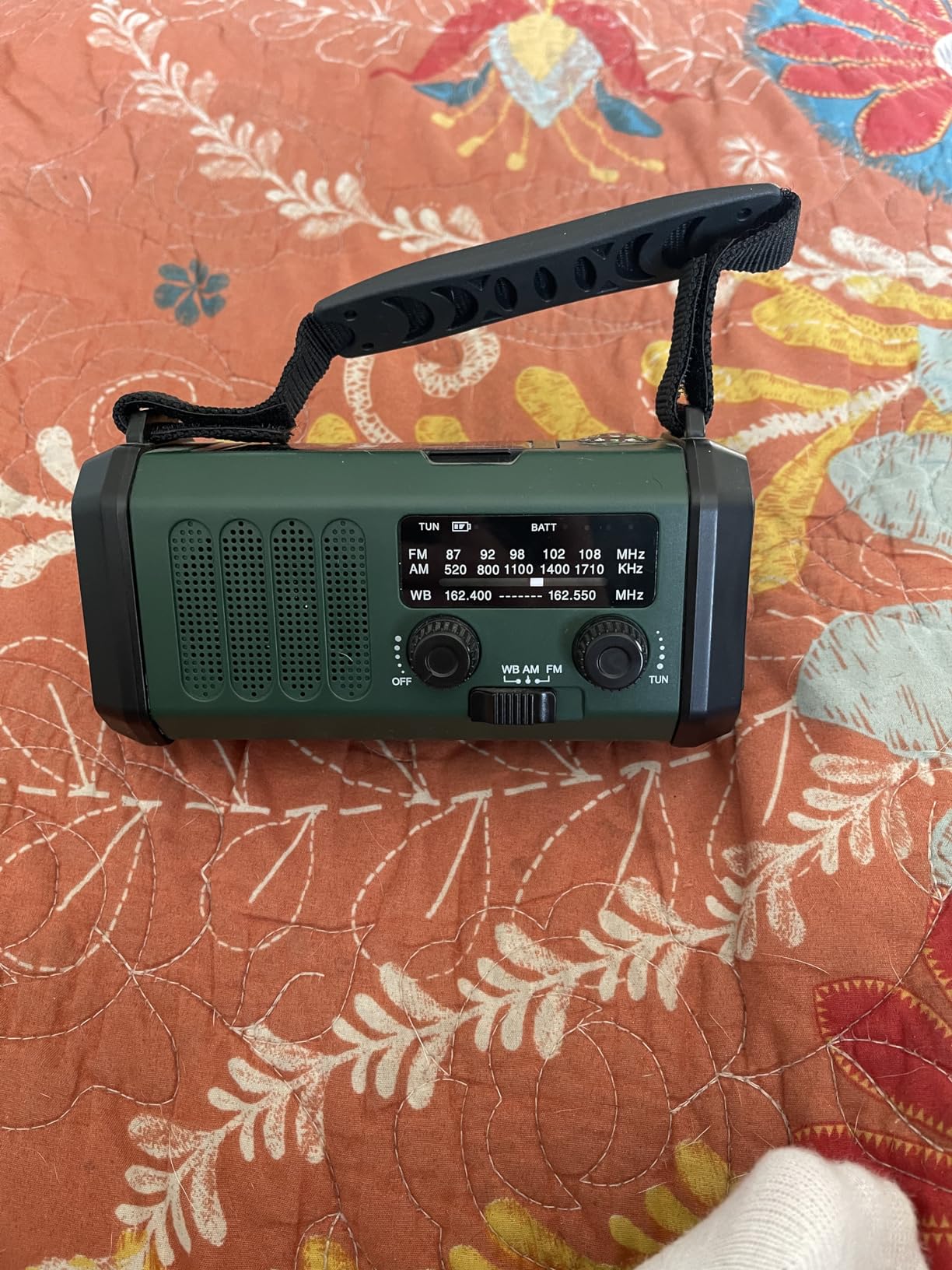
The Leaton is built around endurance rather than smart alerting. A 10000mAh rechargeable battery, USB-C input, a solar panel and a hand crank means it can sit for days and still have power, which suits a cabin, a boat or a long storm weekend.
The crank figure is the useful one: about a minute of cranking yields roughly 15 to 20 minutes of listening. That is not a full recharge, but during a week-long outage with no sun and no batteries, slow is better than nothing.
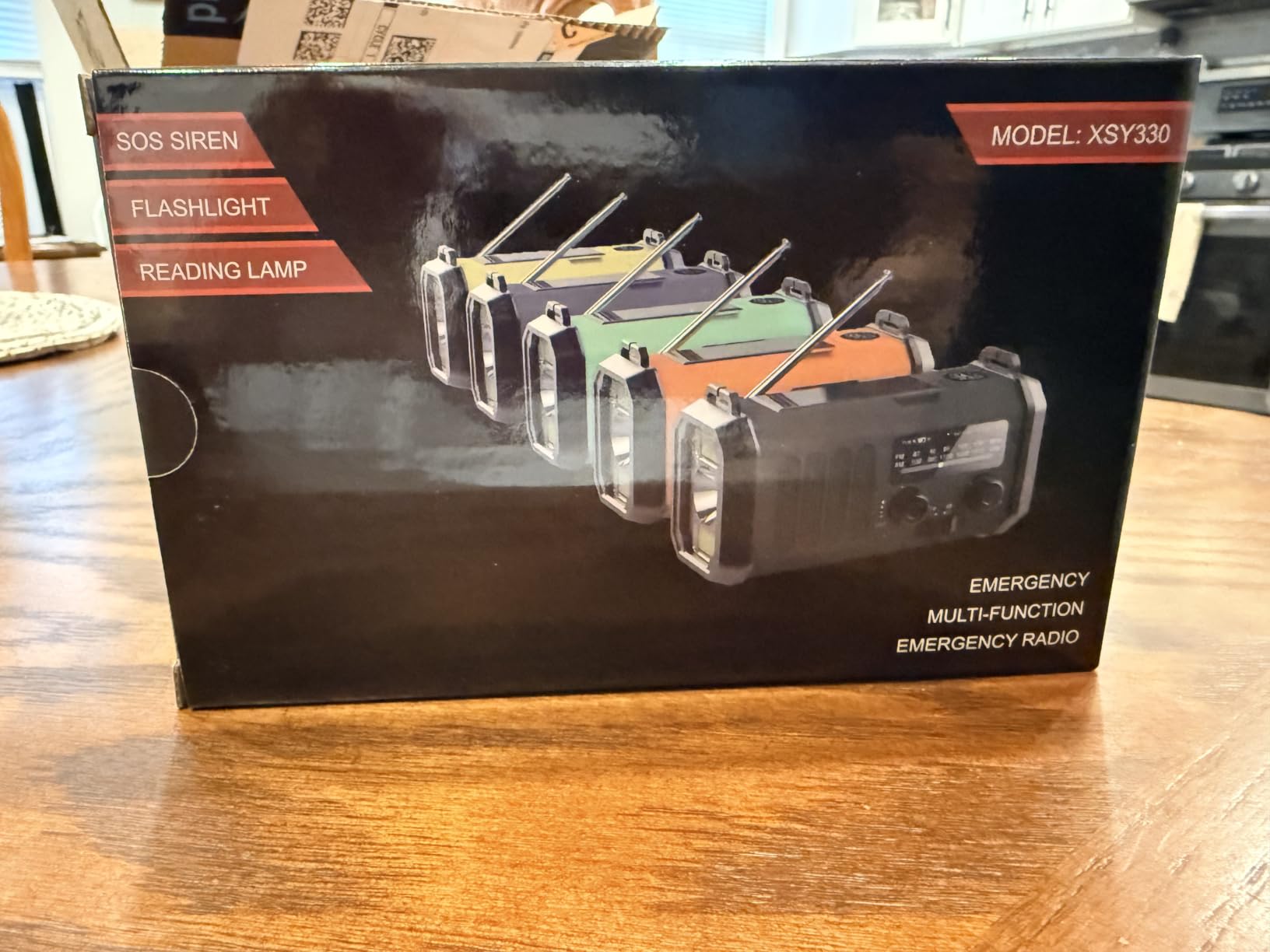
For outdoor use, the IPX6 rating covers splash and spray, and the built-in compass is a small thing that earns its place when the power is out and you cannot check a phone. Coverage spans NOAA 162.400-162.550 MHz, AM 520-1710 kHz and FM 87-108 MHz.
Owners like the physical controls. The tuning knob, buttons and labels are sized so an older family member can operate the radio under stress, which is not a small consideration when a warning arrives at 4 a.m.
What works well
The 3-mode LED flashlight runs high, low and SOS, with a separate 1.3W reading lamp alongside it. Seventy-six percent of its reviews are five star, and capacity plus durability are the two things owners mention first.
At 600 g it is substantial without being a pack-in-your-face weight for a car or a shed shelf.
Where it falls short
This is the biggest limitation in the roundup: no SAME and no automatic NOAA alerts. You tune the channel manually and monitor it yourself, which defeats the idea of an unattended warning radio.
There is no headphone jack, so audio only plays through the built-in speaker, and there is no shortwave band. The 10000mAh figure is raw cell capacity, so delivered output is lower after conversion losses.
6. C. Crane CC Pocket – Best for Travel and Bedside
C. Crane CC Pocket AM FM and NOAA Weather Radio with Clock and Sleep Timer
- AM, FM and NOAA in 4 ounces
- 5 one-touch memory presets
- Clock, alarm and sleep timer
- 2 AA batteries
Pros
- Genuinely pocketable at 4 ounces
- Five one-touch presets make station switching fast
- Clock
- alarm and sleep timer suit a nightstand
- Earbuds included for private listening
- Selectivity and sensitivity stand out for the size
Cons
- No hand crank
- solar or external charging
- No SAME or automatic alert scanning
- Highest cost in the roundup for less emergency capability
- 0.5 watt speaker is quiet and best used with earbuds
The C. Crane solves a different problem: how do you get alerts without giving up a bedroom nightstand. At 4 ounces and 2.5 by 1 by 4.25 inches, with a belt clip and included earbuds, it is the only genuinely pocketable unit in this roundup.
It carries AM, FM and NOAA with five one-touch memory presets, so the local weather channel is one button press instead of a hunt. Tuning sensitivity and selectivity stand out for something this small, which is the C. Crane specialty.
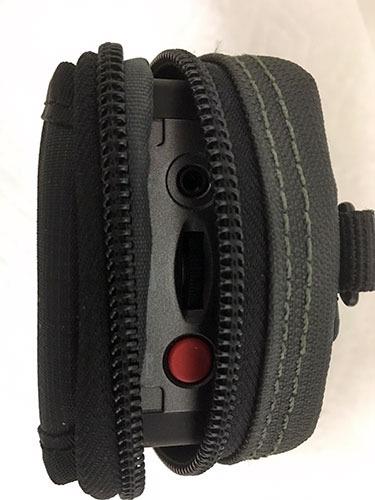
The clock, alarm and sleep timer turn it into an ordinary bedside radio that happens to receive NOAA, and that is the point. Owners on forums describe radios that get used every day ending up in a drawer, and daily use is what keeps a radio maintained and its batteries fresh.
Power is two AA batteries. There is no crank, no solar and no charging input, so it needs a battery habit rather than a power strategy.
Reasons to consider it
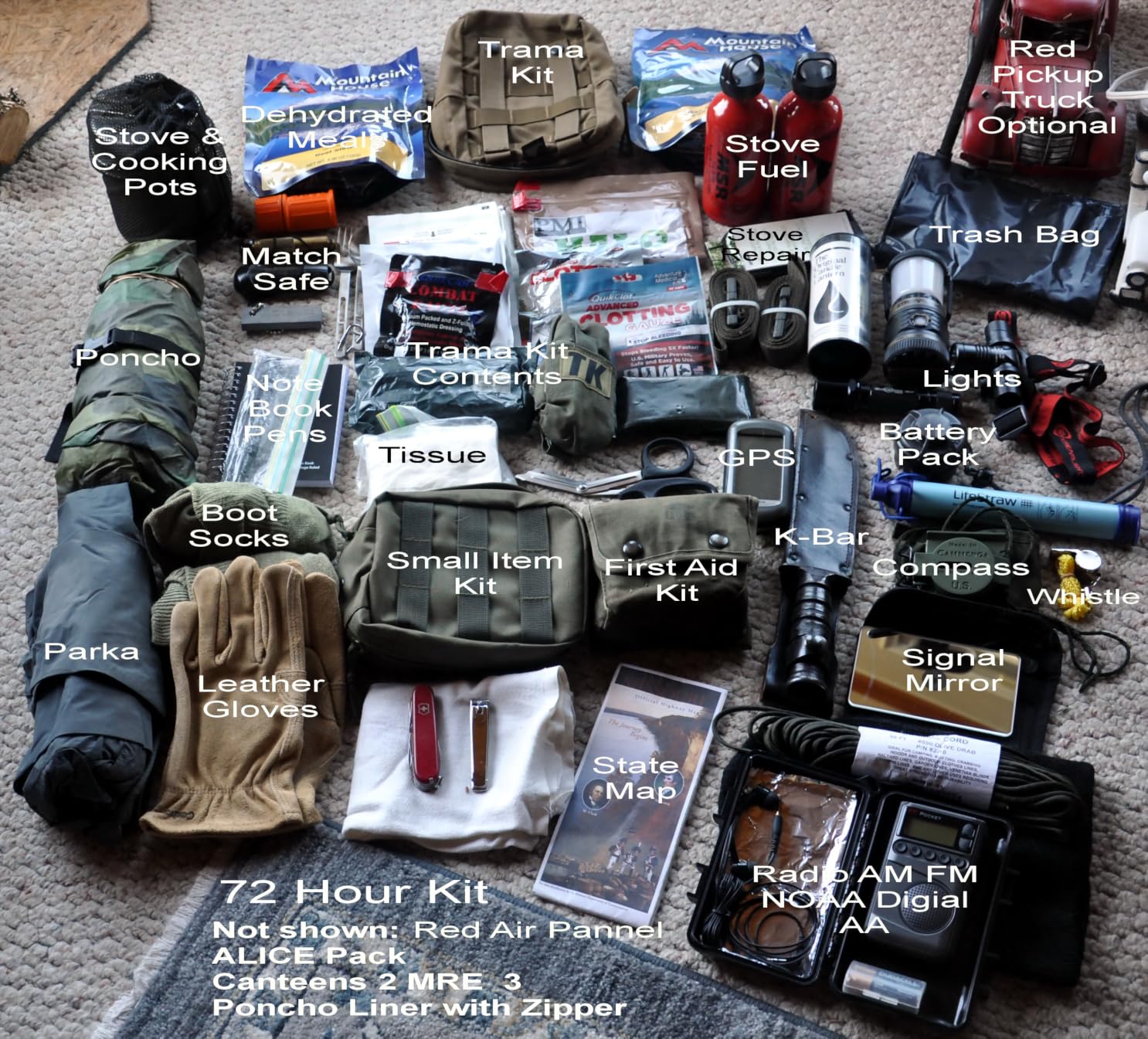
For an RV, a boat, a travel day or a bedroom, size is the deciding factor. Nothing else here goes in a shirt pocket.
Included earbuds solve the volume problem in a way a speaker cannot, since a single listener with earbuds hears far more than a sleeping household hears across a room.
Where it falls short
The 0.5 watt speaker is the quietest in the roundup by a wide margin, which is why earbuds are included rather than optional. Without them this is not a wake-you-up radio.
No SAME and no auto-scan means manual NOAA tuning, and it costs more than several radios here with far more emergency capability. It is a companion radio, not a standalone warning system.
7. ROCAM CR1009 – Best for Redundant Power Options
Emergency Radio with NOAA Weather Alert – Solar Hand Crank Portable AM/FM Shortwave Radio, Rechargeable Battery 5000mAh, USB Charger, Flashlight, SOS Alarm for Home Outdoor Hurricane Survival
- 7 pre-programmed NOAA channels
- 5 power sources including AAA backup
- 3W flashlight and 6-LED reading lamp
- IPX6 body with 12-month warranty
Pros
- Seven pre-programmed NOAA channels remove manual tuning
- Loud alarm tone for severe weather signals
- Five separate power sources
- 3W flashlight plus adjustable swivel reading lamp
- IPX6 water resistance with a 12-month warranty
- Shortwave band adds reception options
Cons
- Analog pointer display instead of an LCD
- No SAME county filtering
- Larger and heavier than the compact options
- Not waterproof
The ROCAM’s argument is power redundancy plus simplicity. It stores seven pre-programmed NOAA channels, so you pick your region from a list instead of hunting for a frequency, and it sounds a loud alarm when severe weather comes through.
It runs five ways: internal 18500mWh rechargeable cell, solar panel, hand crank, three AAA batteries and a DC wall adapter. Having AAA backup matters in practice, because disposable batteries are the one power source you can still find during a prolonged emergency.
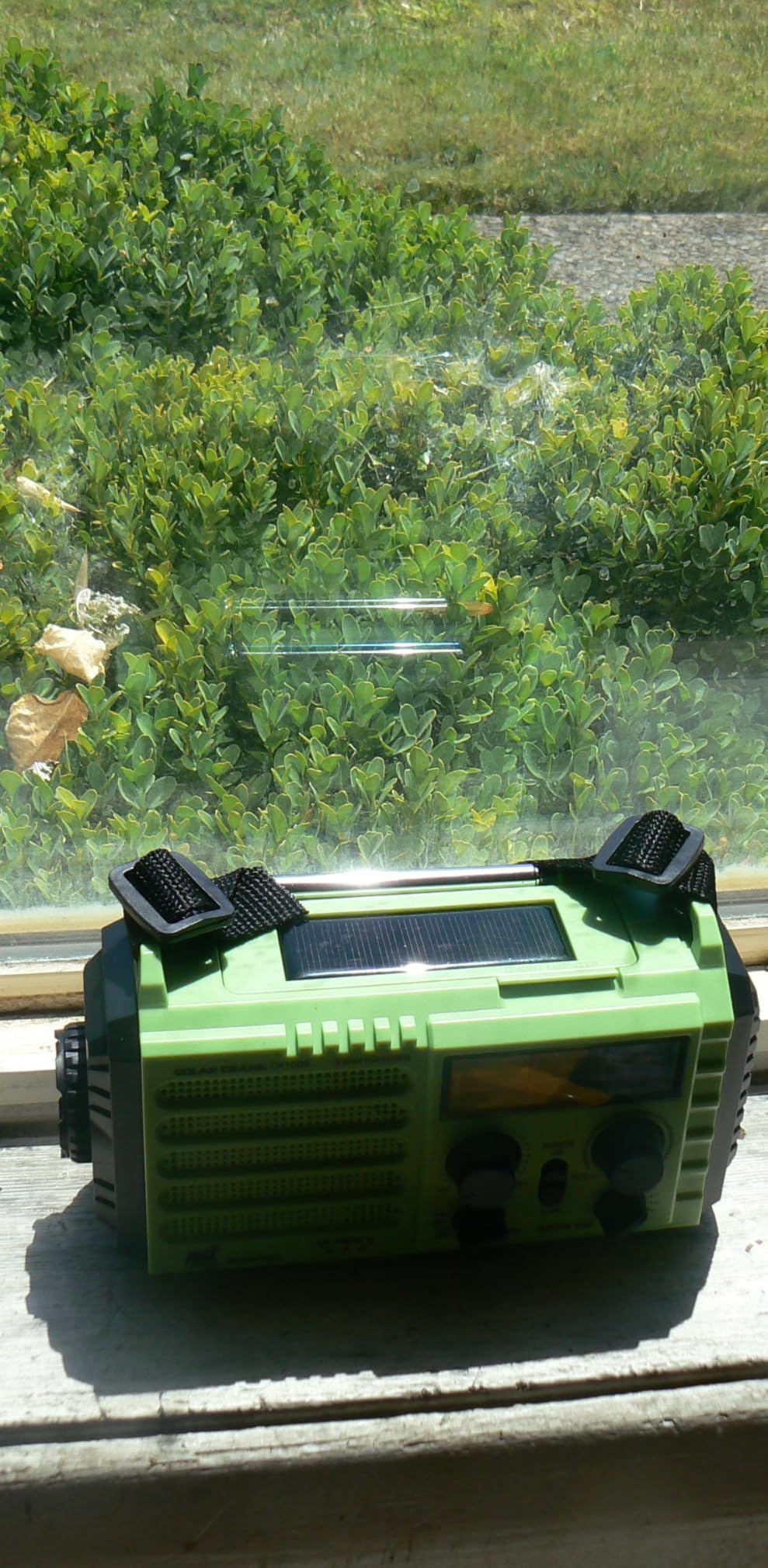
Reception covers AM, FM and shortwave through a telescopic antenna, which adds options beyond the weather band when you want to hear regional news or a distant broadcast. The rechargeable cell also charges phones and tablets.
Lighting is the other strength: a 3W flashlight plus a 6-LED reading lamp on a front-facing swivel, and an SOS button that triggers a loud alarm with a flashing red light for signalling. A 3.5mm headphone jack allows private listening.
What makes it different
Pre-set NOAA channels are the closest thing here to auto-scan without SAME, and for someone who does not want to program anything, that is a real convenience.
IPX6 splash resistance, a carry strap with a compass and a hang buckle make it a genuine outdoor radio. Seventy-one percent of reviews are five star.
Where it falls short
The analog pointer display is the trade-off for those pre-set channels. Identifying a specific station on a dial is less precise than reading a frequency on an LCD, and there is no battery level readout.
No SAME means no county filtering, and at 16 ounces with a 6.8 by 3.7 by 2.9 inch body it is one of the larger units here. It is water resistant, not waterproof.
8. Mesqool CR1030 – Best for Loudest Output and Battery Capacity
Weather Radios Portable AM FM NOAA Alert with Battery Backup 12000mAh
- 12000mAh lithium battery
- 8500mm2 monocrystalline solar panel
- 5 watt speaker output
- 3-year replacement warranty
Pros
- Highest customer rating in the roundup at 4.7
- Largest battery capacity at 12000mAh for multi-day outages
- Genuinely large solar panel and an upgraded crank
- 5 watt speaker delivers the largest stated output here
- Two-level flashlight reaching 260 feet plus a reading lamp
- 3-year replacement or refund warranty
- Large controls with a non-slip grip
Cons
- Heaviest unit in the roundup at 1.6 pounds
- No shortwave band and no SAME county filtering
- Analog display rather than an LCD readout
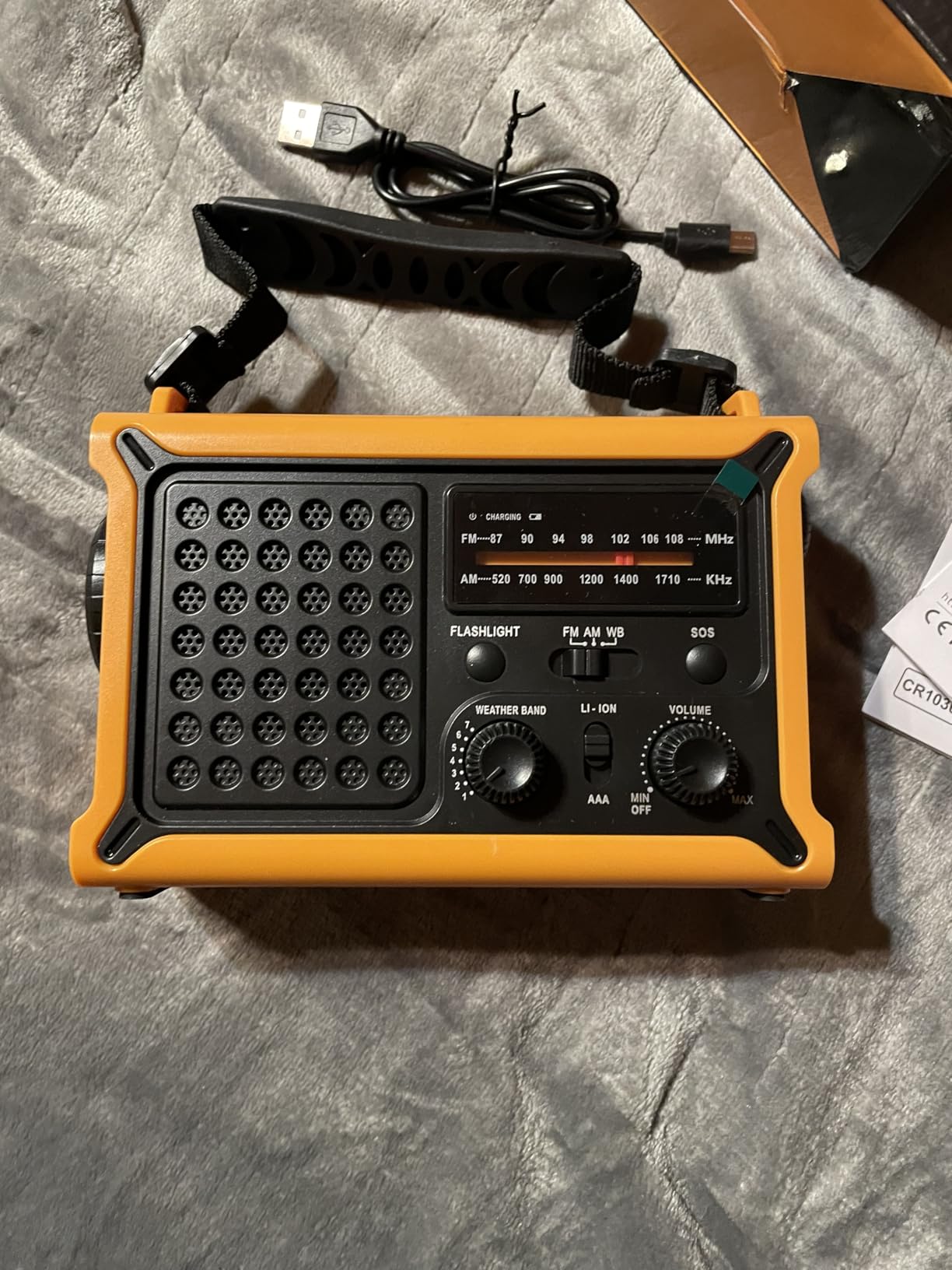
The Mesqool is the one we would buy for alert volume alone. Its 5 watt speaker is the largest stated output in this roundup, and for a household that needs a siren to carry through bedrooms and a closed door, that is the spec that decides the purchase.
It also holds the highest customer rating here at 4.7, with 85 percent of its reviews at five stars. The review base is the smallest of the group at 1164 reviews, which is worth weighing against that score.
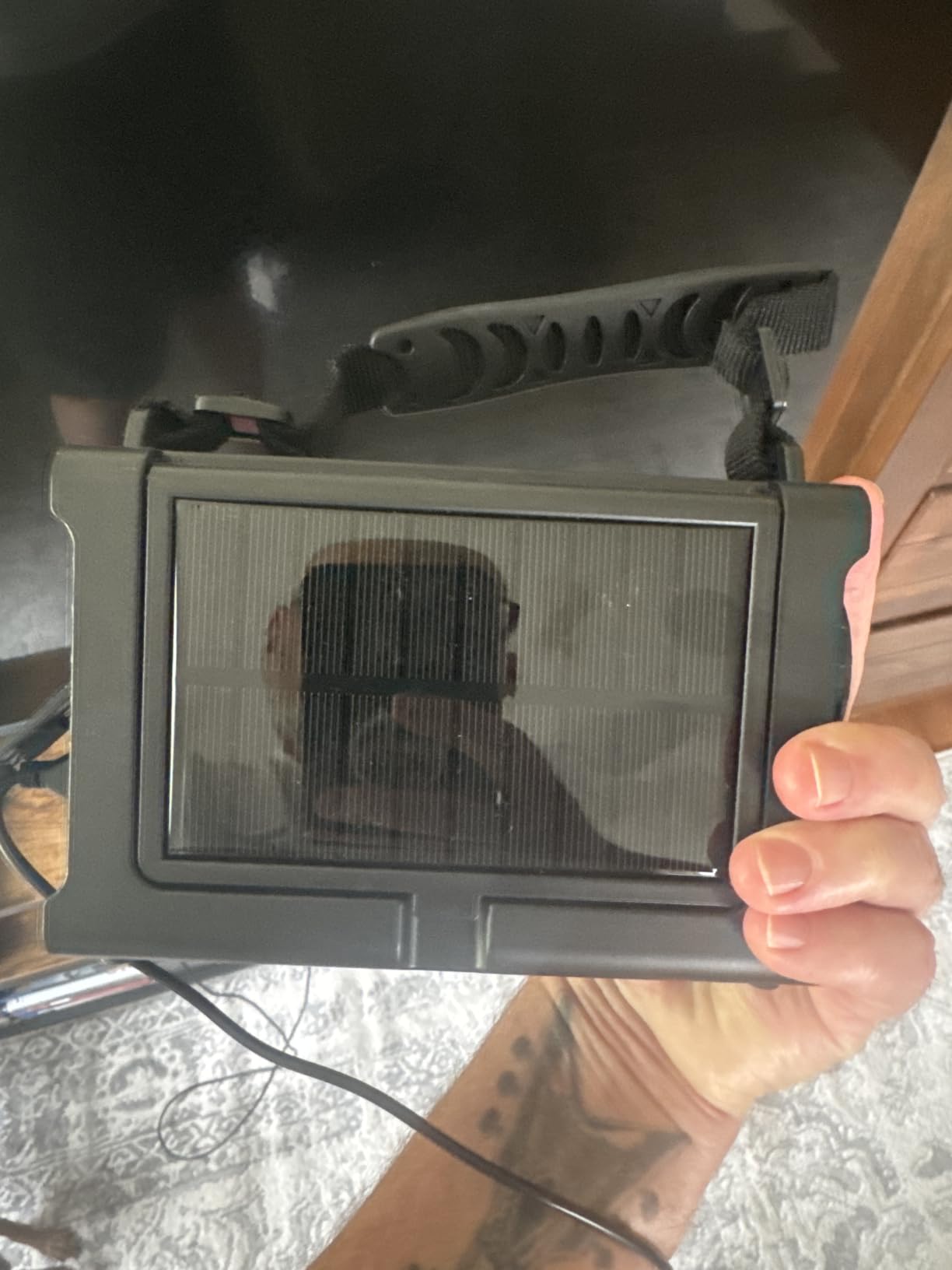
Battery capacity is the other headline: 12000mAh for multi-day radio and lighting use. The solar panel is 8500 square millimeters of monocrystalline silicon, more than four times the decorative 2000 square millimeter panels on most competitors, so it charges in low light instead of sitting there looking decorative.
The crank is upgraded too, with a larger copper coil and reinforced magnet, and reaches a usable charge in about three minutes. Power comes from five places: solar, crank, the internal cell, USB-C at 5V/2A and three AAA batteries.
Reasons to buy it
For a heavy sleeper or a deep house, the speaker and the battery are the two things that decide whether an alert actually reaches you. Both are the best in this roundup.
The warranty is the longest available here at three years of replacement or refund, and a high-sensitivity chip with noise reduction helps reception on weak signals.
Where it falls short
At 1.6 pounds it is the heaviest radio in the roundup. That is fine on a kitchen counter and a poor choice for a go-bag or a long hike.
There is no SAME programming and no shortwave, so alerts are wide-area, and the analog display means no frequency or battery-level readout. You tune and monitor it yourself.
How NOAA Weather Radio Alerts Actually Work
Understanding the chain explains most of the buying decisions above, so it is worth a minute. NOAA broadcasts are free, continuous and independent of your utility, which is why the hardware is the only cost.
A meteorologist at the National Weather Service issues a watch, warning or advisory for a specific set of counties.
The nearest NOAA Weather Radio transmitter rebroadcasts the alert immediately on its assigned frequency.
Each broadcast carries a SAME code naming the affected counties, plus a 1050 Hz attention tone before the message.
Your radio compares those county codes against the ones you programmed in, or against the whole transmitter area if it has no SAME.
If there is a match, the radio overrides whatever you were listening to, overrides your volume setting, and sounds the alarm.
That fifth step is why forum advice repeats the same line: keep your listening volume low, because an alert will still wake you. It is also why SAME matters. Without county coding, a radio in western Kansas hears alerts meant for a county 80 miles east and eventually gets ignored.
Not everything on the network is weather. NOAA Weather Radio All Hazards carries AMBER alerts, chemical spill notices, evacuation orders and civil emergency messages on the same broadcast.
How to Program Your SAME County Code in 5 Steps
Programming SAME is the step people skip, and the manual rarely helps. It takes about five minutes once you have the codes.
Find your county code from the National Weather Service SAME county list for your state. Note the six-digit code and its four-digit time zone offset, for example 036003 for a county in the Central time zone.
Plug the radio into AC power first, with fresh batteries installed if it has a backup compartment. Programming while the batteries are dead loses your settings.
Find the SAME or County menu in the setup options. On the Midland WR120B it sits behind the Menu button, which you hold to reach programming mode.
Enter the county code one digit at a time, then confirm. Add any adjacent counties you want alerts from, up to the model’s limit of 25 on the WR120B.
Test it. Press the Test button to run the full alarm cycle, then confirm the radio received your county’s weekly NOAA test broadcast on Wednesday morning between 10 a.m. and noon.
Two practical notes. Program your home county plus the one just west and the one just east, because fast-moving storms cross county lines. And save a screenshot of your codes somewhere outside the house, so a flood-damaged radio does not take your county list with it.
Where to Place Your Radio for Best Reception and Coverage
Most missed alerts are placement problems, not radio problems. Indoor attenuation from walls and metal kills weak NOAA signals long before the transmitter is at fault.
Put the radio near a window on the second story if you can. Higher floors have less roofing and framing between the radio and the transmitter, and glass blocks less signal than brick or foil-backed insulation.
Keep it away from metal appliances, and avoid inside a metal cabinet or a garage wall. If you still get static or dropouts, a window-mounted or external antenna on a north-facing wall is the single upgrade that fixes reception in a rural area.
For sound, place the unit where an alert can reach sleeping areas. A radio in a basement or a closed office is quiet for the rest of the household and silent when it matters. Test it from your bed once a month.
How to Choose a NOAA Weather Radio: 7 Things That Matter
1. SAME county programming. Only the Midland WR120B in this roundup does it. If you live near a county border or a wide transmitter area, this is the difference between a radio you keep and a radio you mute.
2. Alert volume, honestly assessed. Speaker wattage is a rough proxy, ranging from 0.5 watt on the C. Crane to 5 watts on the Mesqool in this roundup. If you are a heavy sleeper, buy the loud end and add a visual or tactile alert.
3. Power sources. AAA backup batteries are the most underrated layer, because they are the one source you can find during a long outage. Hand crank and solar are useful top-ups, but reviews across this category describe them as maintenance features rather than genuine charging.
4. Battery capacity. 2000mAh covers a phone charge and a night or two of listening. 10000 to 12000mAh covers a multi-day outage with room to spare.
5. Automatic scanning. A radio that finds alerts itself beats one you parked on a channel, because NOAA uses seven frequencies and a wide-area transmitter may not use the one you chose.
6. Form factor. Desktop units suit a bedroom or kitchen. Hand-crank units suit a go-bag or a car. Pocket units suit travel and RVs. For deaf or hard-of-hearing household members, look for models with a headphone jack plus a strobe or pillow shaker you can pair with it.
7. Warranty and daily usability. Warranties here run from one year to three, with the FosPower limited lifetime the outlier. A radio with AM and FM and an alarm clock gets used daily, and a daily-used radio is a radio whose batteries are never dead when the storm arrives.
Maintenance is simpler than most people expect. Replace the backup batteries every 6 to 12 months, and use the weekly NOAA test broadcast on Wednesday mornings between 10 a.m. and noon as your proof the unit still works.
Can You Get a NOAA Weather Radio for Free?
The broadcast is free, and the hardware is the only cost. There is no subscription and no account.
For the radio itself, check your local emergency management office and your county or state emergency management agency, which distribute NOAA radios to residents during preparedness seasons. Your local National Weather Service office can also point you at programs and giveaway events, and organizations such as the Red Cross and centers for independent living sometimes hand them out to households with deaf or hard-of-hearing members.
If buying one is not possible right now, a phone with Wireless Emergency Alerts, registered local outdoor sirens and a NOAA radio at a neighbor’s or relative’s house form a workable substitute while you wait.
Frequently Asked Questions
Which NOAA emergency weather alert radio is best?
The FosPower A1 is our top pick for most households, with a 4.6 rating across more than 37,000 reviews, three power sources and a built-in power bank. If you live near a county border and want alerts filtered to your county, the Midland WR120B is the only pick here with SAME programming.
Can I get a NOAA Weather Radio for free?
The broadcast itself is completely free and needs no subscription. Local and state emergency management agencies distribute NOAA radios to residents during preparedness seasons, your National Weather Service office can point to giveaway programs, and the Red Cross and centers for independent living sometimes provide them. Only the hardware has a cost.
What is the best radio to have during a national emergency?
A NOAA weather radio is the most dependable option because it depends on neither cell towers, internet nor wall power. Add layered alerting: keep Wireless Emergency Alerts on your phone, register for local outdoor sirens, and own a NOAA radio with battery or hand-crank backup. No single method covers every failure.
Is Midland really the best weather radio brand?
Midland is the most established name here and the only brand in this roundup offering SAME county programming, which matters near county borders. Its model range is wide, so you have to pick the right one. The WR120B suits a bedroom or kitchen, and the portable models suit a go-bag.
Do hand crank and solar charging actually work in an emergency?
They work as top-ups rather than full charging. The Mesqool crank reaches a usable charge in about three minutes, and the Leaton gets 15 to 20 minutes of listening from a minute of cranking. Most units in this roundup rely on their internal battery or AAA cells for the real work.
Do I still need a NOAA radio if I have alerts on my phone?
Yes, if you want alerting that survives the storm. Cell towers lose power early, phones run out of battery, and rural dead zones have no signal at all. NOAA transmitters run on backup power and keep broadcasting, which makes the radio the one layer that works independently.
Which NOAA Weather Radio Should You Buy?
Buy the FosPower A1 if you want one radio that covers three power sources, a phone charger and a proven record across more than 37,000 reviews. Buy the Midland WR120B instead if your problem is alerts for counties that are not yours, because SAME programming is not optional for some households.
Below that, the Raynic for automatic scanning, the Mesqool for raw volume and capacity, the Leaton for outdoor endurance, the ROCAM for redundant power, the RunningSnail on a budget and the C. Crane for travel.
Whichever you choose, set it up this week. Program your county, place it where an alert can reach your bedrooms, replace the backup batteries on a schedule and listen for the weekly NOAA test on Wednesday morning. The best NOAA weather radios for storm alerts are the ones already programmed when the sky changes color.