
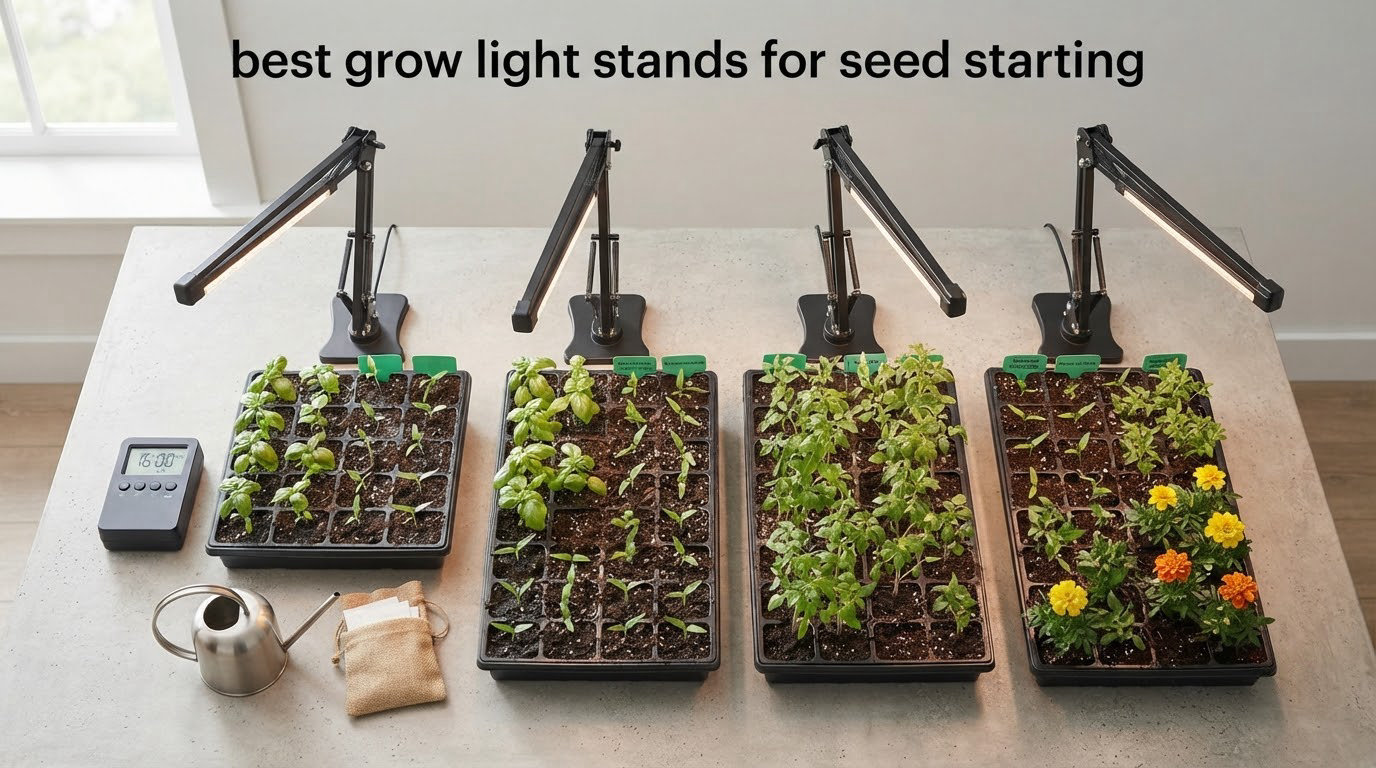
A grow light stand is a freestanding frame that holds a full-spectrum light at an adjustable height above your seed trays, so seedlings get consistent light every day no matter what the weather does outside. Our best overall pick is the LBW Grow Light with Stand, the best value is the GHodec Four-Head Gooseneck Lamp, and the best option for large seed batches is the Bstrip eight-light plant shelf. Updated for 2026, we compared all ten stands in this guide on light output, height range, tray footprint, timer functions and the complaints buyers actually report.
Most seed-starting problems are light problems. A windowsill gives you a short, weak, constantly changing light, and seedlings respond by stretching thin and pale. A stand fixes that by putting a predictable fixture at a repeatable distance above the tray, raised on a schedule as the seedlings grow.
There is one more thing that trips up first-time growers, and it comes up constantly in seed-starting forums: a bright light is not the same as a correctly positioned light. Lumens measure brightness at the source, not at the leaf. How high the fixture sits matters more than how many lumens the box claims, which is why every stand below gets judged on height range as much as brightness.
Table of Contents
- Top 3 Best Grow Light Stands for Seed Starting (October 2026)
- All 10 Grow Light Stands Compared Side by Side in 2026
- 1. LBW Grow Light with Stand – Best Overall for Seed Starting
- 2. GHodec Four-Head Gooseneck Lamp – Best Value Grow Light Stand
- 3. GHodec 60 LED Floor Plant Light – Budget Pick for Seed Starting
- 4. Yiyehu Three-Head Telescoping Grow Light – Best for Taller Seedlings
- 5. FOXGARDEN Grow Light Stand – Best for Countertop Seed Trays
- 6. Bstrip 8-Light Plant Shelf – Best for Large Seed Batches
- 7. Wolezek 2-Foot T5 Grow Light – Best Lightweight T5 Bar
- 8. Spider Farmer 4-Tier Plant Stand – Best Enclosed Seedling Setup
- 9. JCBritw 2-Foot T8 Bar – Best for Soft White Light in Living Spaces
- 10. Barrina CX3 Four-Tier Stand – Best for Tool-Free Assembly
- How to Choose a Grow Light Stand for Seed Starting
- 1. Match the light footprint to the number of trays
- 2. Check the height range, not just the brightness
- 3. Prefer dimming or a long timer range over raw output
- 4. Decide whether you need a timer or a memory function
- 5. Weigh stability seriously in a shared household
- 6. Buy for two tiers of use, not one
- 7. Check water resistance where you are watering
- 8. Look for a spectrum that suits the room
- Seedling Light Settings: Photoperiod, Height and Intensity
- How to Fix Leggy Seedlings: Four Checks in Order
- T5 and T8 Fluorescent Bars vs LED Bars: Which Format to Buy
- Do You Still Need a Heat Mat Under an LED Grow Light Stand?
- What to Do After Your Seedlings Sprout
- Frequently Asked Questions
- The Verdict on the Best Grow Light Stands for Seed Starting
Top 3 Best Grow Light Stands for Seed Starting (October 2026)

LBW Grow Light with Stand
- Adjustable tripod 15-48 inches
- Full spectrum 390nm-730nm
- 30W LED
- 48 light sources
GHodec Gooseneck LED Lamp
- Four gooseneck heads
- Auto timer 4/8/12H
- 5-level brightness
- 5500K spectrum

Bstrip 8-Light Plant Shelf
- Eight 24W full spectrum bars
- Configurable to six tiers
- 270 pound capacity
- Lockable casters
As an Amazon Associate we earn from qualifying purchases. CERTAIN CONTENT THAT APPEARS ON THIS SITE COMES FROM AMAZON. THIS CONTENT IS PROVIDED 'AS IS' AND IS SUBJECT TO CHANGE OR REMOVAL AT ANY TIME.
We also lean heavily on what buyers say after a season of use, since most of the differences between these stands show up as complaints about tippiness, timer drift and uneven coverage at the tray edges rather than in the spec sheet.
All 10 Grow Light Stands Compared Side by Side in 2026
| Product | Specifications | Action |
|---|---|---|
|
LBW Grow Light with Stand
|
|
Check Latest Price |
|
GHodec Four-Head Gooseneck Lamp
|
|
Check Latest Price |
 GHodec 60 LED Floor Plant Light
|
|
Check Latest Price |
 Yiyehu Three-Head Telescoping Grow Light
|
|
Check Latest Price |
 FOXGARDEN Grow Light Stand
|
|
Check Latest Price |
|
Bstrip 8-Light Plant Shelf
|
|
Check Latest Price |
 Wolezek 2-Foot T5 Grow Light
|
|
Check Latest Price |
 Spider Farmer 4-Tier Plant Stand
|
|
Check Latest Price |
 JCBritw 2-Foot T8 Bar
|
|
Check Latest Price |
 Barrina CX3 Four-Tier Stand
|
|
Check Latest Price |
We earn from qualifying purchases. CERTAIN CONTENT THAT APPEARS ON THIS SITE COMES FROM AMAZON. THIS CONTENT IS PROVIDED 'AS IS' AND IS SUBJECT TO CHANGE OR REMOVAL AT ANY TIME.
1. LBW Grow Light with Stand – Best Overall for Seed Starting
LBW Grow Light with Stand, Full Spectrum Grow Lights for Indoor Plants
- 30W full spectrum LED
- Adjustable tripod 15-48 inches
- Aluminum body, floor mount
Pros
- One-minute tool-free assembly
- Adjustable height plus gooseneck angle
- Runs cool enough to leave on unattended
- Strongest review volume in this roundup
Cons
- Top-heavy tripod tips if bumped
- LED panel is not replaceable
- Some units arrive missing hardware
The LBW is the stand we keep coming back to because it does the two things a seed tray needs most, and it does them without fussy setup. The tripod telescopes from 15 to 48 inches, and the head sits on a gooseneck so you can aim the panel down into a tray rather than across the room. Assembly is genuinely a one-minute job: screw the legs together, attach the neck, done.
Output is full spectrum from 390nm to 730nm, which combines 3500K and 6500K white with red and blue. That mix covers germination through flowering, so a single fixture can follow a tomato seedling all the way to transplant size without a swap. At 30W, buyers commonly report healthy pepper and monstera growth, and it runs cool enough to leave on through the day without cooking the tray beneath it.
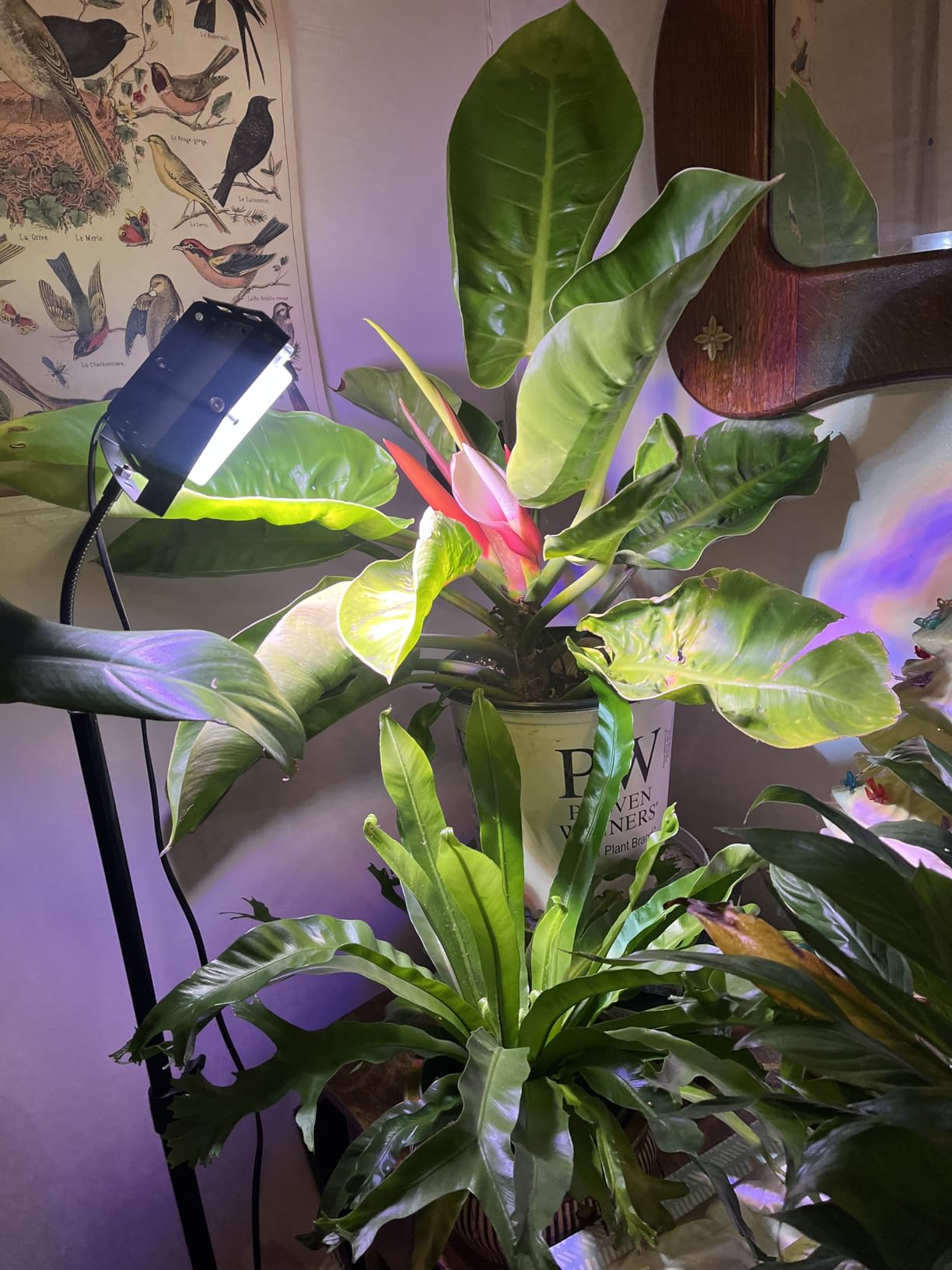
What sold us is the range. Starting at 15 inches is low enough to fill a 72-cell tray with even light, and 48 inches is high enough that the same stand handles a leggy tomato or a potted plant that has outgrown the seed stage. That single range removes the most common beginner error, which is buying a short lamp and then having nothing to hang it from when seedlings stretch.
Buyer photos from seed-starting setups show the panel sitting comfortably over a tray without crowding it, which is the geometry you want. The frame is aluminum with a powder-coated finish, and the manufacturer lists a one-year warranty.
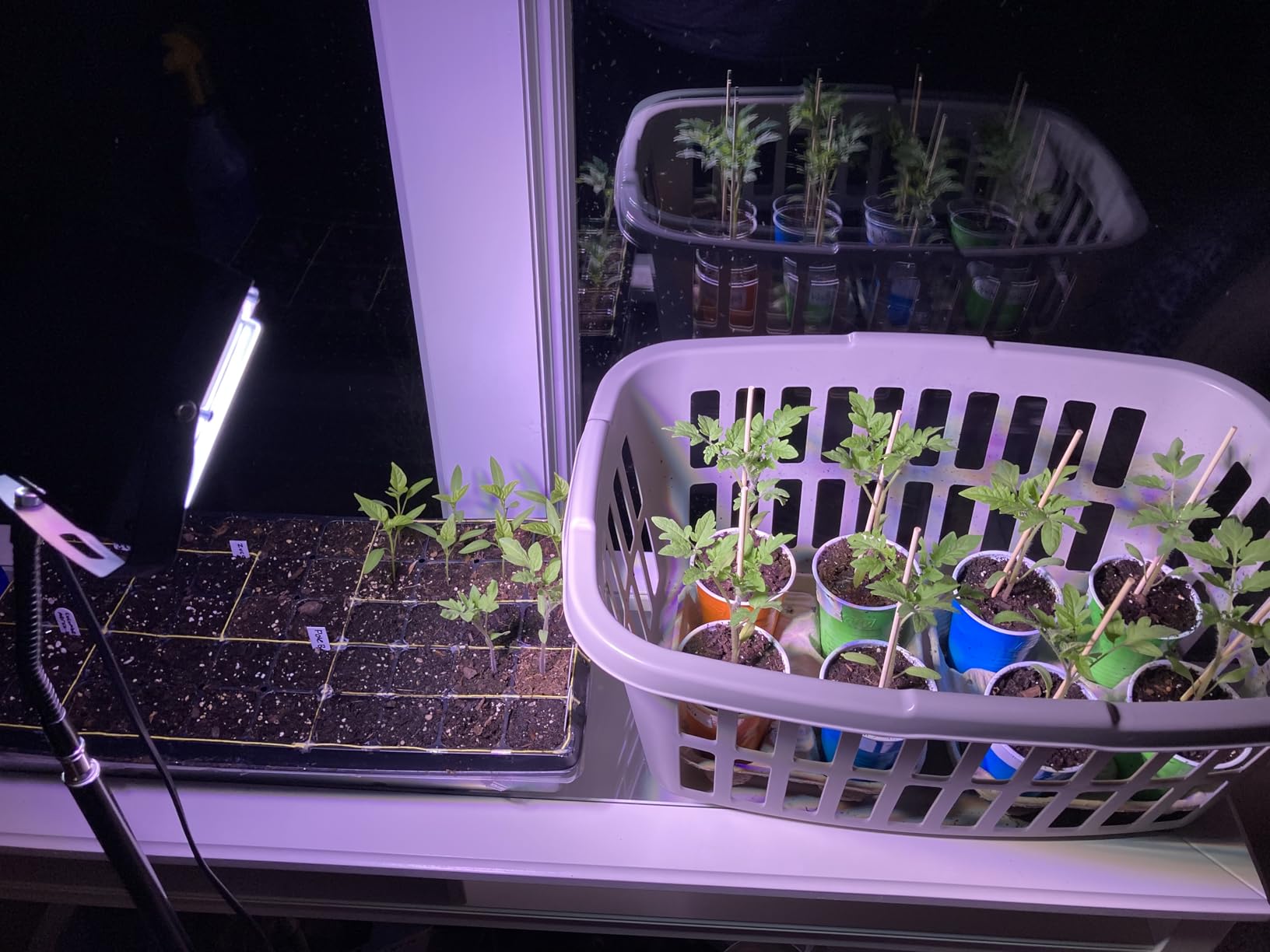
What a full season of seedling use looks like
In a typical tomato or pepper run, you set the tripod low at germination, raise it a few inches as cotyledons appear, and keep raising it until the light is roughly a foot above the canopy at transplant size. Because the gooseneck tilts independently of the stand, you can angle the panel to keep light on the tray even when the stand sits slightly to one side.
The 30W draw also means running this sixteen hours a day is a minor electricity cost, and the stated 50,000-hour LED bead lifespan means you are unlikely to replace the panel during a typical seed-starting career.
Where the LBW falls short
Stability is the recurring complaint. The tripod is top-heavy with the head on top, and reviewers report it tipping over when bumped, which matters in a household with a cat or a small child and a tray of seedlings on the floor. Put it in a corner or against a wall rather than in a walkway.
The other real limitation is that the LED panel is not replaceable, and some buyers report it dimming after roughly 1,500 running hours of daily use. If you plan to keep the same stand on a rolling cart for a decade, that matters. For a seasonal seed tray, it rarely does.
2. GHodec Four-Head Gooseneck Lamp – Best Value Grow Light Stand
GHodec Grow Light Free Standing, 5500K Full Spectrum Gooseneck LED Lamp
- 5500K full spectrum
- Adjustable tripod 15-48 inches
- Auto timer 4/8/12H, 5-level brightness
Pros
- Goosenecks aim in multiple directions
- True white 5500K rather than purple-blue
- Built-in timer and brightness control
- USB powered with included adapter
Cons
- Cable and connector failures after about a year
- Cannot be used with an external timer
- Timer cycle options are confusing at first
Four independent gooseneck arms on a single 15 to 48 inch tripod is the setup we like most for spreading light across more than one tray. Instead of one panel trying to cover a wide area and falling off at the edges, you aim each head at a specific cell block. Buyers consistently cite the positioning flexibility as the reason this lamp works well for mixed seedings on one bench.
The spectrum is 5500K daylight with red LEDs on each strip, which reads as clean white light rather than the purple glow many budget grow lights produce. That matters more than most buyers expect if the stand lives in a kitchen or living room rather than a garage. It is also a genuinely useful light for a home office desk plant between seed cycles.
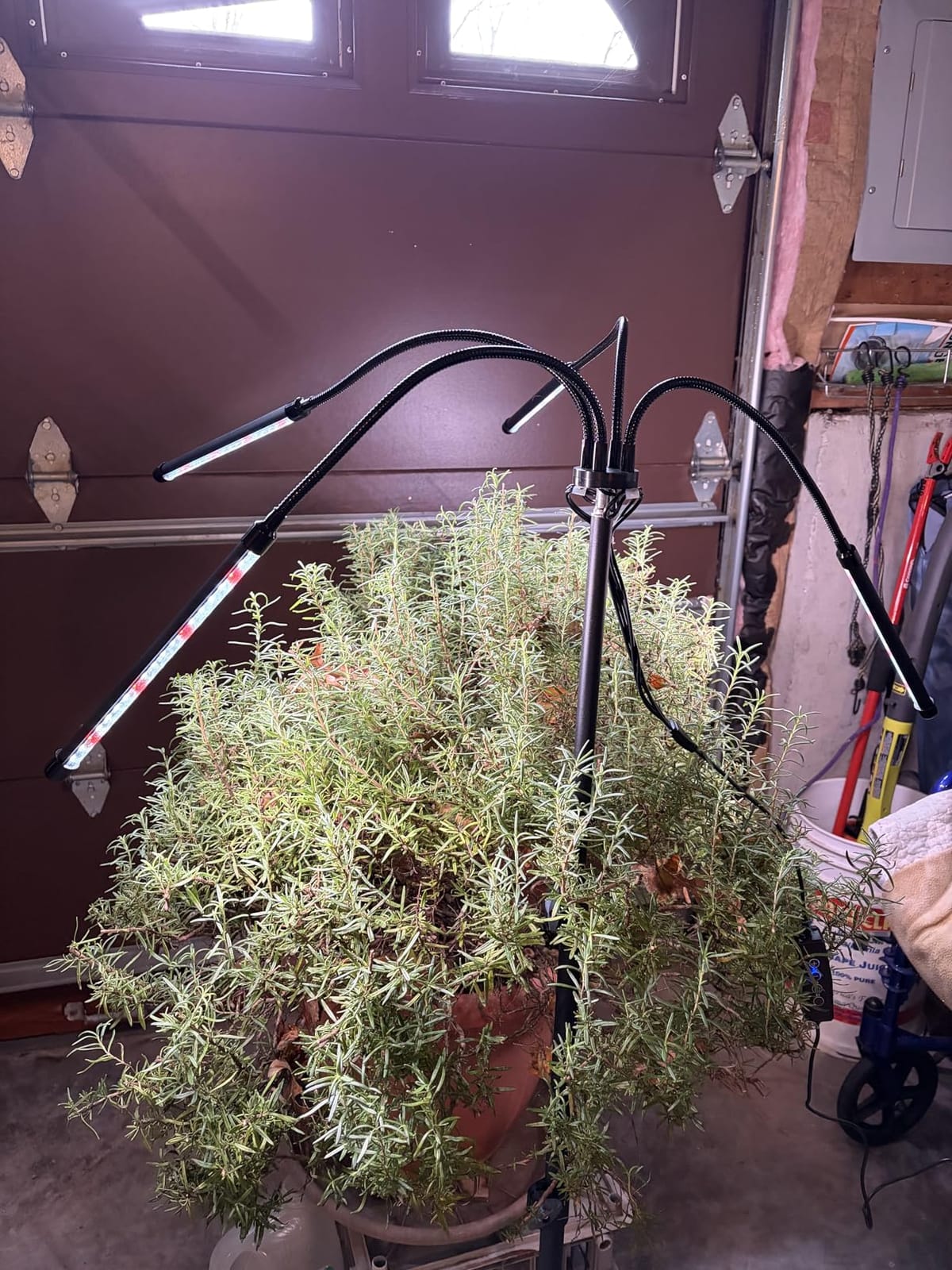
The controls are unusually good for the money. A built-in auto timer offers 4, 8 and 12 hour cycles, and there are five brightness levels, which together let you run a gentler output for freshly emerged seedlings and full output once they have true leaves. USB power with an included adapter also means one wall outlet can serve the whole rig if your adapter takes a hub.
That said, choose the twelve-hour timer setting rather than the four or eight. The shorter cycles exist for photoperiod-sensitive plants, not for seedlings, and a seed-starting day should be closer to sixteen hours. A plug-in external timer is the better route, but this lamp’s built-in timer takes control of the cycle, so plan around it.
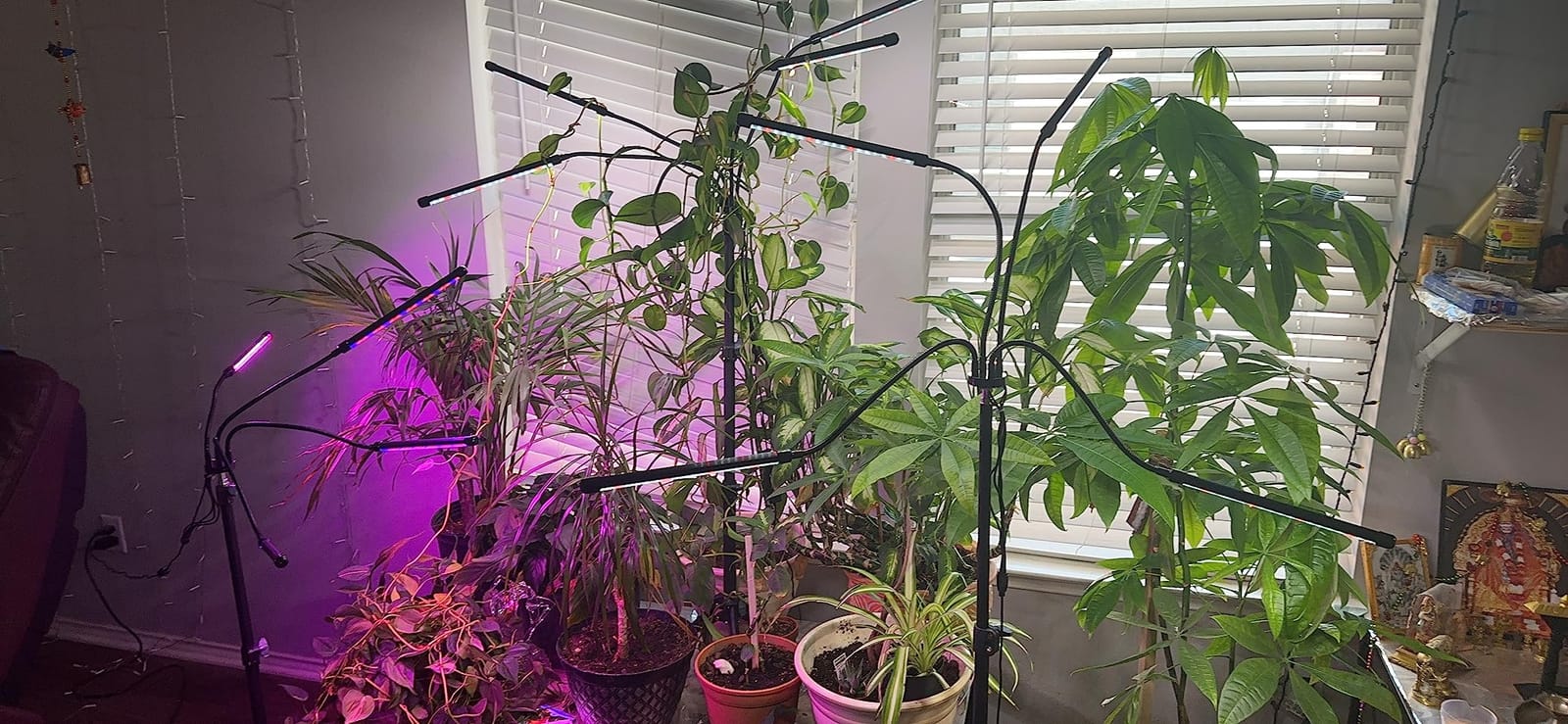
Why the gooseneck heads matter for tray coverage
A single head over a standard tray produces a bright center and dimmer corners, and those corners are where leggy seedlings show up first. Four heads let you split the coverage deliberately, angling two over a 72-cell tray and two over a second tray or a group of pots.
Each strip carries 16 white plus 4 red LEDs, and the steel and aluminum bracket is designed to dissipate heat quickly, so you can run it long without a heat mat underneath. The stand is also USB powered, which keeps the wiring tidy on a shared bench.
Where the GHodec four-head falls short
Durability is the honest weakness. Reviewers report cable and connector failures that cause flickering or the light cutting out after about a year, and the 4.2 average across more than 5,700 reviews reflects that. Some also describe the build as matching the low price point, which is fair.
It is also not water resistant, so it belongs on an indoor bench away from splash zone. For a basement seed shelf with a heat mat and a watering can in reach, that is a real consideration over multiple seasons.
3. GHodec 60 LED Floor Plant Light – Budget Pick for Seed Starting
Grow Light with Stand, 60 LED Floor Plant Light for Indoor Plants Growing
- 60 LEDs across three heads
- Adjustable tripod 15-48 inches
- Three selectable spectrums
Pros
- Long service life reported after years of use
- Adjustable in height and direction
- Runs cool under constant use
- No clamping hardware needed to assemble
Cons
- Top-heavy stand tips over easily
- Timer drifts outside the set schedule
- Not bright beyond about a foot from the plant
This is a low-cost way to get dedicated light onto a seed tray, and the 4.4 rating across 1,775 reviews suggests the low cost is not matched by low satisfaction. The three heads each carry 16 white and 4 red LEDs at 5500K, and you can run the spectrums separately or together, so you can dial back the red contribution for young seedlings that look washed out under full output.
Several owners report six years of continuous use from the same unit, which is a better long-run record than many higher-rated stands on this list. The tripod extends from 15 to 48 inches, giving you the same low start height for germination and room to raise the light as a tomato stretches.
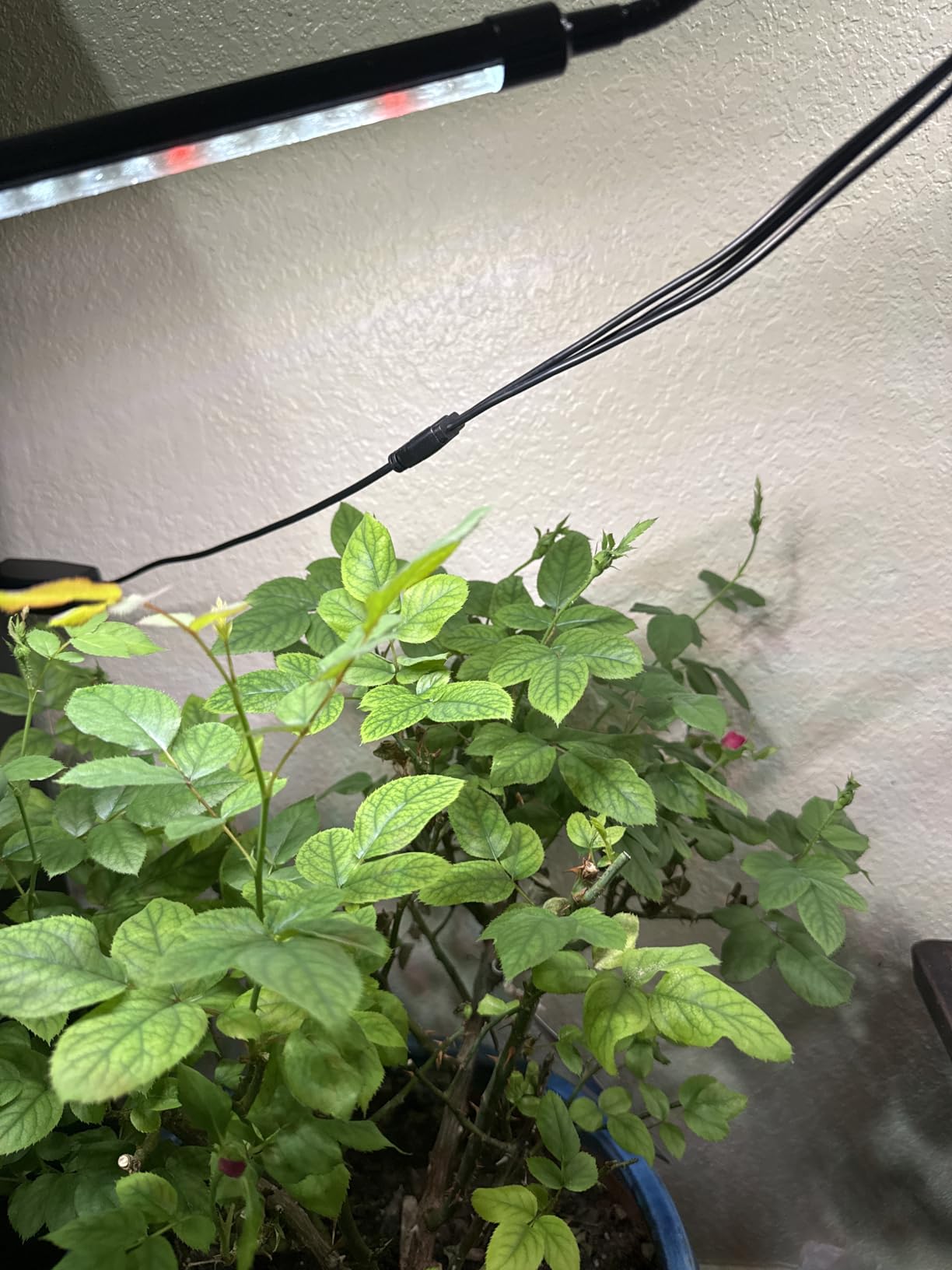
Assembly needs no clamping hardware, and the whole thing runs cool enough to sit directly above a tray without adding a heat mat. The listed dimensions are 4.8 inches deep by 3.62 inches wide by 16.57 inches high, and the manufacturer lists a 12-month warranty.
The bare bulb base and simple push-button controls make this the least refined of the group aesthetically, but for a garage or basement bench it disappears into the background, which is exactly what you want from a light you run sixteen hours a day.
A cheap way to cover several small trays
Because the three heads pivot independently, the practical pattern is one head per small tray rather than three heads over one. Three six-cell or twelve-cell trays spaced across a table, each with a head over it, gives you far more even coverage than one head trying to span all three.
Buyers also like that it stays cool during long run times, which removes one of the arguments for adding a separate heat mat under an LED setup. The light runs cool enough that soil temperature is governed by your mat or ambient room heat rather than by the fixture.
Where the 60 LED floor lamp falls short
Two problems show up repeatedly. The stand is top-heavy and tips over with a light bump, the same issue as the LBW and a caution if you have pets. More importantly, the built-in timer drifts, so the light can switch on outside the schedule you set, and a drifted timer in a basement at night is exactly the kind of thing that erodes trust in an otherwise decent lamp.
Output also falls off quickly past about a foot, so you cannot simply raise the light for a taller plant and assume the plant still gets enough. This is a lamp for a tray at close range, not for a full-grown potted plant.
4. Yiyehu Three-Head Telescoping Grow Light – Best for Taller Seedlings
Full Spectrum Grow Lights for Indoor Plants 15-62 Inches Height Adjustable Aluminum Alloy Plant Growing Lamps with Detachable Tripod Stand, Auto On/Off Timer (Full Spectrum, Three Heads)
- Height range 15-62 inches
- Auto timer 8/12/16H
- Detachable tripod with pot spike
Pros
- Telescoping range covers seedlings to mature plants
- Very easy to assemble and set the timer
- Aluminum body feels solid
- Detachable tripod spikes into a pot
Cons
- Light tripod base is easy to tip
- Stand leans when fully extended
- Individual heads dim for larger plants
The Yiyehu solves a specific problem: a 48 inch stand is not always tall enough. This one telescopes from 15 to 62 inches, which means one fixture can follow seedlings all the way from germination to a tall, leggy tomato that needs the lamp raised rather than replaced. That extra 14 inches of headroom is the reason it earns a place on this list.
The timer is also better specified for seed starting than most competitors. It offers 8, 12 and 16 hour modes with cycle memory, so the 16-hour setting is right there as a default rather than something you have to approximate with a mechanical timer. Full spectrum runs 380nm to 800nm, described as sun-like, across three 360-degree rotating heads.
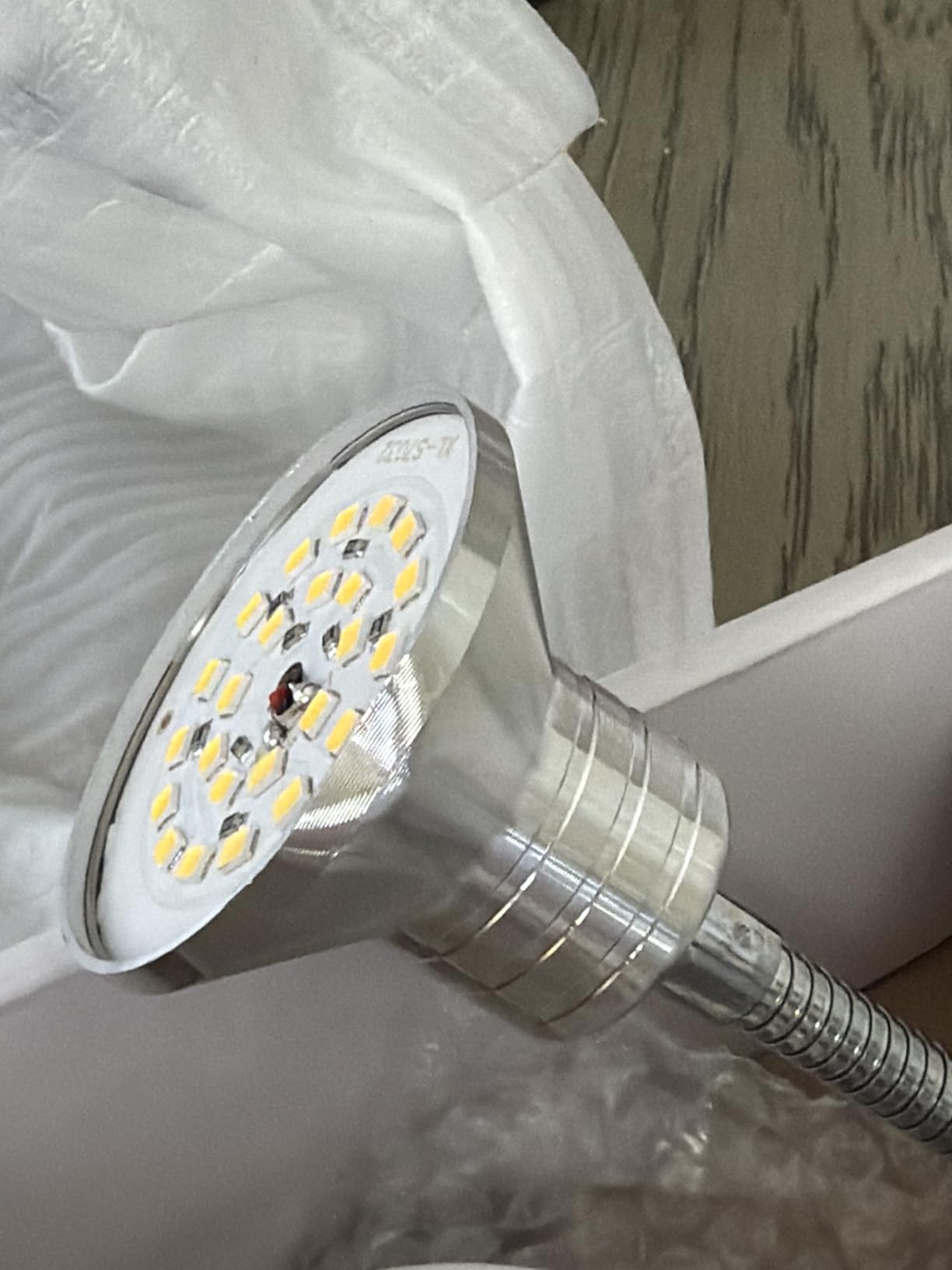
Buyers rate the brightness highly for the money and like the modern die-cast aluminum finish, which matters if this lives anywhere other than a garage. The detachable tripod is genuinely clever: it unscrews from the tall stand and spikes directly into a plant pot, so a single purchase covers both a seed bench and a windowsill herb.
A two-year manufacturer warranty is longer than most in this category, and the unit is listed as a table-mount configuration at 5 inches by 2 inches by 5 inches for the head assembly.
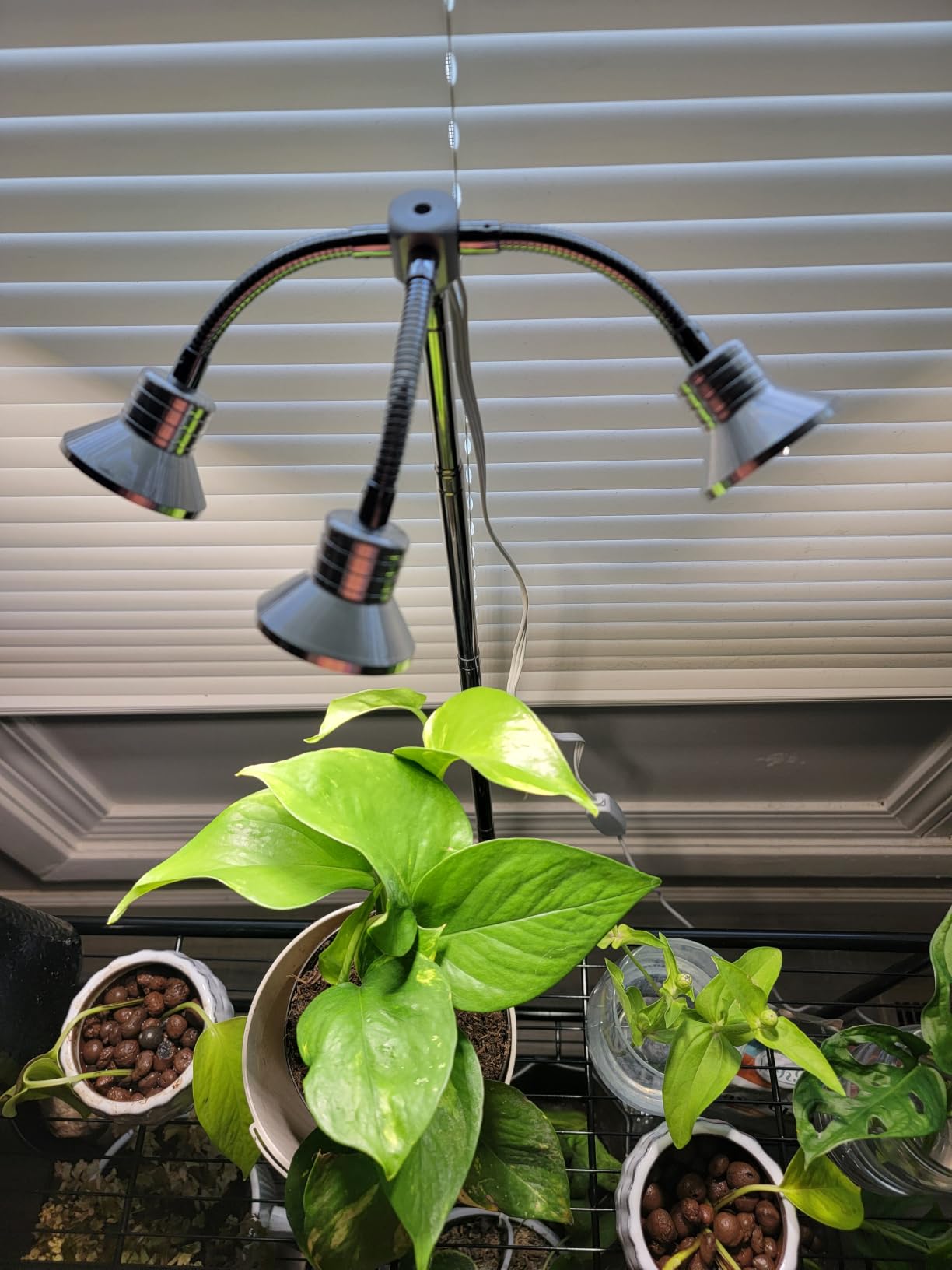
The 15 to 62 inch range and what it solves
Leggy seedlings are usually a light-distance problem, and a stand that cannot go high enough forces you into a bad choice: dim the lamp, or leave it too close and risk leaf bleaching. A 62 inch maximum lets you keep full output and simply raise the fixture as the plant grows, which is the correct fix for the stretching problem.
The 16-hour timer mode also removes a common mistake. Beginners frequently pick a 12-hour cycle because it seems gentler, and end up with short, stocky, under-lit seedlings. Having 16 as a selectable mode keeps the standard seedling photoperiod one button away.
Where the Yiyehu telescoping lamp falls short
The tripod base is light, which is the source of most complaints, and reviewers note the stand leans once fully extended. At 62 inches with three heads on top, the moment arm is long, so we would not use this over a walkway or anywhere a pet could catch it.
Per-head output is also modest. Once plants get large, all three heads need to be aimed at the same spot to produce acceptable intensity, which defeats the multi-head coverage advantage. Treat it as a seedling and young-plant lamp rather than a vegetative-stage workhorse.
5. FOXGARDEN Grow Light Stand – Best for Countertop Seed Trays
FOXGARDEN Grow Light Stand, Advanced LED Plant Growth Lighting with 4/8/12H Timer, 6 Dimming Options, and Adjustable Height – Optimal for Indoor Plants in Seedlings, Vegetative, and Flowering Phases
- 108 LED beads across three spectrums
- 6 dimming levels 10-100%
- Height 11.02-21.65 inches
Pros
- Stable base that does not tip
- Fits over tabletop mini greenhouses and small trays
- Timer plus six dimming levels
- White finish blends into a room
Cons
- Maximum height too short for taller plants
- Plug runs hot on the highest setting
- Audible high-pitched noise at low dimming
The FOXGARDEN is the one stand on this list we would actually put on a kitchen counter. The base is a solid metal disc with a sponge pad underneath, so it will not tip, and it will not mark a tabletop. A single 23.8 inch bar sits over a small seed tray or a tabletop mini greenhouse, which is exactly the footprint most apartment growers need.
Light control is the real strength. There are 108 beads split across 60 cold white, 32 warm white and 16 red, a built-in timer with 4, 8 and 12 hour settings, and six dimming levels from 10 to 100 percent. Dimming to 30 or 40 percent for the first week after emergence is the easiest way to prevent pale, stretched seedlings without moving anything.
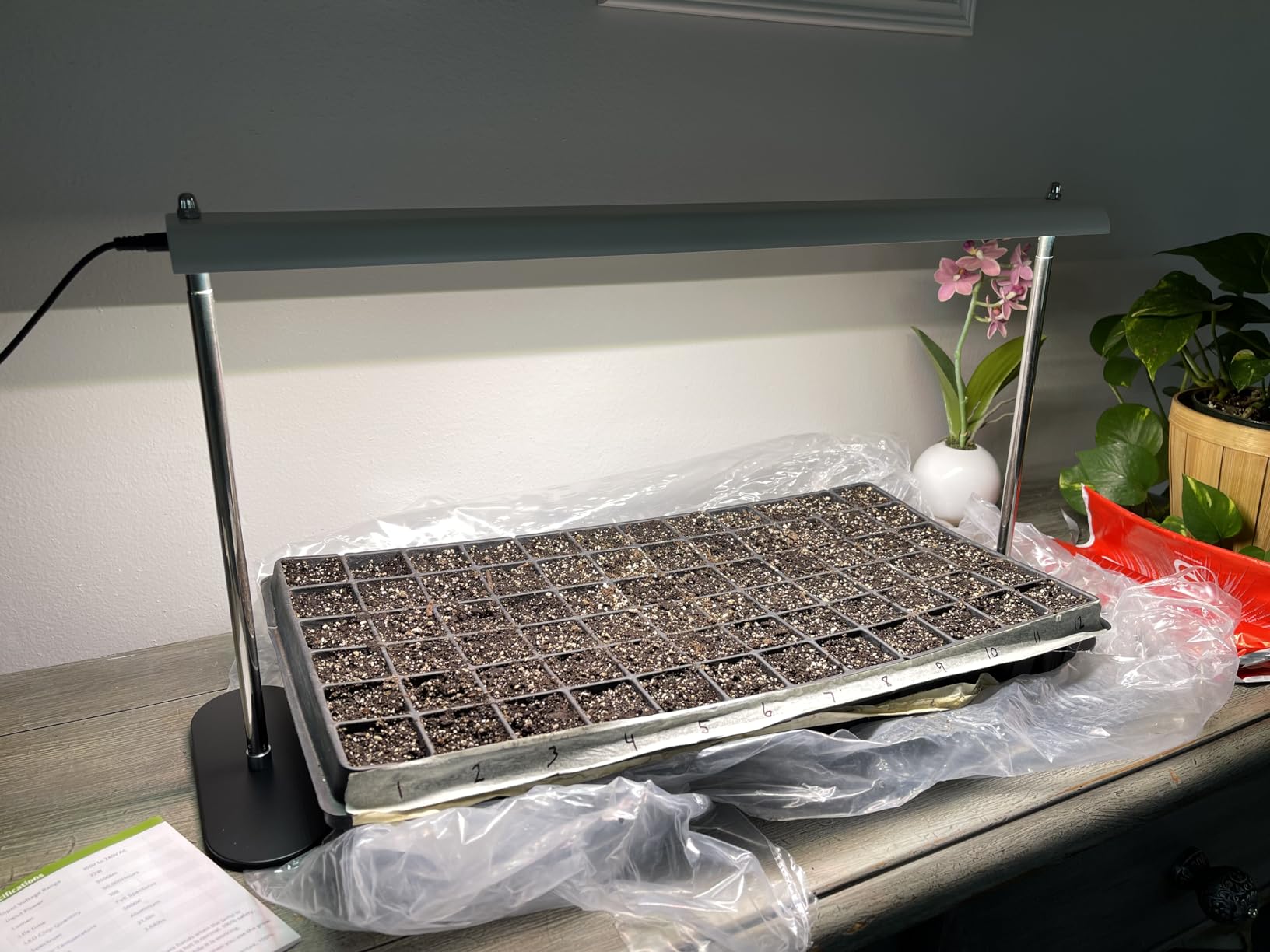
Buyers report successfully overwintering herbs and even Venus flytraps under it, which is a good sign the output is sufficient beyond the seedling stage. The reflector is designed to widen coverage and conserve energy, and the telescoping rod raises the bar as plants grow. A wrench is included in the box along with the base and adapter.
The telescoping range runs from 11.02 to 21.65 inches, which is short, but for a countertop tray under a 72-cell layout that is a workable span that keeps the bar close where it needs to be.
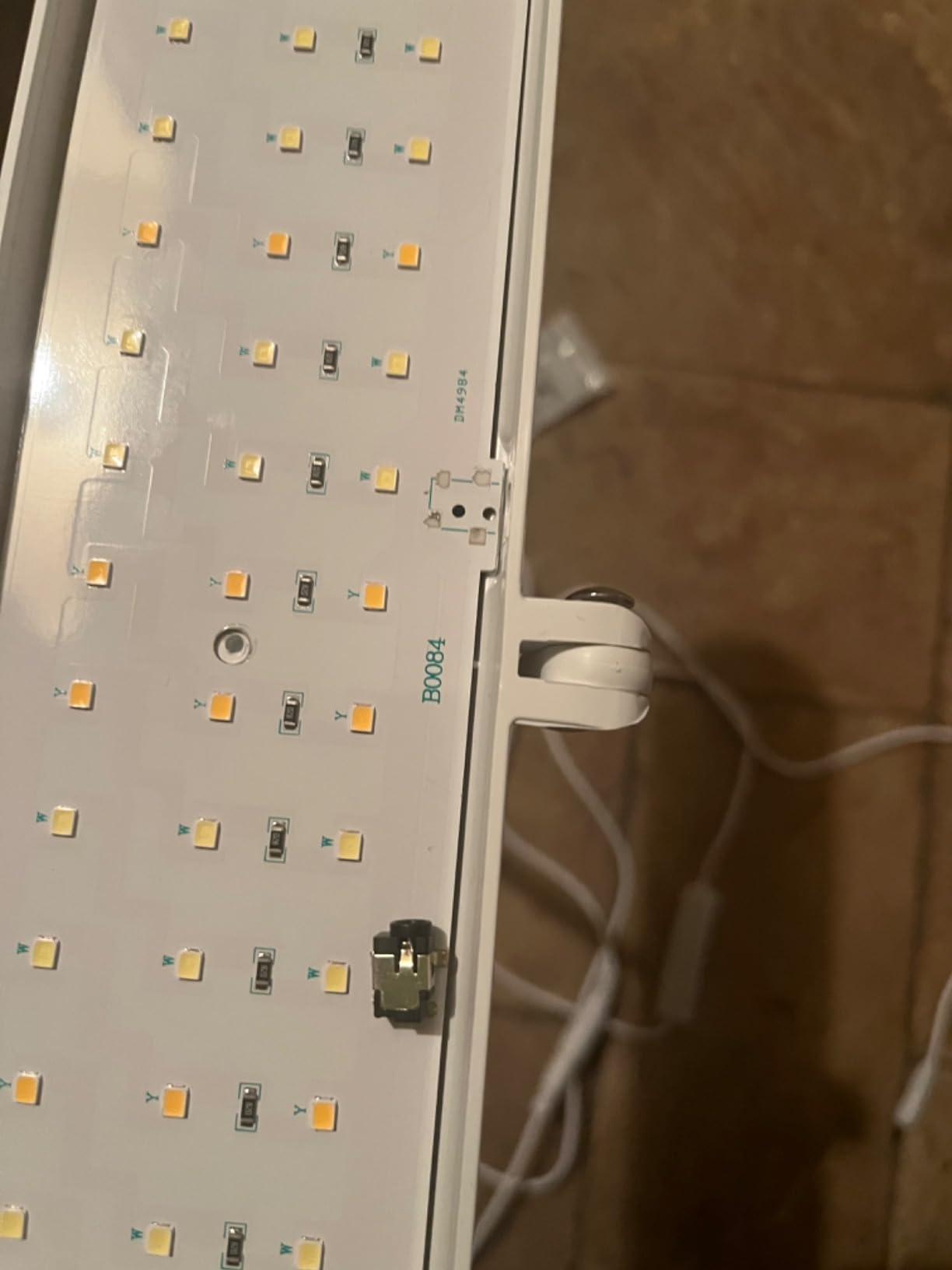
Dimmable light and a base that does not tip
The combination of a weighted base and dimming is what separates this from the tripod lamps. Tripods tip because all the mass is above the feet, and a disc base fixes that. Dimmability solves the opposite problem, letting you soften light without physically moving the fixture, which is useful during the tender week after germination when seedlings are most likely to bleach.
Owners also like the white finish. Most budget grow lights are black, and a black bar on a white counter looks like lab equipment. The twelve-month warranty with a 90-day return window is a reasonable baseline for the category.
Where the FOXGARDEN bar falls short
Twenty-one and a half inches is the hard ceiling. Once a tomato seedling reaches that height, you are out of adjustment and the only options are to move the whole unit or accept leaf bleaching at the top of the canopy. If your season includes more than one tray and you want plants to reach transplant size, budget for a taller stand instead.
Two smaller complaints come up repeatedly: the plug runs hot on the highest dimming setting, and the unit emits a high-pitched fan-like noise at the lowest dimming levels. If you plan to run this in a bedroom or a quiet home office, test it at low output first.
6. Bstrip 8-Light Plant Shelf – Best for Large Seed Batches
Bstrip DIY Plant Shelf with Grow Light, Adjustable, 29.5×13.8×70.9in
- Eight 24W bars, 192W total
- 206.5 micromol at 8 inches
- Six tiers or two three-tier units
Pros
- Sturdy hobby-grade poles and hardware
- Configurable as one tower or two units
- Lockable casters for repositioning
- Holds large quantities of seed trays and flats
Cons
- Hanging chains are awkward to reposition
- PP mats have no lip to catch runoff
- Bulb protective film is undocumented
The Bstrip is the only stand here that is a real production unit, and at 4.6 stars across 489 reviews with 79 percent five-star ratings, it is one of the best-rated products in this roundup. You get eight 24W full spectrum bars, 192W total, on a frame that measures 29.53 by 13.78 by 70.87 inches and weighs 35.8 pounds. Buyers running basil, nasturtium and poppy seedings report a large jump in germination rate and transplant survival.
Stated PPFD is 206.5 micromol per square meter per second at eight inches, which is the only real intensity figure any stand in this roundup publishes. That number is well above the range seedlings need, which is exactly why the height adjustment matters here: you have more than enough light and the correct move is to raise the bar, not to dim it.
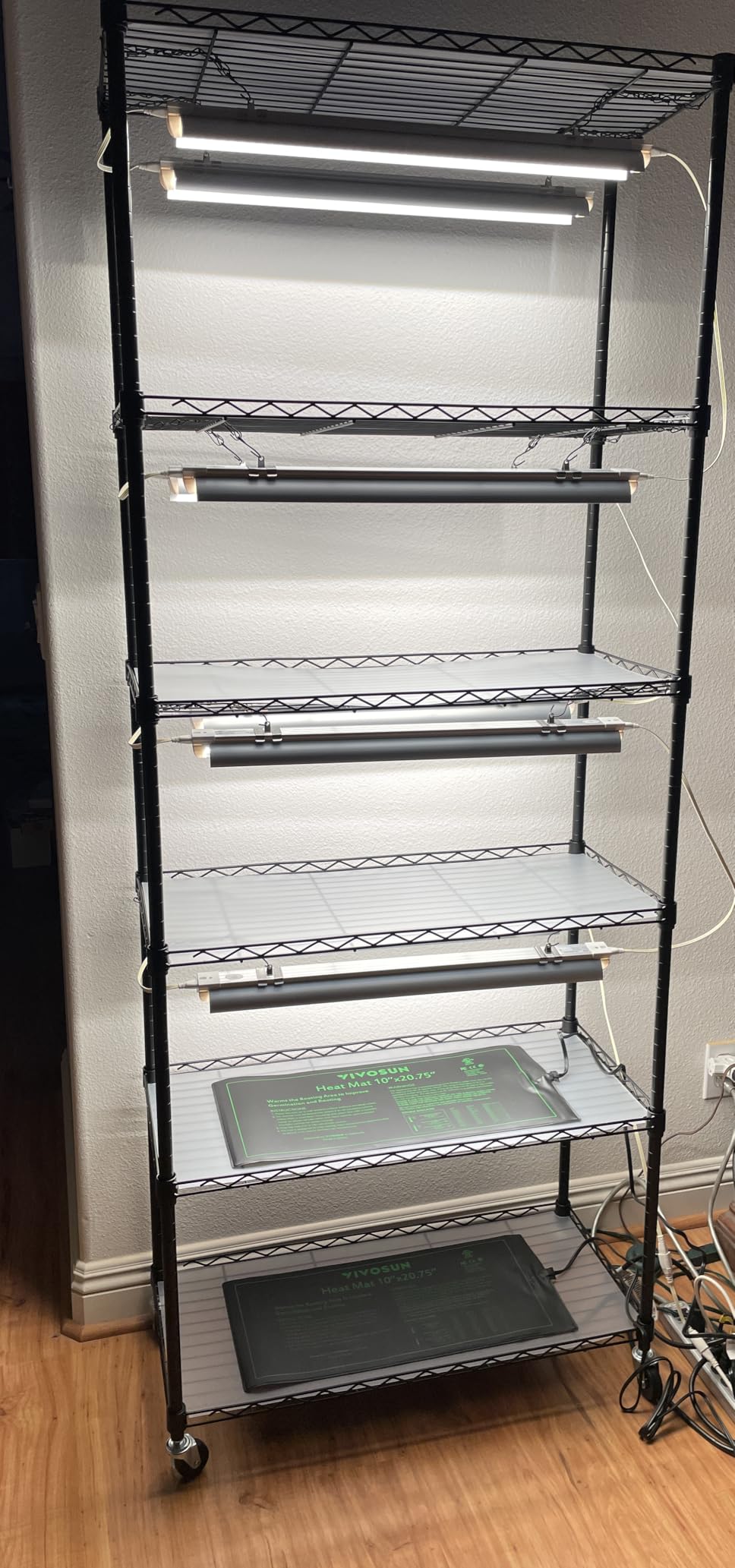
Configuration is the standout feature. The frame assembles as a single six-tier tower or splits into two three-tier units, and shelf height adjusts in one-inch increments. Eight industrial wheels, four with locks, and a 270 pound load capacity mean you can roll the whole thing into position, and six PP mats keep watering runoff off the light bars.
The box includes 8 grow lights, connecting and extension cords, an adapter, a storage belt, 6 wire shelves, 6 PP mats, 8 wheels and accessory kits. This is a substantial build, and the machined hardware reads as hobby-grade rather than flat-pack furniture.
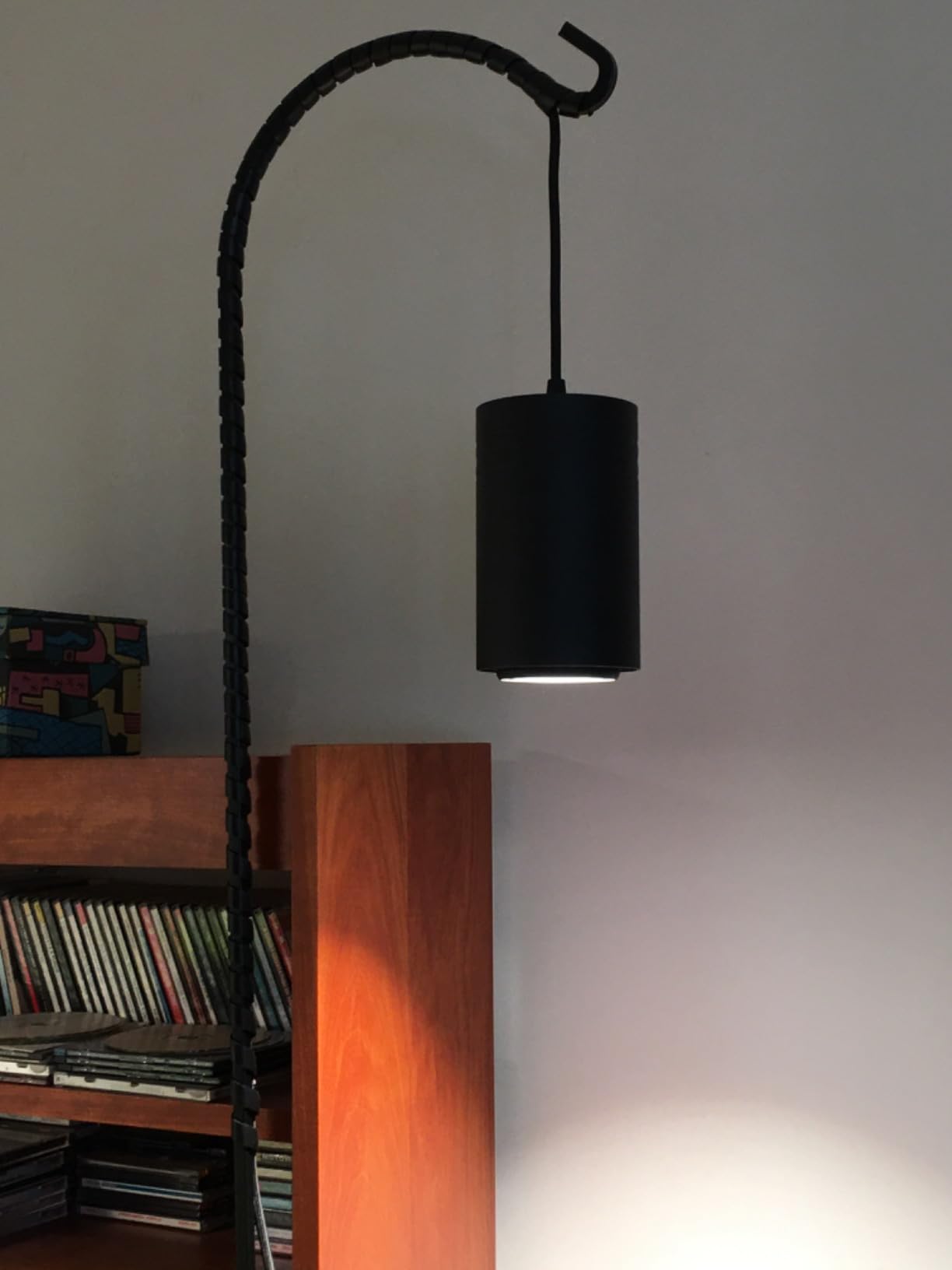
Capacity, configurability and PPFD in practice
For someone starting fifty or more trays a season, the arithmetic changes completely. Single lamps mean re-plugging and re-aiming lights every week as batches mature at different rates. A shelf lets you run separate zones under separate bars, with the lights hung at individual heights by chain, so early-germination trays sit lower while hardened-off seedlings sit higher.
The two three-tier configuration is the more useful one for most home growers, because it gives you a dedicated shelf for germination with humidity domes and a separate shelf for seedlings that need airflow. Locking casters mean you can move both units outside to a porch for hardening off and back in at night.
Where the Bstrip shelf falls short
Assembly is real assembly. This is a multi-hour build with 17 numbered parts, and the hanging chains are the most complained-about component because they are hard to open and awkward to reposition as plants grow. Budget an evening rather than assuming a one-afternoon job.
Quality control also has rough edges reviewers mention: some units ship with only three of the four locking casters, the bulbs arrive with a protective film that the instructions never mention, and the white light cords clash with the black shelving. None of these are dealbreakers, but all of them cost time on build day. Note also that the PP mats have no lip, so water pools at the edge rather than running off cleanly.
7. Wolezek 2-Foot T5 Grow Light – Best Lightweight T5 Bar
Wolezek 2FT T5 Grow Lights for Seed Starting, 32W Full Spectrum
- 2 foot T5 bar, 32W
- 144 LED chips
- Chain height adjustment, folding PVC stand
Pros
- Fast tool-free assembly in about five minutes
- Good light quality for the price
- Covers a 72-cell tray plus extra pots
- Bar plugs in at either end and two units can link
Cons
- PVC tubing feels cheap
- Bar is shorter than the stand footprint
- Hanging clips are fiddly
The Wolezek is the classic T5-format answer done in LED, and it earns its place by covering one 72-cell tray properly without taking up much room. The bar is 23.8 inches long with 144 high-lumen chips at 32W, combining 660nm red, 3000K white and 6000K white. Buyers report fast, even germination and strong seedlings, and several use theirs for carnivorous plants that dislike harsh direct light.
Setup is the fastest in the roundup. No screws, no screwdrivers, about five minutes, and everything is in the box. Height adjustment is via a chain, so raising the bar as plants grow takes one hand. The stand also folds flat, which matters if you store it between seasons in a closet.
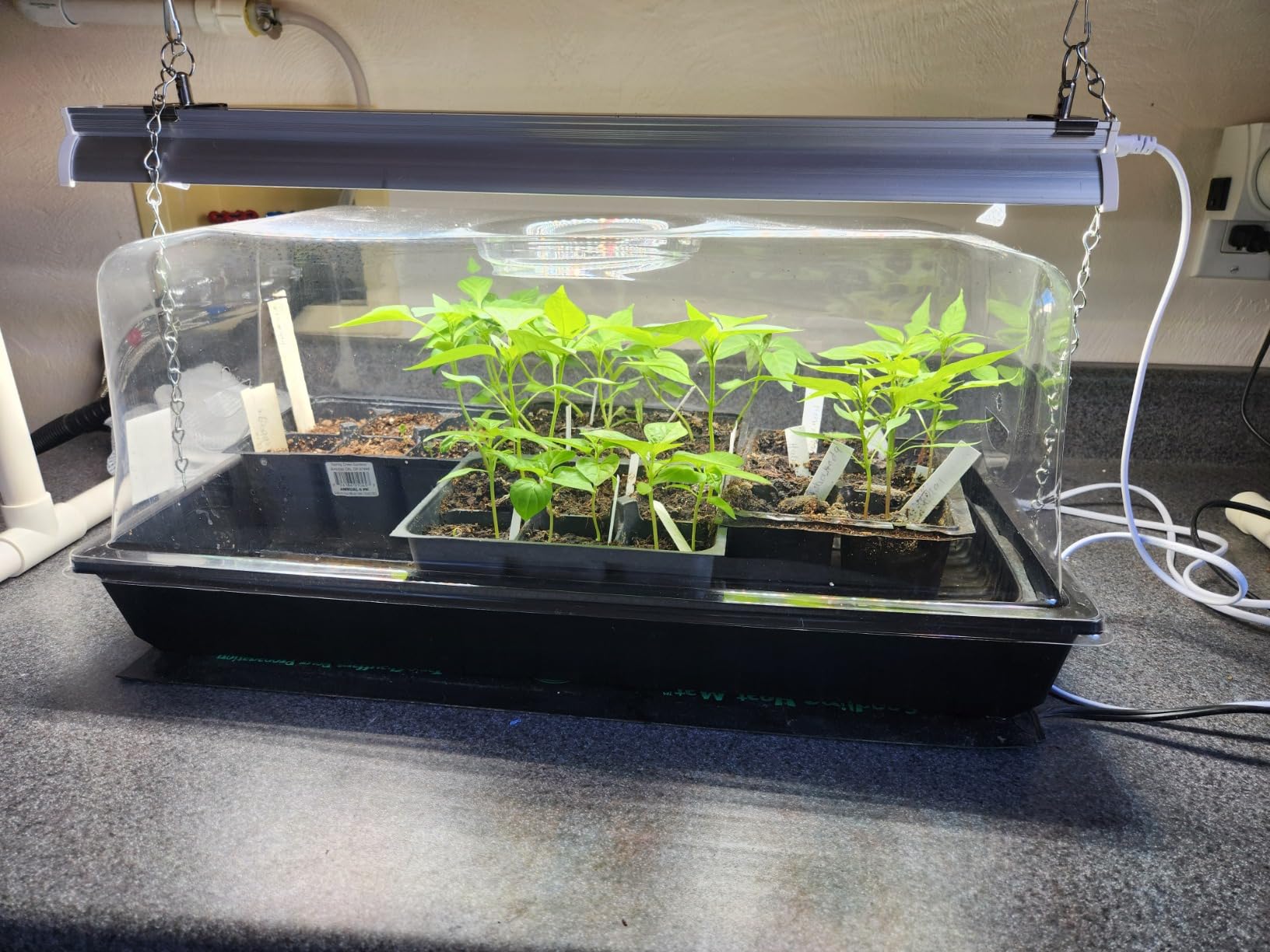
Two design details are genuinely useful. The power cord can plug into either end of the bar, so you can run it from either side depending on where your outlet is, and two units can be linked together. The reflective cover boosts brightness by roughly 30 percent without adding wattage, which is a good way to get more intensity at close range for free.
It is listed at 1.32 kg and 23.8 by 8.5 by 2.6 inches, with a one-year warranty. The light is not dimmable, so your only intensity control is height.
What a T5 bar does well over one 72-cell tray
A two-foot bar is sized for a single standard tray, and that constraint is an advantage for most growers. One bar over one tray means every cell receives roughly the same intensity, which is the entire point of matching footprint to tray count. A four-foot fixture over one tray gives you a hot center and cold edges, and the outer cells produce the weak seedlings you then spend a week worrying about.
The chain adjustment is worth singling out. Cheap stands often use a friction collar that slips over time, dropping the light onto the seedlings overnight. A chain holds position once set, and repositioning is a deliberate action you take as the plant grows rather than an accident.
Where the Wolezek T5 falls short
The main physical complaint is that the light bar is shorter than the stand footprint, so outer cells germinate more slowly than the center. That is exactly the uneven-coverage problem the T5 format is supposed to solve, and in this unit it is only partially solved.
The PVC tubing also feels cheap, and the hanging clips are fiddly enough that buyers worry about damaging the bar. Finally, only one light ships per stand and replacement bars are not sold separately, so a single failure means replacing the fixture rather than a tube.
8. Spider Farmer 4-Tier Plant Stand – Best Enclosed Seedling Setup
Spider Farmer 4 Tier Plant Stand with Grow Lights Indoor Greenhouse Shelf
- Six 18W bars, 120W total
- Four tiers at 110 pounds each
- 1680D Oxford tent with curtains
Pros
- Enclosed tent holds a stable growing environment
- Four adjustable tiers for seed starting and microgreens
- Lockable swivel casters
- Waterproof trays with drainage holes
Cons
- Enclosure blocks daylight so lights carry the whole cycle
- Larger footprint than open shelving
The Spider Farmer is the only stand here with a proper enclosure, and that changes seed-starting in a specific way: light control becomes total. The 1680D waterproof Oxford fabric has a reflective silver interior, a clear viewing curtain for checking on trays, and a blackout curtain for genuinely dark nights. If your basement or spare room has ambient light leaking in, this solves a problem no open rack can.
Inside, four height-adjustable tiers each hold up to 110 pounds, and six 18W full spectrum LED bars deliver 120W total with linkable U-shaped waterproof shades rated to 50,000 hours. Waterproof PVC drainage trays with openable holes sit on every tier, which reduces the watering-related failures that plague seed shelves.
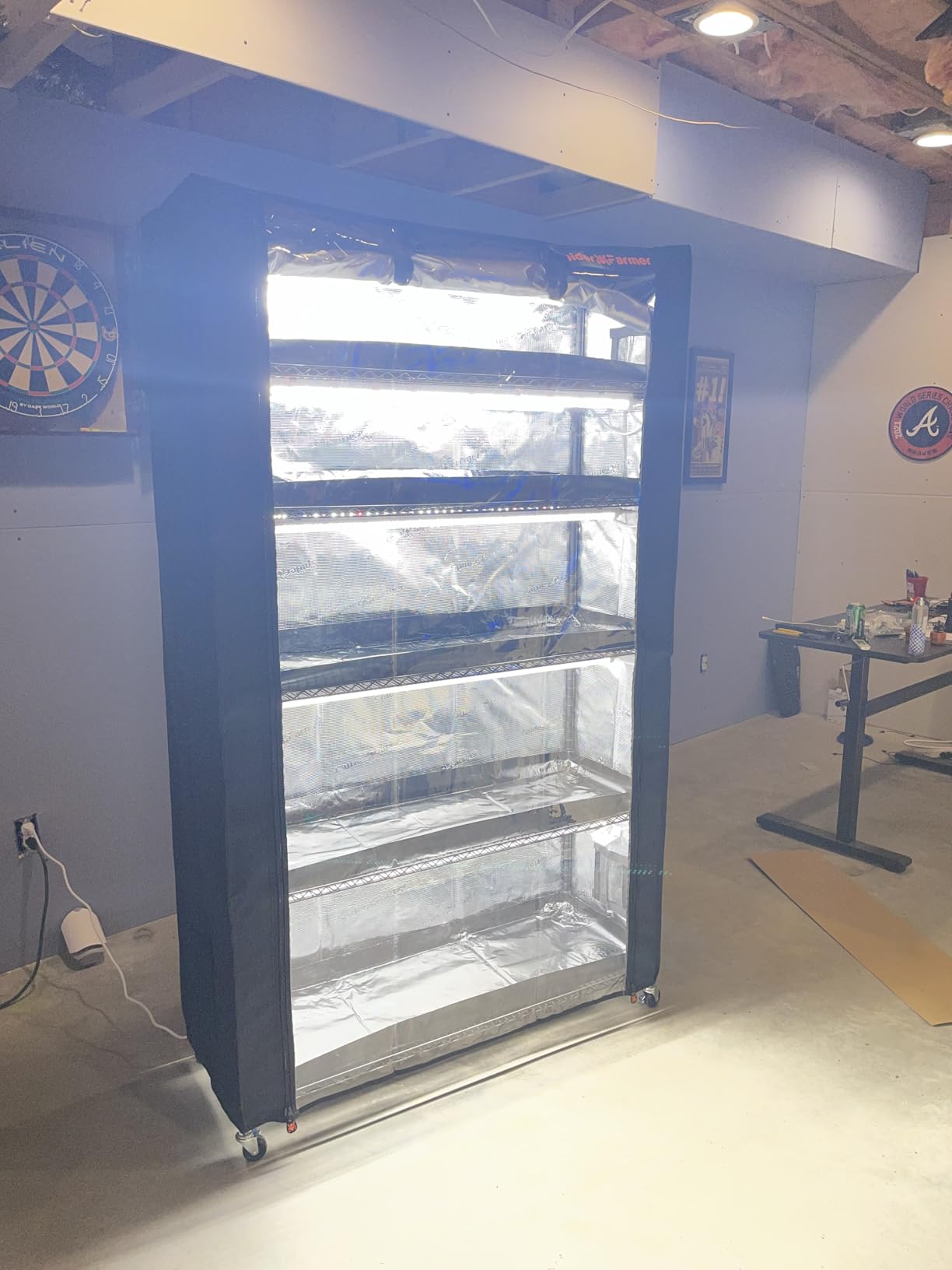
Four lockable swivel wheels make the unit genuinely movable, and the included package covers the full setup: 3 waterproof mats, 6 LED grow light bars, the stand with wheels, and the semi-transparent grow tent. Buyers also value the two-year warranty and 30-day replacement service on a build this size.
Variants exist in a small size at 16 by 12 by 47 inches and a large at 43 by 16 by 71 inches, so check the dimensions against your space before ordering. The listed dimensions for this version are 27.5 inches deep by 59 inches wide by 13.5 inches high for the shelf unit itself.
What the blackout curtain changes about seedling timing
Photoperiod discipline is one of the easiest seed-starting habits to get wrong, because a light left on by accident or an illuminated basement doorway quietly resets the cycle. A blackout curtain makes the dark period enforceable, which is how the sixteen-on, eight-off schedule stays honest across a whole room full of crops.
The reflective silver interior also bounces light back toward the underside of each shelf, which effectively raises the usable intensity at the canopy without adding a watt. On a tiered rack where the top shelf shades the one below, that reflection is the difference between even coverage and a gradient.
Where the Spider Farmer stand falls short
The enclosure is the same feature that makes it good. Because the tent blocks all daylight, the included lights have to carry the entire growth cycle, and there is no free window light to supplement them. If you are only starting a handful of trays, that is overbuilt.
The footprint is also considerably larger than open shelving, and the 59 inch width is a real constraint in a narrow room or an apartment with one usable wall. If you are working in a small space, a slim tiered stand without a tent will serve you better.
9. JCBritw 2-Foot T8 Bar – Best for Soft White Light in Living Spaces
JCBritw Standing LED Grow Light,Adjustable 2ft T8 Bar Plant Light, White 4500K Full Spectrum Plant Grow Lamp on Stand for Indoor Plants Seed Starting, Seedlings, Veg, Flower
- 48 white 4500K LED beads
- 13W consumption
- Height adjustable 25-51cm
Pros
- Soft flicker-free 4500K white light
- Flat base doubles as a pot platform
- Rotatable and tiltable bar
- Low power draw for daily use
Cons
- Listed wattage conflicts with stated consumption
- Height range suits small trays only
- Not water resistant
The JCBritw is the grow light stand you can leave on in a room where people eat. At 4500K with 48 premium white LEDs across 380nm to 800nm, it produces a soft, flicker-free white light that buyers regularly describe as doubling as a night light. There is no purple glow, and no reason to flip it off when company arrives.
Power draw is 13W, described as roughly equivalent to a 60W HPS or MH, which keeps a daily running cost very low. The light bar adjusts 90 degrees and rotates 360 degrees, so you can use it vertically against a shelf edge, and the slim flat base doubles as a platform to set pots on, saving counter space in a small kitchen.
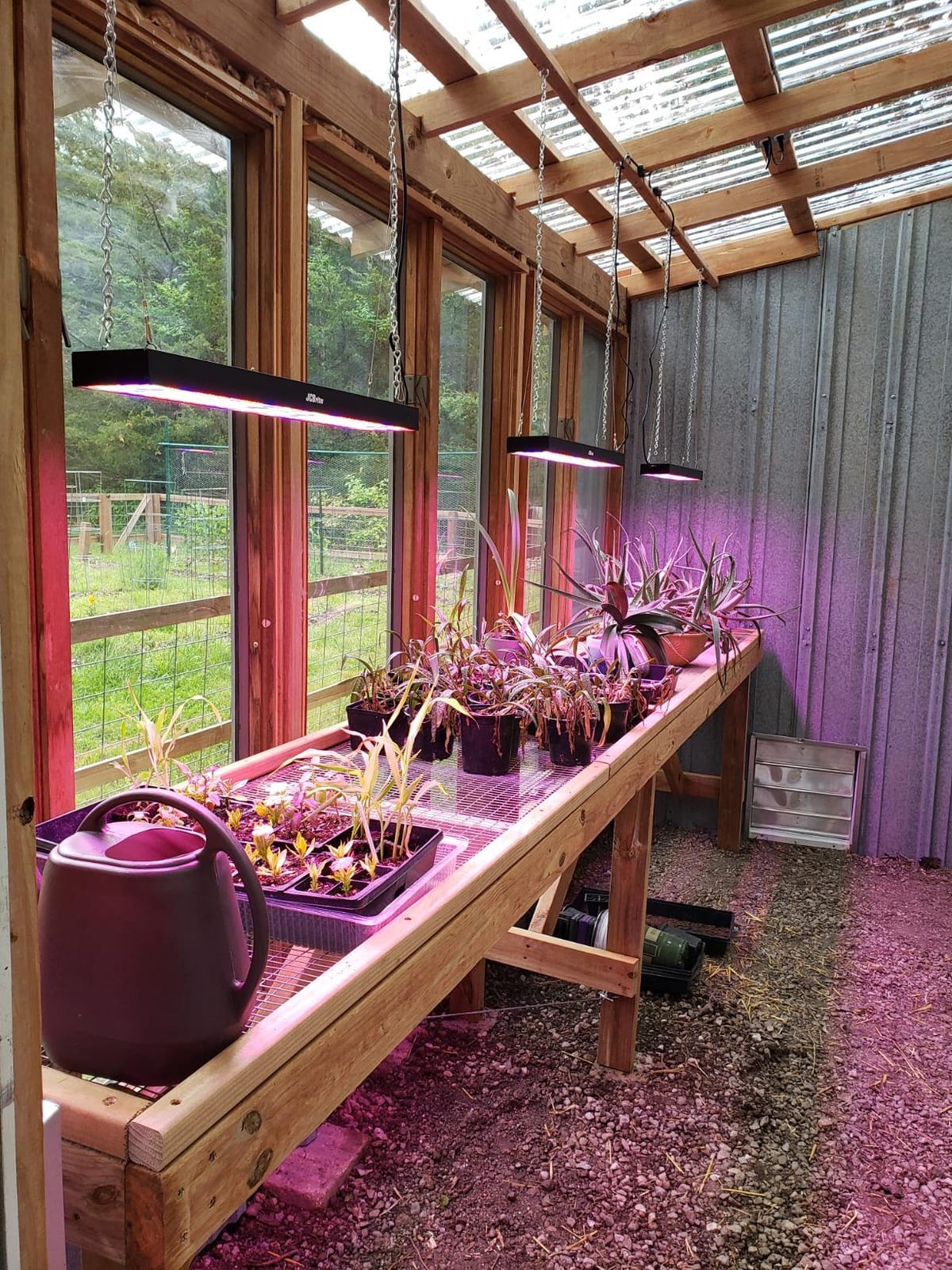
Two ties and two tapes are included, so the bar can be mounted to existing shelving or a fixture instead of using the base at all. That turns it into a retrofit for a bookcase, which is a useful trick for anyone who already owns a shelving unit near a window.
Height adjustment runs from 25cm to 51cm, roughly 10 to 20 inches, with a listed weight of 0.7 kg and a 12-month warranty. Buyers use it for germination, seedlings, succulents and cacti, which is a fair description of its ceiling.
A grow light you can leave on in a kitchen
Most grow lights are designed to be looked away from, because the blue-heavy spectrum reads as harsh in a domestic room. A 4500K white bar sidesteps that entirely, and the flicker-free output matters if the light is near where you work or sit. For seed starting in an apartment where a garage is not an option, that changes the calculus on which stand is realistic.
The flat base that holds pots is a genuine space saver in a small kitchen, and mounting options using the included ties and tape let you reuse it on a shelf after the seed tray is finished. The remote and inline switch give simple control without apps.
Where the JCBritw T8 falls short
The 25 to 51cm range is the main limit. It works for a small tray and short seedlings, but a leggy tomato will outgrow it quickly, and there is no adjustment left by the time you want it. Choose it for herbs, flowers and shallow trays rather than for transplant-size vegetables.
There is also a specification inconsistency worth flagging honestly: the listing shows 100W while the technical description states 13W consumption, and the stated light source wattage and the claimed draw do not agree. The 13W figure is the one consistent with the 48-bead count, but verify the actual draw if electricity cost matters to your setup. The unit is also not water resistant, so keep it away from a humid dome drip.
10. Barrina CX3 Four-Tier Stand – Best for Tool-Free Assembly
Barrina CX3 Plant Stand with Grow Light, 4-Tier, 108W, 35.4×13.8×70.9IN
- Three 36W T5 bars, 108W total
- 90 pounds per tier
- Mechanical timer socket included
Pros
- Highest average rating in this roundup
- Four tiers with 90 pounds per shelf
- Mechanical timer needs setting once
- PP pads protect lights from watering
Cons
- 13.8 inch depth limits tray size
- Open wire shelves offer no light blocking
The Barrina CX3 carries the highest average rating in this roundup at 4.7 stars with an 85 percent five-star share across 175 reviews, and the reason is straightforward: it does the same job as the larger racks without requiring tools. Buyers highlight the four 90-pound tiers, the 108W of full spectrum light, the one-time mechanical timer and the tool-free build as a strong combination for seed starting.
Lighting is three 36W 5000K full spectrum T5 bars, 108W total, on a 35.4 by 13.8 by 70.9 inch frame with wheels. The mechanical timer socket is set once and repeats daily, which is more dependable than the electronic timers on cheaper lamps that drift or reset after a power cut.
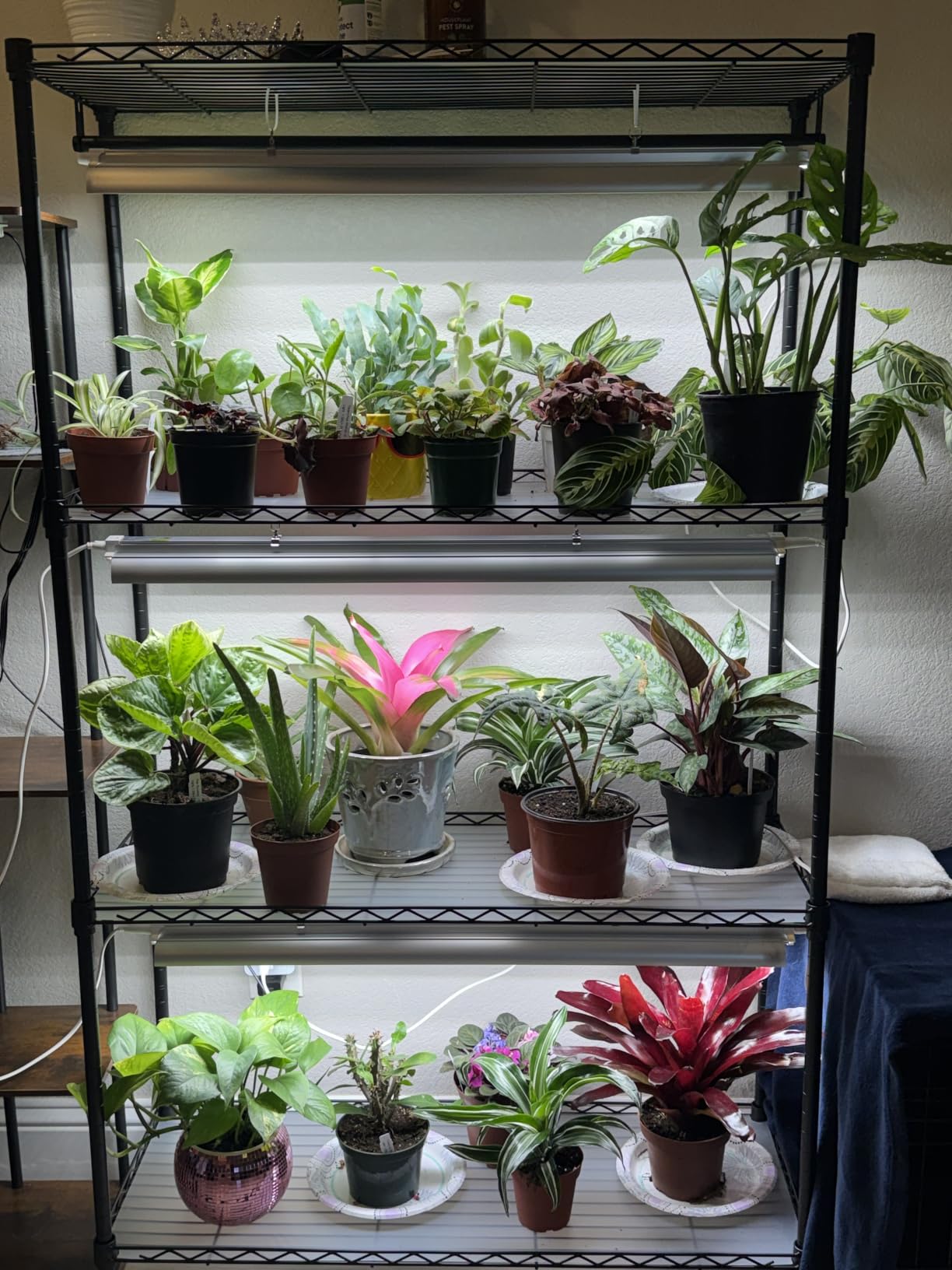
Installation is tool-free, and PP waterproof pads on every layer protect the light bars from watering. The package includes 3 grow lights, 2 connecting cables, the mechanical timer, storage tape, 4 wire racks, 4 PP pads and accessory kits, with a two-year manufacturer warranty behind it.
Total load capacity is 360 pounds, and the fixtures are plug-and-play linkable, so you can extend to more bars later if you expand the setup.
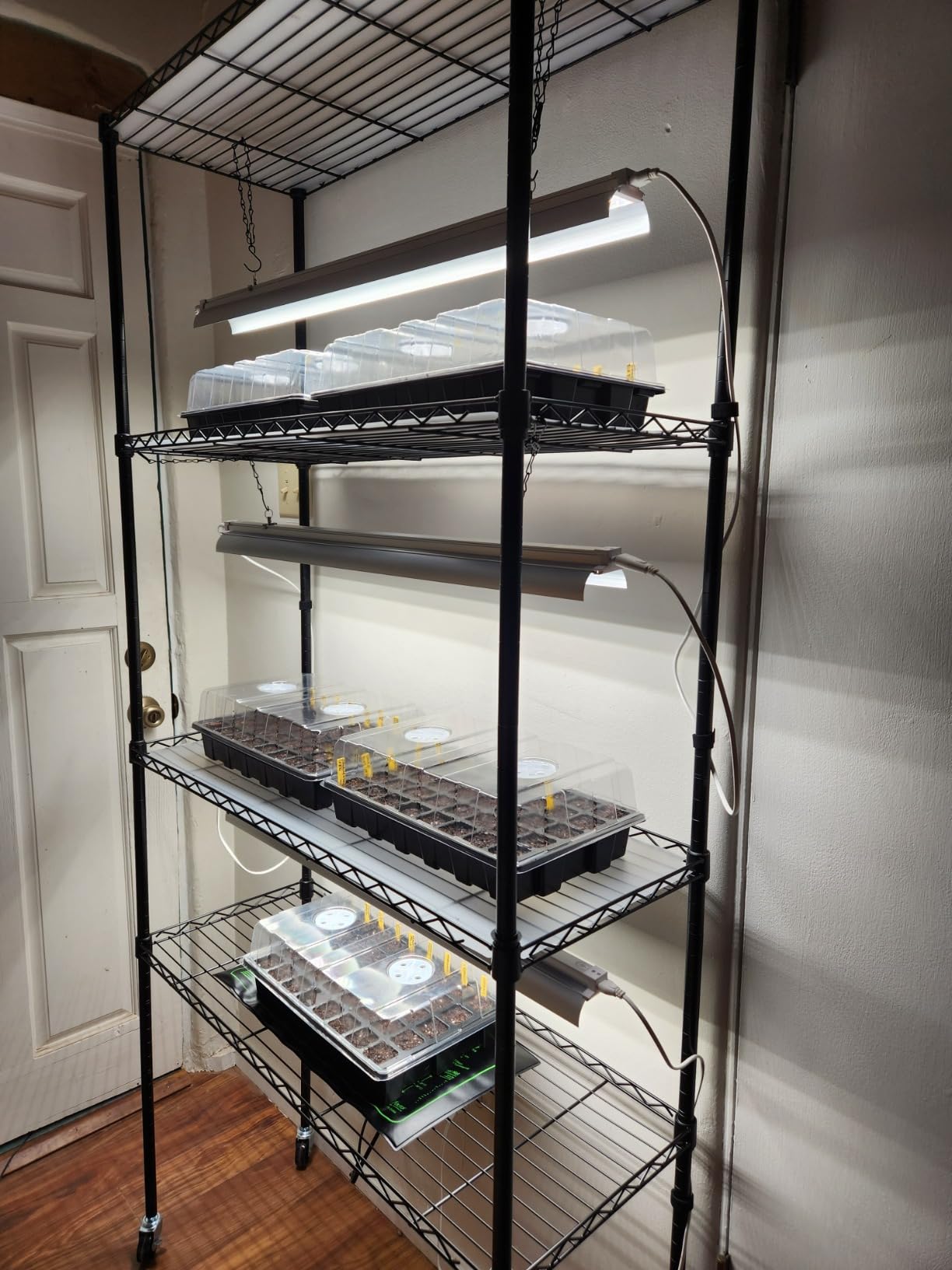
The mechanical timer and tier capacity
The mechanical timer is the sleeper feature. It has no electronics to fail and no memory to lose, so once you dial in the start time, the same cycle repeats indefinitely. For a rack you leave running for eight weeks while you travel for work, that reliability is worth more than a digital timer with extra modes you will not use.
Ninety pounds per tier comfortably holds 1020 trays, flats and pots of damp medium, and 5000K full spectrum is a clean, neutral white that does not tint leaves. The tier height is adjustable, so lower tiers can be set close for germination while upper tiers sit higher for older seedlings.
Where the Barrina CX3 falls short
The 13.8 inch shelf depth is the constraint. Standard 1020 trays are 21 inches long, so they overhang or sit at an angle, and you lose usable space on every tier. If you plan to use standard trays rather than smaller cell trays, check your tray dimensions before committing.
Open wire shelves also mean no light blocking. Unlike the Spider Farmer enclosure, the light on a lower tier spills upward and there is no way to isolate a shelf, so mixed-variety setups with different photoperiod needs need separate units. There is also no humidity cover included, which some growers add for germination.
How to Choose a Grow Light Stand for Seed Starting
Match the stand to your tray count first, then everything else follows. Most disappointing seed-starting setups fail because a light chosen for appearance was asked to cover three trays at once.
1. Match the light footprint to the number of trays
A two-foot bar covers one 72-cell tray or one 1020 tray. A four-foot fixture covers two trays placed side by side. Fixture length and tray count should match one to one, because any extra length creates a bright center and dim edges, and the dim edges are where weak seedlings come from.
2. Check the height range, not just the brightness
Seedlings double in height every few days at the early stage. A stand that starts around 12 to 15 inches and extends past 36 inches covers the full run from germination to transplant. Anything that maxes out under 22 inches is a countertop tray lamp, not a vegetable seed stand.
3. Prefer dimming or a long timer range over raw output
Seedlings need control, not maximum intensity. Six dimming levels, or a timer with a 16-hour mode, gives you the adjustment to prevent bleaching in the first week. A very bright light with no dimming forces you to solve intensity purely by raising the fixture, which is a slower and less precise control.
4. Decide whether you need a timer or a memory function
A mechanical timer socket is the most reliable option and needs setting once. An electronic auto timer with cycle memory is more convenient and lets you change the schedule quickly, but cheaper ones drift or reset after a power cut. Whichever you choose, sixteen hours on and eight hours off is the seedling standard.
5. Weigh stability seriously in a shared household
Tripod stands are top-heavy by design and tip when bumped, which is a recurring complaint across this category. A weighted disc base or a wheeled rack with lockable casters solves it. If you have pets or small children, pay attention to this before the tray is ruined.
6. Buy for two tiers of use, not one
Any decent seed stand will be asked to do a second job: growing microgreens and salad greens indoors, rooting cuttings, or overwintering herbs and a houseplant or two. Stands with adjustable tiers and shelves that fit standard pots serve you all year, which changes how the cost compares to a seasonal single-tier lamp.
7. Check water resistance where you are watering
Seed starting involves watering. Trays with drainage holes, PP waterproof pads on each shelf, and waterproof fabric covers prevent the most common long-term failure, which is water reaching a light fixture or a shelf surface. Open wire shelving with no pads will eventually show it.
8. Look for a spectrum that suits the room
5000K to 5500K white light looks like daylight and works in a living space. Purple-heavy full spectrum fixtures produce more light per watt for plants but are unpleasant to look at and can create a visible glow through a window at night. If the stand lives anywhere but a garage, prioritize the white spectrum.
Seedling Light Settings: Photoperiod, Height and Intensity
Set seedlings to sixteen hours of light on and eight hours of darkness, keep the fixture 4 to 6 inches above the canopy at germination, and raise it to 10 to 12 inches once true leaves appear. Brightness is not the problem most gardeners think it is. A high-lumen light positioned correctly is fine, and a modest light positioned too low is not.
During germination, seeds do not need light at all, so leave the domes on and the light off or on low. Once shoots break the surface, the light goes on and stays on for sixteen hours a day. Eight hours of uninterrupted darkness is not optional; it is the signal that triggers the hormonal changes seedlings need to grow compact rather than stretched.
Height is the adjustment that matters most as plants grow. Start low, roughly 4 to 6 inches, to fill a freshly cleared tray with even light. Raise the lamp every few days as the seedlings extend, aiming for about 10 to 12 inches above the canopy at transplant size. If leaves look bleached, white or papery near the light, the light is too close. If the seedlings are long, thin and leaning, the light is too far away or not bright enough.
If your stand has dimming, use it during that first week after emergence at 30 to 50 percent, then raise the output as the plant hardens. If it does not, use height as your only control and accept a slower ramp.
How to Fix Leggy Seedlings: Four Checks in Order
Work through these in order, because the causes compound and fixing the wrong one wastes a whole week of growth. Most leggy seedlings are a light problem, but not always the one people assume.
1. Check the distance first
Raise the light. This is the single most common fix and the one most often skipped. A lamp that sat 3 inches above a 1-inch sprout is now far too close for a 6-inch seedling, and the seedling stretches searching for a usable intensity. Raise the fixture before you buy anything else.
2. Check the photoperiod
Twelve hours of light a day produces noticeably stretched growth. Confirm the timer is actually running a sixteen-hour cycle and that it has not been reset by a power cut or knocked off schedule. In a room with a window, also check that the light is not being turned off manually at night.
3. Check the coverage across the tray
If only the center cells are stretching and the outer cells look fine, the problem is footprint, not intensity. The light is too small or mounted off-center for the tray. Move it to center it, add a second fixture, or rotate the tray so the weak end gets the strongest light.
4. Check the temperature last
Warm soil and warm air push seedlings taller and thinner. If you are running a heat mat, drop it a few degrees once germination finishes, and make sure air is moving across the canopy. Cooler, brighter conditions produce stockier plants.
T5 and T8 Fluorescent Bars vs LED Bars: Which Format to Buy
Buy a two-foot T5 or T8 format LED bar if you are starting one tray at a time, and buy a bar or quantum-board style light on a tiered rack if you are running several. The format matters far less than matching the footprint to the tray and having enough height adjustment.
True fluorescent T5 tubes are the traditional seed-starting fixture. They are cheap, widely available, and produce good results at close range, but they are declining as a category because tube replacement parts are harder to find and they draw more power for less light. Several of the stands here keep the T5 form factor while using LED chips inside it, which gives you the footprint of a familiar fixture with LED efficiency.
Two-foot T8 bars sit in a similar lane and often come with a flat base that doubles as a pot platform, which is useful in tight spaces. As with T5, the advantage is a predictable, tray-matched footprint rather than raw output.
LED bars and boards produce more usable light per watt and last far longer, but many of them are overpowered for seedlings, which brings back the intensity problem. A board covering a large tray can give you a bright center and dim corners, and it usually has no dimming. Match the board size to the tray and treat height as your main control.
The practical rule we use: fixture length should roughly equal tray length, and if a light is clearly more powerful than a seedling tray needs, the correct response is to raise it, not to shorten the day.
Do You Still Need a Heat Mat Under an LED Grow Light Stand?
Yes, if you are starting warm crops such as tomatoes and peppers, because LED bars run cool and contribute almost no heat to the tray. Most growers use a heat mat for germination, then remove it once shoots appear and rely on ambient room temperature.
LED fixtures emit far less radiant heat than older fluorescent or HID setups, so a mat that was unnecessary under a T5 tube may be needed under an LED bar. The typical sequence is a mat at germination temperature with a dome on, then off or reduced after emergence.
Watch for the opposite problem as well. A mat left on under a bright bar can push soil temperature high enough to stall root development, and it is a common cause of the damping-off losses that end an otherwise good tray. Unplug the mat, lift the dome slightly for airflow, and check soil moisture before you blame the light.
What to Do After Your Seedlings Sprout
Take the dome off a few days after emergence and move the light up. The seedlings no longer need the sealed humidity environment, and leaving the dome on after they are up invites leggy growth and fungal problems at the soil surface.
Then raise the fixture. This is the step most people skip, and it is the direct cause of the pale, stretched seedlings that show up a week later. Keeping the light at the same height as the seedlings grow means intensity falls off as the canopy approaches it, and the seedlings compensate by stretching.
Water from the bottom once the top layer begins to dry, and avoid flooding the tray from above, which pushes soil onto the lights and washes nutrients out. Once true leaves appear, start a dilute balanced feed rather than full strength. Finally, plan hardening off: a few hours of increasing outdoor or porch time over a week before transplanting, and never move a seedling straight from an indoor light to full sun.
Frequently Asked Questions
What is the best grow light for starting seeds?
The best grow light for starting seeds is one whose footprint matches your tray and whose stand adjusts high enough to raise the light as seedlings grow. Our pick is the LBW Grow Light with Stand, which telescopes from 15 to 48 inches and delivers full spectrum output from 390nm to 730nm. For one tray on a countertop, a single two-foot bar such as the Wolezek T5 works. For dozens of trays, choose a tiered rack with per-shelf light control.
Is 10,000 lumens too bright for seedlings?
No, 10,000 lumens is not too bright for seedlings if the light is positioned correctly. Intensity at the leaf depends on distance, not on the number printed on the box. Keep a bright lamp 4 to 6 inches above a freshly cleared tray and raise it to 10 to 12 inches as the canopy grows. Bleached white or papery leaves mean too close; long thin stems mean too far. Most problems blamed on brightness are really distance problems.
What setting should my grow light be on for seedlings?
Run seedlings on a 16 hours on, 8 hours off cycle, and keep the timer consistent because the dark period triggers the growth response that keeps seedlings compact. Use the lowest dimming level for the first week after emergence, then increase output as the plant hardens. If your stand has no dimming, control intensity by raising the light instead. Avoid a 12-hour cycle, which is a common cause of stretched seedlings.
How many hours of light do seedlings need?
Seedlings need roughly 14 to 16 hours of light per day, with 16 hours on and 8 hours off being the most widely used standard. Short days of 12 hours or less produce leggy, stretched growth. Keep the dark period fully dark and consistent, which is one reason an enclosed setup with a blackout curtain can be easier to manage than an open shelf in a room with ambient light. Seedlings do not need light at all before they break the surface of the medium.
Can you use regular LED lights for seedlings?
Ordinary household LED bulbs and strips are not a good substitute for a grow light. They are tuned for human vision, so they deliver a narrow band weighted toward blue and red with little of the spectrum seedlings use efficiently, and the output at plant height is usually too low. A purpose-built full spectrum grow light of 5000K or higher, ideally with red and white LEDs combined, delivers far more usable light from the same power draw for the same electricity cost.
The Verdict on the Best Grow Light Stands for Seed Starting
The LBW Grow Light with Stand is our pick for most people, because a 15 to 48 inch height range and a one-minute setup cover the whole seed-starting season without overbuilding. If you are spreading a small budget across several trays, the GHodec four-head gooseneck gives you four aimable heads and a timer for less than the price of a dinner out. If you start dozens of trays at once, the Bstrip eight-light shelf is the only stand here with the light output and tier capacity to handle it, and the Barrina CX3 gets you a four-tier rack with tool-free assembly if you want a simpler build.
Whatever you choose, the setup rules are the same: one fixture per tray width, sixteen hours on, eight off, and raise the light as the seedlings grow. That last habit solves more leggy seedlings than any purchase on this list. Updated for 2026, these ten stands cover the range from a single countertop tray to a rolling production rack, and the right one is the one whose footprint matches how many trays you actually sow.