
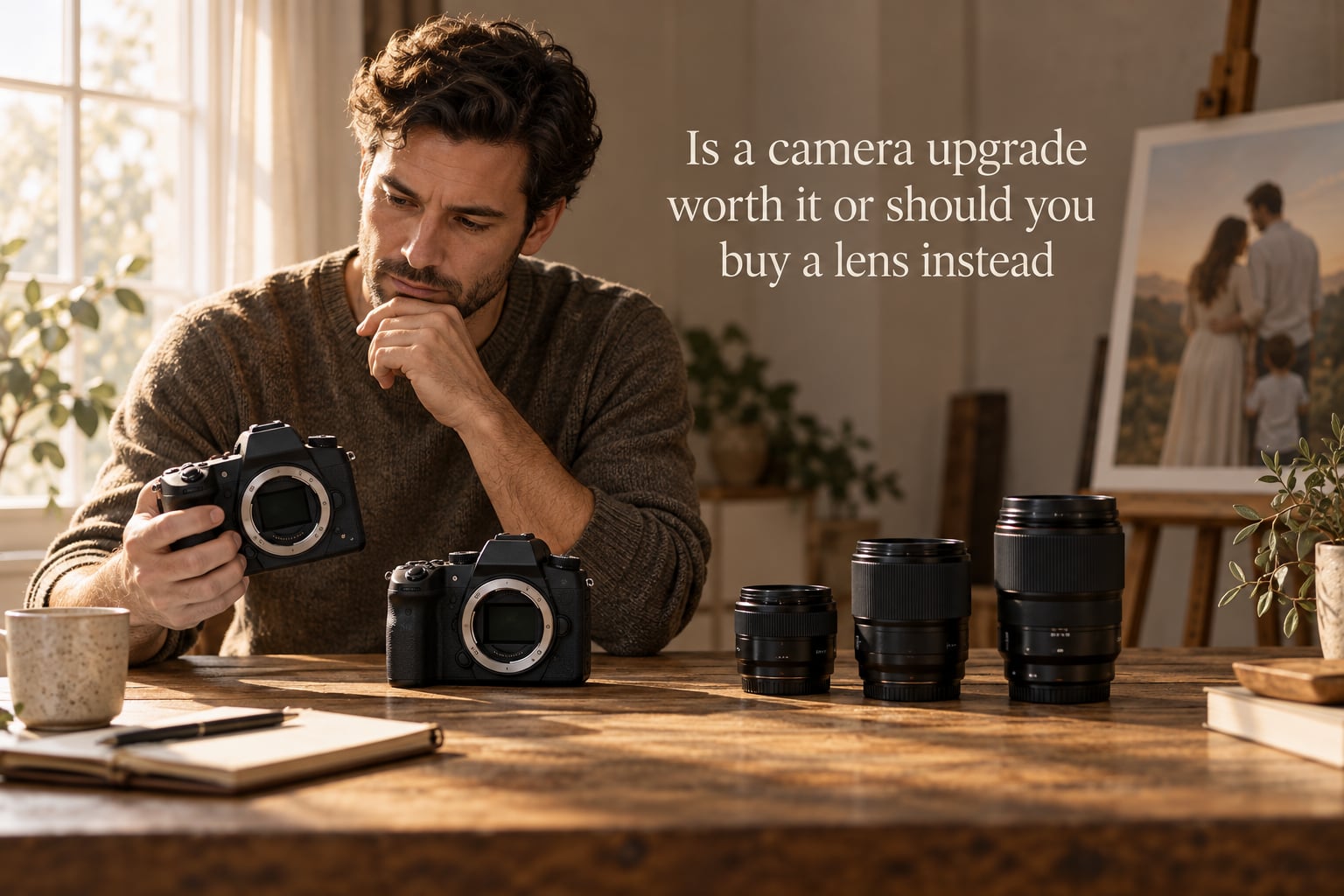
Is a camera upgrade worth it or should you buy a lens instead? In most cases, the lens delivers a bigger, more permanent jump in image quality, while a camera body upgrade earns its money only when your current body is the actual bottleneck. Read on for the short answer, a decision matrix, and a 5-question check to know which way to go.
I have been photographing families in a 1100-square-foot studio for years, and I have watched this exact question play out in our DMs every month. A parent buys a new entry-level mirrorless, drops the kit lens on it, and within a season asks whether the next leap should be a $1800 body or a $700 fast prime. The honest answer is almost always the prime. But the honest answer is not always the lens. So let me walk you through how to tell.
Table of Contents
- The Short Answer: Lens First, With Three Exceptions
- Is a Camera Upgrade Worth It or Should You Buy a Lens Instead: A Decision Matrix
- How a Lens Upgrade Changes Your Photos
- How a Camera Body Upgrade Changes Your Photos
- Lens vs Camera for Low-Light Photography
- Autofocus and Tracking: When the Camera Body Matters Most
- Weight, Size, and Ergonomics: Why Mirrorless Changes the Math
- Investment Value: Lenses Outlive Camera Bodies
- A 5-Question Diagnostic Before You Spend Anything
- Genre-by-Genre: Which Upgrade Wins for the Photos You Actually Take
- When the Answer Is Neither: Upgrade Your Skills First
- Frequently Asked Questions
- What makes a bigger difference, a new lens or a new body?
- Which affects photo quality more, the lens or the camera?
- How do I know when I am ready for a new camera or lens?
- Should I upgrade my lens or camera body for portraits?
- Why is everyone switching to mirrorless?
- What three lenses should every photographer have?
- Conclusion
The Short Answer: Lens First, With Three Exceptions
For most photographers asking whether a camera upgrade is worth it or whether they should buy a lens instead, the lens is the better first move because it controls the light reaching the sensor, the focal length, the sharpness, and the bokeh, while a camera body mostly decides how fast and reliably that light is captured. A great lens on a five-year-old body will outperform a kit lens on a brand-new flagship in nearly every real-world image. The three exceptions: when autofocus is missing shots you cannot recover, when your body fails for reliability reasons (shutter, buffer, weather sealing), and when you need a specific body feature no lens can deliver, such as eye-detect tracking for kids who never sit still.
Is a Camera Upgrade Worth It or Should You Buy a Lens Instead: A Decision Matrix
Use this matrix before you open a new tab to a retailer. If more than two rows point to the same side, that is almost always where your money should go.
| If your problem is… | Upgrade the lens | Upgrade the camera body |
|---|---|---|
| Photos look soft even when focused | Yes — sharper glass fixes this fastest | Only if lens is already pro-grade |
| Indoor family sessions are noisy at ISO 3200+ | Yes — a fast prime adds 3-4 stops of light | Sometimes — newer sensor helps too |
| Kids and pets are blurred from missed focus | Rarely — modern lenses track well | Yes — eye-AF and subject detection matter here |
| You want stronger background blur (bokeh) | Yes — wider aperture is the only way | Sensor size plays a small role |
| Burst buffer fills before the moment | No | Yes — body buffer and write speed |
| Your 5-year-old body just broke | Skip — buy a body first | Yes |
| You shoot wildlife or sports at long focal lengths | Lens first, body to support AF later | Body matters for tracking speed |
| You want a lighter camera for travel | No | Yes — mirrorless bodies shrink dramatically |
| You want to keep this gear for 10+ years | Yes — lenses outlast bodies | No — bodies depreciate |
How a Lens Upgrade Changes Your Photos
A lens upgrade changes three things no sensor can fake: how much light reaches the sensor, the focal length you can reach, and the optical sharpness across the frame. Concretely, moving from a variable f/3.5-5.6 kit lens to a fast f/1.4 prime lets in roughly 16 times more light at the same shutter speed, because aperture area scales with the square of the f-stop ratio. That single fact is why a $700 50mm f/1.8 transforms low-light family photography faster than a $1500 body swap.
Focal length is the other quiet revolution. The 18-55mm kit lens covers a useful range but caps out at a 35mm-equivalent of about 82mm, which is not enough for candid portraits across a room or for any wildlife work. A 70-200mm or 100-400mm opens entirely new subjects, and that is something a body upgrade simply cannot do.
How a Camera Body Upgrade Changes Your Photos
A body upgrade changes how the camera behaves, not what the photo looks like at the optical level. The biggest body-driven improvements are faster and more accurate autofocus (especially subject detection and eye-AF), better high-ISO noise performance from a newer sensor, faster burst rates with deeper buffers, in-body image stabilization, and improved ergonomics like weather sealing, joystick AF selectors, and dual card slots. None of those change the look of a properly focused photo, but every one of them changes how often you get the shot.
The mistake I see most often is upgrading the body to fix a lens problem. A parent brings in a softly focused print from a birthday party, and the reflex is to blame the camera. Nine times out of ten, the lens is the limiting factor, and a body upgrade would have made the same softly focused image slightly noisier in the dark.
Lens vs Camera for Low-Light Photography
Low light is where this debate gets interesting, because both pieces of gear contribute. A newer full-frame sensor will produce cleaner files at ISO 6400 than a five-year-old APS-C sensor. But a fast f/1.4 lens on the older APS-C body will still gather more total light than a slow f/4 lens on the newer full-frame body. The math: an f/1.4 aperture gathers about 8 times more light than an f/4 aperture at the same shutter speed, so the lens advantage often outweighs the sensor generation gap in practical shooting.
For our studio work, the biggest low-light win came not from a body upgrade but from switching the kit 18-55mm for a 35mm f/1.8 and a 50mm f/1.4. Indoor family sessions at ISO 800 went from rare to routine, and the noise floor dropped because we no longer needed to push ISO to 6400.
Autofocus and Tracking: When the Camera Body Matters Most
Autofocus is the single biggest reason a body upgrade is sometimes worth it. Modern mirrorless bodies with eye-detection and subject tracking can hold focus on a toddler running across a living room in ways a five-year-old DSLR simply cannot, no matter what lens is bolted on the front. If your hit rate on moving subjects is below 60%, you are looking at a body problem, not a lens problem.
The decision gets sharper for wildlife and bird-in-flight work. Photographers on r/photography and r/canon consistently say the body matters more than the lens for these genres, because the AF system has to track an unpredictable, fast-moving subject across the frame. A budget telephoto on a flagship body will outperform a flagship telephoto on a budget body for action work.
Weight, Size, and Ergonomics: Why Mirrorless Changes the Math
Mirrorless bodies changed the body-upgrade argument by removing one of its biggest disadvantages: weight. A modern full-frame mirrorless body with a 35mm pancake lens weighs roughly what an entry-level DSLR weighed with no lens at all. For travel, family documentary, and run-and-gun event work, that size and weight difference is the kind of body upgrade that actually changes how often you bring the camera with you, which matters more than any spec sheet.
Ergonomics is the underrated body win. A new grip, a better-positioned joystick, a brighter viewfinder, dual card slots for backup, and weather sealing are real working-photographer advantages, and they live in the body. If your current camera fights your hand after an hour, a body upgrade is justified even when the optics are fine.
Investment Value: Lenses Outlive Camera Bodies
Lenses hold their value far better than camera bodies, and they last far longer. A flagship professional lens bought today will, with reasonable care, still be optically excellent in 2026 and still mount on whatever body system you eventually migrate to with a $25 adapter. A flagship body bought today will be functionally obsolete in 5 to 7 years and worth a fraction of its original cost on the used market. Shutter actuations are the physical reminder of this: every body has a rated shutter life, often 150,000 to 400,000 clicks for pro bodies, and every body will eventually fail in a way a lens simply does not.
There is a saying in working studios: date the camera, marry the lens. The camera body is the short-term partner; the lens is the long-term one. Spend accordingly.
A 5-Question Diagnostic Before You Spend Anything
Before you spend a dollar, run your gear through these five questions. The answers almost always point to the right upgrade without any further research.
- What is the specific problem you are trying to solve? Write it down in one sentence. If the sentence ends with “sharper,” “more blur,” or “too dark,” the lens is the answer. If it ends with “missed focus on moving kids,” “buffer fills,” or “feels heavy,” the body is the answer.
- What lens are you currently using? If it is a kit lens or a variable aperture zoom, stop here and buy a fast prime first. This single step resolves more upgrade confusion than anything else.
- What is the oldest piece of gear you are using? Older bodies hurt more than older lenses, because sensor and AF technology advance quickly. If your body is the oldest item, it is the bottleneck.
- How long do you plan to keep the next purchase? Five years or fewer: spend on whatever solves today’s specific problem. Ten years or more: lean toward the lens for durability and mount-system longevity.
- Would skill, software, or a $150 accessory fix this first? Be honest. A used 50mm f/1.8, a tripod, an off-camera flash, or a Lightroom subscription will often beat any gear upgrade for the same money.
Genre-by-Genre: Which Upgrade Wins for the Photos You Actually Take
The answer changes based on what you point the camera at. Here is the working photographer’s cheat sheet.
Portrait and family studio work: Lens wins. A fast 50mm or 85mm prime on a current body will deliver cleaner, more flattering portraits than a new body with a slow zoom. The Sparkfly team has shot hundreds of family sessions this exact way.
Wildlife and bird-in-flight: Body wins on AF, lens wins on reach. You need both eventually. Start with the longest lens you can afford, then upgrade the body when subject-tracking AF becomes the limiting factor.
Landscape: Lens wins. A sharp wide-angle or ultra-wide lens on a five-year-old body still produces gallery prints. Dynamic range improvements in modern bodies are real but rarely visible in print.
Astrophotography and nightscapes: Lens wins, decisively. A wide, fast aperture lens like a 14mm f/1.8 or 24mm f/1.4 gathers dramatically more light than a kit lens ever will, and no body upgrade closes that gap.
Sports and indoor action: Body wins. AF tracking, burst rate, and buffer depth determine whether you get the peak-action frame, and those live in the body.
Travel and street: Body wins on size and weight. A small mirrorless body encourages you to actually carry the camera, which is the whole game.
When the Answer Is Neither: Upgrade Your Skills First
Sometimes the honest answer is that no gear upgrade will help. If your photos are blurry from camera shake, a faster lens will not fix that; a $60 tripod or a shutter speed lesson will. If your photos are flat and grey, an off-camera flash or a free Lightroom tutorial will move the needle more than any new body. If you have not learned your current camera’s autofocus system deeply enough to customize it for your subject, a new camera will simply give you new menus to ignore.
The photography community is nearly unanimous on this point. Skill-before-gear is one of the most upvoted sentiments on r/photography for a reason: it is the rare piece of advice that actually saves photographers money. Before you buy anything, give yourself a month of intentional shooting with what you already own, with a single weakness picked to improve. Often you will find that the gear was never the problem.
Frequently Asked Questions
What makes a bigger difference, a new lens or a new body?
A new lens makes a bigger difference in image quality (sharpness, aperture, focal length, bokeh) and lasts far longer as an investment. A new body makes a bigger difference in behavior: autofocus tracking, burst speed, low-light sensor performance, ergonomics, and weight. For most photographers, the lens upgrade delivers more visible improvement per dollar.
Which affects photo quality more, the lens or the camera?
The lens affects optical photo quality more: sharpness, contrast, distortion, bokeh, and how much light enters the camera. The camera body affects how reliably that image is captured: autofocus accuracy, dynamic range, ISO noise, color rendering, and resolution. A weak lens will limit even the best body; a great lens on a modest body still produces excellent images.
How do I know when I am ready for a new camera or lens?
You are ready for an upgrade when you can name, in one sentence, the specific problem you are trying to solve, and you have already ruled out skill, technique, and current gear settings as the cause. If the problem is softer-than-expected images at a wide aperture, upgrade the lens. If the problem is missed focus on moving subjects or a buffer that fills too quickly, upgrade the body.
Should I upgrade my lens or camera body for portraits?
For portraits, upgrade your lens first. A fast 50mm or 85mm prime at f/1.4 to f/1.8 produces noticeably smoother background blur, sharper eyes, and cleaner low-light files than a new body with a slow zoom lens. Studio and family portrait work depends far more on focal length, aperture, and rendering than on body generation.
Why is everyone switching to mirrorless?
Photographers are switching to mirrorless because modern mirrorless bodies offer subject-detection autofocus (eye, face, animal, vehicle), in-body image stabilization, smaller and lighter bodies, better video features, and live-view exposure preview that DSLR systems cannot match. For most new buyers in 2026, mirrorless is now the default platform.
What three lenses should every photographer have?
Every photographer should have a fast 50mm prime for low-light and everyday work, a versatile zoom (24-70mm or 24-105mm equivalent) for general coverage, and a telephoto zoom (70-200mm or longer) for portraits, wildlife, and compressed-perspective scenes. These three lenses cover roughly 90% of common shooting situations and let you defer most body upgrade decisions.
Conclusion
So is a camera upgrade worth it or should you buy a lens instead? For most photographers, most of the time, the lens is the right first move, because it changes what your camera can see and how much light it sees, and it will outlast any body you mount it on. The camera body upgrade is the right move when autofocus is missing shots you cannot recover, when reliability features matter for your work, or when the size and weight of your current body keeps the camera in a bag instead of in your hand. Use the decision matrix and the 5-question diagnostic before you spend, and remember that the cheapest upgrade is often the one you make in your own technique first.