
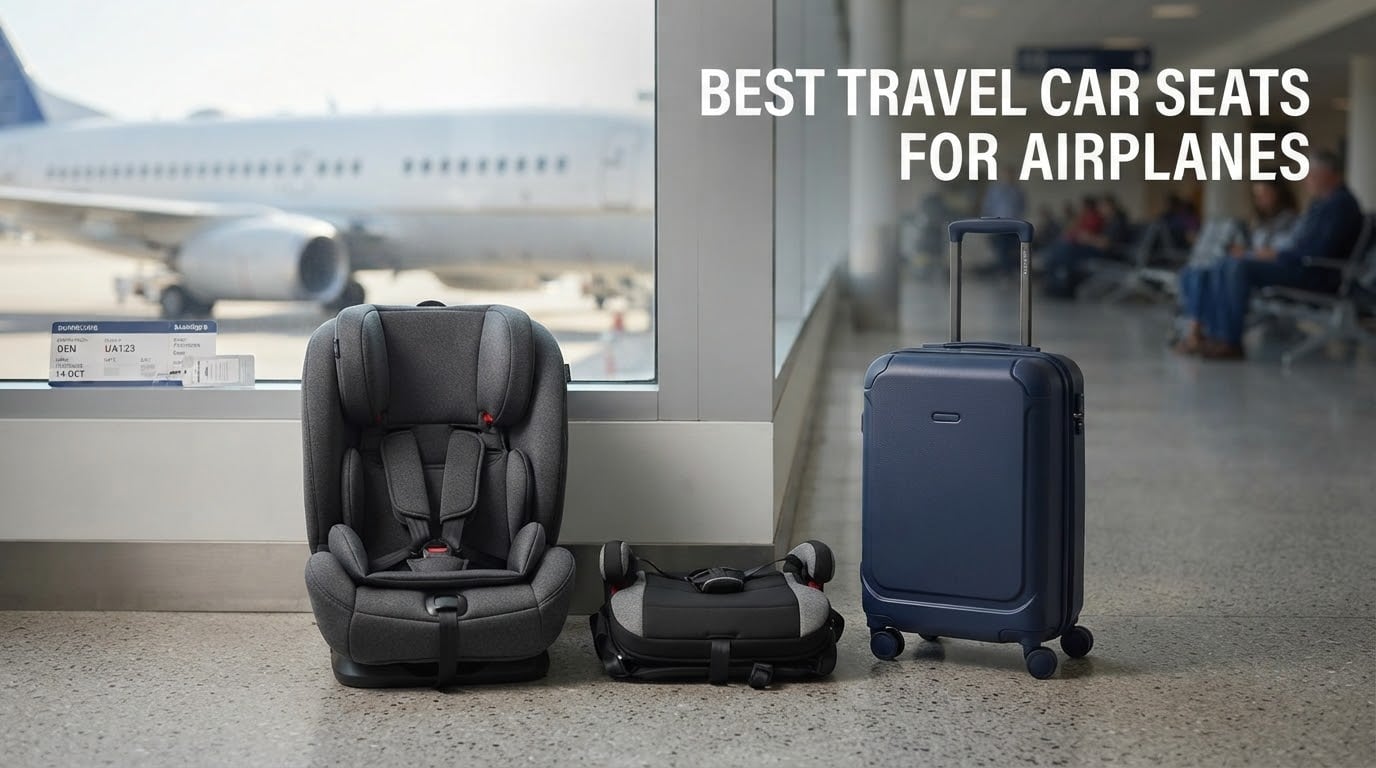
The car seat is the hardest thing to get through an airport. Not the stroller, not the bags, not the car seat.
That is the problem this roundup is built to solve. When you are weighing the best travel car seats for airplanes, two hard numbers decide almost everything: how much the shell weighs in your hands, and whether the airline will let you carry it into the cabin at all. Everything else, including how good a seat looks in a product photo, is secondary.
We compared 12 seats across infant carriers, folding forward-facing seats, high-back boosters and backless boosters. The most useful result turned out to be a blunt one: very few seats on the market carry the aircraft approval that lets a family bring the restraint into the cabin rather than checking it into the hold. In this group of 12, only a small number advertise that label at all.
That gap matters, because the alternative to an approved seat is not just an inconvenience. It is a car seat riding on a conveyor belt, or a rental seat of unknown history waiting at a counter on the other side of the world. Parents on travel forums describe practicing the install at home before the trip specifically so they are not learning it in a rental parking lot with a squalling child.
Table of Contents
- Top 3 Picks for the Best Travel Car Seats for Airplanes in 2026
- All 12 Best Travel Car Seats for Airplanes (October 2026)
- 1. Doona Car Seat and Stroller – the All-in-One That Replaces Two Pieces of Luggage
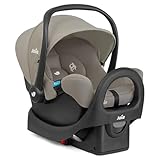
- 2. Joie Rue Infant Car Seat and Base – the Lightest Shell in the Group
- 3. Joie Mint Latch Baseless Infant Seat – the One That Works in Every Vehicle at Once
- 4. RideSafer Gen 5 Vest – the Lightest Thing Here, and Not for the Plane
- 5. WAYB Pico Travel Car Seat – the One That Actually Disappears Into the Overhead Bin
- 6. Mifold Hifold High Back Booster – the One Built for International Trips
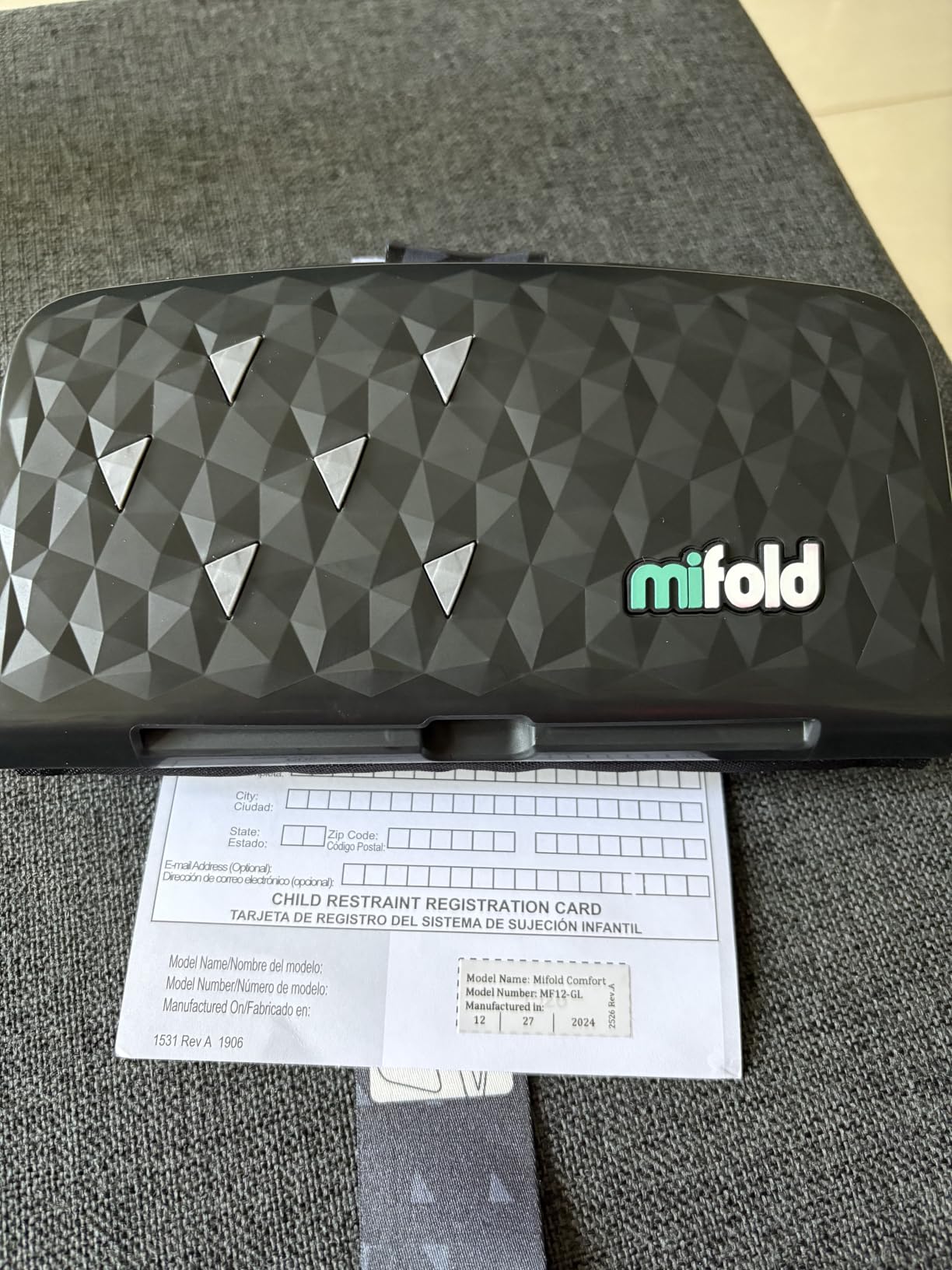
- 7. Mifold Comfort Backless Booster – the One That Lives in a Glove Box
- 8. Peg Perego Viaggio Flex 120 – the High Back That Folds Into a Bin
- 9. Graco TurboBooster 2.0 – the Best-Rated Hard Shell Booster Here
- 10. Baby Trend Protect 2-in-1 Folding Booster – the One That Lives in Every Caregiver’s Trunk
- 11. Hiccapop UberBoost Inflatable Booster – the One That Fits in a Carry-On
- 12. BubbleBum Inflatable Travel Booster – the Longest-Lasting Inflatable Range
- How to Tell If a Car Seat Is Actually Allowed on a Plane
- What Actually Matters When You Choose: Age First, Then Weight, Then Everything Else
- Getting the Seat Through the Airport and Into the Car
- Frequently Asked Questions
- What is the best lightweight car seat for airplane travel?
- Which car seat brands are FAA-approved for airplanes?
- Can I use a booster seat on an airplane?
- How do I know if my car seat is FAA approved?
- Is it worth bringing a car seat on a plane?
- Does a car seat go through the TSA scanner?
- Can you gate check a car seat?
- What is the best travel car seat for a child under 40 lbs?
- Our Verdict on the Best Travel Car Seats for Airplanes
Top 3 Picks for the Best Travel Car Seats for Airplanes in 2026

Doona Car Seat and Stroller
- Converts from car seat to stroller in seconds
- FAA and TUV aircraft approved
- 4-30 lb capacity rear-facing only

Graco TurboBooster 2.0
- 2-in-1 high back to backless conversion
- Height-adjustable armrests and head support
- Retractable hide-away cup holders

Hiccapop UberBoost Inflatable
- Inflates in under 20 seconds
- Deflates into its own travel bag
- FMVSS 213 compliant
As an Amazon Associate we earn from qualifying purchases. CERTAIN CONTENT THAT APPEARS ON THIS SITE COMES FROM AMAZON. THIS CONTENT IS PROVIDED 'AS IS' AND IS SUBJECT TO CHANGE OR REMOVAL AT ANY TIME.
The Doona wins because it removes an entire piece of luggage. For a family with a baby under 30 lbs, the same object serves as the rear-facing car seat on the plane, the stroller through the terminal, and the car seat in a rental vehicle. Its 15400 reviews at 4.8 stars are the deepest well of real-world travel feedback in this list.
The Graco TurboBooster 2.0 sits at the other end of the age range and is the highest rated hard-shell booster here. The Hiccapop UberBoost wins on logistics: it deflates to nothing and works in any car with a three-point belt, which is exactly the rental and rideshare case.
All 12 Best Travel Car Seats for Airplanes (October 2026)
| Product | Specifications | Action |
|---|---|---|
|
Doona Car Seat and Stroller
|
|
Check Latest Price |
 Joie Rue Infant Car Seat and Base
|
|
Check Latest Price |
 Joie Mint Latch Baseless Infant Seat
|
|
Check Latest Price |
 RideSafer Gen 5 Vest
|
|
Check Latest Price |
 WAYB Pico Travel Car Seat
|
|
Check Latest Price |
 Mifold Hifold High Back Booster
|
|
Check Latest Price |
 Mifold Comfort Backless Booster
|
|
Check Latest Price |
 Peg Perego Viaggio Flex 120
|
|
Check Latest Price |
|
Graco TurboBooster 2.0
|
|
Check Latest Price |
 Baby Trend Protect 2-in-1 Booster
|
|
Check Latest Price |
|
Hiccapop UberBoost Inflatable Booster
|
|
Check Latest Price |
 BubbleBum Inflatable Travel Booster
|
|
Check Latest Price |
We earn from qualifying purchases. CERTAIN CONTENT THAT APPEARS ON THIS SITE COMES FROM AMAZON. THIS CONTENT IS PROVIDED 'AS IS' AND IS SUBJECT TO CHANGE OR REMOVAL AT ANY TIME.
Read that table for age first, not for weight. Three of these products are for children under 30 lbs, one is a forward-facing seat for the 26.5 to 50 lb band, and eight are for children over 40 lbs. The gap between those groups is where most travel mistakes happen. A family flying with a 3 year old and a 6 year old needs two entirely different products, and neither of them is a folding bucket seat.
1. Doona Car Seat and Stroller – the All-in-One That Replaces Two Pieces of Luggage
Doona Car Seat & Stroller, Nitro Black – All-in-One Travel System
- Rear-facing only
- 4-30 lb capacity
- 17.2 lb seat and stroller, 9.7 lb base
- FAA and TUV aircraft approved
Pros
- One-click conversion from rear-facing car seat to stroller
- FAA and TUV approved so it can stay in the cabin
- Compact enough for narrow aisles and crowded terminals
- Steers one-handed with the canopy up
Cons
- Heavier than a standard infant seat because of the integrated wheels
- Carry case sold separately
- Rear-facing only and outgrown past 30 lbs
The Doona is the only product in this roundup that removes an entire item from your packing list. One click releases the wheels and the rear-facing car seat becomes a stroller, with the child still in it, in the middle of a terminal.
The numbers explain why it works as a travel product. Capacity is 4 to 30 lbs rear-facing only, the shell is fiber-reinforced polymers with rust-free aluminum, and the seat and stroller assembly weighs 17.2 lbs with a separate 9.7 lb base. Folded, it measures 17.4 by 26 by 22.4 inches, small enough to move through an elevator door without turning sideways.
Safety hardware is where the design earns its keep: three layers of side impact protection, an anti-rebound bar, and a five-point harness. The near-flat infant insert supports a newborn’s upper and lower back and keeps the neck aligned, and a UPF 50+ water-repellant canopy handles the glare and drizzle between terminal and curb.
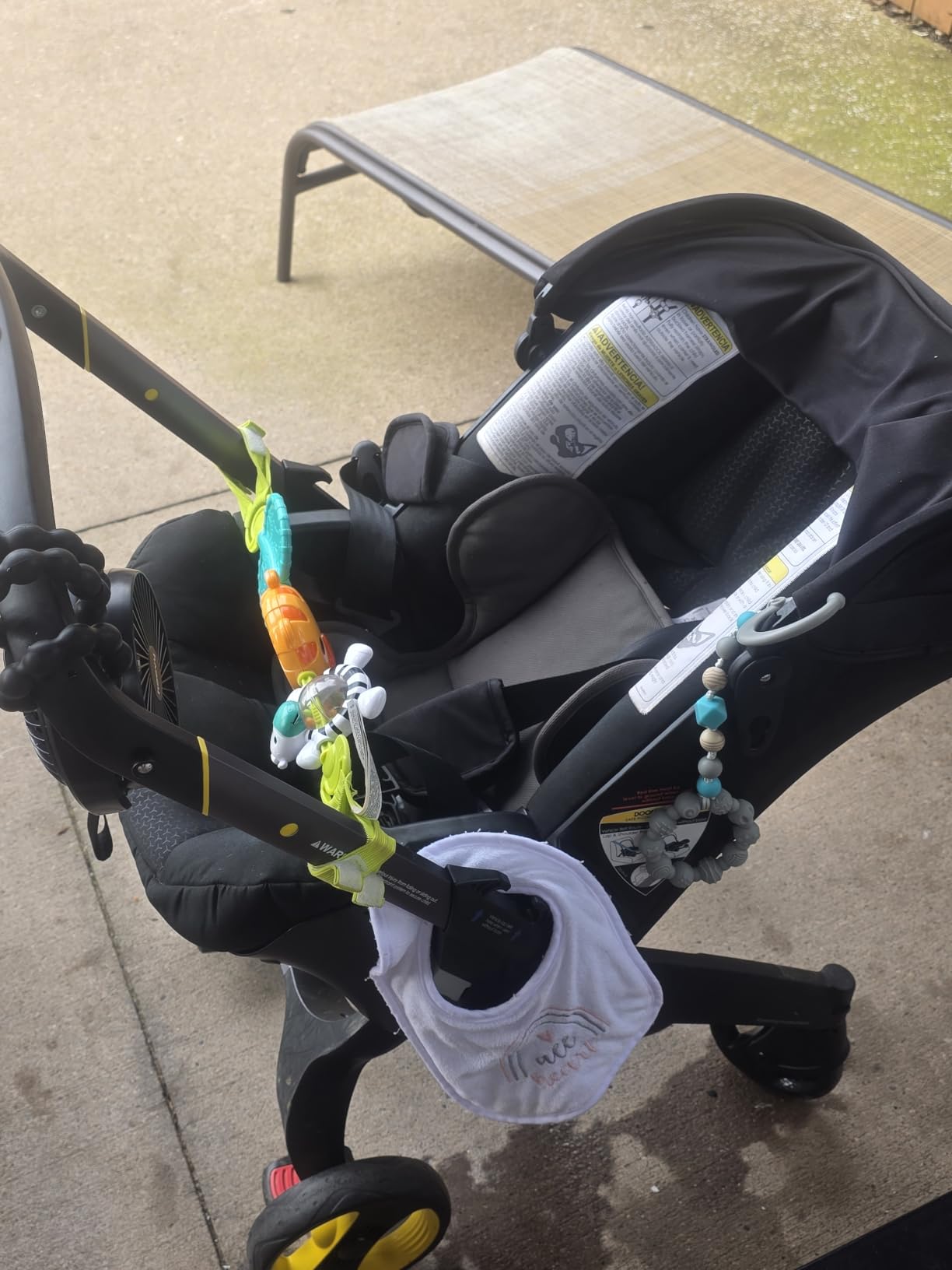
FAA and TUV aircraft approval is the detail that puts this seat at the top of the list of the best travel car seats for airplanes. Approved seats can be brought into the cabin on a purchased ticket and, if the flight attendant asks, gate-checked at the jet bridge instead of the ticket counter. Parents on parent-run forums specifically recommend photographing the red approval label before departure, because crew sometimes want to see it.
What is in the box matters for planning: car seat, stroller frame, infant insert and head support, a vehicle seat protector, and a LATCH base. The seat protector is an underrated inclusion, because rental car seats are exactly where the buckle digs in.
The honest drawback is weight. Parents on travel forums call the Doona heavy at 17 lbs and hard to carry through a long airport, and that complaint comes up every time. The cover is also awkward to launder, and the carrying case is a separate purchase. If your baby is past 30 lbs, this seat is finished, and no amount of cleverness extends it.
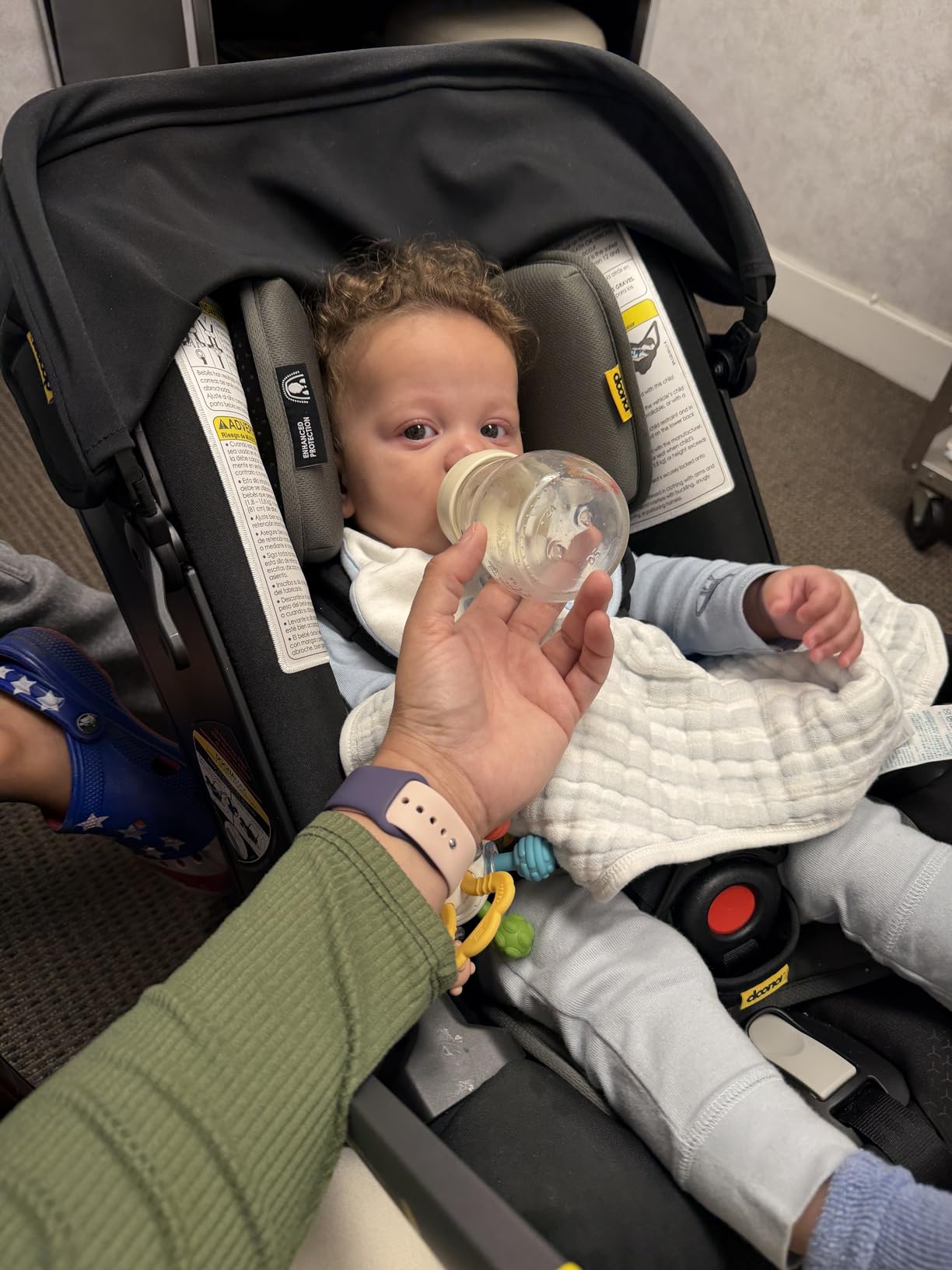
Who the Doona fits and who it does not
It fits babies from 4 lbs up to the 30 lb ceiling, and it is the strongest choice when the destination involves more than a plane, because the stroller function carries you from curb to rental car without a second bulky item. It is also the seat we would pick for a newborn who will not be forward-facing for years, since a rear-facing carrier is the only safe option for them anyway.
It does not fit a toddler who walks, a child over 30 lbs, or a parent who wants a single item for two children. It is also the heaviest thing on this list, so if you are already carrying a full-size seat for an older child, the total load adds up fast. For a family with a 2 year old plus a 6 year old, this pairing costs you two different products and a lot of arm strength.
What to check before you buy
Check the fit of the infant insert on day one, before you leave for the airport. A newborn who has outgrown the insert is safer in the seat with the insert removed than in a different carrier. Also confirm whether your airline charges for the extra infant seat, and book it in advance rather than assuming a boarding pass covers it.
Finally, weigh the stroller question honestly. If your trip is a single flight to a city with flat sidewalks, the Doona earns its size. If your trip involves a long walk across a rough plaza or a train connection, a separate lightweight stroller plus a plain carrier may be lighter overall. We have packed both, and the trade flips depending on how much walking is ahead.
2. Joie Rue Infant Car Seat and Base – the Lightest Shell in the Group
Joie Rue Lightweight Infant Car Seat with Anti-Rebound Base
- Rear-facing infant seat
- 7.8 lb seat shell, 16 lb with base
- 4-30 lbs and 30 in tall
- FMVSS 213a and 213b certified
Pros
- 7.8 lb shell is one of the lightest infant carriers available
- Anti-rebound bar built into the base
- Rigid lower anchor attachments install the base quickly
- Removable inserts and a UPF 50+ canopy adapt as baby grows
Cons
- The base adds more than 8 lbs to the total carry weight
- Heavier than baseless carriers once the base is counted
The Joie Rue is a plain, competent infant carrier with one standout number: 7.8 lbs for the seat alone. That figure is the reason it appears on this list. If your plan is a flight, a taxi, and a short rental car stay, the shell is genuinely easy to lift over a gate, into a trunk, or onto a stroller frame.
It is certified to FMVSS 213a and 213b, takes children from 4 to 30 lbs and up to 30 inches, and is travel-system compatible. Removable three-piece inserts give you head support, body support and an infant wedge, and the knit fabrics are described as breathable, which matters in a seat that sits under a terminal ceiling for four hours.
The base is the story. The full package weighs 16 lbs against 7.7 lbs for the shell alone, and the base adds an anti-rebound bar that limits how far the shell can travel toward the back of the vehicle in a crash. Built-in lower anchor attachments mean you are not threading connectors with cold hands. Dimensions are 25.75 inches long by 17.5 wide by 16 high for the shell, 22.8 high with the base fitted.
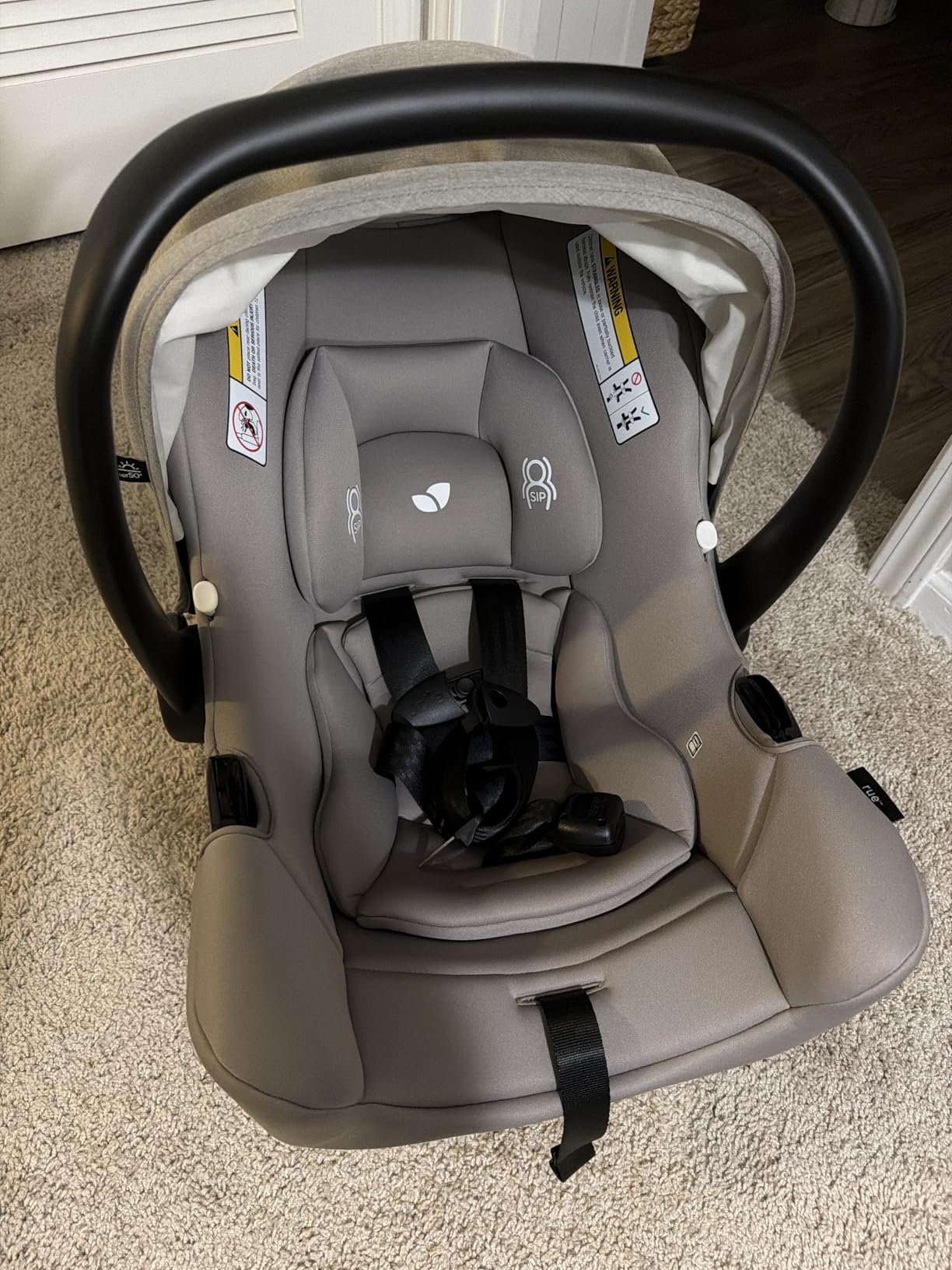
Where the Joie Rue loses to the Doona is obvious: you are carrying two objects, not one. Reviewers note that the base is the item you will resent hauling through an airport, and the design assumes you will need it at the destination. If you are only using taxis and rideshares, the base is dead weight you will leave in a hotel room.
Where this listing does not state aircraft approval the way the Doona does is worth noting. A seat built to FMVSS 213 is compliant for vehicles, and most infant seats in the category are not automatically cleared for cabin use, so confirm the label on the shell before you plan to carry it on. If the label is not there, this becomes a gate-check item rather than a cabin item.
Airline rules are the second thing to check. Under 2 is generally free in a lap, but a paid seat with its own restraint is a different booking. If you want the child in a car seat, you buy a ticket for them, and that ticket has to exist before you arrive at the counter.
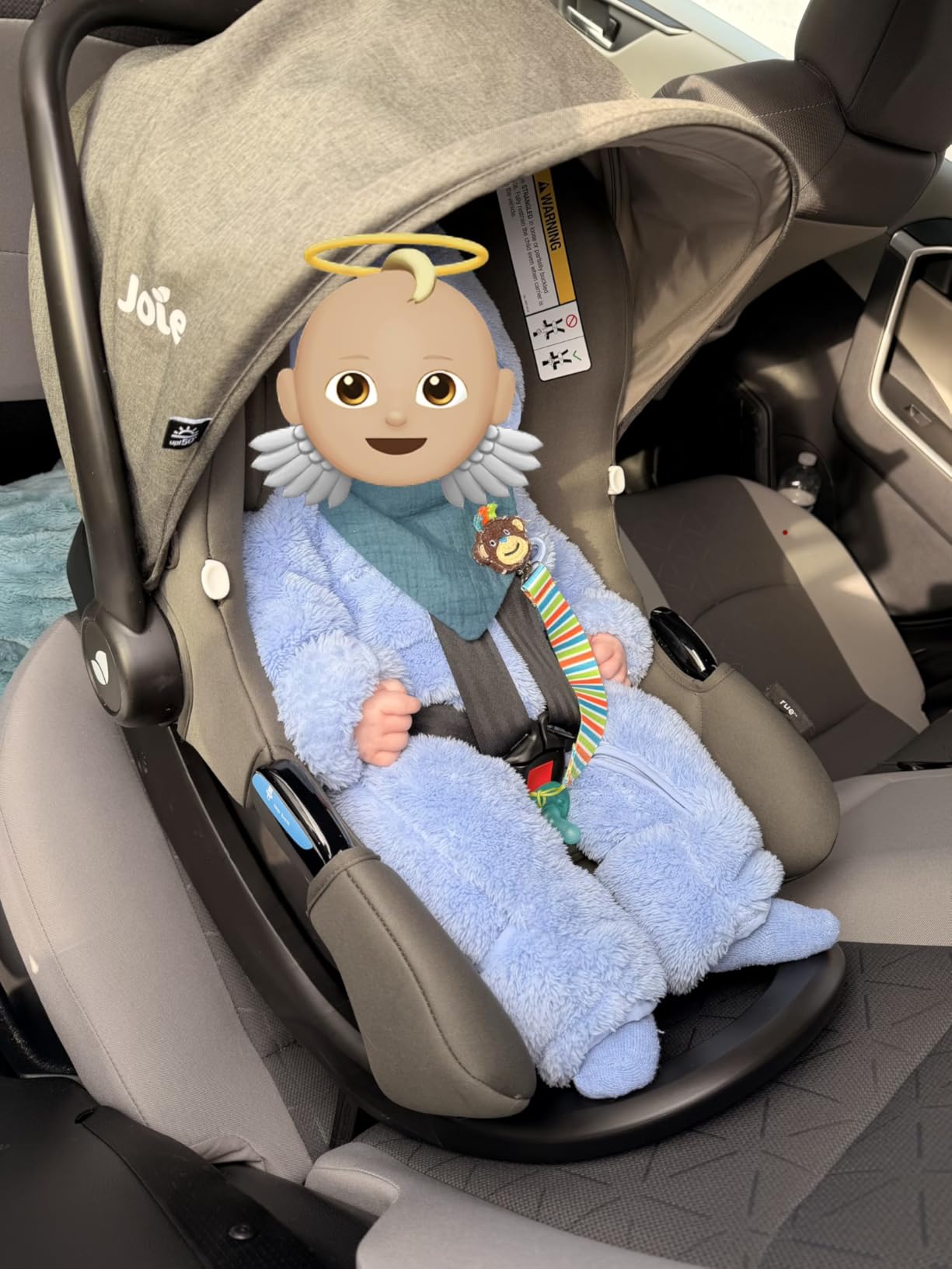
When the Joie Rue is the right pick
It is right when you already own a stroller frame that this seat clicks into, and when your child is small enough that the anti-rebound base is worth its weight. It is also a sensible choice as a second infant seat that lives with a grandparent, rather than a primary travel seat.
It is wrong when the base has to come along every time. If your travel day is gate to gate, gate agent, gate, the base is being carried for nothing, and a baseless design is the more honest engineering choice.
How the fit holds up in a real terminal
Test the shell on the floor of your home, not in the store. Sit the baby in it, adjust the harness until the chest clip sits at armpit level, and pull the harness snug at the shoulder until you can only fit one finger underneath. That is the standard check, and doing it once at home means you are not doing arithmetic on an airport floor with a boarding pass in one hand.
Bring a thin blanket for the flight, because infant seats do not insulate. And bring a wipe-down cloth, since the fabric on any infant seat collects spills long before the flight is over.
3. Joie Mint Latch Baseless Infant Seat – the One That Works in Every Vehicle at Once
Joie Mint Latch Baseless Infant Car Seat – Lightweight, Built-in Rigid Lower Anchor Attachments and Side-Impact Protection – No Base Installation Required, Travel-Friendly Design (Dove)
- Baseless design
- 9.3 lb shell
- FAA-certified for aircraft use
- 4-30 lbs and 30 in tall
Pros
- No separate base to install in a plane
- rental car or rideshare
- FAA-certified for aircraft use with seat belt installation
- Three recline angles match different vehicle seat backs
- Side-impact protection at 9.3 lbs
Cons
- Costs more than typical base-and-seat infant packages
- Integrated LATCH still needs anchors or a usable belt path
Most infant travel advice points at a real contradiction: you want a seat with a base in a rental car, and you do not want a base in a terminal. The Joie Mint resolves it by deleting the base. The lower anchor attachments are integrated into the shell, so one object handles the airplane seat, the rental car, the taxi and the rideshare.
It is 9.3 lbs, certified to FMVSS 213a and 213b, and explicitly listed as FAA-certified for aircraft use with seat belt installation. That line is the one to look for, and it is what separates this from a generic infant seat that happens to be light. Capacity is 4 to 30 lbs and up to 30 inches, with a full-coverage UPF 50+ canopy and breathable knit fabrics for a long flight.
Three adjustable recline angles are the feature we would not have predicted to matter, and then realized matters a lot. Airplane seat backs recline less than car seat backs, and a carrier set to a car angle sits at an uncomfortable angle in the air. Being able to match the shell to whatever the vehicle gives you is what makes this a travel seat rather than a car seat that tolerates airplanes.
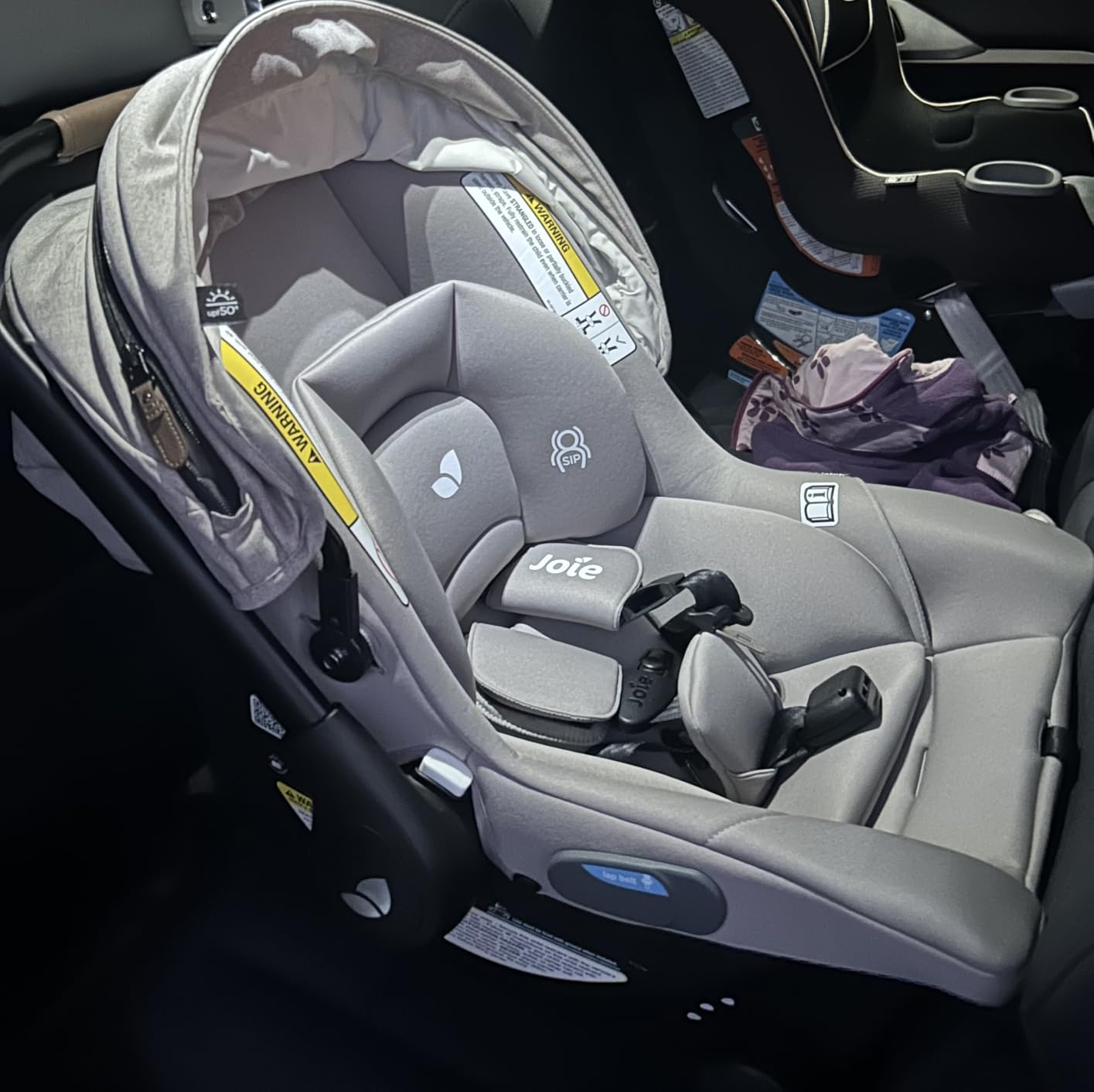
Dimensions are 27.75 inches long, 17.75 wide and 23.25 high, and the height is the number to think about rather than the width. Height determines whether the recline and head support still work for your child in a reclined air seat, and 23 inches is tall for a narrow cabin row.
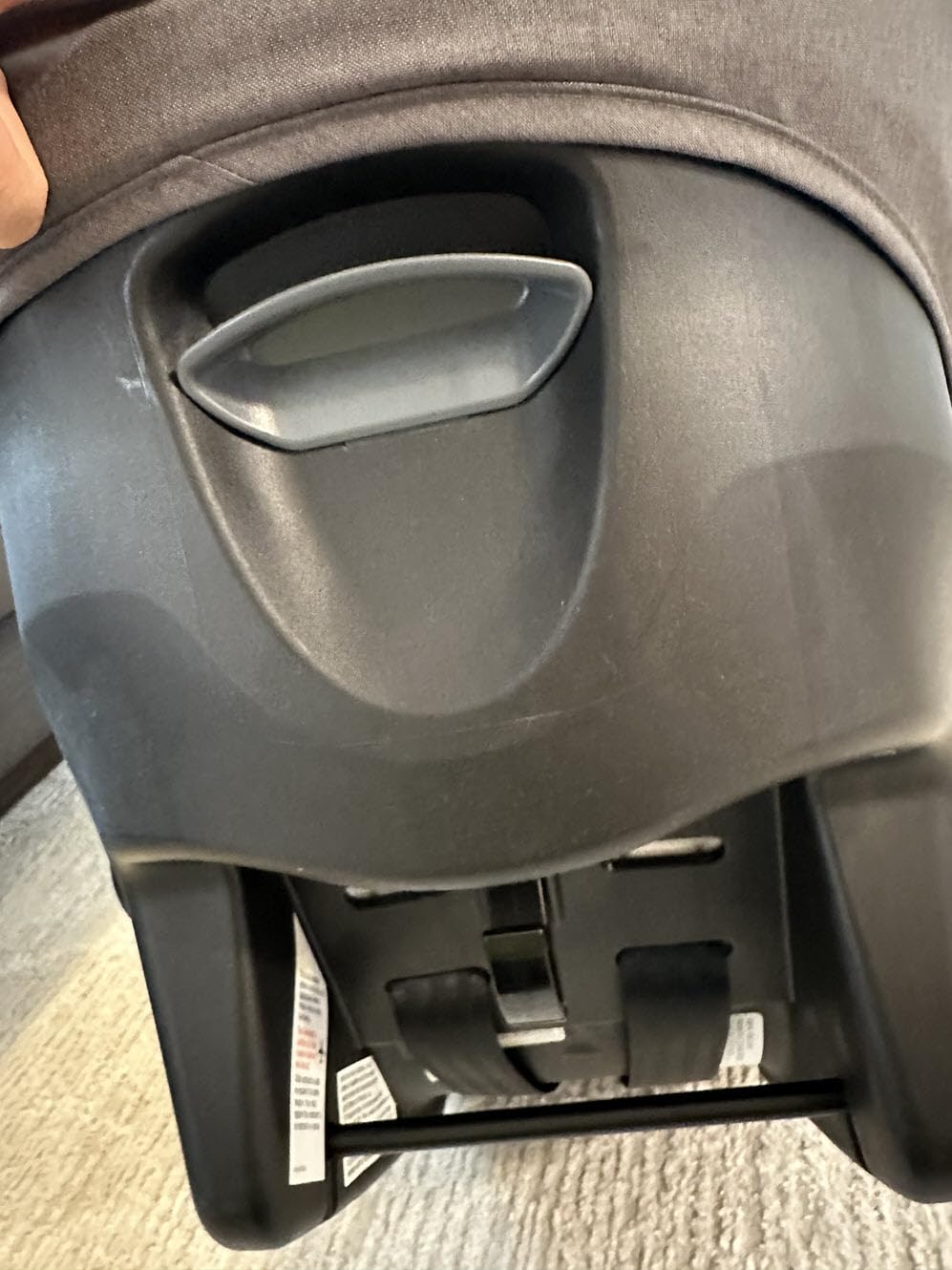
The installation is genuinely simple in a way that sounds too good: click the built-in rigid lower anchors into the vehicle anchor points, or use the vehicle belt. On a plane you use the belt. There is no base to leave behind, nothing to lose at the counter, and nothing to wash in a hotel sink.
The honest limits are financial and mechanical. This costs more than the typical base-and-seat package, and the integrated LATCH still assumes your vehicle has anchor points or a belt path you can use. It is not a fix for a vehicle with no usable belt path, which is rare but real in older cars.
Where this seat earns its place
This is the seat to buy if your trips are one forward, one back, and the middle involves a rental car you did not choose. It is also the strongest answer for a family with a part-time caregiver who needs one device for a train, a taxi and a grandparent’s hatchback. Owners consistently describe that as the reason they keep coming back to it.
It is not the answer for a newborn who will travel many times over two years and rarely leave the house between them, where a heavier seat with a base and an infant insert is more comfortable for long stretches. The insert here is removable rather than absent, so check that the wedge and body support still give you the shape you need.
What we would practice before the trip
Practice the belt install, not the LATCH install. On a plane there are no lower anchors, and the difference in feel between the two is significant. Thread the belt through the marked path, lock the retractor by pulling the belt all the way out until it clicks, then do the pinch test at the belt path and at the shoulder.
Then check the label yourself. Find the red aircraft approval sticker, photograph it with your phone, and keep the photo on the same device as your boarding pass. It costs nothing and it settles the conversation instantly if a gate agent asks.
4. RideSafer Gen 5 Vest – the Lightest Thing Here, and Not for the Plane
RideSafer Gen 5 – Extra Large Black, Lightweight, Compact, Portable Car Seat – Perfect for Travel and Everyday Child Safety
- Vest-style restraint
- 2.9 lb
- 80-110 lb range in the X-Large
- 17 x 11 x 4 in
Pros
- Folds flat enough to pack into a backpack
- Works in any car with a three-point belt
- FMVSS 213 compliant for everyday driving
- Carry bag doubles as a backpack
Cons
- Not FAA approved for use in an airline seat
- Adult belt fit is less protective than a hard shell in a crash
- Sizing runs inconsistent between production years
At 2.9 lbs and 17 by 11 by 4 inches, the RideSafer vest is in a different category from everything else on this list. It folds into a shape you can put in a daypack, which means the travel car seat problem is solved by not having a car seat at all for the flight portion of the trip.
Here is the part that trips people up. This is an FMVSS 213 compliant restraint for motor vehicles, sized for 80 to 110 lbs in the X-Large size and recommended for children 3 years and up. It is not FAA approved for an airline seat. Parents frequently assume the reverse, so be clear with yourself about which device is solving which problem.
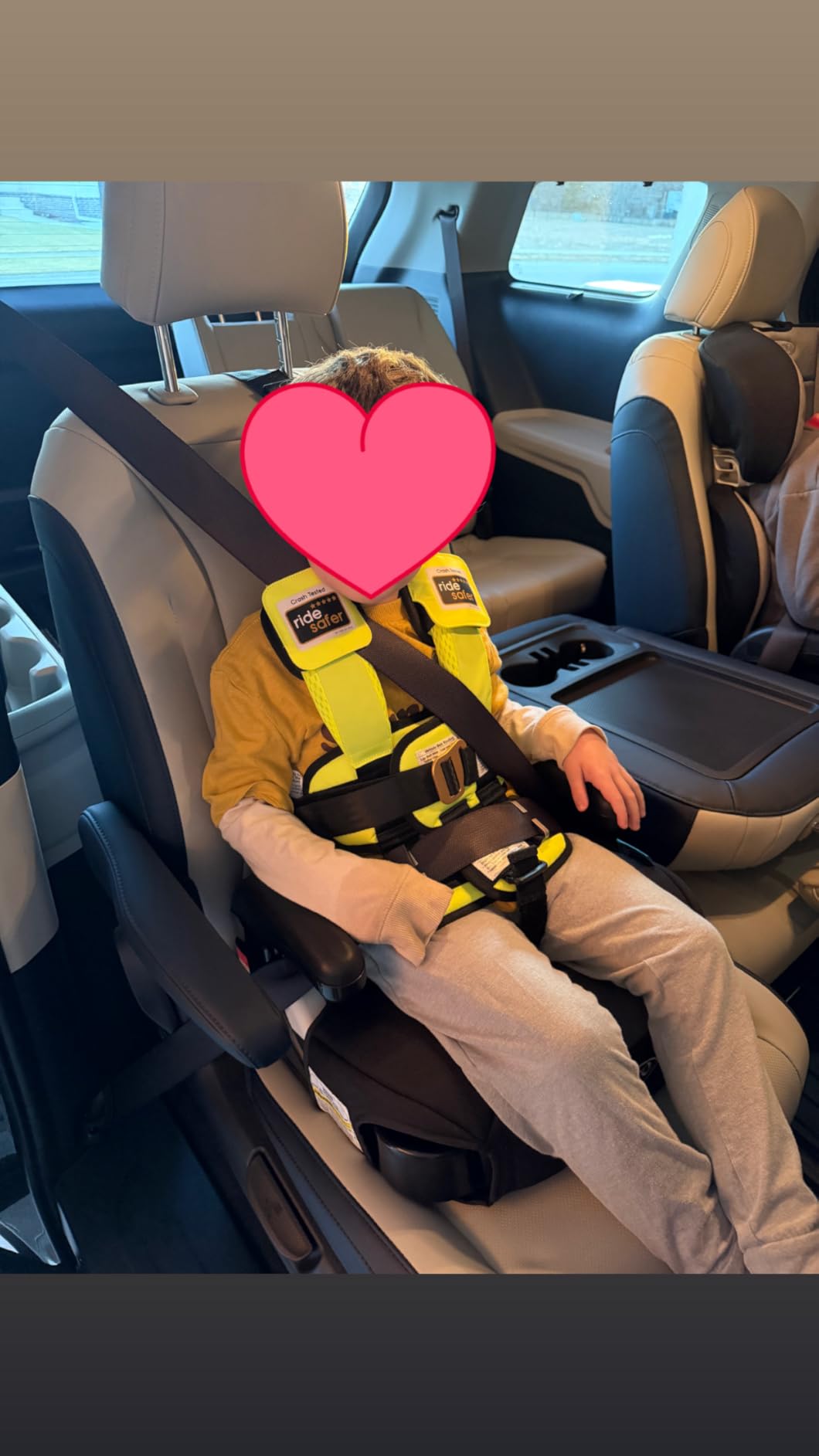
How it works is the part that confuses bystanders. The vest is worn like a garment, and the adult vehicle seat belt routes through the back of the vest so the belt sits on the child rather than on the adult. It can be used with a lap belt and top tether, or with a lap and shoulder belt only. Parents of children who climb out of conventional seats describe the harness as the reason it works at all.
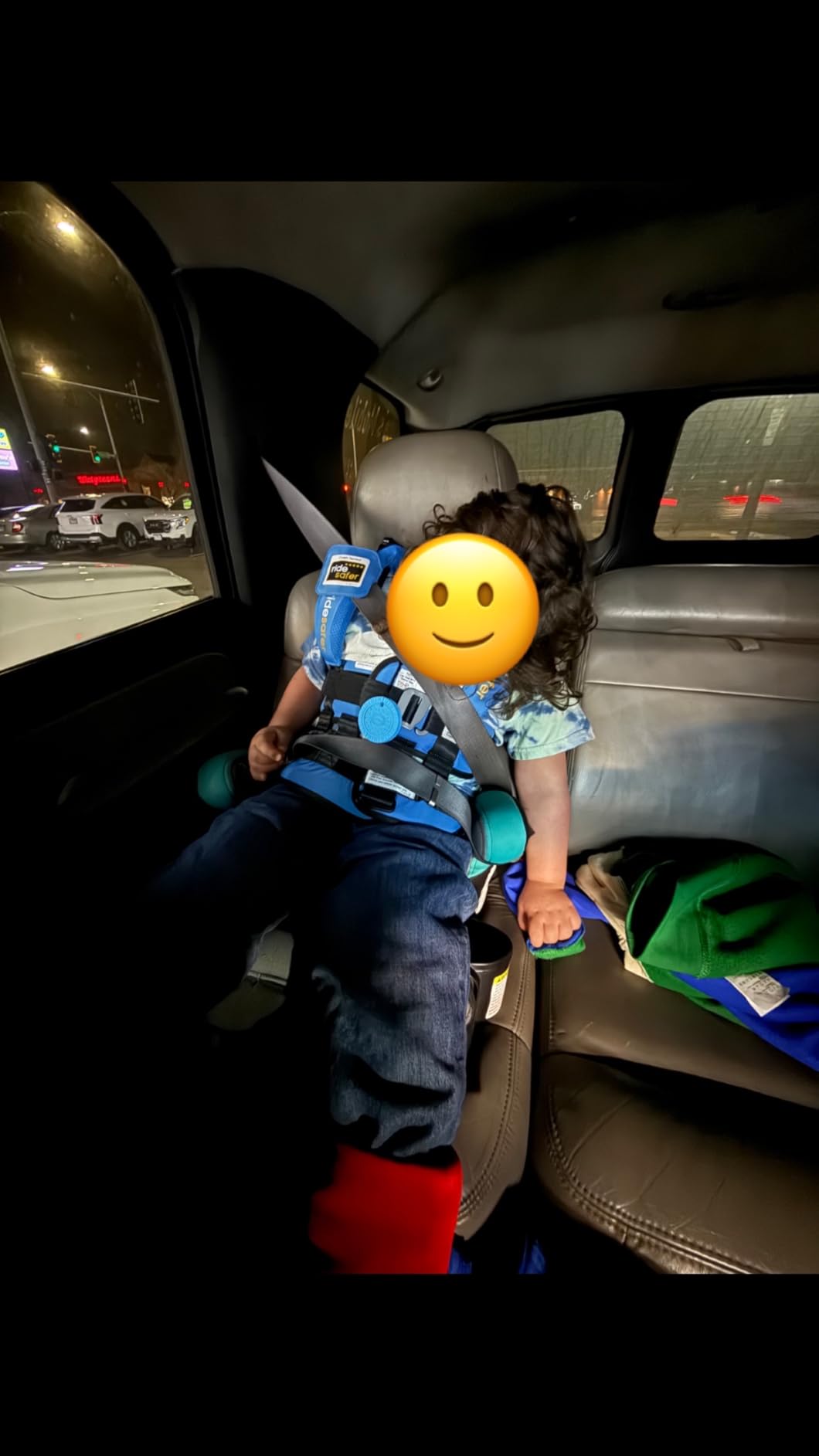
The travel case doubles as a backpack, and that single fact resolves most of the friction. No gate check, no rental counter, no reinstall between vehicles, and no question about whether the seat you found in a taxi has been in a crash. The tradeoff is that you will still need a real seat for the road, whether that is a rental, a grandparent’s car or a borrowed one.
Sizing is the recurring complaint. Reviewers report that sizing varies between production years, and that children on the edge of a range are better served by the next size up. The vest fits three children in one row, which makes it the natural choice for a family in a compact rental car.
Who should buy a vest instead of a seat
Buy it if your child is 80 lbs or more, already fights a five-point harness, and your trips are short-hop with a rental car waiting at the end. This is the lightest, least complicated answer to the destination-car problem, and it is genuinely excellent at that. Buy one for each caregiver so nobody is moving a seat between cars at 7 am.
Do not buy it if your child is under the weight range, if you want a sleep-capable seat, or if you are relying on it for the flight itself. A child who can climb out when unbuckled is also a child for whom a vest is not a walking-around seat, which is a real limitation in airports and museums.
How to fit it in ten minutes
Put the vest on the child, adjust the straps snugly so you cannot slide two fingers under them, then route the vehicle belt through the back guides. The belt should sit low on the hips and across the shoulder, never across the neck, and the shoulder portion should not be tucked under the arm. Buckle, then pull the belt until it is tight, then do the pinch test.
Do this in the parking lot of your own car before you travel, not at the rental counter. It is a two-minute process once you have done it once, and it is far easier on a calm child at home than on a tired one in a rental parking garage.
5. WAYB Pico Travel Car Seat – the One That Actually Disappears Into the Overhead Bin
WAYB Pico Travel Car Seat with Premium Carrying Bag- Lightweight, Portable, Foldable – Perfect for Airplanes, Rideshares, and Road Trips – Forward Facing for Kids 26.5–50 lbs and 33.5–45″
- Forward-facing only
- 8 lb aluminum frame
- Folds to 11.6 x 14.5 x 18.9 in
- 26.5-50 lbs
Pros
- Smallest folded footprint here
- so it fits in an airplane overhead bin
- 8 lbs means one adult can carry and install it
- Folds in one motion and installs in under a minute
- Aluminum frame and no foam make it easy to wipe clean
Cons
- Sits very upright with no recline
- Forward-facing only from 22 or 26.5 lbs
- Highest price point in this roundup
The defining spec for a travel seat is how small it gets when you fold it, and the WAYB Pico wins that measurement in this group. Folded it is 11.6 by 14.5 by 18.9 inches, which is the smallest footprint of the folding hard shells here and the one we would plan a bin stowage around rather than hope a gate agent allows.
At 8 lbs, the frame is aerospace-grade aluminum wrapped in a fabric cover rather than injection-molded plastic. The cover is AstroKnit wool and polyester mesh, and the carry bag is made from bluesign certified recycled polyester with no PU, EVA or EPS foam anywhere in the construction. For a seat that will be hauled through airports and wiped down, that matters more than it sounds.
It is FAA approved with the sticker on the bottom of the seat, and it meets U.S. safety standards regulated by NHTSA and the FAA. Weight range is 26.5 to 50 lbs and height 33.5 to 45 inches, for ages 2 and up. Seats manufactured before June 30, 2025 support children from 22 lbs and 30 inches, so check what you are actually buying.
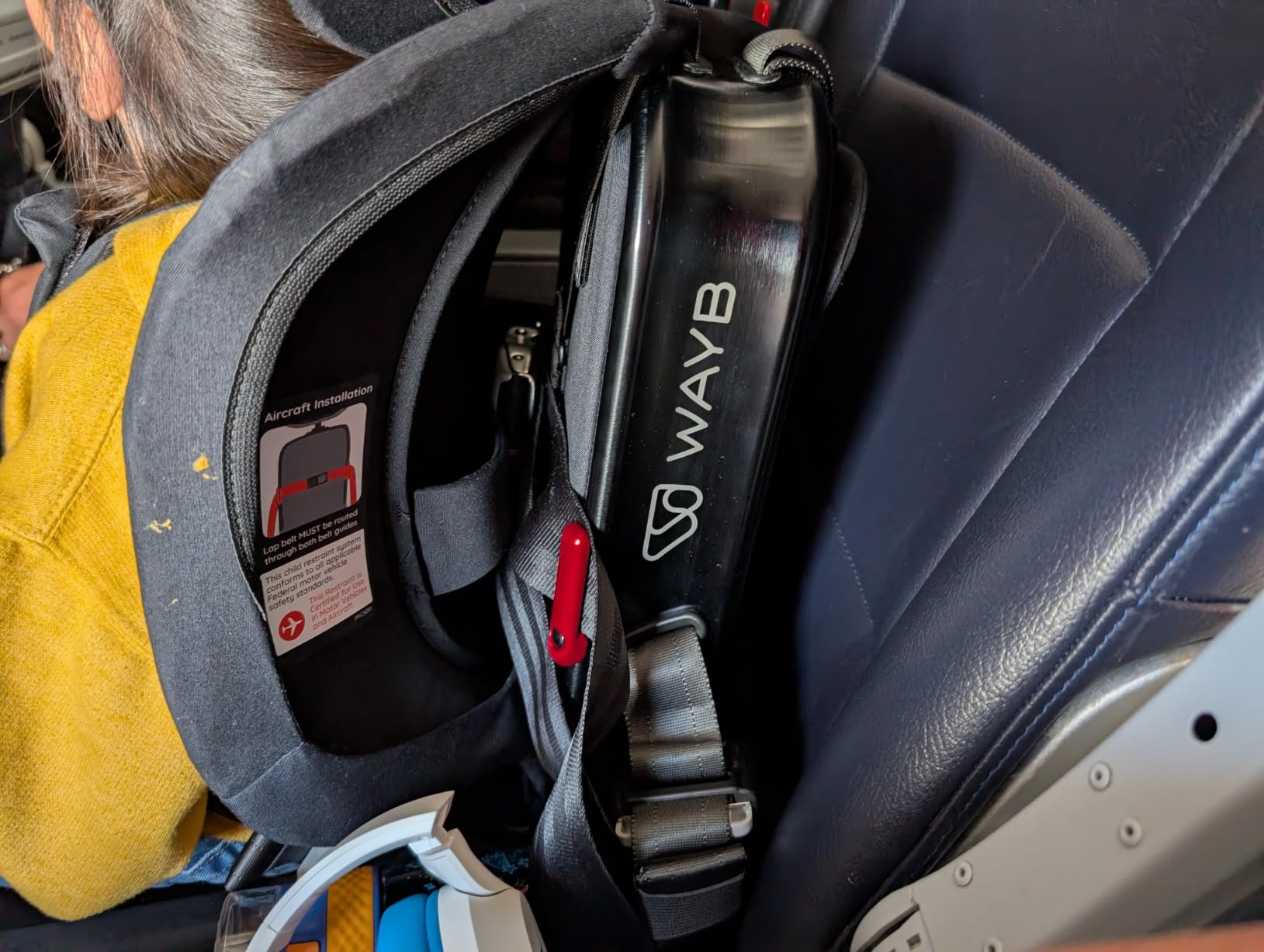
The harness does not loop over the seat back, which is a thoughtful detail rather than a gimmick. In a conventional seat installed on a plane, the harness has to pass around the seat back and the passenger behind you pays for it. Here, nobody behind you is disturbed, and the lap belt threads through the marked path with no guessing.
What you give up for that folded size is comfort. The Pico sits very upright with no recline at all, and a meaningful share of its one-star reviews are about exactly that, not about safety. A child who sleeps on car rides will not sleep here, and a child prone to motion sickness is a poor match for a fixed upright posture over three hours.
The other limit is scope. It is forward-facing only, so it cannot serve a rear-facing toddler at all, and the narrow interior with a short crotch buckle can be tight for a larger 4 year old. The 4.2 rating out of 171 reviews reflects real approval from frequent flyers balanced against a real design ceiling on who it fits.
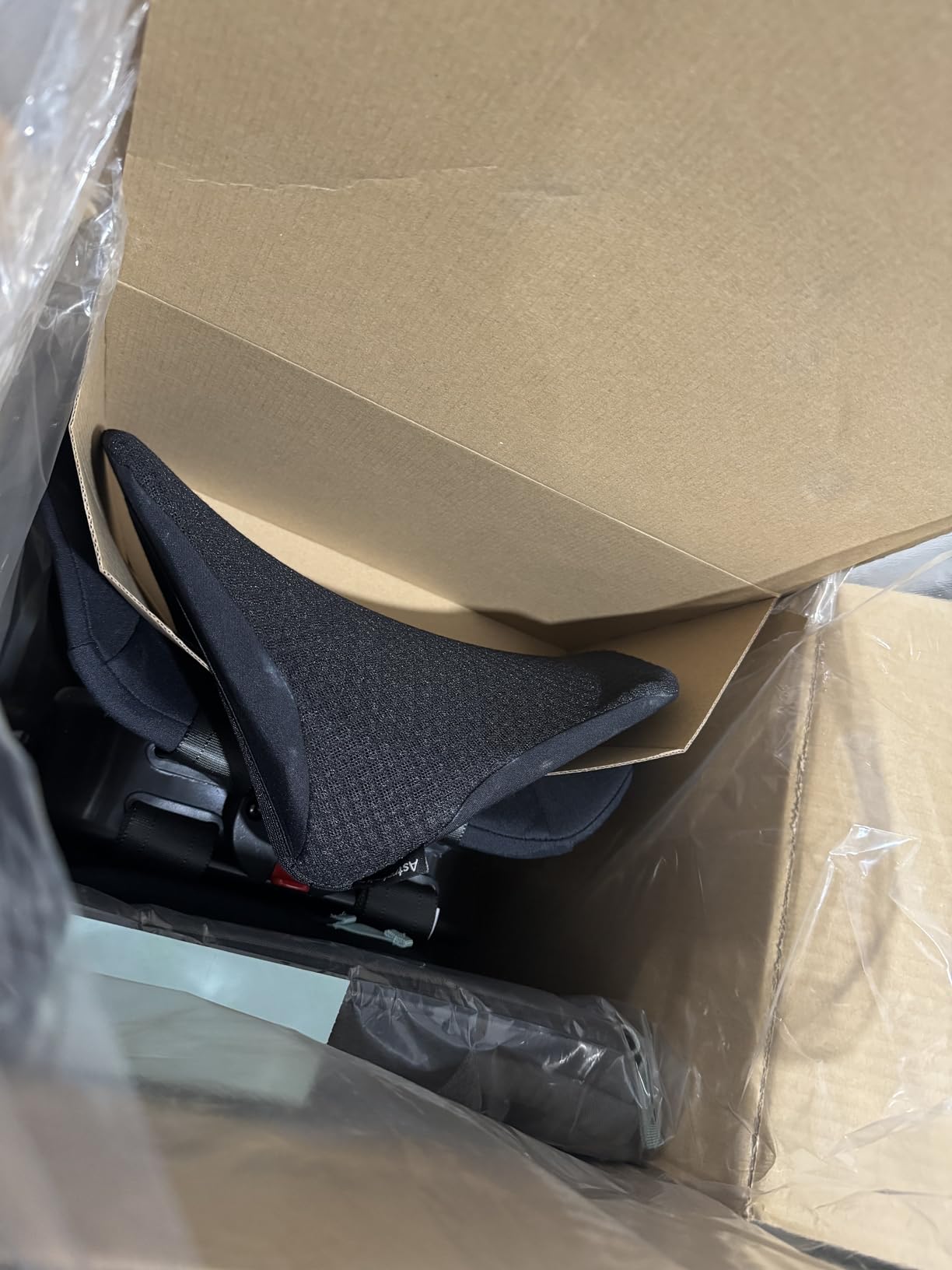
Who the Pico suits
It suits a family with a 2 to 4 year old who already rides forward-facing in a hard-shell seat at home, travels often, and cares more about cabin space and a single-person install than about naps. On a narrow-body flight where overhead space is contested, the folded footprint is the whole argument. Parents note that flight attendants react to how little cabin room it takes.
It does not suit a family with a rear-facing toddler, a baby, or a child who is a reliable napper on the road. If the seat has to be a nap device as well as a restraint, a seat that reclines is worth more than a seat that folds flat.
What to check before the trip
Check the manufacture date on the underside, because the weight minimum changed on June 30, 2025, and a 23 lb toddler needs the pre-2025 version or the newer one with an insert. Check the harness height slots with your child in it, and check that the lap belt path is the one the label specifies rather than the one that looks most convenient.
Measure the seat next to the one you use at home. The Pico gives you side impact protection through the frame and a narrow shell, not the deep energy management of a full-size convertible, and knowing that before you rely on it for a long haul is better than finding out mid-flight.
6. Mifold Hifold High Back Booster – the One Built for International Trips
Mifold Hifold Adjustable Kids High Back Booster Car Seat with Strap – Slate Grey
- High back belt-positioning booster
- 10 lb
- 40-100 lbs and 43.5-59 in
- 243 adjustment settings
Pros
- 243 adjustment points let the seat grow with the child
- Folds to 10.7 x 13.5 in and weighs 10 lbs
- Built-in carry strap removes the need for a separate bag
- Approved for use in most regions worldwide
Cons
- Does not recline
- so it is poor for sleeping children
- Needs a child at least 4 years and 40 lbs who can sit properly
- Fine-tuning four adjustment areas takes patience
The Mifold Hifold stands apart for how long its fit range lasts: 243 individual adjustment settings across four zones, built to follow a child from 4 years old and 40 lbs to 12 years old and 100 lbs. For a family crossing a border, that longevity is the entire value proposition.
It is a belt-positioning booster, not a harness seat, and the vehicle’s own three-point belt does the restraining. The booster’s job is to position the child so the adult belt lands correctly across the hip and shoulder. If your child still needs a five-point harness, this is not the product, and no booster will be.
Size is the other selling point. Unfolded it is 24.7 inches high and 12.8 inches wide, folding to 10.7 by 13.5 inches, at 10 lbs with a built-in carry strap. That is carry-on sized, and the strap means you are not shopping for a separate bag the week before a trip.
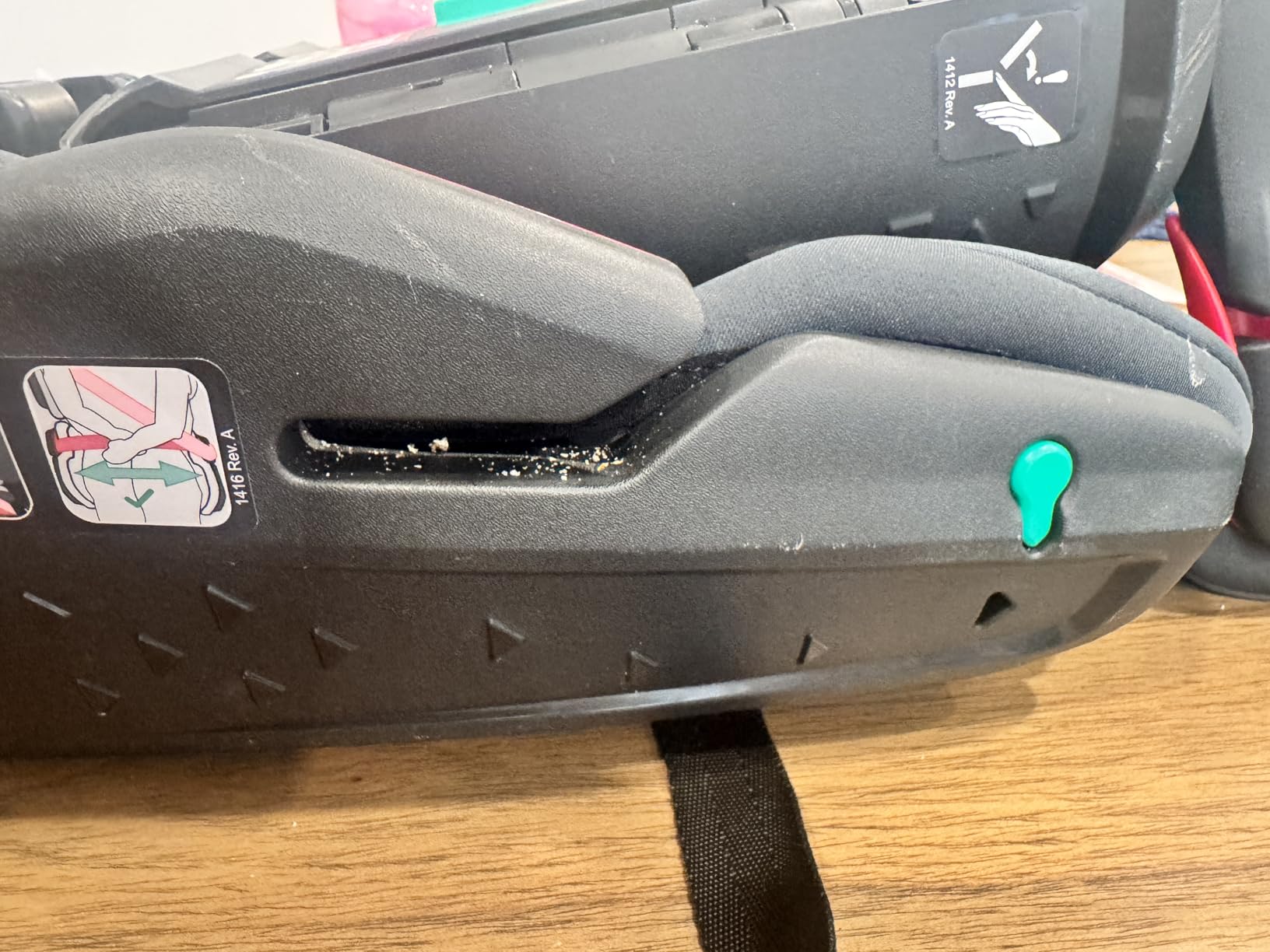
International approval is the reason this one is on the list. It meets or exceeds NHTSA FMVSS 213b and is regulated for global use except Australia and Taiwan. That is a genuinely different regulatory conversation from the rest of this list, and it is worth reading the rules for your destination before you assume a US label transfers.
Adjustments happen in four areas: the seat, the body, the head width and the head height. Each one changes how the adult belt threads through the shell, so a change in the child’s size can be met with a change in belt position. It takes time on the first setup, and reviewers describe the learning curve as the main reason ratings dip from the higher range seen elsewhere in this list.
There is no recline. On a long flight, a child in this booster sits upright against a high back with no angle to fall asleep against, and that is the deal you accept for the folding footprint and the long fit window.
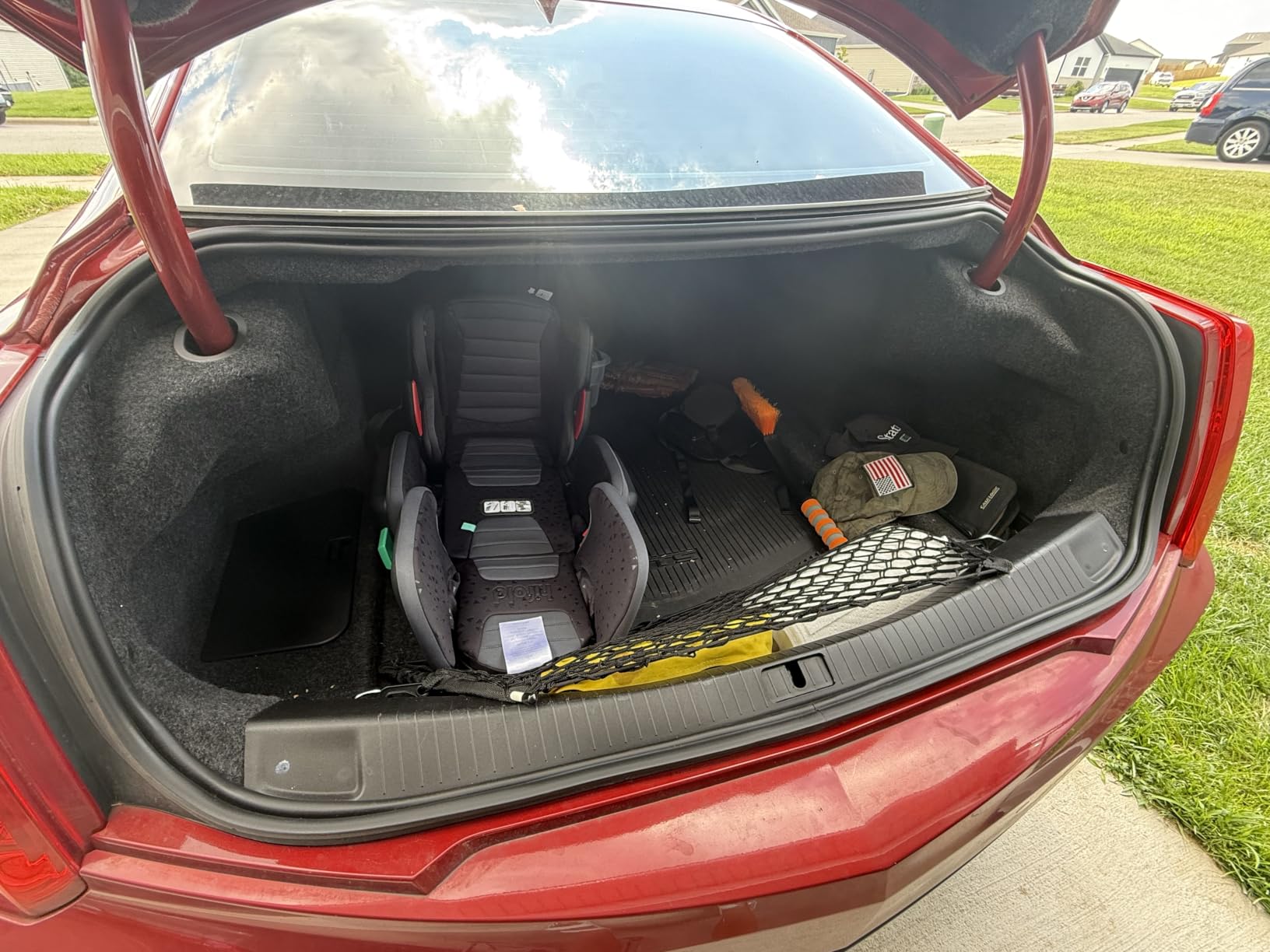
When a high-back booster beats a backless one
High back wins on long flights, on car trips, and for any child who still falls asleep in the car. The shell positions the shoulder belt properly and gives the head somewhere to rest, and for a 4 to 7 year old that is a meaningful difference over a two-hour nap. Backless boosters only make sense once the child is reliably upright and awake for the whole journey.
High back also wins in a three-across layout, because it is the only configuration that keeps the shoulder belt on the shoulder rather than across the collarbone. Backless boosters need a lap and shoulder belt routed in a way that is difficult to guarantee three times over in one row.
Fit checks worth doing twice
Before you buy, sit the child in it and check the fit criteria the manufacturer states: at least 4 years old, 40 to 100 lbs, and 43.5 to 59 inches tall. All three, not just weight. A tall light child and a short heavy child are the two most common mismatches, and both show up in reviews.
After you buy, do the shoulder check in the actual vehicle you will use most. The belt should cross the middle of the shoulder, sit low on the hips on the other side of the body, and stay on the shoulder for the entire trip. If it slips to the neck, adjust the head height before you adjust anything else.
7. Mifold Comfort Backless Booster – the One That Lives in a Glove Box
New Mifold Comfort Grab-and-go Car Backless Booster Seat-Compact and Portable for Every Day, Carpooling, Travel, Charcoal Grey
- Backless belt-positioning booster
- 40-100 lbs and 43.5-59 in
- 4 years and up
- Compact Comfort padded cushion
Pros
- Small enough to live in a glove box or a day bag
- Padded Compact Comfort cushion improves comfort
- No installation
- works in any car with a three-point belt
- Low cost makes it easy to keep one per caregiver
Cons
- Backless design gives no head or side-impact support
- Less refined belt positioning than a high-back booster
- Anti-slip pads rather than anchors
- so it can shift
The Mifold Comfort solves a problem nobody else on this list is trying to solve: keeping a booster permanently present in every car a child uses. It is small enough for a glove box, a backpack or a center console, so it is simply there when a rideshare arrives, when a carpool needs it, or when you borrow a car for a weekend.
It is a backless belt-positioning booster for children 4 and up, 40 to 100 lbs, 43.5 to 59 inches. There is no installation. The adult seat belt does the work, and the booster’s job is to pull the child up to where the belt falls correctly rather than lifting the belt up to reach them.
The updated shell and the extra padded Compact Comfort cushion are the changes over earlier mifold backless models, and the shoulder belt guide and anti-slip pads are the parts that matter in practice. A child sitting on anti-slip pads stays put on cloth upholstery where a bare plastic base would slide.
The limitation is structural, and no product solves it. A backless booster has no shell above the child’s shoulders, so there is no head support, no side-impact protection, and no way for a sleeping child to lean anywhere but forward. For a 7 year old on a three-hour flight, that is uncomfortable in a way a seat with a back simply is not.
It is also dependent on belt geometry. The vehicle belt has to route through the guides and land on the hip, and if the back seat of a particular car has odd anchor geometry or a retractable shoulder belt that shortens as you pull, the fit will not hold. Test it in the specific vehicle before you rely on it.
With 3942 reviews at 4.2, this is a well-proven product with a well-understood ceiling. Roughly 63 percent of its reviews are five stars, and the criticism consistently points at the backless design and the finish quality rather than at safety.
Who this booster is actually for
It is for the family with a child over 40 lbs who travels as a car passenger rather than as a sleeper, who changes vehicles constantly, and who would rather buy three of these than move one heavy seat between cars. Keeping one in each vehicle removes the entire question of whether the seat is there when you need it.
It is not for a long-haul flight with a sleeping child, for a child under 40 lbs, or for a seating position where head support matters. It also is not a substitute for an anchored seat during the drive to and from the airport, where a crash can happen at low speed.
The five-minute check that catches problems early
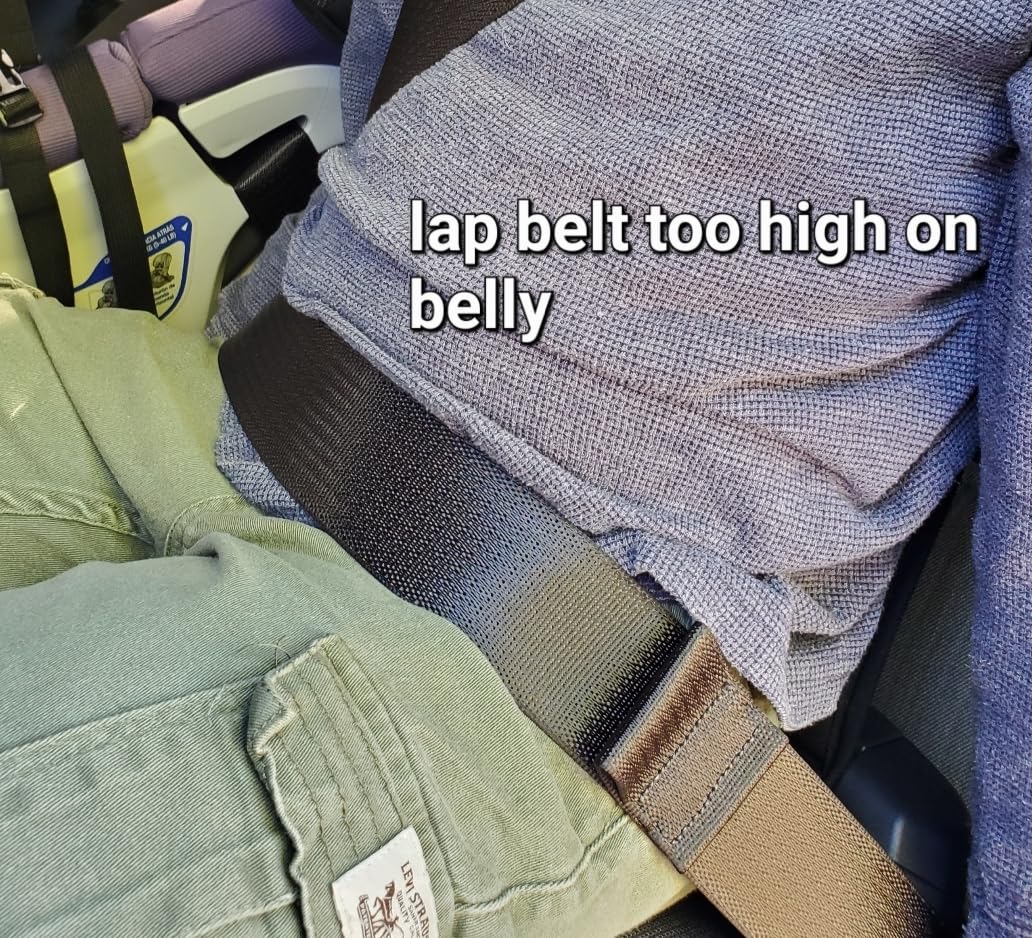
Sit the child in the booster, route the three-point belt through the guides, and pull the belt until it is snug. Look at three things: the shoulder belt is on the shoulder and the chest, the lap belt is low on the hips and not the stomach, and the belt does not slide off the shoulder when you tug the shoulder side.
If the shoulder belt slips, that is a fit failure in that vehicle, not a product failure. Solve it before the trip by testing the next vehicle you would use, and if none of your vehicles pass the check, that is the argument for a high-back booster instead.
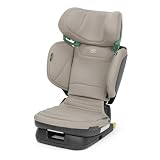
8. Peg Perego Viaggio Flex 120 – the High Back That Folds Into a Bin
PEG Viaggio Flex 120 High Back Folding Booster, Astral (Beige)
- High back folding booster
- 16 lb
- Folds to 9.8 x 23.5 x 17 in
- Unfolded 26.5 x 12 x 17 in
Pros
- Folds to 9.8 inches tall
- so it stows in an overhead bin
- Built-in carry handle simplifies transfers
- High back gives a sleeping child head and side support
- Italian-made Peg Perego construction
Cons
- Heaviest booster in this roundup at 16 lbs
- Folded length of 23.5 inches is deeper than most compact boosters
- No airline-specific FAA approval is claimed in the listing
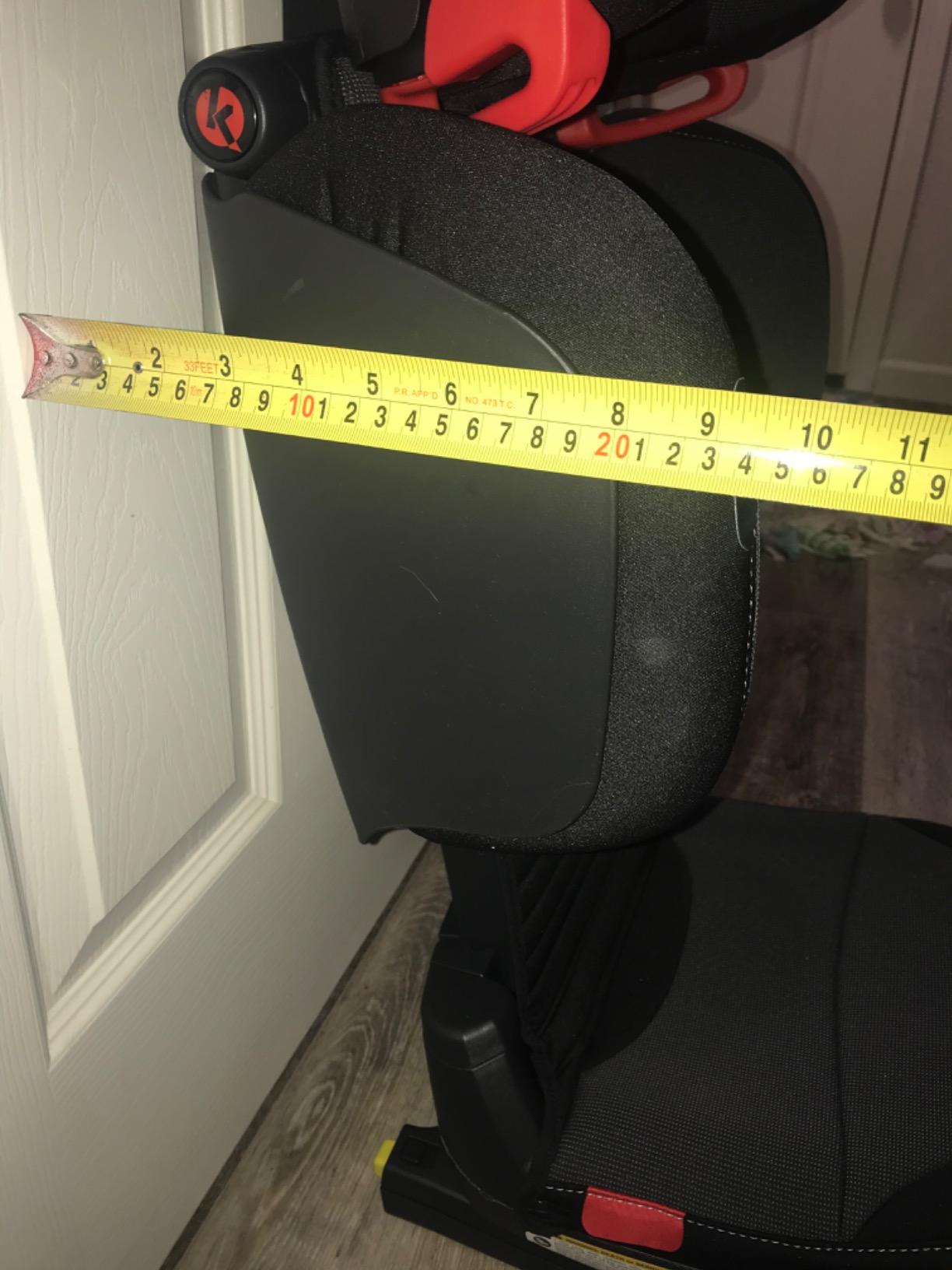
The Peg Perego Viaggio Flex 120 exists to answer a specific complaint about folding boosters: they fold small in one dimension and stay enormous in another. This one folds to 9.8 inches tall, which is the dimension that decides whether it goes in an overhead bin, and its folded length of 23.5 inches is the compromise it pays for that.
Unfolded, it is 26.5 inches high, 12 inches long and 17 inches wide. The 12 inch length is narrow enough to sit next to another seat or an adult in a standard row, and the high back gives a sleeping child a place for the head that a backless booster never will.
At 16 lbs, this is the heaviest booster in the roundup, and we would not pretend otherwise. A built-in carry handle makes the transfer from terminal to trunk manageable, but this is a two-hand carry for most adults and it is the reason this is not our top pick for a solo traveler.
One important check: this listing does not claim airline-specific FAA approval. The travel claims here are about trunks and overhead bins, which is a storage question rather than an aircraft certification question. If you want to carry it into the cabin on a flight, verify the label on the shell with the airline before you rely on it, and assume gate check otherwise.
Construction is Peg Perego’s, made in Italy, with a wide range of fabrics and licensed colorways. The reviews rate it at 4.4 across 431, and the one-star share is smaller than most boosters in this class. Weight and folded depth are the two negatives that appear in nearly every critical review.
It sits in a useful middle ground for a family that has outgrown a forward-facing harness but still naps on car trips. A child at 4 or 5 who falls asleep every 20 minutes in a vehicle is exactly the case a high back solves and a backless booster makes worse.
When this booster beats the lighter options
It beats them when head support is the deciding factor and the child still sleeps in vehicles. Among folding high backs, it beats them on the folded height, which is the measurement that determines bin access. It also beats them on build quality feel, which is subjective but shows up in the ratings.
It loses to the inflatable and backless options on weight, to the Mifold Hifold on fit range, and to every hard-shell option on how fast you can move it between vehicles. If you will only fly twice a year and drive every day, this is not the right emphasis.
Measure before you commit
Measure the folded height and the folded length against the actual bin and the actual trunk you will use, not against a spec sheet. A 23.5 inch length fits most sedans and SUVs but can be awkward in a compact car with a short trunk, and the 16 lb weight matters far more when you are also handling a suitcase and a toddler.
Then check the belt fit in the back seat you will use, with the child in it. The shoulder belt should stay on the shoulder throughout the trip. If it does not, the armrest or head support positions need adjusting before you rely on the seat on a long drive.
9. Graco TurboBooster 2.0 – the Best-Rated Hard Shell Booster Here
Graco TurboBooster 2.0 Highback & Backless Booster Booster Car Seat, Freya
- 2-in-1 high back and backless booster
- Graco ProtectPlus crash engineering
- Height-adjustable armrests and head support
- Retractable hide-away cup holders
Pros
- Converts from high back to backless so one seat covers the booster years
- Enough recline for a head to rest during long drives
- Light and slim enough to move between vehicles
- Open-loop belt guides let kids buckle independently
Cons
- No anchor connection
- so the seat can move in a severe crash
- Some younger children still need help with the armrest buckle
- Lighter padding than higher-priced boosters
With 5149 reviews at 4.7, the Graco TurboBooster 2.0 has the strongest rating and review combination of any hard-shell booster in this roundup. It is the seat we would hand to a family with a child around 4 or 5 who has just outgrown a five-point harness and is not ready to sit without a back.
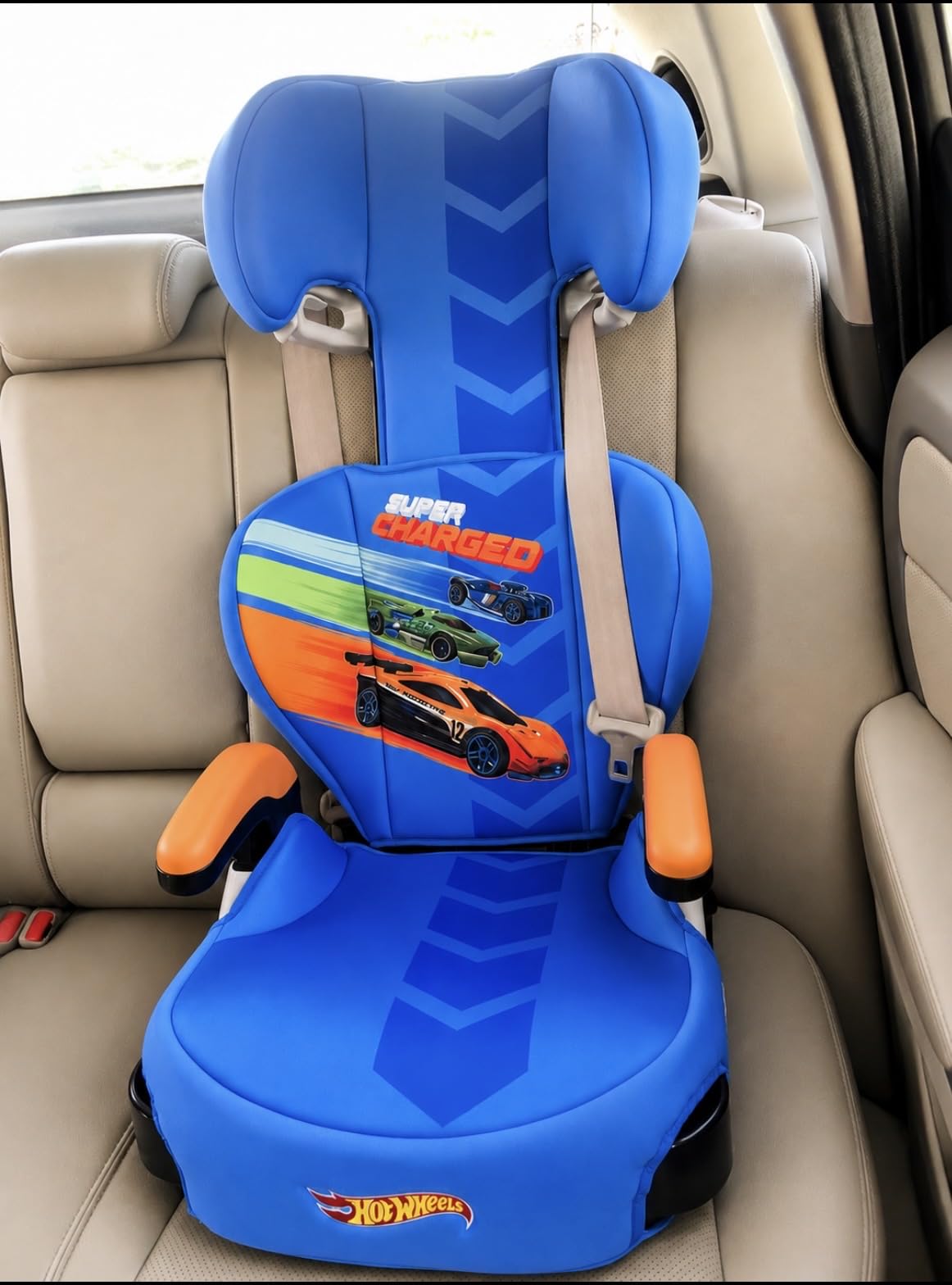
It converts from high back to backless in one motion, which extends it across the whole booster period rather than a slice of it. Height-adjustable armrests and head support do the fitting, and the hide-away cup holders retract into the base so they do not add width when you need three-across fit.
Construction is Graco ProtectPlus, engineered and crash tested against frontal, rear and rollover crashes. Every booster in this list meets the same federal standard, so this is not a stronger safety claim than the others, but the depth of the engineering behind the shell is worth knowing when you are choosing between two similar-looking objects.
Two details separate this from cheaper boosters. The open-loop belt guides are shaped so a child can find and thread the belt themselves, which matters enormously in a carpool or on a road trip where you do not want to do this buckle forty times in a day. And there is enough recline in the high back mode for a sleeping child’s head to rest, which is not something most boosters in this class offer.
There is one real safety-adjacent limitation: the TurboBooster does not anchor into the vehicle. It is a belt-positioning booster, so it relies on the vehicle belt and the friction of the seat base. In a severe crash, an unanchored booster can move. That is the accepted tradeoff across this entire booster category, not a defect unique to this model.
Licensed character colorways including Barbie, Hot Wheels and John Deere are the detail that decides it for many families, and reviewers mention them often. Padding is lighter than premium boosters, which shows on long drives more than on short ones.
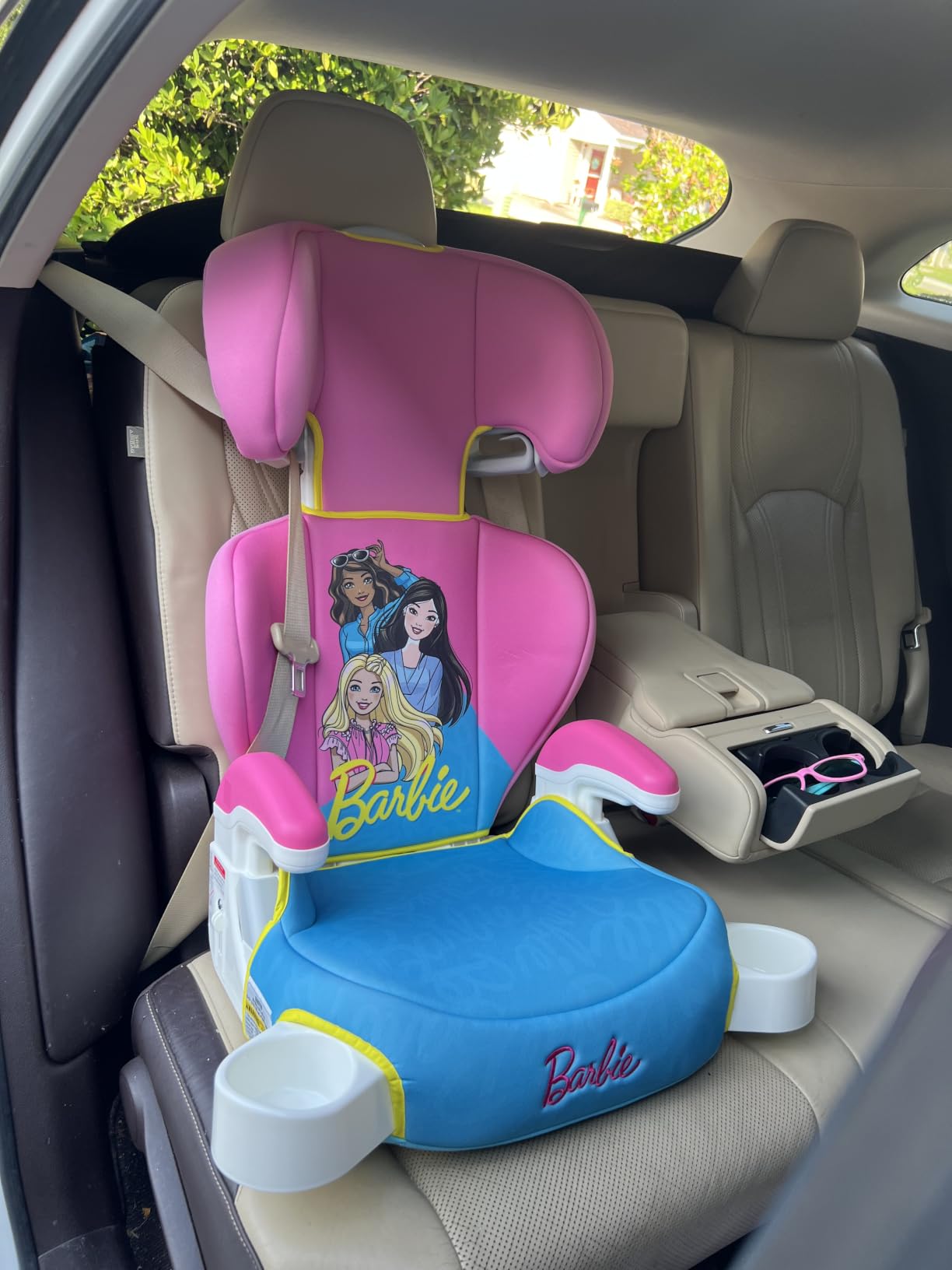
Why this is the one to buy for a 4 year old
At age 4 most children are outgrowing a forward-facing harness and nowhere near ready for a backless booster. This seat is the answer to that gap: a real shell with head support that still converts into a backless booster two years later. A family that buys a backless booster at 4 is solving a problem the child will not have for another two years.
It also works well for a second car. It is light for a hard-shell booster, and parents note it moves between vehicles easily, which is the difficulty the RideSafer and inflatable options solve at the other end of the market.
How to convert and fit it in one sitting
Convert by pulling the back section down into the base rather than disassembling anything. Then fit the child: shoulder belt across the middle of the shoulder, lap belt low on the hips, and the belt staying on the shoulder through a full recline of the seat back. If the belt moves to the neck when the seat reclines, the head support is too low.
Do the conversion at home, not in a parking lot. And give it a week of ordinary use before a trip, because children who have never seen a self-buckling belt guide will not use one on their own the first time.
10. Baby Trend Protect 2-in-1 Folding Booster – the One That Lives in Every Caregiver’s Trunk
Baby Trend Protect 2-in-1 Folding Belt-Positioning Booster Seat, Aqua Tech
- 2-in-1 folding belt-positioning booster
- 100 percent polyester
- High back and backless modes
- Built-in cup holder
Pros
- Folds flat like a book and is light enough to carry by hand
- Two-in-one design works as high back or backless
- Built-in cup holders hold snacks and drinks
- Low cost and belt-only install in any vehicle
Cons
- No lower anchor attachments
- so installation is seat belt only
- Armrests are short
- so a child can barely rest an elbow
- Less padding and side-impact protection than higher-priced boosters
The Baby Trend Protect is built around a simple question: who else drives this child around? Grandparents, a second parent, a carpool, a babysitter. A booster that folds flat and lives permanently in someone’s car answers that question better than a nicer booster that has to be transferred first.
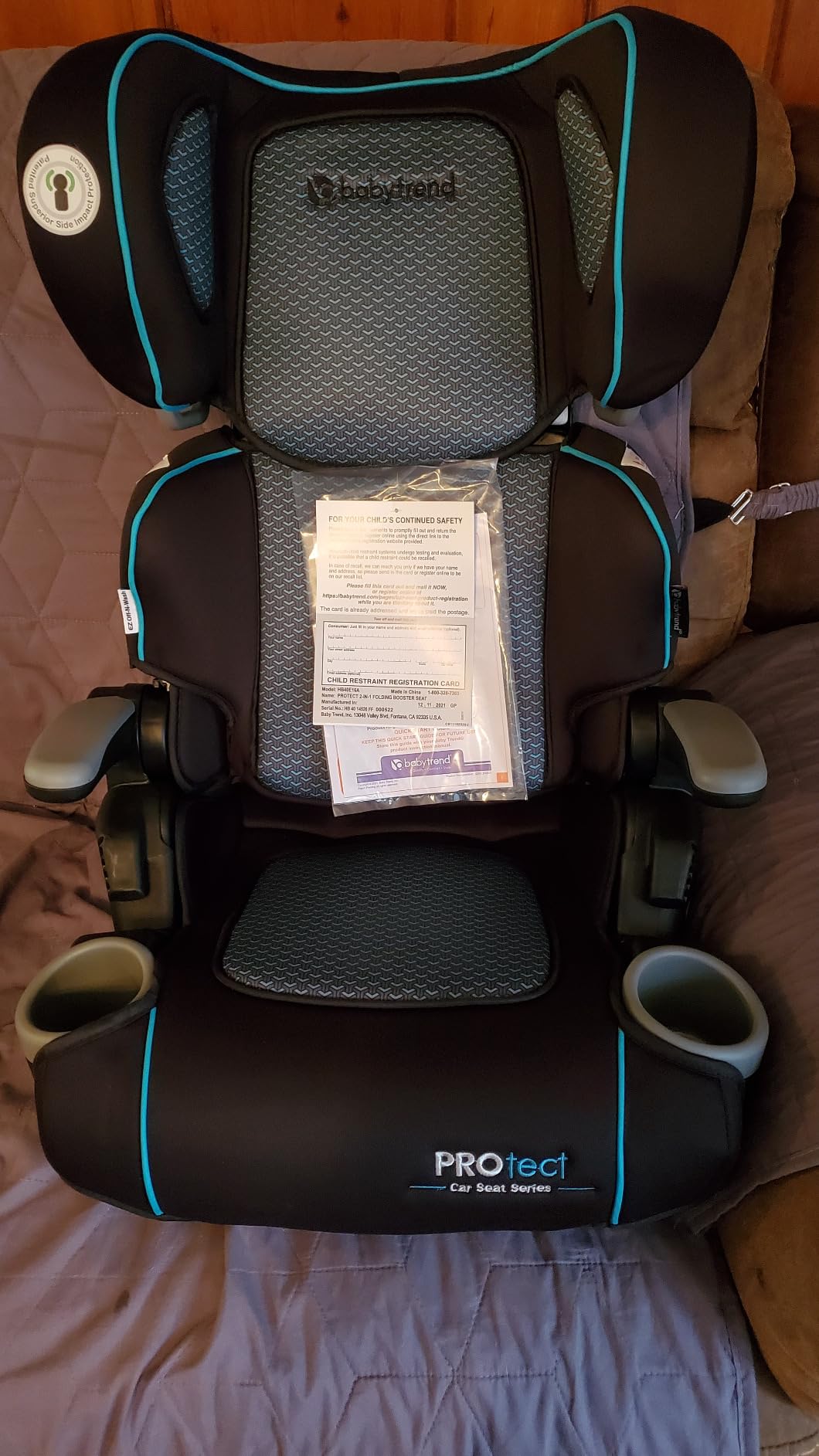
It folds flat for storage and transport, works as a high back or a backless booster, and includes a built-in cup holder with belt-positioning support. The 100 percent polyester cover is unremarkable in the way that is actually useful, because polyester wipes clean and does not need special handling after a road trip.
Reviewers of this seat consistently call out the fold and the low weight as the deciding factors, with multiple reviews noting it fits into a regular bag. At 572 reviews and 4.5 stars, it is well proven for what it does.
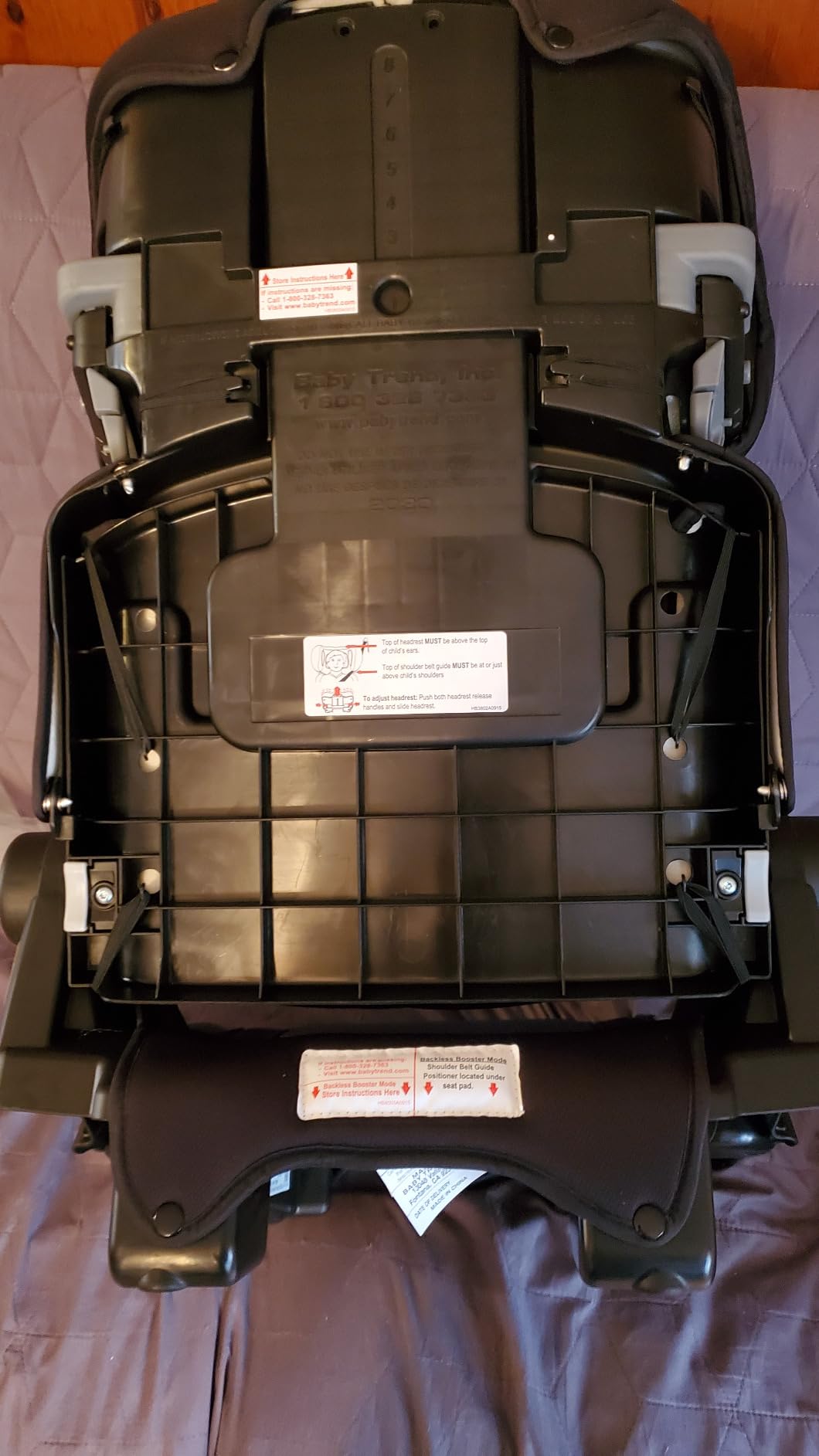
The armrests are the recurring complaint, and it is worth taking seriously rather than writing off. Short armrests on a belt-positioning booster mean the child’s shoulder is not supported where it needs to be, and a child who slides forward loses the correct belt position. If your child is at the upper end of the size range, test the fit in the specific car before you commit.
There are no lower anchor attachments, so installation is seat belt only. For a belt-positioning booster that is not an error, since boosters do not use anchors, but it does mean the seat depends entirely on the vehicle belt routing correctly through its guides. The lighter padding and reduced side-impact protection are the other two limits, and both are real in a longer drive.
What you get for those compromises is a seat that costs little enough to buy two of, which is the honest argument for it. One for your car, one for your mother’s car, and neither one has to move.
When a folding booster in a bag is the right answer
It is the right answer for a child over 40 lbs who is reliably upright on car rides and whose caregivers are spread across two or three vehicles. It is also the right answer for anyone who has ever had the conversation about a booster not making it back from another house, because a booster that fits in a bag ends that conversation permanently.
It is wrong for a child who sleeps in the car, for a child under 40 lbs, or for a family that wants one premium seat rather than two adequate ones. If the plan is a long flight with a nap in it, head support matters more than packability.
What to check in the first ten minutes
Open it, sit your child in it, and route the belt before you decide. The shoulder belt has to stay on the shoulder, and the lap belt has to land low on the hips rather than across the stomach. With short armrests, this is where the fit usually fails or passes, and it takes five minutes to know which.
Then fold and unfold it twice. A folding booster that is stiff on the second fold will end up permanently in a car trunk, which defeats the entire purpose of buying it.
11. Hiccapop UberBoost Inflatable Booster – the One That Fits in a Carry-On
UberBoost Inflatable Booster Seat for Car, Travel Booster Seat, Black/Gray
- Inflatable backless booster
- Inflates in under 20 seconds
- Meets or exceeds FMVSS 213
- Narrow enough for 3 across in smaller vehicles
Pros
- Inflates in about 20 seconds and packs to almost nothing
- Low cost makes one per caregiver realistic
- Meets FMVSS 213 so it is a real restraint
- Narrow profile fits three across in many vehicles
Cons
- No back or side support
- so no head support for a sleeping child
- Air-filled design is less reassuring in a severe crash
- Inflation is required every single trip
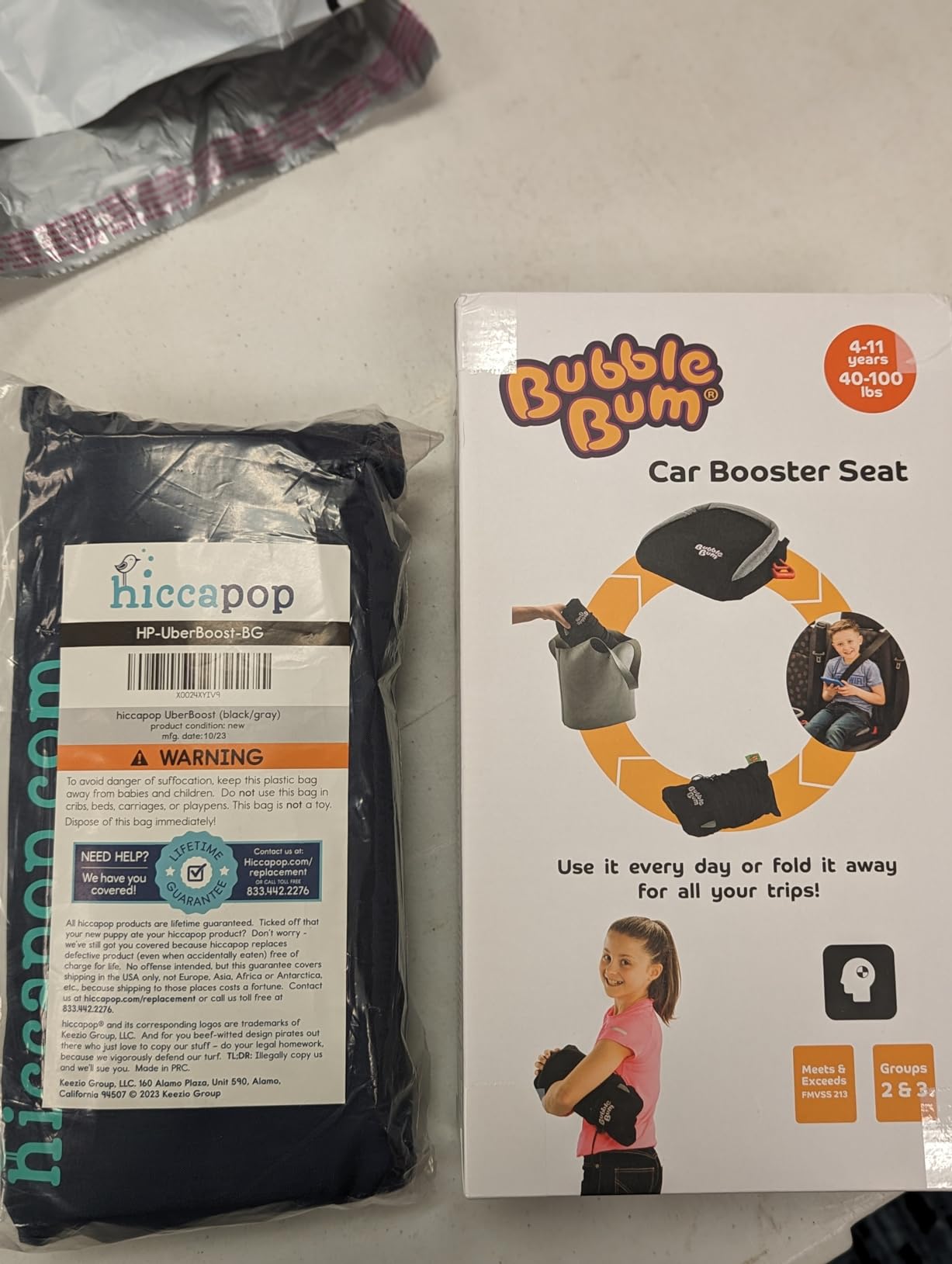
The Hiccapop UberBoost has the most reviews of any booster here at 7614, and the reason is not subtle: it deflates, rolls into its own travel bag, and disappears into a carry-on. For a family flying to a destination where a rental car is waiting, that solves both the flight problem and the destination problem in one object.
It inflates in about 20 seconds with a few breaths, no pump required, and it meets or exceeds FMVSS 213, which makes it a genuine belt-positioning restraint rather than a cushion. The non-skid base sits firm on leather, vinyl or cloth, and positioning clips keep the lap belt across the child’s thighs rather than digging into the stomach.
The narrow design is the quiet advantage. It fits three UberBoost seats across the back of a smaller vehicle, or one between two traditional car seats, which is exactly the configuration a family with three children needs in a compact rental car.
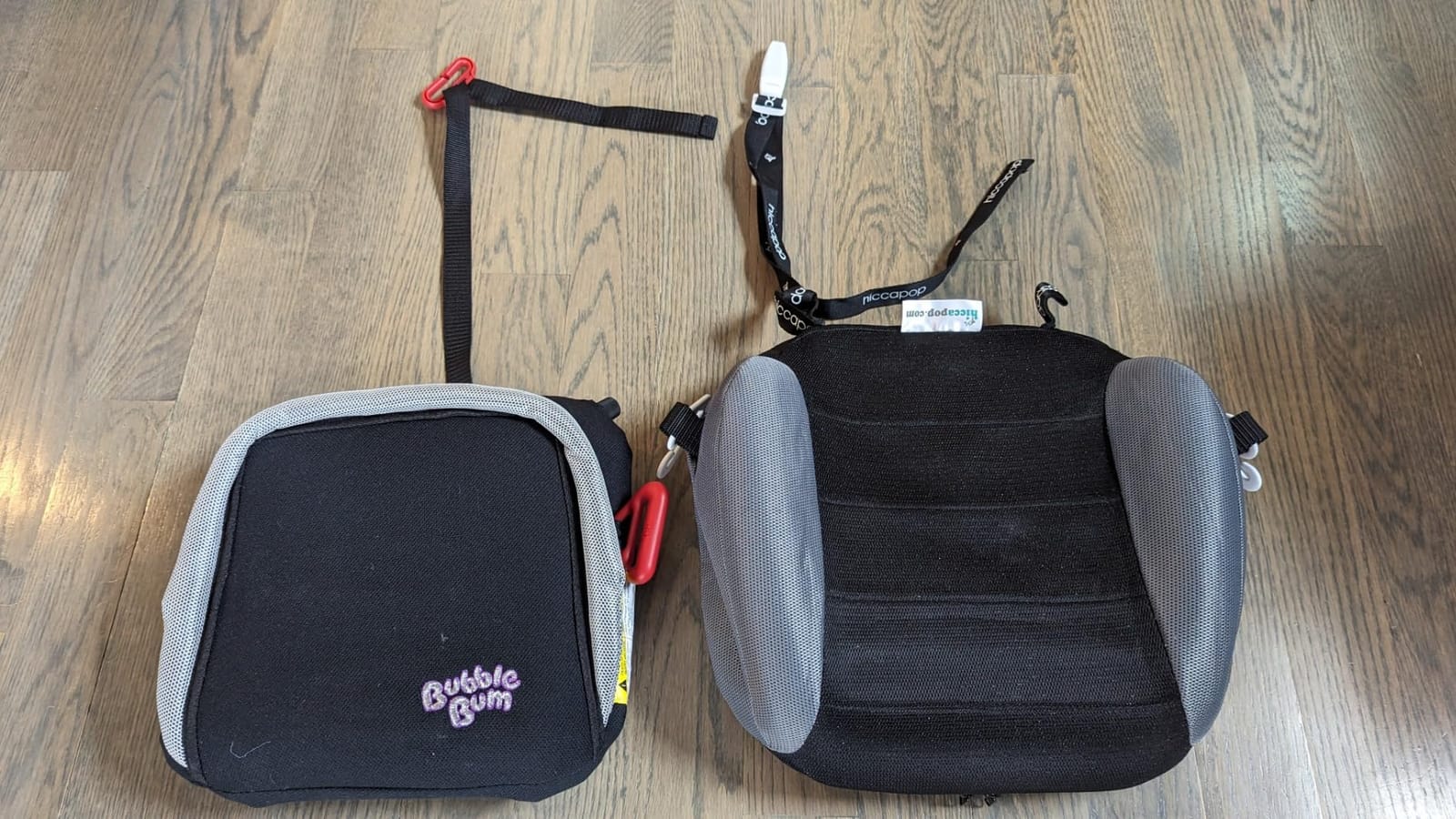
It has to be inflated every single time, and that is the deal. Parents describe the twenty seconds as a routine rather than a chore, and the trade is worth it if the alternative is not having a restraint at all when the car arrives.
There is no back, no head support and no side-impact structure, because there is no shell. A sleeping child in this booster leans forward against the seat back, and an air-filled design gives you less confidence in a severe crash than a rigid shell does. This is not a product for a 4 year old who falls asleep on every car ride, whatever the packing size suggests.
It also only works above 40 lbs, which is a hard line rather than a guideline. Below that a child needs a harness, and a harness is not something this product can be. Reviewers treat that as understood rather than as a flaw, which is a fair read.
Who this is the practical choice for
It is the practical choice for a child above 40 lbs who travels light, changes vehicles constantly, and is awake rather than asleep for the duration. It is also the one we would pack for a trip with three children, because three inflatable boosters occupy almost no luggage space and three hard shells would not fit in a suitcase at all.
It is the wrong choice if the child naps, if you want something that doubles as a seat the child can sit in while waiting at a restaurant, or if the trip involves long winding drives where a rigid shell would be more reassuring to you as a parent.
The one-step routine that makes it work
Inflate it in the back seat, not in the terminal. Then route the three-point belt through the clips so the lap portion sits low across the hips and the shoulder portion stays on the shoulder, and pull the belt tight. Deflate, roll, and bag it, and the whole cycle takes about two minutes once you have done it a few times.
Keep the bag in the same pocket every time. The most common review comment about inflatable boosters is that people leave them inflated in a trunk, at which point you own an inflated booster permanently and have lost the entire benefit of the design.
12. BubbleBum Inflatable Travel Booster – the Longest-Lasting Inflatable Range
BubbleBum Inflatable Travel Booster Car Seat – Narrow Backless
- Narrow inflatable backless booster
- 40-110 lb range
- Ages 4-11
- Deflates to 12 x 6 x 4 in
Pros
- Packs to 12 x 6 x 4 in
- so it never competes for carry-on space
- Inflates in about 20 seconds with no pump
- Highest weight range here at 40-110 lbs
- Works in any car with a standard three-point belt
- Wipes clean with a damp cloth
Cons
- No back
- head or side-impact support
- Inflation is required for every single use
- Air-filled construction gives less crash protection than a rigid shell
- Not suitable for children under 40 lbs
The BubbleBum shares the inflatable concept with the UberBoost and improves on it in two specific ways: it deflates to 12 by 6 by 4 inches, and its weight ceiling is 110 lbs rather than a more modest figure. With 6866 reviews at 4.3, it is one of the most established products in the category.
It is independently crash tested to exceed FMVSS 213, works in any vehicle with a standard three-point belt, and needs no LATCH anchors or special hardware. Inflation takes about 20 seconds and it wipes clean with a damp cloth, which is the practical detail that decides whether a travel seat survives repeated use.
Children 40 to 110 lbs, ages 4 to 11. That upper end is the reason to choose it over a cheaper inflatable: most children in this age band outgrow a booster with a 100 lb or lower ceiling well before they are ready to stop using one, and this one is still in range at the top.
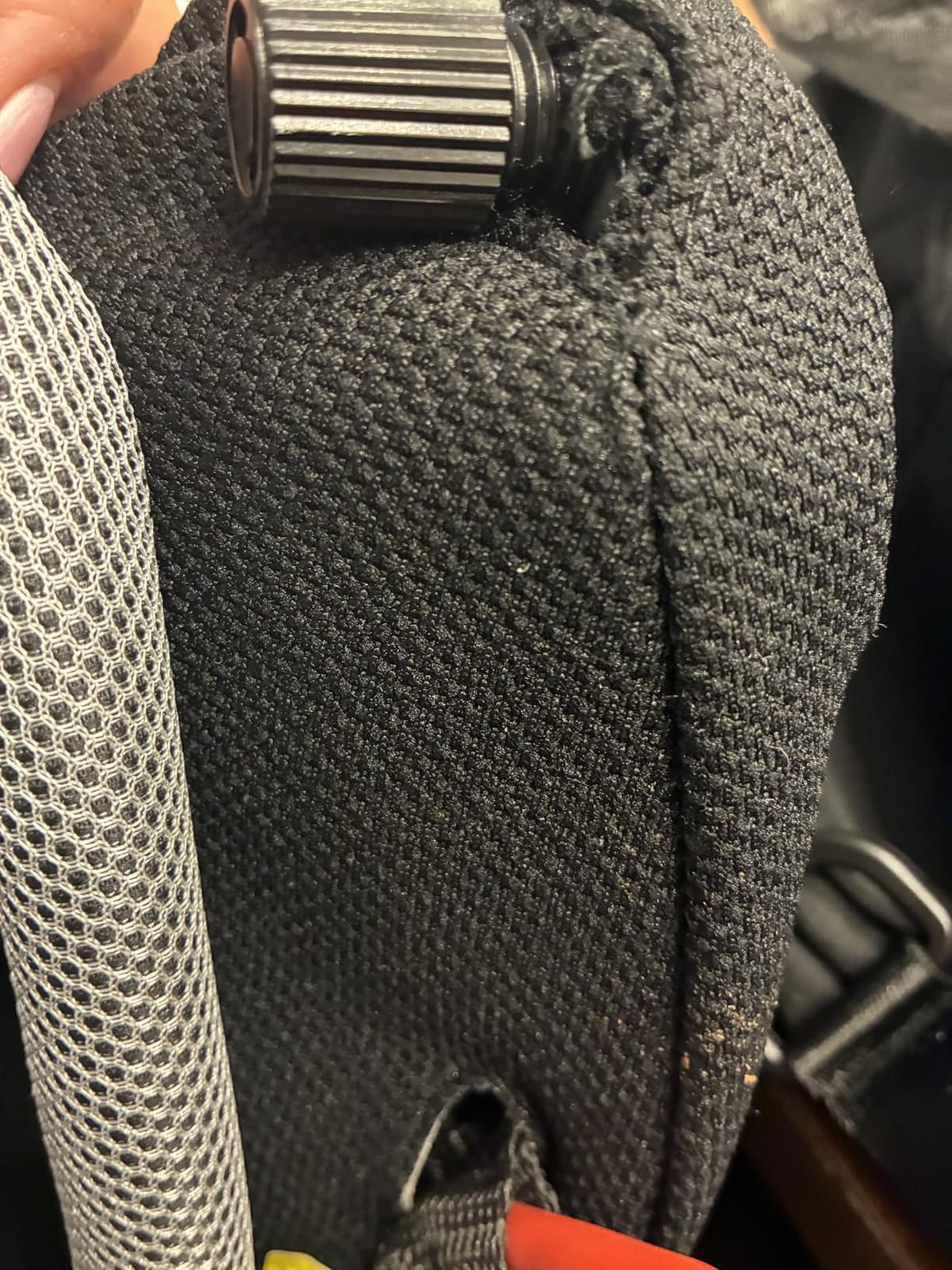
The backless limitation is the same as any inflatable and it is not fixable. No back means no head support and no side-impact structure, and the air-filled construction gives you less in a severe crash than a rigid shell. For a child who sleeps through car rides, that is a real cost, and this is not the product for them.
State booster laws vary, and a parent should know that a child legal in one state may not be legal in another. That is a legal question rather than a product question, but it is the reason to check your local requirement rather than assuming a bag will be enough once your child reaches a certain age.
Available in single and twin packs, which matters for three-across configurations. Reviewers repeatedly stress the 40 to 110 lb range and the ease of moving between vehicles, with the backless design treated as the known limitation rather than a complaint.
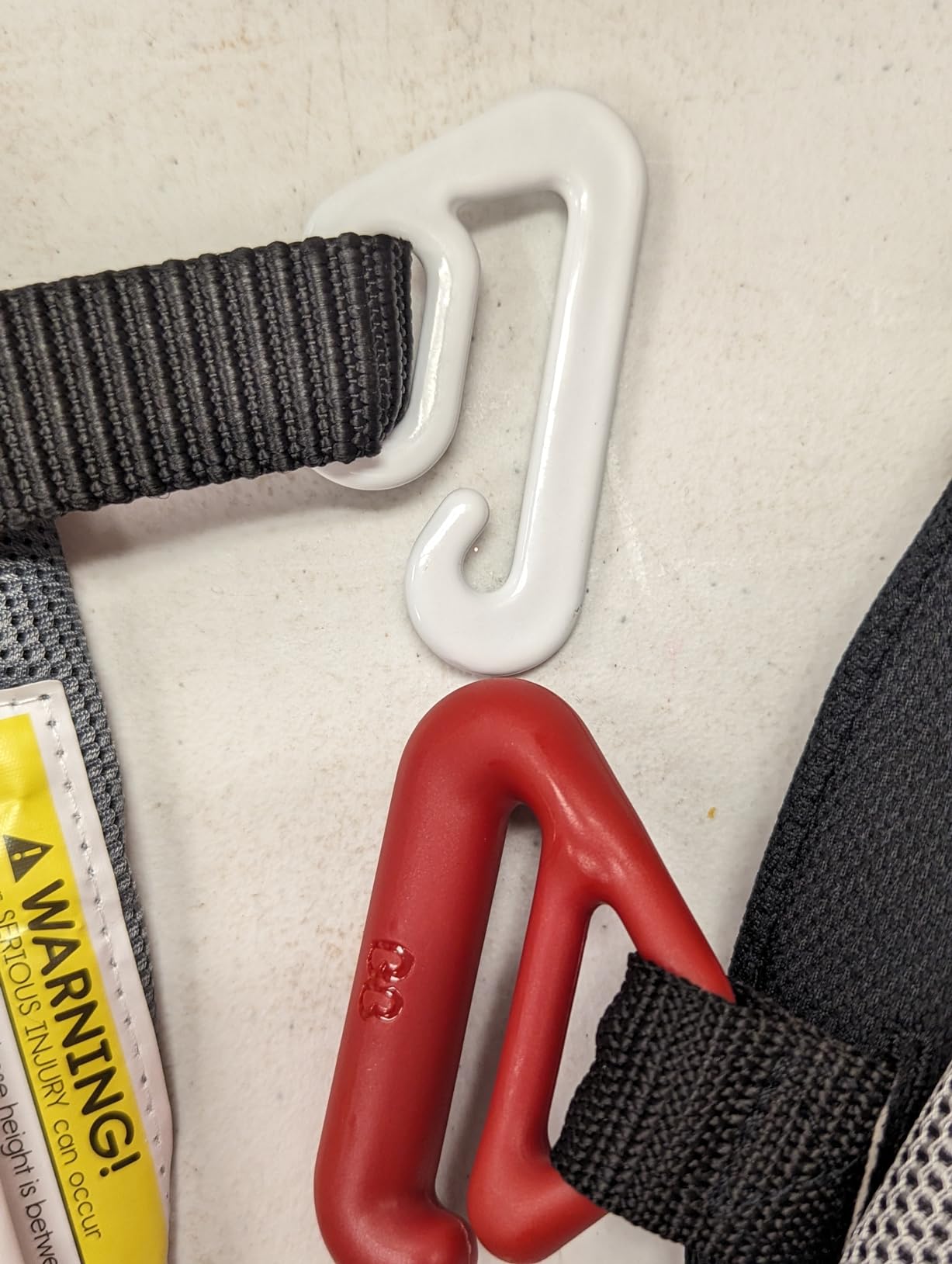
Why the wider weight range matters more than it sounds
A weight ceiling is a date on a calendar. A child who outgrows a booster at 100 lbs in the third grade still needs one for several more years, and a ceiling that stops below the growth curve means buying two. The 40 to 110 lb range here covers the full span most families need in a single purchase, and it is the main reason we rank this above its cheaper rivals.
Combined with the deflated size of 12 by 6 by 4 inches, this is the seat to buy for a family with two or three children over 40 lbs who are travelling on a budget of luggage space. Three of them fit in a single bag, and the whole set weighs less than one hard shell.
How to get a clean, correct fit
Inflate fully. A partially inflated booster sits lower and puts the belt across the stomach instead of the hips, which is the most common installation error with this product and the easiest to avoid. Then route the three-point belt through the positioning clips, check that the shoulder belt is on the shoulder, and pull until the lap belt is snug against the hip bone.
Wipe it down with a damp cloth after every trip and let it dry fully before rolling it into the bag. Inflating it to check the shape takes twenty seconds, and a valve that is packed away damp will not inflate properly the next time you need it.
How to Tell If a Car Seat Is Actually Allowed on a Plane
Every seat that can be used in an aircraft cabin carries a red sticker somewhere on the shell stating that the restraint meets all applicable FAA requirements for aircraft use. That label is the whole test. It is not the same as FMVSS 213 compliance, which is the U.S. vehicle crash standard, and a seat can satisfy one without satisfying the other.
Here is the distinction that catches people. Every car seat sold in the United States meets FMVSS 213, and every booster in this roundup meets it. That says nothing about the aircraft. A backless booster, a belt-positioning booster and a travel vest are all vehicle restraints, and all three are typically not approved for cabin use because the aircraft lap belt cannot be positioned to hold them correctly.
So what is permitted? A child restraint that has the red aircraft label, installed on a purchased seat using the aircraft’s lap belt, in forward-facing mode. What is not permitted is any booster or any vest used as the child’s aircraft restraint, because the aircraft lap belt cannot hold them. For those, the honest answer is a lap infant seat for a small baby, or a child old enough to sit in a standard seat belt with a booster used only on the ground.
Where the label sits varies. On some shells it is on the back, on some on the underside, and on the WAYB Pico it is on the bottom of the seat. Check before you travel, photograph it, and keep the photo with your boarding pass. Parents on travel forums report that crew occasionally ask to see it, and a photo ends the conversation in seconds.
Gate checking is the fallback, and it is not a failure. An approved seat that has to go in the hold travels in a padded bag, ideally at the jet bridge rather than the ticket counter, which is where handlers are more likely to protect the shell from damage. Forum advice is consistent that gate checking costs you the seat in the cabin but removes the risk of a bag-handling conveyor and saves you carrying it through the terminal.
What Actually Matters When You Choose: Age First, Then Weight, Then Everything Else
Start with the child, not the product. Under 30 lbs, the choice is a rear-facing infant carrier and there is no way around it, which narrows the field to three products in this roundup. Between about 22 and 50 lbs and already forward-facing at home, the WAYB Pico is the only purpose-built travel seat here. Over 40 lbs and outgrowing the harness, the decision is between a high-back booster and a backless one, and that is a much easier problem.
Then check the belt-fit criteria in writing rather than by age. A booster that fits your child at 5 may not fit at 6, and a child who is 43 inches tall can be entirely outgrown in a seat that still accepts their weight. The Mifold products state height limits explicitly for this reason, and they are the numbers worth writing down before you shop.
After that, weight of the seat and folded size are logistics, not safety. Under 10 lbs is the threshold most travel guides use, because that is the point at which one adult can manage a terminal comfortably. The RideSafer vest at 2.9 lbs and the UberBoost and BubbleBum in their deflated bags are the extremes, and the Doona at 17.2 lbs is the other end of the range entirely.
Recline is the factor people forget until they are on a long flight. A seat with no recline, which includes the WAYB Pico and both mifold products, will hold an awake child comfortably and will not hold a sleeping one. If your child sleeps through car rides, treat that as a hard requirement rather than a nice-to-have.
Finally, think about the return trip and the rental car. The best travel car seat for airplanes is often the one that works in three places rather than one. A seat with an integrated base, or a backless booster that works with any three-point belt, saves you from a second purchase or a rental counter conversation. That is worth a lot more than a feature you will use once.
Getting the Seat Through the Airport and Into the Car
A dedicated travel bag is the cheapest upgrade in this entire roundup. A padded bag with backpack straps, the kind that fits a car seat, means your hands are free for a boarding pass, a suitcase and a toddler. Parents on forums treat a padded gate-check bag as essential rather than optional, and it is the single most commonly recommended accessory in the discussions we reviewed.
A wheeled travel cart solves a different problem. If you are moving through a long terminal with a heavy hard-shell seat and no help, a cart lets you move the seat and the child separately. It is awkward with stairs and escalators, and useless in the narrow aisles of a jet bridge, but it beats carrying 17 lbs plus a bag plus a toddler across a concourse.
At the destination, practice the rental car install before you leave the lot. Lower anchors are usually found in the seat bight, and the retractor lock is either a dedicated button or a locking mode you engage by pulling the belt all the way out. Do the pinch test at the belt path, tighten until you cannot slide more than an inch, and check the harness height at armpit level with the child in the seat.
For international travel, the certification question changes completely. The European Union operates under ECE R44 and R129 i-Size rules, Canada follows CMVSS, and Australia follows AS/NZS 1754. A US label does not transfer, and the mifold Hifold is the only product in this roundup whose listing states approval for use in most regions outside Australia and Taiwan. Anything else means researching the destination’s rules or planning on a rental seat.
Cleaning after a flight is a smaller job than most people expect. Machine-wash the fabric cover on its own cycle, wipe the plastic shell and the belt path with a damp cloth, and let everything dry fully before reassembling. Check the harness straps for fraying while the cover is off, since a strap that has been under tension for six hours is worth looking at before you reuse it.
Frequently Asked Questions
What is the best lightweight car seat for airplane travel?
The Doona Car Seat and Stroller is the strongest all-round answer for infants, weighing 17.2 lbs as a seat and stroller with a 9.7 lb base, carrying both FAA and TUV aircraft approval, and converting from a rear-facing car seat to a stroller with one click. For a seat under 30 lbs where weight matters most, the Joie Rue shell at 7.8 lbs is the lightest carrier here, and the Joie Mint at 9.3 lbs is the only baseless design listed as FAA-certified for aircraft use.
Which car seat brands are FAA-approved for airplanes?
Approval sits with a specific model, not a brand. In this roundup the Doona lists TUV and FAA aircraft approval and the WAYB Pico has an FAA approval sticker on the bottom of the seat. The Joie Mint is listed as FAA-certified for aircraft use with seat belt installation. The RideSafer vest, the mifold products, the Peg Perego Viaggio and every booster here are vehicle restraints and are not approved as aircraft restraints.
Can I use a booster seat on an airplane?
No. Booster seats and travel vests are not permitted as the child’s restraint in an aircraft seat because the aircraft lap belt cannot be positioned to hold them correctly. A booster is a vehicle restraint for a child who can already sit upright and handle a standard three-point belt. On a plane, a child under the airline’s threshold either uses a lap infant seat or travels in a purchased seat with an FAA-approved child restraint fitted to the aircraft lap belt.
How do I know if my car seat is FAA approved?
Look for a red sticker on the shell that states the restraint meets all applicable FAA requirements for aircraft use. The location varies by model: on the back, on the side, or on the underside. The WAYB Pico carries it on the bottom of the seat. Photograph the label before you travel and keep the picture with your boarding pass, because cabin crew occasionally ask to see it.
Is it worth bringing a car seat on a plane?
It depends on what happens after you land. If you are taking a taxi or a rideshare and heading straight home, a compact seat or a vest that fits in a daypack is often easier than a full shell. If a rental car, a grandparent’s house or a road trip is waiting, the right travel seat removes both the rental counter and the daily fee, and it means your child has a properly fitted restraint from the moment you land.
Does a car seat go through the TSA scanner?
A car seat goes through the X-ray machine like any other item of baggage and does not need to be removed. The only exception is a stroller with an integrated car seat, where the seat usually has to come off so the stroller frame can be folded. Allow extra time for a car seat to be screened, and be prepared for a manual inspection rather than a quick pass, particularly for a large hard-shell seat.
Can you gate check a car seat?
Yes, and it is often the better choice than carrying an approved seat through the terminal. Gate checking at the jet bridge hands the seat to the cabin crew rather than to the ticket counter, which is where a padded bag and careful handling make the most difference. An FAA-approved seat can usually be gate checked and returned at your destination, but confirm with your airline before you fly since policies differ by carrier.
What is the best travel car seat for a child under 40 lbs?
For a child under 30 lbs the answer is a rear-facing infant carrier, and the choice in this roundup is between the Doona, the Joie Rue and the Joie Mint. The Doona is the only one that also works as a stroller. From 26.5 to 50 lbs, the WAYB Pico is the purpose-built option, but it is forward-facing only and never for a rear-facing toddler. There is no good lightweight rear-facing travel seat past the infant stage, which is a real gap in this market.
Our Verdict on the Best Travel Car Seats for Airplanes
Pick the Doona if you are flying with a baby, because it carries both FAA and TUV approval, replaces a second piece of luggage, and has the deepest pool of real-world travel feedback in this group at 15400 reviews. Pick the WAYB Pico if your child is forward-facing at 26.5 lbs and cabin space is what is driving you crazy. Pick the Graco TurboBooster 2.0 if your child has just outgrown the harness and still needs a real shell around them.
For everything above 40 lbs, the choice is simple. Buy a high back if the child sleeps in vehicles, and buy a backless or inflatable one if they do not, if you change cars constantly, or if luggage space is the binding constraint. Those are the only two axes that matter, and they point to very different products.
Whatever you choose, verify the red aircraft label yourself, practice the install at home, and buy the padded carry bag. Those three steps cost almost nothing and remove nearly every problem we saw described by families who have done this trip more than once. It is the best guide to the best travel car seats for airplanes we could write in 2026, and it will hold up next year too.