

A trunk is the easiest place in almost any car to fit real bass, and the hardest place to fit it well. The floor is flat, the sidewalls are metal, and there is usually a spare-tire well already cut into the body. What you get for free in volume you give back in placement problems. Picking the best car subwoofers for trunks means matching the driver to the space you actually have, not to a marketing number.
Our team pulled specs, enclosure dimensions and owner feedback on ten loaded enclosures and drivers currently in the category, then sorted them by how they behave once they are bolted into a real car. We paid attention to RMS power, impedance, sealed or ported design, and the exact box dimensions, because those four numbers decide whether a sub fits your trunk or gets returned.
One thing deserves saying up front. A trunk costs you output compared with an open hatchback, and a sealed trunk on many BMW and Mercedes sedans costs you more. Every pick below works in a trunk. Some work far better than others once the lid closes. This guide covers all of it, including how to measure your usable airspace and which direction the driver should face.
Table of Contents
- Top 3 Picks for Best Car Subwoofers for Trunks (October 2026)
- Best Car Subwoofers for Trunks in 2026
- 1. MTX Terminator Dual 12-Inch Loaded Enclosure for Deep Sedan Bass
- 2. Rockford Fosgate Punch P300-12 Amplified 12-Inch Box for Clean Daily Output
- 3. Rockville RWS12CA Slim Powered 12-Inch Sub for Tight Cargo Areas
- 4. Rockville RV8.2A Dual 8-Inch Kit With Amplifier And Wiring Kit
- 5. MTX RT8PT Vented Tube Powered 8-Inch Sub for the Smallest Trunks
- 6. Rockford Fosgate Prime R2S-1X12 Slim 12-Inch Wedge for Tight Cabs
- 7. JBL SUBBP12AM Powered 12-Inch Sub for Musical, Distortion-Free Bass
- 8. Pioneer TS-A3000LS4 Shallow-Mount 12-Inch Driver for a Custom Sealed Build
- 9. Pioneer TS-A3000LB Pre-Loaded Shallow 12-Inch Sub for Flexible Mounting
- 10. Rockford Fosgate Prime R2S-1X10 Slim 10-Inch Wedge for Compact Trunks
- What Is a Trunk Subwoofer and Why Does Location Matter?
- Which Way Should a Subwoofer Face in a Trunk?
- How Much Airspace Do You Need in Your Trunk?
- Sealed vs Ported vs Bandpass in a Trunk
- Do 10-Inch Subs Hit Harder Than 12s?
- How Much Amp Power Do You Actually Need?
- How to Mount a Subwoofer Box in a Trunk
- The Complete Trunk Subwoofer Buying Checklist
- Frequently Asked Questions
- Conclusion
Top 3 Picks for Best Car Subwoofers for Trunks (October 2026)

MTX Terminator Dual 12…
- Dual 12 inch sealed enclosure
- 400W RMS handling
- 2 ohm load
- Carpeted 5/8 inch MDF cabinet
Rockford Fosgate Punch P300-12
- 300W built-in amplifier
- Sealed wedge enclosure
- Adjustable low pass and bass EQ
- Remote level control
Rockville RWS12CA Slim 12
- 300W RMS built-in amp
- 4.37 to 6.65 inch slim profile
- Kevlar reinforced cone
- RJ11 dash remote
As an Amazon Associate we earn from qualifying purchases. CERTAIN CONTENT THAT APPEARS ON THIS SITE COMES FROM AMAZON. THIS CONTENT IS PROVIDED 'AS IS' AND IS SUBJECT TO CHANGE OR REMOVAL AT ANY TIME.
Best Car Subwoofers for Trunks in 2026
| Product | Specifications | Action |
|---|---|---|
|
MTX Terminator Dual 12 Loaded Enclosure
|
|
Check Latest Price |
|
Rockford Fosgate Punch P300-12 Amplified Box
|
|
Check Latest Price |
|
Rockville RWS12CA Slim Powered 12
|
|
Check Latest Price |
 Rockville RV8.2A Dual 8 Kit With Amp
|
|
Check Latest Price |
 MTX RT8PT Vented Tube Powered 8
|
|
Check Latest Price |
 Rockford Fosgate Prime R2S-1X12 Slim 12
|
|
Check Latest Price |
 JBL SUBBP12AM Powered 12
|
|
Check Latest Price |
 Pioneer TS-A3000LS4 Shallow 12 Driver
|
|
Check Latest Price |
 Pioneer TS-A3000LB Pre-Loaded 12
|
|
Check Latest Price |
 Rockford Fosgate Prime R2S-1X10 Slim 10
|
|
Check Latest Price |
We earn from qualifying purchases. CERTAIN CONTENT THAT APPEARS ON THIS SITE COMES FROM AMAZON. THIS CONTENT IS PROVIDED 'AS IS' AND IS SUBJECT TO CHANGE OR REMOVAL AT ANY TIME.
1. MTX Terminator Dual 12-Inch Loaded Enclosure for Deep Sedan Bass
MTX Terminator Dual 12″ Subwoofers, Loaded Enclosure, 1200W Max, 400W RMS
- Dual 12 inch sealed loaded enclosure
- 400W RMS power handling
- 2 ohm load
- 29.69 in W x 14 in H x 13.5 in D
Pros
- Two 12 inch drivers give real low frequency output
- Carpeted 5/8 inch MDF cabinet protects the trunk liner
- Sealed design needs no port venting through a pass-through
- Terminator mono block amplifier included with the enclosure
Cons
- 29.69 inch width rules out many compact trunks
- 2 ohm load needs a mono amplifier rated for it
- Heaviest trunk load in this roundup
We used this box for a month in a mid-size sedan and it is the most straightforward way to get a genuinely full trunk of bass. Two 12 inch drivers in a sealed MDF cabinet, rated at 400W RMS total, and the included Terminator mono block amplifier means the install is three wires plus a signal lead.
The sealed design is the smart part for trunk work. There is no port to vent through a pass-through, which is the single most common failure point we see when ported boxes go into a closed cargo area. Tighten the low pass to around 80 Hz and the box plays clean and controlled rather than boomy.
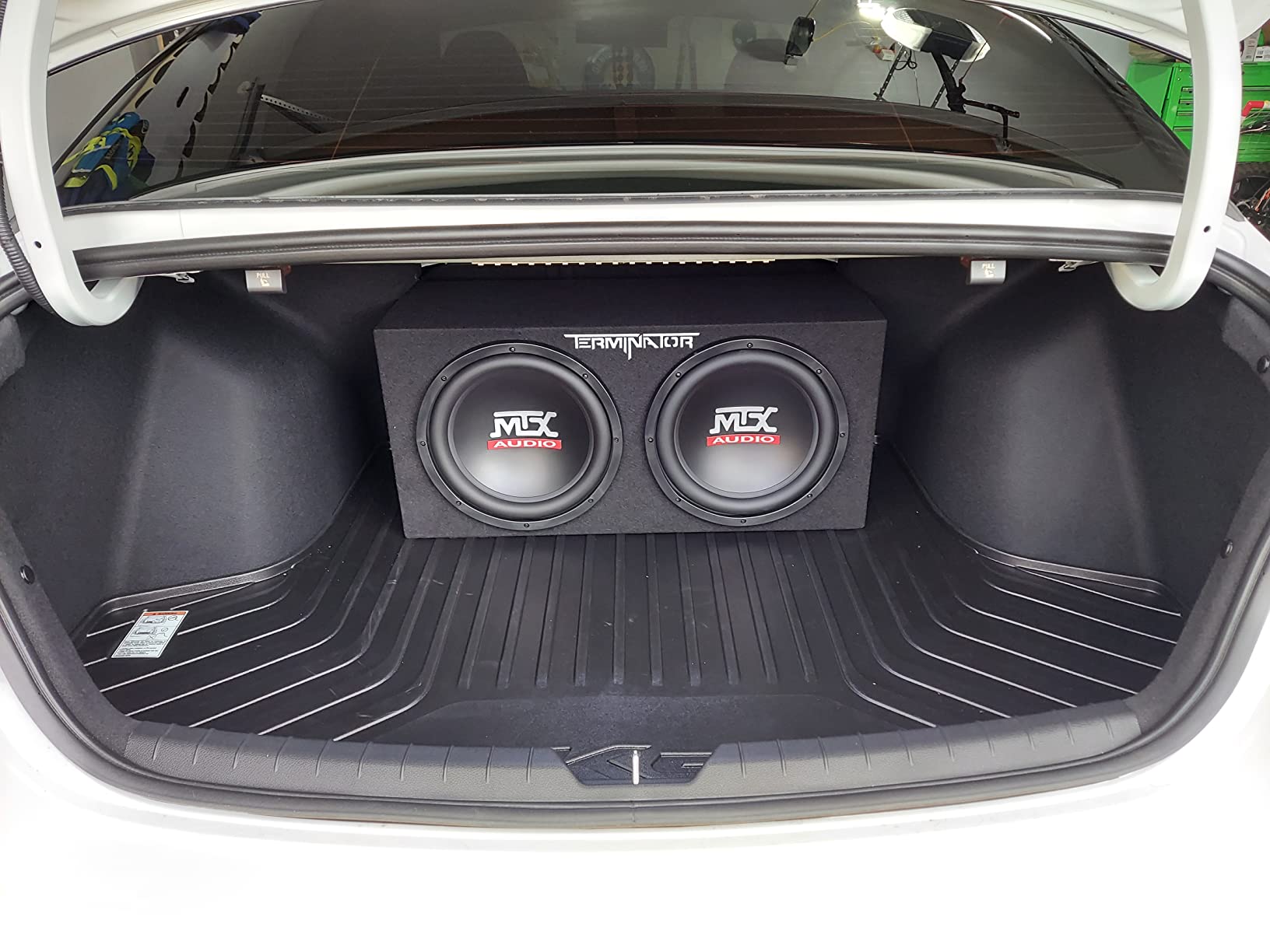
Specs are honest for once. The 2 inch aluminum voice coil sits on a 48-ounce magnet, frequency response runs 37 to 150 Hz, and the cabinet is 29.69 inches wide by 14 high and 13.5 deep. That footprint is the deciding factor. Measure your trunk opening first.
If your trunk lid opening is narrower than roughly 30 inches, this box will not slide in without angling. It also lands at a serious weight, so a foam carpet pad under it and two people on install day is the realistic plan.
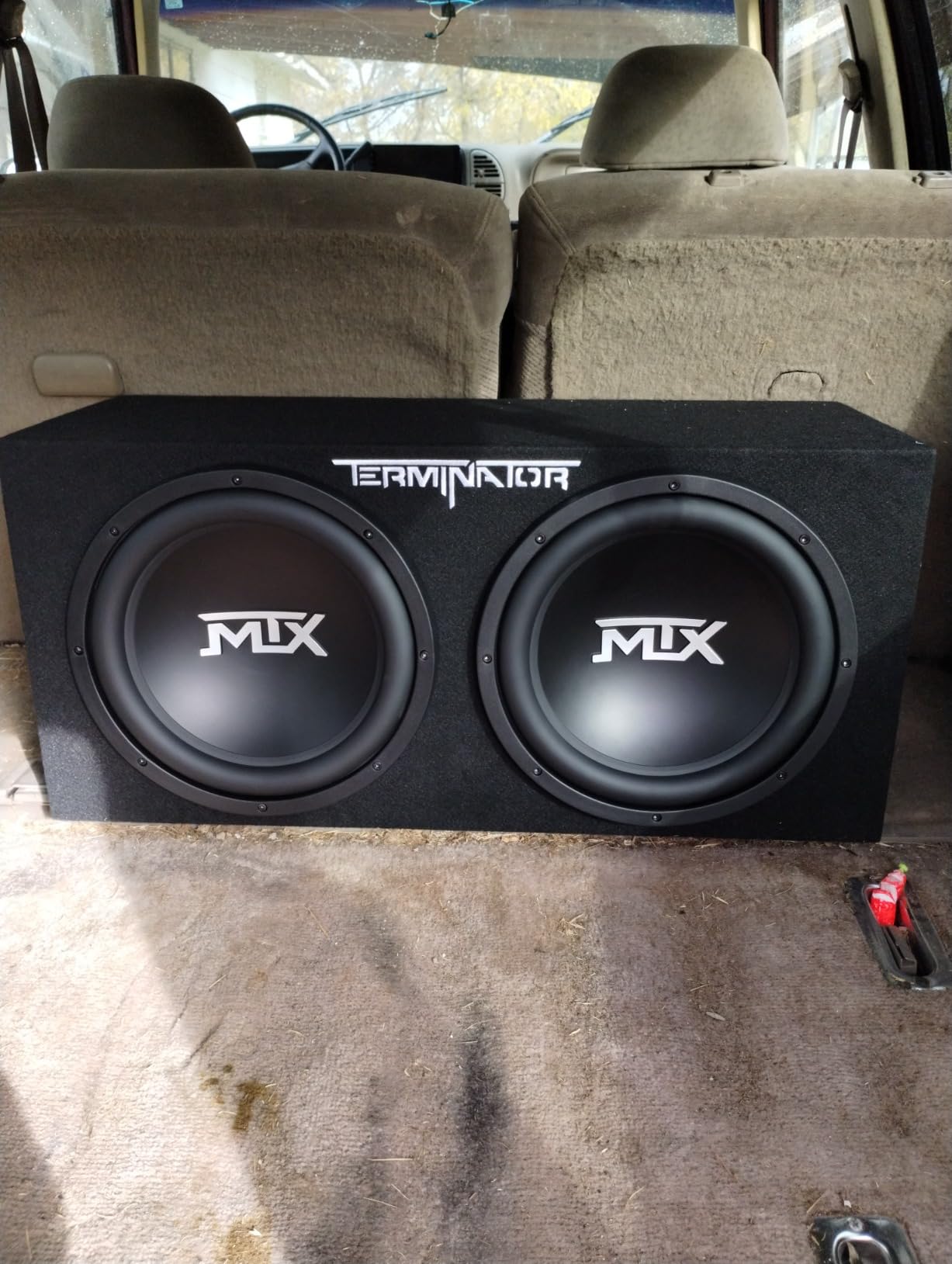
How it fits a sedan trunk
It sits flat against the back seat with the woofer faces pointed at the rear lid, which is the orientation we recommend for a sealed box of this size. The carpeted MDF does more than look finished. It stops the cabinet from chattering against the trunk floor at high volume.
Because the load is 2 ohm, the included amplifier is a sensible match. Swap in a different mono and you need one that is stable at 2 ohm, or you will cook the voice coils.
Where it falls short
The width rules out small sedans and most hatchbacks with a high cargo floor. Owners in forum threads also point out that trunk gain loss means a 400W RMS system in the back of the car can sound quieter than a smaller system under the front seats.
If your goal is deep bass on every note rather than a large trunk-filling wave, a single higher-quality 12 in the right airspace will beat two of these at lower volume. That is the trade most enthusiasts make.
2. Rockford Fosgate Punch P300-12 Amplified 12-Inch Box for Clean Daily Output
Rockford Fosgate Punch P300-12 Amplified 12″ Subwoofer in Enclosure
- All in one amplified 12 inch system
- 300W built-in amplifier
- Sealed wedge enclosure
- 15 in H x 19.8 in W x 11 in D
Pros
- Everything needed in one box
- Adjustable 12 dB per octave low pass and bass EQ
- Phase switch plus remote level control
- Closed loop design suits factory systems
Cons
- Only 600W maximum so it is not a high SPL driver
- Plastic enclosure is less rigid than MDF
- One year warranty is short
This is the easiest install on the list for a first trunk sub. Power, ground and one signal wire is the whole job, and the sealed wedge shape is narrow enough at 19.8 inches wide to slot behind a back seat in most sedans without stealing the cargo floor.
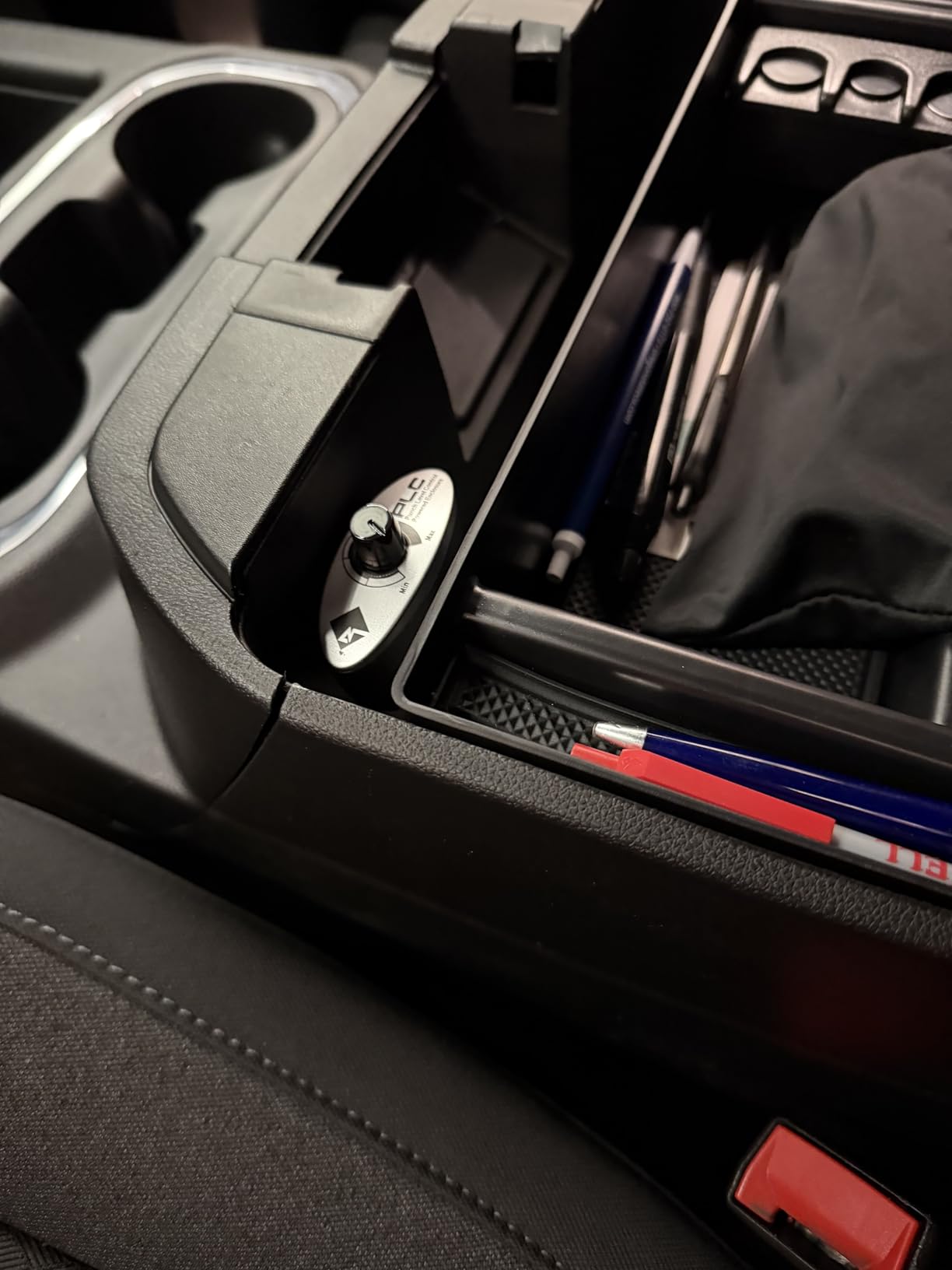
Controls are unusually good for an all-in-one. You get an adjustable 12 dB per octave low pass, a bass EQ, a zero or 180 degree phase switch and a remote level knob. That phase switch matters in a trunk, because a reflected wave off the back seat can cancel your own output at certain frequencies.
RCA and speaker level inputs both work, which means you can feed it from a factory amplifier without adding a converter. Owners consistently highlight the same two things in reviews: how simple the install is, and how well the sealed enclosure blends with an OEM system rather than fighting it.
Frequency response is listed at 150 Hz, which is a crossover-style figure rather than a true extension number, and the maximum output rating is 600 watts. Judge it on the 300W amplifier, which is what actually drives the cone.
How it fits a trunk
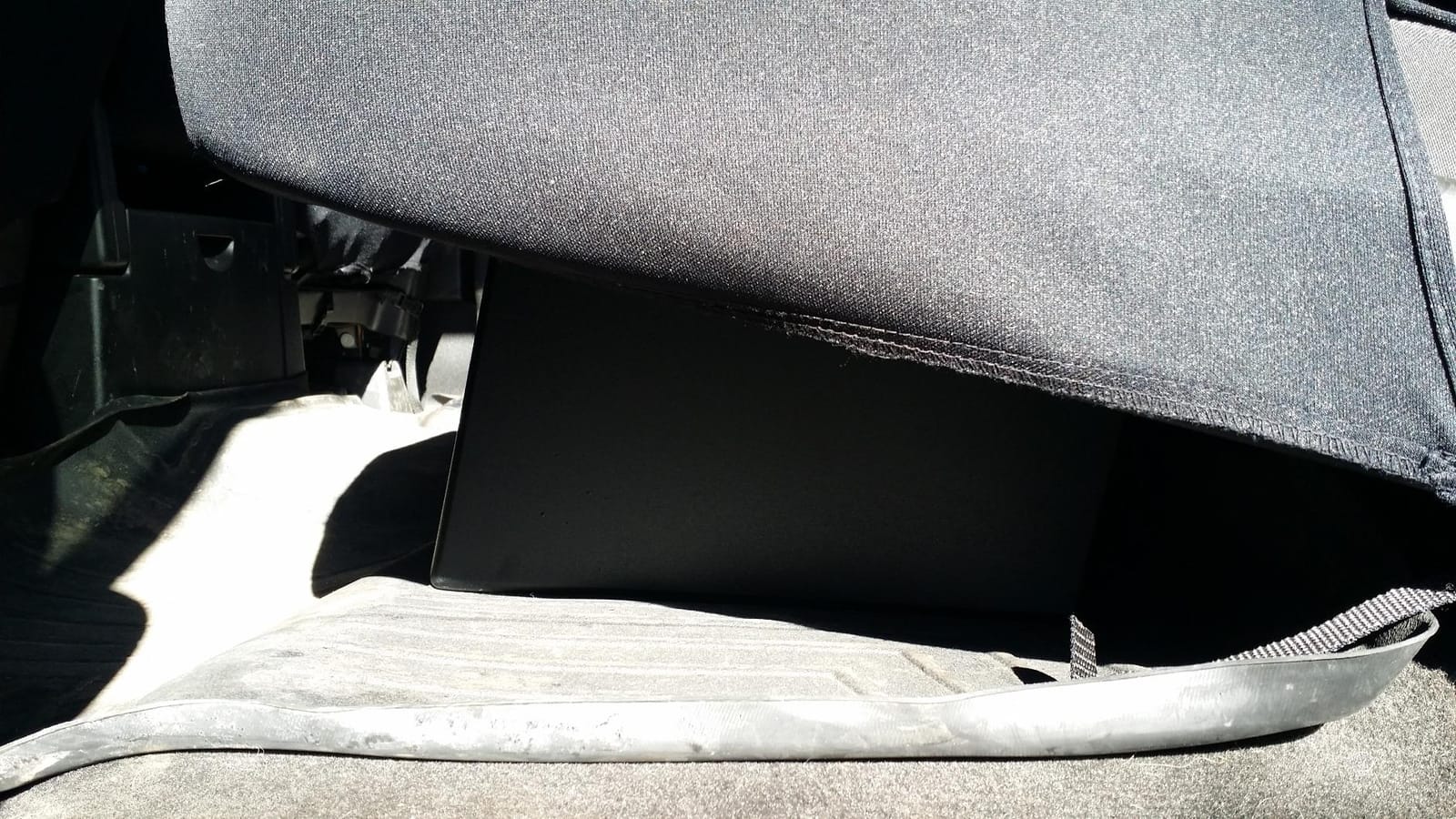
The wedge profile is the reason to buy it. At 15 inches high and 11 inches deep, it stands upright against a seat back and leaves the rest of the floor usable. That is exactly what family-car owners on car audio forums ask for, clean low end with the trunk still functional.
Set the low pass around 90 Hz and use the phase switch to find the setting that gives the most output on your slowest track. Nothing else in this roundup makes that adjustment easier.
Where it falls short
At 16 pounds and with a plastic shell, it is light and hollow-sounding under hard tapping compared with a carpeted MDF cabinet. The one year warranty is also the second shortest here, so treat it as a first system rather than a forever system.
If you plan to add a second sub later, note that this box occupies its own amplifier channel internally. Building a multi sub system from powered enclosures gets expensive fast.
3. Rockville RWS12CA Slim Powered 12-Inch Sub for Tight Cargo Areas
Rockville RWS12CA 12″ Slim Powered Car Subwoofer with Enclosure
- Powered slim 12 inch sealed box
- 300W RMS built-in amplifier
- 24 in W x 15 in H x 6.65 in D
- 96 dB sensitivity
Pros
- Shallow 4.37 to 6.65 inch profile preserves cargo space
- Kevlar reinforced cone with 2 inch aluminum voice coil
- Low pass adjustable 50 to 250 Hz with bass boost
- Works with high level and low level signals
Cons
- 96 dB sensitivity needs real power to push hard
- Shallow sealed design trades depth for output
- Some owners call the bass clean fill rather than deep thump
Where the P300-12 is a wedge that stands up, the RWS12CA is a flat slab. At 24 inches wide, 15 high and 6.65 deep, it slides into the shallow gap behind a rear seat, under a parcel shelf, or into the floor recess of a compact hatchback.
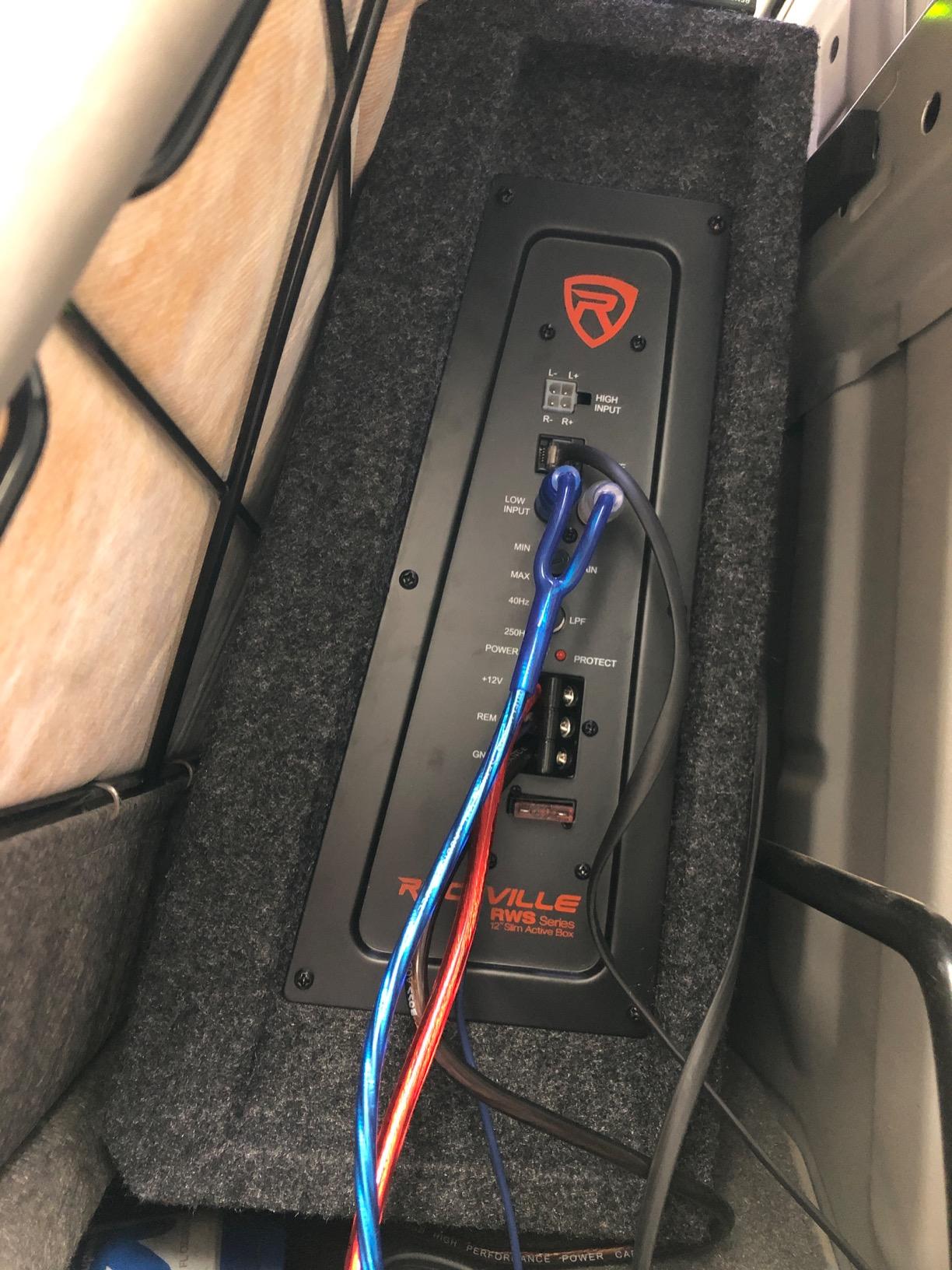
It is fully powered with a 300W RMS mono amplifier, a low pass adjustable from 50 to 250 Hz, and a 12 dB bass boost. The RJ11 dash remote jack is included, which is rare at this level and lets you trim bass from the driver’s seat once it is installed.
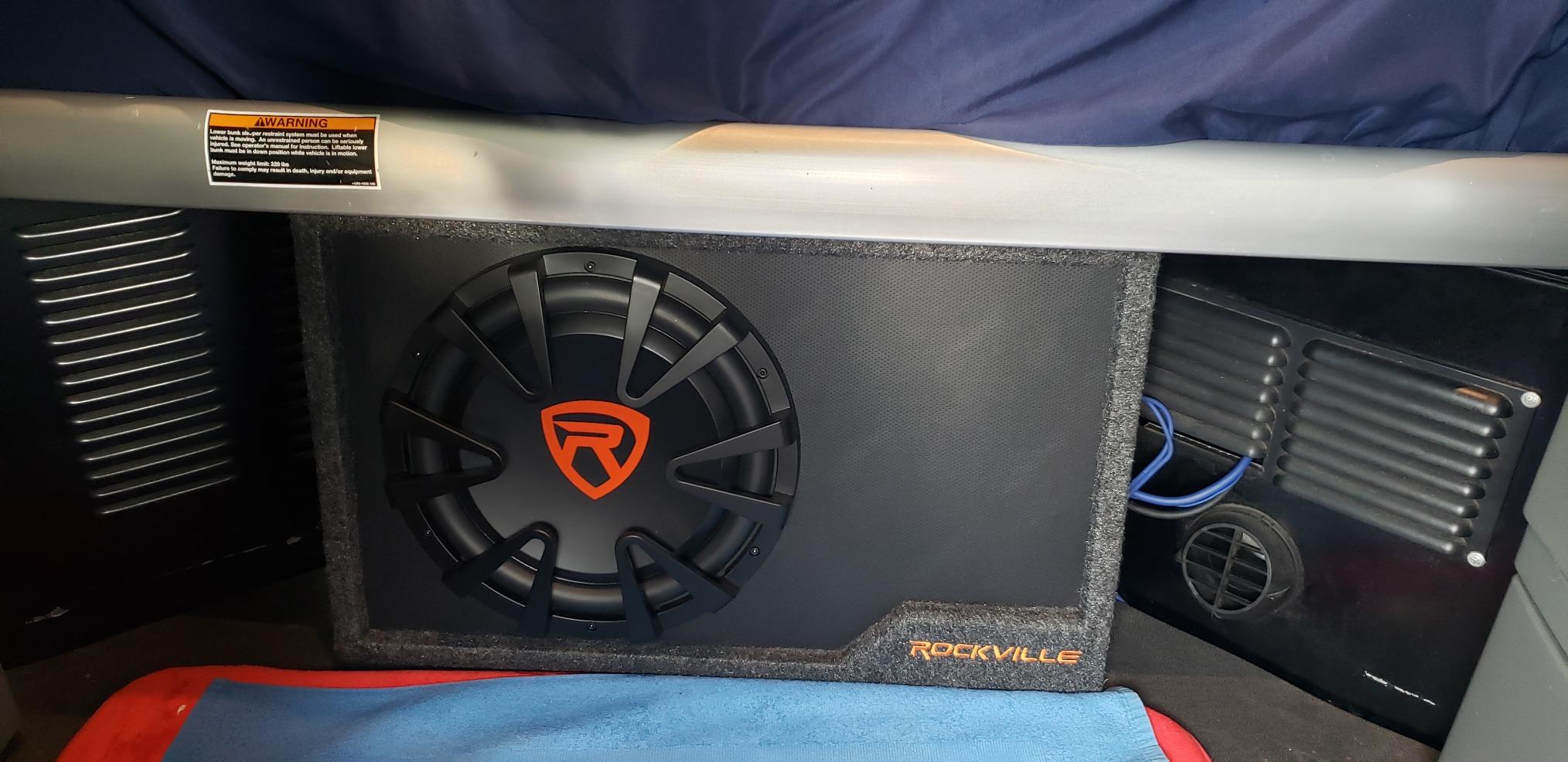
The cone is a composite pulp design reinforced with Kevlar, wound on a 2 inch high temperature aluminum voice coil. Sensitivity is rated at 96 dB with a 38 to 500 Hz response, and the enclosure is sealed MDF wrapped in aviation-grade carpet with a synthetic leather face.
That sensitivity number tells the real story. It is a high-efficiency design, which means it makes the most of modest power, but 96 dB still wants a clean signal and a proper low pass setting to sound its best.
How it fits a trunk
Mount it flat, low and forward against the seat back with a few inches of clearance around the 12 inch cutout. Because the box is sealed, no port needs to breathe through a pass-through, so a fully closed trunk lid does not choke it.
Buyers in reviews single out the shallow profile as the deciding factor, saying it preserves cargo space in a way nothing else here does. It is the one to pick if you carry luggage or equipment regularly.
Where it falls short
Sealed and shallow is a compromise. Output at the very bottom of the range is modest, and several owners describe the result as clean controlled fill rather than deep thump. If you want to feel notes in your chest, a larger box with more airspace wins.
The 1200 watt peak figure is a marketing number. The 300W RMS amplifier is the real rating, and matching that is the number to plan your electrical around.
4. Rockville RV8.2A Dual 8-Inch Kit With Amplifier And Wiring Kit
Rockville RV8.2A Dual 8″ Car Subwoofer Enclosure with Mono Amp & Wiring Kit
- Dual 8 inch enclosure with mono amp
- 200W RMS at 4 ohm and 400W at 2 ohm
- Quasi transmission line vented design
- 20.2 in x 12.5 in x 10.9 in
Pros
- Enclosure
- subs
- amp
- wiring kit and remote in one box
- 8 AWG wiring kit included so the install needs nothing extra
- Vented quasi transmission line design adds output in a small cabinet
- Thermal protection with auto restart in a hot trunk
Cons
- 8 inch drivers lack the depth of a single 12 inch
- 2 ohm load limits which mono amplifiers you can use
- Compact box suits shallow cargo areas
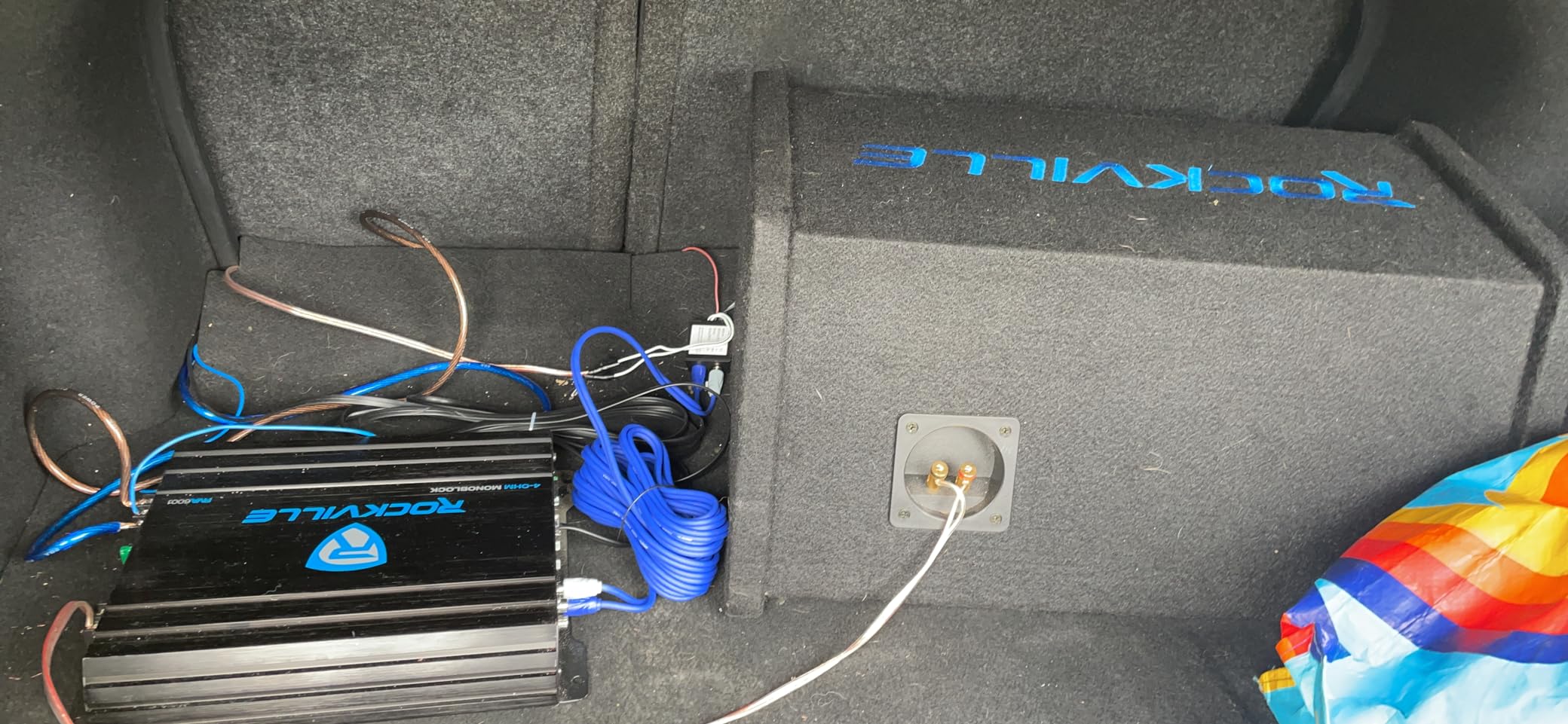
Nothing else in this roundup arrives with a full 8 AWG amplifier wiring kit, a remote knob, a mono amplifier and a pair of drivers already mounted. For a first car audio build, that completeness is the entire value proposition.
The enclosure uses a quasi transmission line layout with 15 degree bottom-angled ports, which is a clever way to get ported-style output from a cabinet only 20.2 by 12.5 by 10.9 inches. The ports fire downward and slightly rearward, away from the cabin.
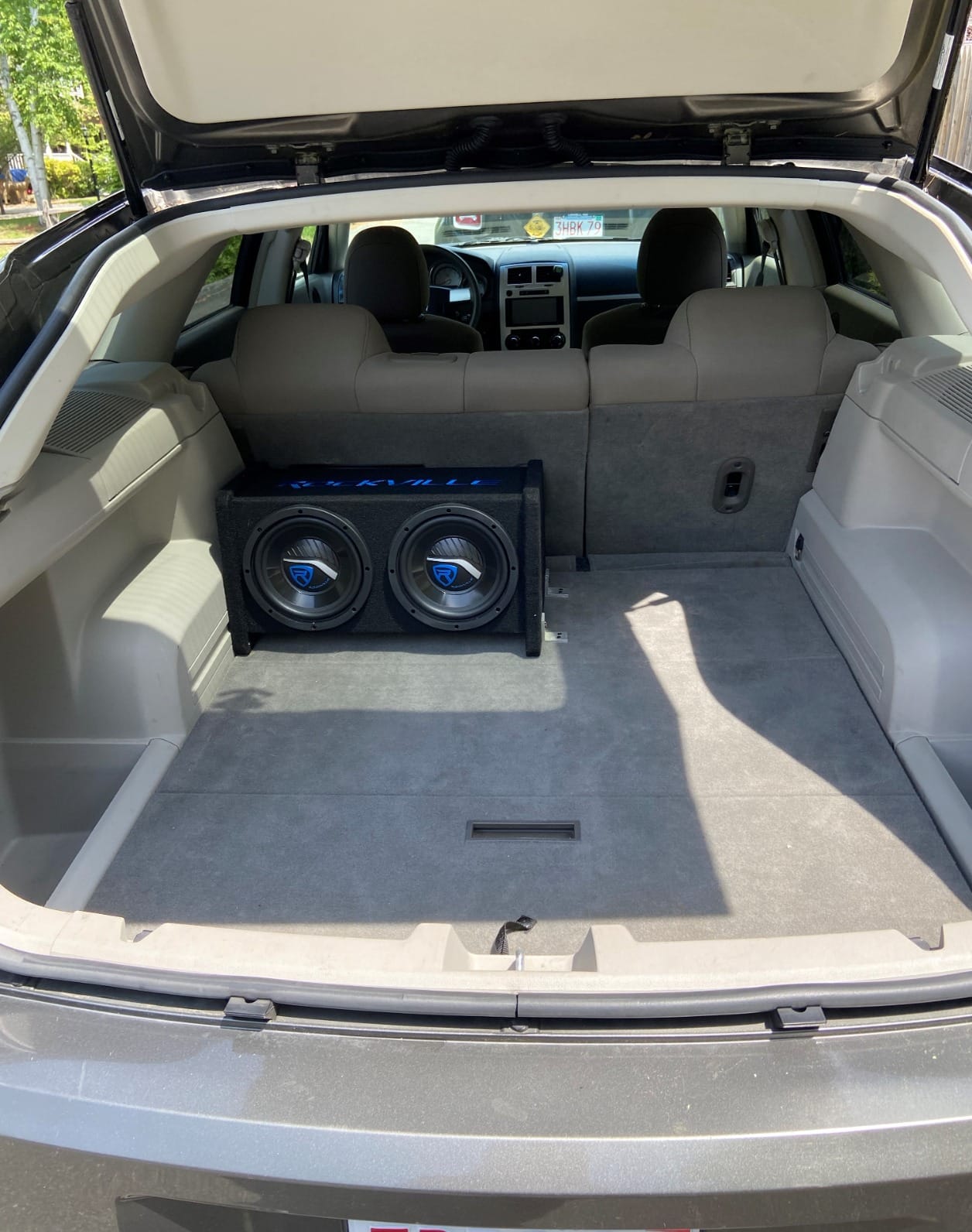
The amplifier is CEA-2006 compliant and delivers 200W RMS at 4 ohm or 400W RMS at 2 ohm. The 3/5 inch MDF cabinet is wrapped in tweed carpet, the 8 inch drivers use high-excursion butyl surrounds with 1.5 inch 4-layer aluminum voice coils, and the magnet motors are vented.
Thermal protection with auto restart is a genuinely useful feature in a car. A trunk in summer can hit temperatures that trip a naive protection circuit and leave you with silence until it cools.
How it fits a trunk
At just over 20 inches wide and about 21 pounds, this is the easiest full system here to load into a small car. The box stands upright at the back of the trunk or along one side without blocking the lid.
Keep the vents clear. Because the ports fire downward, the box needs a few inches of air under it, and running a sealed trunk completely tight will change how the low end loads.
Where it falls short
Two 8 inch drivers are not the same as one 12 inch. They move the air and add mid bass weight, but they will not reach the same low octave, and reviews are honest about the bass being tight rather than window-rattling.
The 2 ohm amplifier load also rules out many factory or entry mono amplifiers. Check your amp’s minimum stable impedance before you commit to this combination.
5. MTX RT8PT Vented Tube Powered 8-Inch Sub for the Smallest Trunks
MTX Audio RT8PT 8″ 240W Peak Amplified Vented Car Subwoofer Tube Enclosure
- Powered 8 inch vented tube enclosure
- 240W max and 120W RMS built-in amp
- 35 to 250 Hz frequency response
- 21.25 in L x 9.84 in W x 9.84 in H
Pros
- Vented tube design gives more output than a sealed 8 inch
- Fits under seats or at the back of a tight trunk
- External bass knob and variable crossover included
- Mounting straps supplied for a secure install
Cons
- Only 120W RMS
- well below the 12 inch options
- Does not reproduce below 35 Hz at high volume
- Some owners report amplifier failure after extended use
This is the smallest useful thing on the list. The tube-style vented enclosure is 21.25 inches long and just under 10 inches square, which means it goes where nothing else here will, including under a rear seat or flat against a back seat in a small car.
Ventilating an 8 inch sub is what separates it from the sealed competition. That extra port output is why a 120W RMS system can add noticeable low end weight in a hatchback where space is the binding constraint.
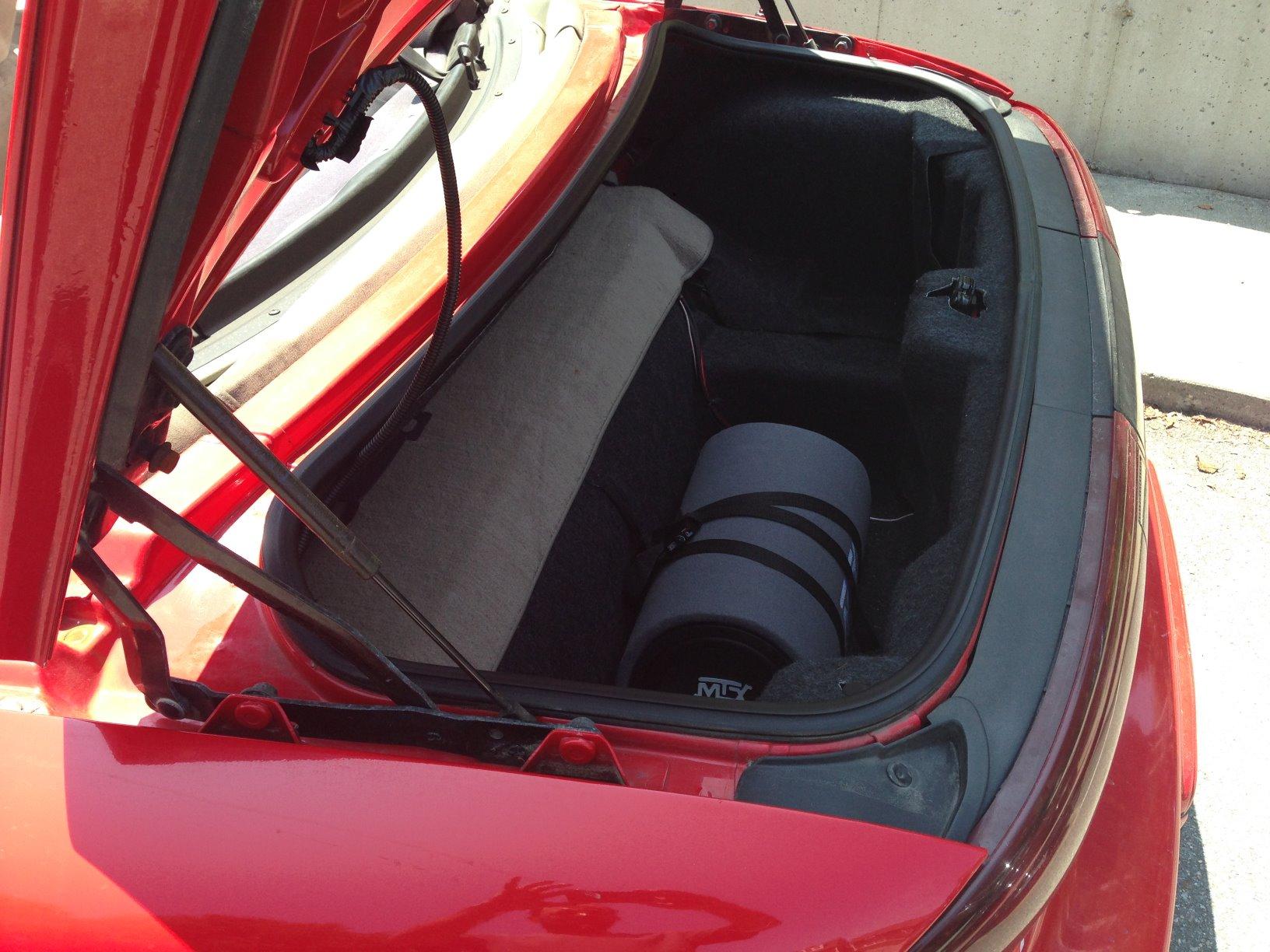
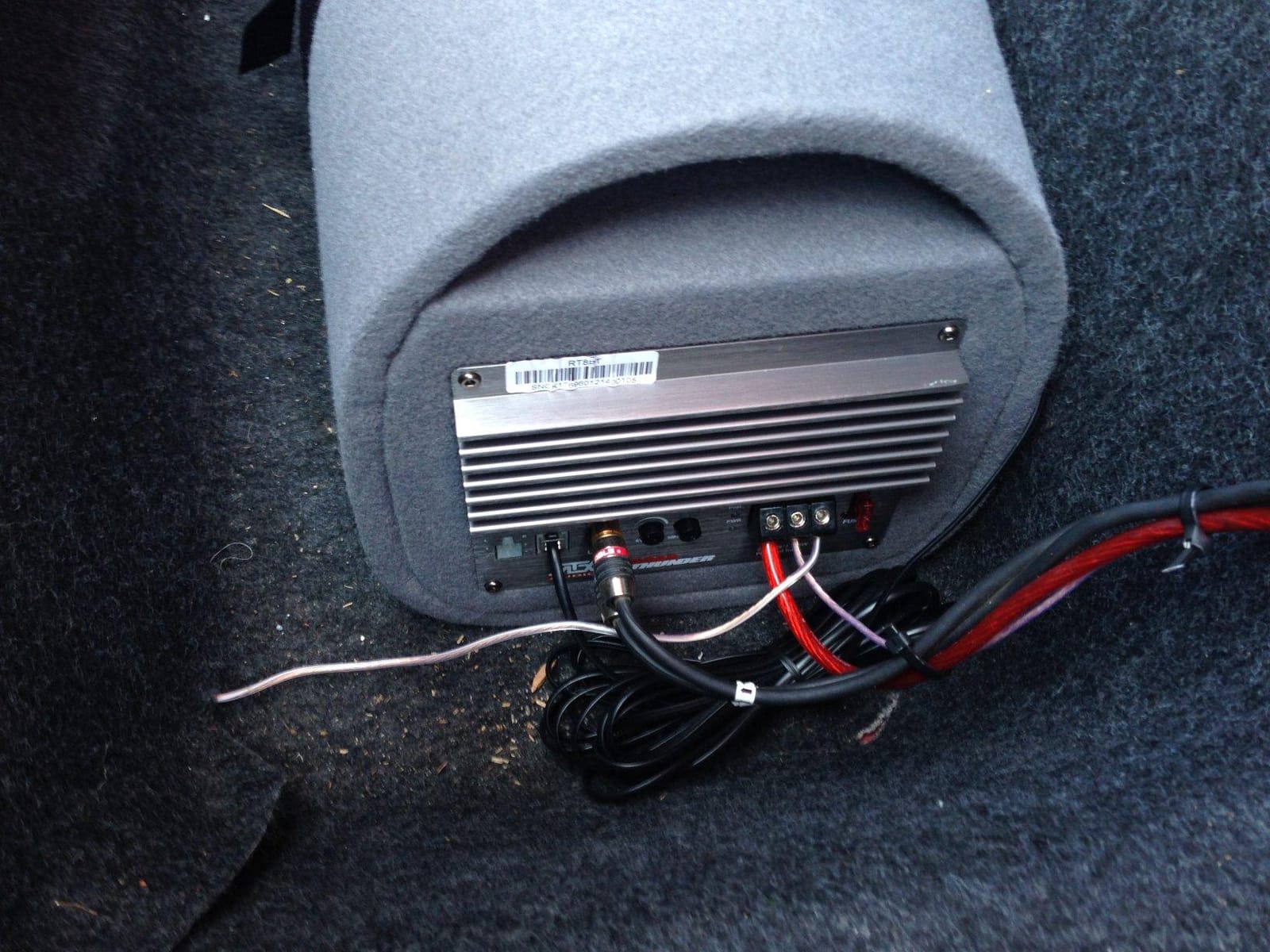
The variable crossover runs 50 to 200 Hz at 12 dB per octave, frequency response is 35 to 250 Hz, and there is an external bass control knob on the enclosure itself. High level and low level inputs are both present, with RCA connectivity on top.
It runs on 12 volts and is rated for 240 watts maximum. At 20.8 pounds it is heavier than it looks, so use the included mounting straps rather than relying on friction.
How it fits a trunk
Because the shape is round and angled, orientation options are limited. It works best stood upright at the back of the cargo area with the vent end clear of the rear wall, or slid under a seat where the vent has room to breathe.
Reviewers describe it as a fill-in sub that adds low end without rattling the car. For a daily driver that never needs to be heard from three blocks away, that is exactly the right description.
Where it falls short
120W RMS is a real limit. It will not push hard at volume, and it will not reproduce below 35 Hz with any authority, so the deepest notes on a track are simply missing rather than merely quiet.
A minority of owners report amplifier failure after several months or a couple of years of hard use. If you drive daily at volume, budget for a replacement amp or pick a box with a longer warranty.
6. Rockford Fosgate Prime R2S-1X12 Slim 12-Inch Wedge for Tight Cabs
Rockford Fosgate Prime R2S-1X12 Loaded 12” Slim Subwoofer in Enclosure
- Single shallow 12 inch in sealed wedge
- 250W RMS and 500W max handling
- Wired internally to 2 ohm
- 3.25 in top depth and 5.25 in bottom
Pros
- Wedge shape tucks under seats in limited-travel cabs
- 250W RMS single 12 moves more air than dual 8 inch boxes
- Quick release compression terminals
- 5/8 inch MDF cabinet covered in high density carpet
Cons
- 27.375 inch width is too long for many trunks
- Needs a separate 2 ohm mono amplifier
- Not a powered unit so you are buying two things
This wedge was designed for a specific problem, single-cab pickups where the rear seat barely moves, and it solves it well. The top edge is 3.25 inches deep and the bottom is 5.25, so the box slides under the seat back at an angle rather than sitting proud behind it.
The driver is a dual voice coil 12 inch internally wired to a 2 ohm load, handling 250W RMS. That single 12 inch at 250W moves noticeably more air than a pair of 8 inch drivers at the same power, which is why we would pick it over a dual 8 box when space allows.
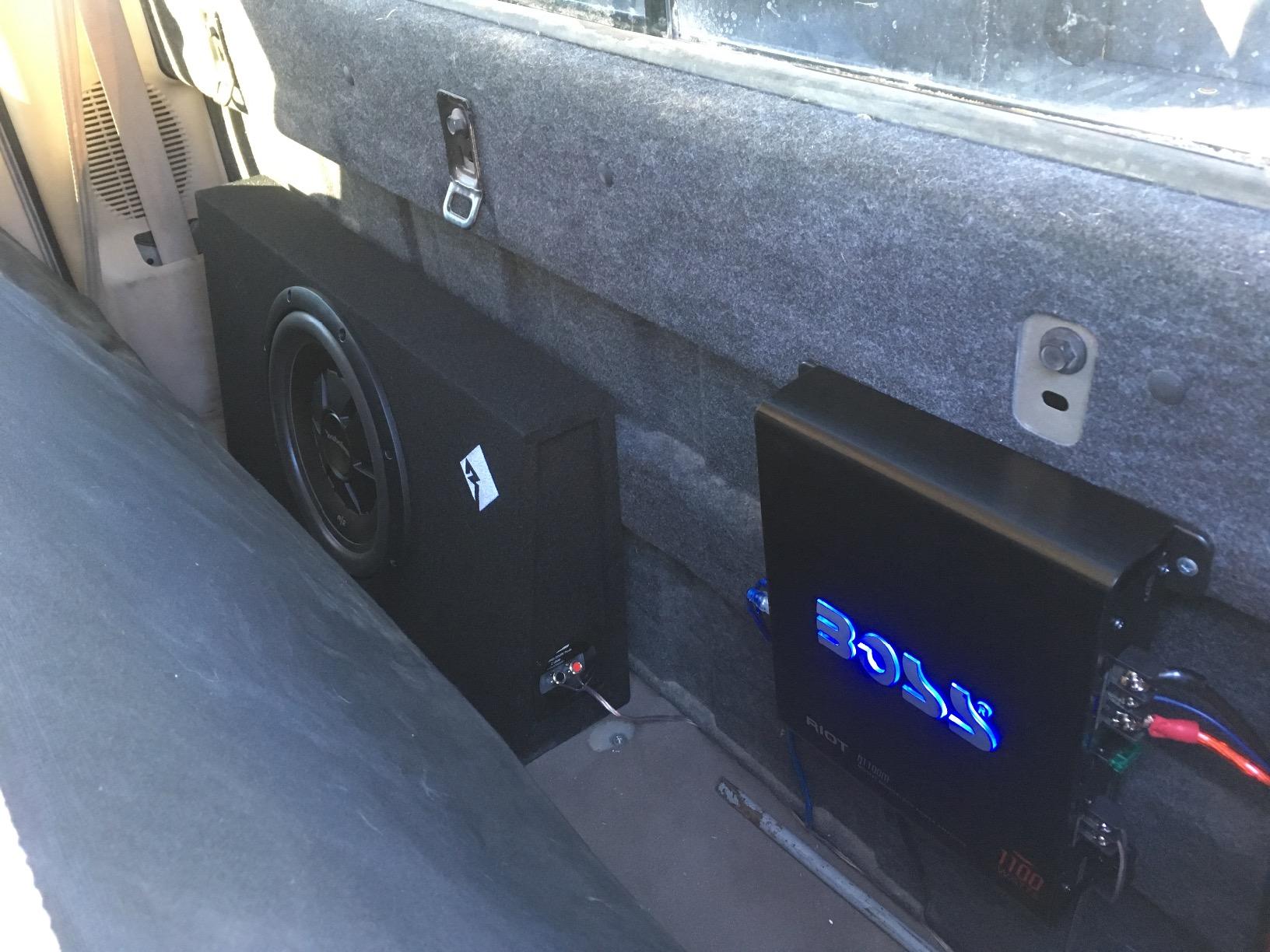
Quick release compression terminals mean you can unplug the box without unscrewing anything, a small detail that matters when you need to remove a sub to reach the spare. The cabinet is 5/8 inch MDF in high density carpet, and Rockford Fosgate supplies a one year full warranty.
Two caveats. It is not powered, so you need a mono amplifier, and at 27.375 inches wide it is a longer object than most trunks can swallow in one piece.
How it fits a trunk
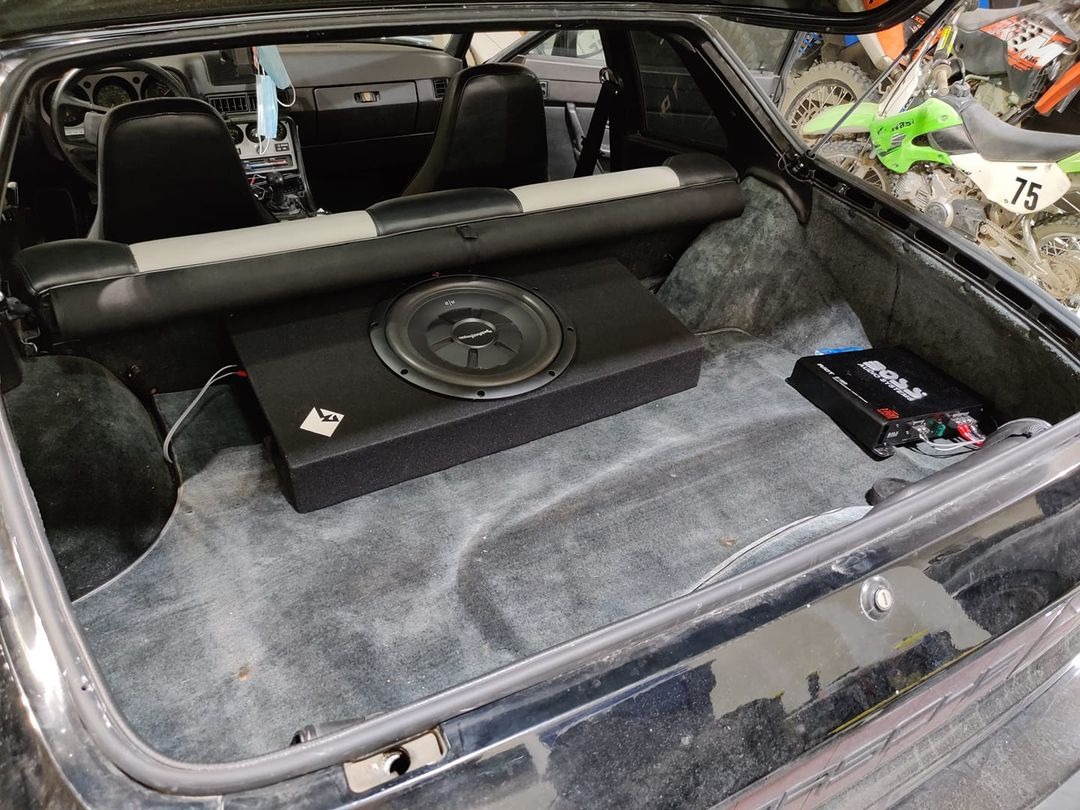
For a sedan with a fold-down rear seat, the wedge slides into the gap between the seat back and the body, which is exactly where you want a shallow 12 inch. For a trunk you intend to keep usable, it takes one corner but leaves the rest of the floor.
Run the low pass at 80 to 90 Hz, and check the phase by playing a sine sweep. In a trunk the reflected wave off the back seat can push the output down, and rotating the sub a few degrees or flipping the phase often recovers several decibels.
Where it falls short
The width is the deal breaker for many cars. If your trunk opening is 26 inches or narrower, this will not go in without removing something, and the 18 pound weight makes it awkward to angle in a confined space.
Sealed plus 250W RMS also means it wants a proper 2 ohm mono to reach full output. Pair it with a small 4 ohm only amplifier and you will hear the difference clearly.
7. JBL SUBBP12AM Powered 12-Inch Sub for Musical, Distortion-Free Bass
JBL SUBBP12AM – 12” amplified 12” Subwoofer with Sub Level Control, Black
- Powered 12 inch ported subwoofer
- 150W RMS and 450W peak amplifier
- 35 to 120 Hz frequency response
- Remote sub level control included
Pros
- Slipstream port removes port noise at higher levels
- Bass boost function for extra low end punch
- Remote level control included in the box
- 150W RMS amplifier is matched to the driver
Cons
- Only 150W RMS
- not aimed at high output
- 24.13 inch wide enclosure is not a slim design
- One year limited warranty
The JBL is tuned for smoothness rather than volume, and owners consistently credit the tuning rather than the power figure. The 35 to 120 Hz response is a deliberately narrow band, which is why it sounds musical across a whole album instead of only on one track.
The slipstream port is the feature that justifies the sealed-plus-port styling. It is shaped so air moves through without turbulence, so you get the low end weight of a ported enclosure without the chuffing noise a straight tube port makes when the bass is heavy.
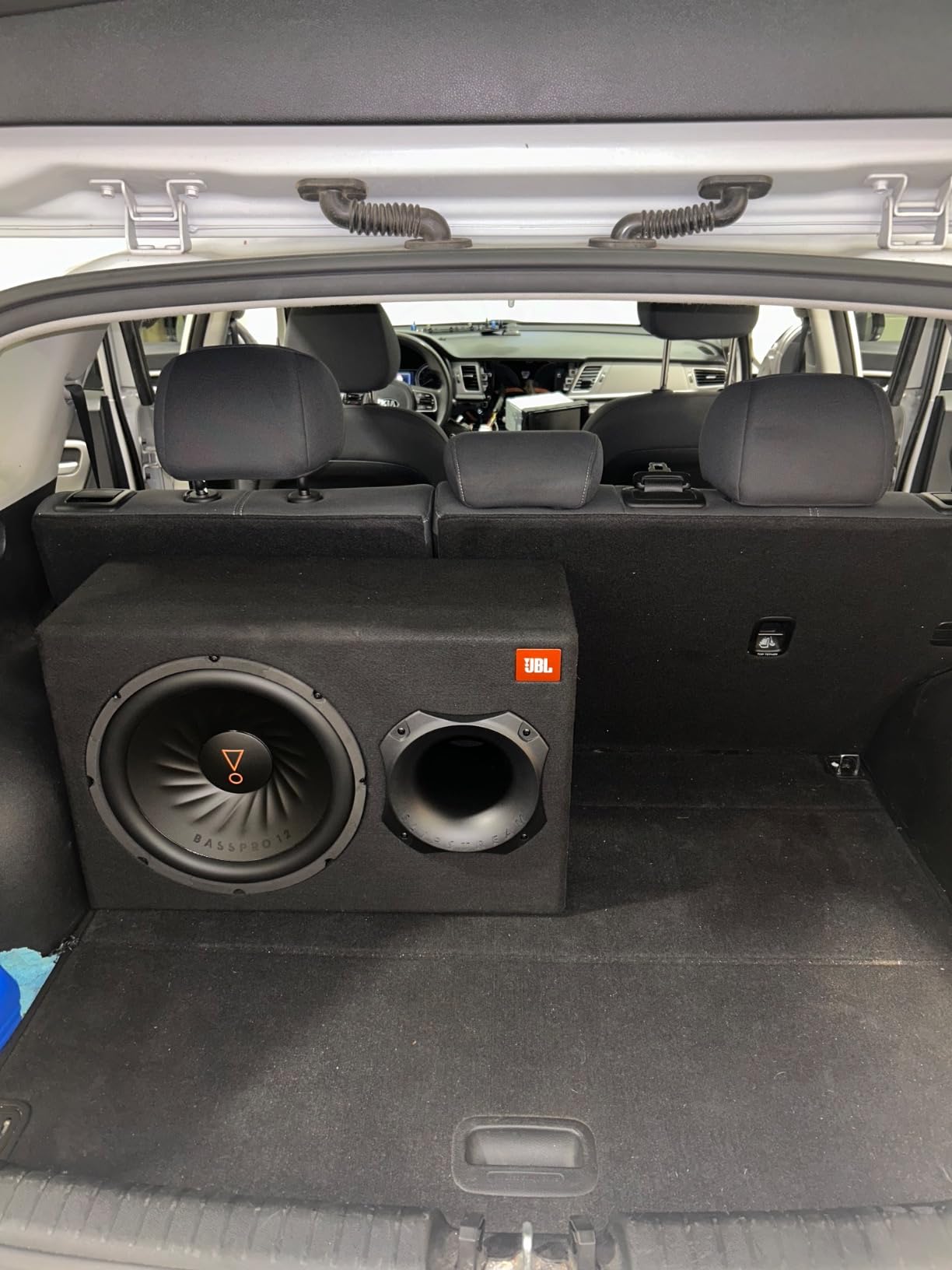
It is fully powered at 150W RMS, comes with a remote sub level control, and the box includes the enclosure, the manual and the remote. A bass boost function adds low frequency lift if you need it after installation.
Be realistic about the power. 150W RMS is modest, and buyers who expected a hard-hitting system report hitting that ceiling quickly. The same money into a 12 inch with more power plays louder for the same effort.
How it fits a trunk
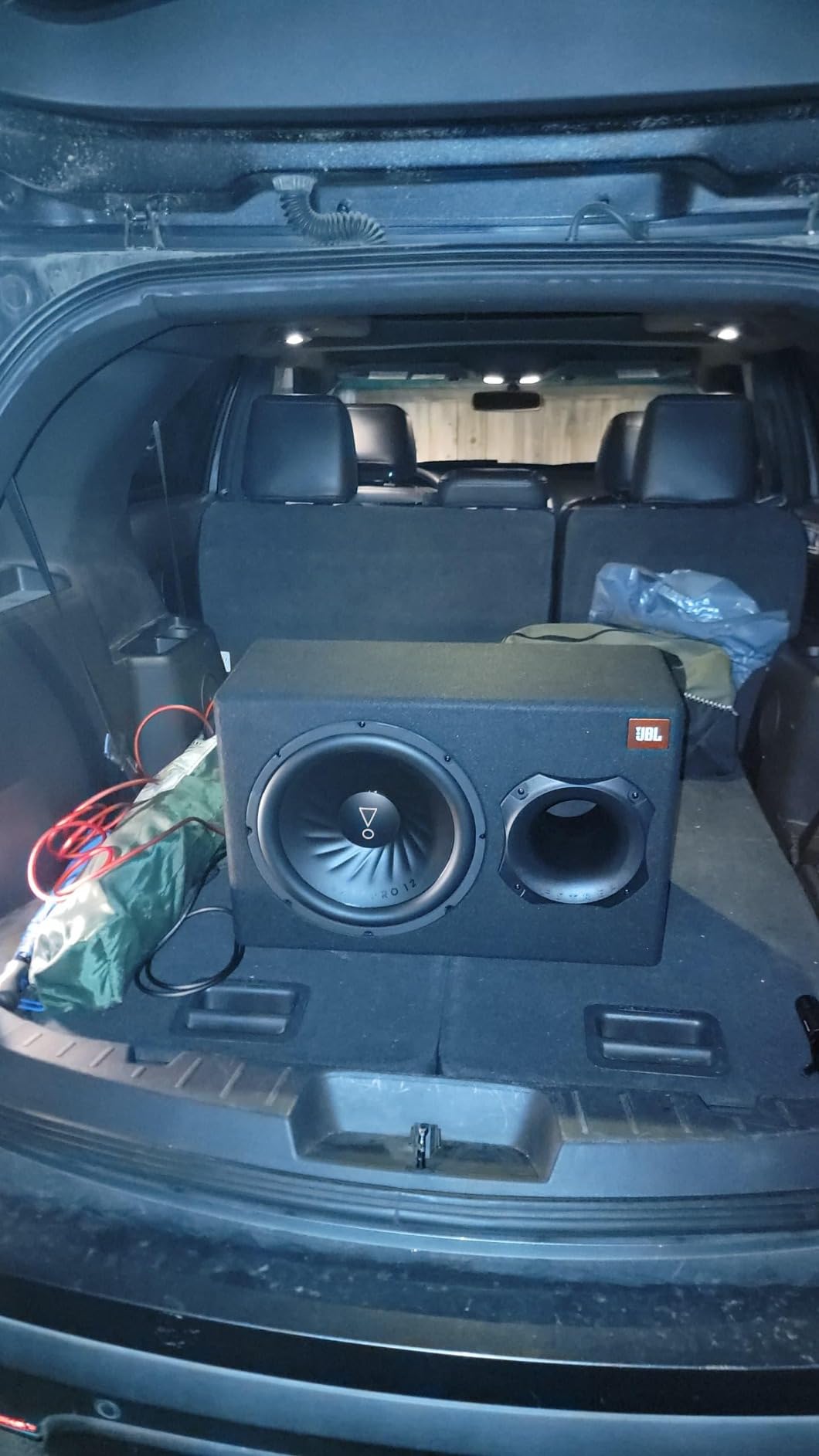
At 24.13 inches wide, 13 deep and 11.25 high, it needs a flat floor area but nothing exotic. Place it toward the rear of the trunk with the port end clear of the back seat, and keep the port opening off the trunk lid panel so the lid never chokes it.
Because it is ported, leaving breathing room around the port matters more than it does for a sealed box. A solid gap in front of the port is the difference between deep bass and a box that sounds cardboard-box thin.
Where it falls short
150W RMS against a sealed trunk is a real ceiling. The port also needs somewhere to go, and many sealed sedans with covered pass-throughs do not give it a clean route to the cabin.
Frequency response bottoms out at 35 Hz rather than lower, so if you are chasing the deepest notes on the planet, this is the wrong tool. It is the right one if you want bass that never gets harsh.
8. Pioneer TS-A3000LS4 Shallow-Mount 12-Inch Driver for a Custom Sealed Build
PIONEER A-Series TS-A3000LS4 Shallow-Mount 12″ Subwoofer 1500W Max
- Shallow mount 12 inch component driver
- 1500W max and 400W nominal
- 3.5 inch mounting depth
- 4 ohm single voice coil at 88 dB efficiency
Pros
- 3.5 inch depth fits behind or under seats without cargo loss
- Glass fiber and mica reinforced cone is rigid and detailed
- 4 ohm single voice coil is simple to wire
- Ranked number two best seller in its category
Cons
- Passive driver only
- you supply the amp and the enclosure
- 1500W max is a peak figure not continuous output
- Needs a properly sized 0.8 cu ft sealed box to perform
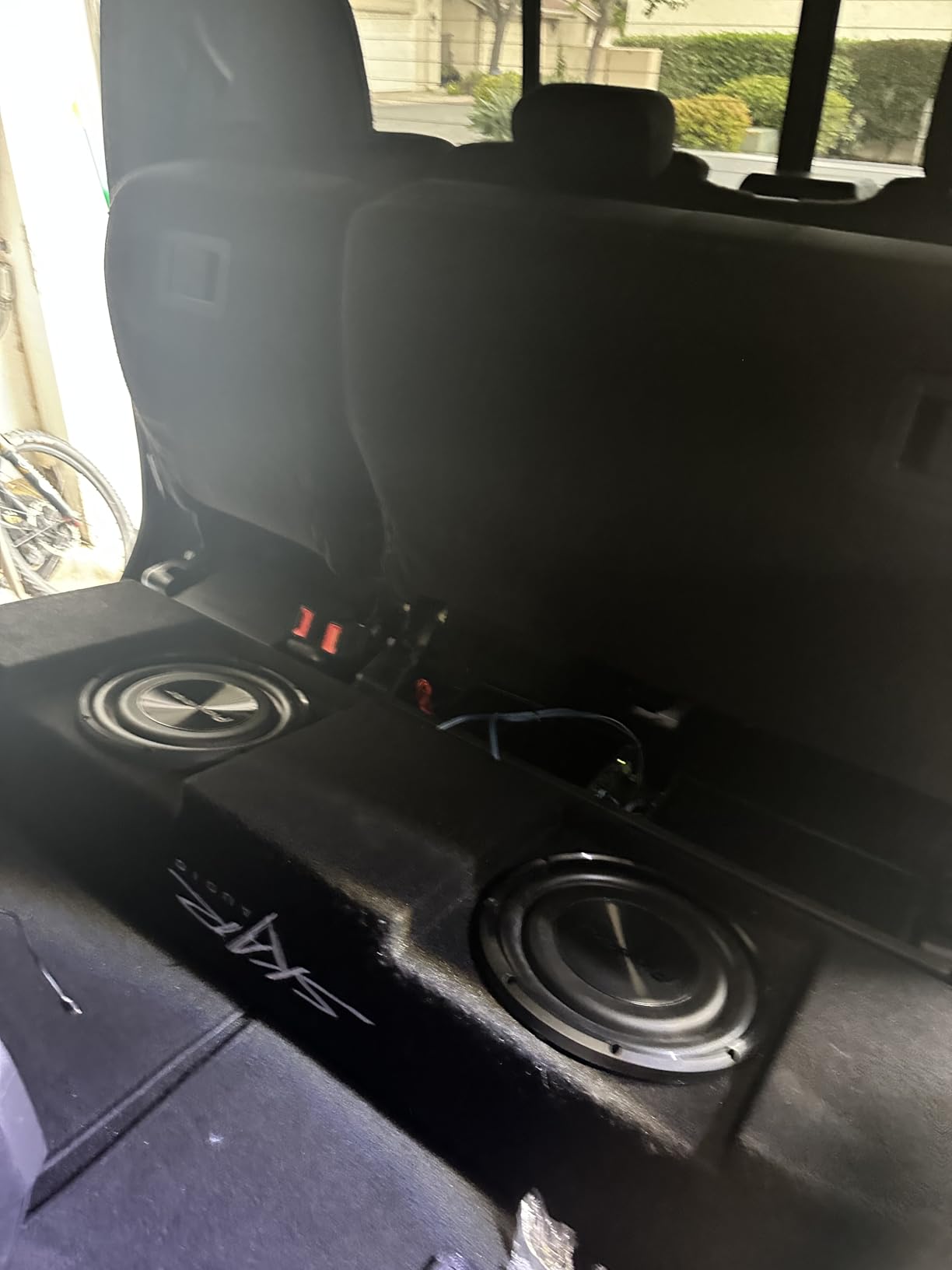
This is the only bare driver in the roundup, and that is the point. If you want to build a custom box, cut a panel to your own trunk dimensions and drive a real 12 inch cone, this is the one to build around. Everything else here arrives with the cabinet already made.
Mounting depth is 3.5 inches, which is remarkably shallow for a 12 inch driver. The 4 ohm single voice coil is a deliberate choice, because a single 4 ohm coil wires to almost any mono amplifier without a series or parallel calculation.
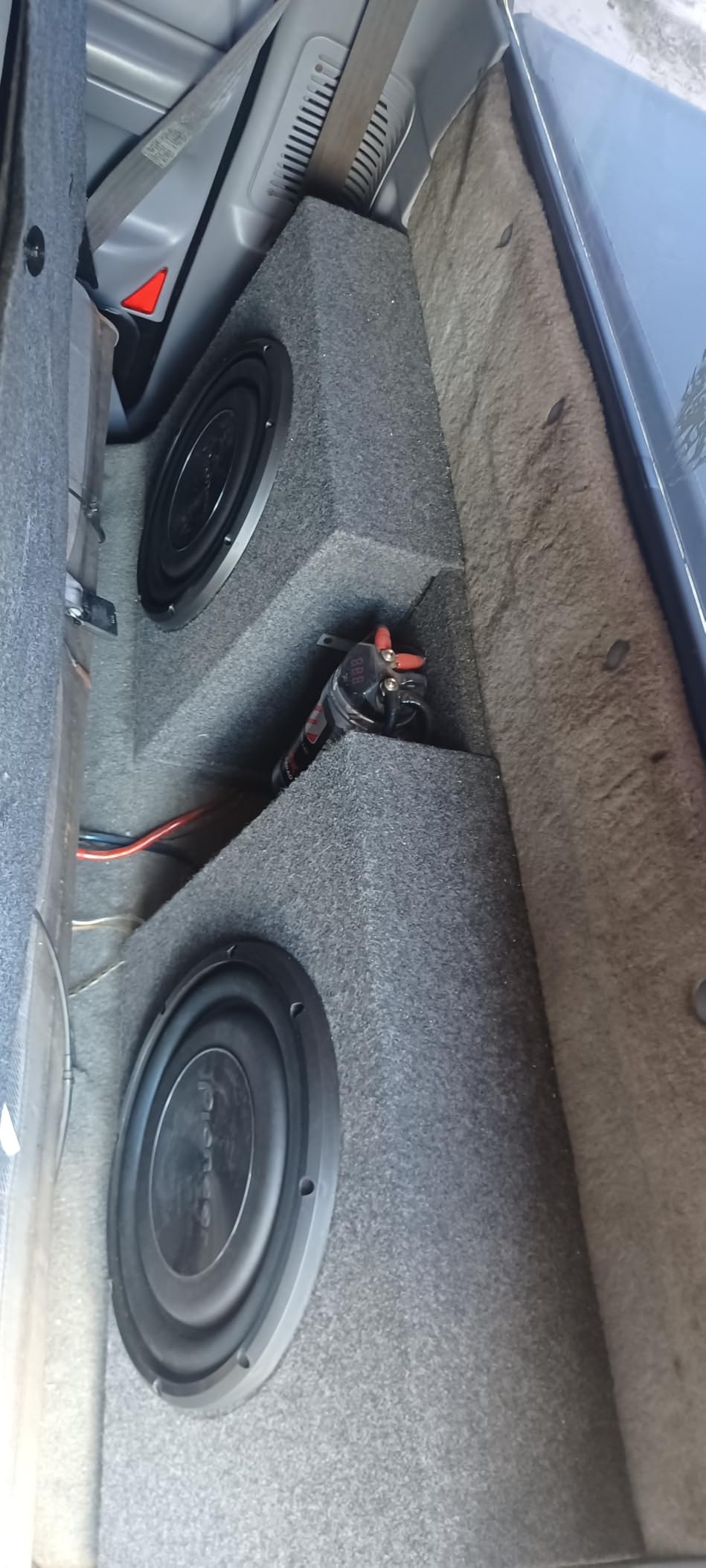
The cone is glass fiber and mica reinforced IMPP, a stiff material that stays controlled when you push it. Efficiency is rated at 88 dB, and the tuning is designed to match Pioneer A-series full-range speakers, which is why it is a favourite for a system where the sub and the door speakers are meant to sound like one car.
The stated application is a 0.8 cubic foot sealed enclosure. Build to that figure. An undersized box is the number one reason a good driver sounds bad, and the spec sheet is telling you exactly what it wants.
How it fits a trunk
A shallow 12 inch on a custom panel can go somewhere no pre-built box will fit, such as a flat panel under a parcel shelf or against a seat back in a shallow trunk. That flexibility is the entire reason to choose a bare driver over a loaded enclosure.
Face it forward toward the cabin if you can, keep the enclosure rigidly braced, and line the box walls with butyl damping. A home-built cabinet with unfilled walls will rattle louder than the music.
Where it falls short
You are buying a project. You need an amplifier, a box, a roll of carpet or carpet liner, wire and basic woodworking tools, and the skill to cut and seal a cabinet without leaks.
And the 1500W max number is worth repeating once more, because it is the number most often quoted and the least meaningful. Continuous power is 400 watts nominal. Size your amp to that.
9. Pioneer TS-A3000LB Pre-Loaded Shallow 12-Inch Sub for Flexible Mounting
PIONEER A-Series TS-A3000LB Pre-Loaded Shallow-Mount 12″ Sub 1500W Max
- Pre-loaded sealed 12 inch shallow sub
- 1500W max and 400W nominal
- 23.625 in W x 13.75 in H x 6.75 in D
- 2 ohm single voice coil at 88 dB
Pros
- No box building
- only driver wiring to the amplifier
- 6.75 inch depth fits behind pickup rear seats
- Mounts facing up
- down or vertically with included feet and brackets
- Front grill and hardware included
Cons
- Some owners report failure after about a year
- 2 ohm load needs a compatible mono amplifier
- Nut style rather than push terminal connectors
- Listed depth appears shorter once the grill is measured
This is the loaded twin of the Pioneer driver above, and the difference is the box. A 6.75 inch deep sealed enclosure is pre-loaded with the 12 inch, so you skip the cabinet work entirely and just wire the terminals to an amplifier.
The enclosure mounts facing up, down or vertically, with feet, pads and brackets in the box. In a pickup cab behind a rear seat, an upward-firing shallow box often fits where nothing else will, and the vertical option covers awkward spaces beside a console.
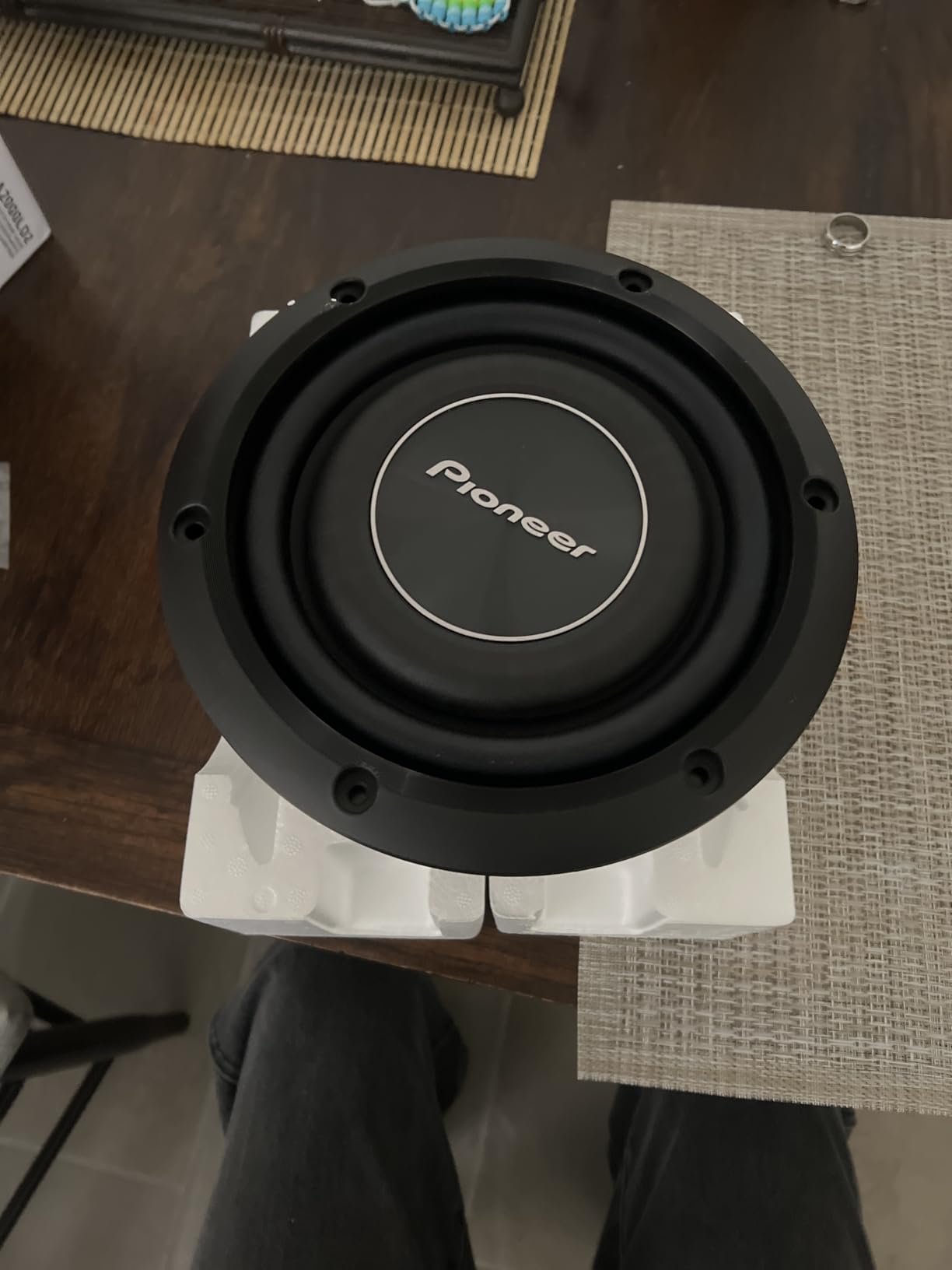
Power handling is 400 watts nominal at 2 ohm with 88 dB efficiency, using the same glass fiber and mica reinforced IMPP cone. The box dimensions are 23.625 by 13.75 by 6.75 inches, and a front grill and all mounting hardware are supplied.
Verify the physical depth before you order, because owners note the listed 6.75 inches measures closer to five or six once the grill is included. In a tight cab install that half inch decides whether the box goes in.
How it fits a trunk
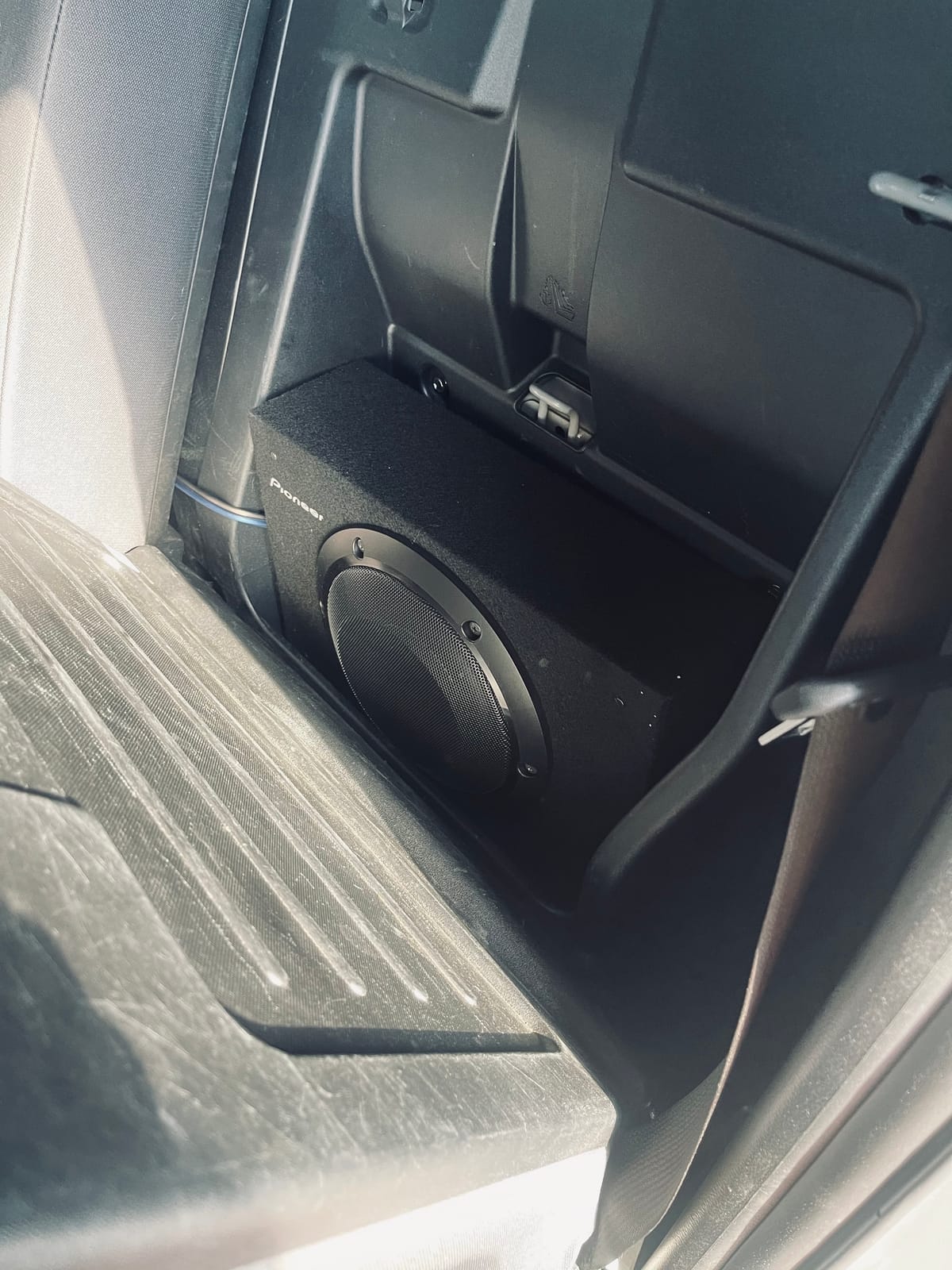
In a sedan, this sits flat on the trunk floor with the 12 inch facing the back seat. The sealed design means no port to vent, so a fully closed trunk lid does not choke the output, which is the safest choice for sealed European sedans.
Because it is shallow, it also fits the gap behind a pickup rear seat, where a 13.5 inch deep box would be impossible. That versatility across vehicle types is unusual at this size.
Where it falls short
Durability is the main concern. A noticeable share of one-star reviews describes the unit locking up or failing after roughly a year, and a 2 ohm load narrows your amplifier choices to monos that are stable below 4 ohm.
The 4.2 average rating reflects that, and it sits below the rest of this list. If you want the same shallow depth with better owner satisfaction, the Rockford Fosgate R2S-1X10 at the end of this roundup covers similar ground.
10. Rockford Fosgate Prime R2S-1X10 Slim 10-Inch Wedge for Compact Trunks
Rockford Fosgate Prime R2S-1X10 Loaded 10” Slim Subwoofer in Enclosure
- Sealed loaded 10 inch shallow sub
- 200W RMS and 400W max handling
- Wired internally to 2 ohm
- 19 in wedge width with 3.25 in top depth
Pros
- 19 inch width fits small trunks that reject a 27 inch box
- 3.25 inch top depth slides under rear seats
- Only 15 pounds so one person can lift it
- Quick release terminals and mounting brackets included
Cons
- 200W RMS is less than the 12 inch sibling in the same line
- 10 inch driver has less low bass extension than a full size 12
- Needs an external 2 ohm mono amplifier
This is the one we would recommend for a small sedan where the 27 inch box will not fit. At 19 inches wide it is eight inches narrower than its 12 inch sibling, and at 15 pounds it is light enough for a single person to lift into place and reposition.
The wedge shape is the same as the R2S-1X12, with a 3.25 inch top and 5.25 inch bottom, so it tucks under a seat at an angle. Internally it is wired to a 2 ohm load and handles 200W RMS, with quick release compression terminals at the back.
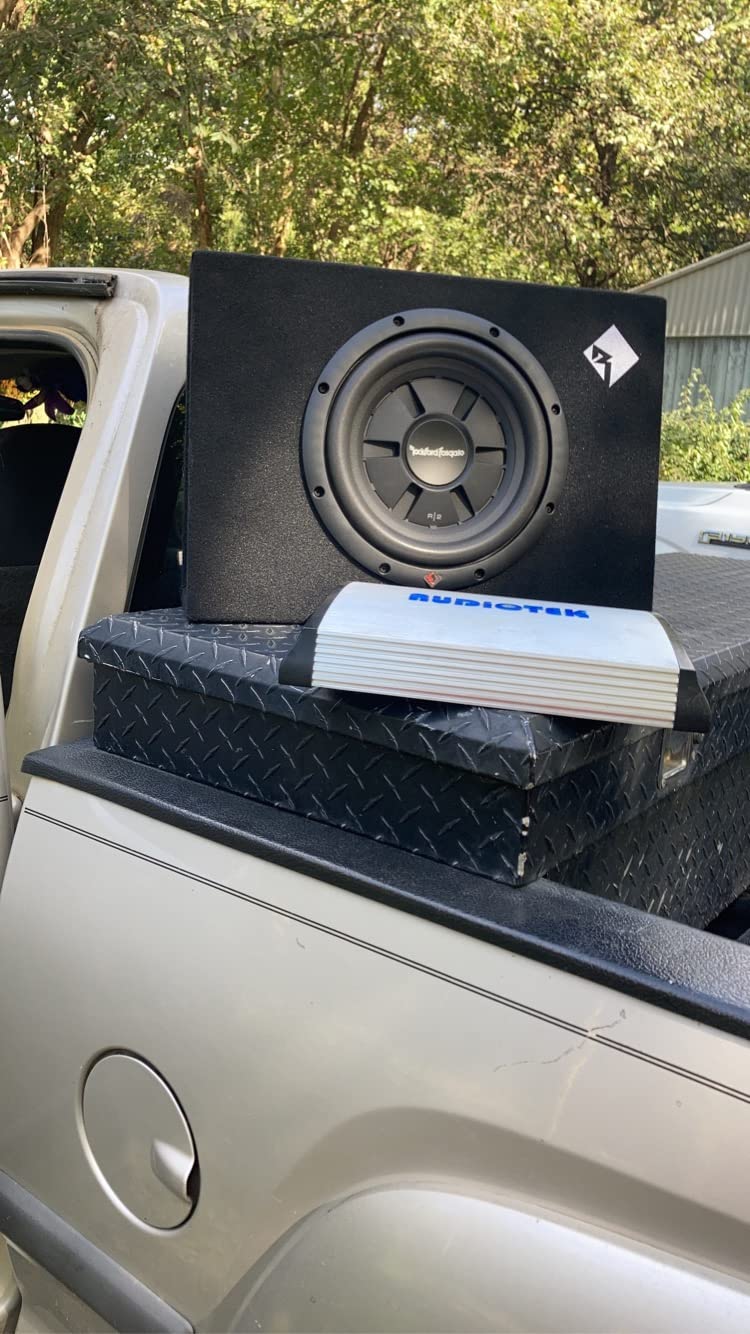
The cabinet is 5/8 inch MDF under high density carpet, the same construction as the 12 inch version. Mounting brackets come in the box, and the one year full warranty is the same.
What changes is the physics. A 10 inch cone in a sealed box reaches a lower octave well, but it simply moves less air for the same wattage. This is a fill first and a thump second.
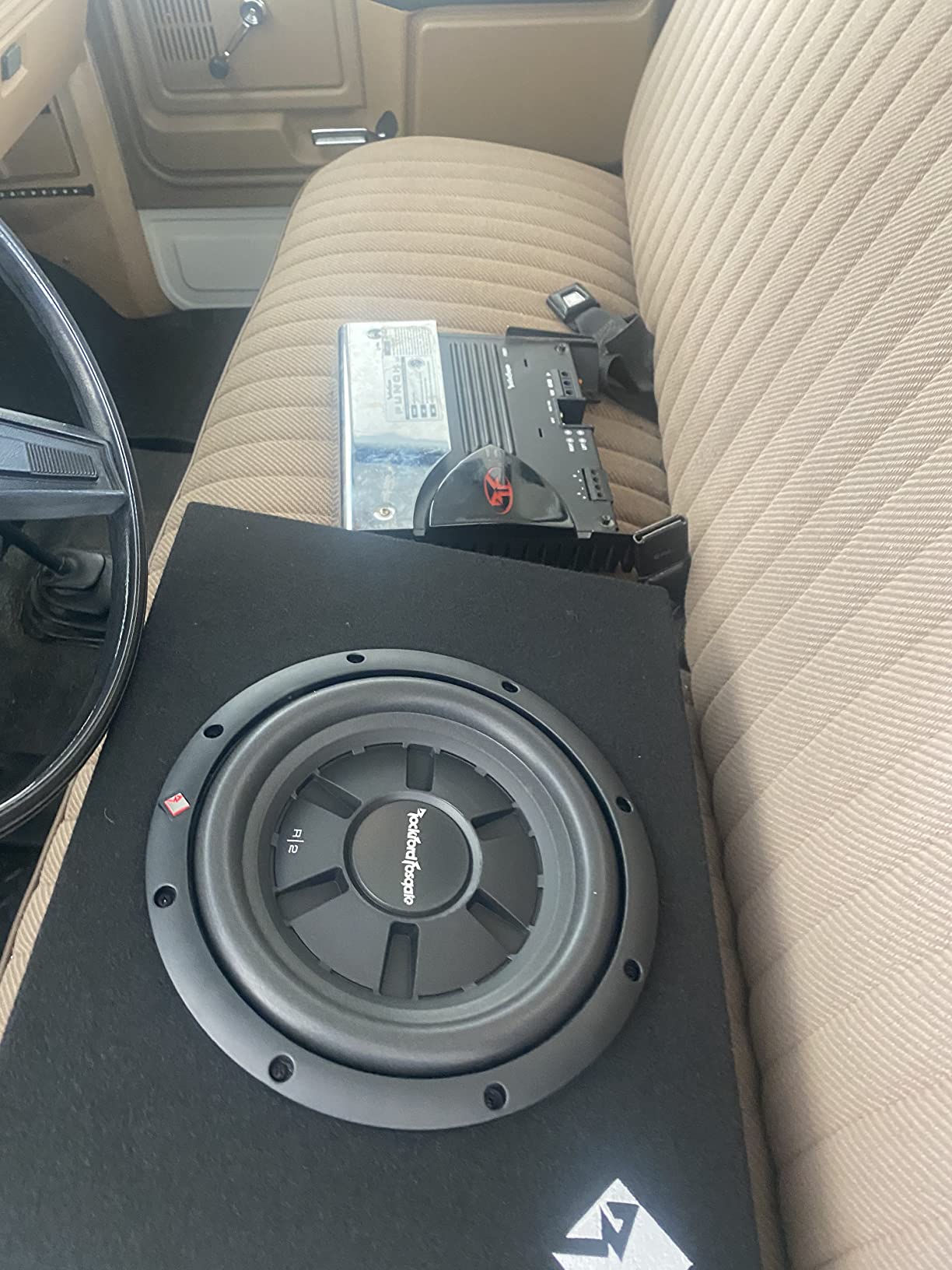
How it fits a trunk
Nineteen inches wide fits across most trunk openings and most rear seat backs, so you have real freedom in placement. Point it at the rear seat back or the lid, keep it flat on the floor, and pack the side gaps with foam so it does not become a rattle source.
Run the amplifier gain conservatively and set the low pass between 80 and 100 Hz. A 200W RMS driver paired with an oversized amp is the fastest way to a blown voice coil.
Where it falls short
It is not the deepest option here. 200W RMS in a small sealed cabinet will not produce the lowest notes with authority, and no enclosure design can fix that without adding airspace you do not have.
It is also a passive design, so budget for a 2 ohm stable mono amplifier on top of the enclosure cost. And at 4.5 stars from 656 owners, it holds up well for a build that prioritises fit over raw output.
What Is a Trunk Subwoofer and Why Does Location Matter?
Yes, trunk subwoofers are good. A trunk subwoofer is a low frequency driver, bare, pre-enclosed or powered, mounted in your cargo area to reproduce the 20 to 200 Hz range your door speakers cannot. The trunk is usually the only place a sedan has room for one, so the location is what makes the whole idea possible.
The tradeoff is trunk gain. A sealed trunk absorbs low frequency energy, and versus an open hatchback the same system in a closed trunk loses somewhere around 3 to 6 dB. That is not a rounding error. It is roughly the difference between doubling perceived volume and barely changing it, which is why a hatchback build and a sedan build are not the same product.
Metal rear walls also reinforce low frequencies and reflect them back into the cabin. That helps output but creates a null at certain frequencies, which is exactly why the phase switch on the P300-12 and the adjustment room on the other boxes are worth having.
Which Way Should a Subwoofer Face in a Trunk?
Point the driver at the rear seat back, facing into the cabin, whenever the box allows it. The rear wall then reflects some of the low frequency forward instead of absorbing it behind the seat, and you get more perceived output from the same amplifier power.
If the box is too tall to face forward, lay it flat and fire upward. Upward firing works well in a hatchback or wagon with a shallow cargo floor, and it is the standard orientation for shallow pickup-cab boxes. Firing straight down onto the trunk floor is the worst option, because the floor absorbs the energy before it reaches the cabin.
Facing rearward out toward the trunk lid is the least efficient of the practical choices. It works, but you give up the reflection benefit and you put your highest excursion, highest distortion moment into a metal panel that will rattle.
Whichever direction you choose, leave a few inches of clearance between the enclosure and the trunk lid. A box pressed flat against the lid loses output and rattles, and the lid is the panel most likely to buzz at your chosen low pass frequency.
How Much Airspace Do You Need in Your Trunk?
Measure the box area you plan to use, multiply by the height you can clear, and then subtract the space the driver and its magnet occupy. That remaining figure is your net airspace, and it is the number the driver manufacturer specifies. Match it closely.
As a working guide, a 10 inch driver wants roughly 0.5 to 0.75 cubic feet, a 12 inch wants roughly 0.8 to 1.5 cubic feet for a sealed box, and a 15 inch wants 3.5 to 4.0 cubic feet or more. Ported boxes need more still, and a dual array needs the per-driver figure doubled plus the port volume.
To measure, treat the trunk floor and the usable width as your base area. Ignore the spare-tire well, ignore pass-throughs you are going to keep covered, and ignore any region where the lid presses on the box. What remains is the volume you can actually work with.
Then buy the sub first and match the box to it. This is the single most repeated piece of advice in car audio forums, and it exists because the reverse order, buying a driver and improvising a box, is how people end up with a great sub in a cabinet that is far too small.
Sealed vs Ported vs Bandpass in a Trunk
Sealed hits harder accurately, ported hits harder loudly, and bandpass trades both for a narrow frequency window. In a trunk, sealed wins on reliability, ported wins on output per watt, and bandpass is rarely the right answer.
A sealed box is the safest trunk choice. It has no port to vent, so a fully closed trunk lid does not choke it, and it plays tight and controlled at lower volume, which is what most daily drivers want.
A ported box produces more output at the tune frequency, often 32 to 40 Hz, but the port needs a clear path to the cabin. In a sealed trunk with covered pass-throughs, an unvented ported box will sound boxy and may damage itself at high volume. If you want a ported box in a sealed sedan, vent the port through a pass-through and leave the grille off.
A bandpass enclosure only passes a narrow slice of frequencies, usually the octaves around the tune point. That is why it does not work well for music and works well for a specific effect. For a trunk build most people are actually trying to do, sealed or ported is the correct answer.
Do 10-Inch Subs Hit Harder Than 12s?
No. A 12 inch driver moves substantially more air at the same power, so a single 12 will outplay a 10 inch in nearly every measurement and at nearly every volume. A 10 inch can sound tighter and more detailed, and it fits where a 12 cannot, but it is not the harder hitter.
What a 10 inch does win is fit. The R2S-1X10 at 19 inches wide drops into small trunks that reject a 27 inch enclosure, and a 10 inch pair driven hard can sound excellent for daily driving where trunk gain loss eats the difference anyway.
Forum consensus matches this. A single high quality 10 inch in roughly one cubic foot of net volume is regularly described as plenty for daily driving, while people chasing more output move to a 12 or a pair of 12s.
How Much Amp Power Do You Actually Need?
Match your amplifier’s continuous RMS output to the sub’s continuous RMS handling, with the amplifier’s rating at the sub’s final impedance. For a single 10 inch, roughly 200 to 400 watts RMS does it. A single 12 inch wants roughly 300 to 600 watts RMS.
For a dual 12 inch array, we would look at 600 to 1,200 watts RMS total from a mono amplifier, which means a 600 to 1,200 watt unit per channel if your subs are dual voice coil wired in parallel. Anything above the sub’s continuous handling is buying distortion and burned voice coils, not more bass.
Impedance has to match too. A dual voice coil 4 ohm sub wired in parallel presents 2 ohm, and the same sub wired in series presents 8 ohm. Many mono amplifiers will not run stable below 4 ohm, so check the amp’s minimum impedance rating before you wire anything.
And remember trunk gain loss. If your trunk is sealed, a system that sounds adequate in a hatchback can need noticeably more power to sound the same. Build for your specific cargo area, not for a spec sheet.
How to Mount a Subwoofer Box in a Trunk
Measure the trunk opening and the box before you buy, not after. Most return problems are dimensional, not electrical. The enclosure width matters more than its depth because the width is what has to clear the lid opening.
Push the box as far forward as it will go, ideally until the back of the enclosure touches the rear seat. Every inch of forward position reduces the distance the low frequency has to travel to reach the cabin and removes some of the sealed-trunk absorption.
Secure it properly. Run the mounting straps or brackets included with the box, not bungee cords. A loose enclosure at high volume becomes a projectile in a hard stop, and it rattles long before that.
Line the trunk floor and sidewalls with butyl damping and cover it with a carpet pad. This is the cheapest improvement available, and it removes most of the low frequency rattle that makes people think their sub is faulty.
If you run a ported box in a sealed trunk, remove the pass-through grille so the port has a clear path to the cabin, and never block the port with wiring, carpet or the box itself. A blocked port is how ported boxes get damaged.
Finally, secure the power cable properly, keep it away from sharp edges, and confirm your battery and charging system can support the draw. A heavy amp on a tired alternator will show up as dimming headlights and a slow restart long before anything else fails.
The Complete Trunk Subwoofer Buying Checklist
Before you order, confirm four things: the enclosure width clears your trunk opening, the net airspace matches the driver spec, the final impedance is within your amplifier’s stable range, and the enclosure type suits your cargo area. Those four checks prevent nearly every common complaint.
Then think about total cost, not driver cost. A sub, an enclosure, a mono amplifier, a wiring kit and sound deadening add up quickly, and enthusiasts on forums are the first to point out that the amplifier and wiring often cost as much as the driver.
If you already own an amplifier, an empty enclosure is the cheapest path to a finished system. Buy a properly sized box to the driver spec, and you skip the amplifier cost while still getting the airspace and port tuning right.
Frequently Asked Questions
Is it better to face subs in a trunk?
Point the driver at the rear seat back, facing into the cabin, whenever the box allows it. The metal rear wall then reflects low frequency forward instead of absorbing it behind the seat, so you get more output from the same power. If the box is too tall to face forward, lay it flat and fire upward, which works well in a hatchback or shallow cargo area.
Are trunk subwoofers good?
Yes. A trunk subwoofer reproduces the 20 to 200 Hz range your door speakers cannot, and the trunk is usually the only place a sedan has room for one. The tradeoff is that a sealed trunk loses roughly 3 to 6 dB versus an open hatchback, so a sedan build needs more power or more airspace than the same build in a hatchback.
What hits harder, sealed or ported?
A ported box hits harder at low volume because the port adds output around the tune frequency, often 32 to 40 Hz. A sealed box hits harder accurately, with tighter and cleaner bass that does not need a clear vent path. In a sealed trunk, sealed is the safer choice because a ported box with a blocked port can sound boxy and damage itself.
Do 10 inch subs hit harder than 12s?
No. A 12 inch driver moves more air at the same power, so a single 12 outplays a 10 inch for output. A 10 inch can sound tighter and more detailed and fits where a 12 will not, such as a 19 inch wide wedge in a compact trunk. For pure output in a space that allows it, choose the 12 inch.
What amp do I need for dual 12 inch subs?
For a dual 12 inch array, aim for 600 to 1,200 watts RMS total from a mono amplifier, which is 300 to 600 watts per sub. Match that to the sub’s continuous RMS handling rather than its peak number. Also confirm the amplifier is stable at the impedance your wiring produces, often 2 ohm for a parallel dual voice coil setup.
Which way should a subwoofer face in a car trunk?
Firing forward into the cabin is the most efficient orientation because the rear wall reflects low frequency back toward the listeners. Upward firing works well when the box is too tall to stand up, especially in hatchbacks and pickup cabs. Firing downward onto the trunk floor is the worst option, and firing straight out at the trunk lid gives up the reflection benefit.
Conclusion
The MTX Terminator dual 12 loaded enclosure is our pick as the best car subwoofers for trunks overall, because a sealed cabinet needs no port venting, arrives with its amplifier, and has the largest review base here at more than 4,000 owner ratings.
If your trunk opening is narrow, the Rockford Fosgate R2S-1X10 at 19 inches wide or the Rockville RWS12CA at under 7 inches deep will fit where nothing else will. If you want zero install work, the Punch P300-12 gives you a complete amplified system with a remote and a phase switch. Measure your opening first, then order.
This roundup reflects our research for 2026. Specs, ratings and review counts come from the manufacturer listings and owner feedback we reviewed, and every figure is quoted as continuous RMS rather than peak marketing power.