
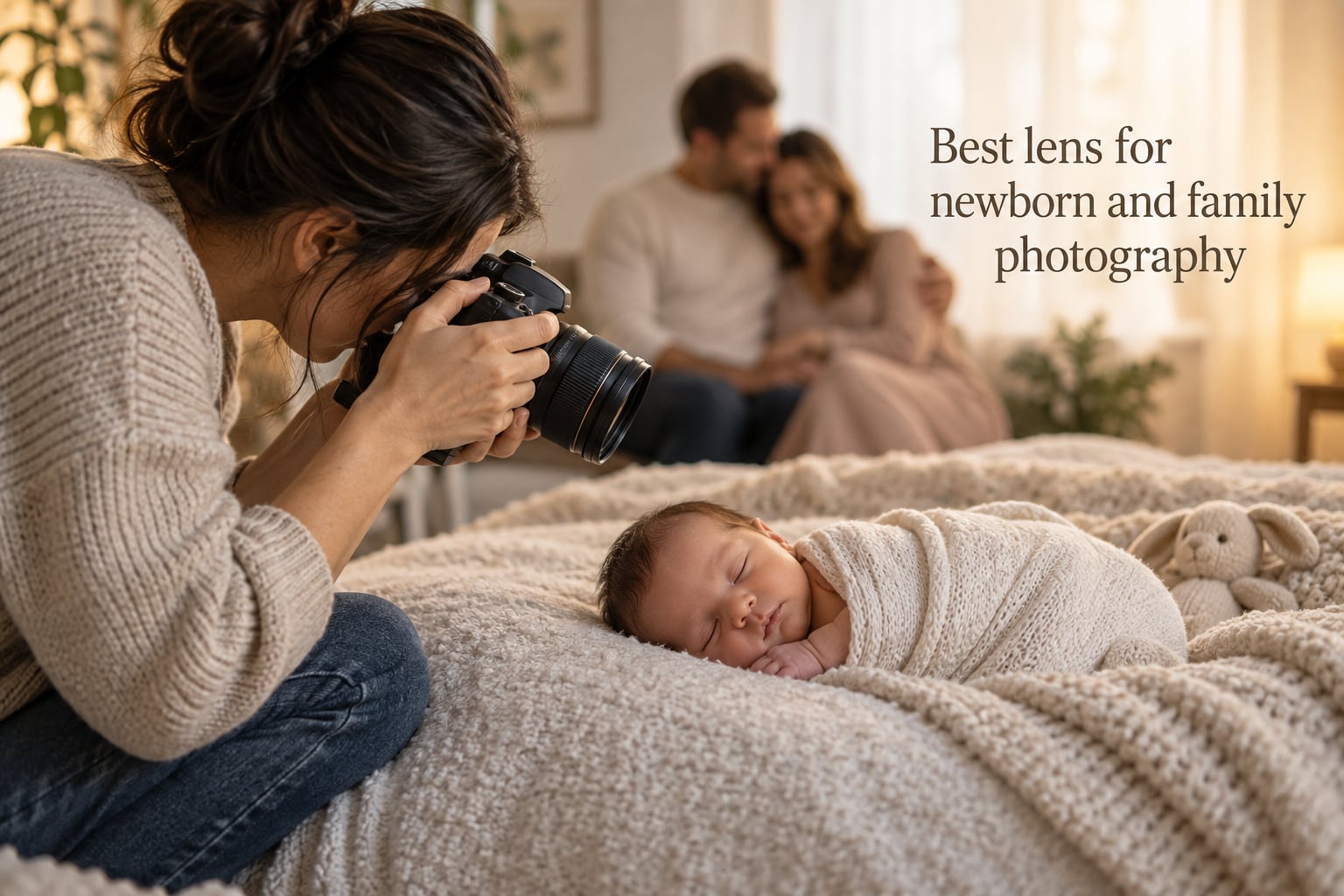
Choosing the best lens for newborn and family photography is the single biggest decision that shapes your images after the camera body itself. We have spent the last three years shooting newborn sessions in studios, lifestyle sessions in family homes, and outdoor family portraits in every season, and the lens makes the difference between a sharp, intimate portrait and a missed moment.
Newborn and family photography also creates a unique three-way tension that no other genre combines. You need to stay physically close to a baby for safety. You need to shoot in low indoor light without firing a flash that would wake a sleeping newborn. And you need to capture both tiny details (eyelashes, toes, tiny fingers curled around a parent’s hand) and wider moments of the whole family together. The right lens handles all three.
This guide breaks down the focal lengths, apertures, and lens types that professional newborn and family photographers reach for first. We will cover the quick answer, a glossary for beginners, a focal-length guide, prime-versus-zoom, brand-specific picks, crop-sensor considerations, and a decision flowchart to help you pick the right lens for your kit and budget.
Table of Contents
- Quick Answer: Which Lens Is Best for Newborn and Family Photography?
- Lens Fundamentals: A Quick Glossary for Parents
- Focal Length Guide: Which Lens for Which Shot
- Prime vs Zoom: Which Should You Choose?
- Best Lens for Newborn Photography: Safety and Detail First
- Best Lens for Family Photography: Indoors and Out
- Aperture and Low-Light Performance
- Brand-Specific Lens Picks
- Crop Sensor vs Full Frame: Focal Length Equivalents
- Decision Flowchart: Which Lens Should You Buy?
- Lens Picks by Scenario
- Frequently Asked Questions
- Final Thoughts: Start With a 35mm or 50mm Prime
Quick Answer: Which Lens Is Best for Newborn and Family Photography?
The best lens for newborn and family photography is a fast prime in the 35mm to 50mm range with a maximum aperture of f/1.8 or wider. A 35mm or 50mm f/1.8 prime lets you stay within arm’s reach of the baby, shoot handheld in dim indoor light without flash, and frame both intimate portraits and wider family shots without distortion.
- Best all-around pick: 35mm f/1.8 prime (versatile for newborn + family combined sessions)
- Best for classic family portraits: 50mm f/1.4 or f/1.8 (the “nifty fifty”)
- Best for newborn detail shots: 100mm macro (eyelashes, tiny toes)
- Best zoom flexibility: 24-70mm f/2.8 workhorse
Every recommendation below builds on this core idea: a fast, mid-range prime is the foundation of a strong newborn and family kit.
Lens Fundamentals: A Quick Glossary for Parents
Before you choose a lens, it helps to know the five terms that come up in every review. We will keep these short.
Focal length is measured in millimeters and describes how wide or telephoto the lens is. Smaller numbers (24mm, 35mm) capture more of the scene. Larger numbers (85mm, 100mm, 200mm) zoom in and compress the background.
Aperture is the size of the opening inside the lens that lets light hit the sensor, written as an f-number like f/1.8 or f/2.8. Smaller f-numbers mean a wider opening, more light, and shallower depth of field. Wide apertures are critical for indoor newborn work without flash.
Prime lens is a fixed focal length with no zoom. Primes are usually sharper, faster, lighter, and more affordable than zooms at the same quality level.
Zoom lens covers a range of focal lengths in one lens, like 24-70mm or 70-200mm. Zooms trade some sharpness and low-light speed for flexibility.
Bokeh is the soft, creamy blur in the out-of-focus parts of an image. Wide apertures create more pronounced bokeh, which is why portrait and newborn photographers love fast primes.
Full frame vs crop sensor: full-frame sensors match a 35mm film frame; crop sensors (APS-C) are smaller and “crop in” on the lens image, effectively multiplying the focal length by roughly 1.5x to 1.6x. A 35mm lens on a crop body behaves like about a 50mm lens on full frame. We cover this in detail later.
Focal Length Guide: Which Lens for Which Shot
The right focal length depends entirely on what you are photographing. Here is how photographers use each range in real sessions.
35mm Prime: The Newborn and Family Hybrid
The 35mm focal length is the workhorse for combined newborn and family sessions. It is wide enough to capture a parent holding a baby and the rest of the family together, and tight enough to step in for an intimate portrait of just the baby.
This is the lens Sophie Crew Photography reaches for on every newborn session because it lets her stay within arm’s reach of the baby for safety while still framing the wider scene. One Reddit user on r/canon calls the Canon RF 35mm f/1.8 Macro IS STM “very sharp, versatile, small and light” for exactly this kind of hybrid baby and family work.
50mm Prime: The Nifty Fifty
The 50mm prime, often called the “nifty fifty,” is the classic portrait and lifestyle focal length. On a full-frame body it produces a natural perspective that flatters faces without distortion.
Jennifer Nicole recommends the 50mm in her YouTube guide to family and newborn lifestyle work because it strikes a balance between intimacy and context. It is also the most affordable fast prime in any system, making it the obvious first lens for new parents who already own a camera.
85mm Prime: The Classic Portrait Lens
The 85mm prime is what most working portrait photographers reach for when they want creamy background separation and flattering facial compression. It throws the background into beautiful blur and produces a slightly slimmer, more sculpted look on faces.
The downside is working distance. To fill the frame with a baby’s face, you need to step back, which can be a problem if you want to keep a hand on the baby for safety. For older children and family group portraits where distance is fine, the 85mm is hard to beat.
100mm Macro: Newborn Detail Shots
A 100mm macro lens is a specialty tool for extreme close-ups: eyelashes, lips, tiny curled fingers, toes, the texture of a knit blanket. Sarah Borchgrevink Photography uses an EF 100mm f/2.8L Macro for roughly 60 percent of her newborn shoots specifically for these detail images.
You do not need a dedicated macro for everyday newborn work, but if you love the detail shots and want tack-sharp close focus, a 100mm macro is worth adding as a second lens.
24-70mm Zoom: The Workhorse
The 24-70mm f/2.8 zoom is the single lens many professional wedding and family photographers keep on their camera for an entire session. It covers wide environmental shots, mid-range group portraits, and tighter individual frames without swapping lenses.
Zooms are heavier, slower (f/2.8 instead of f/1.4 or f/1.8), and more expensive than a single prime. They are the right choice when flexibility matters more than maximum sharpness or low-light speed.
70-200mm Telephoto Zoom
The 70-200mm f/2.8 telephoto is the choice for outdoor family sessions, beach portraits, and candid moments where you want to compress the background and shoot from a distance. It is also excellent for capturing toddlers and older children in motion because the long focal length lets you stay back and still fill the frame.
It is not the first lens we would buy for newborn work because the working distance is too far to keep a hand on the baby safely. But for family-only outdoor sessions, it is the gold standard.
Prime vs Zoom: Which Should You Choose?
The prime-versus-zoom decision is one of the most common questions new photographers ask. Here is a direct side-by-side.
| Feature | Prime Lens | Zoom Lens |
|---|---|---|
| Sharpness at wide aperture | Excellent | Good to very good |
| Maximum aperture | Often f/1.4 or f/1.8 | Usually f/2.8 or slower |
| Low-light performance | Best in class | Good but not as fast |
| Size and weight | Compact and light | Larger and heavier |
| Price for given quality | Lower | Higher |
| Flexibility | One focal length | Range of focal lengths |
| Bokeh quality | Smooth and creamy | Good but often busier |
| Best for | Studio, lifestyle, indoor newborn | Events, outdoor family, run-and-gun |
For most parents and hobbyist photographers, we recommend starting with one fast prime. You will get better low-light performance, sharper images, and save money. Add a zoom later if you need the flexibility.
Best Lens for Newborn Photography: Safety and Detail First
Newborn photography has two priorities that every other genre does not: baby safety and tiny detail capture. Your lens choice needs to support both.
Working Distance and Newborn Safety
Professional newborn photographers keep one hand within arm’s reach of the baby at all times during a pose. A long telephoto lens forces you too far away. A 35mm or 50mm prime lets you stay close, frame tightly, and still keep a hand on or near the baby for safety.
This is the single biggest reason so many working newborn photographers reach for a 35mm or 50mm first, even when they own an 85mm or 100mm macro.
Macro Detail Shots
Detail shots are the bread and butter of a newborn gallery: a tiny hand wrapped around a parent’s finger, eyelashes, lips, toes, the texture of a knit wrap. A 100mm macro lens is the ideal tool because it focuses very close and renders these details tack sharp.
If you only want one lens, a 35mm or 50mm prime can still capture detail-style frames by getting physically close to the baby. If detail work is a priority for you, plan for a dedicated macro as your second lens.
Studio vs Lifestyle Newborn
Studio newborn sessions are usually shot in controlled lighting at lower ISO, so a 50mm f/2.8 or even f/4 prime works well. Lifestyle newborn sessions at the family home usually mean dimmer ambient light, faster apertures (f/1.8 or wider), and higher ISO capability on the camera body. Match your lens to the environment you shoot in most.
Best Lens for Family Photography: Indoors and Out
Family photography splits into two very different shooting environments, and the right lens changes between them.
Outdoor Family Portraits
Outdoor portraits love an 85mm prime or a 70-200mm telephoto zoom. The longer focal length compresses the background, throws trees and grass into creamy blur, and flatters faces. You can step back and let the family interact naturally while you shoot from a comfortable distance.
For golden-hour beach sessions and large extended-family groups, a 24-70mm f/2.8 zoom is often the better tool because it lets you swap between wide group shots and tighter portraits without moving your feet.
Indoor Lifestyle Family
Indoor sessions are where the 35mm and 50mm primes really shine. You are working with available window light, often handholding, and need a fast aperture to keep ISO low. A 35mm f/1.8 lets you capture the whole family on the couch and then step in for a tight portrait of one child without swapping lenses.
Large Group Family Photos
For extended family gatherings or holiday portraits with more than six people, a wider zoom like 24-70mm f/2.8 or even a 24-105mm f/4 gives you the breathing room to fit everyone in the frame without awkward cropping.
Aperture and Low-Light Performance
Aperture matters more for newborn and family photography than almost any other genre. Here is why.
Newborns sleep best in dim, quiet rooms. Firing a flash often wakes the baby and breaks the moment. A wide aperture (f/1.4, f/1.8, or f/2.8) lets in two to four times more light than a kit zoom at f/5.6, which means you can shoot handheld at low ISO without flash.
The same applies to indoor family sessions. Window light in a family living room rarely reaches the brightness you need at f/5.6. A fast prime turns that dim light into a usable exposure and produces creamy bokeh in the background that pulls the subject forward.
As a rule of thumb, aim for a lens with a maximum aperture of at least f/2.8 for any indoor newborn or family work, and at least f/1.8 if you can.
Brand-Specific Lens Picks
Lens recommendations change by camera mount. Here are our top picks by system, all proven in real newborn and family sessions.
Canon RF (Mirrorless)
- Canon RF 35mm f/1.8 Macro IS STM – Hybrid baby and family work, close-focus, lightweight, sharp wide open. The most-mentioned lens in beginner forums for Canon mirrorless parents.
- Canon RF 50mm f/1.8 STM – Affordable nifty fifty, natural perspective, great low-light performance.
- Canon RF 85mm f/2 Macro IS STM – Portrait lens with macro capability for detail work.
- Canon RF 24-70mm f/2.8L IS USM – Pro workhorse zoom for events and outdoor family sessions.
Nikon Z (Mirrorless)
- Nikkor Z 50mm f/1.8 S – Sharp, lightweight, the obvious first prime for Nikon Z shooters.
- Nikkor Z 35mm f/1.8 S – Newborn and family hybrid, beautiful rendering.
- Nikkor Z 85mm f/1.8 S – Classic portrait focal length, creamy bokeh.
- Nikkor Z 24-70mm f/2.8 S – Professional zoom workhorse.
Sony E (Mirrorless Full Frame)
- Sony FE 50mm f/1.8 – Affordable, sharp, light, the obvious starter prime.
- Sony FE 35mm f/1.8 – Versatile hybrid for newborn and family.
- Sony FE 85mm f/1.8 – Best-in-class portrait lens at the price.
- Sony FE 24-70mm f/2.8 GM – Pro-grade zoom for working photographers.
Third-Party Options (Sigma, Tamron)
Sigma Art and Tamron lenses mount on Canon RF, Nikon Z, and Sony E via official adapters or native mounts. The Sigma 35mm f/1.4 DG DN Art is a particularly strong choice for hybrid newborn and family work. Sophie Crew Photography uses the original Sigma Art 35mm f/1.4 for nearly all of her studio and outdoor newborn sessions.
Crop Sensor vs Full Frame: Focal Length Equivalents
If you shoot with an APS-C crop-sensor body (Canon EOS R50, R100, R7; Nikon Z50, Z fc; Sony a6100, a6400), your lens focal length does not behave the same as on full frame. The crop factor multiplies the focal length by roughly 1.5x (Nikon, Sony, Fuji) or 1.6x (Canon).
This matters because a 35mm lens on a crop body gives you the field of view of about a 50mm lens on full frame. Here is how the common focal lengths translate.
| Crop-sensor lens | Equivalent on full frame | Best for |
|---|---|---|
| 23mm | 35mm | Newborn + family hybrid |
| 35mm | 50mm | Lifestyle portraits |
| 50mm | 75-80mm | Classic portraits |
| 85mm | 125-135mm | Detail and outdoor portraits |
For crop-sensor shooters, our recommendations shift accordingly. A “nifty fifty” on a crop body is closer to a 35mm lens on full frame. Many beginner parents find a 35mm f/1.8 on their crop DSLR works just like a 50mm on full frame for everyday family portraits.
Decision Flowchart: Which Lens Should You Buy?
Use this quick scenario guide to pick the right starting lens for your situation.
| Your situation | Best first lens | Add later |
|---|---|---|
| You only want to buy one lens | 35mm or 50mm f/1.8 prime | 85mm or 100mm macro |
| You shoot mostly indoors without flash | 35mm f/1.8 prime | 50mm f/1.4 for even more bokeh |
| You shoot mostly outdoors | 85mm f/1.8 prime | 70-200mm f/2.8 zoom |
| You want newborn detail shots | 50mm f/1.8 prime | 100mm macro |
| You have a crop-sensor body | 35mm f/1.8 (behaves like 50mm) | 50mm f/1.8 (behaves like 75-80mm) |
| You want one lens for everything | 24-70mm f/2.8 zoom | Fast 50mm prime for indoor low light |
| Budget is the priority | 50mm f/1.8 kit prime | Used 35mm f/1.8 |
Lens Picks by Scenario
Budget-Conscious New Parent
You already own a camera with a kit lens and want one affordable lens that does everything better. Buy the native 50mm f/1.8 prime for your mount. On Canon it is under 200 dollars, on Nikon Z around 250, on Sony FE around 200. You will see an immediate jump in sharpness, low-light ability, and bokeh quality.
Hobbyist Photographer With One Body
You shoot both indoor lifestyle and outdoor family sessions. Buy the 35mm f/1.8 first. It covers newborn and family hybrid work, fits indoor scenes, and works beautifully outdoors for environmental portraits. Add an 85mm or 100mm macro later when you know which focal length you reach for most.
Working Photographer Building a Kit
You shoot newborn and family sessions as paid work. Build around a 35mm or 50mm prime as your everyday lens, an 85mm or 100mm macro for portraits and detail, and a 24-70mm f/2.8 zoom as your event and outdoor workhorse. Many professionals also carry a 70-200mm f/2.8 for outdoor family and large group sessions.
Newborn Safety Note
No matter which lens you choose, always keep one hand on or within arm’s reach of the baby during any posed newborn session. Long lenses may compress the background beautifully, but they force you too far from the baby to act quickly if the baby shifts position. A 35mm or 50mm prime is the safest choice for posed work.
Frequently Asked Questions
What is the best lens for taking newborn photos?
A fast 35mm or 50mm prime lens with a maximum aperture of f/1.8 or wider is the best all-around choice for newborn photos. It lets you stay within arm’s reach of the baby for safety, shoot in dim indoor light without flash, and frame both intimate portraits and wider family moments. For dedicated macro detail shots of hands, feet, and eyelashes, add a 100mm macro lens as your second lens.
Is 50mm or 85mm better for family photos?
Both focal lengths work for family photos, but they suit different situations. A 50mm f/1.8 is better for indoor lifestyle sessions, candid family moments, and situations where you need to stay close to children or a newborn. An 85mm f/1.8 is better for classic posed family portraits, outdoor sessions, and creamy background blur. If you only want one lens, pick the 50mm for versatility. If you want the most flattering portrait look and have room to step back, pick the 85mm.
What is the best lens for taking family photos?
The best lens for family photos depends on where you shoot, but a 50mm f/1.8 prime is the most versatile starting choice for most parents and hobbyists. For indoor sessions, a 35mm or 50mm f/1.8 lets you work in low light without flash. For outdoor classic portraits, an 85mm f/1.8 gives you creamy bokeh and flattering compression. For a single-lens solution that covers both, a 24-70mm f/2.8 zoom is the professional workhorse.
What is the best camera for taking newborn photos?
The best camera for newborn photos is any modern full-frame or APS-C mirrorless body with good high-ISO performance and reliable autofocus. Most working newborn photographers use full-frame bodies from Canon (EOS R5, R6 Mark II), Nikon (Z 7II, Z 6III), or Sony (A7 IV, A7C II) because these sensors deliver clean images at the high ISO values required for indoor low-light shooting. That said, the lens matters more than the body for image quality. A great lens on an entry-level body outperforms a kit lens on a flagship body.
Final Thoughts: Start With a 35mm or 50mm Prime
The best lens for newborn and family photography is not the most expensive or the most exotic. It is the focal length and aperture that lets you stay close to the baby, work in available light, and frame both intimate portraits and wider family moments. For almost every reader of this guide, that means starting with a 35mm or 50mm f/1.8 prime in your camera mount.
Once you own that lens and shoot with it for a season, you will know exactly which focal length you reach for most often. Add an 85mm for classic portraits, a 100mm macro for newborn detail work, or a 24-70mm zoom for events and outdoor sessions. Build your kit around how you actually shoot, not around what other photographers own.
Most importantly, prioritize newborn safety. The best lens in the world is the wrong choice if it pulls you too far from the baby during a posed session. Stay close, shoot wide open, and let the lens do the work.