
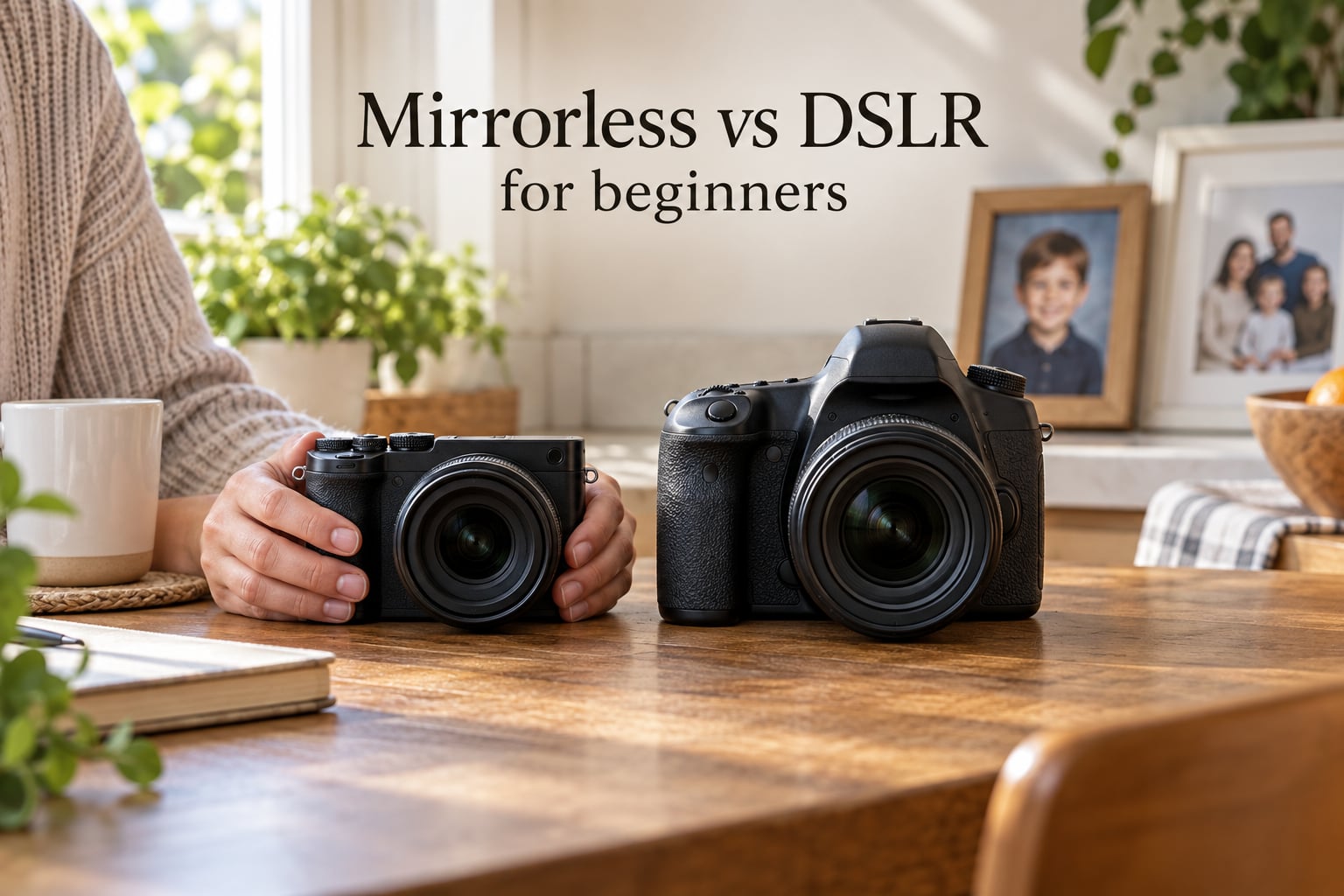
Choosing your first interchangeable-lens camera is a real decision, and the mirrorless vs DSLR question gets louder every year. I run a family photography studio, and I hear the same question from parents at almost every session: should I have bought a mirrorless or a DSLR? Here’s the honest, beginner-focused answer for 2026.
I’ve spent the last decade shooting families, milestones, school events, and chaotic holiday mornings with both systems in my bag. I’ll walk you through the real mechanical difference, the things that actually matter for a beginner, and the use cases where one still beats the other. By the end, you’ll know which camera to buy with confidence.
Table of Contents
- Mirrorless vs DSLR: Which Should a Beginner Buy in 2026?
- What’s the Actual Mechanical Difference Between Mirrorless and DSLR?
- Viewfinder Comparison: OVF vs EVF Explained Simply
- Autofocus and Subject Tracking: Who Wins for Beginners?
- Size, Weight, and Handling for Everyday Carry
- Battery Life Reality Check: Can You Shoot a Full Day?
- Video, Stabilization, and Modern Features
- Lens Compatibility and Adapters: Can You Use Old DSLR Lenses?
- Beginner Recommendation by Use Case
- When You’re Not Ready for a Real Camera Yet
- The Case for DSLR: Why Some Photographers Still Choose It
- Buying Considerations for Your First Camera in 2026
- Frequently Asked Questions
- Final Verdict: Mirrorless or DSLR as a Beginner?
Mirrorless vs DSLR: Which Should a Beginner Buy in 2026?
The short answer: most beginners in 2026 should buy a mirrorless camera. Mirrorless autofocus, eye detection, video quality, and live exposure preview make it the easier system to learn on and the more useful system to grow into. A used DSLR is still a smart pick if you’re on a strict budget, mainly shoot stills in daylight, and want longer battery life.
| Feature | Mirrorless | DSLR |
|---|---|---|
| Viewfinder | Electronic (EVF) – digital preview | Optical (OVF) – direct light through mirror |
| Autofocus (live subjects) | On-sensor, eye AF, subject tracking | Phase-detect through viewfinder, slower in live view |
| Body size | Smaller, lighter | Larger, heavier |
| Battery life (per charge) | Around 250 to 400 shots | Around 800 to 1500 shots |
| Video | 4K common, continuous AF during video | Limited, often contrast-detect only in live view |
| Lens ecosystem | New native mount, growing fast | Mature, huge used market |
| Learning curve | Easier (what you see is what you get) | Steeper (you learn exposure by feel) |
| Used value in 2026 | Improving rapidly | Often excellent bargains |
That table is your compass for the rest of the article. Now let’s look at why each of those differences exists, starting with the mechanism that started it all.
What’s the Actual Mechanical Difference Between Mirrorless and DSLR?
The whole mirrorless vs DSLR debate for beginners boils down to one physical part: a mirror inside the camera body. A DSLR (Digital Single-Lens Reflex) has a mirror that flips up every time you press the shutter. A mirrorless camera does not.
In a DSLR, light enters the lens, bounces off a mirror up into a prism, and exits through an optical viewfinder (OVF). When you take a photo, the mirror flips up so light can reach the sensor. In a mirrorless camera, light travels straight from the lens to the sensor all the time, and you compose using an electronic viewfinder (EVF) or the rear LCD.
That single difference cascades into almost every buying consideration. No mirror means a smaller body, a quieter shutter, a simpler autofocus system that lives on the sensor, and a digital preview instead of an optical one. The trade-off is that the sensor and EVF are always working, which costs battery life.
Viewfinder Comparison: OVF vs EVF Explained Simply
The viewfinder is what you look through to take a picture, and it works completely differently between these two systems. An optical viewfinder (OVF) on a DSLR shows you the scene exactly as light enters the lens – no digital processing, no lag, and no battery use. An electronic viewfinder (EVF) on a mirrorless camera shows you a tiny digital screen that mimics what the sensor sees.
EVFs have caught up a lot in 2026. A modern EVF is sharp, bright, and fast enough that most beginners cannot tell the difference at a glance. The huge advantage for a new photographer is what photographers call WYSIWYG – what you see is what you get. Change your aperture and the EVF gets darker or brighter instantly. Bump the ISO and you see the noise before you shoot. This feedback loop is genuinely helpful when you’re learning exposure.
An OVF, by contrast, shows you a clean, bright image regardless of your settings. The trade-off is that you can’t preview your exposure until after you take the shot. Some photographers love that traditional feel and find it less distracting. For a beginner, the EVF’s preview is the more forgiving teacher.
Autofocus and Subject Tracking: Who Wins for Beginners?
Modern mirrorless autofocus is one of the biggest reasons to choose the system in 2026. On-sensor phase detection with eye detection and subject tracking has reached a point where the camera can find a child’s eye, lock on, and follow them around the frame. It feels almost magical the first time you see it work.
DSLRs still have excellent autofocus when you shoot through the optical viewfinder. The catch is that this AF system lives below the mirror and works only in that mode. The moment you switch to live view (using the rear LCD instead of the OVF), most DSLRs drop back to a slower contrast-detection system that struggles with moving subjects.
For a beginner photographing kids, pets, sports, or any kind of movement, mirrorless is the easier tool. For someone who almost exclusively shoots stationary subjects in good light, a DSLR still focuses very well and is perfectly capable.
Size, Weight, and Handling for Everyday Carry
Mirrorless bodies are noticeably smaller and lighter than equivalent DSLRs because they don’t need to fit a mirror box or prism. Lenses are also more compact, especially wide-angle zooms. The total kit weight difference can be 30 to 40 percent, and after a long day at a school play or a hike, that matters.
As a family photographer, I notice this difference most when parents are the ones carrying the camera. A bulky DSLR with a long zoom lens is the gear that stays home in the diaper bag. A smaller mirrorless kit actually comes out at the playground. The best camera for your family is the one you’ll pick up and use.
There is one trade-off: smaller bodies can feel cramped for people with larger hands, and the controls are sometimes more menu-driven. If you can, hold both styles in a store before deciding.
Battery Life Reality Check: Can You Shoot a Full Day?
This is the one area where DSLRs genuinely win, and it’s the most common pain point I hear from new mirrorless owners. Because the sensor and EVF are always running, a mirrorless camera typically gets 250 to 400 shots per charge. A comparable DSLR often gets 800 to 1500.
In real family-photography terms, that means a mirrorless user might burn through one or two batteries at a long event like a wedding or a school sports day. A DSLR user might do the same day on a single battery. If you travel or shoot outdoors without easy access to charging, that gap matters.
The mitigation is real too. Most modern mirrorless cameras charge over USB-C, and a small power bank in your bag effectively solves the problem. If you do a lot of backcountry shooting without power, a DSLR remains the more reliable tool.
Video, Stabilization, and Modern Features
If you want to shoot video – even casually – mirrorless is the clear winner. Modern mirrorless cameras shoot 4K with continuous autofocus that actually works during recording. Most DSLRs either can’t shoot 4K or fall back to a sluggish autofocus mode the moment you start recording video.
Another feature beginner buyers ask about is in-body image stabilization (IBIS). This is a mechanical system inside the camera that moves the sensor to compensate for hand shake. It lets you shoot at slower shutter speeds in low light and produces smoother handheld video. IBIS is now standard on most mid-range mirrorless bodies, and rare on DSLRs.
You will also find fully articulating screens, silent electronic shutters, and focus peaking on most current mirrorless cameras. These features sound technical, but in practice they make a beginner’s life much easier – you can flip the screen up for vlogging, shoot silently at a recital, and see exactly which parts of your image are in sharp focus.
Lens Compatibility and Adapters: Can You Use Old DSLR Lenses?
One of the biggest worries for a beginner is lens ecosystem lock-in. If you buy a Canon DSLR today and want to switch to mirrorless next year, will your old lenses become paperweights? The good news in 2026 is that all the major manufacturers now offer official adapters for their own DSLR glass.
Canon EF lenses work on Canon RF mirrorless bodies with full autofocus. Nikon F lenses work on Nikon Z mirrorless bodies, again with full autofocus. Sony, Fujifilm, and Panasonic all support adapting other systems’ lenses, often with working autofocus for native-mount adapters.
What you give up is some speed. Adapted lenses typically focus a bit slower than native mirrorless glass. For most family and travel shooting, this is irrelevant. For sports or wildlife where every millisecond of AF matters, native lenses are worth the investment.
Beginner Recommendation by Use Case
Different photographers need different tools. Here is the same question I’ve been asked hundreds of times at my studio, answered by what you’re actually trying to photograph.
| What you shoot most | Best beginner choice in 2026 | Why |
|---|---|---|
| Family, kids, milestones | Mirrorless | Eye AF tracks moving children; compact for outings |
| Travel and everyday carry | Mirrorless | Lighter kit in your daypack; USB-C charging |
| Sports and wildlife | Mirrorless | Subject tracking and burst rates are far ahead |
| Video, vlogging, hybrid | Mirrorless | 4K with continuous AF; articulating screen |
| Low light, indoor events | Mirrorless | IBIS + modern sensors handle high ISO cleanly |
| Strict budget, mostly stills | Used DSLR | Mature used market; great value per dollar |
| Outdoor/backcountry, no power | DSLR | 1000+ shots per battery; no EVF drain |
Notice that the DSLR only wins in two narrow scenarios: a tight budget and situations where you really can’t recharge. For most beginners, the mirrorless column is the right answer in 2026.
When You’re Not Ready for a Real Camera Yet
This is the section most beginner camera guides skip, and it’s the one I wish more people would read. A dedicated camera is a meaningful investment, and it only pays off if you actually enjoy using it.
If you haven’t shot regularly with your phone for at least six months, you’re probably not ready for an interchangeable-lens camera. The best beginner camera is the one you already carry. Spend a few months deliberately photographing with your phone in manual mode if it offers one. Learn composition, light, and moments. If that hobby sticks, you’ll know you’re ready.
Signals you ARE ready: you keep wishing your phone had more zoom or better low-light performance, you find yourself mentally composing scenes while walking, and you’re willing to carry a small bag for the gear. If all three are true, a beginner mirrorless body will feel like a gift.
The Case for DSLR: Why Some Photographers Still Choose It
I’d be doing you a disservice if I only told you the mirrorless story. Real photographers still choose DSLRs in 2026, and there are honest reasons behind that.
The first is battery life, which I’ve already covered. The second is durability and longevity. A DSLR has fewer electronic systems that depend on firmware updates and sensor-readout improvements. Many DSLR bodies from 2014 still shoot beautifully today. The third is the optical viewfinder experience itself. Looking through an OVF is calm, immediate, and battery-free. Some street and documentary photographers I respect have gone back to DSLR deliberately because it changes how they shoot.
Fourth, and most relevant for beginners, the used DSLR market in 2026 is the best value in photography right now. A three or four-year-old mid-range DSLR, used but in good condition, can cost a fraction of what it did new, and it still takes stunning images. If you decide photography isn’t for you, you can resell it for close to what you paid.
Buying Considerations for Your First Camera in 2026
Whichever direction you lean, the body is only half the decision. Here are the considerations I share with every parent who walks into my studio asking where to start.
Your first lens matters more than your first body. A cheap body with a good lens will outperform a flagship body with a bad lens almost every time. For most beginners, a 50mm f/1.8 or 35mm f/2 on the system you choose is the single best upgrade you can make.
Don’t over-buy the kit lens. Kit lenses are fine for learning, but they slow down in low light and limit your creative options. Budget for one fast prime as a second purchase.
Choose the system you’ll stay in. Lenses outlive bodies. Every major manufacturer has shifted aggressively to mirrorless, and new lens development is concentrated on mirrorless mounts. If you plan to grow into the hobby, mirrorless is the safer long-term bet. If you plan to keep one camera for five years and shoot stills in good light, used DSLR is still totally reasonable.
Try before you commit. Hold both systems in a real store if you can. Grip, menu layout, and viewfinder feel are surprisingly personal.
Plan a small starter kit. Body, one fast prime, one memory card, one extra battery, and a small bag. Skip the third-party accessories until you know what you’ll actually use.
Frequently Asked Questions
Should a beginner get a DSLR or mirrorless camera in 2026?
Most beginners should buy a mirrorless camera in 2026. The on-sensor autofocus, eye detection, smaller body, and live exposure preview make mirrorless easier to learn on and easier to grow into. A used DSLR still makes sense if your budget is tight, you mostly shoot stills in good light, and you want longer battery life.
Are DSLRs still relevant in 2026?
Yes, but mainly through the used market. Manufacturers have shifted almost all new development to mirrorless, so the newest lenses, autofocus features, and video tools live on mirrorless systems. For beginners who mainly shoot stills in daylight, a used DSLR still takes excellent photos and offers real value in 2026.
Why are some photographers going back to DSLR?
A small but visible group of photographers, especially in street and documentary work, have returned to DSLR in 2026. Their reasons usually center on the optical viewfinder experience, longer battery life, simpler menu systems, and the way a DSLR changes shooting rhythm compared to a feature-dense mirrorless body.
Can I use my old DSLR lenses on a new mirrorless camera?
Yes, in most cases with full autofocus. Canon EF lenses work on Canon RF mirrorless bodies, Nikon F lenses work on Nikon Z bodies, and Sony, Fujifilm, and Panasonic all support adapters for other systems. Autofocus is typically a bit slower than native lenses, but for family, travel, and portrait shooting the difference is minor.
Do I really need a camera, or is my phone enough?
If you haven’t shot regularly with your phone for at least six months, your phone is enough for now. A dedicated camera is a meaningful investment that only pays off if you actually use it. Spend a few months photographing with your phone on purpose, learn composition and light, and if the habit sticks, you’ll know you’re ready to upgrade.
Final Verdict: Mirrorless or DSLR as a Beginner?
For most beginners in 2026, mirrorless is the right starting point. The autofocus, eye detection, video, and live exposure preview make it the system that teaches you fastest and the system you’ll grow into without outgrowing. It’s also the system that camera makers are actively developing, which matters if you plan to invest in lenses over the next several years.
That said, mirrorless is not the only valid choice. A used DSLR is genuinely good value right now, especially if you’re on a tight budget, mostly shoot in good light, and want a battery that lasts all day. The worst choice is the one you don’t make because you got stuck in spec sheets and Reddit threads. Pick the system that fits the photography you actually want to do, buy one good lens with it, and start shooting.
As a family photographer, my honest recommendation is this: if you’re documenting your kids, your travels, and the milestones that won’t happen twice, a small mirrorless body with a 35mm or 50mm prime lens will serve you for the next decade. If you’re a parent who already owns a DSLR and a few lenses, use what you have – the best camera is the one in your hand. And if you’re still deciding, the answer to mirrorless vs DSLR for beginners in 2026 is, more often than not, mirrorless – with the freedom to ignore that advice when your situation calls for something different.