
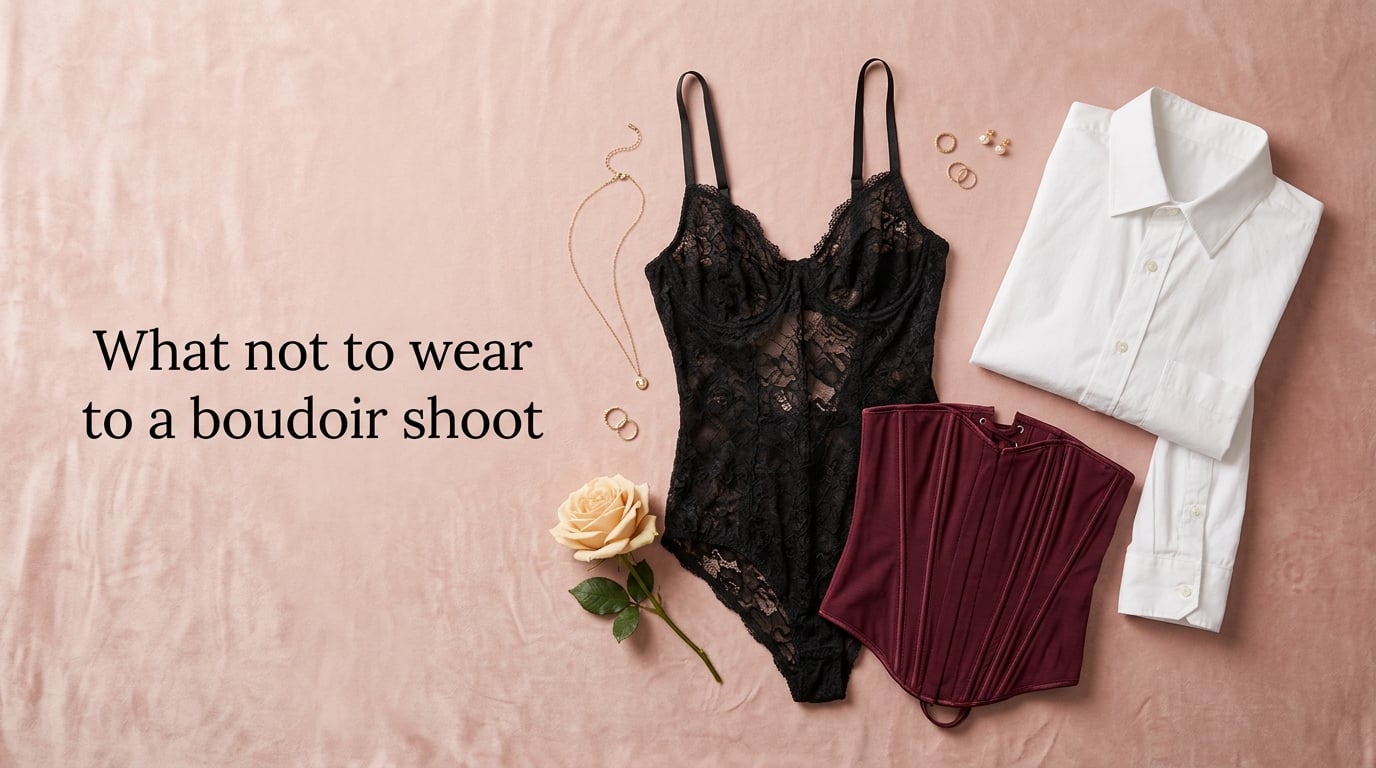
If you’ve ever typed what not to wear to a boudoir shoot into a search bar at midnight, you’re not alone. Most women who book a boudoir session have never done one before, and the wardrobe question eats up more brain space than anything else.
I’ve been behind the camera at our studio for years, and I can tell you from hundreds of sessions: the wrong outfit choice doesn’t just look bad on camera, it can flatten your confidence mid-shoot. The right outfit does the opposite. It frees you up to actually enjoy being photographed.
This guide walks you through the boudoir wardrobe mistakes I see over and over, why they don’t photograph well, and what to wear instead. Whether you’re a first-timer, a bride, plus-size, or someone who doesn’t own a scrap of lingerie, you’ll find something here you can use.
Table of Contents
- Quick Boudoir Don’t List (What to Avoid at a Glance)
- What NOT to Wear to a Boudoir Shoot (and Why)
- What to Wear the Day of Your Boudoir Shoot
- What to Wear to a Boudoir Shoot Instead (Positive Alternatives)
- Boudoir Wardrobe Mistakes by Body Type
- Frequently Asked Questions
- Final Thoughts on Boudoir Wardrobe Choices
Quick Boudoir Don’t List (What to Avoid at a Glance)
Here’s the scannable short version. Bookmark this section or screenshot it before your studio wardrobe pull.
- Anything that doesn’t fit (too tight or too loose in the wrong places)
- Shape-hiding garments (babydolls, oversized robes, baggy t-shirts)
- Wrinkle-prone fabrics (thin satin, cheap lace, linen without pressing)
- Neon, fluorescent, or day-glo colors
- Corsets sized too small
- Halloween costumes (French maid, schoolgirl, etc.)
- Three identical bra-and-panty sets
- Tight socks, leggings, or jeans the day of your shoot
- Hair ties on your wrist for hours before the shoot
- A fresh self-tanner or spray tan
Now let’s dig into each one.
What NOT to Wear to a Boudoir Shoot (and Why)
The single biggest mistake I see is choosing an outfit based on how it looks in your bedroom mirror. Mirrors lie. Camera sensors catch seams, pinching, fluorescent undertones, and splotchy tan lines that your eyes simply smooth over. Here’s the breakdown.
1. Clothing That Doesn’t Fit
If your lingerie is pinching, rolling, or gapping, the camera will find it. A too-small bra creates back rolls and a double-bust line. A too-large panty creates visible bunching that no amount of retouching can fully disguise.
I retouch wardrobe malfunctions every single shoot. Seams dig into skin, elastic bites into hips, and straps leave red stripes that show up under studio lighting. Fit is everything.
What to wear instead: Get professionally measured, even if you’ve worn the same bra size for ten years. Bodies change. A bra that fit last year may be riding up your back right now. If you can’t get measured in time, try the band test: a new bra should fit snugly on the loosest hook and never gap at the top of the cup.
2. Babydolls, Slip Dresses, and Other Shape-Hiding Garments
A babydoll is a short, flowy nightgown-style lingerie piece. It looks romantic on the hanger. On camera, it hides the curves you came to celebrate. The fabric blurs your waistline and turns your shape into a vague column.
The same goes for oversized button-ups, blanket-sized robes, and slinky slip dresses that skim rather than skim-and-show. Boudoir photography is about your body, your lines, your shape. Garments that erase shape erase the whole point.
What to wear instead: Choose garments that suggest your outline. A fitted bodysuit, a structured corset that fits correctly, or a bra-and-panty set with a coordinating robe you can wear open or shrug off mid-session. The robe becomes the prop. The fitted pieces underneath do the work.
3. Items That Wrinkle Easily
Thin satin, cheap polyester, untreated linen, and tissue-weight lace look pressed in your closet and crushed in your luggage. By the time you change into them at the studio, you’ll have new wrinkles every ten minutes, and Photoshop can only fix so much before your skin starts looking plasticky.
I once spent forty minutes smoothing wrinkles out of a single satin chemise. Forty minutes that should have been spent on poses and expression. Now I tell every client: thicker fabric forgives more than you think.
What to wear instead: Heavier satin, structured lace, microfiber, modal, and quality cotton blends. Bring your pieces in a garment bag and hang them the moment you arrive. If they need a quick steam, ask your studio. Most have a steamer on hand.
4. Neon, Fluorescent, and Day-Glo Colors
Bright pink, traffic-cone orange, electric yellow, and other high-saturation colors cast unflattering reflections on your skin. They also tend to bloom under studio strobes, blowing out detail in your face and creating a halo effect on your hairline.
This isn’t about being modest. It’s about how camera sensors interpret color. Pastels, jewel tones, deep neutrals, and classic black photograph beautifully. Bright neons do not.
What to wear instead: Burgundy, emerald, navy, plum, deep teal, champagne, blush, soft gold, classic black, and crisp white all photograph well on most skin tones. If you’re unsure, ask your photographer to pull examples from past sessions.
5. Corsets That Are Too Small
A corset that doesn’t fit creates two problems. First, it physically restricts breathing, and a client who can’t breathe makes tense, painful expressions. Second, it pushes flesh into strange places above and below the corset line, creating visible bulge patterns under studio lighting.
Corsets should feel snug, never punishing. If you can’t take a full breath in it, you can’t relax in it.
What to wear instead: Get professionally fitted at a corsetiere or buy from a brand that lists torso measurements rather than dress sizes. A quality corset should reduce your waist by 2-4 inches comfortably, not 6+. Always break in a new corset for at least a week before your shoot.
6. Halloween Costumes
French maid aprons, schoolgirl pleated skirts, nurse uniforms, and cat-eared headbands have a place, and that place is Halloween. Costume fabrics are typically cheap polyester that photograph poorly, fits are usually off-the-rack unflattering, and the overall vibe reads as costume rather than confidence.
The exception: if you’re doing a themed boudoir shoot for a partner who specifically requested a costume and you both love it, do you. But don’t default to it because you couldn’t find anything else.
What to wear instead: Real lingerie from brands that specialize in it. Even simple pieces look elevated when they’re quality. A basic black set from a real lingerie brand looks more sensual than a $30 Halloween costume from a party store.
7. Three Identical Bra-and-Panty Sets
I’ve opened client wardrobe bags and found three black bra-and-panty sets, all nearly identical. Variety creates visual interest. Three of the same creates monotony that tires the eye by the second outfit.
You don’t need ten outfits. You need three that look different from each other.
What to wear instead: Mix silhouettes and colors. One bra-and-panty set, one bodysuit or corset, and one non-lingerie option like a fitted button-down with nothing underneath, an oversized sweater, or a sheer robe with something structured beneath. Three completely different looks beat ten of the same.
8. Tight Clothing Hours Before the Shoot
This is the one nobody warns you about. Tight socks leave horizontal lines on your calves. Tight underwear leaves indents on your hips. Tight jeans leave lines across your thighs. Tight bras leave strap marks on your shoulders. These marks can linger for an hour or more after you undress, and they show up in close-up shots.
I’ve had to reshoot entire setups because a client’s sock line was visible in every frame. Don’t be that client.
What to wear instead: Plan your wardrobe the night before. The morning of your shoot, wear loose, comfortable clothing: a flowy dress, an oversized t-shirt, loose sweatpants, and slip-on shoes. Skip socks entirely if you can, or wear very loose ones. Remove hair ties from your wrist. Take off your bra until you need to leave for the studio.
What to Wear the Day of Your Boudoir Shoot
The hours before your shoot matter as much as the outfits you bring. Here’s a timeline I share with every first-time client.
Twelve hours before: Stop wearing anything with a tight elastic band. Skip jeans, leggings, control-top underwear, and form-fitting shapewear. If you wear a bra to bed (and many of us do), switch to a soft bralette tonight.
Morning of: Shower with gentle, fragrance-free body wash. Skip body lotion on areas that will be photographed directly, because lotion creates a glare under studio lights. Apply lotion only on dry spots like elbows and feet.
Outfit to the studio: Loose pants or a flowing dress. An oversized cardigan or zip hoodie. Slip-on shoes or fluffy slippers. No socks if you can avoid them. No tight waistband. No tight bra band.
Remove before leaving the house: Hair ties from your wrist. Bra (or switch to a soft bralette). Rings that might leave indent marks. Anything else that presses into your skin.
At the studio: Most photographers will give you 15-30 minutes to settle in. Use this time to hang your outfits, hydrate, and let any last marks fade. Bring a robe or cover-up for the in-between moments.
What to Wear to a Boudoir Shoot Instead (Positive Alternatives)
After all those don’ts, you might feel stuck. Here’s the positive list to balance it out. These are the garments and approaches that photograph beautifully and feel good to wear.
- A fitted bodysuit. Smooth lines, no bunching, easy to move in. Black is classic, but jewel tones look stunning too.
- A structured corset with matching bottoms. Make sure it fits. Add a robe or kimono for layering.
- A bra-and-panty set in a flattering color. Skip matching “his and hers” sets. Choose pieces that work together but aren’t identical.
- An oversized button-down shirt. Worn open over a bra and panties, or with nothing underneath. White men’s shirts look incredible on most bodies.
- A white t-shirt. Pair with cotton briefs or a thong. Classic, fresh, editorial.
- A sweater set. Cozy autumn vibes work year-round in boudoir. Slip one shoulder down.
- A kimono or lace robe. Open, with something fitted underneath. Functions as a prop, not a costume.
- Statement hosiery or thigh-highs. Adds visual interest without committing to a full look.
The goal isn’t to dress like a magazine model. The goal is to wear something that makes you feel like yourself, just slightly more intentional.
Boudoir Wardrobe Mistakes by Body Type
One-size-fits-all advice fails most clients. Here’s how to adjust for your body type and avoid the mistakes that matter most.
For Curvy and Plus-Size Clients
The biggest mistake I see with curvy clients is choosing shapewear that’s too compressive. Shapewear that cuts in creates lines at the top and bottom, which look worse than the curves it was meant to smooth.
Choose properly sized shapewear, or skip it entirely. Focus instead on structured pieces with boning, wide bands, and full coverage where you want it. Bodysuits with built-in shaping work beautifully. So do high-waisted bottoms that hit at your natural waist rather than digging into it.
For Small-Busted Clients
Padded bras and push-ups are your friend. Many small-busted clients shy away from lingerie because they assume it was designed for larger chests. It wasn’t. Plenty of pieces look stunning on smaller frames.
Avoid triangle bralettes and unstructured soft cups if you want definition. Look for molded cups, padding, and underwire. A balconette bra in a beautiful color photographs like a dream on smaller chests.
For Bustier Clients
Support is non-negotiable. A bustier client in a poorly fitting bra will spend the entire shoot adjusting, and that discomfort shows in every frame. Get professionally fitted and bring a backup bra in case the first one starts to dig.
Avoid halter tops and triangle bralettes, which provide minimal support. Look for full-coverage bras, underwire, and wide bands that distribute weight. A great bra is the foundation of every other outfit.
For Bridal Boudoir
Bridal boudoir has its own set of don’ts. Skip the all-white look unless your photographer has shot white-on-white before (it’s harder than it looks). Skip the veil in most setups. Skip anything you actually wore on your wedding day.
Choose a dedicated bridal piece (a white lace robe, a pearl-trimmed bodysuit) or skip the bridal theme entirely and do classic boudoir with a wedding-week memento like your engagement ring, a handwritten vow, or a champagne flute. The contrast often looks better than literal bridalwear.
Frequently Asked Questions
What to wear to a boudoir shoot for females?
Choose garments that fit well and show your shape. Bodysuits, structured corsets, bra-and-panty sets, oversized button-downs, and white t-shirts all photograph beautifully. Mix silhouettes across three outfits for variety, and skip anything that’s too tight, too loose, or too neon.
What colors not to wear for a photo shoot?
Avoid neon, fluorescent, and day-glo colors like bright pink, electric orange, and traffic-cone yellow. They cast unflattering reflections on skin and bloom under studio lighting. Stick to jewel tones, deep neutrals, pastels, classic black, and crisp white instead.
Should I shave before a boudoir shoot?
Only shave if that’s your normal routine. Boudoir photographers see every body type and style. Don’t shave or wax the day of your shoot, as irritation and stubble can show up in close-ups. If you prefer smooth skin, do your routine two to three days before.
What are some things I wish I knew before my boudoir shoot?
Wear loose, comfortable clothing the day of the shoot to avoid sock marks, panty lines, and bra-strap indents. Remove hair ties from your wrist before changing. Skip fresh spray tans and self-tanner, as Photoshop cannot fix orange or splotchy tones. Hydrate the day before for better skin on camera.
What colors are most flattering in boudoir?
Deep jewel tones (burgundy, emerald, sapphire, plum), soft pastels (blush, champagne, dusty rose), classic black, and crisp white flatter most skin tones. These colors don’t cast color reflections on skin and look elegant under studio lighting. Ask your photographer what they’d recommend for your specific skin tone and studio setup.
What to avoid wearing for a photo shoot?
Avoid anything that doesn’t fit, wrinkle-prone fabrics, neon or fluorescent colors, shape-hiding garments like oversized robes, and tight socks or underwear the morning of the shoot. Halloween costumes, all-bra-and-panty monotony, and corsets that restrict breathing are also common mistakes that show up on camera.
Final Thoughts on Boudoir Wardrobe Choices
Knowing what not to wear to a boudoir shoot is half the battle. The other half is showing up, trusting your photographer, and letting yourself enjoy the experience. Your outfit is a tool, not a costume. It exists to make you feel comfortable enough to be present in your own skin.
If you’re nervous about your wardrobe, reach out to your studio before the shoot. Most boudoir photographers (us included) offer a consultation where you can show them your pieces, ask questions, and get specific feedback. The goal is a set of images that make you feel like the best version of yourself. We’ll help you get there.