
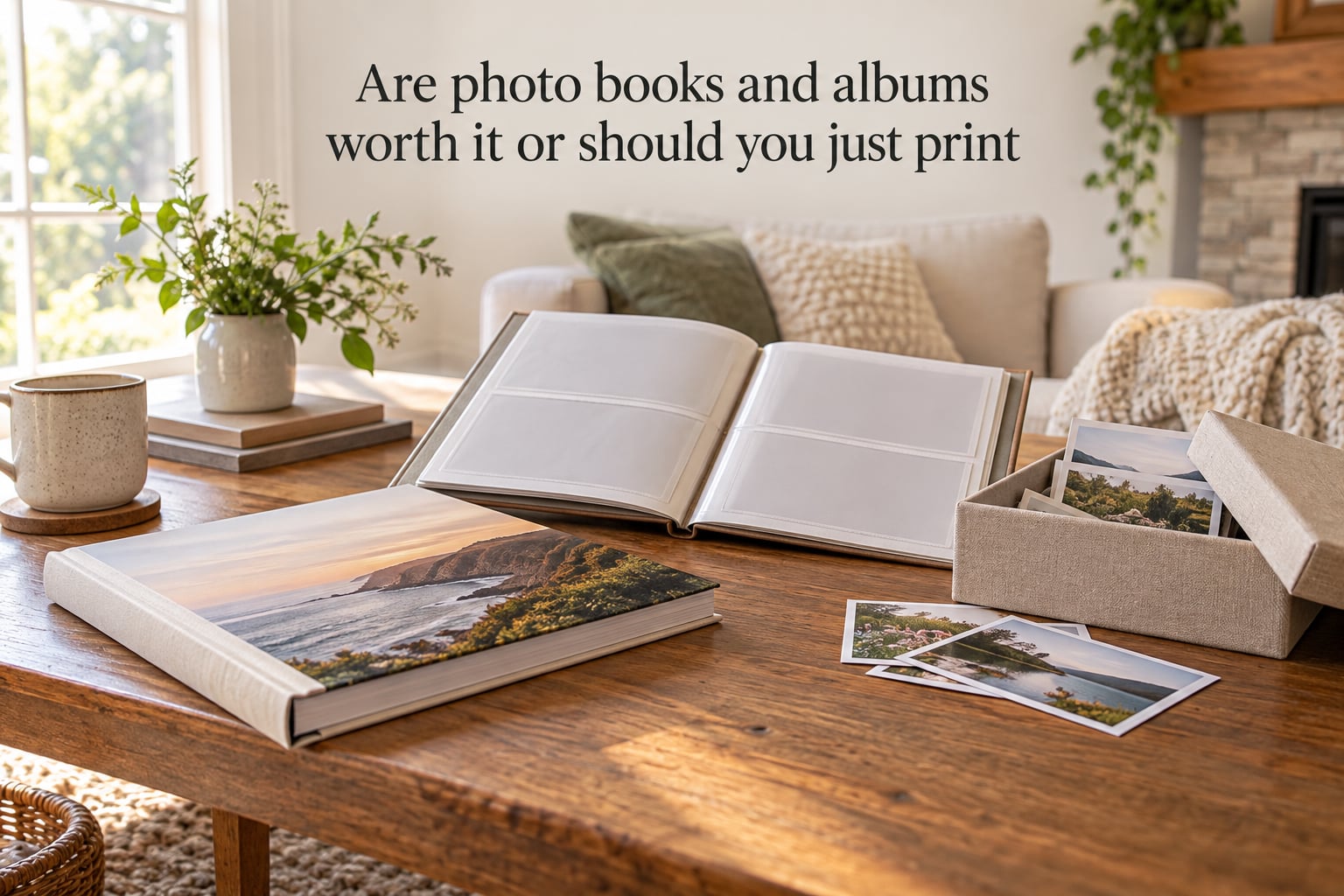
I have been a family photographer long enough to hear the same sentence in almost every studio consult: “I have thousands of photos on my phone and I never look at them.” If that sounds like you, you are not failing at memory-keeping. You just have not picked a path yet.
When families ask me whether they should invest in a photo book, start a photo album, or just print their favorite photos and put them in a box, I have stopped giving a one-line answer. The honest answer is that all three options work, and the right one depends on your time, your personality, and how you actually enjoy looking back at memories.
This guide is the conversation I wish more articles had: an honest look at photo books, photo albums, and the often-ignored third option of just printing photos and storing them in a box. No vendor pitch. Just the practical, emotional, and financial trade-offs, so you can pick the path you will actually follow through on.
Table of Contents
- Are Photo Books and Albums Worth It? The Short Answer
- What Is a Photo Book?
- What Is a Photo Album?
- The Third Option: Just Print Your Photos
- Photo Book vs Photo Album vs Just Printing Photos
- Photo Book Pros and Cons
- Photo Album Pros and Cons
- Just Printing Photos: Pros and Cons
- Cost Per Photo: The Real Math
- How Long Do Photo Books and Albums Last?
- Which Option Fits Your Life Right Now?
- Common Photobook Mistakes (and How to Avoid Them)
- How to Organize Thousands of Photos Before Printing
- Frequently Asked Questions
- The Honest Takeaway
Are Photo Books and Albums Worth It? The Short Answer
Yes, photo books and albums are worth it if you want a tangible, lasting way to revisit your memories – but for many people, simply printing favorite photos and keeping them in a labeled box is the most realistic, and still genuinely meaningful, option. Photo books win on polish and storytelling, photo albums win on flexibility, and loose prints win on speed and cost. None of the three is wrong.
If you have been paralyzed by the “someday I will make a photo book” feeling, here is your permission slip: printing your favorites this month and putting them in a shoebox beats leaving them on your phone for another three years. The best format is the one you will actually finish.
What Is a Photo Book?
A photo book is a custom-printed, bound book with your photos printed directly onto thick, archival pages. You design the layout online using a template or from scratch, choose the paper and cover, and the printer binds it as one finished keepsake. Most photo books range from a softcover pocket size to a large 12×12 hardcover with lay-flat pages.
The defining trait is that the photos are part of the book itself – they are not slid in later. Common paper choices include standard matte, lustre (a soft satin finish that resists fingerprints), and press paper (a heavier, cotton-based stock often used for wedding and heirloom books). Lay-flat binding lets a two-page spread sit flat without the gutter cutting your image in half.
What Is a Photo Album?
A photo album is a binder or pre-bound book with empty sleeves, slots, or pages where you physically insert or mount prints after you have developed them separately. The album itself can come from a craft store, a photo lab, or an heirloom brand, and the photos come from your printer or photo finisher.
Albums split into a few styles. Plastic sleeve albums have transparent pockets you slide prints into. Magnetic albums use adhesive pages that grip the back of your print. Post-bound albums have screw posts that let you add or remove pages. D-ring albums are heavy-duty three-ring binders disguised as a coffee-table book. The format you pick shapes how flexible, how archival, and how long-lasting your album will be.
The Third Option: Just Print Your Photos
The third option – the one almost no vendor article mentions – is to print your favorite photos as individual prints (4×6, 5×7, or larger) and keep them in a box, a drawer, a shoebox, or an archival photo box. No design software. No layout decisions. No minimum page count. Just the prints you actually love, in one place where you can find them.
This is the path many parents and travelers actually take, and there is real tenderness to it. Pulling a shoebox off a closet shelf at random and finding a print from a beach trip seven years ago is a different experience than turning to page 14 of a finished book. It is less curated, but it can be more surprising, and surprise is a big part of why we keep photos in the first place.
Photo Book vs Photo Album vs Just Printing Photos
The table below maps the three options across the dimensions most people actually care about. Use it as a quick scan, then read the section that matches your situation.
| Dimension | Photo Book | Photo Album | Just Print Photos |
|---|---|---|---|
| Paper and finish | Matte, lustre, or press paper; printed directly on the page | Plastic sleeves, magnetic adhesive, or post-bound pages | Whatever paper your lab offers (matte, glossy, lustre, metallic) |
| Binding | Hardcover or softcover; lay flat is premium | D-ring, post-bound, or magnetic; some are heirloom-bound | None – prints are loose |
| Customization | Full layout, captions, colors, fonts, cover | Cover material and page style only – layout is fixed by sleeves | None – prints are individual |
| Flexibility | Low – finished product once printed | High – add, swap, or rearrange anytime | Highest – reorganize the box as you like |
| Longevity | 30+ years for a quality hardcover out of sunlight | 10-20 years before adhesive yellows or spine fails | 50+ years in an archival box if stored well |
| Cost per photo | Lowest of the three (amortized across many images) | Moderate – prints plus album | Higher per photo, no upfront design cost |
| Design time | Hours per book, especially the first one | Low – just slot in prints | None |
| Gift-ready | Excellent – looks finished | Good for grandparents who can flip through | Poor – a box is rarely a gift |
| Best for | Weddings, newborn, milestones, anniversaries | Ongoing collection during busy family years | Travelers, casual memory keepers, anyone time-poor |
Photo Book Pros and Cons
Photo books are the most polished of the three options. A well-designed book feels like an heirloom the day it arrives, and it will keep that feeling for decades.
Pros of photo books:
- Finished, gift-ready product that looks intentional from the first page
- Strong storytelling – you control the sequence, captions, and pacing
- Highest longevity when stored out of direct sunlight
- Great for milestone events: weddings, newborn sessions, senior portraits, big trips
- Hardcover lay-flat books double as a coffee-table ritual with kids and grandparents
Cons of photo books:
- Highest upfront design time – first book can take an entire weekend
- Once printed, the design is locked in – awkward to revise
- More expensive per book than a single print run
- Hard to update over time – one book per year or event is the realistic cadence
Photo Album Pros and Cons
Photo albums are the flexible middle path. They look like a finished object on the shelf but let you add prints whenever new memories arrive.
Pros of photo albums:
- Add, swap, or rearrange prints at any time
- Lower upfront cost – you can start with a basic album and a few prints
- Perfect for parents in the thick of baby and toddler years when memories arrive weekly
- Works for grandparents who want to flip through with a child beside them
- Reusable – move prints to a new album if the first one fills up
Cons of photo albums:
- Adhesive and sleeve pages yellow and can fail after 10-20 years
- Page-volume limits on cheaper albums – filling it up forces a new purchase
- Less “designed” feel – looks more like a craft project than a keepsake
- Photo arrangement can shift over time if sleeves are loose
Just Printing Photos: Pros and Cons
Loose prints in a box get dismissed as the lazy option, but they are quietly the choice many of us actually live with – and there is nothing wrong with that.
Pros of just printing photos:
- Lowest cost per session – print only the photos you love
- Zero design time – order prints, drop them in a box
- Random-discovery nostalgia – pulling a box off a shelf beats scrolling
- Easy to share – hand a print to a grandparent, a friend, a child
- Works for the truly overwhelmed – some photos in a box beats none
Cons of just printing photos:
- No narrative – photos are not in chronological or thematic order
- Not gift-ready – a shoebox is rarely the right present
- Risk of being forgotten if the box is buried in a closet
- Prints can curl, stick, or fade faster than photos bound in a book
Cost Per Photo: The Real Math
One of the most common Reddit complaints about photo books is that they feel expensive compared to printing 4x6s. The math actually flips when you count cost per photo.
A small hardcover photo book with 30 pages and 2-3 photos per spread holds roughly 80-100 photos for a single upfront fee. Divide that across the photos inside and the cost per photo drops well below what most photo labs charge for a single 4×6 print. The catch is that the cost is upfront, and you only get the savings if you actually finish the book.
Loose prints at a typical consumer lab are individually priced per 4×6, 5×7, or 8×10. Twenty prints will cost more than a single small photo book of similar size. The advantage of prints is that you do not have to commit all at once – print ten this month, ten next month, no design software required.
Albums sit between the two. You buy the album once, then add prints as you go. The upfront album cost is lower than a photo book of similar size, and the per-print cost is the same as loose prints, but the album cost is amortized across however many prints you actually add.
If budget is the deciding factor, the honest breakdown is this: loose prints are cheapest to start, albums are cheapest to maintain over a busy year, and photo books are cheapest per photo if you finish them.
How Long Do Photo Books and Albums Last?
A quality hardcover photo book printed on archival paper and stored on a shelf out of direct sunlight can last 30 years or more without noticeable fading. Press paper and metallic paper last longer than standard matte. The enemy is UV light and humidity – keep the book away from south-facing windows and you will likely hand it down.
Albums have a shorter and less predictable lifespan. Adhesive pages yellow within 10-15 years and the glue can fail, letting prints slide out. Plastic sleeve albums hold up better structurally but the sleeves themselves can become brittle. If longevity is your priority, an acid-free, archival-quality album is worth the upgrade.
Loose prints stored in an archival photo box in a climate-controlled closet can last 50 years or more. Matte and lustre papers outlast glossy, which tends to stick over time. The risk is not the paper – it is the box being forgotten in a closet and never opened.
Which Option Fits Your Life Right Now?
Here is the honest decision framework I walk families through in the studio. Read the scenarios that sound like your life and pick the one that fits.
Choose a photo book if… you have a milestone you want to mark (wedding, newborn, senior session, anniversary, big trip) and you are willing to spend a weekend designing it. Photo books also win if you want a gift for grandparents or a finished piece for the coffee table.
Choose a photo album if… you are in a season of life where memories keep arriving (the 0-5 years with little kids, a year of frequent travel, a long recovery that produced a lot of phone photos). Albums let you start small and add over time without redesigning anything.
Choose just printing photos if… you have thousands of unsorted photos, no free weekend, and the “someday” photo book has not happened for three years running. Print your 20 favorites this month. Put them in a labeled box on a shelf. Look at them once a month. You can always graduate to a book or album later.
Choose a mix if… you cannot pick. Many families end up with a yearly photo book for the milestone year, a slow-growing album for everyday life, and a small box of recent prints waiting to be sorted. None of these cancels the others out.
Common Photobook Mistakes (and How to Avoid Them)
The “common photobook mistakes” question shows up in search for a reason. Most first-time photo book projects run into the same handful of avoidable problems.
- Choosing too many photos. Crowding a spread with 12 small images dilutes every one of them. Aim for 1-3 images per spread so each photo gets room to breathe.
- Skipping the color profile check. Photos edited on a backlit screen often print too dark or too saturated. Preview with the lab’s soft proof and adjust before uploading.
- Using the auto-layout for everything. Templates are fine, but applying them blindly leaves awkward crops and bad caption placement. Edit at least the milestone spreads by hand.
- Forgetting the spine. Lay-flat binding is worth it for any spread where an image crosses the gutter. Without it, the binding eats the middle of your favorite photo.
- Printing without a backup. Once the file uploads, the project is fragile. Save the original layout file, the high-res images, and the order confirmation.
- Ordering one copy. If this is a meaningful book, order two – one to keep, one to give. The cost difference is small and the gift impact is large.
How to Organize Thousands of Photos Before Printing
Before any of these options work, you have to face the thousands of unsorted photos on your phone. The good news is that you do not have to organize all of them. You only have to find the ones worth printing.
- Pick one event or month. Do not start with “all of last year.” Start with one trip, one month of baby photos, or one holiday. Small batches build the habit.
- Star or favorite as you scroll. Use your phone’s built-in favorite or star tool. Do not overthink it – if it makes you smile, star it.
- Aim for a target number. Twenty to forty photos is enough for one photo book or one album year. Forty prints is enough to fill a shoebox with intention.
- Export favorites to a single folder. AirDrop, Google Photos download, or a manual export. One folder, no subfolders for now.
- Decide before you design. Decide now whether this batch becomes a book, an album, or a printed box. The decision shapes how many photos you need.
- Repeat monthly. One small batch per month is enough. By the end of the year you have 12 manageable projects instead of one impossible one.
Frequently Asked Questions
Are photo books better than photo albums?
Photo books are better than photo albums for finished, gift-ready projects and milestone events like weddings and newborns because the photos are printed directly onto archival pages and bound into the book. Photo albums are better when you want flexibility to add, swap, or rearrange prints over time, especially during busy family years. Neither is objectively better – they serve different purposes.
What are common photobook mistakes?
Common photobook mistakes include crowding too many photos onto one spread, skipping the lab’s color profile check, relying on auto-layout for every page, forgetting to choose lay-flat binding for gutter-crossing images, failing to back up the layout file and high-res photos, and ordering only one copy of a meaningful book.
Is it worth printing your own photos?
Yes, printing your own photos is worth it even if you never make a book or album. A small set of favorites in a labeled box on a shelf gets looked at far more often than the same photos stuck in a phone library. Prints become physical memories; pixels do not.
What is the average price of a photobook?
The average photo book price varies widely by size, paper, and cover. Small softcover books start at the low end, mid-size hardcover lay-flat books sit in the middle range, and large heirloom-quality books with press paper and leather covers sit at the premium end. Per photo, however, a finished book almost always costs less than the same number of individual prints.
Does anyone use photo albums anymore?
Yes, photo albums are still widely used, especially by parents of young children and families who want to add prints gradually without committing to a full photo book design. The format has shifted from heavy magnetic albums to archival sleeve albums and post-bound heirloom styles, but the core idea – a flexible home for growing prints – is unchanged.
What is the best way to organize thousands of photos?
The best way to organize thousands of photos is to start small with one event or month at a time rather than trying to tackle the whole library at once. Star or favorite the photos that make you smile, export them into a single folder, aim for 20 to 40 keepers per project, and repeat monthly until the backlog is under control.
The Honest Takeaway
Photo books, photo albums, and printed photos are all worth it – they just are not all worth it for the same person at the same moment. The best format is the one you will actually finish, and the most common mistake is waiting for the “perfect” format that never arrives.
If you are starting from a backlog of thousands of unsorted photos, print your 20 favorites this month. Put them in a box. Put the box on a shelf where you will see it. If that ritual sticks, you have your answer – and it might be the only one that matters for now. If you want to talk through what to do with the photos from your next family session, our studio is always happy to help.