
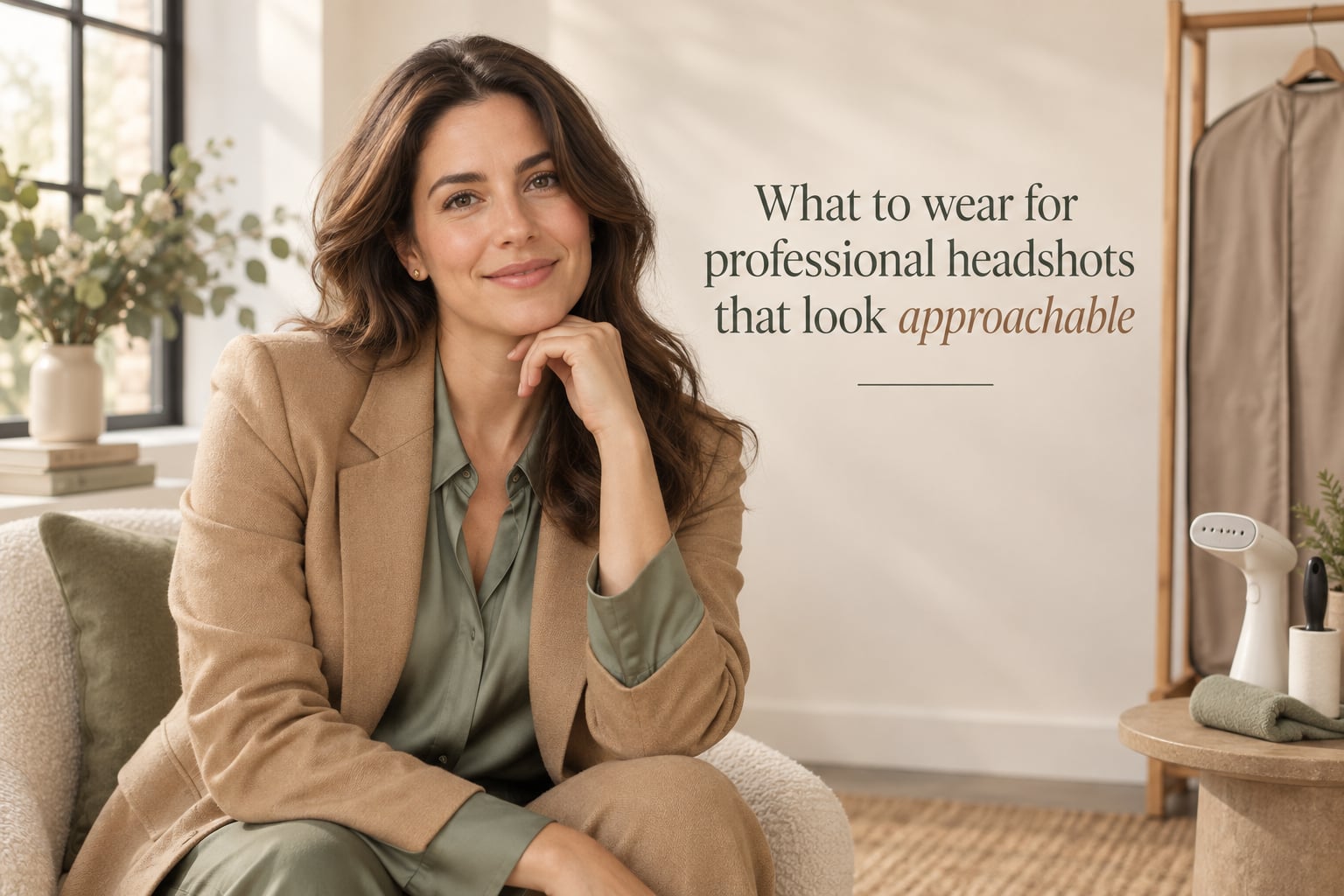
If you’ve ever wondered what to wear for professional headshots that look approachable, the short answer is this: choose solid, warm-toned or muted colors in soft blues, warm taupes, sage, or muted jewel tones, pair them with simple necklines and minimal jewelry, and skip anything shiny, high-contrast, or stiff. That’s the formula I walk every client through before they step in front of my camera, and it’s the one that consistently produces headshots people describe as friendly, trustworthy, and easy to talk to.
I’ve shot hundreds of professional headshots over the past decade at Sparkfly Photography, and the wardrobe choice is usually the make-or-break detail. A LinkedIn profile with an approachable photo gets 21 times more profile views and 9 times more connection requests than one without a photo at all. Viewers also form a trust impression in roughly 100 milliseconds, according to the well-known Willis and Todorov study. Your outfit is the second thing they notice after your face, and it quietly shapes whether they read you as someone they want to work with.
This guide breaks down the exact wardrobe, color, fabric, neckline, and grooming choices that produce an approachable headshot, plus the mistakes that quietly push a photo into cold, clinical, or intimidating territory. Whether you’re updating a LinkedIn photo, refreshing your company bio page, or building a personal brand as a coach, therapist, real estate agent, or small business owner, the framework below will help you walk into your session feeling prepared.
Table of Contents
- What ‘Approachable’ Actually Looks Like on Camera
- The Approachable Color Palette
- Necklines and Fabrics That Soften the Frame
- Approachable Outfit Formulas for Women
- Approachable Outfit Formulas for Men
- Industry-Specific Approachable Looks
- What to Avoid: Wardrobe Mistakes That Undercut Approachability
- Hair, Makeup, and Grooming That Supports an Approachable Vibe
- Pairing Your Outfit With Expression and Body Language
- Final Pre-Session Outfit Checklist
- Frequently Asked Questions
- Bring It All Together for Your Next Headshot
What ‘Approachable’ Actually Looks Like on Camera
Approachable on camera means the viewer reads you as warm, open, and trustworthy within the first half-second of seeing your photo. It is not the same as casual, and it is not the opposite of professional. Approachable is a tone: relaxed but pulled together, confident but not stiff, friendly but competent.
The psychology behind it comes down to soft contrast, warm color temperature, and a sense of openness. Soft contrast between your skin, your clothing, and the background keeps the eye on your face rather than your outfit. Warm color temperature (think soft blues, sage, terracotta, dusty rose, warm taupe) signals openness and emotional warmth. And openness shows up in necklines that reveal a little collarbone, shoulders that aren’t pinned back like a coat hanger, and fabrics that drape instead of armor.
Think of approachable as the midpoint on a spectrum. On one end sits authoritative: dark suit, crisp white shirt, high contrast, sharp tailoring. On the other end sits casual: worn tee, no structure, lots of bare skin. Approachable lives right between them, where the viewer feels like they could have a conversation with you and you would actually enjoy it.
The Approachable Color Palette
Color is the single biggest lever you have for approachability in a headshot. The right color makes your skin glow and your eyes look engaged. The wrong color makes you look tired, washed out, or severe, no matter how nice the clothing is.
The best colors for approachable professional headshots are warm or muted mid-tones that sit close to your skin tone in value. They create soft contrast, which keeps attention on your face instead of your shoulders. They also tend to photograph without clashing with common studio backdrops (gray, cream, soft brown, muted blue-green).
Colors that consistently photograph as approachable:
- Soft blue, dusty blue, chambray
- Sage green, eucalyptus, muted olive
- Warm taupe, camel, soft tan, oatmeal
- Dusty rose, blush, muted coral
- Muted jewel tones: deep teal, soft burgundy, plum, forest green
- Soft mauve, muted lilac
Warm neutrals and muted earth tones are usually the safest choice for a friendly first impression. If your brand calls for more authority (executive, lawyer, finance), you can lean into deeper jewel tones like navy, deep teal, or burgundy, which still read warm compared to stark black or pure white. For deeper skin tones, deeper jewel tones and rich earthy colors create beautiful, grounded approachable portraits because the soft contrast against your skin remains intact.
Two color rules matter more than the exact shade. First, match your color to your undertone. Cool undertones (pink, red, or bluish skin veins) look best in soft blue, sage, mauve, and plum. Warm undertones (yellow, green, or olive veins) glow in warm taupe, terracotta, camel, and dusty rose. Neutral undertones can wear almost anything in the approachable palette. Second, match your color to your backdrop. If your photographer is using a soft gray or cream backdrop, your top should be a clear step away from it in tone, but not a loud jump. A medium-warm top on a cream backdrop reads beautifully. A medium-warm top on a dark backdrop can disappear.
Necklines and Fabrics That Soften the Frame
The neckline matters more than most people expect, because a headshot is mostly shoulders, neck, and face. Whatever sits closest to your jawline and collarbone sets the emotional tone of the whole frame.
Necklines that read as approachable:
- V-neck tops and sweaters (a moderate V, not a plunge)
- Soft scoop necks
- Open or relaxed collars on button-down shirts
- Wrap-style tops and surplice necklines
- Crew necks that sit close to the collarbone, not high on the neck
- Boat necks that show a clean shoulder line
Necklines to be cautious with: a high mock neck or turtleneck can read as severe unless paired with very soft fabric. A deep plunge can pull attention away from your face. A floppy or oversized collar looks dated and distracts the eye. And an undershirt ghosting through an open collar looks unfinished under studio lighting. If you wear a button-down with an open collar, leave the undershirt at home or choose a V-neck tee in a color close to your skin tone.
Fabric choices follow the same logic. Approachable fabrics have a soft drape and a matte finish. They absorb light gently, so the camera sees texture rather than glare. The fabrics I recommend most often:
- Fine-gauge merino or cashmere knit
- Soft cotton and cotton-modal blends
- Matte silk or silk-charmeuse (not shiny satin)
- Lightweight wool suiting, hopsack, or fresco
- Crepe and ponte for structured but soft blazers
Avoid anything with a high sheen (satin, lamé, glossy polyester), heavy starch (crisp poplin can read stiff on camera), or loud texture (chunky cable knits, thick ribbing). These fabrics either reflect light in unflattering ways or pull visual weight away from your face.
Approachable Outfit Formulas for Women
Women often have the most options, which can also be the most paralyzing. Here are the outfit formulas I suggest most often for a friendly, polished headshot.
Formula 1: Soft blouse plus tailored blazer. A silk or matte-finish blouse in dusty blue, sage, blush, or warm cream, layered under a structured but softly tailored blazer in camel, soft taupe, or muted jewel tone. Skip the undershirt if your blouse has any sheerness. Statement jewelry: optional small stud earrings or a delicate chain.
Formula 2: V-neck sweater alone. A fine-gauge merino or cashmere V-neck in a soft mid-tone (warm taupe, sage, dusty rose, soft blue) with simple jewelry. This is the easiest, fastest formula for a coaching or therapy headshot that needs to feel warm and unhurried.
Formula 3: Wrap dress or surplice top. A wrap or faux-wrap top in a muted color photographs beautifully because the soft drape flatters every body shape and the diagonal neckline draws the eye to your face.
Formula 4: Structured shell plus relaxed blazer. A matte shell or shell top with a clean boat or scoop neck, layered under a softly tailored blazer. This is a strong pick for corporate roles where you want to look pulled together without feeling stiff.
A few notes specifically for women’s headshots: a fitted-but-not-tight silhouette photographs better than a loose, draped one. If you’re plus-size and worried about fabric clinging, layer a thin smoothing cami under a blouse, or choose a ponte or crepe blazer that skims the body instead of gripping it. Beading, sequins, and reflective embellishments almost always backfire on camera. And if you love a strong lipstick, leave it at home for the headshot; matte finish in a soft, slightly muted color reads cleaner under studio lights than a bold glossy lip.
Approachable Outfit Formulas for Men
For men, the goal is the same: warm, open, professional, and not stiff. The blazer-plus-shirt-without-tie look has become the modern default for a friendly professional headshot, and it works because it pulls authority down a notch and warmth up a notch.
Formula 1: Open-collar button-down, no tie, optional blazer. A well-fitted button-down in soft blue, sage, warm white, dusty pink, or muted jewel tone, worn with the top button open and no undershirt (or a V-neck tee in your skin tone). Add a structured but soft-shouldered blazer in navy, charcoal, camel, or warm taupe if your role calls for more authority.
Formula 2: Crew or V-neck sweater alone. A fine-gauge merino or cotton sweater in a warm neutral or muted mid-tone, no shirt collar underneath. Reads warm, intellectual, and unhurried. Great for coaches, consultants, writers, and creative founders.
Formula 3: Polo or refined knit, no blazer. A high-quality polo or piqué knit in a soft solid color photographs cleanly and reads friendly without feeling underdressed. Good for tech founders, real estate agents, and small business owners.
Formula 4: Casual shirt with structured jacket. A textured but solid shirt (oxford, brushed cotton, lightweight chambray) under a hopsack or fresco blazer. The texture difference adds depth without introducing pattern.
Men’s specific guidance: the floppy collar is one of the most common mistakes I see. If your shirt collar curls or wilts under studio lighting, the whole photo looks tired. Either iron your collar crisply the morning of, use collar stays, or wear a shirt with structured collar bones. Avoid white undershirts under an open collar; they ghost through, look unfinished, and create moire distortion under certain lights. Skip the tie unless your industry specifically calls for it. If you do wear a tie, choose a soft matte fabric in a color that pulls from your shirt rather than competing with it.
Industry-Specific Approachable Looks
Different industries reward different shades of approachability. Here’s how I’d translate the framework above for the most common roles.
Real estate agents want warmth and trust, because clients are about to invite them into one of the biggest transactions of their lives. The friendly professional headshot here leans into soft blue, sage, warm taupe, or dusty rose. A relaxed blazer plus a soft top photographs beautifully and signals “I’d love to help you buy a house.”
Coaches, therapists, and consultants want warmth and openness, often more than authority. A soft V-neck sweater, a wrap top, or a matte blouse in muted earth tones or soft blues reads exactly right. Skip the blazer unless your niche calls for it.
Healthcare providers (doctors, nurse practitioners, dentists, therapists in white coats) want competence plus warmth. If you wear a white coat, layer a soft colored shell underneath in sage, soft blue, or dusty rose. If you don’t, the same shell-plus-soft-blazer formula works. Avoid pure black scrubs under a white coat; the contrast goes harsh on camera.
Tech professionals and startup founders want approachable authority. A high-quality henley, polo, or unstructured blazer plus a solid crew-neck tee reads polished without looking like you’re interviewing for a bank job. Soft navy, warm gray, deep teal, and forest green are strong picks.
Creative entrepreneurs (designers, photographers, makers, writers) have the most freedom. A matte linen shirt, a soft sweater, a tailored jumpsuit, or a simple blouse in a slightly unexpected color (muted ochre, soft terracotta, plum) can all read warm and professional without looking corporate.
Corporate and executive roles benefit from a softer spin on classic tailoring. Instead of a stark white shirt and dark suit, choose a soft blue or warm-toned shirt with a charcoal or navy blazer and skip the tie. You keep the authority and add a layer of warmth.
What to Avoid: Wardrobe Mistakes That Undercut Approachability
These are the wardrobe choices that quietly push a photo toward cold, severe, or distracting. Skipping them is half the battle.
- Pure black tops or pure white shirts. Pure black absorbs light and creates harsh shadows under your chin. Pure white blows out under most studio lighting and creates a halo effect. Choose warm or muted versions instead (warm cream, off-white, deep teal, charcoal with warmth).
- Loud patterns. Stripes, checks, houndstooth, florals, and graphic prints create moire distortion on digital sensors and pull the eye away from your face. Solid colors photograph cleaner.
- High-contrast pairings without intention. A stark white shirt under a black blazer reads as formal and severe. A soft cream shirt under a warm camel blazer reads as approachable and intentional.
- Statement jewelry that competes with your face. Chunky necklaces, large chandelier earrings, and bold brooches pull attention away from your expression. Simple studs, a thin chain, or one small pendant is plenty.
- Visible undershirts under open collars. They ghost through the fabric, look unfinished, and add a “waiter” or “doctor” vibe that doesn’t translate.
- Stiff or wrinkled fabric. Wrinkles double on camera. Anything packed for the session should be steamed or pressed. Anything stiff will look starched and severe.
- Logo-heavy clothing. Visible brand logos or text distract from your face and date the photo. Skip them.
- Heavy makeup or matte overload. Foundation that is too thick or matte reads flat on camera. Lipstick that is too glossy or too dark pulls attention to the mouth. Keep both natural and soft.
Hair, Makeup, and Grooming That Supports an Approachable Vibe
Grooming is the supporting actor, not the lead. The goal is to look like yourself on a well-rested, polished day. Anything that feels like a costume will feel like a costume in the photo.
For hair, choose a style you actually wear day-to-day. If you always have your hair down, leaving it down for the shoot is fine. If you usually wear it up, an updo works. Bring a small comb and any products you use to control flyaways. Hair texture is welcome; smoothed-out hair that fights your natural pattern often photographs stiff.
For makeup, build your look around a matte finish. Studio lights amplify shine, so a light layer of translucent powder on the T-zone helps. Eyeshadow in soft, warm mid-tones opens the face. A touch of blush in a soft pink or peach tone adds warmth that reads as approachable. Mascara defines the eyes without looking heavy. Skip heavy contour, dramatic false lashes, and glossy lips.
For men, a clean shave or a well-groomed beard both photograph well. Stubble can read as careless if it’s uneven. If you wear glasses, clean the lenses the morning of and ask your photographer about anti-reflective coating or whether you should angle your head slightly to avoid glare. Nails should be clean and unchipped.
Pairing Your Outfit With Expression and Body Language
No wardrobe choice can save a tense expression or a closed-off posture. The approachable headshot is a package: outfit plus expression plus body language.
A real, easy smile reaches the eyes. Think of something you genuinely find funny or someone you love, then settle into the smile from there. Most photographers will guide you through small talk or a joke to get there naturally. You should smile in an approachable professional headshot unless your role specifically calls for a more serious tone (lawyer, surgeon, executive). Even then, a relaxed expression with a hint of softness at the corners of the mouth reads warmer than a flat, neutral mouth.
Body language: angle your shoulders slightly toward the camera rather than squared up. Drop your shoulders away from your ears. Lift your chin a touch so the jawline reads clean without you tilting into a chin-up. If your hands are in the frame, keep them soft: a gentle clasp, an open palm resting on a surface, or hands relaxed at your sides.
Final Pre-Session Outfit Checklist
The night before your session, run through this short checklist. It is what I send to every Sparkfly Photography client and it removes 90 percent of the day-of stress.
- Steam or press your outfit the morning of, including the inside of the collar and cuffs.
- Bring a backup outfit in a garment bag. A simple top in a different color from your first pick is plenty.
- Pack a small steamer or lint roller for touch-ups.
- Bring your everyday jewelry options. Two pairs of studs and one delicate chain is usually enough.
- Clean your glasses, if applicable. Bring a microfiber cloth.
- Trim or file nails the day before, especially if your hands might appear in the frame.
- Moisturize your face and lips the morning of, but skip heavy creams that can cause shine under lights.
- Bring a reference photo or two of headshots you admire so you and your photographer can match tone.
- Get a normal night’s sleep. Real rest shows up more than any product.
- Arrive a few minutes early so you can settle in and breathe before the camera comes up.
Frequently Asked Questions
What not to wear in headshots?
Avoid pure black, pure white, loud patterns, statement jewelry that competes with your face, visible undershirts under open collars, stiff or wrinkled fabric, and logo-heavy clothing. These elements create harsh contrast, moire distortion, or distraction. Choose soft, muted, solid colors with a matte finish instead.
What is the best color to wear for a professional headshot?
Warm or muted mid-tones like soft blue, sage green, warm taupe, dusty rose, and muted jewel tones (deep teal, soft burgundy, plum) photograph as the most approachable. They create soft contrast with your skin so attention stays on your face. Match the color to your undertone and to your backdrop for the best result.
What is the best outfit to wear for a professional headshot?
The most reliable approachable outfit is a simple solid top in a warm or muted color, paired with a softly tailored blazer if your role calls for extra authority. Examples include a silk blouse plus blazer for women, or an open-collar button-down plus unstructured blazer for men. Fit matters more than the brand label.
What colors to avoid for acting headshots?
Avoid colors that wash you out or clash with your skin tone, including pure white, pure black, neon shades, and colors that match your backdrop exactly. Also skip very bright primaries (fire-engine red, royal blue, kelly green) because they pull focus from your face and date the photo quickly. Soft, slightly muted versions of the same hues photograph far better.
What should a woman wear for a professional headshot?
A softly tailored outfit in a warm or muted solid color: a silk or matte-finish blouse in dusty blue, sage, blush, or warm cream, layered under a structured but soft blazer. A V-neck sweater, a wrap top, or a structured shell plus relaxed blazer all work. Choose simple stud earrings or a delicate chain and skip anything shiny or loud.
Should I smile in a professional headshot?
Yes, for most approachable professional headshots you should smile. A real, easy smile that reaches the eyes reads as warm, confident, and trustworthy. If your role requires a more serious tone, settle for a relaxed expression with softness at the corners of the mouth rather than a flat, closed mouth.
Bring It All Together for Your Next Headshot
If you remember nothing else from this guide on what to wear for professional headshots that look approachable, remember this: choose one solid color from the warm or muted palette, pair it with a soft neckline and minimal jewelry, and skip anything shiny, stark, or patterned. The rest is refinement. Add a softly tailored blazer if your role calls for more authority, swap in a V-neck sweater if you want more warmth, and adjust the color to your undertone and your backdrop.
Your headshot is one of the most reused images in your career. It will live on LinkedIn, your company bio, your speaker page, your email signature, and your business cards. A friendly, approachable photo pays dividends every single time someone searches your name, lands on your profile, and decides whether they want to talk to you. Showing up with the right outfit is the easiest part of that decision to control.
If you have a headshot session coming up, walk through the pre-session checklist above, pack two outfit options, and talk to your photographer about your backdrop and lighting in advance. And if you want help building a wardrobe around your specific industry and brand, our team at Sparkfly Photography is happy to walk through it with you before the shoot. The right outfit, paired with a relaxed expression and a clear sense of who you are, is what turns a headshot into an open door.