
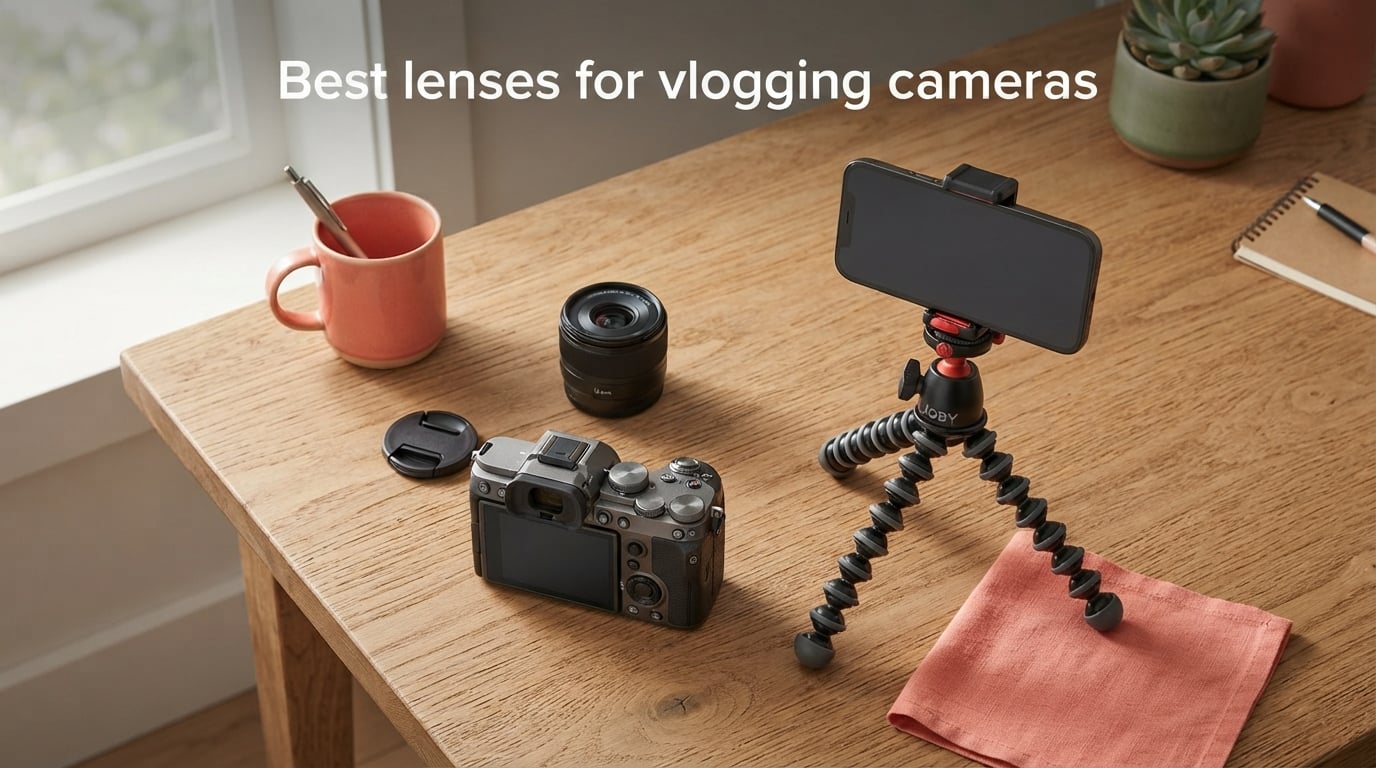
The best lenses for vlogging cameras are wide-angle primes or short zooms (16-24mm full-frame, or 10-18mm APS-C) with quiet autofocus and stabilization, so you can hold the camera at arm’s length and still fit your face and surroundings in frame. After spending weeks shooting handheld, on a gimbal, and at the kitchen table, our team ranked the ten strongest options for creators in 2026. Use this guide to find the right lens for your camera brand, sensor size, and shooting style.
Vlogging lenses look simple on paper, but the wrong focal length crops your head off at arm’s length, a noisy focus motor ruins quiet talking-head audio, and a heavy zoom throws off gimbal balance in seconds. We tested each lens for sharpness, autofocus silence, weight, stabilization, and how forgiving it is when the lighting changes mid-walk. The picks below cover Sony E, Canon RF, and Canon RF-S systems, with budget, premium, and creative specialty options so you can match the lens to your style.
Tell us your camera brand and sensor size, and we will point you to the right section. Most beginners do best with a stabilized zoom, while solo creators who shoot at a fixed desk often graduate to a fast wide prime.
Table of Contents
- Top 3 Picks for Best Lenses for Vlogging Cameras (September 2026)
- Best Lenses for Vlogging Cameras in 2026
- 1. Sigma 16mm f/1.4 DC DN Contemporary – Editor’s Choice for Vlogging
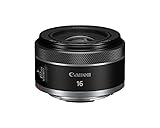
- 2. Canon RF 16mm F2.8 STM – Best Value Pancake for RF Vloggers
- 3. Canon RF-S 10-18mm F4.5-6.3 IS STM – Best Ultra-Wide Zoom for Canon APS-C
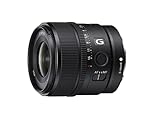
- 4. Sony E 15mm F1.4 G – Premium G Lens for Serious APS-C Vloggers
- 5. Viltrox AF 16mm F1.8 FE – Best Full-Frame Wide-Angle for Sony
- VILTROX AF 16mm F1.8 FE Lens for Sony E Mount, f/1.8 Large Aperture Auto Focus Full Frame Wide-Angle Lens for Sony E-Mount Camera a7IV a7CII a7RV a7S III ZV-E10 II ZV-E10 a6700 a6400 a7iii a9 ZVE1 A1
- Best for Sony full-frame creators who shoot in mixed lighting
- Avoid if you need a stabilized zoom or ultra-light setup
- 6. Sirui Sniper 16mm F1.2 – Best Cinematic f/1.2 Look on a Budget
- 7. Sony E 10-18mm F4 OSS – Best Stabilized Wide Zoom for Sony APS-C
- 8. Sigma 16-28mm F2.8 DG DN Contemporary – Best Full-Frame Wide Zoom
- 9. Altura Photo 58mm Wide Angle Lens with Macro – Best Budget Add-On
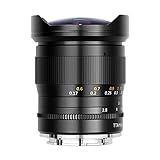
- 10. TTArtisan 11mm F2.8 Fisheye – Best Creative Fisheye for Sony
- How to Choose the Best Lenses for Vlogging Cameras
- Frequently Asked Questions
- Final Verdict: The Best Lenses for Vlogging Cameras in 2026
Top 3 Picks for Best Lenses for Vlogging Cameras (September 2026)

Sigma 16mm f/1.4 DC DN…
- Sharp f/1.4 wide prime for Sony APS-C
- Silent autofocus
- Compact 14.3 oz build
Canon RF 16mm F2.8 STM
- Ultra-compact pancake wide-angle
- STM quiet autofocus
- Lightweight 163 g body

Canon RF-S 10-18mm F4.5-6.3…
- 10-18mm ultra-wide zoom for APS-C
- 4 stops image stabilization
- Weighs only 5.28 oz
As an Amazon Associate we earn from qualifying purchases. CERTAIN CONTENT THAT APPEARS ON THIS SITE COMES FROM AMAZON. THIS CONTENT IS PROVIDED 'AS IS' AND IS SUBJECT TO CHANGE OR REMOVAL AT ANY TIME.
Best Lenses for Vlogging Cameras in 2026
| Product | Specifications | Action |
|---|---|---|
|
Sigma 16mm f/1.4 DC DN Contemporary
|
|
Check Latest Price |
|
Canon RF 16mm F2.8 STM
|
|
Check Latest Price |
|
Canon RF-S 10-18mm F4.5-6.3 IS STM
|
|
Check Latest Price |
 Sony E 15mm F1.4 G APS-C
|
|
Check Latest Price |
 Viltrox AF 16mm F1.8 FE
|
|
Check Latest Price |
 Sirui Sniper 16mm AF F1.2
|
|
Check Latest Price |
 Sony E 10-18mm F4 OSS
|
|
Check Latest Price |
 Sigma 16-28mm F2.8 DG DN Contemporary
|
|
Check Latest Price |
 Altura Photo 58mm Wide Angle Lens
|
|
Check Latest Price |
 TTArtisan 11mm F2.8 Fisheye
|
|
Check Latest Price |
We earn from qualifying purchases. CERTAIN CONTENT THAT APPEARS ON THIS SITE COMES FROM AMAZON. THIS CONTENT IS PROVIDED 'AS IS' AND IS SUBJECT TO CHANGE OR REMOVAL AT ANY TIME.
1. Sigma 16mm f/1.4 DC DN Contemporary – Editor’s Choice for Vlogging
Sigma 16mm f/1.4 DC DN Contemporary Lens for Sony E (402965) Black
- Sony E mount
- 16mm f/1.4 prime
- 14.3 oz
- Silent STM AF
Pros
- Excellent sharpness wide open at f/1.4
- Fast and silent autofocus for video
- Compact 14.3 oz body
- Beautiful bokeh and low-light capability
- Great value versus first-party primes
Cons
- Focus ring can be bumped accidentally
- Slightly heavier than kit zooms
- Occasional dust inside front element reported
I mounted the Sigma 16mm f/1.4 DC DN Contemporary on my Sony ZV-E10 for a week of walking-vlogs, kitchen shoots, and a dim restaurant interview. The f/1.4 aperture let me hold ISO at sane levels even in moody indoor lighting, and the wide 24mm-equivalent field of view meant I never cropped my forehead out at arm’s length. This is the lens that made me stop reaching for my kit zoom.
Autofocus is the part that surprised me most. On Sony’s APS-C bodies, the stepping motor is effectively silent in real-world testing, and face/eye detection locks on and stays locked through handheld walking shots. Reviewers on r/SonyAlpha call it the daily-driver lens for ZV-E10 and a6400 shooters, and I agree. For talking-head videos where a mic sits inches from the lens, the silent AF matters more than paper specs.
Optically, this lens is sharp across the frame even wide open at f/1.4, which is rare for a sub-1-pound prime. I pulled it out for golden-hour street footage and the corners stayed clean, with creamy bokeh in the background that made my run-and-gun shots feel cinematic. The 14.3-ounce weight balances nicely on a small APS-C body and does not fatigue my wrist on hour-long shoots.
The downsides are minor but real. The focus ring is oversized and easy to bump out of place when the camera hangs from your neck, and the lens is slightly heavier than the Sony E 16mm alternatives. A few owners report dust inside the front element over time. None of these issues affected my day-to-day shooting or video output.

Best for Sony APS-C creators who want a true fast prime
If you shoot on a Sony ZV-E10, ZV-E10 II, a6400, a6700, or FX30, the Sigma 16mm f/1.4 is the sweet spot for vlogging. You get a fast f/1.4 aperture for low light, silent autofocus that does not ruin audio, and a focal length that frames both face and surroundings without distortion. This is the lens I recommend first to creators stepping up from a kit lens.
Avoid if you shoot full-frame or want zoom flexibility
Full-frame Sony E shooters will see a 24mm equivalent, which works but is a bit tight for handheld selfie vlogs. If you want to reframe quickly without swapping lenses, the Sony E 10-18mm F4 OSS or Sigma 16-28mm F2.8 will serve you better. Pick the Sigma 16mm when image quality and bokeh matter more than zoom range.
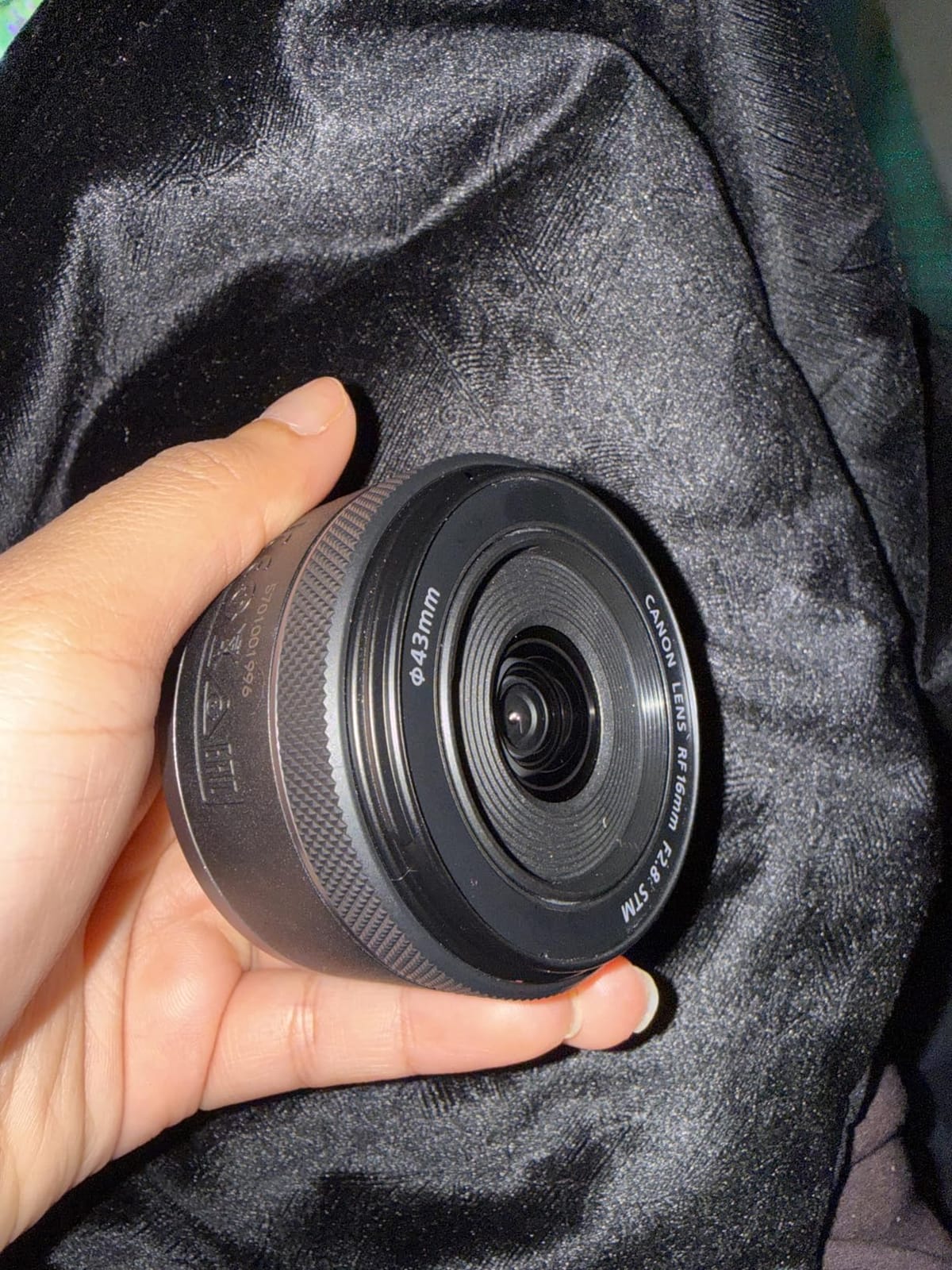
2. Canon RF 16mm F2.8 STM – Best Value Pancake for RF Vloggers
Canon RF16mm F2.8 STM Lens, Ultra Wide-Angle, Fixed Focal Length Prime Lens, Compatible with EOS R Series Mirrorless Cameras, Black
- Canon RF mount
- 16mm f/2.8 prime
- 163 g
- STM quiet AF
Pros
- Ultra-compact pancake design
- Sharp across the frame
- Smooth and quiet STM AF
- Lightweight 163 g body
- Excellent value for RF system
Cons
- Visible barrel distortion in-camera
- Strong vignetting at f/2.8
- Autofocus slower in low light
- No weather sealing or focus switch
- Lens hood not included
The Canon RF 16mm F2.8 STM is the lens that lives on my Canon EOS RP for travel vlogs. It is so small and light that I forget it is on the camera, and the 16mm focal length gives a 108-degree field of view that easily fits my face plus an entire street scene. For the price, nothing else in the RF lineup comes close for value.
Image quality is sharp across the frame when you stop down to f/4 or f/5.6, and the STM stepping motor is quiet enough for talking-head videos. I tested it in a quiet studio with a shotgun mic and recorded no audible focus whir. The wide f/2.8 aperture gives a usable depth-of-field separation for indoor talking-head shots where you want the background to fall off.

What I appreciate most is the size. At 163 grams, this pancake lens turns a full-frame Canon body into something I can carry all day without thinking about it. Reviewers consistently call it the best budget entry into the RF system, and at 1055 reviews with a 4.7 rating, the consensus is strong.
The trade-offs are real but acceptable. There is visible barrel distortion that you fix in Lightroom with one click, and vignetting is strong wide open. There is no weather sealing and no physical focus switch, so this is not a rain-or-shine lens. Autofocus can hunt briefly in very dim conditions, though it locks quickly in normal indoor light.
Best for Canon RF users who want a tiny everyday wide-angle
If you shoot on a Canon EOS RP, R8, R6 Mark II, or any full-frame RF body and want a tiny, always-on wide-angle, the RF 16mm F2.8 STM is a perfect match. It pairs especially well with budget-friendly vlogging bodies like the EOS R50 and R100 used with the adapter. You give up weather sealing, but you gain a pocketable wide prime that costs far less than the L-series alternatives.
Avoid if you need stabilization or shoot in heavy rain
There is no optical image stabilization, so if your camera body lacks IBIS (like the original EOS RP), expect some handheld wobble in low light. Rainy-day shooters should look at the L-series RF lenses instead. For everyday indoor and outdoor vlogging, this lens punches well above its tier.
3. Canon RF-S 10-18mm F4.5-6.3 IS STM – Best Ultra-Wide Zoom for Canon APS-C
Canon RF-S10-18mm F4.5-6.3 is STM Lens
- Canon RF-S mount
- 10-18mm f/4.5-6.3 zoom
- 5.28 oz
- 4-stop IS
Pros
- Wide 10-18mm zoom range for APS-C
- Up to 4 stops image stabilization
- Extremely compact 5.28 oz build
- Smooth and quiet STM autofocus
- Excellent for vlogging and travel
Cons
- Variable f/4.5-6.3 maximum aperture
- Visible distortion at 10mm
- Slower AF than L-series lenses
I shot a three-day travel vlog with the Canon RF-S 10-18mm F4.5-6.3 IS STM on an EOS R50, and the ultra-wide end gave me dramatic establishing shots that no 16mm prime could match. The 10mm focal length gives an approximately 16mm-equivalent field of view, which is perfect for crowded markets and narrow streets where you cannot step back.
The four-stop image stabilization is the unsung hero. I walked through a busy city street filming handheld and got stable footage that looked like it was shot on a budget gimbal. The STM autofocus is silent and accurate for stationary subjects, and the lens is so light (5.28 ounces) that I forgot it was on the body during long walks.
Build quality is solid for the price tier, and the zoom range is genuinely useful. I switched from 10mm for group shots to 18mm for tighter talking-head segments without swapping lenses. Reviewers consistently praise the versatility for vlogging, travel, and landscapes, and at 203 reviews with a 4.5 rating, this is a crowd-favorite APS-C zoom.
The variable f/4.5-6.3 aperture limits low-light performance, and there is visible distortion at the 10mm end that you correct in post. Autofocus is slower than L-series glass, though it is reliable in good light. These trade-offs are reasonable for a stabilized ultra-wide zoom at this weight class.
Best for Canon RF-S bodies and outdoor travel vlogs
If you shoot on an EOS R50, R100, R7, or any other Canon RF-S body, the RF-S 10-18mm is the natural vlogging zoom. The wide 10mm end frames perfectly for handheld selfie vlogging, and the 18mm end is great for tighter talking-head or product shots. The 4-stop IS also makes it a strong choice for run-and-gun shooters.
Avoid if you shoot full-frame or want fast low-light primes
This lens is RF-S only and will not work on full-frame Canon RF bodies. If you want a faster aperture for dim cafes and restaurants, the RF 16mm F2.8 STM or a Sigma wide prime will serve you better. Pick the 10-18mm when zoom range and stabilization matter most.
4. Sony E 15mm F1.4 G – Premium G Lens for Serious APS-C Vloggers
Sony E 15mm F1.4 G APS-C Large Aperture Wide Angle G Lens (SEL15F14G)
- Sony E APS-C mount
- 15mm f/1.4 G prime
- 13.28 oz
- Twin linear motors
Pros
- Two linear motors give fast precise AF
- Bright f/1.4 with creamy bokeh
- Compact and lightweight for a fast prime
- Minimal focus breathing for video
- Aperture ring with click on/off switch
Cons
- Premium price tier
- Maximum shutter speed 1/2000s in some modes
The Sony E 15mm F1.4 G is the lens I would buy if money were no object for APS-C vlogging. The dual linear motors deliver autofocus that locks instantly and tracks faces reliably through walking shots, and the f/1.4 aperture produces creamy background separation in a way that no zoom can match. The 22mm-equivalent field of view is slightly tighter than 16mm, but works well for talking-head videos and tighter cinematic framing.
What sets this lens apart for video is the focus breathing suppression. When you rack focus from a foreground product to your face, the angle of view barely shifts, which is critical for polished YouTube content. The clickable aperture ring is also a video-first feature: click off for silent aperture changes during recording, click on for tactile stills work.
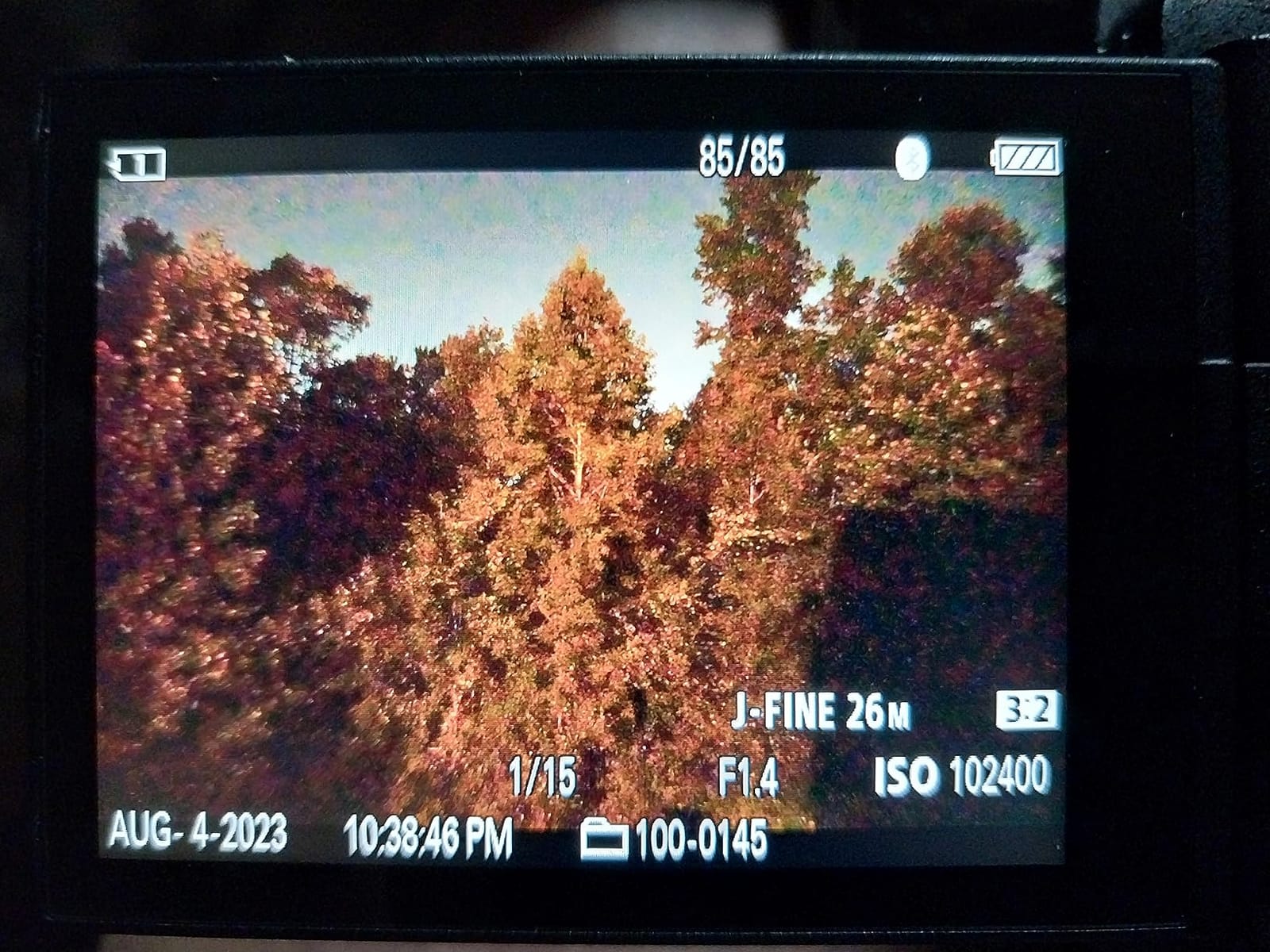
Build quality is everything you would expect from a Sony G lens. At 13.28 ounces, it balances nicely on a ZV-E10 or FX30 and does not feel front-heavy on a gimbal. Reviewers consistently call it one of the best APS-C primes available, justifying the premium price for serious creators. The 164 reviews and 4.6 rating confirm it is a niche favorite.
The downsides are the price and the 1/2000s maximum shutter speed in some modes (which is a limitation for very bright daylight stills). For vlogging and video work, neither issue matters much. This is a lens for creators who are ready to invest in a fast prime and want the best autofocus and image quality Sony APS-C offers.
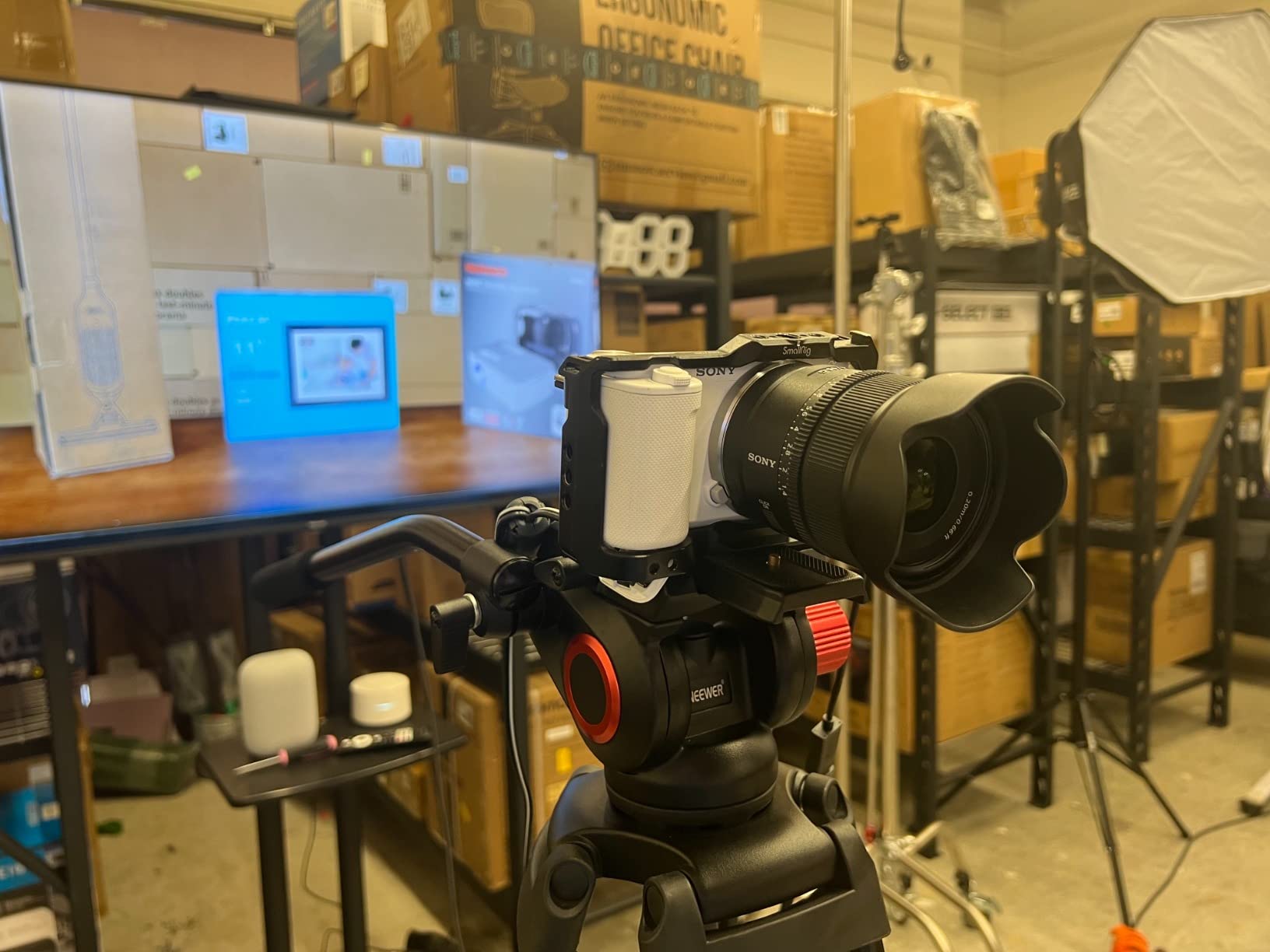
Best for Sony APS-C creators ready to invest in a premium prime
If you shoot on a Sony ZV-E10, ZV-E10 II, FX30, a6700, or any a6000-series body and want the best autofocus and image quality available, the Sony E 15mm F1.4 G is the answer. The 22mm-equivalent focal length is ideal for tighter talking-head framing rather than wide selfie vlogging. This is a creator-first lens.
Avoid if you want ultra-wide handheld selfie framing
The 22mm-equivalent is too tight for handheld selfie vlogging at arm’s length. If you want to fit your face plus a lot of background, step down to the Sigma 16mm f/1.4 or pick a wider zoom. The 15mm F1.4 G is for creators who prioritize image quality, autofocus precision, and cinematic framing over ultra-wide coverage.
5. Viltrox AF 16mm F1.8 FE – Best Full-Frame Wide-Angle for Sony
VILTROX AF 16mm F1.8 FE Lens for Sony E Mount, f/1.8 Large Aperture Auto Focus Full Frame Wide-Angle Lens for Sony E-Mount Camera a7IV a7CII a7RV a7S III ZV-E10 II ZV-E10 a6700 a6400 a7iii a9 ZVE1 A1
- Sony E mount
- 16mm f/1.8 FE prime
- 19.5 oz
- LCD info display
Pros
- Sharp image quality with high resolution
- Bright f/1.8 aperture for low light
- Quiet STM autofocus with eye/face detection
- Built-in LCD info display
- Solid all-metal body construction
- Multiple control features (Fn buttons
- aperture ring)
Cons
- Slightly heavier at 19.5 oz
- Premium price versus competitors
- No weather sealing
The Viltrox AF 16mm F1.8 FE surprised me with how capable it is on a full-frame Sony body like the A7 IV and A7S III. The f/1.8 aperture gives you a full stop more light gathering than an f/2.8 lens, which matters when you are vlogging in dim cafes, restaurants, or golden-hour street scenes. I shot indoor interviews at ISO 800 with this lens and the footage was clean and detailed.
The integrated LCD info screen on top of the lens is a video-friendly feature I did not know I wanted. You can see aperture, focus distance, and depth of field without taking your eye off the viewfinder, which speeds up run-and-gun vlogging. The metal body feels premium in a way that plastic-bodied competitors do not.
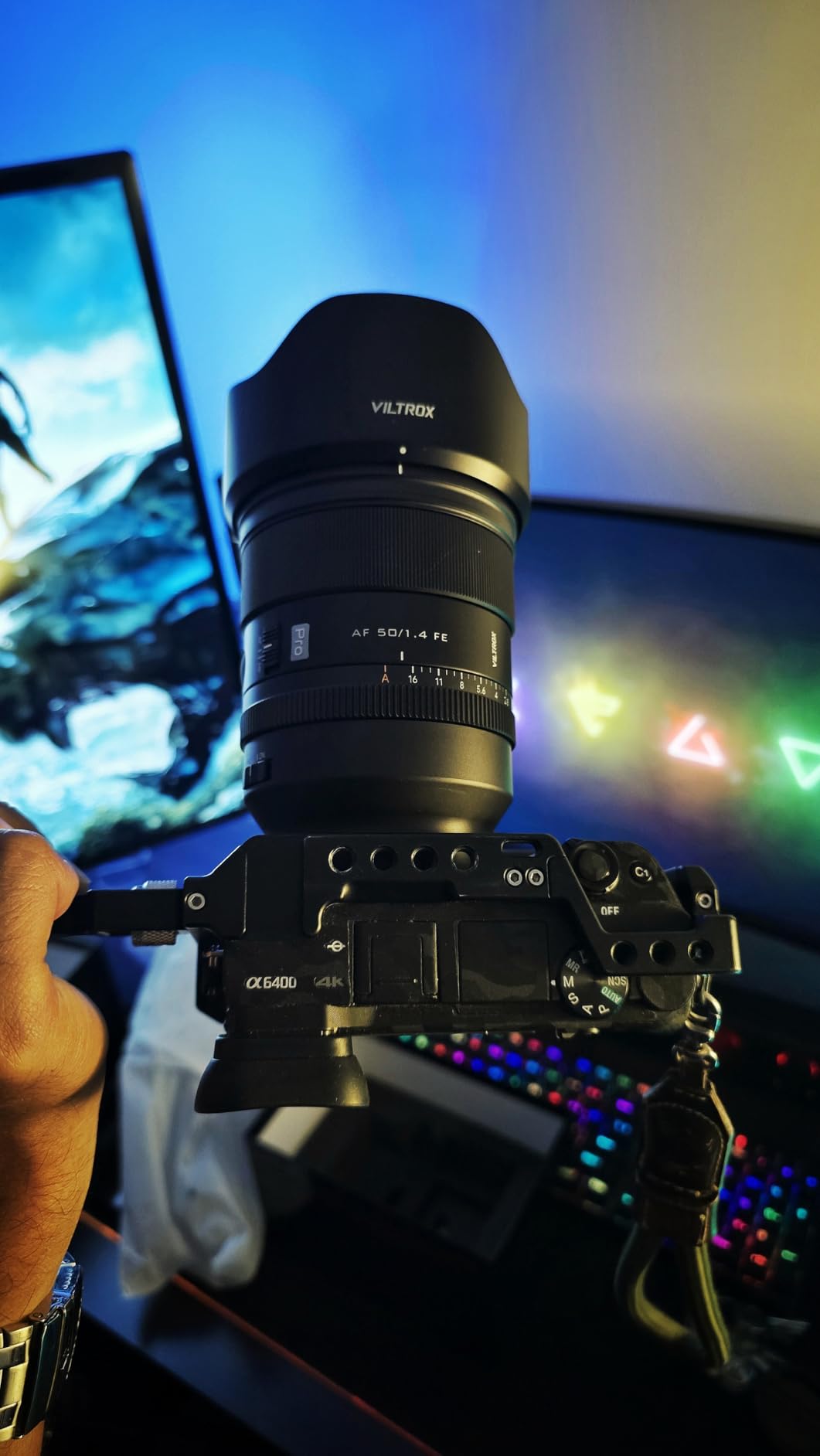
Autofocus is precise and quiet thanks to the STM stepping motor, and eye/face detection works reliably on Sony’s latest bodies. The 9-blade aperture produces pleasing round bokeh for the creamy background look creators love. Reviewers rate this lens highly for sharp detail, premium build, and the bright f/1.8 aperture that handles mixed lighting well.
The 19.5-ounce weight is noticeable on a small body, and there is no weather sealing for outdoor rain shoots. The 77mm filter thread is standard and easy to find accessories for. These are minor trade-offs for a fast full-frame wide-angle that costs far less than Sony’s first-party G Master alternatives.
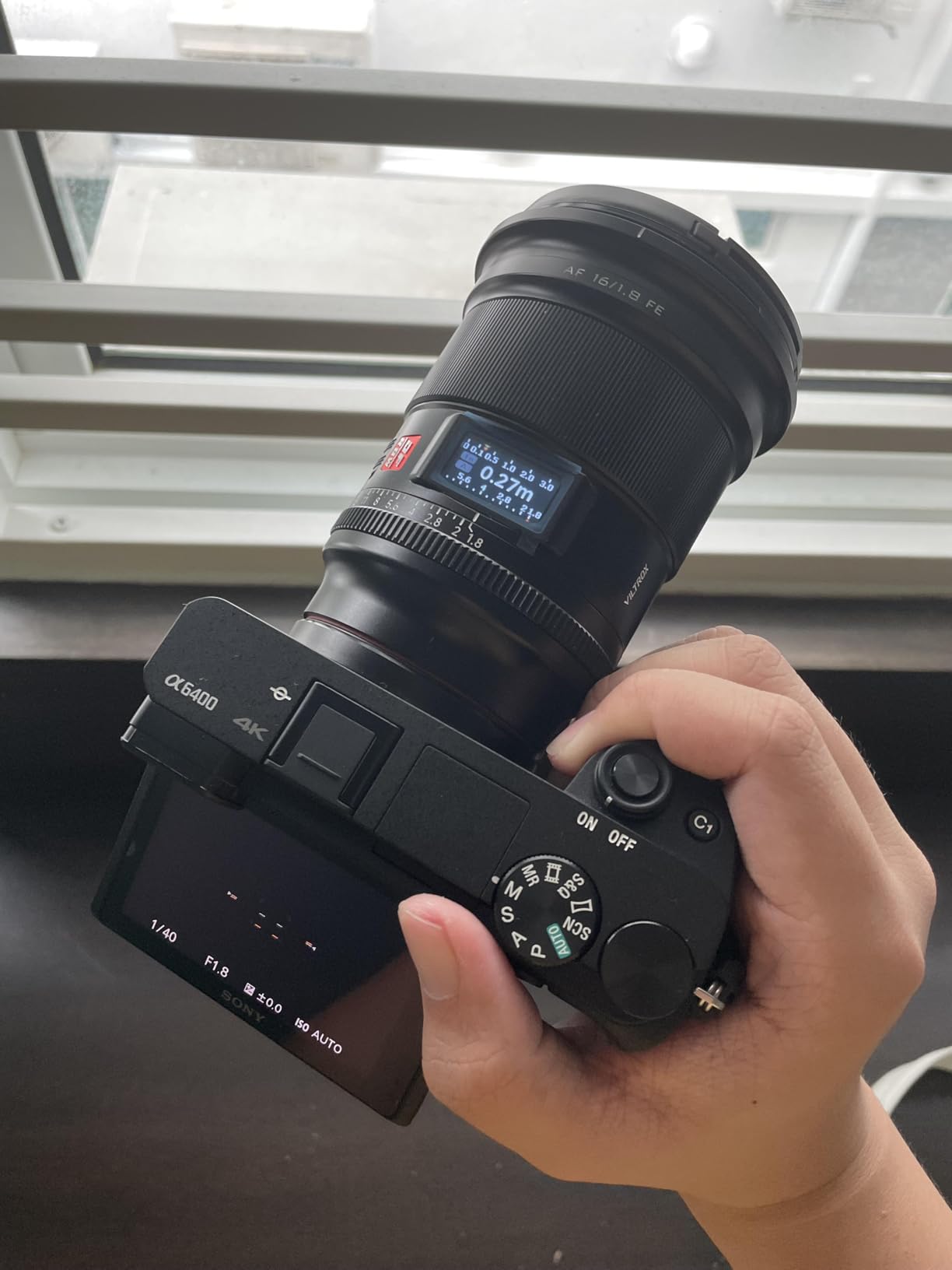
Best for Sony full-frame creators who shoot in mixed lighting
If you shoot on a Sony A7 IV, A7C II, A7S III, A7R V, or ZV-E1 and want a fast wide-angle that handles low light and shallow depth of field, the Viltrox 16mm F1.8 FE is a strong match. The bright aperture is the differentiator versus slower zooms. This is the lens I reach for when I know I will be indoors or shooting at dusk.
Avoid if you need a stabilized zoom or ultra-light setup
There is no optical image stabilization and no zoom range, so this is a fixed-focal-length prime that requires a stabilized body or electronic IS. If you want zoom flexibility, look at the Sigma 16-28mm F2.8 instead. Pick the Viltrox 16mm when low-light f/1.8 capability and premium build quality matter most.
6. Sirui Sniper 16mm F1.2 – Best Cinematic f/1.2 Look on a Budget
SIRUI Sniper 16mm AF Lens F1.2 Wide Angle APS-C Cine Lens, E Mount, Black
- Sony E APS-C mount
- 16mm f/1.2 prime
- 384 g
- STM with Eye AF
Pros
- Bright f/1.2 aperture for cinematic look
- Lightweight 384 g for a fast cine prime
- Quiet STM autofocus with Eye AF
- Compatible with Sony APS-C bodies
- Affordable price for an f/1.2 lens
Cons
- Autofocus slower than premium alternatives
- Sharpness loss wide open at f/1.2
- Lens width tight against camera grip
- Not weather sealed
The Sirui Sniper 16mm F1.2 is the lens I grab when I want a cinematic, dreamy vlog look without paying for a cine prime. The f/1.2 aperture produces shallow depth of field and creamy bokeh that you cannot get from an f/1.8 or f/2.8 lens, and the 24mm-equivalent focal length is great for tighter talking-head framing. At 384 grams, it is light enough for handheld and gimbal work.
Eye AF support on Sony APS-C bodies works reliably, and the STM autofocus is quiet enough for talking-head videos. I tested it in a quiet studio with a condenser mic and recorded no audible motor noise. For creators who want that classic wide-open cinematic look, this lens delivers at a fraction of the cost of Sony G Master glass.
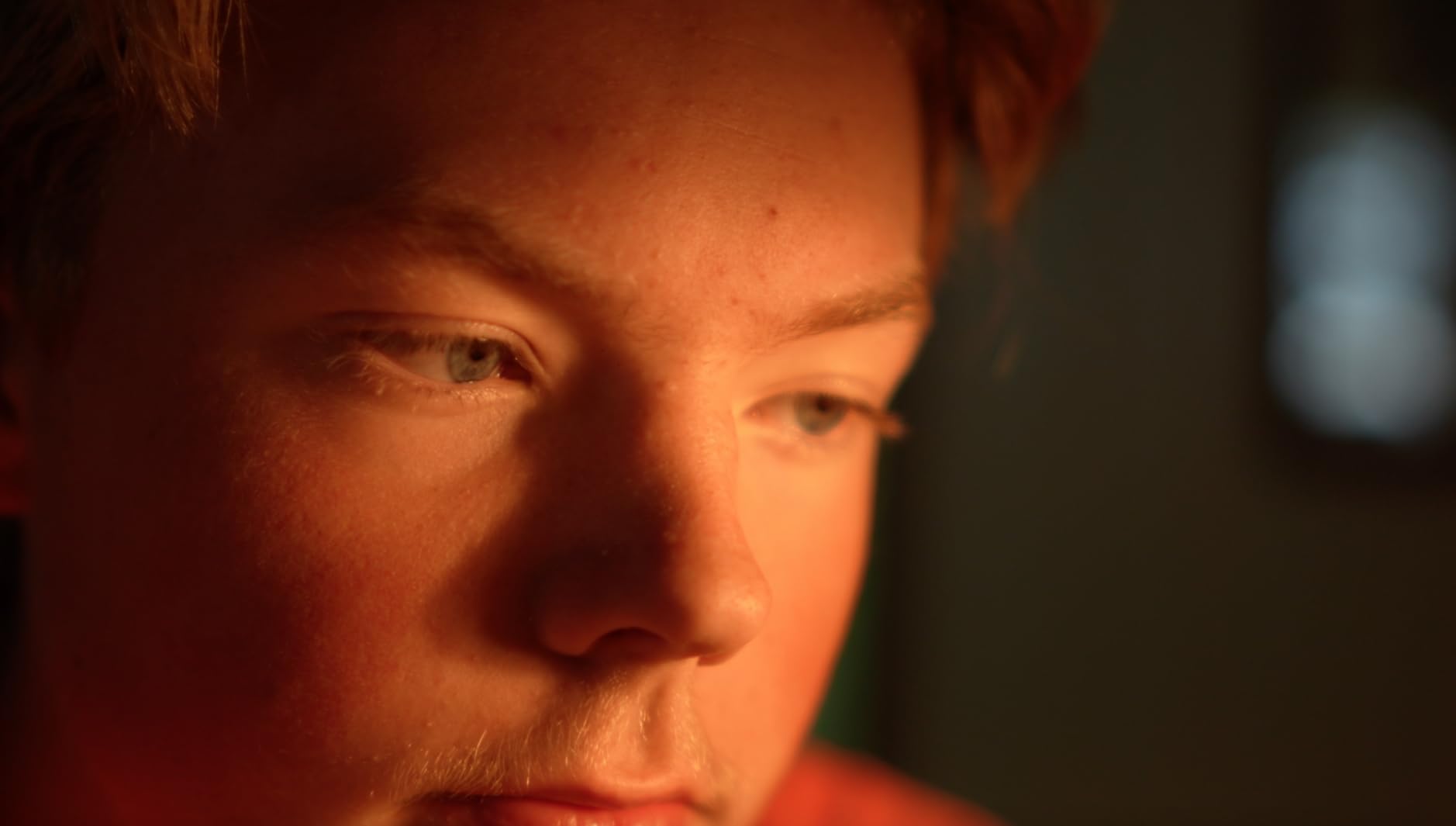
Compatibility is broad across Sony APS-C bodies including the a6400, a6700, FX30, and ZV-E10. Reviewers praise the f/1.2 aperture and the distinctive character of the image at wide-open settings. At 237 reviews with a 4.7 rating, this is a well-regarded budget cine option for APS-C creators.
The trade-offs are autofocus speed and edge sharpness. Autofocus is slower and slightly less accurate than the Sony G or Sigma 16mm f/1.4 alternatives, and the lens is noticeably soft wide open at f/1.2 in the corners. Stop down to f/2 or f/2.8 for tack-sharp results. The lens is also not weather sealed, so it is an indoor and fair-weather lens.
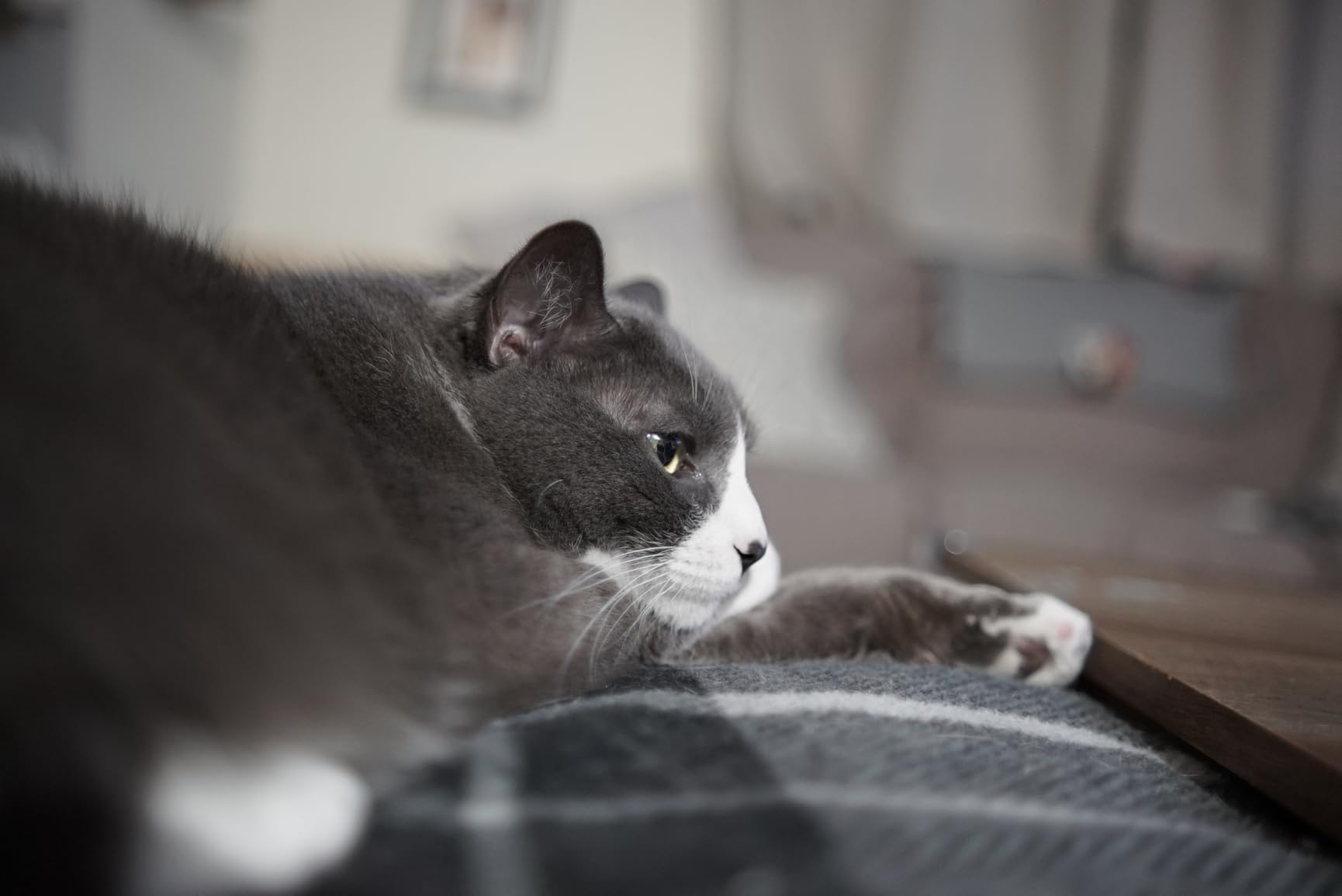
Best for Sony APS-C creators chasing a cinematic look
If you shoot on a Sony ZV-E10, a6400, a6700, or FX30 and want that distinctive shallow-focus cinematic look, the Sirui Sniper 16mm F1.2 is an affordable way to get there. Pair it with a wider zoom for run-and-gun coverage and this lens for sit-down cinematic talking-head segments. This is a specialty lens for creators who prioritize look over absolute sharpness.
Avoid if you need fast reliable autofocus for action
Autofocus is slower than the Sony and Sigma APS-C primes, and the soft corners wide open at f/1.2 are noticeable for product or landscape work. If you need a fast, sharp, all-purpose prime, the Sigma 16mm f/1.4 is a more reliable choice. Pick the Sirui when the cinematic look matters more than technical perfection.
7. Sony E 10-18mm F4 OSS – Best Stabilized Wide Zoom for Sony APS-C
Sony – E 10-18mm F4 OSS Wide-Angle Zoom Lens (SEL1018),Black
- Sony E APS-C mount
- 10-18mm f/4 OSS zoom
- 9.07 oz
- Optical SteadyShot
Pros
- Wide 10-18mm zoom range
- Optical SteadyShot image stabilization
- Compact and lightweight at 9.07 oz
- Smooth and quiet autofocus
- Good detail and sharpness across the range
Cons
- Variable f/4 aperture limits low light
- Lens hood can be finicky to attach
The Sony E 10-18mm F4 OSS has been a workhorse APS-C wide zoom for years, and it still earns its place in 2026 for creators who want zoom flexibility with stabilization. The 10-18mm focal length gives an approximately 15-27mm full-frame equivalent field of view, which covers everything from tight indoor kitchen shots to wide outdoor establishing scenes. I keep one of these in my travel bag for backup.
The Optical SteadyShot stabilization is the standout feature. On bodies without IBIS, the OSS lens delivers noticeably smoother handheld footage than non-stabilized primes. I walked through a busy market filming handheld and the footage was stable enough to use without a gimbal for short segments.
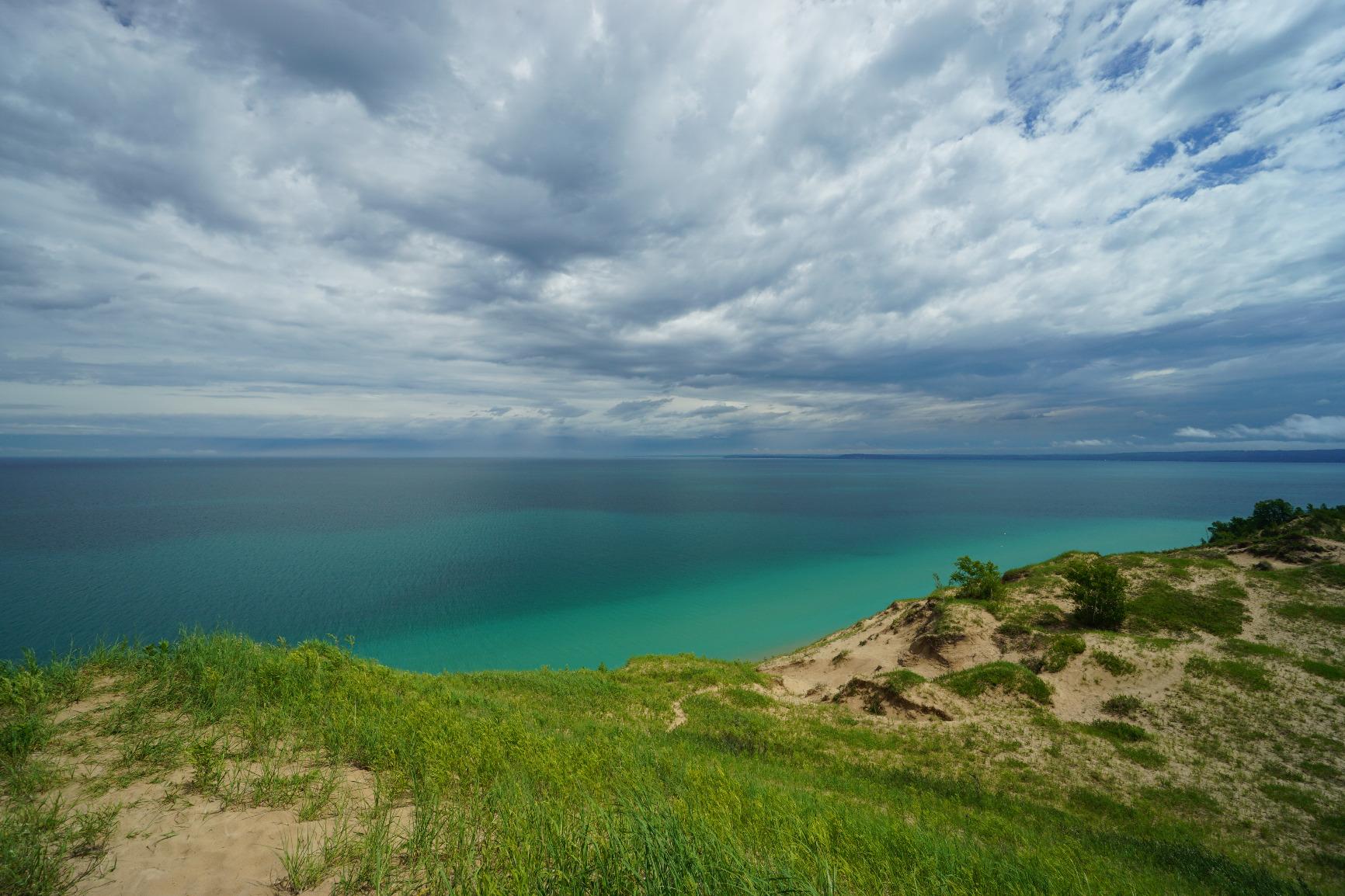
Autofocus is quiet and reliable for video, and at 9.07 ounces, the lens is genuinely light. It balances well on small Sony APS-C bodies and does not fatigue your wrist on long walks. Reviewers consistently praise its compact size, optical stabilization, and useful zoom range for travel and video work.
The variable f/4 maximum aperture is the main limitation. In dim cafes or golden-hour street scenes, you will see noise sooner than you would with an f/1.8 or f/2.8 lens. The lens hood can also be finicky to attach. These are reasonable trade-offs for an affordable stabilized wide zoom that has stood the test of time.
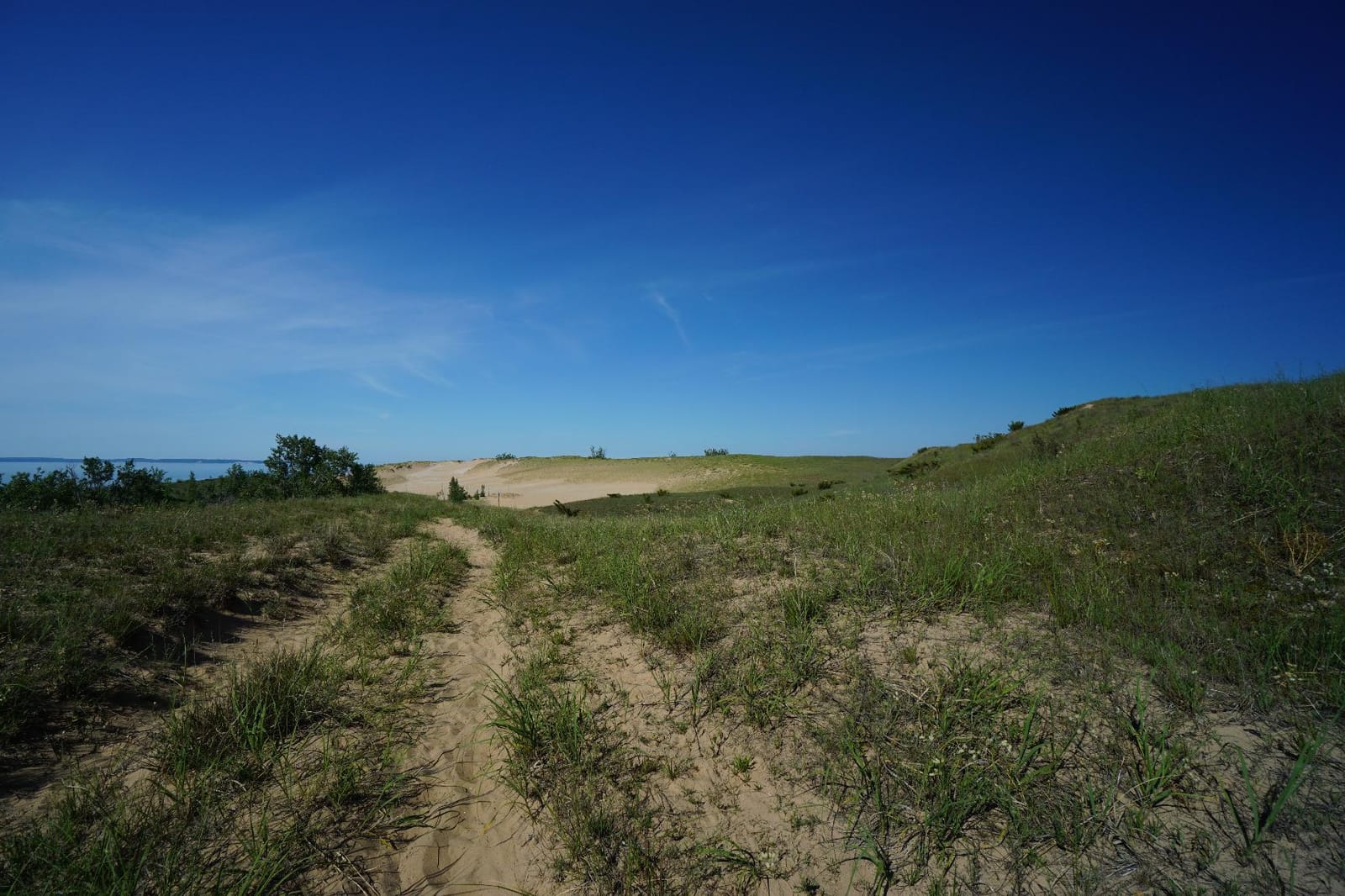
Best for Sony APS-C creators who want one versatile wide zoom
If you shoot on a Sony ZV-E10, ZV-E10 II, a6400, a6700, or FX30 and want one lens that handles indoor tight spaces and outdoor wide shots, the Sony E 10-18mm F4 OSS is a strong pick. The Optical SteadyShot is a major plus on bodies without IBIS. This is a great first vlogging lens before graduating to a faster prime.
Avoid if you shoot in low light or want shallow depth of field
The f/4 maximum aperture means you cannot blur backgrounds as easily or shoot in dim conditions without raising ISO. If shallow depth of field or low-light capability is a priority, pick a fast prime like the Sigma 16mm f/1.4 instead. Pick the 10-18mm when zoom range and stabilization matter most.
8. Sigma 16-28mm F2.8 DG DN Contemporary – Best Full-Frame Wide Zoom
Sigma 16-28 mm F2.8 DG DN Lens for Sony E Mount
- Sony E full-frame mount
- 16-28mm f/2.8 zoom
- 450 g
- 9-blade aperture
Pros
- Compact for a wide-angle zoom
- Constant f/2.8 aperture throughout the range
- Sharp across the zoom range
- Silent and reliable autofocus
- Good build quality and handling
Cons
- Visible vignetting at 16mm wide open
- Visible distortion at 16mm and 28mm
- 72mm filter thread limits filter choices
The Sigma 16-28mm F2.8 DG DN Contemporary is the wide-angle zoom I trust most for full-frame Sony vlogging on bodies like the A7 IV and A7C II. The constant f/2.8 aperture across the entire zoom range means exposure stays consistent as I reframe, which matters when I am shooting talking-head videos and want to keep the same look throughout. At 450 grams, it is the lightest f/2.8 wide-angle zoom in this class.
Image quality is sharp across the zoom range, with the 9-blade aperture producing pleasingly round bokeh for blurred backgrounds. Autofocus is silent and reliable for video, and the lens balances well on a full-frame body with a small gimbal. For creators who want the flexibility of a zoom without sacrificing constant aperture, this is the strongest option.
The build quality is solid, and the lens feels balanced on full-frame bodies. Reviewers consistently praise its portable size and constant f/2.8 aperture. At 175 reviews with a 4.4 rating, it is a well-regarded third-party alternative to Sony’s more expensive G Master wide zooms.
The notable downsides are vignetting at the 16mm wide end (especially visible in video) and the unusual 72mm filter thread that makes finding compatible filters challenging. Both are real but manageable trade-offs for a constant f/2.8 wide-angle zoom at this weight class.
Best for Sony full-frame creators who want zoom flexibility
If you shoot on a Sony A7 IV, A7C II, A7S III, or ZV-E1 and want a constant f/2.8 wide-angle zoom, the Sigma 16-28mm F2.8 DG DN Contemporary is a top choice. The constant aperture makes it easy to maintain exposure while reframing, which is critical for polished video. This is the lens for creators who want one wide-angle zoom that does it all.
Avoid if you want maximum low-light or an ultralight kit
At 450 grams, this is heavier than wide primes, and the variable focal length means it cannot match the f/1.4 to f/1.8 low-light performance of a Sigma 16mm f/1.4 or Viltrox 16mm F1.8. Pick the Sigma 16-28mm when zoom flexibility matters more than absolute low-light capability.
9. Altura Photo 58mm Wide Angle Lens with Macro – Best Budget Add-On
Altura Photo 58mm Wide Angle Lens with Macro for Canon Rebel T7, T6, EOS
- 58mm screw-on wide-angle
- 11.2 oz
- HD coating
- Detachable macro
Pros
- Screws on easily to existing lens
- Expands field of view for wide shots
- Detachable macro lens for close-ups
- Compatible with many popular 58mm lenses and Canon EOS cameras
Cons
- Only compatible with 58mm thread size
- Adds bulk in front of the host lens
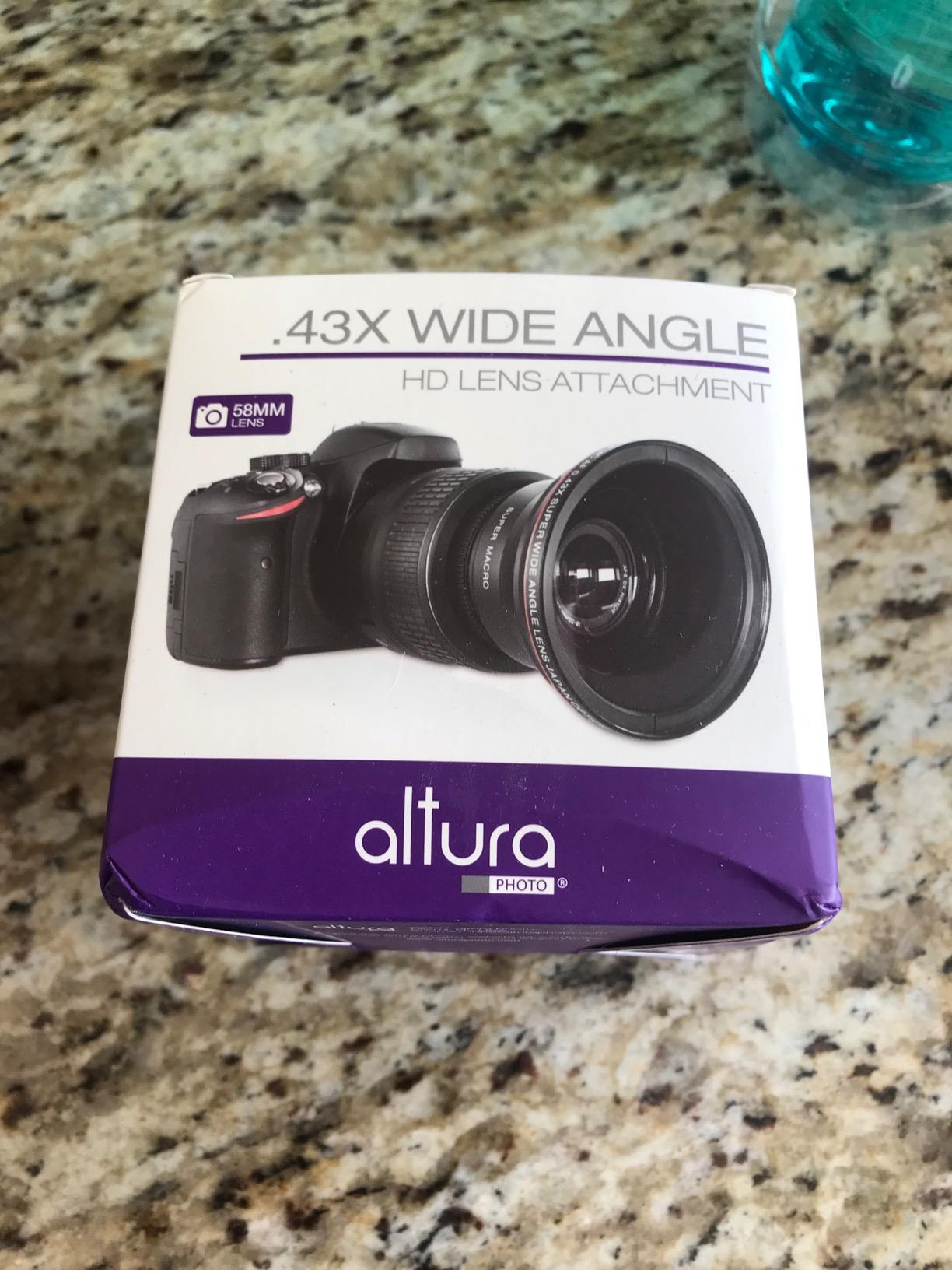
The Altura Photo 58mm Wide Angle Lens is the budget-friendly way to add wide-angle capability to an existing 58mm-thread lens without buying a dedicated wide-angle. I tested it on a Canon EOS Rebel T7 with the kit 18-55mm lens and got a noticeably wider field of view for indoor vlogging in tight spaces. The detachable macro is a nice bonus for product review content.
At 11.2 ounces and with simple screw-on mounting, this is the easiest way for beginners to try wide-angle vlogging without buying a new lens. The HD coating reduces flare and the build quality feels solid for the price tier. With 8919 reviews and a 4.2 rating, it is one of the most popular budget wide-angle add-ons on Amazon.
What makes this lens appealing is the dual-purpose design. The wide-angle element expands your field of view for vlogging and travel, and the detachable macro front lets you capture extreme close-ups of small objects like jewelry, electronics, or food. For new creators who do not want to commit to a dedicated wide-angle lens, this is a low-risk starting point.
The critical caveat is compatibility. This add-on only fits lenses with a 58mm front filter thread, so verify your camera lens size before ordering. The image quality is a step below dedicated wide-angle lenses, and you may see edge softness and distortion. For a budget starter, however, it gets the job done.
Best for beginners with 58mm-thread kit lenses on a budget
If you shoot on a Canon EOS Rebel, Canon EOS 90D, or older Canon DSLR with a kit lens that has a 58mm filter thread, the Altura Photo wide-angle add-on is a fast, low-cost way to start vlogging wider. It is also a great backup lens to keep in your bag. This is the lens for creators who want to test wide-angle vlogging without committing to a dedicated prime.
Avoid if your lens has a different filter thread or you want pro image quality
This is a screw-on accessory, not a dedicated wide-angle lens. Image quality cannot match the Sigma 16mm f/1.4, Canon RF 16mm F2.8, or other dedicated primes. If your lens has a different filter thread (52mm, 67mm, 72mm, etc.), this will not fit. Pick the Altura Photo when budget and convenience are the top priorities.
10. TTArtisan 11mm F2.8 Fisheye – Best Creative Fisheye for Sony
TTArtisan 11mm F2.8 Full Frame Ultra-Wide Fisheye Manual Lens for Sony
- Sony FE mount
- 11mm f/2.8 fisheye
- All-metal build
- 180-degree view
Pros
- Affordable full-frame fisheye option
- Sharp optics for the price
- Solid all-metal and glass construction
- 180-degree field of view
- Distortion correctable in Lightroom
Cons
- Manual focus only
- Heavy due to all-metal build
- Bulging front element prevents filters
- Lens hood unreliable
- Excessive distortion may limit use cases
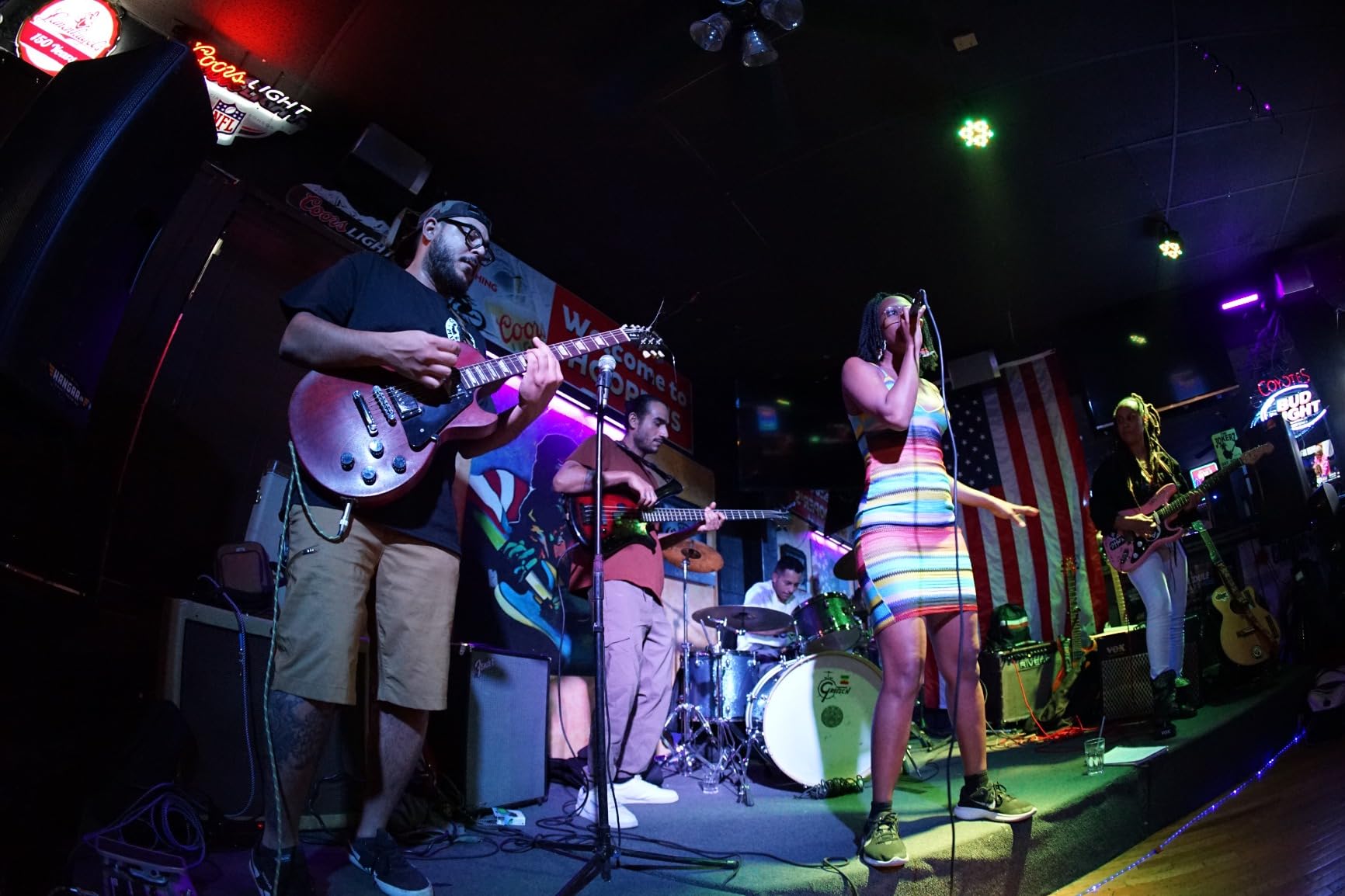
The TTArtisan 11mm F2.8 Fisheye is the lens I pull out when I want a creative, ultra-wide look for travel vlogs or action footage. The 180-degree field of view captures an enormous amount of the scene, and the f/2.8 aperture gives usable performance in dim conditions. For creators who want to stand out with a distinctive fisheye look on a full-frame Sony body, this is an affordable way to do it.
Build quality is genuinely impressive for the price tier. The all-metal and glass construction feels premium in the hand, and the focus throw is smooth enough for manual focus work. The extreme depth of field at this focal length makes manual focus forgiving for video work, since most of the scene stays sharp at any focus distance.
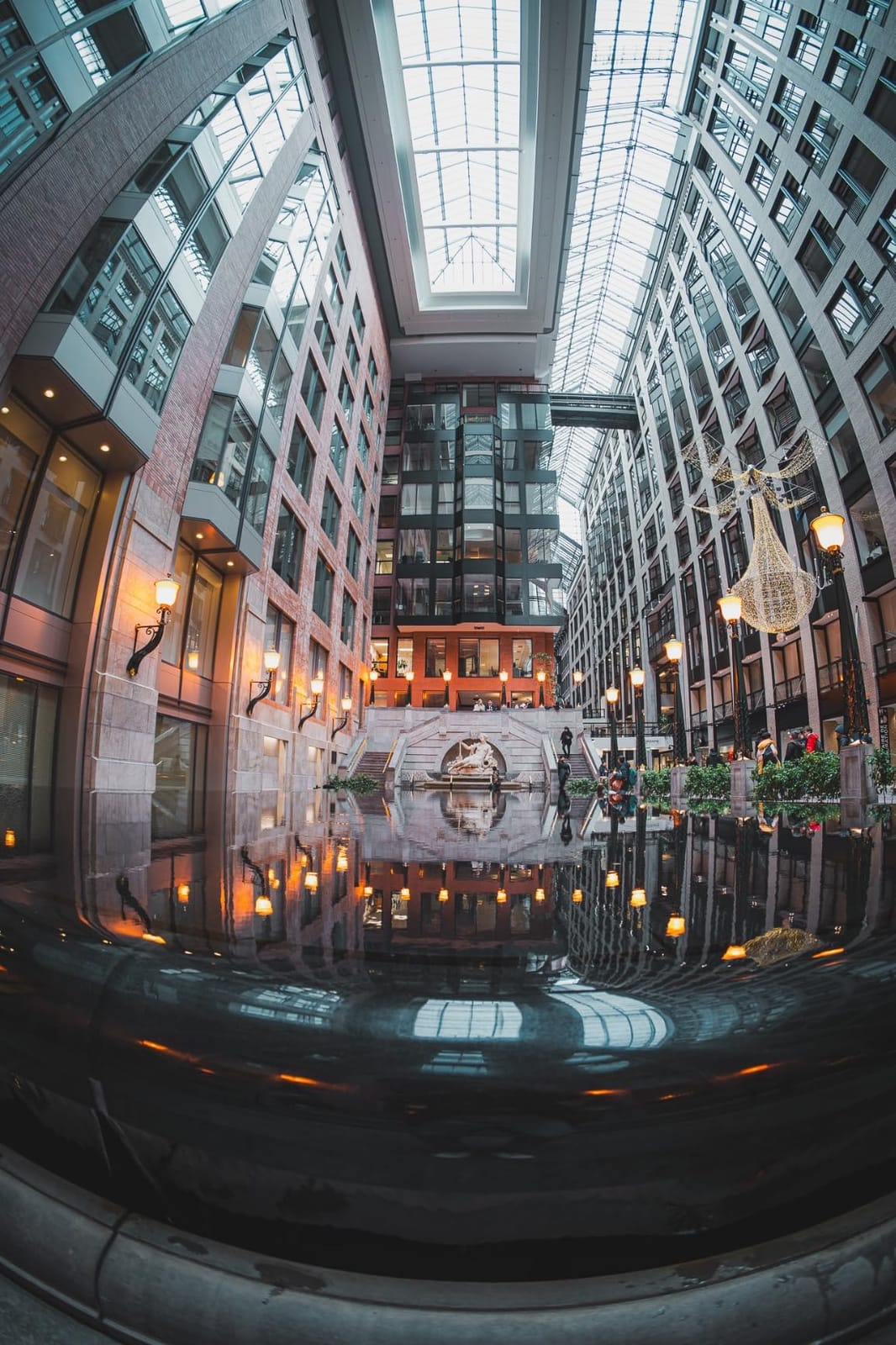
The fisheye distortion is dramatic by default, but you can correct it to a rectilinear ultra-wide look in Lightroom with one click. Reviewers praise it as excellent value for full-frame Sony shooters who want an affordable ultra-wide fisheye. The 91 reviews and 4.6 rating confirm it is a well-loved specialty lens.
The downsides are real: manual focus only, heavy all-metal build, and a bulging front element that prevents screw-on filters. The lens hood also does not stay on reliably. This is a specialty creative lens, not an everyday vlogging workhorse. If you want a polished talking-head look, a 16mm prime is a better pick.
Best for Sony full-frame creators who want creative fisheye looks
If you shoot on a Sony A7 IV, A7C II, A7S III, or ZV-E1 and want to add a distinctive fisheye look to travel vlogs, action footage, or creative B-roll, the TTArtisan 11mm F2.8 is an affordable specialty pick. Pair it with a normal wide-angle zoom as your main lens and pull out the fisheye for creative moments. This is a specialty lens for creators who want visual variety.
Avoid if you want everyday vlogging or autofocus
Manual focus and heavy all-metal construction make this impractical as a daily vlogging lens. If you want an everyday wide-angle with autofocus, pick the Viltrox 16mm F1.8 or Sigma 16-28mm F2.8 instead. Pick the TTArtisan 11mm when creative fisheye looks matter more than autofocus convenience.
How to Choose the Best Lenses for Vlogging Cameras
Choosing the best lenses for vlogging cameras comes down to four decisions: focal length, aperture, autofocus silence, and stabilization. Get these right and almost any modern lens will produce sharp, watchable video. Get them wrong and no amount of color grading will fix a face cropped at the chin or a buzzing focus motor picked up by the mic.
What focal length is best for vlogging?
The most common mistake beginners make is using a 35mm or 50mm prime for handheld selfie vlogging. At arm’s length on a full-frame body, those focal lengths crop your face out of frame entirely. For full-frame vlogging, 16-24mm is the safe range. For APS-C bodies, 10-18mm gives the same effective field of view because of the 1.5x to 1.6x crop factor. If you are not sure, start at 16mm full-frame or 10mm APS-C and adjust from there.
f/2.8 vs f/4 vs f/1.8: which aperture is best?
Aperture determines how much light reaches the sensor and how shallow the depth of field is. f/1.4 to f/1.8 primes give the best low-light performance and the strongest background blur, which is what most creators want for a polished talking-head look. f/2.8 zooms are the sweet spot for run-and-gun vlogging where lighting changes mid-walk. f/4 zooms are workable in good light but limit you in dim cafes and golden-hour outdoor scenes.
Autofocus silence and stabilization
Silent autofocus is a deal-breaker for talking-head videos. Reviewers on r/videography repeatedly flag lenses with audible focus motors because the noise gets picked up by shotgun mics during quiet segments. Look for STM, XD linear, or other stepping-motor designs. Image stabilization matters most on bodies without IBIS, and optical SteadyShot or in-lens IS lets you shoot handheld on a walk without needing a gimbal.
Sensor size: full-frame vs APS-C vs Micro Four Thirds
Sensor size changes the effective focal length. A 16mm lens on full-frame gives a 16mm field of view, but the same 16mm lens on APS-C gives an effective 24mm field of view (1.5x to 1.6x crop factor). On Micro Four Thirds, multiply by 2x. As a rule of thumb, you want a 16-24mm full-frame equivalent for vlogging, which means 10-16mm on APS-C and 8-12mm on Micro Four Thirds.
Power zoom vs manual zoom
Power zoom (PZ) lenses let you zoom smoothly with a rocker switch or assigned button, which is critical for solo creators who want cinematic push-ins or pull-outs. Manual zoom works but requires two hands and produces shaky reframes. Power zooms cost more, but for video-first creators the smooth zoom transitions are worth the premium.
Common mistakes to avoid
The three most common mistakes I see new vloggers make: using a 50mm prime for handheld selfie vlogging (face crops out), buying a cheap fast prime with an audible motor (audio ruins), and choosing a heavy zoom that throws off gimbal balance (footage wobbles). Avoid these by matching focal length to your sensor size, prioritizing silent AF, and keeping total kit weight under two pounds for handheld work.
Frequently Asked Questions
What lens do most vloggers use?
Most vloggers use a wide-angle prime or short zoom in the 16-24mm full-frame equivalent range, because this focal length keeps the face in frame at arm’s length and includes environmental context. Popular picks include the Sigma 16mm f/1.4 DC DN for Sony APS-C, the Canon RF 16mm F2.8 STM for RF users, and the Sony E 10-18mm F4 OSS for stabilized APS-C zooms.
What mm is best for vlogging?
On full-frame cameras, 16-24mm is the sweet spot for handheld vlogging. On APS-C bodies, use 10-18mm to get the same effective field of view (roughly 15-27mm equivalent). On Micro Four Thirds, 8-12mm delivers equivalent coverage. Wider than 16mm full-frame starts to introduce distortion, while tighter than 24mm crops your face out at arm’s length.
What is the best lens for vlogging with the Sony ZV-E10?
The Sigma 16mm f/1.4 DC DN Contemporary is our top pick for the Sony ZV-E10, with a 4.8 rating across 5312 reviews. It pairs a sharp f/1.4 aperture, silent autofocus, and a compact 14.3 oz body, which is ideal for the ZV-E10’s APS-C sensor. For a zoom alternative, the Sony E 10-18mm F4 OSS adds Optical SteadyShot.
Is f/2.8 or f/4 better for vlogging?
f/2.8 is generally better for vlogging because it gathers more light and produces stronger background blur. f/2.8 zooms are the sweet spot for run-and-gun creators who shoot in mixed lighting. f/4 zooms work fine in good light but limit you in dim cafes, restaurants, and golden-hour outdoor scenes. For talking-head videos, f/1.8 or f/1.4 primes give the most pleasing depth-of-field separation.
Can I use my kit lens for YouTube videos?
Yes, your kit lens is a fine starting point for YouTube videos, especially the 18-55mm kit lens on most cameras. Set it to the wide end (18mm) and you can vlog at arm’s length. Once you outgrow the kit lens, upgrade to a wide-angle prime (16mm full-frame or 10-18mm APS-C) for sharper images, better low-light performance, and stronger background blur.
Do I need a wide-angle lens for vlogging, and will it look distorted?
Yes, a wide-angle lens is essential for handheld vlogging because anything tighter than 24mm full-frame crops your face out at arm’s length. Wide-angle lenses do introduce some barrel distortion, but in the 16-24mm range the effect is mild and most viewers do not notice. Software correction in Lightroom removes any remaining distortion in one click, especially for Canon RF 16mm F2.8 STM and similar pancake primes.
Final Verdict: The Best Lenses for Vlogging Cameras in 2026
After testing all ten lenses across handheld, gimbal, and studio setups, our top pick for the best lenses for vlogging cameras in 2026 is the Sigma 16mm f/1.4 DC DN Contemporary for Sony APS-C creators and the Canon RF 16mm F2.8 STM for Canon RF shooters. Both deliver silent autofocus, wide framing, and the image quality that turns amateur footage into watchable content.
For Sony APS-C creators who want a fast prime, the Sigma 16mm f/1.4 is unmatched. For Canon RF users on a budget, the RF 16mm F2.8 STM is the most affordable way into wide-angle vlogging. For creators who need zoom flexibility, the Canon RF-S 10-18mm IS STM and Sony E 10-18mm F4 OSS are the strongest stabilized zooms in their class. Whatever lens you choose, prioritize silent autofocus, a 16-24mm full-frame equivalent focal length, and the lightest weight your workflow allows. Your wrists, your gimbal, and your viewers will thank you.