
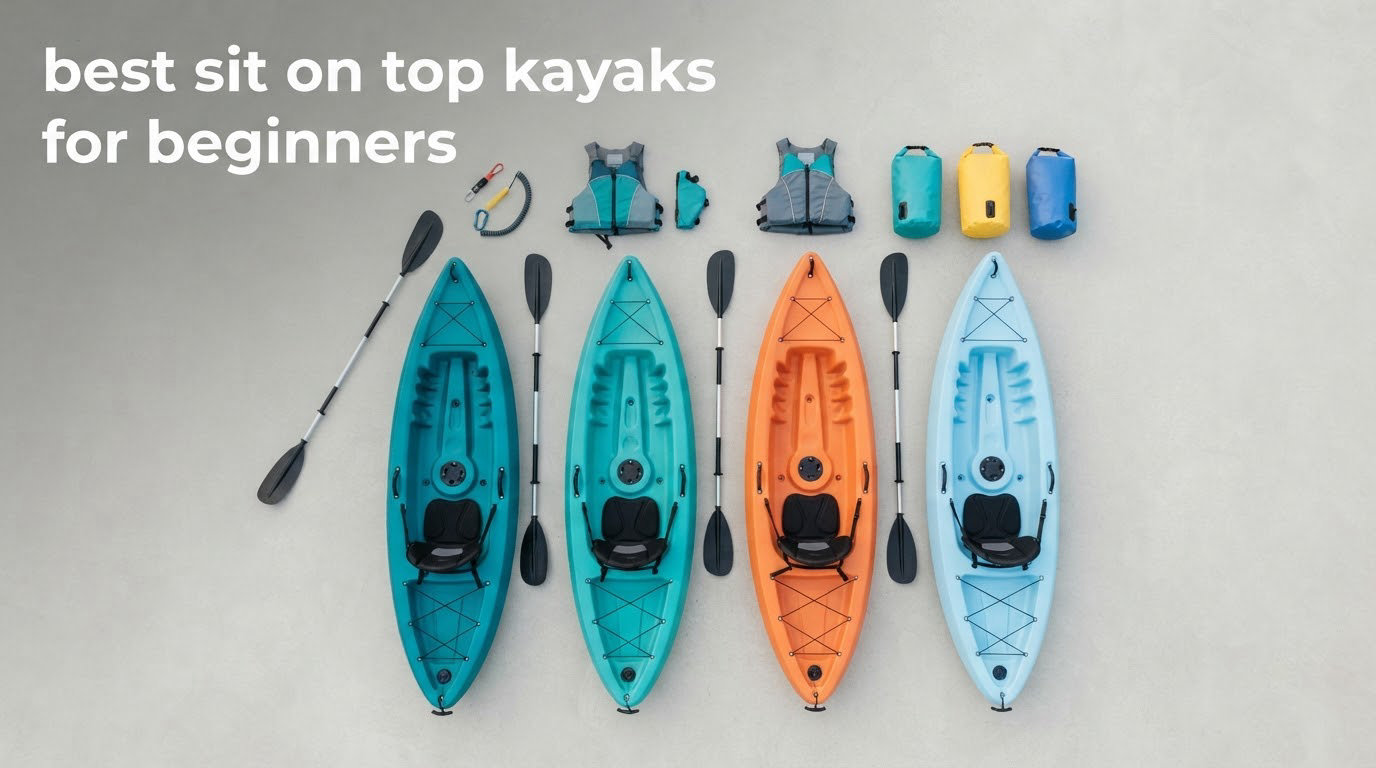
The best sit-on-top kayaks for beginners is the Lifetime Tamarack Angler 100, because it pairs a wide flat-bottomed polyethylene hull with a 275 lb capacity, includes the paddle in the box, and stays light enough for one person to load onto a roof rack without planning the whole afternoon around it. Our team compared ten sit-on-top kayaks on beam width, hull weight, seating, storage and owner review history to find the boat that makes a first season enjoyable instead of discouraging.
I want to be straight with you about how this list was built. We read every published spec for these ten boats, weighed the manufacturer numbers against the complaints and praise in thousands of owner reviews, and compared how each hull behaves in the conditions a beginner actually paddles. We did not put in a full season on every one of them, and we say so wherever a spec needs a qualification. No brand paid for a spot on this list, and the award labels follow directly from the numbers on the page.
Here is what we look for when we sort a first sit-on-top kayak, and it is the same short list we would hand a friend at the ramp:
Beam of 30 inches or more. Width is the single biggest contributor to primary stability, which is the stability you feel when you lean over or a stroke goes slightly wrong.
An open deck and a swim deck you can climb over. Getting back aboard after a capsize should take seconds, not a lesson.
A padded or framed seat that adjusts. The thin molded plastic saddles that come on cheap boats are the number one reason beginners quit in month two.
A hull you can lift alone. Heavy hulls over about 55 lb need a second pair of hands, which is where a lot of first boats end up parked in a garage forever.
Capacity with 20 percent of headroom. Stay under 80 percent of the stated limit once you add a paddle, a life vest and a cooler.
One more thing worth knowing before you scroll: a paddle is not part of most of these purchases, and a personal flotation device never is. We break down what your real first-season outlay looks like further down.
Table of Contents
- Top 3 Picks for the Best Sit-on-Top Kayaks for Beginners (October 2026)
- All 10 Beginner Sit-on-Top Kayaks Compared at a Glance in 2026
- 1. Lifetime Tamarack Angler 100: the best sit-on-top kayak for beginners overall
- 2. Pelican Sentinel 100X: the best value for a beginner who carries their own boat
- 3. Perception Tribe 9.5: the best sit-on-top kayak for beginners who want a real seat
- 4. Lifetime Lotus: the best budget sit-on-top kayak for a beginner
- 5. Lifetime Tamarack Pro 103: the best sit-on-top kayak for beginner fishing
- 6. Pelican Catch Classic Angler: the most stable sit-on-top kayak here
- 7. Perception Tribe 11.5: the best sit-on-top kayak for two people or longer days
- 8. Perception Zip 9.5: the best sit-on-top kayak for a beginner at any skill level
- 9. Pelican Sentinel 80X: the best sit-on-top kayak for smaller paddlers
- 10. Emotion Spitfire 8: the best sit-on-top kayak for tight storage
- What Is the 120 Rule? Sizing Your First Kayak
- How to Choose a Sit-on-Top Kayak as a Beginner
- Beam Width and Hull Shape Are What Keep You Upright
- Hull Weight Decides Whether You Can Launch Solo
- Seat Comfort and Weight Capacity Are the Same Decision
- Storage, Rigging and What Comes in the Box
- Safety Gear Is Part of the First Purchase, Not an Extra
- Match the Boat to the Water You Will Actually Paddle
- Sit-on-Top vs Sit-Inside: What Beginners Should Know
- Frequently Asked Questions
- Which Beginner Sit-on-Top Kayak Should You Buy?
Top 3 Picks for the Best Sit-on-Top Kayaks for Beginners (October 2026)

Lifetime Tamarack Angler 100
- 120 inch by 31 inch hull
- 275 lb capacity
- Paddle included
- 51 lb
As an Amazon Associate we earn from qualifying purchases. CERTAIN CONTENT THAT APPEARS ON THIS SITE COMES FROM AMAZON. THIS CONTENT IS PROVIDED 'AS IS' AND IS SUBJECT TO CHANGE OR REMOVAL AT ANY TIME.
Those three cover the three ways first boats usually go wrong. The Tamarack Angler 100 solves the gear gap, the Sentinel 100X solves the solo-carry problem, and the Tribe 9.5 solves the seat comfort problem that ends most beginner ownership.
All 10 Beginner Sit-on-Top Kayaks Compared at a Glance in 2026
| Product | Specifications | Action |
|---|---|---|
|
Lifetime Tamarack Angler 100
|
|
Check Latest Price |
 Pelican Sentinel 100X
|
|
Check Latest Price |
 Perception Tribe 9.5
|
|
Check Latest Price |
 Lifetime Lotus
|
|
Check Latest Price |
 Lifetime Tamarack Pro 103
|
|
Check Latest Price |
 Pelican Catch Classic Angler
|
|
Check Latest Price |
 Perception Tribe 11.5
|
|
Check Latest Price |
 Perception Zip 9.5
|
|
Check Latest Price |
 Pelican Sentinel 80X
|
|
Check Latest Price |
 Emotion Spitfire
|
|
Check Latest Price |
We earn from qualifying purchases. CERTAIN CONTENT THAT APPEARS ON THIS SITE COMES FROM AMAZON. THIS CONTENT IS PROVIDED 'AS IS' AND IS SUBJECT TO CHANGE OR REMOVAL AT ANY TIME.
One thing deserves attention before anything else. Owner review counts range from 33 to more than 1300, and a 4.7 average built on 33 reviews tells you much less than a 4.4 average built on the same number. Where a rating is thin, we lean on the published spec sheet and on the pattern of what owners actually complain about.
1. Lifetime Tamarack Angler 100: the best sit-on-top kayak for beginners overall
Lifetime Muskie Angler Sit-On-Top Kayak with Paddle, Tan, 120″
- 120 in L x 31 in W, 51 lb hull, 275 lb capacity, paddle included
Pros
- Very stable flat bottom that holds up in choppy water
- Light enough at 51 lb for one person to load onto a car roof
- Flush-mounted rod holder works well
- Durable HDPE hull takes bumps and dog claws
- Paddle included in the box
Cons
- Seat connector clips bent out of their slot under back weight
- Included paddle is short and flimsy
- Tracks loosely and tends to veer when you stop
- Storage compartments need cup inserts that are not included
The Lifetime Tamarack Angler 100 is the boat I keep coming back to because it answers the beginner’s real question, which is not how fast it goes but whether you will still want to take it out in October. It measures 120 inches long by 31 inches wide, carries a stated 275 lb capacity, and weighs 51 lb in the hull. That is a boat you can lift onto a roof rack alone, and it is one of only two boats in this group that hand you a paddle as well.
With 1343 owner reviews averaging 4.4 stars, it also has the largest evidence base of any boat here, which matters more than the average itself. When a spec is disputed in the reviews, 1300-plus owners is a much better referee than 30.
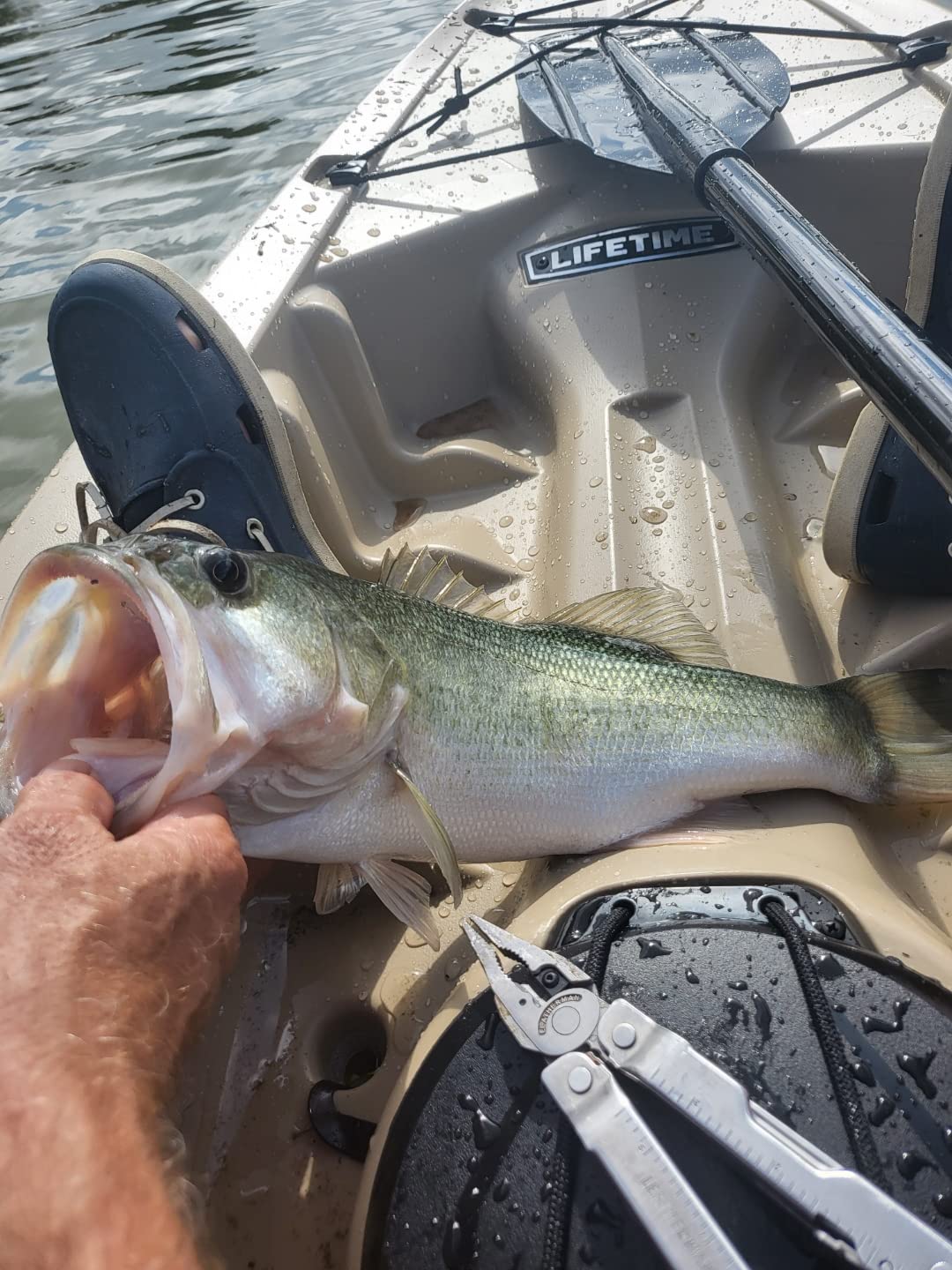
Technically it is a UV-protected high-density polyethylene boat with a deliberately flat bottom, multiple footrest positions, an adjustable padded seat back and seat pad, and a sharp bow for speed and tracking. There is a skeg for straight-line travel, deep tracking channels down the hull, and two 6-inch storage compartments in the rear and centre. Two flush-mounted rod holders and one top-mount holder come as standard, and front and rear T-handles make the solo carry more manageable than the weight alone suggests.
The honest complaints are worth hearing before you buy. Owners report the molded plastic seat connector clips bending out of their slot under body weight, which is exactly the failure mode that makes a cheap seat the first thing you replace. The included paddle draws repeated criticism as short and flimsy, and the tracking is loose enough that the boat veers when you stop paddling. The storage compartments need cup inserts that are not in the box, and a few buyers found plastic chips in the hull from manufacturing.

Why this hull keeps beginners upright
The flat bottom is doing the heavy lifting for primary stability, and 31 inches of beam is wide enough that shifting your weight to reach for a drink does not start a lean. Owners single out how well it holds in choppy water for a boat in this category, which is the property that keeps a first-season paddler willing to go out when the lake has a little texture on it. The skeg and deep channels recover tracking once you find your rhythm, so the veering complaint is a first-week problem more than a permanent one.
The two 6-inch compartments are genuinely useful rather than decorative, and once you fit cup inserts they handle a water bottle, a small tackle box and a sandwich without any deck rigging. The paddle keeper on shock cords means the paddle is not sliding off the deck every time you lean, which sounds trivial until you have spent an hour fishing without a paddle holder.
Who should look past this boat
Skip it if the flimsy stock paddle is not a problem for you, because you will replace it within a season anyway, and skip it if loose tracking bothers you more than a small amount of extra effort. If you are a larger paddler, the 275 lb ceiling is workable but the 300 lb boats on this list give you more headroom, and if you are under about 5 ft tall you may find 31 inches of beam feels unnecessarily wide.
There is also a fulfilment pattern worth knowing: 75 percent of reviews are five-star and 7 percent are one-star, and the one-star group is almost entirely about scratch-and-dent deliveries and replacement handling rather than the boat. That is a service problem, not a hull problem, but it is still your problem on the day the box shows up dented.
2. Pelican Sentinel 100X: the best value for a beginner who carries their own boat
Pelican Sentinel 100X – Angler Sit on top Fishing Kayak – Forest Mist – Lightweight – Ergolounge™ Seating System – 10 ft, Sentinel 100X Angler Fishing Kayak
- 114 in L x 30 in W, 44.6 lb hull, 275 lb capacity, Ergolounge seat
Pros
- One of the lighter 10-foot angler kayaks at under 45 lb
- Molded-in side carrying handles
- Ergolounge seat gives high wide back support
- Removable ExoPak storage simplifies packing
- Four rod holders cover most setups
Cons
- No paddle included in the package
- Beam is slightly narrower than some competing angler kayaks
The Pelican Sentinel 100X is the best value sit-on-top kayak for a beginner, and the reason is arithmetic rather than adjectives. It is 9 ft 6 in long, 30 inches wide, rated to 275 lb, and the hull weighs 44.6 lb. Among ten-foot angler boats in this group that is a genuinely light load, and it is the difference between a solo launch and needing to find someone to help you at the ramp.
With 528 reviews at 4.4 stars, it has the second-deepest owner base here, and the praise is unusually consistent. Buyers point at the Ergolounge seating system with its extra-thick cushioning and extra high, wide padded backrest, at the ExoPak removable storage compartment that you pack at home and drop in at the water, and at the molded-in side carrying handles.
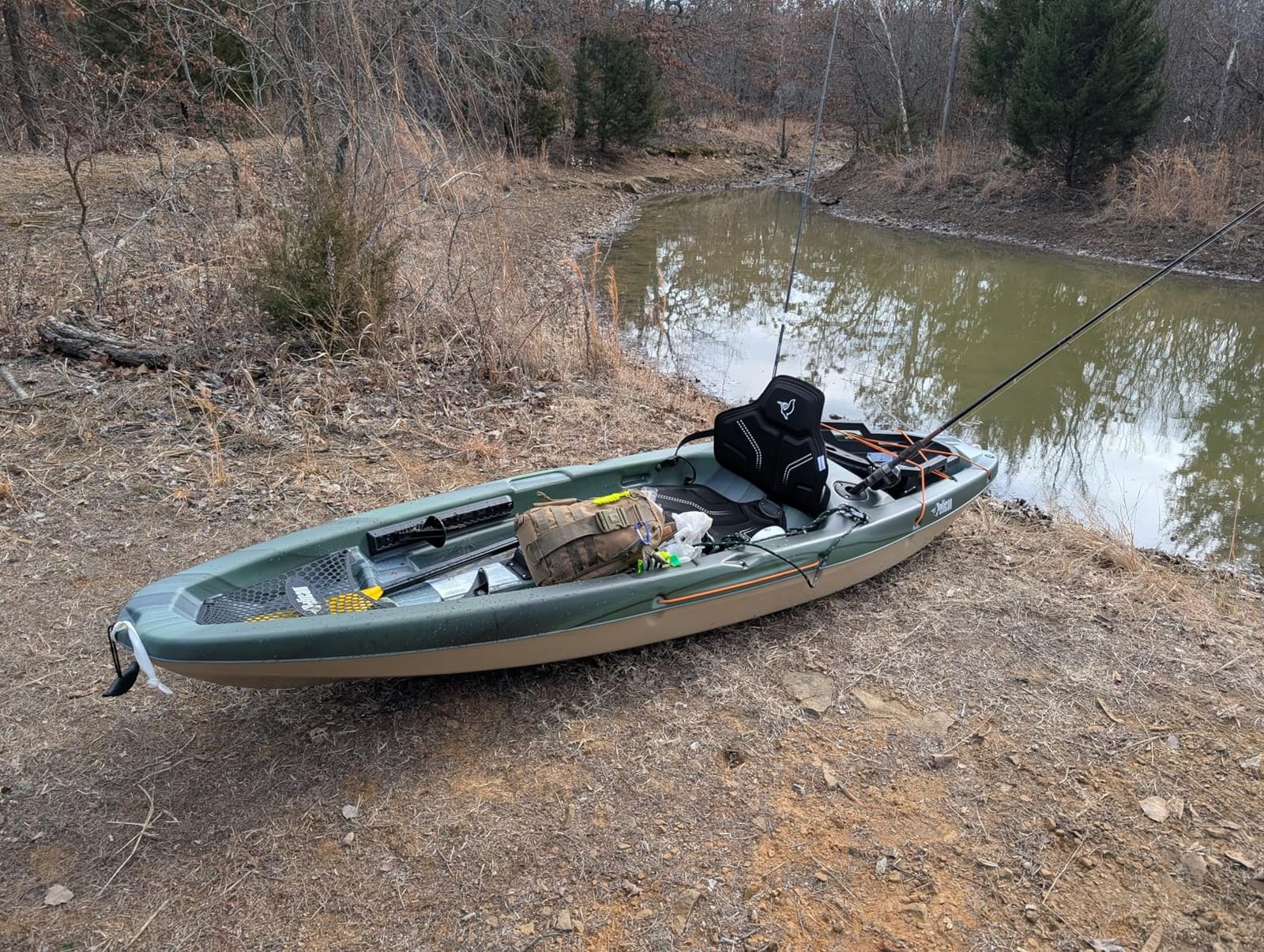
There are four rod holders in total, two flush-mounted and two vertical in the ExoPak, which covers nearly every freshwater fishing setup without drilling a single hole. The polyethylene construction and a lifetime limited warranty against manufacturer defects add a durability layer that matters if you plan to drag the boat across gravel ramps regularly. Owners also note that despite the ten-foot length it fits in a garage or a small vehicle when you need it to.
Two complaints come up repeatedly and neither is subtle. The first is that no paddle is included, which is the single most common surprise in this whole category. The second is that the 30-inch beam is a little narrower than some competing angler kayaks, so if you have a history of feeling twitchy in wider boats, test this one before you commit.
What 44.6 lb actually changes about your season
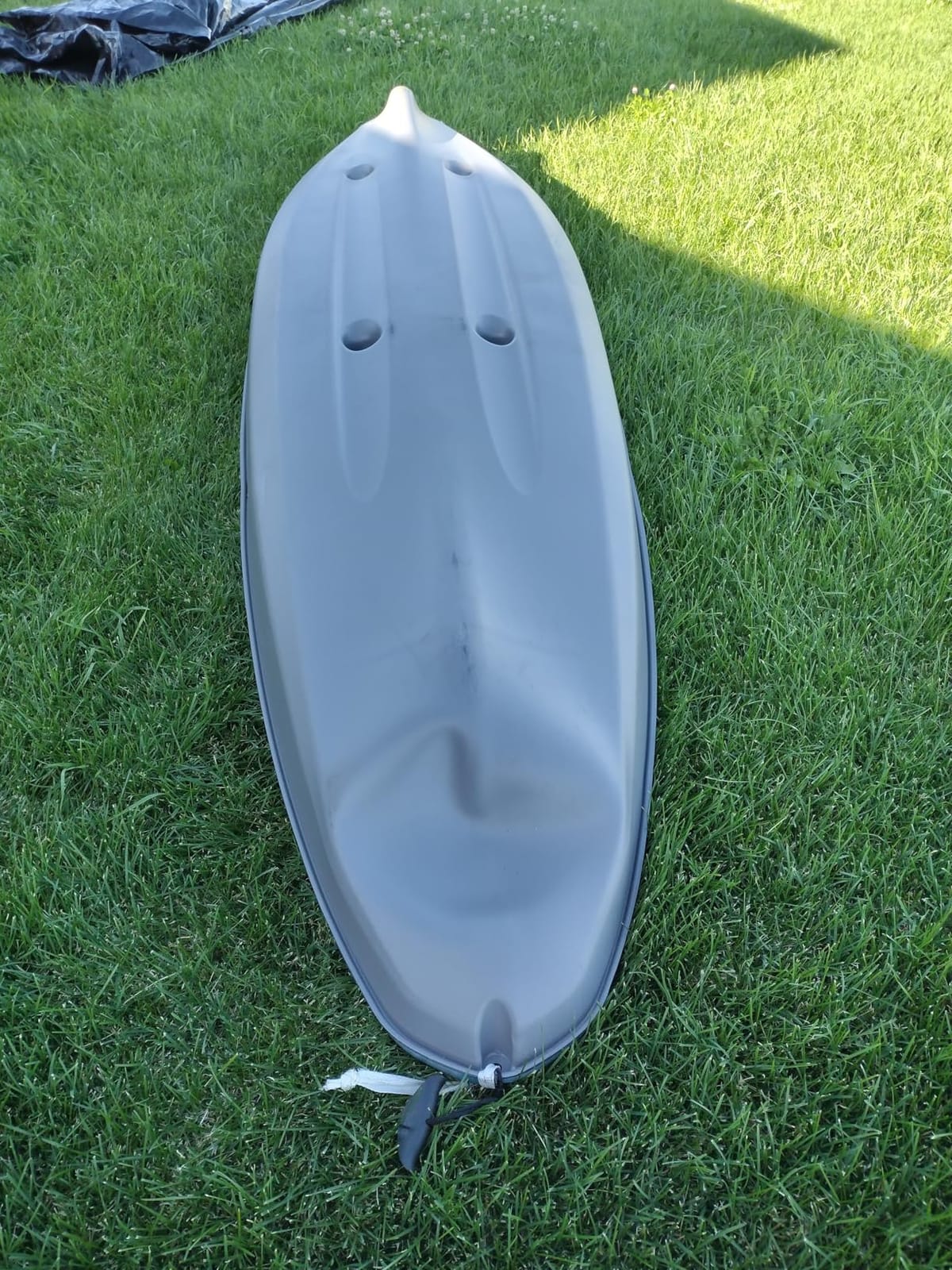
Weight is the spec beginners most underestimate, because it is the one that decides whether you paddle twice a season or twenty. At 44.6 lb with side handles moulded into the hull, one person can lift this boat into a bed rack, walk it across a car park and lower it down a shallow launch without improvising. Reviewers consistently describe the seat as the standout for long sessions rather than for short ones.
The 74 percent five-star share and 5 percent one-star share put it among the most consistently liked boats in this group. The ExoPak is the detail that wins repeat mentions, because a removable gear tub breaks the boat down into two manageable pieces at the car and a full kit at the water.
Who should look past this boat
Move on if you want a boat you can buy and paddle the same afternoon with nothing else to buy, since the paddle is a separate purchase. Move on if you need a hull for a bigger paddler, because 275 lb is a moderate ceiling once you add gear, and consider the Perception Tribe 9.5 or the Catch Classic Angler instead.
This is also not the boat for a large angler in a hurry. It carries one person, one rod setup and a decent amount of gear, but if you are standing up to cast, the open casting deck and dual-position seat on the Catch Classic make more sense.
3. Perception Tribe 9.5: the best sit-on-top kayak for beginners who want a real seat
Perception Tribe 9.5 – Recerational Kayak Sit on Top – Large Rear Storage with Tie Downs – 9.5 ft – Déjà Vu
- 113 in L x 31.5 in W, 46 lb hull, 300 lb capacity, high-back frame seat
Pros
- High-back framed seat is comfortable and adjustable
- 300 lb capacity suits larger paddlers
- Easy to enter and exit from shallow water
- Self-bailing scupper holes drain quickly
- Bow and stern handles help with solo roof-rack loading
Cons
- Heavier in the hand than it looks and often needs two people
- High seatback raises the center of gravity
- Tiny built-in storage area that is not watertight
- Slower than sleeker hulls
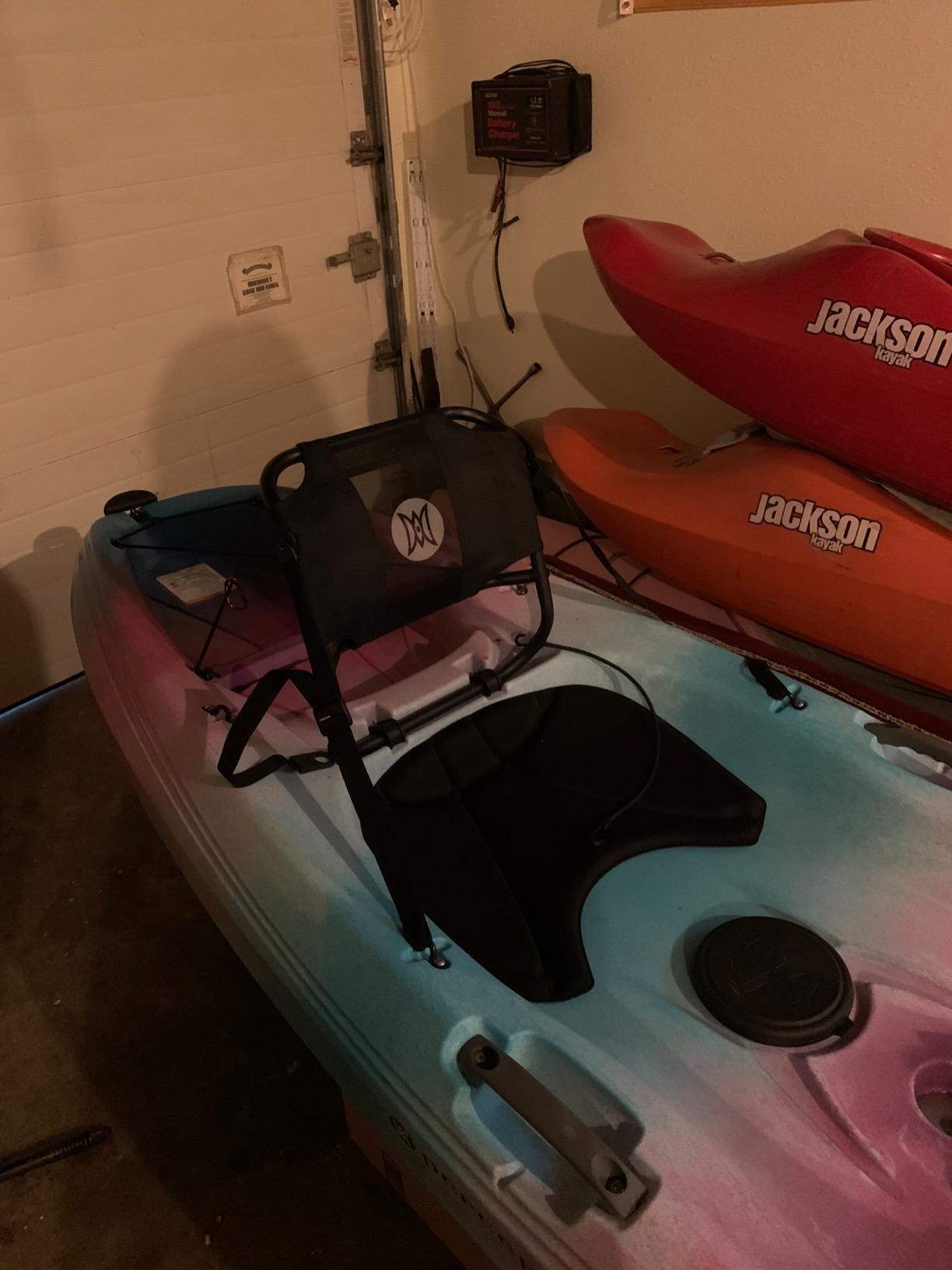
The Perception Tribe 9.5 is the best sit-on-top kayak for a beginner who plans to be out for more than an hour at a time. It is 113 inches long, 31.5 inches wide, rated to 300 lb, and weighs 46 lb. The high-back framed seat with adjustable recline positions is the reason, and it is the feature owners return to most in the 220 reviews that average 4.5 stars.
That 4.5 is the second-highest average in this group, though the review base is roughly a sixth the size of the Tamarack’s. On r/Kayaking, the Perception Tribe and the Pelican Sentinel classes are the two names that come up most often when first-kayak owners ask for a lake recommendation, and the Tribe is usually the one described as the more comfortable long sit.
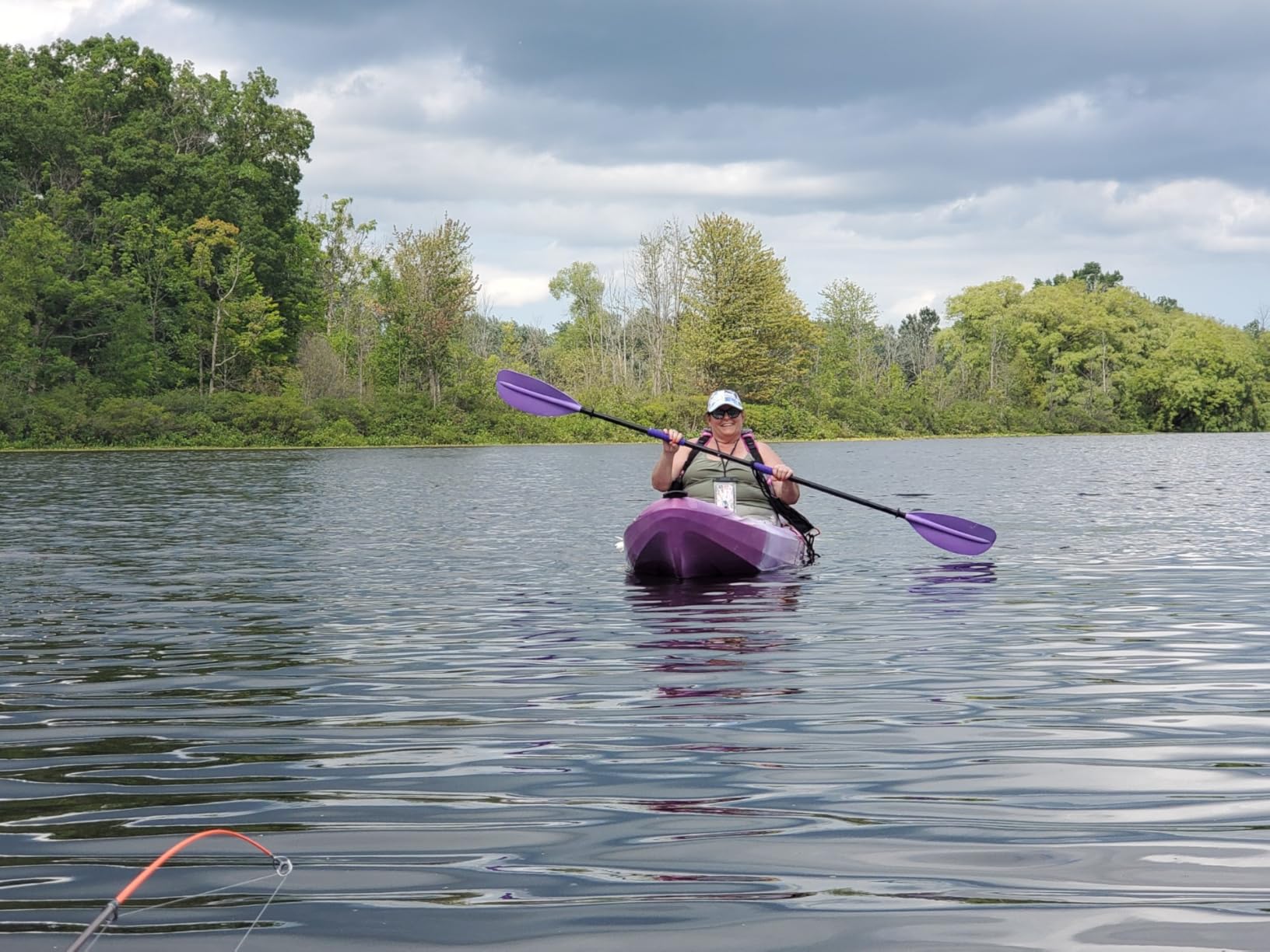
Mechanically it is a polyethylene sit-on-top with a high-back frame seatback, ample rear storage secured by durable tie-downs, and a lightweight stackable hull made in the USA. The 300 lb maximum capacity is one of the higher ratings in its class, and the 5-year limited warranty covers the hull and deck against material or manufacturing defects with 1 year on installed accessories. Owners like that it is easy to get in and out of from shallow water, which quietly matters enormously for anyone with knee issues.
The trade-offs are equally clear. The high seatback raises your center of gravity and makes this boat measurably less stable than a low-profile sit-on-top, which is a real cost for anyone whose balance is not what it was. The built-in dry storage area is tiny and not watertight, so dry bags are not optional, and a few owners report it being slower than sleeker hulls, which is expected from a boat built for stability over speed.
Why the seat decides this boat
Comfort is the difference between a boat you use twice and a boat you keep for a decade, and the framed seat here has real adjustment and real foot support. At 300 lb capacity it also fits a wider range of body sizes than most of the 250 and 275 lb boats in this roundup, which means you are not shrinking your gear pile to fit the boat.
Self-bailing scupper holes drain the cockpit quickly, so a rain shower or a wake from a passing boat does not leave you sitting in a puddle for the rest of the trip. Seventy-six percent of its reviews are five-star, and the recurring minor notes are the awkward solo carry and the tall seat reducing stability.
Who should look past this boat
Skip it if your priority is maximum primary stability, because a high-back framed seat and a 300 lb capacity are a package deal. Consider the Pelican Sentinel 100X instead, whose lower-profile seat and 44.6 lb hull suit a nervous beginner better.
Also weigh the fact that most owners need two people to launch it. That is manageable if you paddle socially and impossible if you paddle alone, and a small number of one-star reviews concern delivery damage and a cracked hull that let the stern fill, so inspect the hull carefully on arrival.
4. Lifetime Lotus: the best budget sit-on-top kayak for a beginner
Lifetime Lotus Sit-on-Top Kayak with Paddle, Blue, 8′
- 96 in L x 30 in W, 39 lb hull, 250 lb capacity, paddle and backrest included
Pros
- Short 8-foot footprint that is easy to store and carry solo
- Ultra-stable hull that beginners find forgiving
- Paddle and adjustable backrest included in the box
- Three sets of carry handles make solo launching straightforward
- Self-bailing scupper holes keep the cockpit from filling
Cons
- Small cockpit and 250 lb capacity limit it to lighter paddlers
- Backrest is basic rather than supportive over long sessions
The Lifetime Lotus is the best budget sit-on-top kayak for a beginner, and it wins on a simple package: an 8-foot hull at 39 lb that comes with a paddle and a hard adjustable backrest already in the box. That combination removes two hidden outlays at once, and for a first purchase it is hard to argue with.
It measures 96 inches long by 30 inches wide with a 250 lb weight capacity, and it carries a 5-year limited warranty. The 198 owner reviews average 4.3 stars, which is the lower half of this group but entirely consistent with what the boat is: a simple, stable first kayak for casual paddling on small lakes.
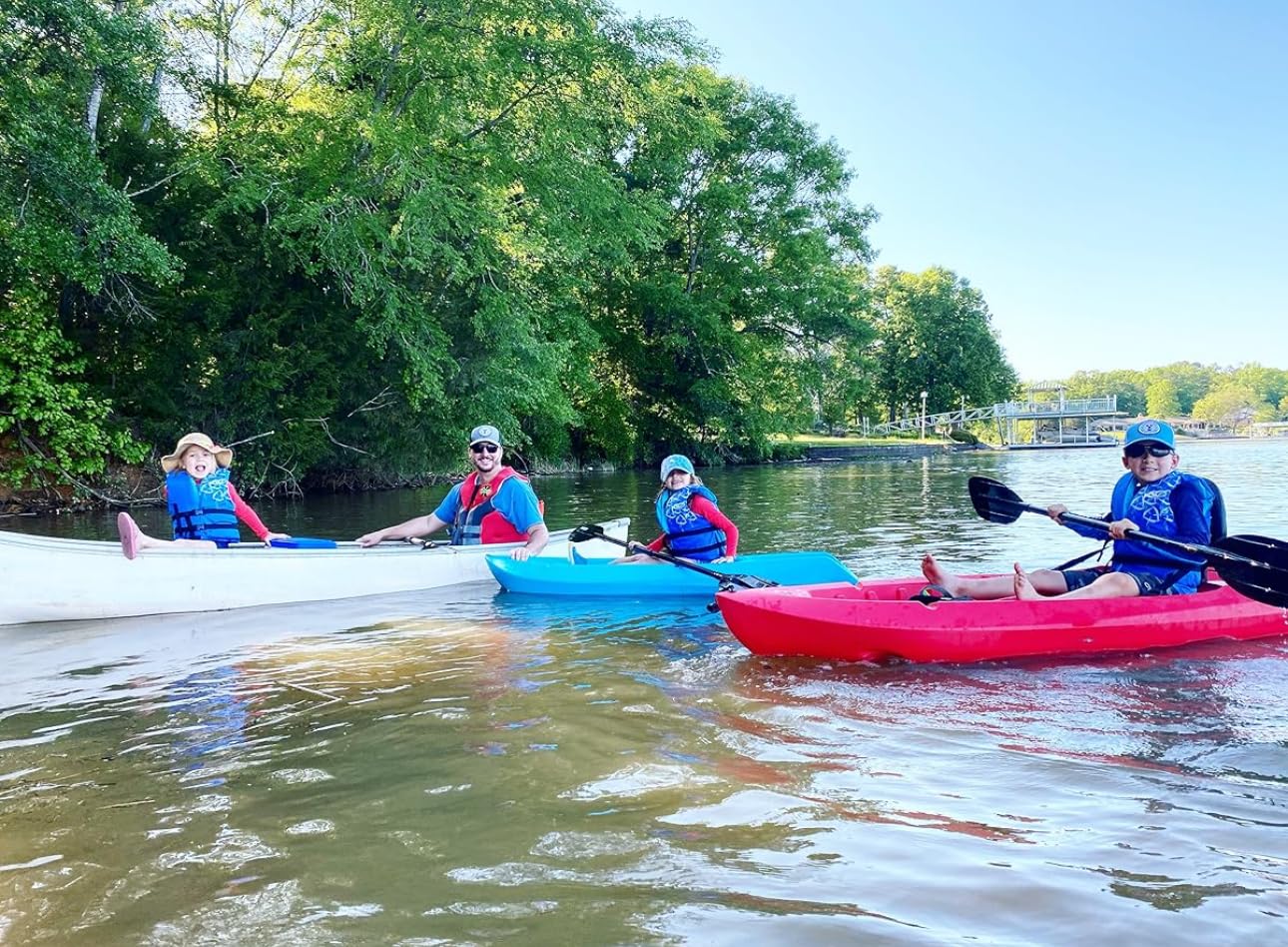
Construction is UV-protected HDPE with an ultra-stable hull designed for smooth tracking and easy maneuverability. There are front and rear and center carry handles, multiple footrest positions, an adjustable quick-release seat back, and self-bailing scupper holes that drain the cockpit and tank well. A double-sided Lite Elite paddle comes with the kayak, and the model is also produced as a two-pack if you and a partner are starting together.
The limitations are structural rather than quality issues. The cockpit is small and the 250 lb capacity is at the lower end here, which together limit it to lighter paddlers and shorter trips. The backrest is adjustable but basic, and it is not the seat you want for a six-hour day on the water. A 9 percent one-star share reflects assembly, seat comfort and damage-on-arrival experiences more than anything about handling.

Why an 8-foot boat still makes sense for a first purchase
Short boats get dismissed, but at 39 lb with three carry handle positions this one answers the question a lot of first owners actually have, which is whether they can get the boat to the water by themselves. It is also one of the easiest of the ten to store upright against a wall or in a small garage corner. The ultra-stable hull is the other quiet asset, because a forgiving boat shortens the learning curve more than any feature list can.
Self-bailing scuppers matter more in an 8-foot boat than in a 12-foot one, because the smaller cockpit drains faster and stays drier. For someone paddling a sheltered pond on a warm afternoon, none of the compromises in this boat are things you will ever notice.
Who should look past this boat
Pass if you are a larger paddler, if you want to bring a dog, or if your plan involves anything longer than a couple of hours, because the small cockpit and 250 lb ceiling rule all three out. The 275 and 300 lb boats ask little more of you and give you real headroom.
Pass if you want a boat you can grow into. Because it is 8 feet long, tracking is adequate rather than crisp, and paddlers who quickly want straighter lines on longer reaches usually step up to a 9.5 or 10-foot hull within a season.
5. Lifetime Tamarack Pro 103: the best sit-on-top kayak for beginner fishing
Lifetime Tamarack Pro 103 Sit-On-Top Kayak, Lightning Fusion, 10 ft. 3 in.
- 123 in L x 31 in W, 57.5 lb hull, 300 lb capacity, adjustable framed seat
Pros
- Most fishing-ready out of the box with rod holders and tackle storage
- Chine rails and deep hull channels give good tracking and secondary stability
- Adjustable framed seat and footrests fit a wide range of sizes
- Center hatch with bucket is larger than on the base Tamarack models
Cons
- Heaviest of the Lifetime models here at 57.5 lb so solo transport takes planning
- 10 ft 3 in length means it will not fit inside most small cars
The Lifetime Tamarack Pro 103 is the best sit-on-top kayak for beginner fishing, because it arrives with the rigging already installed rather than as a list of holes. You get one adjustable and two flush-mounted rod holders, accessory mounting points, tackle box storage and an onboard ruler, which is the kind of detail anglers ask for and cheap boats never include.
At 123 inches long by 31 inches wide, it carries a 300 lb capacity on a 57.5 lb hull. The 136 owner reviews average 4.4 stars, and the consensus is that this is the most accessorized boat among the Lifetime models in this roundup.
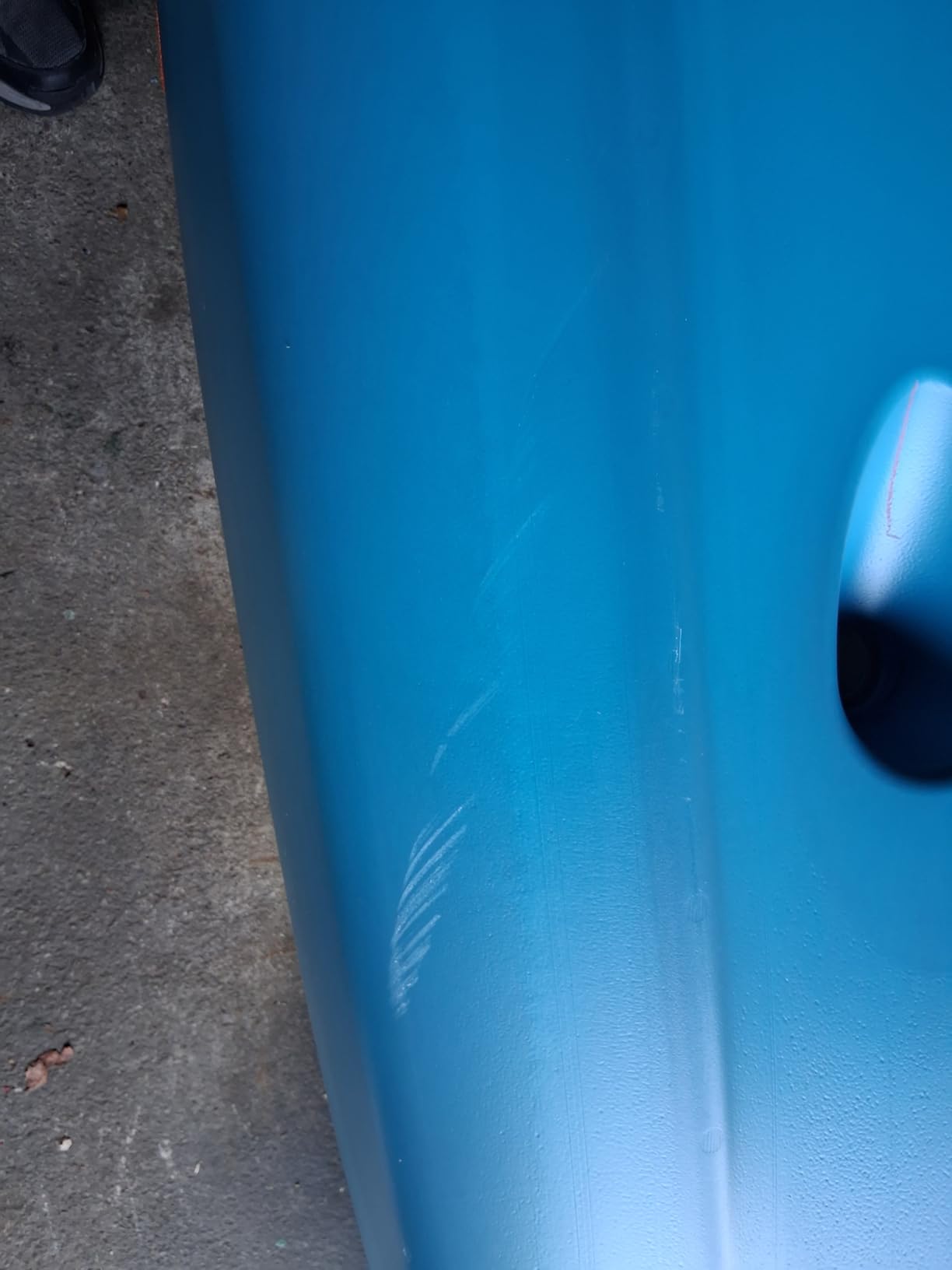
The hull is where the design earns its keep. Deep hull channels give you tracking and chine rails add lateral stability, which is the combination you want when you are standing up or leaning over a side to cast. The adjustable framed seat and adjustable footrests let you dial in a fit for a wide range of paddler sizes, and the center storage hatch with bucket is larger than on the base Tamarack models, with a deeper tank well behind it. Front and rear bungee cords plus a paddle keeper complete the deck.
Both drawbacks are about transport and nothing else. At 57.5 lb this is the heaviest of the Lifetime models in this roundup, and solo roof-rack loading takes planning or a second pair of hands. At 10 ft 3 in it will not fit inside most small cars, so a rack is effectively part of the purchase. Nine percent one-star reviews reflect the general Lifetime fulfilment friction rather than a problem with the boat.
Why chine rails matter for an angler
Primary stability keeps you upright when you move suddenly. Secondary stability, which is what chine rails and deep channels provide, is what keeps you upright when you lean over to work a fish or reach for a landing net. Beginners assume they only need the first kind, and then they stand up in a flat-bottomed boat and find out otherwise.
The tackle box storage and the onboard ruler are small features that tell you what the boat was designed around. A center hatch that swallows a five-gallon bucket and a tank well that holds a crate is the difference between fishing all day and cutting the trip short to go home for a bigger bag.
Who should look past this boat
Pass if you paddle solo and far from a vehicle, because 57.5 lb across a car park is a bad first impression of a hobby. The Pelican Sentinel 100X does the same job at 44.6 lb. Pass if you plan to keep the boat inside a hatchback.
Pass if you have no interest in fishing. You would be buying rod holders, a ruler and a bucket you will never use, and the plainer Perception Tribe 9.5 gives you a better seat without any of the fishing rig.
6. Pelican Catch Classic Angler: the most stable sit-on-top kayak here
Pelican Catch Classic 100 Angler – Sit-on-Top Fishing Kayak – Ergocast Dual Position Seating System – 10 ft – Outback
- 120 in L x 34 in W, 57 lb hull, 350 lb capacity, tunnel hull
Pros
- Tunnel hull and wide 34-inch beam make it exceptionally stable
- Very easy to enter and exit which suits limited mobility
- 350 lb capacity is tied for the highest rating in this group
- Rigging tracks and accessory eyelets allow adding gear without drilling
- Dual-position seat switches between high and low support
Cons
- Among the heaviest boats here at 57 lb so it needs two people or a cart
- Paddle is not included
- Has a 12 percent one-star share which is the highest in this group
The Pelican Catch Classic Angler is the most stable beginner sit-on-top kayak in this roundup, and the stability comes from two numbers. The tunnel hull and a 34-inch beam give it the widest platform in the set, and at 120 inches long it still has the length to hold a line rather than simply pivot.
It is rated to 350 lb, which is the joint-highest capacity among these ten boats, and the 132 owner reviews average 4.2 stars. That is the joint-lowest average in the group, so read it properly: the boat performs well, and the dissatisfaction is concentrated in delivery damage and surface finish rather than in handling.
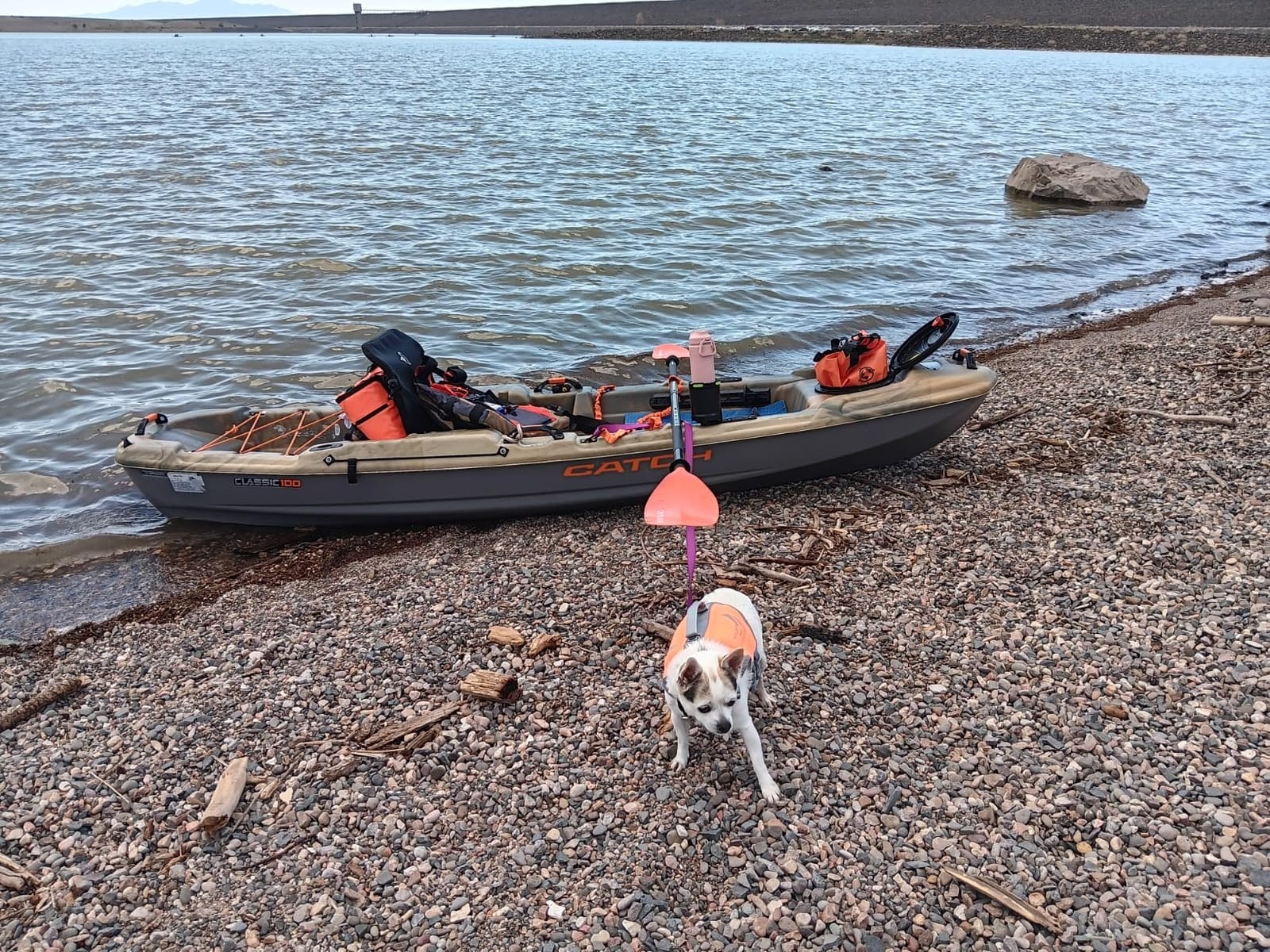
The ergonomics are what make it a genuinely beginner-friendly design. The tunnel hull allows easy entry and exit, and there is clear deck space for standing casts. The Ergocast Classic seat is dual-position, adjustable to high or low support, so you can sit low for stability on the water and raise up to cast. A front quick-lock hatch sits ahead of the seat with a rear tank well and bungee cords behind it, and there are two flush-mount rod holders, two accessory eyelets, two four-inch rigging tracks and paddle tie-downs, plus adjustable footrests and a bottle holder.
Additional internal flotation takes it to meet or exceed ABYC standards, which is a real safety upgrade in a boat with this much open deck. It is made from high molecular weight polyethylene and carries a lifetime limited warranty against manufacturer defects. The Catch Classic is also produced in a 120-length version in Lightning, which is worth a look if you want more tracking than 10 feet gives you.
Why a tunnel hull feels so planted
A tunnel hull pushes water down through a channel along the bottom of the boat, which resists the small side-to-side roll that makes a narrow hull feel nervous. Add 34 inches of beam and a 350 lb rating, and you have a boat that stays level when you reach for a landing net or stand to cast. For a beginner, that is the single most confidence-building trait a kayak can have.
The easy entry and exit is the second one, and owners with limited mobility mention it directly. Because you climb over a low deck rather than sliding into a cockpit, getting out at a shallow sandy beach is uneventful, which means more spontaneous trips and fewer excuses.
Who should look past this boat
Pass if you are under about 150 lb with no interest in fishing. Give it a few of those and the boat feels heavy for a beginner. Pass if you paddle alone, because at 57 lb this boat realistically needs two people or a cart.
Pass if you are watching the whole-package budget, since no paddle is included and the 12 percent one-star share is the highest in this list. The Lifetime Tamarack Angler 100 gives you a paddle, more stable owner feedback and a much larger review base for the same outlay.
7. Perception Tribe 11.5: the best sit-on-top kayak for two people or longer days
Perception Tribe 11.5 | Sit on Top Kayak for All-Around Fun | Large Rear Storage with Tie Downs | 11′ 5″ | Déjà vu
- 138 in L x 30.25 in W, 52 lb hull, 350 lb capacity, framed seat
Pros
- Roomy 11.5-foot platform that tracks well and can carry two people
- 350 lb capacity suits larger paddlers and heavy gear
- Ample storage with front and rear tank wells and a center hatch
- Adjustable framed seatback and cushioned seat pan suit long outings
- Scupper holes drain water without compromising buoyancy
Cons
- At 11.5 feet it needs a roof rack and will not fit most vehicles
- Premium outlay for a first recreational kayak
- 52 lb is heavy for a solo carry to the launch
The Perception Tribe 11.5 is the best sit-on-top kayak for a beginner who will not be paddling alone or for two hours at a time. It is 11 ft 5 in long, 30-1/4 inches wide, rated to 350 lb, and weighs 52 lb. Owners value the extra two feet over the Tribe 9.5 for stability, tracking, passenger capacity and storage, and several describe paddling it with two adults plus gear.
Perception markets it as their best-selling sit-on-top aimed at beginner and intermediate paddlers, and the 115 owner reviews average 4.4 stars with 75 percent at five stars. It is made in the USA with a 5-year limited warranty on the hull and deck and 1 year on installed accessories.
Storage is where an 11.5-foot hull earns its size. There are front and rear tank wells with bungee tie-downs, a center storage hatch, and a built-in drink holder, so the whole boat is usable as a cargo deck. The adjustable framed seatback and cushioned seat pad are the same design that earns the Tribe 9.5 its reputation, and integrated footrests plus molded knee and thigh areas make long sessions bearable. Bow and stern toggle handles help with transport, and scupper holes drain water while maintaining buoyancy.
Every limitation here is a length limitation. At 11.5 feet this boat will not fit inside most vehicles, so a roof rack is effectively mandatory, and 52 lb is a heavy solo carry to the launch. It is also the highest outlay in this roundup, which is a reasonable thing to commit to a boat you keep for a decade and a poor choice for a first outing.
Why length buys you tracking and company
Tracking is the ability to travel in a straight line without constantly correcting, and it is the hardest thing for a new paddler to learn. A longer hull has less hull length to swing around, so the boat holds a line more willingly and you spend less of your first season fighting the wind. That is a quieter, more satisfying version of progress than simply not tipping over.
The second tank well is what makes it a two-person boat rather than a large one-person boat. A second paddler or a small dog can ride up front while gear sits in the wells, and 350 lb of capacity leaves genuine headroom for both. Scupper holes positioned to keep buoyancy while draining is a detail that matters more in a longer boat with more hull volume to manage.
Who should look past this boat
Pass if you do not have a roof rack and are not prepared to buy one, because an 11.5-foot hull does not go in a hatchback. Pass if you are paddling alone and light, because you would be buying length and capacity you are not using.
Pass if your storage situation is tight, and read the rest of this list as a prompt to think about how the boat will live in your life, not just on the water. The 39 lb Lotus or the 34 lb Sentinel 80X solve a garage and a car park. This boat solves a long day with a passenger, and only one of those problems is yours.
8. Perception Zip 9.5: the best sit-on-top kayak for a beginner at any skill level
Perception Kayaks Zip 9.5 | Sit on Top Kayak | Stable and Fast | Multiple footrests | 9′ 6″ | Blaze
- 114 in L x 32 in W, 41 lb hull, 325 lb capacity, seat sold separately
Pros
- Very light at 41 lb for a 9.5-foot boat and easy to store
- Stable in choppy water which new paddlers notice immediately
- Glides faster than its size suggests
- Large rear open storage holds coolers and dry bags
- One-piece molded construction with integrated handles and a drain plug
Cons
- No seat included and back support is a separate purchase
- Tracking is only moderate so it turns if you stop paddling
- No tie-downs in the front tank well
- Bulky to flip onto a car roof singlehanded
The Perception Zip 9.5 is the best sit-on-top kayak for a beginner who wants one boat that keeps working as they improve. It is 114 inches long, 32 inches wide, rated to 325 lb and weighs 41 lb, which makes it the lightest Perception boat in this roundup and one of the easier ten-foot hulls to handle solo.
It holds a 4.5 average across 107 reviews, tied with the Tribe 9.5 for the highest star rating in this group, and 71 percent of those reviews are five-star with only 4 percent at one star. Reviewers describe it as an excellent first kayak, made in the USA for lakes, ponds, slow-moving rivers and calm coastal water.
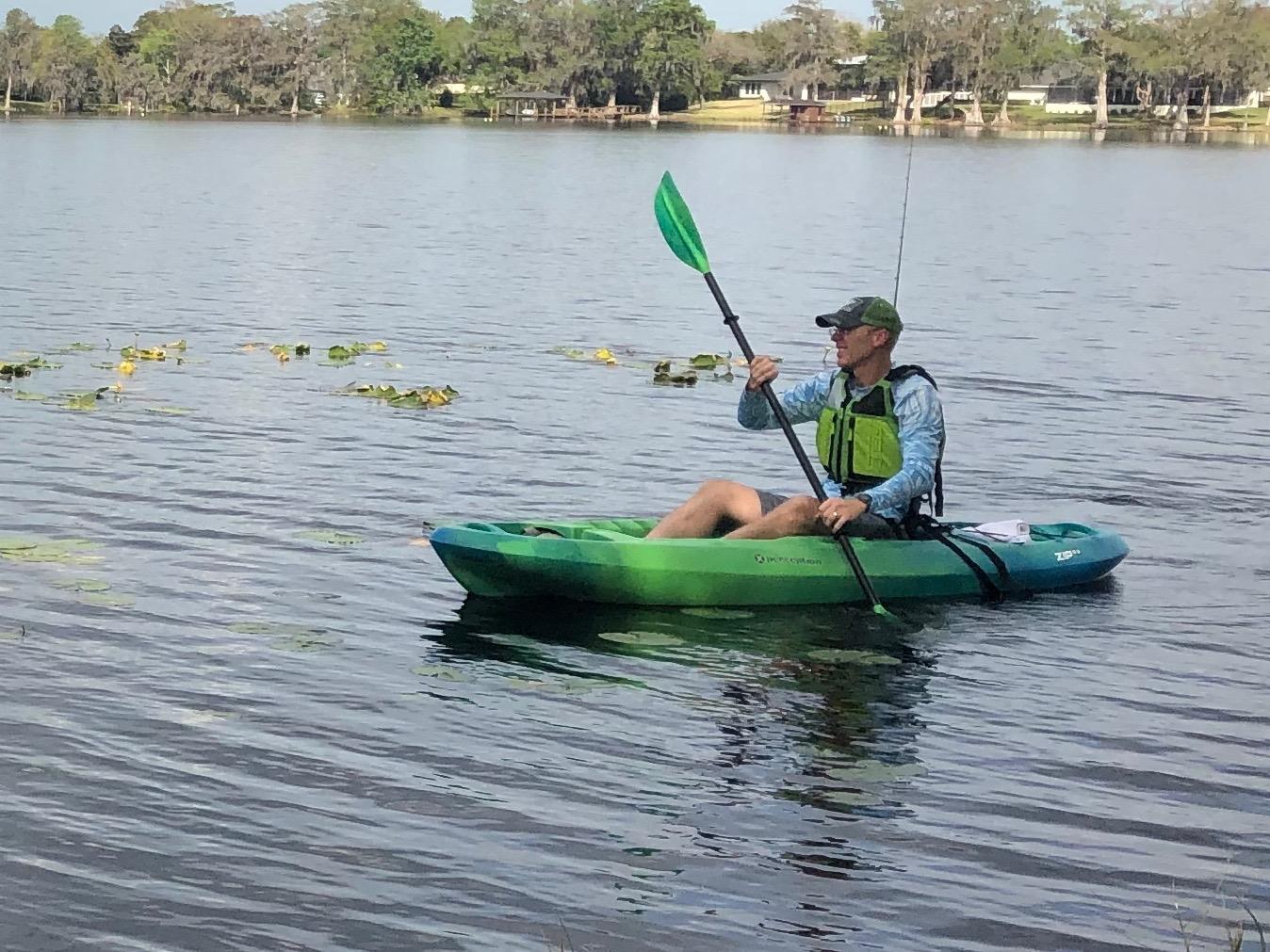
The scupper layout here is the most thorough in the roundup: four holes in the cockpit leg area, two in the seat and two in the rear tank well, all self-draining. The cockpit is spacious for easy entry and exit, the large rear open storage area with bungee cord lashes takes coolers, dry bags or fishing crates, and there is a built-in center cup holder. Molded front and rear handles plus cockpit-side carry handles and a drain plug for cleaning round out a one-piece molded design with no separate frame to fail.
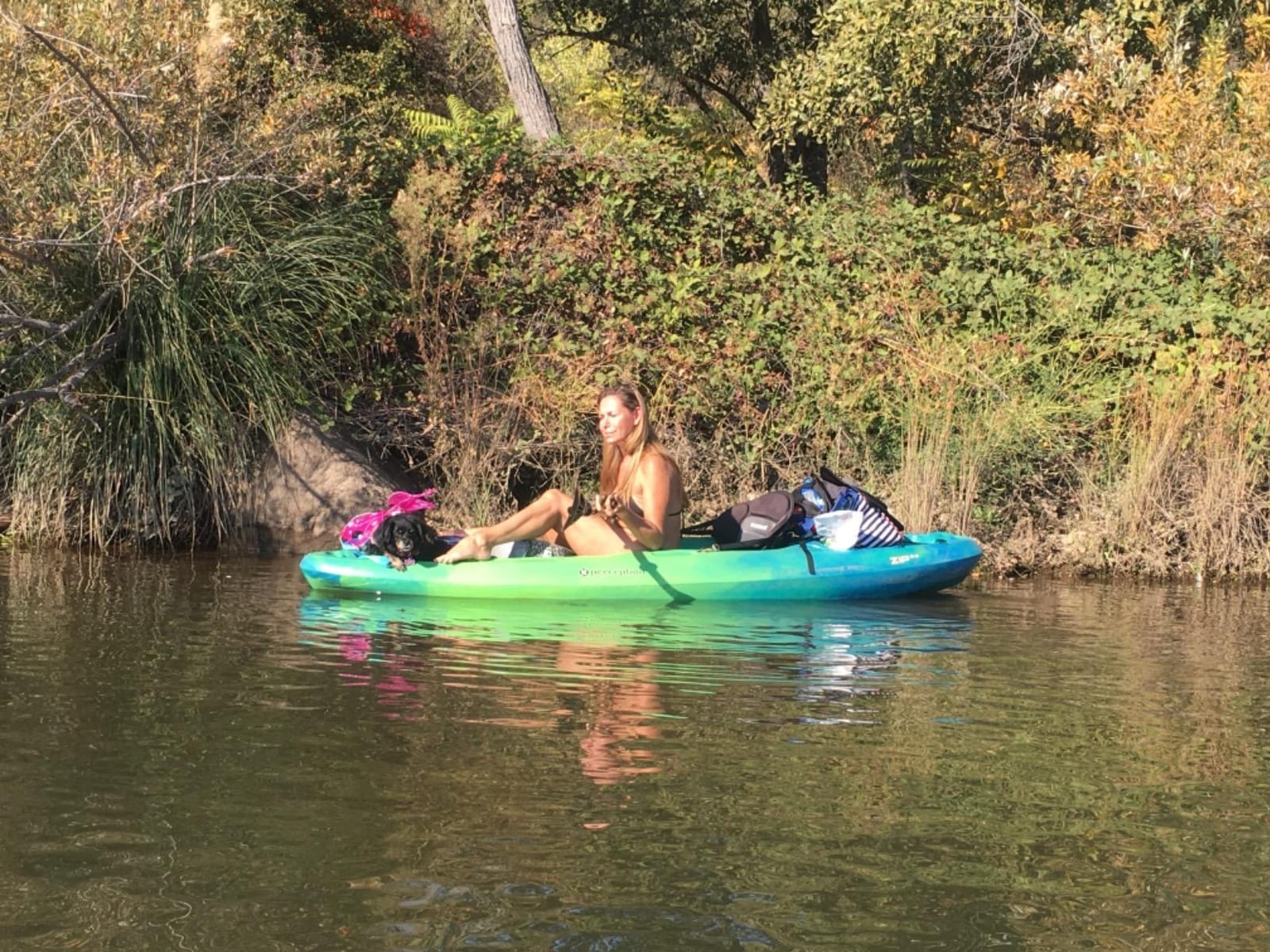
It comes with no seat at all, and back support is a separate purchase, so owners add a backrest before their first outing. The other recurring notes are moderate tracking, so it turns if you stop paddling, a missing tie-down in the front tank well that lets a backpack slide out, and being bulky to flip onto a car roof one-handed.
Why 32 inches of beam is the sweet spot
This is one of the widest hulls among the ten-foot boats in this group, and owners say the stability in chop is what they notice first as a beginner. Wide enough to feel planted, narrow enough to glide faster than the beam suggests, and 41 lb is light enough that a second person is optional rather than required. Those three things together are why it converts beginners to regular paddlers.
The drainage detail is worth crediting as well. With scuppers in the cockpit leg area, the seat and the tank well, water leaves as fast as it arrives, so the boat stays usable in a squall or after a wake without a sponge session. 32 inches is a good number to look for if you are torn between the 30-inch fishing platforms and the sleeker recreational shapes.
Who should look past this boat
Pass if you want to be paddling the day you buy. The missing seat is a real friction point, not a rounding error, and you will be adding both a backrest and a paddle before you can get on the water.
Pass if straight-line tracking is your priority, because the moderate tracking here will disappoint anyone who wants to cover distance on open water. Pass if you carry a lot of gear, since the missing front tie-down and the single large rear well limit how neatly you can organise a full load.
9. Pelican Sentinel 80X: the best sit-on-top kayak for smaller paddlers
Pelican Sentinel 80X – Recreational Sit on top Kayak – Fade Turquoise White – Lightweight Patented Ram-X™ Material – Ergoform™ backrest – 8 ft
- 100 in L x 29.5 in W, 34 lb hull, 225 lb capacity, multi-chine Ram-X hull
Pros
- Highest average rating in the roundup at 4.7 stars
- Very light at 34 lb so one person can load it alone
- Eight-foot length fits inside SUVs and hatchbacks
- Twin-arched multi-chine hull is genuinely stable
- Paddle reported as included by customers
Cons
- 225 lb capacity is the lowest figure in the list and limits gear weight
- Some buyers report a light-gauge plastic shell
- Blocks the right-side mirror view when stowed inside a vehicle
The Pelican Sentinel 80X is the best sit-on-top kayak for a smaller paddler, and it wins on two things none of the other nine hulls in this group can combine. At 34 lb it is the lightest hull listed here, and at 8 feet long it fits inside an SUV or hatchback instead of demanding a roof rack. Pelican describes it as best suited to paddlers around 5 ft 1 in to 5 ft 10 in, which matches owner reports closely.
It holds a 4.7 average, the highest rating in the roundup, but across only 33 reviews. That sample is the smallest here by a wide margin, so treat the star figure as encouraging rather than conclusive. The pattern inside those reviews is strongly positive, with nearly 79 percent at five stars and 2 percent at one star, the lowest one-star share in the roundup.
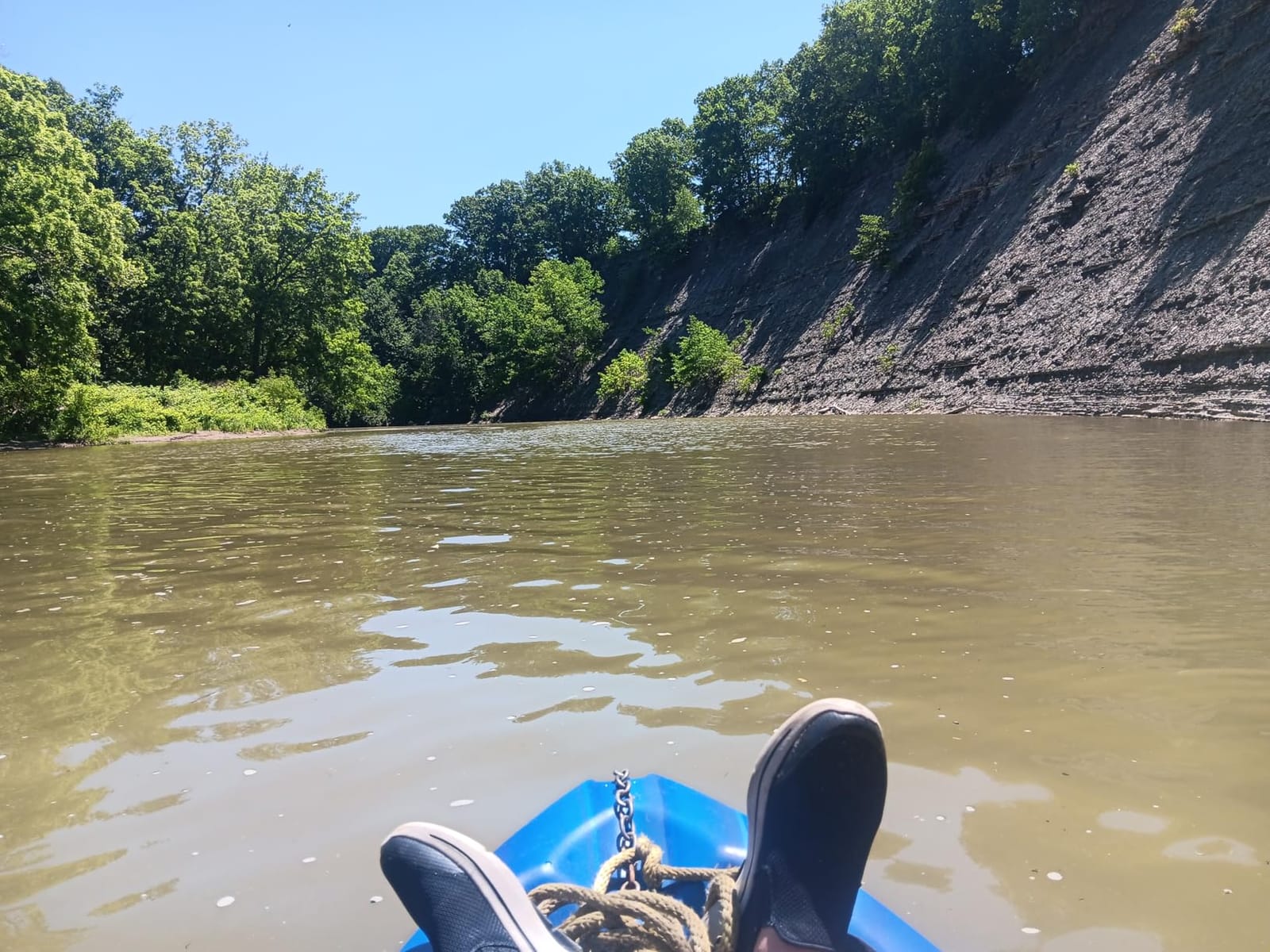
The hull design is the reason it feels stable despite being 29.5 inches wide, the narrowest beam in this group. A twin-arched multi-chine hull increases the water contact area, giving you the stability of a wider platform without the drag. The patented Ram-X material is described by the manufacturer as durable and super lightweight, and the Ergoform backrest offers soft cushioning with adjustability, which is more support than most eight-foot boats in this list manage.
It is also the only 8-foot hull in the group that comes with a flotation block built into the hull, which matters more in a small boat carrying a 225 lb rating. A lifetime limited warranty covers manufacturer defects with 1 year on parts and accessories. Owners in the 4 ft 10 in to 5 ft 6 in range call the fit perfect and stress that they can load and unload it alone and that it fits inside their car.
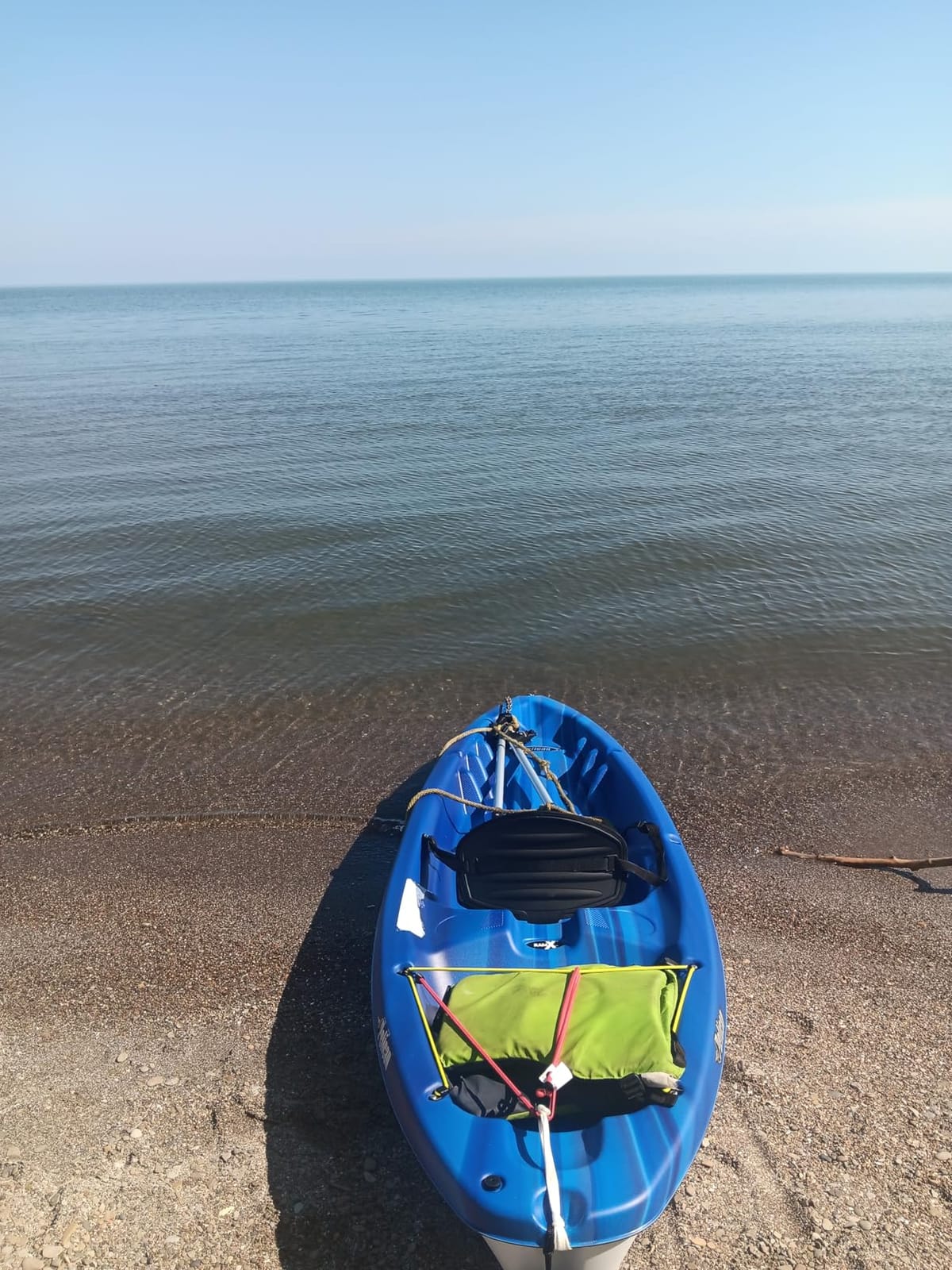
Why an 8-foot hull can still feel stable
Stability on a sit-on-top comes from how flat and how wide the platform is, not from how long the boat is. The twin-arched multi-chine design creates two angled surfaces either side of the hull that resist a lean early, which is why a 29.5-inch beam can still feel planted. For a paddler under 5 ft 6 in, that combination beats a long narrow boat every time.
The practical wins are equally significant. At 34 lb you can lift it out of a boot, and at 8 feet you can sleep with it in the house if you own a kayak that has never slept in a house before. The main reservation in the reviews is build quality, with a few owners describing thin-gauge plastic that they doubt will last a decade, plus a mirror visibility issue when stowed inside a car.
Who should look past this boat
Pass if you are a larger paddler or if you carry a dog, a cooler and a full tackle box, because 225 lb is the lowest capacity in this roundup and leaves almost no headroom. Pass if you want to carry a passenger or plan to fish seriously.
Pass if you will paddle in open water with wind. An 8-foot hull is inherently quicker to turn, and while the shape keeps you upright, you will be correcting more than you would in a 10-foot boat. For flat lakes and calm bays it is the most beginner-friendly platform in the list.
10. Emotion Spitfire 8: the best sit-on-top kayak for tight storage
emotion 90245 Spitfire Sit-On-Top 8 Foot Kayak, Green
- 8 ft long, about 32 in wide, 240 lb capacity, ST Performance hull
Pros
- Short 8-foot length fits inside a hatchback or minivan
- Handles well in wind for a boat this size
- Supportive adjustable backrest for two to three hour outings
- Molded-in footwells give solid bracing
- Light enough for one person to handle short distances
Cons
- Flat bottom gives poor tracking so some owners add a skag
- Scupper holes sit under the seat and let water in unless plugged
- Backrest loses support beyond roughly two hours
- 240 lb capacity sits at the tight end of the range
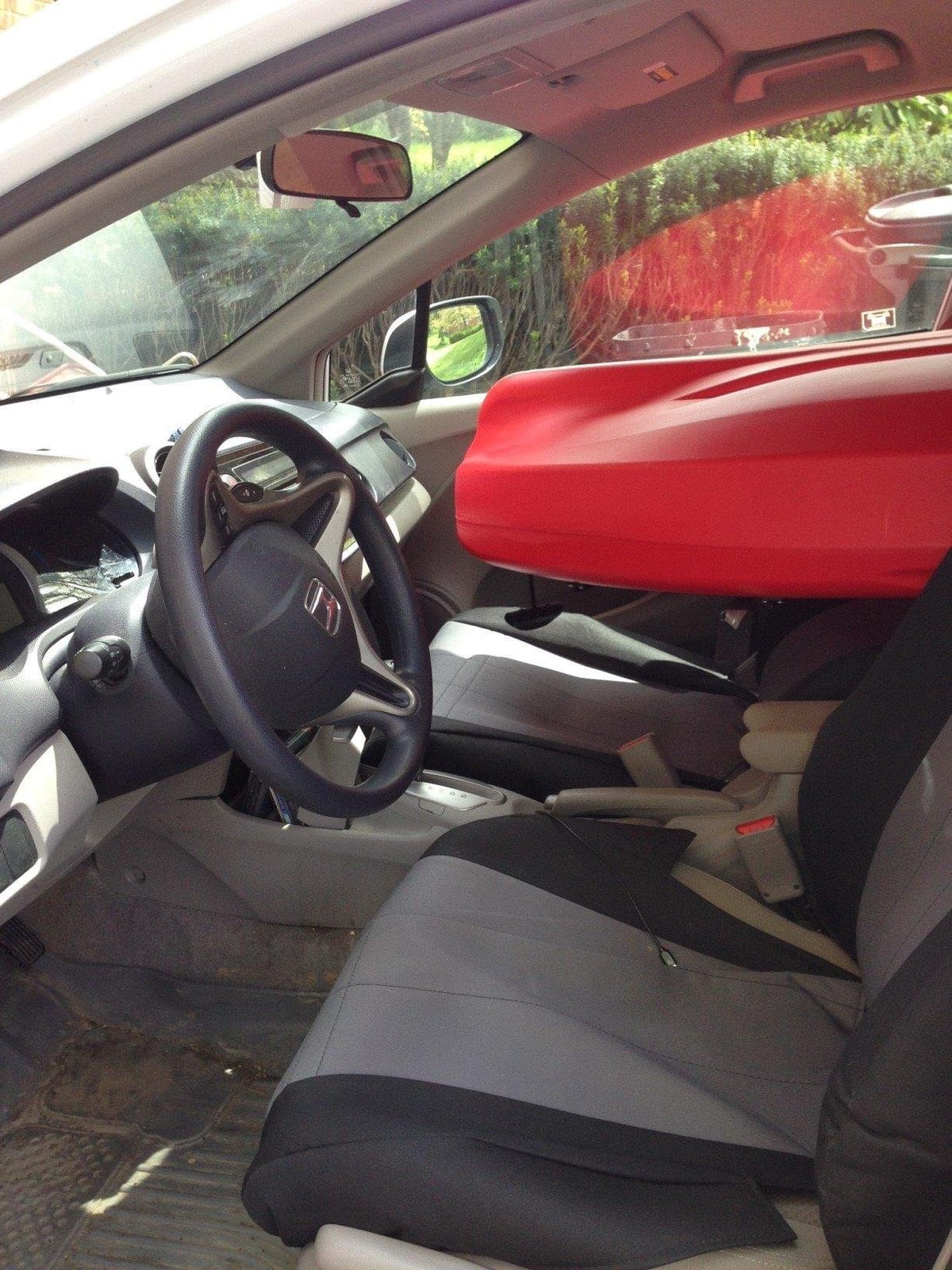
The Emotion Spitfire 8 is the best sit-on-top kayak for a beginner whose real constraint is storage, not paddling. It is 8 feet long, roughly 32 inches wide per owner reports, rated to 240 lb, and owners bought it for one reason: it fits inside a Honda Insight, a Subaru or a pickup bed, where it can be locked away rather than tied to a rack outside.
The 48 owner reviews average 4.2 stars, one of the two lower averages in this roundup, and the complaints about build quality and scuff-prone decals run through the lower-rated reviews, so this is a boat to buy for its transport advantage rather than its finish.
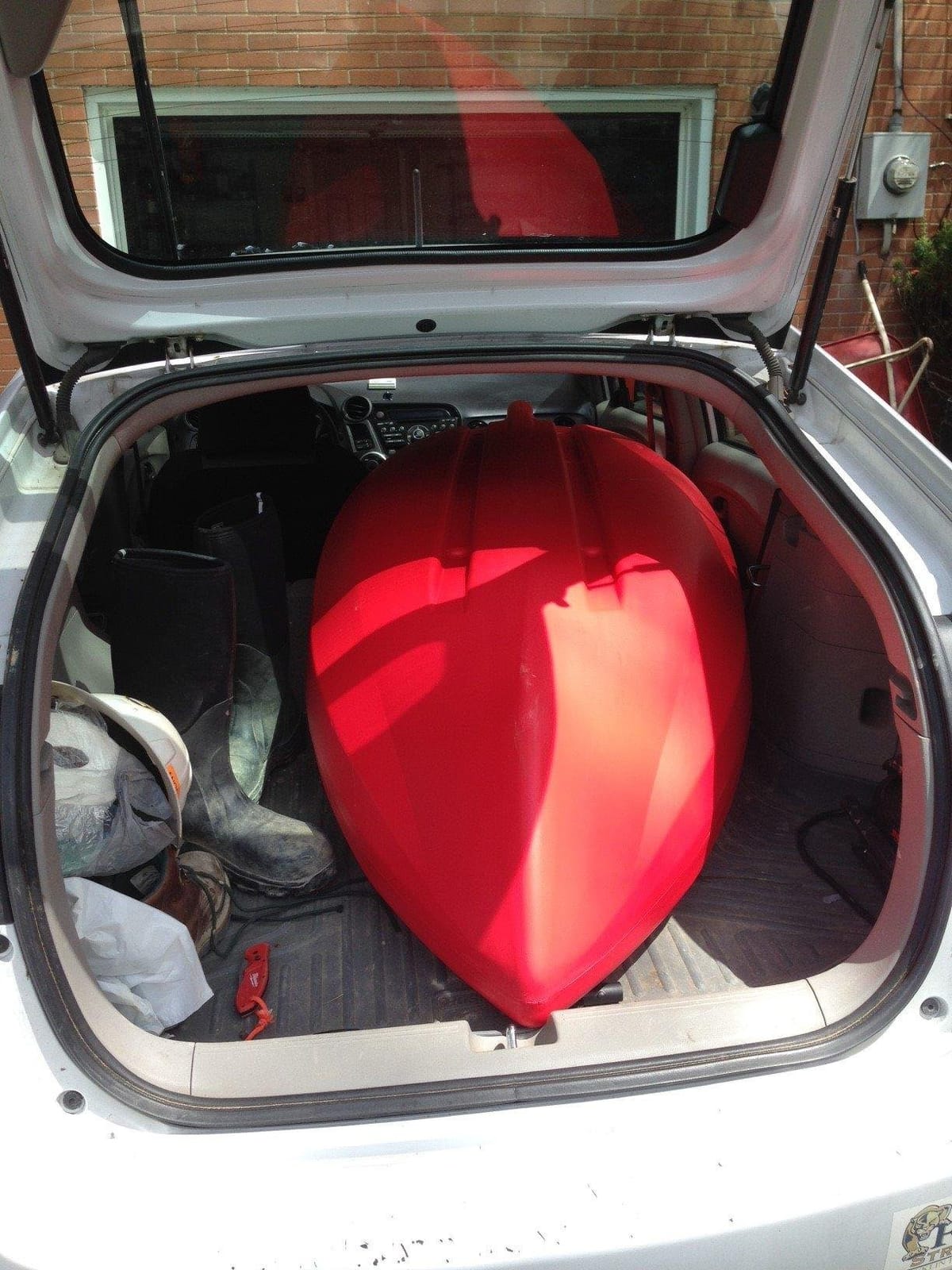
Construction is blow-molded from UV-protected high-density polyethylene in green, with a 5-year limited manufacturer warranty. The ST Performance hull is marketed for stability and tracking, and in the water the boat handles well in wind and stays on course for something this short. There are front, rear and side carry handles, a rear tankwell with cargo net lacing for gear storage, and molded-in freedom footwells that give solid foot bracing rather than a loose strap.
The backrest is supportive enough for two to three hour outings, which covers most beginners’ entire summer, and the boat is light enough for one person to handle over short distances. The tracking complaint is the consistent one: a flat bottom gives poor straight-line travel, so some owners add a skag. Owners also report that the scupper holes sit right under the seat area and let water in unless you plug them, and 240 lb is a tight ceiling once gear is loaded.
Why 8 feet can be the right answer
The case for a very short boat is entirely about where it lives. If you rent, live in a flat, or drive a car without a rack, the question is not whether an 8-foot hull performs best on the water, it is whether you will actually have it with you when the weather turns good. Owners of this boat say the answer is yes, and that the wind handling more than compensates for the short length on local lakes.
Molded-in footwells are underrated on a boat this size, because they give you a real brace for the power stroke rather than a footrest that slides. The rear tankwell with cargo net lacing turns an 8-foot deck into usable storage, and the side carry handles make a tight parking bay much less awkward.
Who should look past this boat
Pass if you want straight-line tracking, cover distance, or paddle in any kind of open water, because the flat bottom will make you work to hold a line. Pass if you are near or above 200 lb, since 240 lb of capacity leaves very little for gear.
Pass if you plan to spend long days in the seat, because the backrest support fades after a couple of hours, and pass if the finish matters to you. The 10 percent one-star share is the second highest in this set, driven by build quality rather than handling. If you want another short boat with a better-rated hull, the Sentinel 80X is the alternative.
What Is the 120 Rule? Sizing Your First Kayak
The 120 rule is a sizing shortcut that most beginner guides never explain: your kayak length in feet should roughly match your height in inches. A paddler who is 5 ft 9 in, or 69 inches, starts around a 10-foot boat, which is why 9.5 and 10-foot hulls dominate the beginner end of this market. It is a starting point, not a law, and you can step up or down a foot from it without regret.
Longer is not automatically better for a beginner. A longer hull tracks straighter but turns more slowly, and if you are fishing or exploring coves, maneuverability usually matters more in the first season. Shorter is lighter, easier to store and easier to turn, at the cost of wandering on straight reaches.
Here is how the rule maps onto real body sizes for sit-on-top kayaks.
Under 5 ft 2 in, or under 62 inches: an 8-foot hull. The 8-foot Emotion Spitfire and the 8-foot Pelican Sentinel 80X both suit this range, and the Sentinel lists suitability up to 5 ft 10 in.
5 ft 2 in to 5 ft 9 in, or 62 to 69 inches: a 9 to 10-foot hull. This is the most common beginner size and where most of this list sits.
5 ft 10 in to 6 ft 2 in, or 70 to 74 inches: a 10 to 11.5-foot hull. The Tribe 11.5 suits this band if you have roof-rack space.
Over 6 ft 2 in, or over 74 inches: step up to 11.5 feet or more, and check footroom, because a cramped cockpit will ruin a long day faster than any hull shape.
Height is only half the sizing question. Weight capacity is the other half, and the working number is 80 percent of the stated limit. A paddler at 180 lb with a 25 lb paddle, a 15 lb life vest and a 25 lb cooler is carrying 245 lb, which means a 275 lb boat is at 89 percent and a 300 lb boat is the right call.
How to Choose a Sit-on-Top Kayak as a Beginner
Six decisions account for almost every mistake we see in first sit-on-top purchases, in the order you will actually face them. Work through them in sequence and the boat that falls out of the end will suit you without a single visit to a showroom.
Beam Width and Hull Shape Are What Keep You Upright
Primary stability is the stability you feel when you lean, shift or make a sloppy stroke, and it comes almost entirely from beam. Thirty inches is the practical floor for an adult beginner, thirty-one to thirty-two is comfortable, and anything above thirty-three will feel planted but slow. Among these ten, the Sentinel 80X is narrowest at 29.5 inches, the Sentinel 100X and Lotus sit at 30, the Tamarack Angler 100 and Tamarack Pro 103 sit at 31, the Tribe 9.5 is 31.5, the Zip 9.5 is 32, and the Catch Classic Angler is 34, while the Emotion Spitfire measures roughly 32 inches according to owner reports.
Shape is the second half of the equation. A multi-chine hull like the Sentinel 80X uses angled surfaces to create a wide water contact area without a wide hull. A tunnel hull like the Catch Classic pushes water down through a channel, which resists side-to-side roll. A flat bottom like the Tamarack Angler 100 maximises primary stability and gives up some tracking. Chine rails, as on the Tamarack Pro 103, add the secondary stability that keeps you upright when you lean over the side to cast.
Hull Weight Decides Whether You Can Launch Solo
The listed weights in this roundup run from 34 lb to 57.5 lb, and that range is the single most consequential number for a beginner. Under about 40 lb you can lift a boat onto a roof rack alone, walk it across a car park and lower it down a launch. Between 40 and 50 lb it is doable with technique and a decent shoulder. Above 50 lb, plan on a second person or a kayak cart for anything longer than a short carry.
Two things that catch first-time owners out. The stated weight is the hull, not the boat, because a paddle, a life vest, a seat and a rack all add up. And adding anything to a roof rack changes the handling of the car itself, so the long-term answer for a heavy boat is a cart and a rack designed for the load rather than a stronger shoulder.
Seat Comfort and Weight Capacity Are the Same Decision
Every padded seat on these boats is a compromise, and every molded plastic saddle is a placeholder you will replace. The high-back framed seats on the two Perception Tribe models, the Ergolounge on the Sentinel 100X, the Ergocast Classic on the Catch Classic and the Ergoform on the Sentinel 80X are the real options here, and they are the reason to choose one boat over another when everything else is equal.
Remember that a taller seat raises your center of gravity and reduces stability, which is the recurring trade-off owners mention with the Tribe 9.5. A dual-position seat, as on the Catch Classic, resolves it by letting you choose per outing. On capacity, stay under 80 percent of the stated figure with your gear aboard, and remember the Emotion Spitfire at 240 lb and the Sentinel 80X at 225 lb are the tightest ceilings in this list.
Storage, Rigging and What Comes in the Box
Here is the part of the first purchase that surprises people. Only the Lifetime Tamarack Angler 100 and the Lifetime Lotus clearly include a paddle, and a personal flotation device is never included on any of them. Every boat here also needs a paddle sized to your height, and a properly fitted PFD, and those are the two line items that turn a simple first purchase into a real one.
Then there is transport, because a boat over about 9 feet will not live in a hatchback. A roof rack, a cart, or a boat short enough to carry are all part of the first-season budget, and they are the reason the 34 lb Sentinel 80X and the 39 lb Lotus remain genuinely popular with people who have no rack and no second pair of hands.
On storage features, the differences are real but not dramatic. A rear tank well with bungee cords, as on the Zip 9.5 and the Tribe 11.5, holds a crate. Rod holders matter only if you fish, as the three rod holders on the Tamarack Angler 100 and four on the Sentinel 100X show. Rigging tracks and accessory eyelets, as on the Catch Classic, let you add gear later without drilling, and self-bailing scupper holes keep a wet cockpit from becoming a wet seat.
Safety Gear Is Part of the First Purchase, Not an Extra
A PFD is not optional, not a suggestion, and not something to buy in a pinch at the ramp. Buy a paddling PFD that fits your chest snugly enough that you cannot lift the shoulder straps over your head, and wear it every single outing from the first one. A loose PFD rides up over your ears in a capsize, which defeats its entire purpose.
Then practise the wet exit and the recovery before you need it. A sit-on-top has no cockpit to leave, so a capsize recovery means swimming to the side of the boat, finding a grab point, pushing down and rolling your chest over the deck. Do it in shallow water with a friend watching, and do it in the first month rather than the third.
A few more basics complete a sane kit: a whistle, a bow line, a bailer or sponge, a dry bag for your phone and keys, a spare dry layer for cold-water months, and a light that works at dusk. On top of that, check local rules, because watercraft registration and PFD requirements vary by state and by launch.
Match the Boat to the Water You Will Actually Paddle
Almost every wrong purchase in this category is a boat bought for imagined water. Flat lakes, slow rivers and sheltered creeks are where almost every hull here belongs, and the difference between them matters mostly in wind. A wide flat-bottomed boat such as the Tamarack Angler 100 is stable in chop but loose in tracking, while a longer hull such as the Tribe 11.5 tracks straighter and needs more room to turn.
For open water and any real chop, the wide fishing platforms with chine rails or tunnel hulls, meaning the Tamarack Pro 103 and the Catch Classic hold up better in waves because secondary stability keeps you level when one arrives. For a first season on a small inland lake, none of that matters and a light, agile, easy-to-store boat is the better buy.
One more consideration: the Perception Zip 9.5 and the Tribe 11.5 are both built in the USA for lakes, ponds, slow-moving rivers and calm coastal water, which is a useful indicator of the design intent across this whole category. A boat marketed for whitewater is not a boat you should be learning on.
Sit-on-Top vs Sit-Inside: What Beginners Should Know
Sit-on-top kayaks are easier to learn on, and the honest disadvantages are worth knowing before you commit. They are heavier, they have more exposed surface area to catch wind, they are slower, they offer less cargo protection, and you get wetter in cold water because there is no cockpit rim to seal around you. The higher center of gravity of a high-backed seat is a fifth item that catches older paddlers and anyone with balance issues.
On the other side of the argument, a sit-inside kayak is more efficient, which matters enormously to experienced paddlers covering real distances. This debate fills the comment sections on the big kayaking forums, where sit-in crossover designs such as the Dagger Katana and the Liquidlogic Remix XP are regularly recommended to first-time owners who want a large cockpit and a supportive seat, sometimes with the blunt warning that a sit-on-top is a poor choice for that purpose.
That advice is not wrong, it is aimed at a different paddler. If you are learning on flat water, want to climb aboard after a capsize without a wet exit, want to bring a dog, want to fish or simply want the least intimidating first boat, a sit-on-top is the correct answer. If you already know you will be covering miles on a river, a crossover sit-in is the faster tool. The mistake is buying a recreational sit-on-top and then being frustrated that it is not a touring boat, or buying a touring sit-in and being frightened of it on day one.
Frequently Asked Questions
What is the 120 rule for kayaking?
The 120 rule says your kayak length in feet should roughly match your height in inches. A 5 ft 9 in paddler, 69 inches, starts near a 10-foot boat, which is why 9.5 and 10-foot sit-on-top hulls dominate the beginner market. It is a starting point rather than a rule, and you can step a foot either side of it without regret.
What size kayak is best for a beginner kayaker?
Most adults are best served by a 9 to 10-foot sit-on-top. Under 5 ft 2 in, choose an 8-foot hull. Between 5 ft 2 in and 5 ft 9 in, stay between 9 and 10 feet. Taller paddlers above 5 ft 10 in gain better tracking and footroom in 10 to 11.5-foot boats, provided you have room to transport and store the extra length.
What is the best kayak for an older beginner?
Choose a wide, high-capacity boat with an easy low entry: the 34-inch beam and 350 lb rating of the Pelican Catch Classic, or the 350 lb rating and framed seat of the Perception Tribe 11.5. Both climb over rather than into, which reduces strain on knees and hips. Add a dual-position seat so you can lower your center of gravity on rough days.
What are the disadvantages of sit-on-top kayaks?
They are heavier than sit-insides, catch more wind, travel slower, protect cargo less, and leave you wetter in cold water because there is no cockpit rim. A high-backed seat also raises your center of gravity and reduces stability. Sit-on-tops are easier to learn on, self-bailing, and far simpler to get into and out of after a capsize.
What is a good sit-on-top kayak for beginners?
A good beginner sit-on-top has a beam of 30 inches or more, a hull light enough for one person to lift, an open deck for easy re-entry, and a padded or framed adjustable seat. On that basis the Lifetime Tamarack Angler 100, the Pelican Sentinel 100X and the Perception Tribe 9.5 are the three strongest starting points in this roundup.
What type of kayak should a beginner get?
Beginners paddling flat lakes, slow rivers and sheltered bays should start with a sit-on-top, because there is no cockpit to seal and you can climb back aboard in seconds after a capsize. Choose a crossover sit-in instead if you already know you will cover long distances, or if cold water and spray make a sealed cockpit essential. Fishing sit-on-tops suit anyone who wants rod holders and a tank well.
Which Beginner Sit-on-Top Kayak Should You Buy?
The Lifetime Tamarack Angler 100 is our pick for the best sit-on-top kayaks for beginners, because it is the rare boat that handles the four things that end first ownership: it is stable enough for chop, light enough to launch alone, roomy enough to grow into, and it comes with a paddle so you can get on the water the same day. Its 1343 owner reviews at 4.4 stars are the deepest evidence base in the category, which is what convinced us to lead with it.
Buy the Pelican Sentinel 100X instead if the launch ramp is a solo affair and you would rather carry 44.6 lb than 51 lb, or if the seat matters more than the rod holders. Buy the Perception Tribe 9.5 if you intend to spend hours in the boat, and pick the Pelican Sentinel 80X if you are a smaller paddler who needs a hull that lives inside the car.
Whatever you choose, budget for a paddle, a properly fitted PFD and a cart or rack, then go and practise getting back in after a capsize before your first real trip. The best sit-on-top kayaks for beginners list comes down to one test: the boat you can get to the water on a Tuesday evening without needing a second person to help you. That is the whole test, and all ten of these boats pass it to some degree.