

Most leveling guides get one thing wrong before they even list a product. The tongue jack on your travel trailer already handles the front-to-back pitch, the nose-up nose-down tilt you feel when you park on a slope. What blocks actually solve is the side-to-side camber, the lean that makes a slide-out ride low on one edge and a bed feel like it is sliding off the wall. Get that tilt wrong and everything downstream suffers: appliances run on a slant, the slide-out works harder against its seals, and the trailer rocks every time someone walks past.
These are the best RV leveling blocks for travel trailers, and we picked eight that cover the range of real setups rather than eight variations on the same yellow block. We weighed the category’s biggest decisions for you: load rating against your trailer’s GVWR, the difference between stacking blocks and driving up a curved ramp, how much clearance sits between tandem tires, and what happens to a block on soft ground once several thousand pounds of trailer is sitting on it.
Every pick below is listed with its stated load capacity, its actual adjustment range, and the failure mode owners report most often. The ratings and review counts are the current ones listed on the product pages, which matters in a category full of no-name SKUs carrying three or four reviews. We leaned on long-term owner reports in the RV forums for the setup details, because the hard-won knowledge about stacking geometry lives there and not in the spec sheets.
One thing worth saying up front: the best RV leveling blocks for travel trailers are the ones you will actually use. A ten-pack you never pull out of the storage bin is worse than a two-piece ramp you learn in one try. Match the product to your site type and how much patience you have, not to the biggest number on the box.
Table of Contents
- Top 3 Picks for Best RV Leveling Blocks for Travel Trailers (October 2026)
- Best RV Leveling Blocks at a Glance (2026)
- What Are RV Leveling Blocks?
- 1. Tri-Lynx Lynx Levelers 11 Pack – Best Overall
- 2. Camco RV Leveling Blocks 10-Pack – Best for Soft Ground
- 3. Andersen Hitches Camper Leveler 2-Pack – Best Drive-On Speed
- 4. CARMTEK Camper Leveler Kit – Best for Dual-Axle Trailers
- 5. Camco FasTen Leveling Blocks – Best for Carrying and Storage
- 6. Beech Lane Camper Leveler 2-Pack – Best Complete Kit
- 7. RVMATE 12 Pack Leveling Blocks – Budget Pick Block Count
- 8. Homeon Wheels 10 Pack with Ramp Sliders – Best for Easy Drive-On
- How Many Leveling Blocks Do You Need?
- How to Level a Travel Trailer on Blocks
- Soft Ground: Why Blocks Sink and What to Put Under Them
- Leveling Blocks vs Jack Pads vs Auto-Leveling Systems
- How to Choose Leveling Blocks for Your Trailer
- Frequently Asked Questions
- Which Leveling Blocks Should You Buy?
Top 3 Picks for Best RV Leveling Blocks for Travel Trailers (October 2026)

Tri-Lynx Lynx Levelers 11 Pack
- Rated to 40000 lbs
- Each block adds 1 inch
- Includes Lynx Cap and storage bag
Camco Leveling Blocks 10-Pack
- Solid base resists sinking
- UV-stabilized resin
- Zippered storage bag

Andersen Camper Leveler 2-Pack
- 1/2 to 4 inch lift in any increment
- Drive-on wedge
- Up to 30000 lbs
As an Amazon Associate we earn from qualifying purchases. CERTAIN CONTENT THAT APPEARS ON THIS SITE COMES FROM AMAZON. THIS CONTENT IS PROVIDED 'AS IS' AND IS SUBJECT TO CHANGE OR REMOVAL AT ANY TIME.
Best RV Leveling Blocks at a Glance (2026)
All eight picks in one place, with the type, the load rating and the adjustment range that matters most when you are standing on an uneven site at dusk.
| Product | Specifications | Action |
|---|---|---|
|
Tri-Lynx Lynx Levelers 11 Pack
|
|
Check Latest Price |
|
Camco Leveling Blocks 10-Pack
|
|
Check Latest Price |
|
Andersen Camper Leveler 2-Pack
|
|
Check Latest Price |
 CARMTEK Camper Leveler Kit
|
|
Check Latest Price |
 Camco FasTen Leveling Blocks
|
|
Check Latest Price |
 Beech Lane Camper Leveler 2-Pack
|
|
Check Latest Price |
 RVMATE 12 Pack Leveling Blocks
|
|
Check Latest Price |
 Homeon Wheels 10 Pack Set
|
|
Check Latest Price |
We earn from qualifying purchases. CERTAIN CONTENT THAT APPEARS ON THIS SITE COMES FROM AMAZON. THIS CONTENT IS PROVIDED 'AS IS' AND IS SUBJECT TO CHANGE OR REMOVAL AT ANY TIME.
What Are RV Leveling Blocks?
RV leveling blocks are rigid pads or curved ramps placed under a travel trailer’s tires or jack feet to raise the low side of the rig so the floor sits flat. They correct the side-to-side tilt that the tongue jack cannot, and they do it in a fixed stack height or a continuous ramp, depending on the type.
There are three main formats you will run into in this category:
Interlocking stacking blocks nest one inside the next and add a fixed increment, usually 1 inch, per block. You build the height by hand, then drive or jack onto it.
Curved drive-on ramps let you back the wheel up a wedge and stop at the height you need, giving continuous adjustment in roughly 1 inch increments from a fraction of an inch up to about 4 inches.
Hybrid block sets combine a stack of blocks with slanted entry ramps or tire-saver top pieces, so you can still build by hand but drive on rather than creep up an edge.
Stacking blocks give you more control over the shape of the load and handle taller corrections. Ramps are faster once you have learned the backing motion. Everything else in this roundup is a variation on that trade.
1. Tri-Lynx Lynx Levelers 11 Pack – Best Overall
Lynx Levelers 11 Pack Including 1 Lynx Cap Level Top for RV/Trailer/Motorhome/Vanlife Interlocking Leveling Blocks with Storage Bag for Most Leveling and Stabilizing Functions. 00015, Made in USA.
- UV-stabilized polymer
- Rated to 40000 lbs
- Each block adds 1 inch
- 10 blocks plus Lynx Cap and bag
Pros
- Interlocking design covers leveling and stabilizing jobs
- 40000 lb rating with 1 inch increments for fine tuning
- Includes Lynx Cap level top and nylon storage bag
- Made in the USA by the original inventor of RV leveling blocks
Cons
- Blocks must be stacked and interlocked by hand at each site
- Bright colors are easy to leave behind at the campsite
The Lynx Levelers set is the one I hand to people who ask me what to buy without describing their trailer. It has been made in the USA since 1992, it is rated to support up to 40,000 lbs, and it carries more owner history than anything else in this roundup at more than 18,000 reviews averaging 4.8 stars.
What makes it versatile is the geometry. Each block measures 8.5 by 8.5 by 1.5 inches and stands 1.5 inches on its own, but once interlocked into a stack each one contributes 1 inch of height. That lets you build a low two-block column for a gentle site or a taller pyramid where you need to spread the load, using the same pieces.
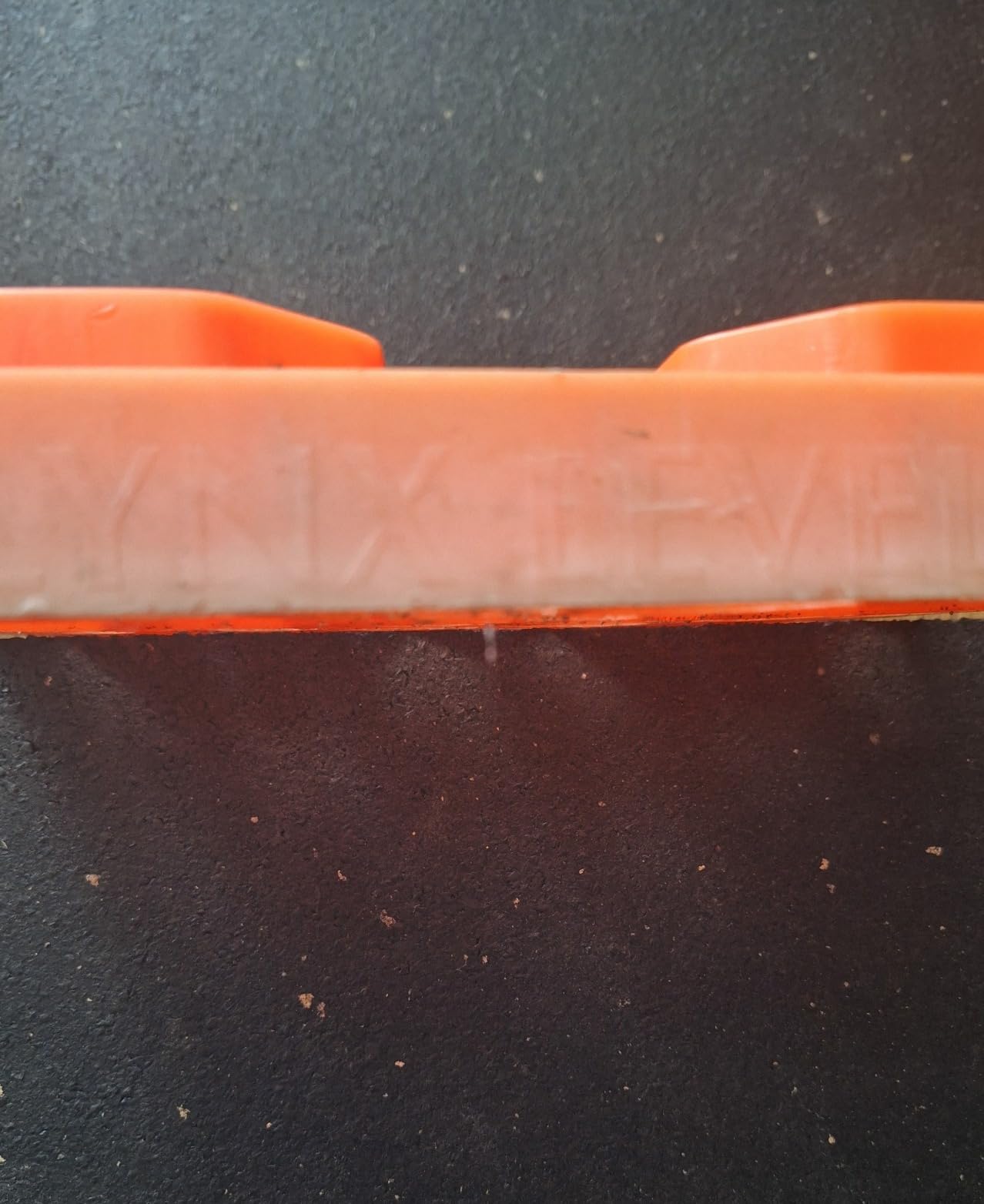
The 11-piece count is worth understanding. You get 10 blocks, one Lynx Cap level top and a nylon storage bag. The cap is a 0.5 inch piece that adds a quarter inch of height to a stack and, more usefully, gives the tire a smooth surface to sit on instead of a stepped edge. On the Good Sam travel trailer forum the most repeated piece of advice involving this brand is the flat-top add-on, which lets you link two blocks side by side into one wider platform when axle spacing is tight.
Setup is entirely by hand. You interlock the blocks to your measured height, set them under the tire or jack foot, and drive on. Owners on r/RVLiving treat it as a five-minute job once you have the muscle memory for the interlock, but it is manual work every single time, with no way to creep up and stop partway.
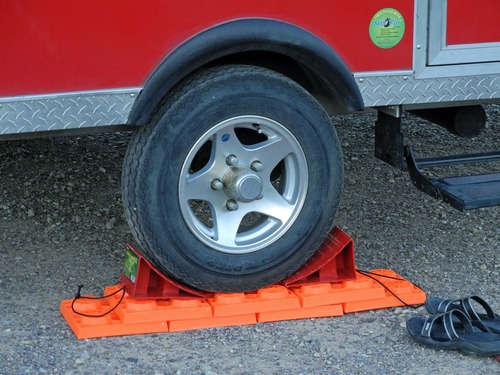
When the Lynx Levelers are the right call
They suit trailers that park on genuinely varied terrain, because the same set handles a one-inch correction and a four-inch correction. A 40,000 lb rating means the capacity question is closed for essentially every bumper-pull travel trailer, so you are choosing on fit and preference rather than on whether it will hold.
They are also the safest recommendation for a first-time buyer who wants the broadest set of jobs covered. Blocks under tires, blocks under tongue jack feet, blocks under stabilizer jacks and stacked pads for a tire you do not want to climb over all fall inside what this kit does.
Where they fall short
The main drawback is time. Every setup means carrying, interlocking and aligning blocks by hand in whatever light you have. On a dark arrival with kids in the car, that is the difference between a two-minute fix and a ten-minute one.
Second, the bright colors work in your favor when you are looking for a block at dusk and against you when you are packing up. Owners report more than one abandoned set left at a campground. Count your pieces before you drive away.
2. Camco RV Leveling Blocks 10-Pack – Best for Soft Ground
Camco RV Leveling Blocks – Features Interlocking Nested Design & Storage Bag for RV Storage and Organization – Each Leveling Block Measures 8.5″ x 8.5″ x 1″ – 10-Pack, Design May Vary (44510)
- UV-stabilized resin
- Each block adds 1 inch
- Solid base for soft ground
- Zippered storage bag
Pros
- Solid bottoms resist sinking on soft or uneven campsites
- Nested design dials in exact height one inch at a time
- Bright yellow makes blocks easy to spot at dusk
- Hose-off clean and packs into the included bag
- Works with single
- dual and tandem axle setups
Cons
- Blocks must be manually stacked and interlocked for each setup
- Listing notes design and appearance may vary between production batches
If your campground is grass, rain-soaked dirt or anything that gives under a tire, the solid bottom on this Camco set is the reason to look here. Waffle-grid bases are the standard in this category and they are the reason blocks crack on soft soil. These have a flat, continuous base, which spreads the load instead of driving it into a few ribs.
Construction is UV-stabilized resin, which is what keeps the blocks from going brittle after a few seasons of direct sun. Camco rates each block at 1 inch of added stack height, and the nested design means the blocks lock into a column without drifting once the tire is on top.
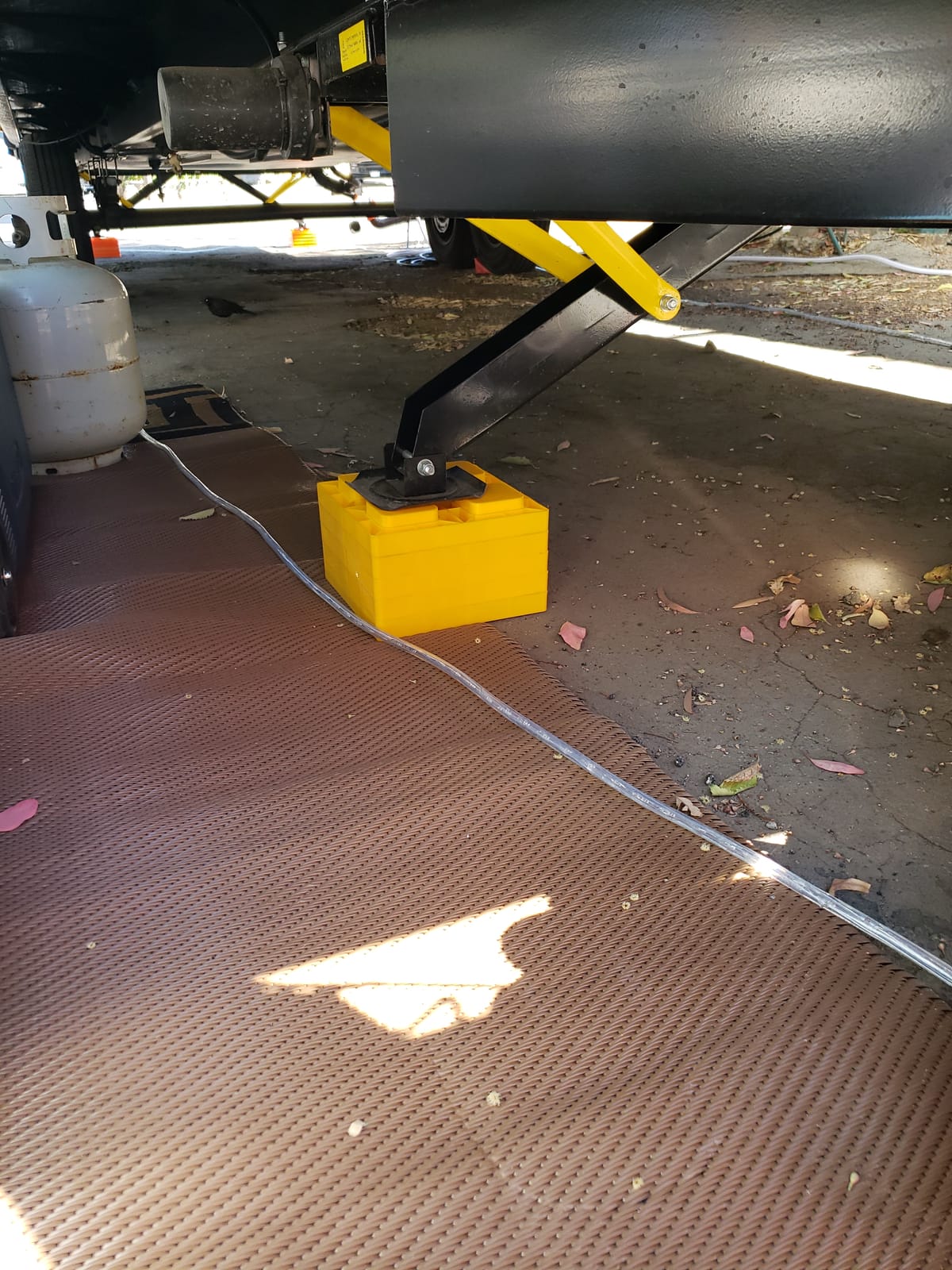
Compatibility is broad. The set works under single wheels, dual wheels, hydraulic jacks, tongue jacks, stabilizer jacks, fifth wheel jacks and tandem axles, so the same ten pieces cover the wheels and the four corner jack feet. That is a real advantage on campsites where the ground is not level enough to trust the stabilizers to start from.
With more than 14,000 reviews at a 4.7 average, this is the most reviewed solid-base option available, and the feedback is consistent: owners like the one-inch precision, the visibility of the yellow color and the fact that the set hoses off and goes back in the zippered bag.

When the Camco 10-Pack is the right call
Pick it when the site is softer than the pavement at a regular campground. Beach camping, spring mud, backcountry dispersed sites and grassy pull-ins after rain are where a solid base earns its cost. It is also a good universal answer if you want one set that covers tires and all four jacks.
The color is a small thing that pays off more than expected. A yellow block is visible in grass, at night with a headlamp, and in the grass around your site after you have driven away without it.
Where they fall short
These are still hand-stacked blocks, so you pay the same setup time as the Lynx set. If you want to be level in under five minutes on a firm site, a drive-on ramp is the better tool.
The listing also notes that design and appearance can vary between production batches. It is a cosmetic issue rather than a fit or strength one, but it does mean the set you receive may not look identical to the product photos.
3. Andersen Hitches Camper Leveler 2-Pack – Best Drive-On Speed
Andersen Hitches 2-Pack Camper Leveler Blocks for RVs and Trailers Up to 30000 lbs Precise 1/2 to 4 Inch Leveling Made in USA
- Drive-on curved wedge
- 1/2 to 4 inch lift in any increment
- Up to 30000 lbs and 32 inch tires
- Lifetime warranty
Pros
- Levels both sides in under five minutes by driving the tire up the wedge
- Adjusts in any increment between 1/2 inch and 4 inches
- Handles trailers up to 30000 lbs with 32 inch tires
- Backing out is as fast as setting up
- Lifetime manufacturer warranty
Cons
- Long levelers may need trimming to fit closely spaced tandem tires
- Wedge surface can slide on soft sand or mud without grip mats
- Higher cost than stacking block sets
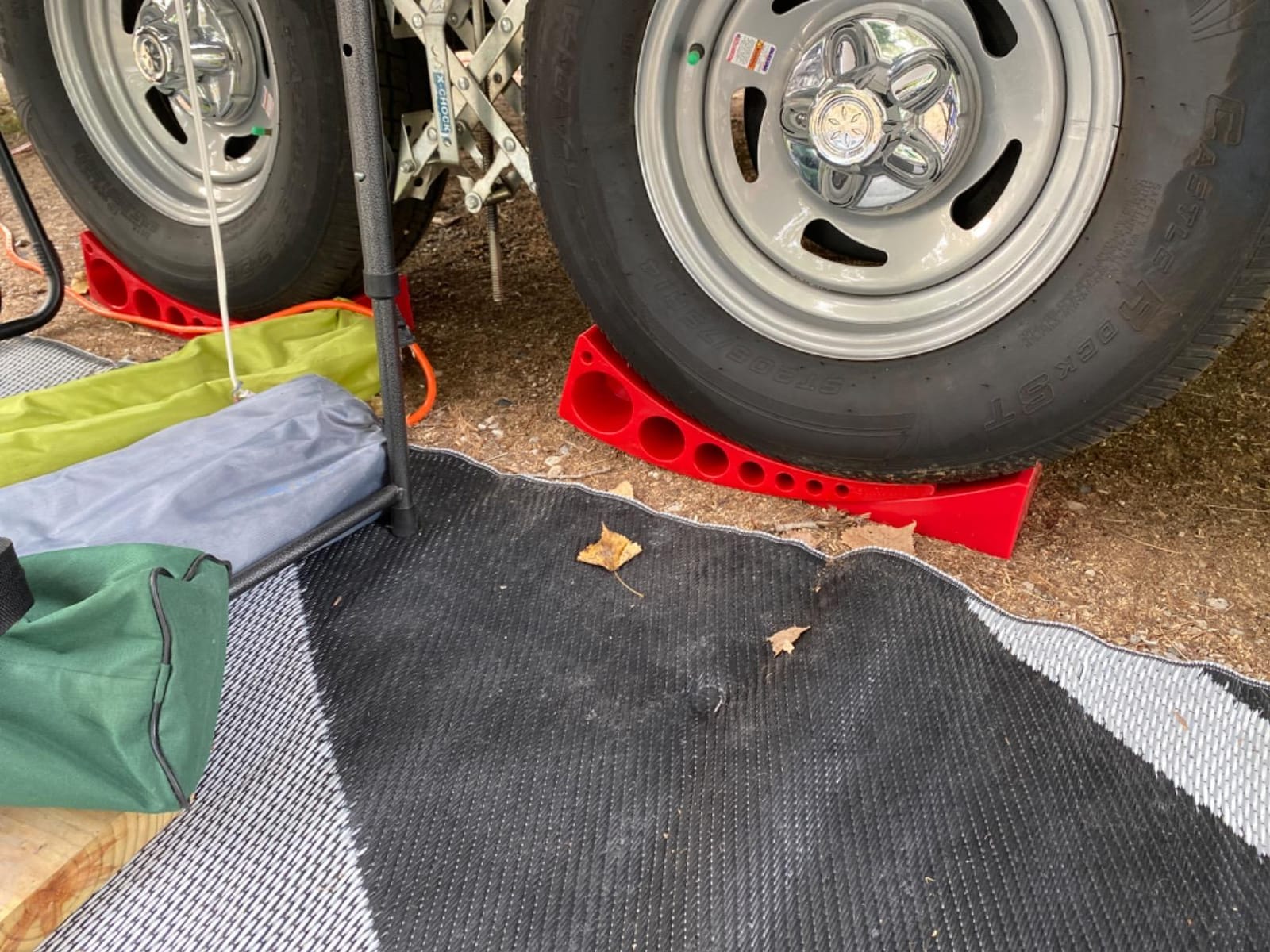
This is the benchmark drive-on leveler. Instead of building a stack, you back each tire up the curved wedge and stop when the bubble level says you are there. Two units mean both sides are handled in one pass, and the whole job takes under five minutes once you have done it twice.
The adjustment is continuous rather than stepped. You can pick up anywhere from half an inch to 4 inches of lift, which removes the single most frustrating part of stacking blocks, where you are adding or removing whole one-inch pieces to chase a level. The rating is 30,000 lbs with tires up to 32 inches in diameter, and Andersen backs it with a lifetime manufacturer warranty.
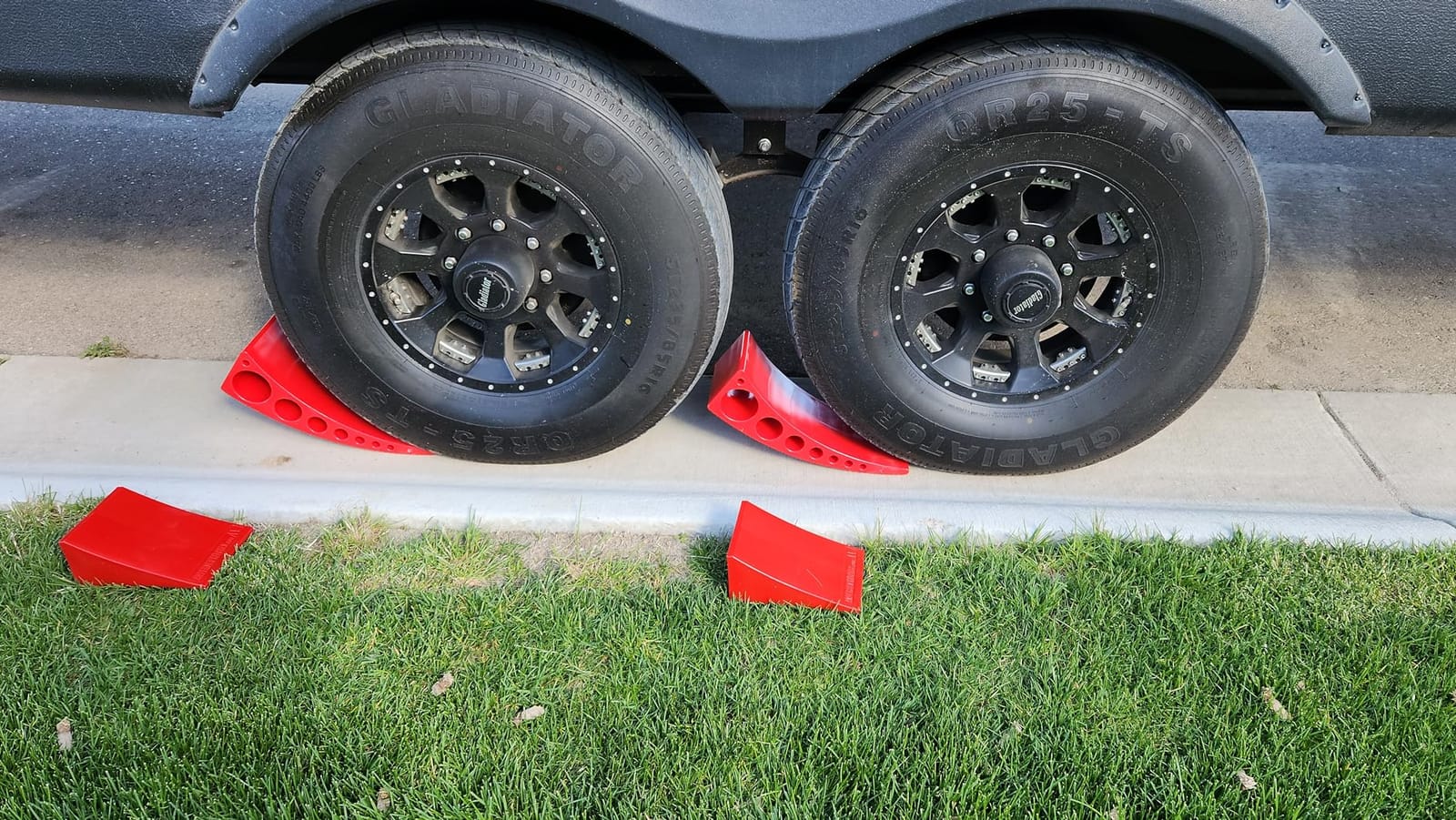
RVForum owners single this product out for exactly three reasons: easier use, more precise adjustment, and a smaller storage footprint than a ten-block set. For a small trailer where storage space is the real constraint, two ramps that nest together are a genuine upgrade over ten separate blocks and a bag.
The physics are the tradeoff. A wedge is a triangle, so the load concentrates where the tire meets it rather than spreading across a block face. On firm ground that is a non-issue. On loose sand or mud, the ramp can shift sideways as you creep up it.
When the Andersen Leveler is the right call
It suits campers who are tired of the stacking routine, who arrive often, or who set up in the dark. It also suits anyone who wants a genuinely level result rather than the closest level a one-inch increment allows, since you can stop at any point on the curve.
Because the two pieces nest and store flat, it is a good pick for trailers with a shallow storage bay or for anyone who does not want ten loose parts to keep track of.
Where it falls short
Measure your axle clearance before you buy. On dual-axle trailers with closely spaced tires, a full-length ramp may not fit between the wheels, and trimming it is a step some owners skip and then regret.
On soft ground you will want grip mats under the wedge, and those are an add-on kit rather than standard equipment. A few owners have also reported a cracked chock piece, often on large-diameter tires that concentrate load on the ends of the wedge. That is a minority report against more than 5,500 reviews, but it is worth knowing.
4. CARMTEK Camper Leveler Kit – Best for Dual-Axle Trailers
CARMTEK Camper Leveler 2-Pack Kit | Curved RV Levelers with Trailer Wheel Chocks for Dual Axle Trailers | Faster RV Leveling System Than RV Leveling Blocks | RV Accessories for Travel Trailers
- High-performance polymer
- Up to 35000 lbs and 32 inch tires
- 1/2 to 4 inch lift under 5 minutes
- Trimmable ramp with chocks
Pros
- Patented anti-slip jointing system locks chocks in place once level
- Rated for trailers up to 35000 lbs and 32 inch tires
- Trims up to 4 inches to fit tight dual-axle spacing
- Two levelers plus two matching chocks included
- Lifetime warranty
Cons
- Ramp may need trimming for closely spaced dual-axle tires
- Colorways arrive all black rather than the listing photos
- Some owners want an added skid plate for soft ground
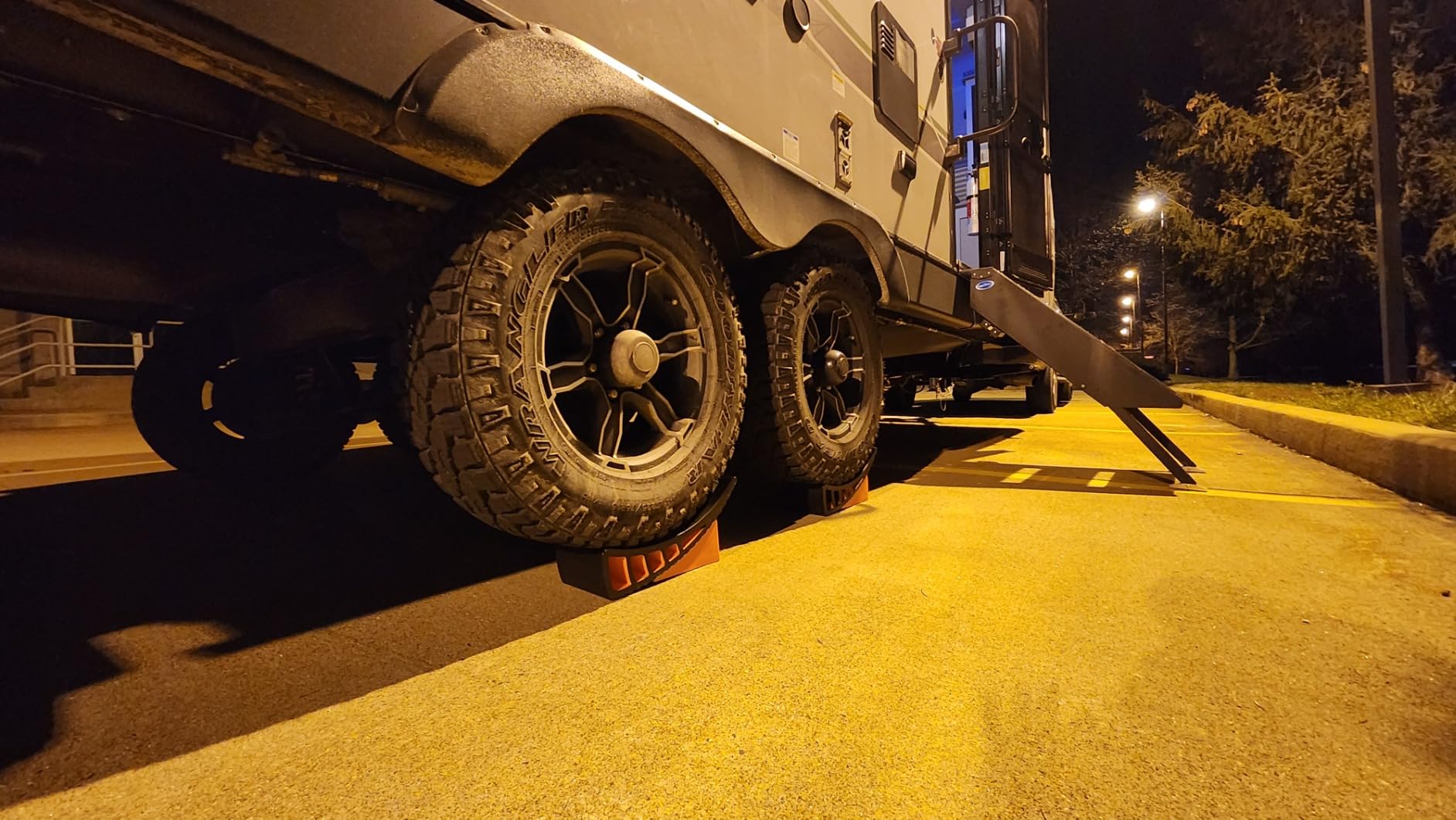
The idea that makes this kit different is the jointing system. Grip channels on the leveler line up with notches on the chocks based on trailer weight, so once you are level the chocks lock into the ramp rather than sitting next to it. The trailer cannot roll back off the wedge, which is the fear almost every forum thread mentions first.
Capacity is 35,000 lbs with tires up to 32 inches, and the lift range runs from half an inch to 4 inches in any increment. Leveling takes under five minutes, and the set includes two levelers and two chocks, so the roll-back protection is not an extra purchase.
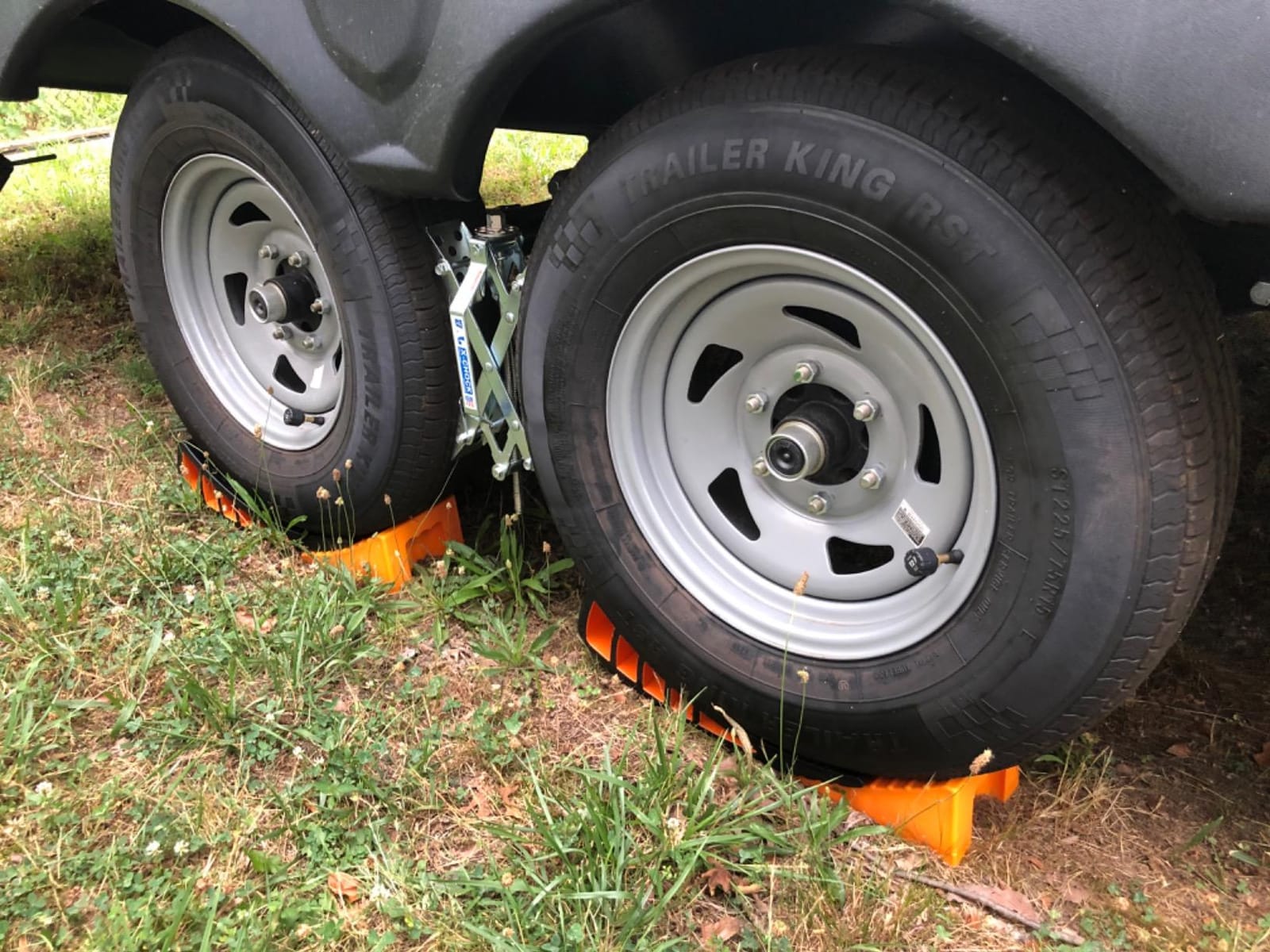
For dual-axle trailers this is the ramp designed around your problem. It trims up to 4 inches to clear closely spaced tandem tires, and 2.5 to 3 inches of clearance is usually enough to use it uncut. Owners report the polymer holds up well over gravel, grass and asphalt, and backing out is a simple forward nudge.
With 3,000-plus reviews at a 4.7 average, it sits in the same confidence band as the Andersen unit with a slightly different feature emphasis: less about the ramp surface and more about keeping the chock in place once you are loaded.
When the CARMTEK Kit is the right call
Choose it if your trailer has tandem axles with tight tire spacing, or if the roll-back worry is the thing that stops you leveling at all. The chock and leveler working as one locked system is the feature that separates it from a bare wedge.
It is also a good match for two people setting up in the dark, since the whole routine is back up, stop, chock, and the chocks stay where you put them.
Where it falls short
It is 11.79 pounds to carry, which is real if you are walking a long way from the truck to the site. And a handful of owners point out that the colorways now arrive all black rather than the black-and-orange combination shown in the listing photos.
On soft ground, a few owners would like an added skid plate to protect the surface underneath. Grip mats are not included in the base kit here either, so add them if your sites are sandy.
5. Camco FasTen Leveling Blocks – Best for Carrying and Storage
Camco FasTen RV Leveling Blocks – 8.5” x 8.5” x 1”- 10-Pk – Made in the USA
- Quad-grid load bearing
- 1 inch per block, not above 4.5 inches
- T-handle carry and twist-lock
- 10-pack made in USA
Pros
- Top rated block set in the group with 4.8 stars
- T-handle doubles as a carry handle and a storage twist-lock
- Quad-grid structure built for dependable load bearing
- Works with single
- dual and tandem wheels and most jacks
- Made in the USA under a patent with a one-year warranty
Cons
- Blocks must be manually stacked and interlocked for each setup
- Stack should not be built higher than 4.5 inches
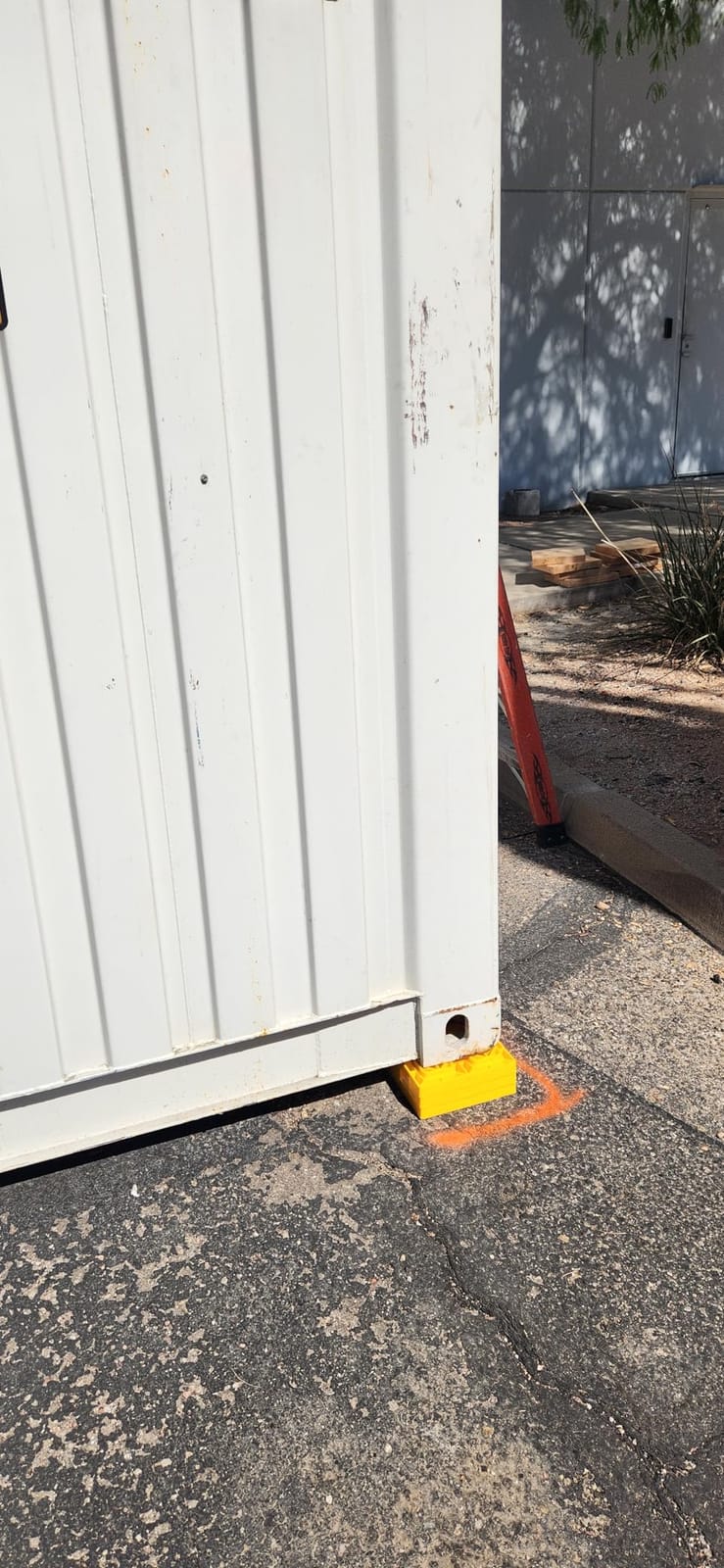
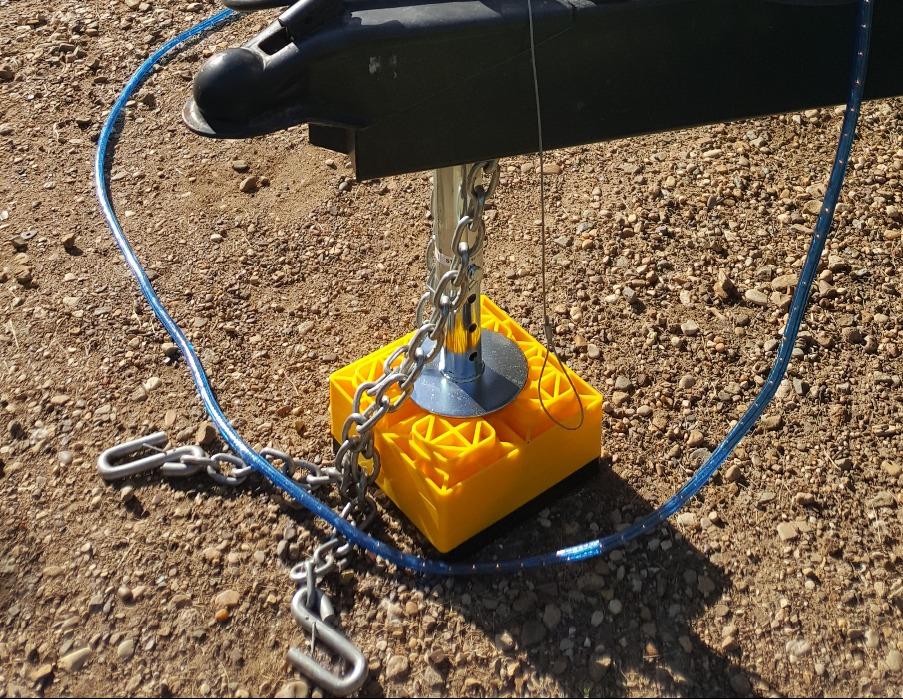
The FasTen set solves a problem most block sets ignore, which is how ten separate pieces behave in a storage bay. The top block carries an integrated T-handle. You lift the stack by the handle, and when you are done you twist the handle into the base block to lock the whole column together so nothing scatters in transit.
Underneath that, it is a conventional interlocking block set with one difference: the quad-grid extreme load-bearing structure. Each block measures 8.5 by 8.5 by 1.5 inches and adds 1 inch of interlocked height, and Camco advises against stacking higher than 4.5 inches.
It rates 4.8 stars from roughly 2,900 reviews with 87 percent of ratings at five stars, which is the highest share of top marks among the block sets here. Owners mention the T-handle more than any other feature, specifically because it turns a loose pile into one carryable object.
Compatibility covers single wheels, double wheels, tandem axles, hydraulic jacks, tongue jacks, stabilizer jacks and fifth wheel jacks. The design is patented and made in the USA, with a one-year manufacturer warranty rather than a lifetime one.
When the FasTen set is the right call
It suits trailers where storage is tight and the blocks travel badly, and for anyone who has arrived at a site before to find a bag of loose blocks scattered across the bed. The carry-and-lock handle removes that failure mode entirely.
It is also a solid all-around choice for a trailer that sees mixed terrain, since the same ten blocks handle tires and every jack type.
Where it falls short
It is still a manual stack, so the setup time is the same as any other interlocking set. And the 4.5 inch stack limit is a real constraint on a badly sloped site, where a ramp that reaches 4 inches of continuous lift handles more correction in less height.
The warranty is one year rather than lifetime, which is shorter than the Andersen, CARMTEK and Beech Lane ramps. For a product made of plastic that should sit in a shaded storage bay, that difference matters less than it would for a metal part.
6. Beech Lane Camper Leveler 2-Pack – Best Complete Kit
Beech Lane Camper Leveler 2 Pack with Carrying Bag – Precise Camper Leveling, Includes Two Curved Levelers, Two Chocks, Two Rubber Grip Mats, and A Carrying Bag, Patented
- Two curved levelers rated to 4 inches
- Two chocks and two rubber grip mats
- Carrying bag included
- Lifetime warranty
Pros
- Most complete kit with levelers
- chocks
- grip mats and a carrying bag
- Nylon polymer body marketed as rock solid under trailer weight
- Grip mats reduce the sliding that plagues bare wedges
- Highest rated drive-on option here at 4.8 stars
- Lifetime manufacturer warranty
Cons
- Heaviest kit in the group at 17 pounds
- One leveler often must be cut to fit tight tandem clearance
- Less flexible than stacking blocks on very uneven sites
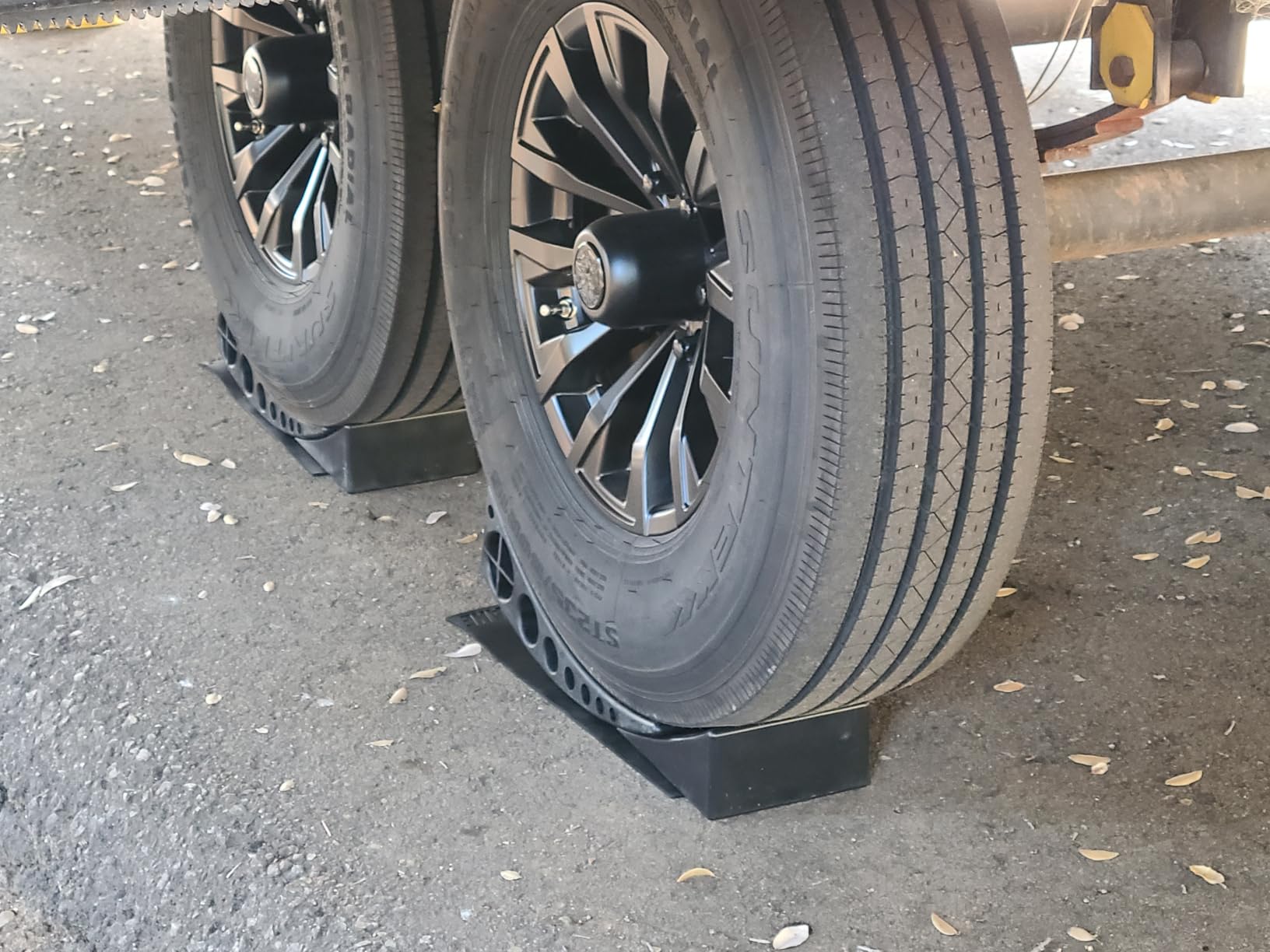
This is the most complete package on the list. You get two curved levelers, two matching chocks, two custom rubber grip mats and a carrying bag. Nothing is an add-on, which is the reason this kit edges out a bare ramp for a first purchase.
The grip mats are the feature owners mention most. A bare wedge on soft ground can slide sideways as you back the tire up, and the mats are what make the backing motion repeatable. The body is a high-performance nylon polymer chosen for structural load-bearing work, and Beech Lane markets it as designed not to compress or crack under trailer weight.
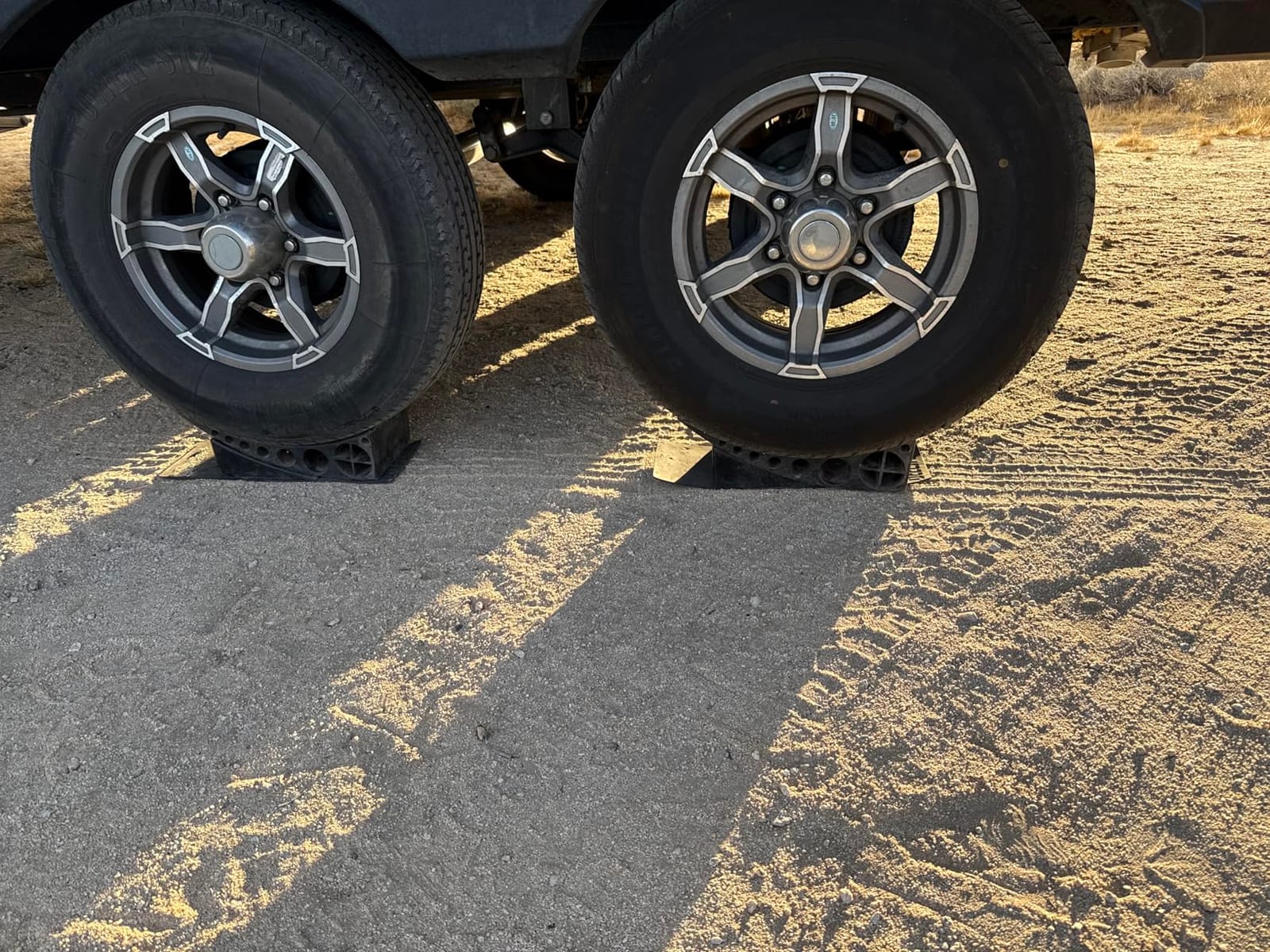
Adjustment runs from half an inch to 4 inches in any increment, each leveler measures roughly 6 inches wide by 15 inches long, and the kit is backed by a lifetime warranty under patent D949746. It carries 4.8 stars from close to 2,000 reviews with 84 percent at five stars, the highest star average among the drive-on options.
As with the other ramps, dual-axle clearance is the thing to check. Up to 4 inches may need cutting from one leveler depending on tire spacing, and 2.5 to 3 inches of clearance usually lets you use it uncut. The lifetime warranty still applies after a cut-to-fit modification.
When the Beech Lane Kit is the right call
It suits anyone who wants drive-on speed and anti-slip grip on soft ground without buying a second accessory kit. If you camp on a mix of pavement and dirt, this is the set that handles both in the box.
The carrying bag also matters more than it sounds. Two ramps, two chocks and two mats in a single bag is far easier to keep with the trailer than an equivalent collection of loose pieces.
Where it falls short
It is 17 pounds, the heaviest kit here by a wide margin, and that is real when the walk from the truck to the site is long or the pitch is steep. It is also the least flexible option on very uneven ground, because a ramp fixes one height per position rather than letting you reshape a stack.
And you should still expect to trim one ramp for tight tandem spacing. Measure before you pack.
7. RVMATE 12 Pack Leveling Blocks – Budget Pick Block Count
RVMATE 12 Pack RV Leveling Blocks, Camper Trailer Leveling Blocks
- 10 blocks plus 2 top blocks and bag
- Each block adds 1 inch
- 0.75 inch tire saver top blocks
- High-density reinforced
Pros
- Top blocks cut direct tire contact and reduce tread compression wear
- Largest block count in the roundup at 12 pieces
- Stacks in multiple shapes and heights from the same pieces
- Carrying bag included in the box
- Holds the number one rank in the RV Levelers category
Cons
- Newer listing with a much smaller review base than the established brands
- Second lowest star average in the group at 4.6
- Blocks still require manual stacking and interlocking at every site
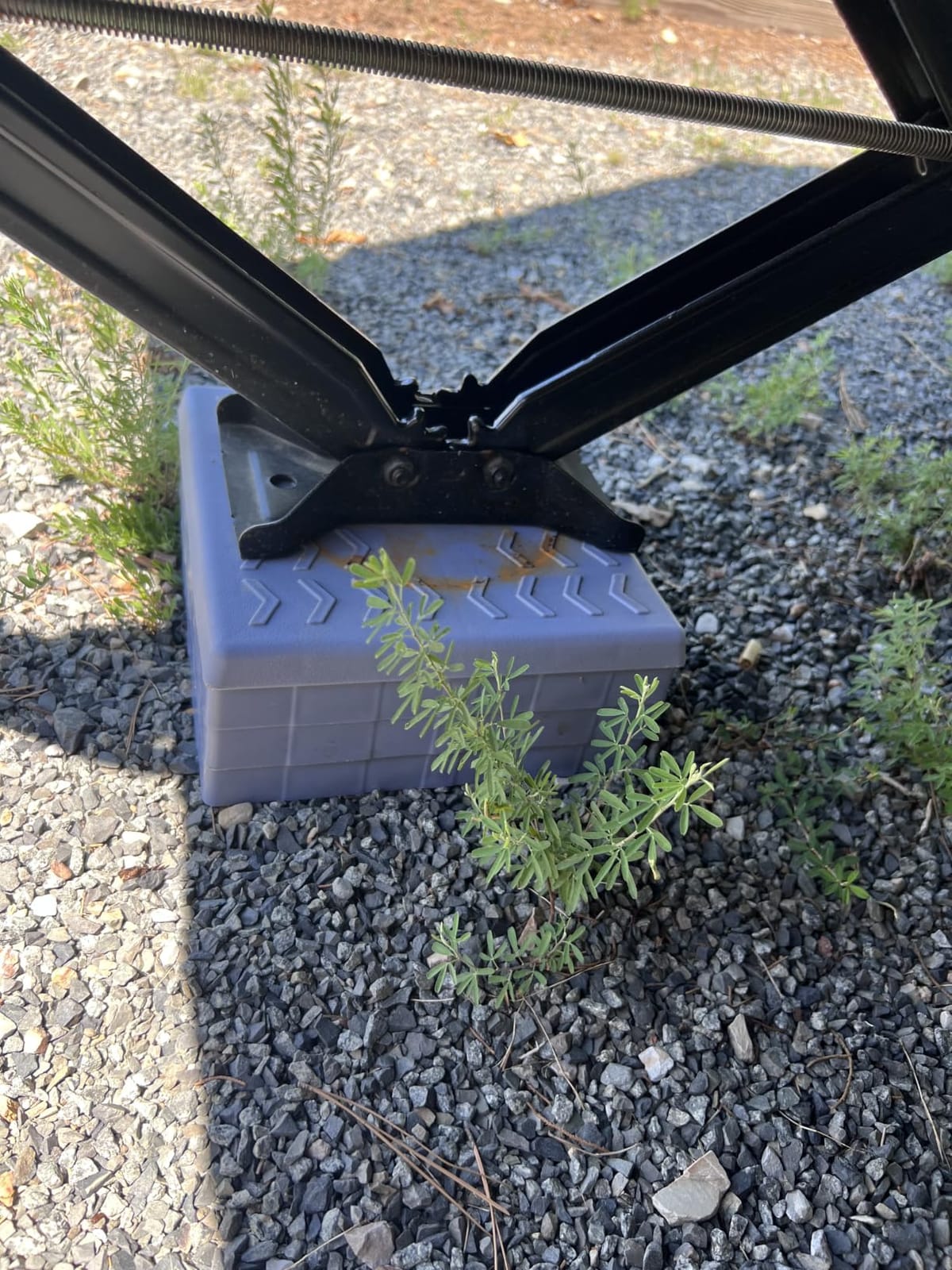
The 12-piece count is the headline here: 10 leveling blocks at 8.5 by 8.5 by 1.5 inches, plus two top blocks at 8.5 by 8.5 by 0.75 inches, plus a carrying bag. Each block adds 1 inch of stack height, and the set interlocks into columns or pyramids depending on what the site needs.
Those two top blocks are the reason this is not just a larger bag of the same block. They act as tire-saver covers that sit between the tire and the block body, which spreads the contact patch and reduces compression wear on the tread. Owners with low-mileage tires appreciate that more than the piece count does.
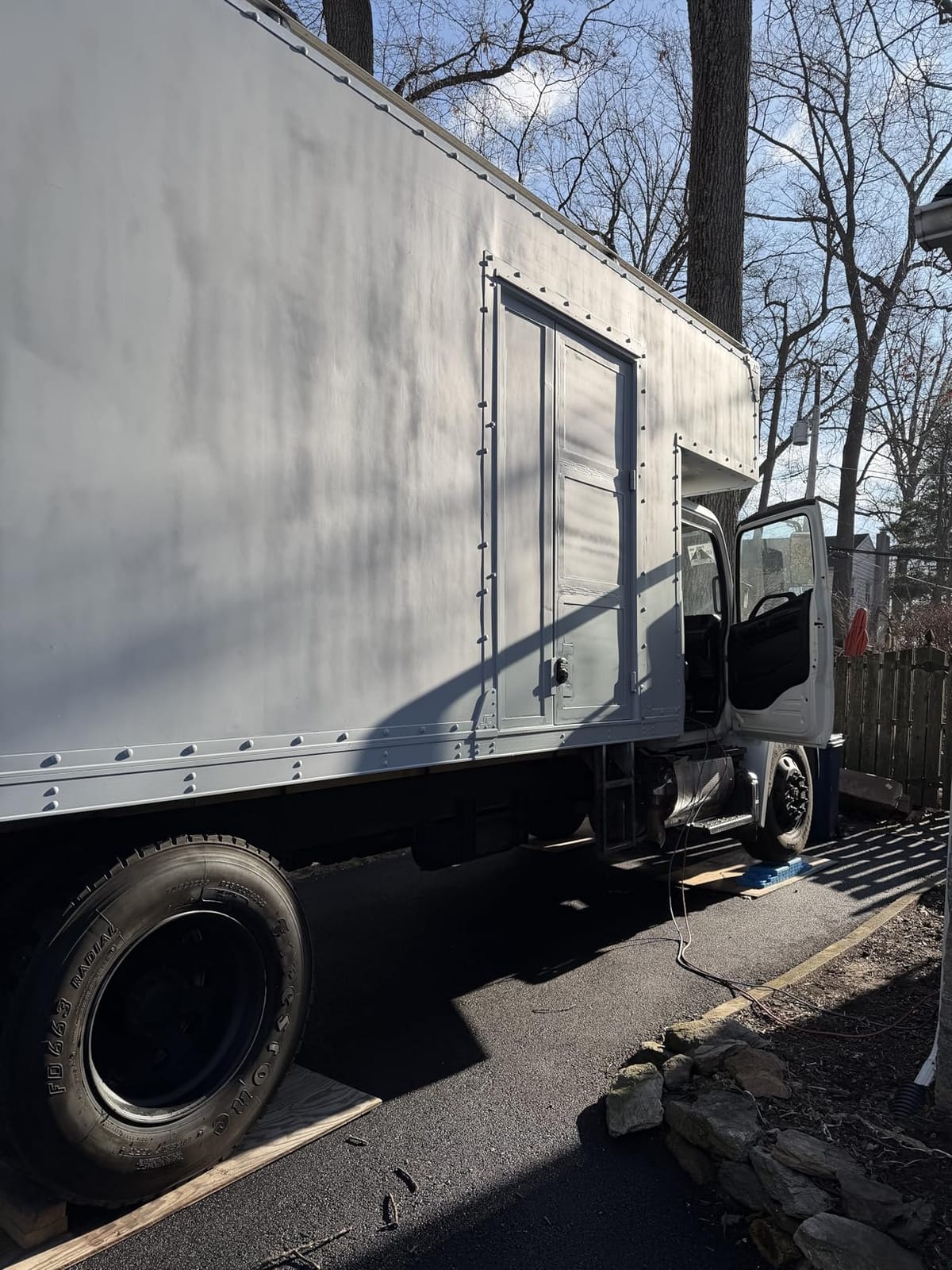
The construction is described as high-density reinforced interlocking material, and it works with single wheels, dual wheels, hydraulic jacks, tongue jacks, stabilizer jacks and fifth wheel jacks. Despite only being on the market for a couple of seasons, it currently holds the number one rank in the RV Levelers category with about 1,500 reviews at 4.6 stars.
Being a newer listing, the review base is much thinner than the Lynx or Camco sets, and the star average is second lowest in this group. That is the honest tradeoff: more pieces and a tire-saver feature against less long-term history.
When the RVMATE set is the right call
It fits campers who want more blocks than they strictly need, so a spare column is always available for the opposite side or for a jack foot. The 12-piece count also makes it a natural fit for a tandem trailer with a slide-out that needs supporting at more than one point.
The top blocks make it a good choice if you tow often and watch tire tread closely, since the tire is not resting directly on the block body.
Where it falls short
The thin review history is the main caution. With around 1,500 reviews against 18,000 on the Lynx set, there is less evidence about how the material ages through multiple seasons of sun exposure.
Like the other block sets, it is hand-stacked at every site. If speed of setup is your priority rather than block count, one of the drive-on ramps is the better tool.
8. Homeon Wheels 10 Pack with Ramp Sliders – Best for Easy Drive-On
Homeon Wheels 10 Packs Rv/Camper Leveling Blocks, Chocks Anti-Slip Pads Design Include One Wheel Chock and Carrying Bag for Camper Travel Trailer
- 9 interlocking blocks plus 3 ramp sliders
- Each block adds 1 inch
- Solid bottom structure
- Chock and bag included
Pros
- Only set here with three slanted entry ramps for driving on and off easily
- Lightest of the ten-count sets at 6.91 pounds
- Solid bottom structure helps resist sinking on soft ground
- Pieces interlock tight and pack into the included zippered bag
- Manufacturer replaced a poor quality bag on request
Cons
- Lowest star average in the group at 4.4
- Several owners report blocks cracking when stacked more than two high or on uneven ground
- Included bag is described as too small for the full set and chock
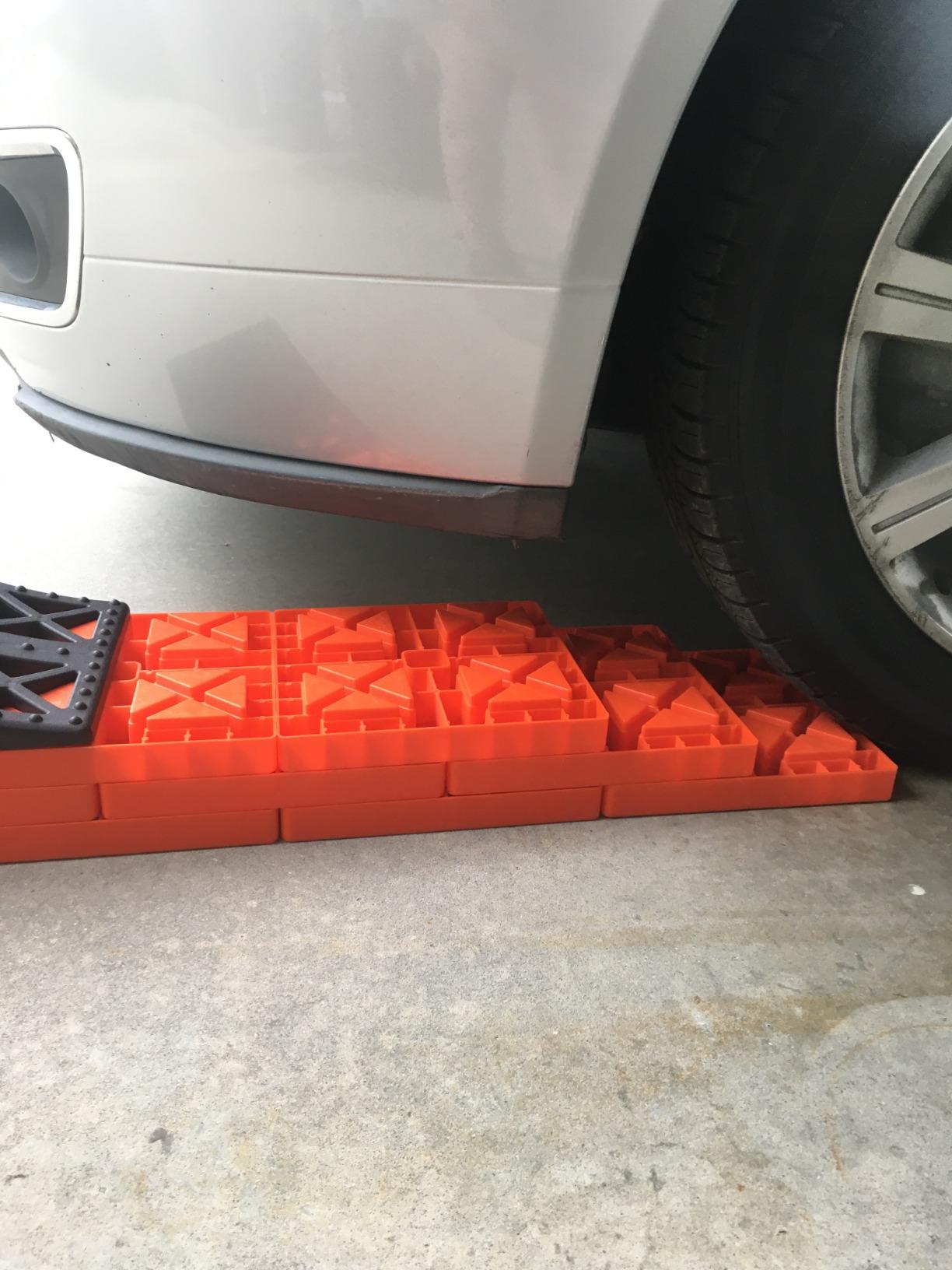
The distinguishing feature here is the three black slanted ramp sliders, and it matters more than the block count suggests. With a plain stepped stack you have to climb onto a one-inch ledge and work the tire up. The slanted sliders give you a graded entry, and two of the pieces double as carrying blocks for the bag.
The package holds 9 interlocking horizontal blocks at 8.5 by 8.5 by 1.3 inches, 3 slanted sliders at 8.5 by 4.2 by 1 inch, one wheel chock and a storage bag. Each block adds a full inch of height and the design stacks in a pyramid shape to reach the level you need.
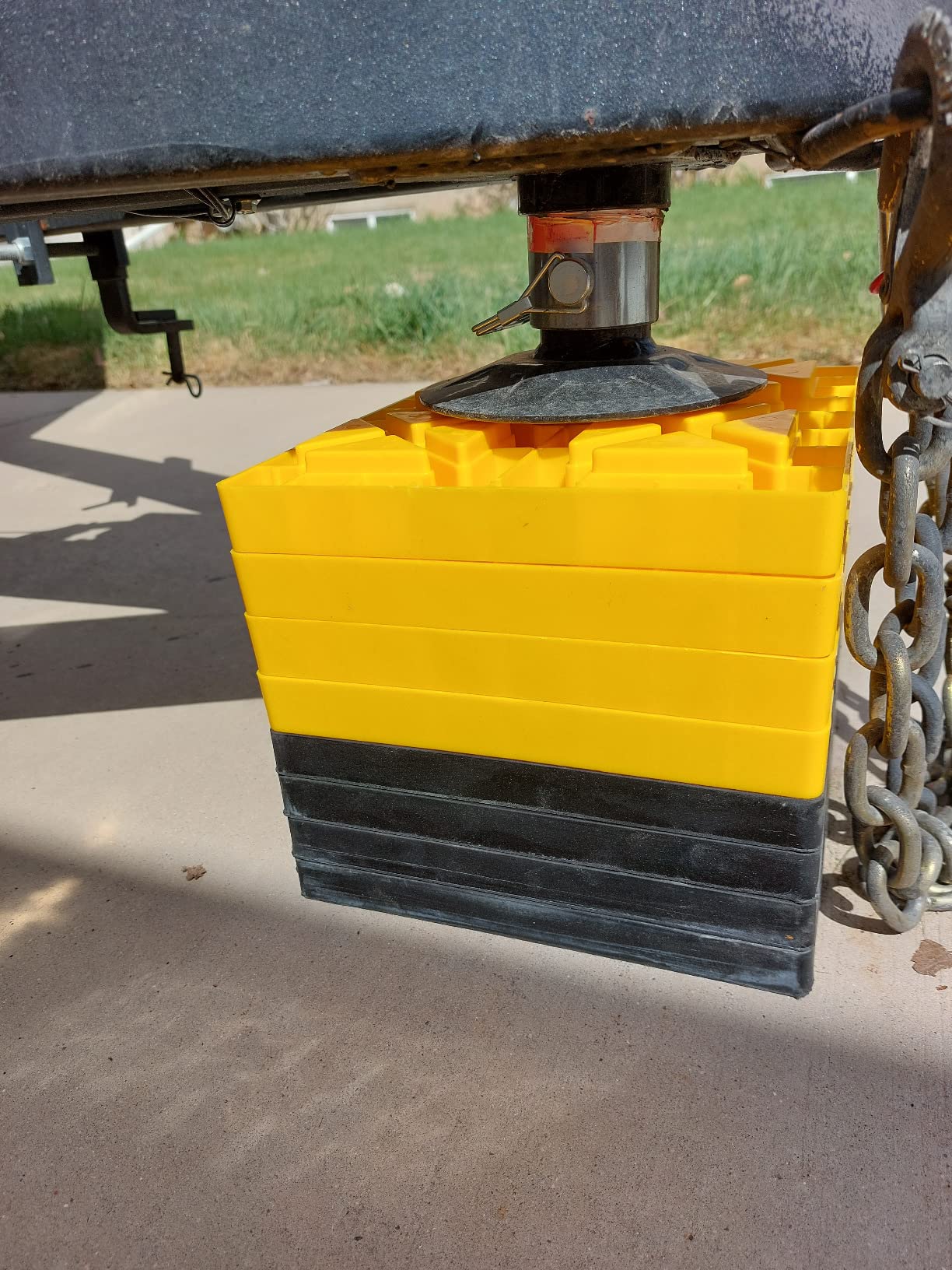
Solid bottom structure is the other differentiator. It is the same approach as the Camco 10-Pack, designed to reduce sinking and block crushing on soft ground, and at 6.91 pounds this is the lightest of the ten-count sets in the roundup.
At 4.4 stars from about 1,590 reviews, it carries the lowest average in the group, with 5 percent one-star and 3 percent two-star ratings. Reading the reviews, the complaint cluster is consistent: blocks cracking when stacked more than two high or on uneven ground, and a bag that is too small for the full set.
When the Homeon Wheels set is the right call
It makes sense if driving onto a stack is the part you dread. The slanted sliders turn a bump-and-hope into a smooth climb, which helps most on a tandem trailer where you have to make the approach twice.
The lighter carry weight is a real advantage for a walk-up site, and the interlocking design tightens for storage rather than leaving loose pieces in a bag.
Where it falls short
Stacking higher than two blocks is where owners report cracking, and that caps how much correction you can reach before you need a different tool. On a genuinely sloped site, that is a meaningful limit.
Given the 4.4 average, we would keep the stack to two or three high and treat the sliders as the main event. Check that the bag fits everything before your first trip, since owners report it running short of the full set plus the chock.
How Many Leveling Blocks Do You Need?
A typical tandem-axle travel trailer needs between four and eight blocks in total, which usually works out to two or three per low-side wheel plus whatever you want under the jack feet. A single-axle trailer needs fewer. This is the most-asked question in the RV forums and almost never appears in a roundup, so here is the geometry.
Pyramid stacking is the default and the most stable. You place one block on the ground, then two on top side by side, then two more, building outward as you go up. Each layer is wider than the one below it, so the load has a path down instead of sitting on a single column. Use a pyramid whenever the correction is more than 2 inches.
Single column stacking is one block on top of another. It uses fewer pieces and reaches the same height faster, but the wheel sits on a narrow footprint. It is fine for a one-inch correction and a poor choice on soft ground.
Two linked blocks with a flat top is the trick that shows up most often on the Good Sam travel trailer forum. Taking two blocks and linking them side by side under a flat-top piece gives you one wide platform instead of two narrow ones. That is the answer for short trailers with tight axle spacing, where a full-length ramp will not fit between the wheels and a single column is not stable enough to trust.
Buy for the site, not the number. Most owners who complain about wasted blocks bought a ten-pack for a campsite that is nearly flat, then used three or four of them forever. If you camp mostly on graded pads, a small set plus a wedge is enough. If you camp on dispersed and backcountry ground, the extra blocks earn their storage space.
How to Level a Travel Trailer on Blocks
Back in, then assess. Get the trailer roughly positioned first. The tongue jack handles front-to-back pitch, so what you are looking for now is the side-to-side difference between the two wheels on the low side.
Measure the drop. Put a bubble level on the floor inside, or use a leveling app, and note how far the bubble sits off center. Half a bubble is roughly an inch at typical trailer width.
Build the stack. Interlock the blocks to your measured height in a pyramid for anything above 2 inches, or set the ramp at the matching point on its curve.
Position and place. Move the stack or ramp under the wheel or jack foot. For a ramp, nudge it under the tire first so it cannot shoot sideways when you creep up.
Drive or jack on. Creep forward in short movements, checking the level after each. A one-inch step without entry ramps can be a hard bump at speed.
Chock. Fit a chock on the wheel so the trailer cannot roll back off the leveler while people are inside. This matters more on a ramp than on blocks.
Verify, then re-check later. Confirm the level, drop the stabilizers, and check again after an hour. Soft ground keeps settling, and a stack that was level on arrival may not be later.
Soft Ground: Why Blocks Sink and What to Put Under Them
Blocks sink because the base is small and the load is enormous. A tandem trailer with a few thousand pounds over one wheel concentrates that weight onto a footprint the size of a dinner plate, and wet soil or sand simply gives way. As the block settles unevenly, the load shifts to one edge, and that is when plastic cracks.
The structural answer is a solid, continuous base instead of a waffle grid. Ribbed grids are lighter and cheaper, but they punch into soil and the ribs carry the load individually. The Camco 10-Pack and the Homeon Wheels set both use solid bottoms for this reason, and that is the single spec that separates good soft-ground blocks from the rest.
On r/RVLiving the most repeated technique is to put a rigid base down first, then add the levelers on top. Plywood or a pair of 2×8 boards spread the load over a much larger area, and users report that the blocks essentially stop sinking once they have that base. The same threads note that experienced campers carry more than one approach, using lumber on soft ground and a different tool on hard ground.
Stacking taller is not a substitute for a base. A user on a Facebook RVing group reported building Camco blocks two or three high to offset a slope on soft ground and finding the result unsatisfactory. Height multiplies the leverage, not the footprint, so a taller stack on soft soil settles faster and cracks sooner.
One more caution from the forums, and it comes from manufacturer guidance rather than owners: blocks that shift or settle can cause slide-out damage. If you have a slide-out, treat a level trailer as a maintenance item rather than a comfort one, and re-check the level after the first night.
Leveling Blocks vs Jack Pads vs Auto-Leveling Systems
These three get confused constantly, and they solve different problems.
Leveling blocks and ramps go under the tires or the jack feet and raise the low side. They correct tilt. Nothing else in this list does that.
Stabilizer jack pads are small flat pads that go under the corner stabilizer legs. They spread the jack foot over soft soil so it does not punch in, and they add stability after you are level. Some oversized footplates are wide enough to level a small trailer without separate blocks, but they only work for the jack feet, not the wheels.
Electric auto-leveling systems are a different category entirely. They mount powered jacks or sensors to bring the rig to level automatically, which is genuinely appealing for frequent or full-time travelers who set up alone in the dark. They cost considerably more, need wiring and a battery, and require maintenance and occasional replacement actuators. The sensible approach is to still carry a few blocks, because an auto-leveler can only correct within its own range and you will eventually want one under a jack foot on a soft site.
For most travel trailer owners camping a handful of weekends a year, a block set or a ramp pair is the right investment. For someone who moves weekly, the powered system earns its keep.
How to Choose Leveling Blocks for Your Trailer
Match capacity to your loaded weight, not your empty weight. Every pick here rates between 30,000 and 40,000 lbs, so capacity is rarely the deciding factor for a bumper-pull. Confirm the stated rating exceeds your trailer’s GVWR anyway, since that is the number printed on your own documentation.
Decide between adjustment range and adjustment increment. This is the most important difference in the category. Stacking blocks move in fixed 1 inch steps, which means you are always choosing the nearest height rather than the correct one. Ramps adjust continuously from half an inch to 4 inches. If you have ever spent ten minutes swapping a block to chase a level, that difference is the whole argument for a ramp.
Check axle clearance before buying any ramp. Measure the gap between your tires with a tape. If you have 2.5 to 3 inches, a full-length ramp fits uncut. Below that, buy a trimmable ramp and know that the warranty needs to survive the cut. Both the CARMTEK and Beech Lane kits are designed for it.
Look at the base if you camp off pavement. Solid bottom for soft ground, waffle grid for weight savings on firm sites. This one choice predicts most of the crack complaints in the reviews.
Count storage before pieces. Two ramps that nest with a bag beat ten loose blocks in a shallow storage bay. RVForum users treat storage footprint as a primary buying factor, and in a small trailer they are right.
Check the warranty length. The ramps here carry lifetime manufacturer warranties, and in the Beech Lane case the lifetime coverage still applies after cutting a leveler to fit. The Camco FasTen set carries one year. Blocks made of UV-stabilized resin or nylon should last many seasons, but the warranty tells you what the maker will stand behind.
Confirm what comes in the box. A bag, a chock, grip mats and top blocks are not small additions. Four of the eight picks here include a carrying bag, and the two most complete kits include chocks and mats. That difference decides whether a set works on a soft site or only on a flat one.
Frequently Asked Questions
What are the best leveling blocks for a travel trailer?
The best RV leveling blocks for a travel trailer depend on ground type and patience. Interlocking stacking blocks such as the Lynx Levelers or the Camco 10-Pack give the most control over load shape and work on uneven or soft sites. Curved drive-on ramps such as the Andersen or Beech Lane level in under five minutes and adjust continuously from half an inch to 4 inches. Pick blocks for soft ground, a ramp for speed, and check axle clearance either way.
How many leveling blocks do I need for my camper?
A tandem-axle travel trailer typically needs four to eight blocks in total, usually two or three per low-side wheel plus extras for jack feet. Build in a pyramid above 2 inches of correction so each layer is wider than the one below it. On tight axle spacing, link two blocks side by side under a flat top piece to create one wide platform instead of two narrow columns.
What are the differences between Lynx levelers and Camco levelers?
Both are interlocking stacking sets rated for far more weight than a travel trailer needs, and both add 1 inch of height per interlocked block. The Lynx 11-pack includes a cap level top and is rated to 40,000 lbs with UV-stabilized polymer construction. The Camco 10-pack uses a solid base rather than an open grid, which resists sinking on soft ground, and its bright yellow color is easier to spot at dusk.
How much weight can Camco leveling blocks hold?
Camco leveling blocks are built from UV-stabilized resin and are sold in interlocking sets that add 1 inch of stack height per block. They are used under single and dual wheels, tandem axles, tongue jacks, stabilizer jacks and hydraulic jacks, which means the load is always the portion of your trailer’s weight carried by a single wheel or jack foot. With more than 14,000 reviews averaging 4.7 stars, the solid-base design is the most established soft-ground option in this roundup.
Are curved levelers better than stackable blocks?
Curved levelers are better when you want speed and precision. You back the tire up the ramp and stop at any point between half an inch and 4 inches of lift, which levels both sides in under five minutes. Stackable blocks are better when the ground is soft or very uneven, because you can build a pyramid that spreads load over a wider area. A common compromise is a block set with slanted entry ramps, so you get a stack that is easy to drive onto.
Which Leveling Blocks Should You Buy?
For most travel trailer owners, the best RV leveling blocks for travel trailers come down to two questions: how fast do you need to be level, and how soft is the ground. Answer the second one first. On soft or wet sites, take the Camco 10-Pack with its solid base, and put a piece of plywood down underneath it if the site is genuinely soft. On firm, graded ground, take a ramp and enjoy the five-minute setup.
Our overall pick is the Tri-Lynx Lynx Levelers 11 Pack. The 40,000 lb rating closes the capacity question outright, the cap level top and storage bag make it a complete kit, and more than 18,000 reviews at 4.8 stars give it the deepest ownership history in the category. For speed, the Andersen Hitches 2-Pack levels both sides in one pass with continuous adjustment from half an inch to 4 inches.
Whichever you choose, measure your axle clearance first, put down a rigid base when the ground is soft, chock the wheel once you are level, and re-check the trailer after it has been sitting an hour. That last habit matters more than any brand choice in this roundup, because a level trailer protects your slide-outs, your appliances and your sleep.