
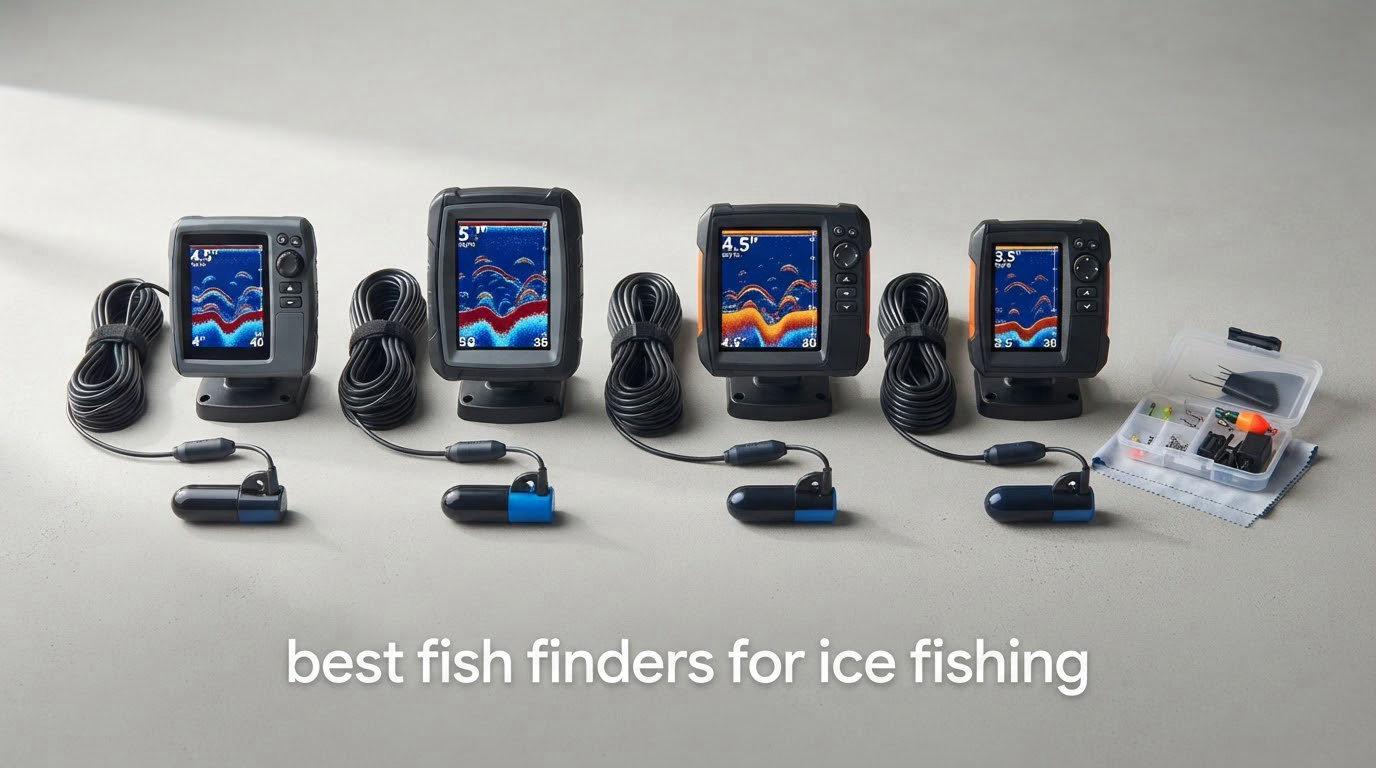
The Garmin Striker 4 with Portable Kit is the best fish finder for ice fishing overall in 2026, and the Garmin Striker Cast is the easiest one to get started with. Both handle the thing that matters most on ice: showing you the water column directly under your hole while you jig.
Ice fishing breaks every rule about sonar. You are not moving across a lake, you are standing over one narrow column of water, holding a jig, waiting for something to happen. That means a fish finder built for open water is not automatically the right tool, and a big color screen matters less than most roundups claim.
Our team worked through ten of the best fish finders for ice fishing, split them into the three families that actually exist, and looked hard at what owners say after a full season on the ice. We used published specifications and the patterns that show up repeatedly in owner reviews, and we weighed each one on how it performs over a hole rather than on how it looks on a boat transom.
If you only read one section, skip to the quick overview. Everything else below explains why the ordering falls the way it does.
Table of Contents
- Top 3 Best Fish Finders for Ice Fishing (October 2026)
- All 10 Ice Fishing Fish Finders at a Glance (2026)
- 1. Garmin Striker 4 with Portable Kit – Best All-Rounder for Ice and Open Water
- 2. Garmin Striker Cast – Best Low-Cost Way to Start on the Ice
- 3. Deeper PRO+ 2 – Best for Mapping Structure from Shore
- 4. Garmin Striker Plus 4 Ice Bundle – Best Complete Ice Kit with a Color Screen
- 5. Humminbird HELIX5 CHIRP G3 Ice Sonar System – Best Full Setup for a Group
- 6. Vexilar FL-8se Genz Pack – Best Classic LED Flasher
- 7. Vexilar GP1812 FL18 Genz Pack – Best Narrow Cone for Fish Holding Tight
- 8. LUCKY Wireless Handheld Fish Finder – Best for Scouting Water Without a Sled
- 9. Humminbird ICE Portable Kit – Best Add-On if You Already Own a HELIX
- 10. Humminbird ICE 55 Flasher – Best Color Flashing Without a Mapping Screen
- How to Choose an Ice Fishing Fish Finder (2026)
- Flasher Mode vs Scrolling Sonar: Which One Ice Needs
- Castable Sonar vs a Rigged Transducer
- Match Max Depth to the Lakes You Fish
- Cold-Weather Power and Battery Management
- Reading the Screen With Gloves On
- Garmin vs Humminbird vs Vexilar: Where Each Brand Wins
- Ice Fishing Cameras: The Tool That Does What a Flasher Cannot
- Frequently Asked Questions
- The Best Fish Finders for Ice Fishing: Our Final Verdict
Top 3 Best Fish Finders for Ice Fishing (October 2026)

Garmin Striker 4 Portable Kit
- Built-in flasher mode
- CHIRP sonar
- Rechargeable battery included
Garmin Striker Plus 4 Ice Bundle
- Dual-beam ice transducer
- 4 inch color screen
- Quickdraw Contours

As an Amazon Associate we earn from qualifying purchases. CERTAIN CONTENT THAT APPEARS ON THIS SITE COMES FROM AMAZON. THIS CONTENT IS PROVIDED 'AS IS' AND IS SUBJECT TO CHANGE OR REMOVAL AT ANY TIME.
All 10 Ice Fishing Fish Finders at a Glance (2026)
Three different jobs are being done in this list, so a straight ranking hides more than it shows. Read the readout column first: flasher, scrolling, or phone-based castable. That one choice narrows the field faster than any other.
| Product | Specifications | Action |
|---|---|---|
|
Garmin Striker 4 with Portable Kit
|
|
Check Latest Price |
|
Garmin Striker Cast
|
|
Check Latest Price |
 Deeper PRO+ 2
|
|
Check Latest Price |
|
Garmin Striker Plus 4 Ice Bundle
|
|
Check Latest Price |
 Humminbird HELIX5 CHIRP G3 Ice Sonar System
|
|
Check Latest Price |
 Vexilar FL-8se Genz Pack
|
|
Check Latest Price |
 Vexilar GP1812 FL18 Genz Pack
|
|
Check Latest Price |
 LUCKY Wireless Handheld Fish Finder
|
|
Check Latest Price |
 Humminbird ICE Portable Kit
|
|
Check Latest Price |
 Humminbird ICE 55 Flasher
|
|
Check Latest Price |
We earn from qualifying purchases. CERTAIN CONTENT THAT APPEARS ON THIS SITE COMES FROM AMAZON. THIS CONTENT IS PROVIDED 'AS IS' AND IS SUBJECT TO CHANGE OR REMOVAL AT ANY TIME.
1. Garmin Striker 4 with Portable Kit – Best All-Rounder for Ice and Open Water
Garmin 010-01550-10 Striker 4 Fish-Finder with Portable kit, 3.5″
- 3.5 inch LCD
- Built-in flasher mode
- CHIRP sonar
- Rechargeable battery in the box
Pros
- Flasher mode works well with the included transducer
- Rechargeable battery plus AC charger included
- Readable in direct sunlight
- Carry bag holds unit battery and transducer
- Waypoint marking helps you return to productive spots
Cons
- Bundled transducer is not ice-specific and has no arm
- Dedicated ice transducer costs extra
- Cord can stiffen in very cold temperatures
I came to the Striker 4 expecting to have to choose between fishing it on the ice and fishing it from the boat. It does both without a second purchase, which is why it sits at the top of this list for most people. The flasher mode is the reason it works on ice, and the waypoint map is the reason it does not become dead weight come July.
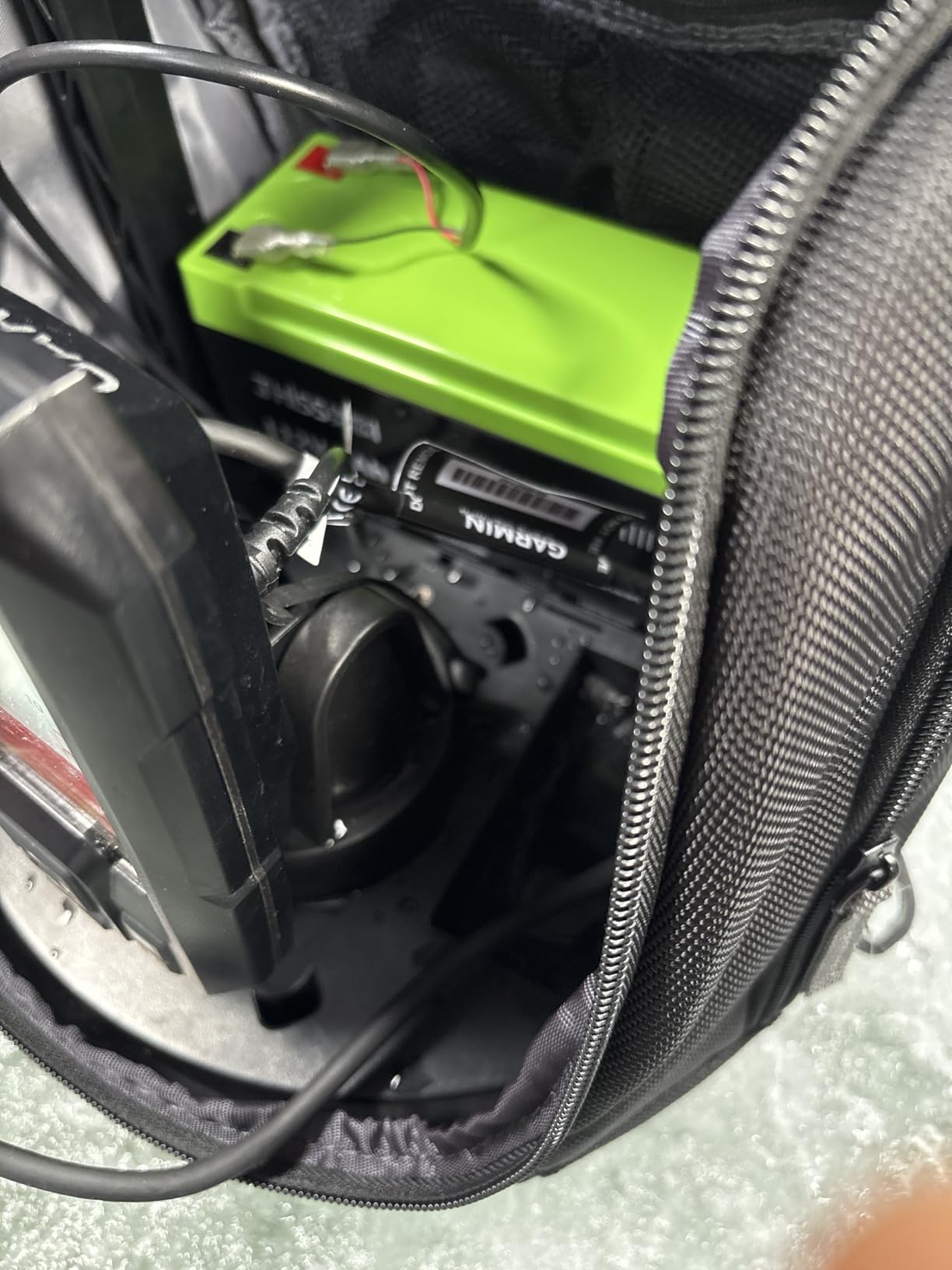
The included rechargeable battery and AC charger matter more than the spec sheet suggests. You are not plugging a unit into a wall at a shack, so a sealed rechargeable pack that runs a full day is the difference between a usable finder and a paperweight. The carry bag takes the unit, the battery and the transducer in one trip.
Owners are consistent about the screen. In flat winter light, on a bright overcast noon, a 3.5 inch monochrome LCD with a keyed interface is genuinely readable, and dedicated buttons are far easier to hit with a glove on than a touchscreen.
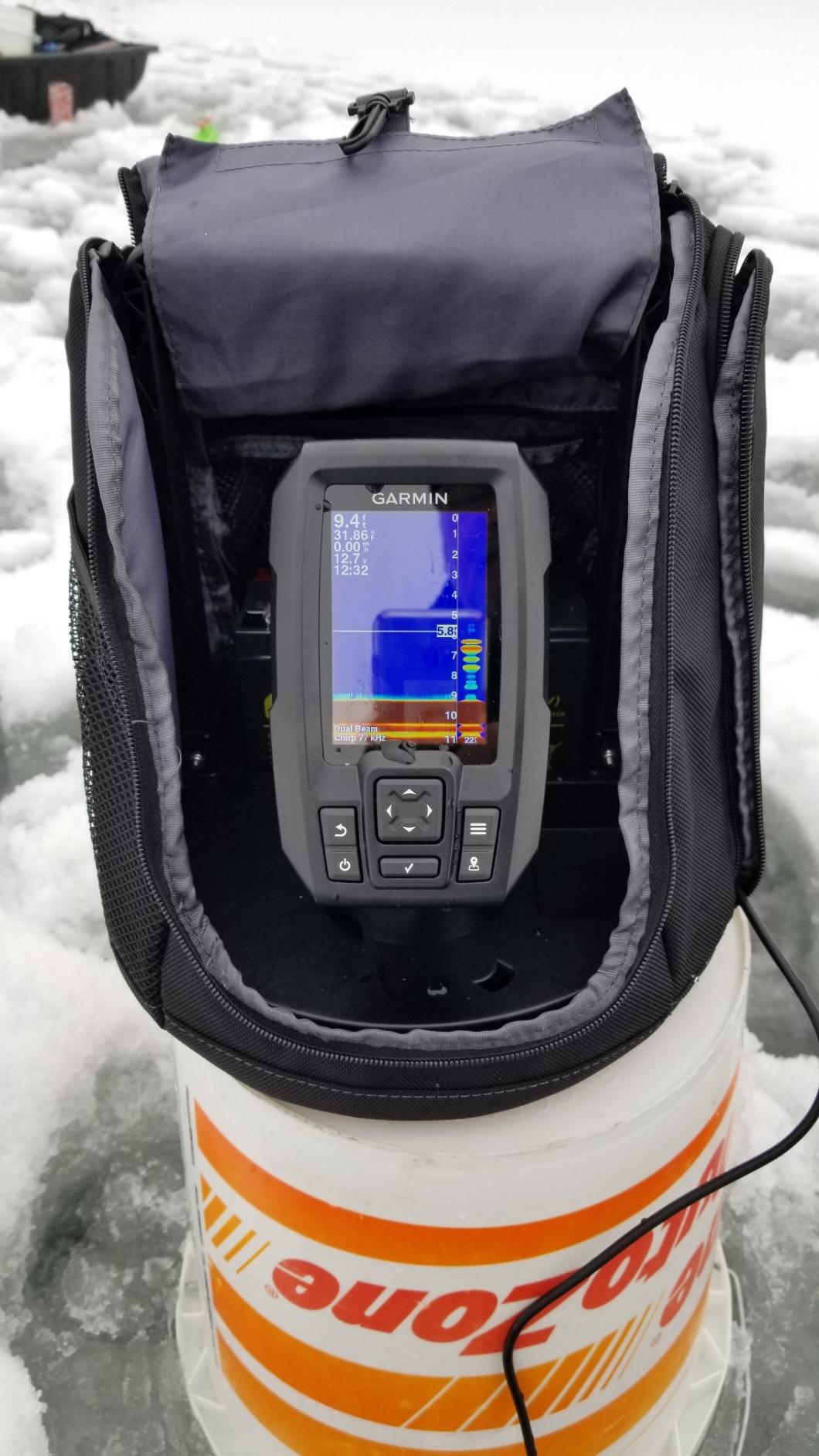
The recurring gripe is the transducer, not the unit. It is a boat-style transducer, so it has no arm to hold it off the edge of the hole, and owners regularly report buying a dedicated ice transducer separately. A dedicated ice transducer for this unit runs at a meaningful fraction of the finder cost, which is worth budgeting for before you drill your first hole.
Two smaller things come up repeatedly: the power cable has no quick disconnect, so charging means undoing wires at the battery terminal, and the cord stiffens in deep cold. Neither is a deal breaker, but both are annoying when your hands are bare and it is ten degrees below zero.
Boat forum owners who run a Striker 4 describe the same appeal from the other end of the year, using one unit on a kayak, on the ice and on the boat. That dual-season pattern shows up again and again in the owner reviews for this model, and it is the reason the finder sits at the top of our list.
Is the Striker 4 good enough as your only fish finder?
Yes, for most anglers. The flasher covers vertical jigging, the scrolling sonar covers structure hunting, and the waypoint map gets you back to the spot that produced fish last week. Very few people need more than that for a season.
The one case where it is not enough is if you are fishing deep water and want high-resolution structure imaging, because CHIRP on a small monochrome screen is not the same as a dedicated side-imaging view. If that is your game, look at a color unit with an ice transducer in the box.
What should you budget for alongside the Striker 4?
Budget for a battery if the rechargeable pack does not get you through a day, and for an ice transducer. Owners also mention that the documentation is confusing and that many of them learned the setup from third-party videos instead, which is worth knowing before you open the box in the car park.
Also plan a shuttle or sled to keep everything off the wet snow. A flat platform that holds the battery and the display at chest height is not an accessory, it is the difference between fishing all day and fighting yourself all day.
2. Garmin Striker Cast – Best Low-Cost Way to Start on the Ice
Garmin Striker Cast, Castable Sonar, Pair with Mobile Device and Cast from Anywhere, Reel in to Locate and Display Fish on Smartphone or Tablet (010-02246-00)
- Castable wireless sonar
- Flasher mode over the hole
- Pairs with a phone or tablet
- 10+ hour battery
Pros
- Smallest and lightest unit here
- No separate screen to power in the cold
- Supports traditional flasher mode
- Quick setup with the free app
- 10+ hour internal rechargeable battery
Cons
- Relies entirely on a phone or tablet
- No own display if the paired device fails
- Transducer must be fished rather than parked
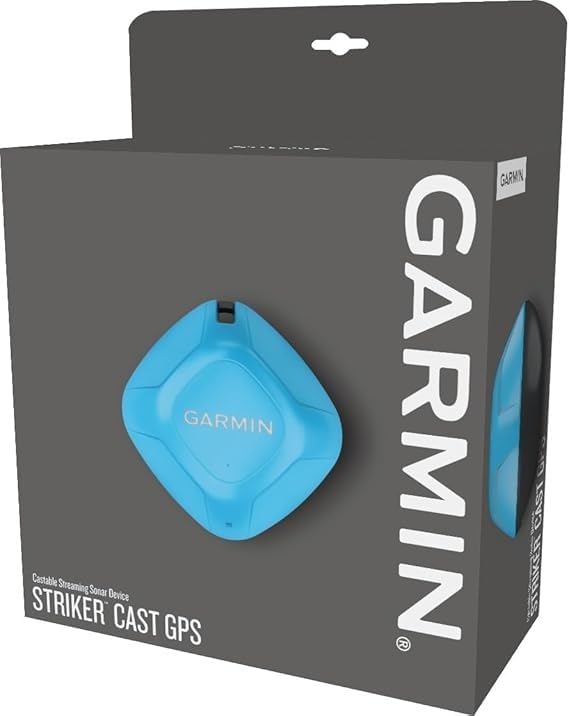
The Striker Cast answers a question a lot of first-timers have, which is whether they need to own any hardware at all. The answer is: very little of it. A pod the size of a small thermos streams sonar to your phone, and the free app gives you a flasher view over the hole.
Because the sensor has to be fished rather than parked, this is a jigging tool first. That is a genuinely good fit for ice fishing, since you are already working a lure up and down. Drop it in the hole, watch the flasher band, and you see the same instant feedback a desktop flasher gives you.
It also solves the weight problem. At 75 g the whole rig fits in a jacket pocket, which means no shuttle, no sled hauling and no heavy battery across the flats. For someone walking onto a lake alone at first light, that matters more than screen quality.
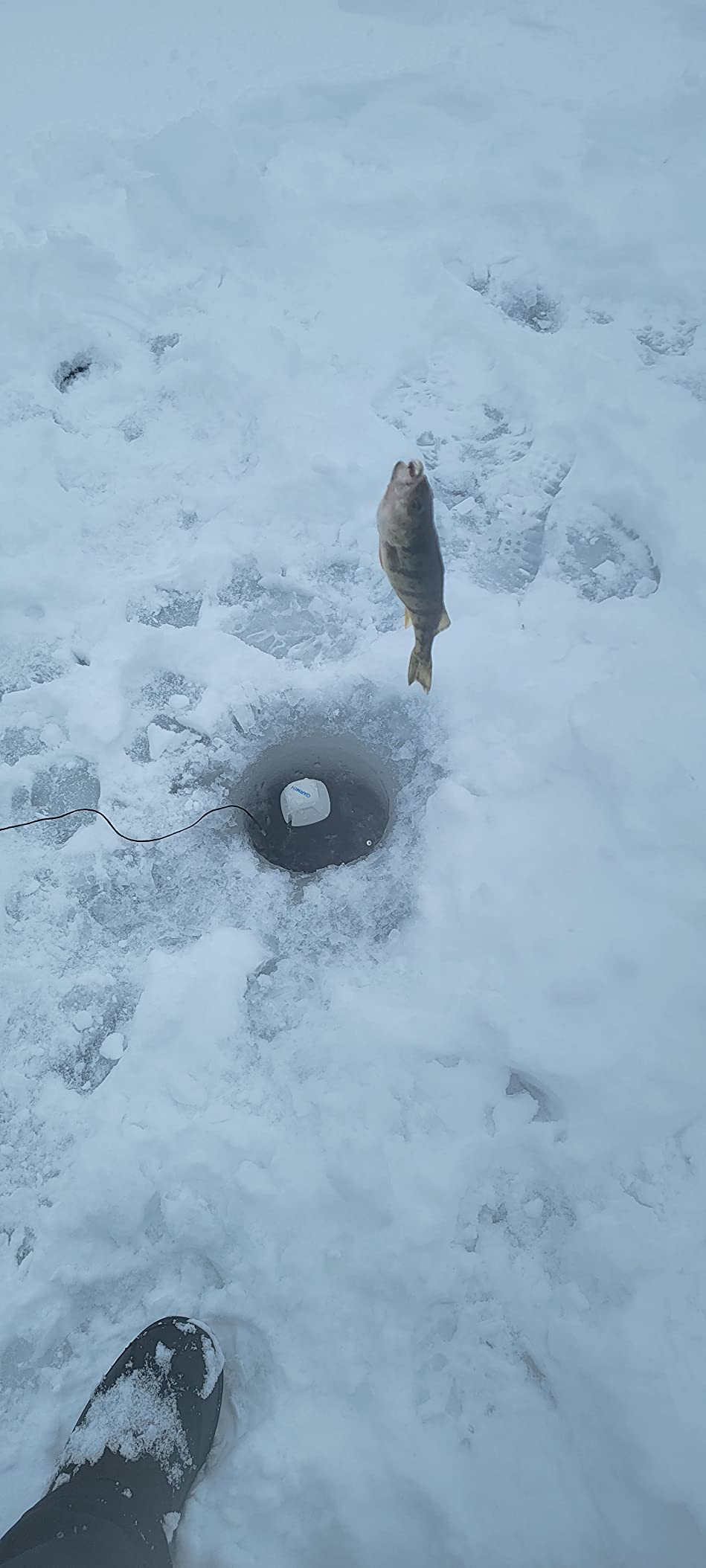
Wi-Fi range is up to 200 feet from your device, so you can leave the sensor in the hole and step back to a sheltered spot. Owners like the pairing speed, and the fact that it powers on when the sensor floats and off when you pull it out means you are not draining the battery while you walk between holes.
The phone dependency is the real tradeoff, and cold makes it worse. A phone battery in winter loses charge quickly, and if the screen cracks or dies on a frozen lake you have no fallback readout. That failure mode is the most common complaint in the owner reviews for phone-based castable sonar.
Owners also note that this is a fishing sensor, not something to park. Sitting on the bottom under ice it still returns data, but you are meant to work it, and the readings are less settled than a rigged unit.
Is a phone-based castable sonar good enough for a first season?
Yes, for shallow and mid-depth water and for anyone who fishes alone. The flasher mode is the part that matters on ice, and it works. The moment you need to mark a spot and come back to it in the afternoon, a castable sensor stops being the right tool.
It is also a good second unit. A lot of anglers carry one of these in the truck for scouting a new lake and keep a rigged flasher at the shack.
What are the tradeoffs you accept with the Striker Cast?
You accept screen fragility and cold battery drain in exchange for carrying nothing. If you fish with a partner, you can hand the phone off and share one screen. If you fish alone in serious cold, the phone is your single point of failure.
There is no graph history and no mapping of your own, though you can pull contour maps from the Garmin Quickdraw Community. That is a borrowing library, not your own recorded bathymetry.
3. Deeper PRO+ 2 – Best for Mapping Structure from Shore
Deeper PRO+ 2 Sonar Fish Finder – Portable Fish Finder and Depth Finder For Kayaks, Boats and Ice Fishing with GPS Enabled | Castable Deeper Fish Finder with FREE User Friendly App
- 3.2 ounces
- 330 ft depth
- Wide mid and narrow beams
- Built-in GPS
Pros
- Very light at just over 3 ounces
- Three beam options for scanning or drilling in
- 0.4 inch target separation on narrow beam
- Built-in GPS for saving your own bathymetry
- Strong wireless connection to the app
Cons
- No own display
- Phone battery drains in cold weather
- Wi-Fi link can lag or drop
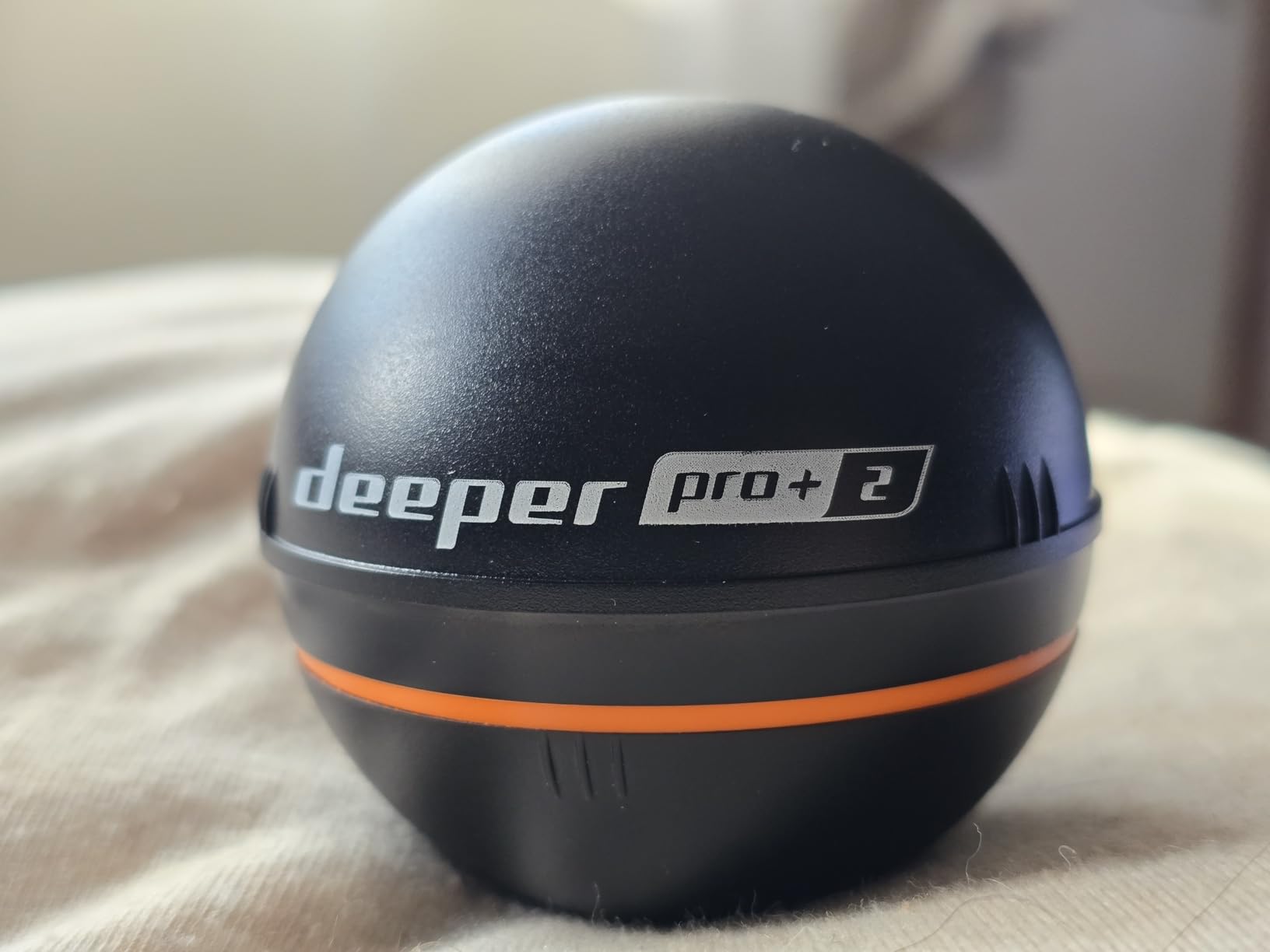
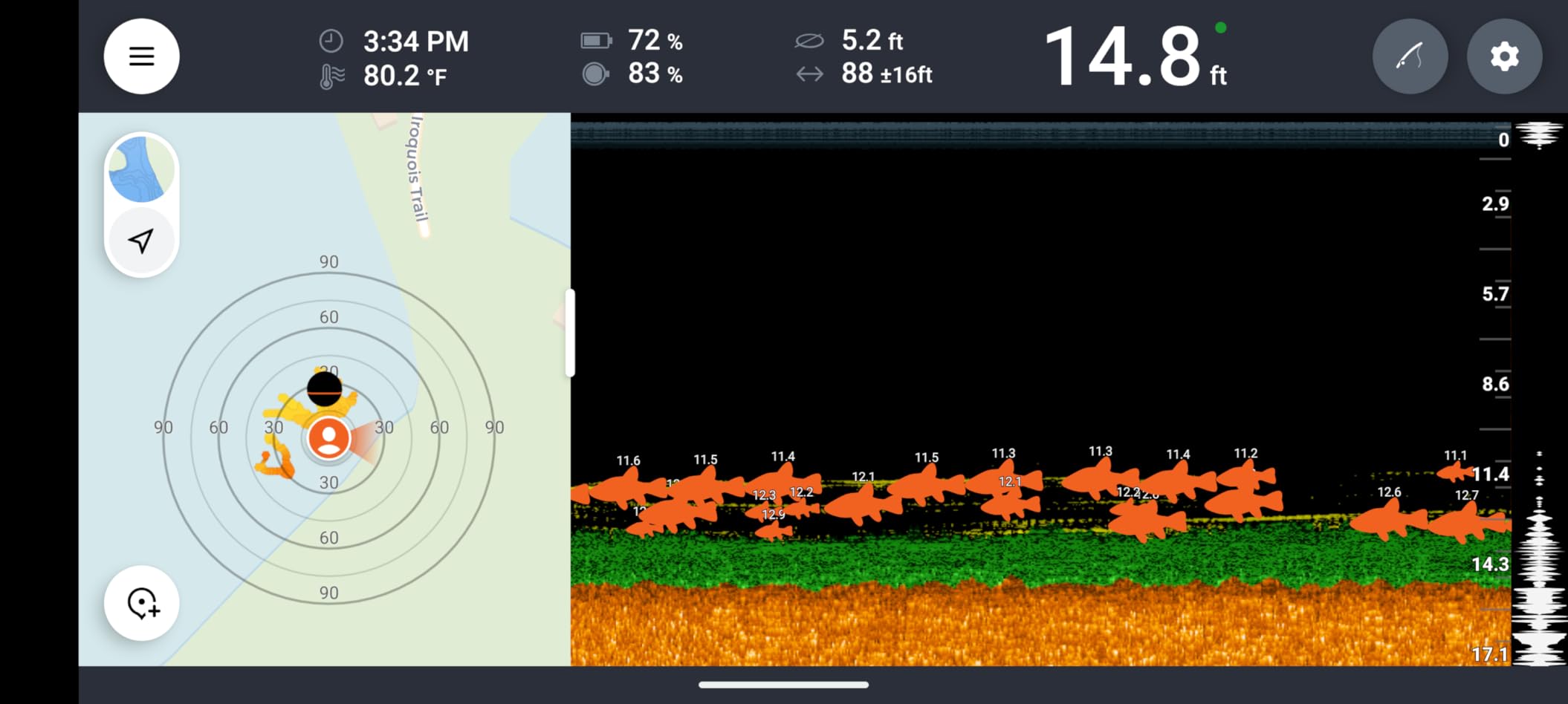
The Deeper PRO+ 2 is the one to buy if your plan is to walk a shoreline, find the drop-off, and come back later with a rod. Built-in GPS plus wide, mid and narrow beams is a combination aimed squarely at mapping, and the app saves what you record for next time.
On the ice it behaves as a vertical jigging sensor. The narrow beam resolves targets down to 0.4 inch, which means a small jig or a panfish is a separate mark instead of part of a smear. That specificity is what you want when you are working a hole over structure in 20 feet of water.
At just over 3 ounces it is light enough to carry and drill with all day without thinking about the weight, and the neoprene pouch and short USB cable mean the whole thing lives in a jacket pocket between trips.
The 4.2 average on this one deserves an explanation, because the reviews are sharply split by use case. Owners using it as intended, for mapping and for vertical jigging over a hole, rate it very highly. The low tail comes from people expecting a standalone unit with their own screen.
Wireless dropouts are the other theme. A few owners report the Wi-Fi link lagging in heavy cover or under thick ice, which is exactly where you might be standing. Keep the phone close to the hole and this rarely becomes a problem.
Reviewers also flag the phone battery as the limiting factor in a full day of fishing. A power bank in the sled solves it, and it is a far cheaper fix than the alternative.
Is the Deeper PRO+ 2 better than a rigged flasher over a hole?
No. A rigged flasher gives steadier, more sensitive feedback on a stationary jig, which is the whole point of vertical jigging. What the Deeper adds is mobility, beam choice and the ability to record a map you can return to.
Most anglers who own one end up using them for both jobs, the flasher-style screen for the hole and the wide beam for finding the drop-off on the walk.
Is 330 feet of depth enough for lake trout water?
For most inland lakes, yes. The rating is stated in metric and converts to 330 feet, which covers the great majority of the ice fishing most people do. If you fish a very deep clear-water lake where fish hold well past 300 feet, check that before you commit.
The narrow beam is where the accuracy claim lives, and it is the mode to use when you are watching your own lure rather than scanning.
4. Garmin Striker Plus 4 Ice Bundle – Best Complete Ice Kit with a Color Screen
Garmin Striker Plus 4 Ice Fishing Bundle, Includes Portable Striker Plus 4 Fishfinder and Dual Beam-IF Transducer
- 4 inch color display
- Dual-beam ice transducer in the box
- Quickdraw Contours
- GPS
Pros
- Color screen is far easier to read than monochrome
- Purpose-built ice transducer included
- CHIRP gives strong target separation
- Battery charger bag and foam float all included
- Two-year limited warranty
Cons
- Costs more than entry portable kits
- Color screens draw more power in cold weather
- Power cable connects directly to the battery
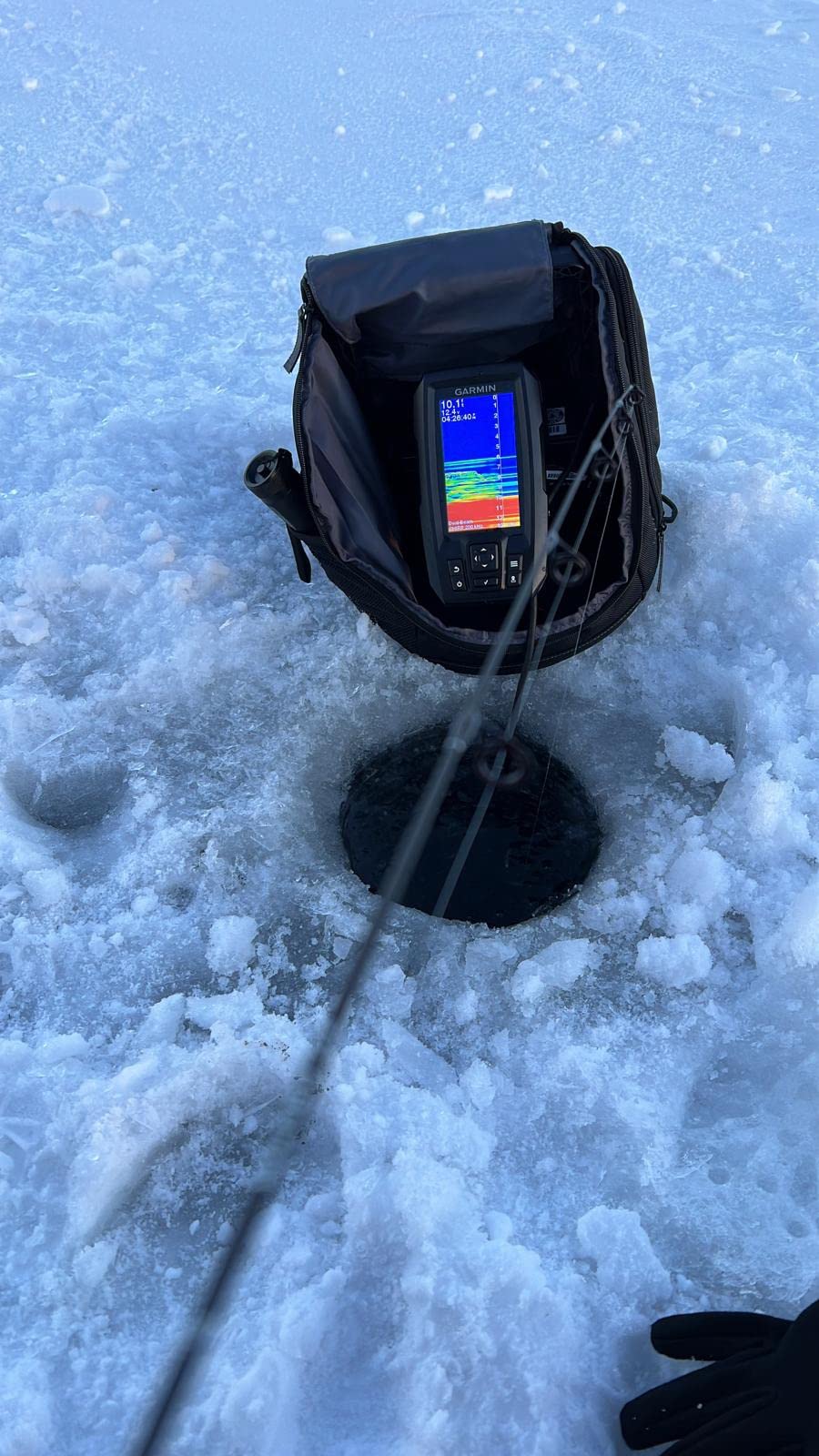
This is the bundle to buy if you do not want to assemble a rig piece by piece. The Striker Plus 4 Ice Bundle arrives with a dual-beam ice transducer, a rechargeable battery, an AC charger, a foam float, a tilt and swivel mount and a case. Nothing else to buy except a shuttle or sled.
The 4 inch color screen is the differentiator against every other unit in this list. Color separates a fish return from a jig return from bottom clutter at a glance, which is the specific weakness of a monochrome flasher when a lake is full of structure.
Owners rate this bundle at 4.7, and the two things they name most often are the transducer and the display. That combination is the reason it finishes where it does.
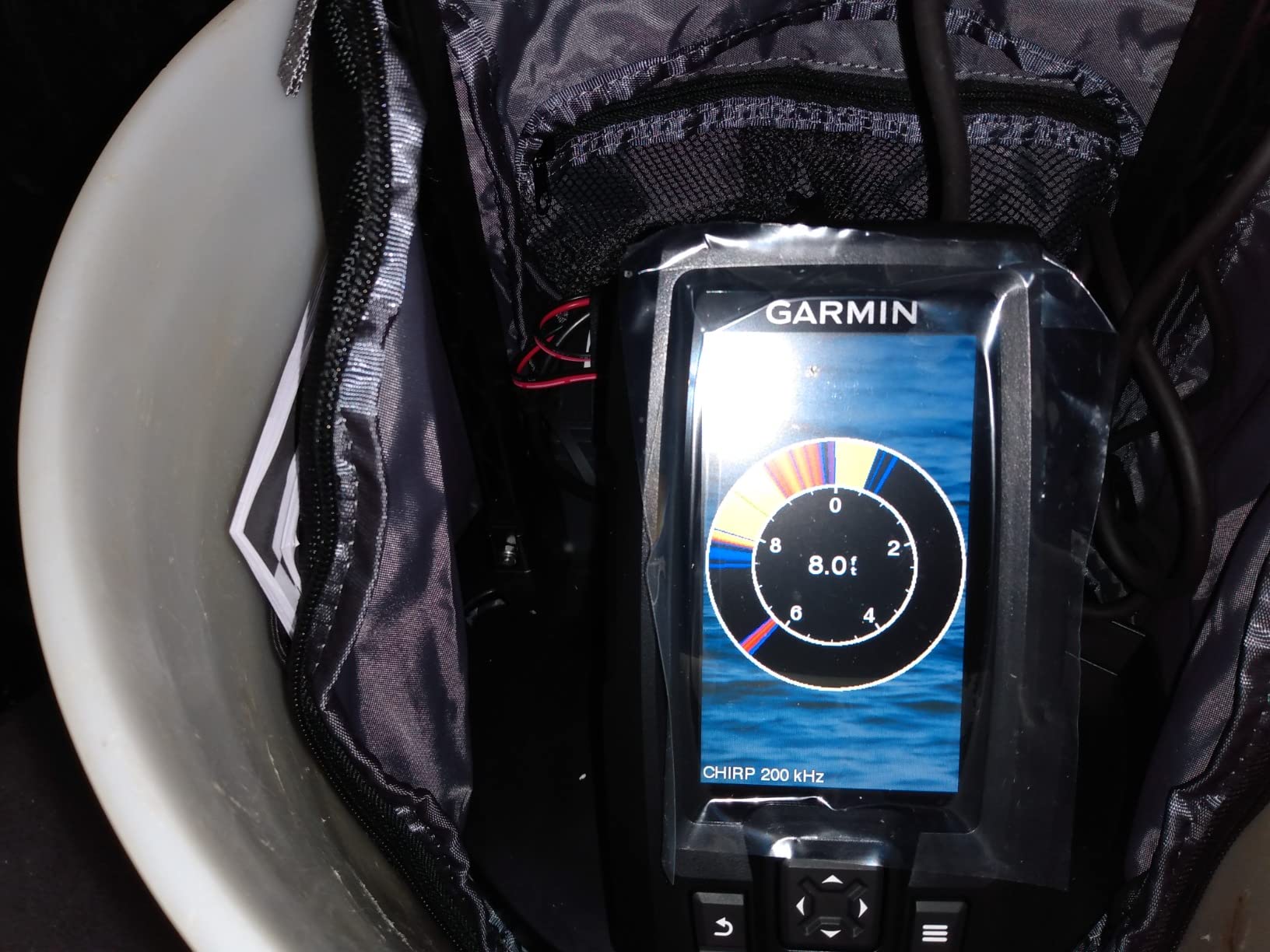
CHIRP traditional sonar on a dual-beam transducer gives good target separation, which is the term for cleanly showing two fish as two marks instead of one blob. On ice that is the difference between seeing a school as a wall and seeing individual fish to work.
Quickdraw Contours and high-sensitivity GPS let you record depth contours and mark waypoints. Marking a productive hole and coming back to it is one of the highest-value habits on the ice, and it is not available at all on a pure flasher.
The complaint pattern is thin, which is itself informative. Owners mention the higher cost compared with entry portable kits, more battery draw from the color display in cold conditions, and a power cable that connects straight to a battery rather than a quick disconnect.
Is the bigger color screen worth the extra cost on ice?
For most anglers, yes, because color and size solve a real problem: telling targets apart on a cluttered bottom. If you are fishing open water over sand and rock with a single species, a monochrome flasher does the job at a lower cost.
There is a second benefit that gets overlooked. A color screen shows you more information in low light at dusk, which is when many serious ice anglers start.
How does this compare with the cheaper Striker 4 Portable Kit?
The two overlap heavily, and the honest answer is that the Striker 4 is the better value purchase. Choose the Plus 4 bundle if you want the ice transducer in the box, the color screen, GPS mapping and a two-year warranty already handled.
Choose the Striker 4 if you are willing to add an ice transducer later and you mainly want flasher performance with a waypoint map.
5. Humminbird HELIX5 CHIRP G3 Ice Sonar System – Best Full Setup for a Group
Humminbird HELIX5 CHIRP G3 Ice Sonar System
- 5 inch LCD
- Dual Spectrum CHIRP in ICE mode
- Ice shuttle with battery space
- 9Ah battery and charger
Pros
- Dual Spectrum CHIRP gives crisp arches and bottom detail
- Dedicated flasher A-Scope and zoom ICE views
- Shuttle has battery space for hole-hopping
- 9Ah battery and charger plus portable bag
- Interference rejection helps in crowded shacks
Cons
- One-year manufacturer warranty
- Heaviest unit in this lineup at 12 pounds
- Only 47 ratings so the long-term record is thin
The HELIX5 CHIRP G3 Ice Sonar System is one of the most complete single-box setups here, and the reason is the shuttle. It has a defined space for the battery, so the whole thing moves from hole to hole as one unit instead of becoming a pile of loose parts in a sled.
Dual Spectrum CHIRP is the technical headline, and on the ice it shows up as crisp arches and a clear bottom line. The custom ICE views go beyond a single flasher screen: flasher, A-Scope, zoom and interference rejection are all available, and the interference mode is genuinely useful when several people are fishing close together.
The 5 inch display is roomy enough to read at arm’s length, which is a real advantage in a shelter where two people want to watch the same readout.
Owners are enthusiastic about image quality. The sample size is the caveat worth stating plainly: 47 ratings is a thin base, so you are trusting the specification and the design more than a long field record.
Weight is the practical problem. At 12 pounds this is the heaviest item in the lineup, and a full sled with an auger, a shelter and this unit on top is a real walk. Nobody describes hauling it as easy.
The one-year manufacturer warranty is also shorter than the two years offered on some competing bundles, which matters more on electronics that live in a wet, freezing environment.
Is the HELIX5 CHIRP G3 worth choosing over a Garmin bundle?
If you fish alone or in a light shelter, the weight-to-capability ratio works against it. If you fish in a group and want the most screen and the most ICE display modes in one box, it is hard to argue with.
The interference rejection mode is the sleeper feature. In a busy shack it is the difference between a readable flasher and a flickering mess.
What should you consider before buying a 12 pound setup?
Consider your walk. If the nearest launch is a long way from your spot, the total sled weight is the deciding factor and a wireless unit will change your day. If you are set up close to a road, the shuttle system is worth the extra weight.
Also read the warranty term before you commit. A one-year term on an ice unit is a shorter safety net than the two-year terms offered elsewhere in this list.
6. Vexilar FL-8se Genz Pack – Best Classic LED Flasher
Vexilar FL-8se Genz Pack with 19 Degree Ice Flasher – GP0819
- 19 degree ice flasher cone
- 120 ft max depth
- LED flasher display
- Dial and switch controls
Pros
- Very sensitive
- tracks a small bait all the way down
- Instant feedback with no scrolling delay
- Battery life measured in full days
- Single dial and switch work with gloves on
Cons
- No graph and no history screen
- No battery life indicator on the unit
- Bulky case alongside an auger
The FL-8se is the unit that ice fishing communities keep calling the adequate basic model, and after reading the owner reviews I understand why. It does one thing, it does that thing instantly, and it runs for days on a charge. Nothing about the experience is slow.
A 19 degree cone gives a focused target zone right around your jig, which is exactly the geometry you want when you are working vertically over a hole. Owners describe being able to track a tiny bait falling all the way to the bottom, which tells you the sensitivity is real.
The controls are a single dial and a switch. With gloves on, in the cold, while holding a rod, that is about as close to foolproof as electronics get.
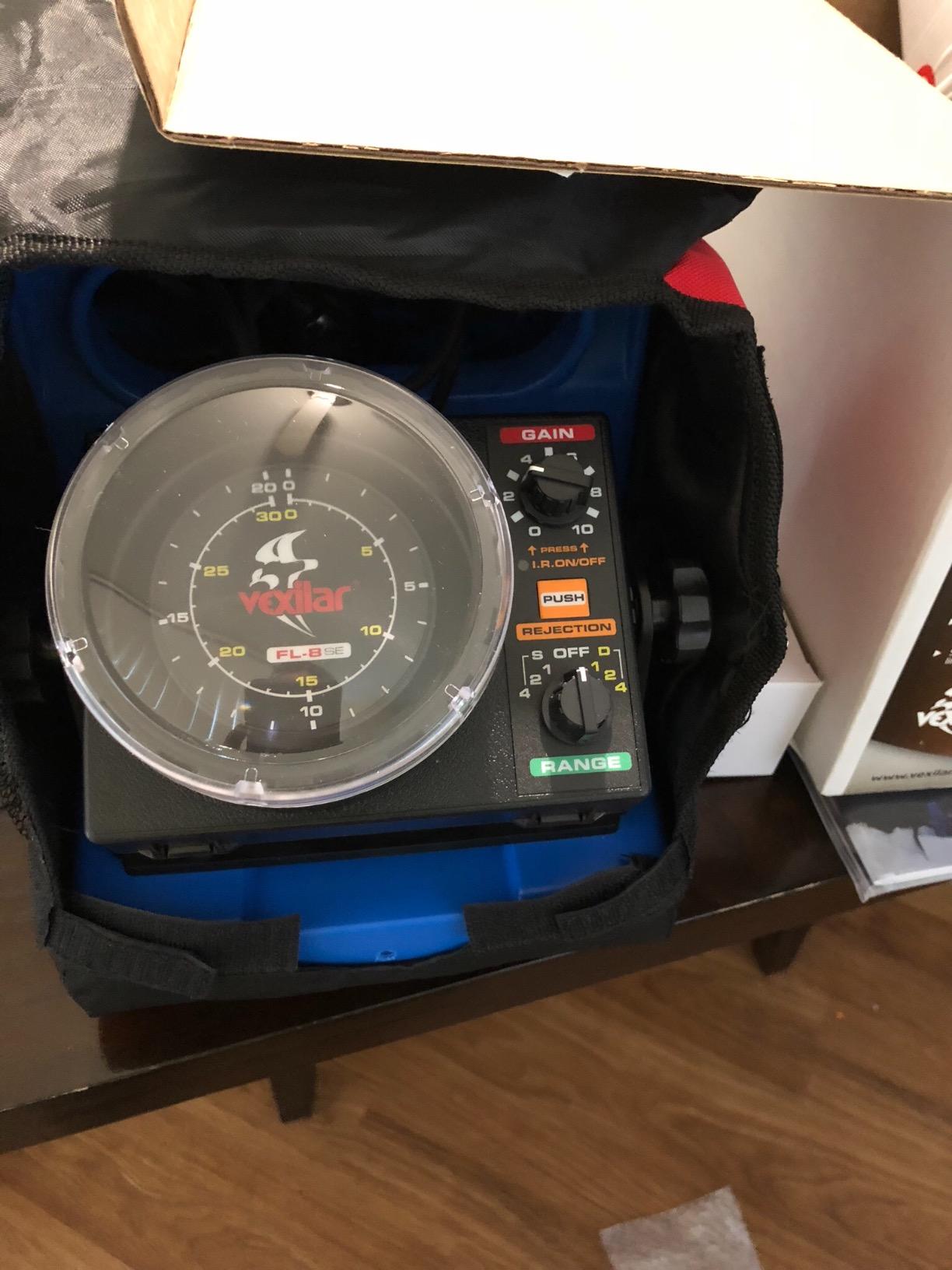
On ice fishing forums, buyers asked for something crisp and smooth but not expensive, and the FL-8se came up alongside Humminbird as one of the answers. It is a known quantity in that community, and threads regularly point beginners at it as the step they can take without overreaching.
What you give up is everything else. There is no graph, no recorded history and no way to review what happened after you lifted the jig. You either see the strike or you do not.
There is also no battery gauge on the unit, which is the one omission owners complain about most. Charge it the night before and treat it as a rule, and this stops mattering.
Is the FL-8se good enough, or do you need to step up to a wider flasher?
It is good enough for most people. The 19 degree cone is tight, and if you are fishing open water rather than structure, a wider cone such as the one on the FL-18 gives you a bigger picture of what is around your jig.
Step up when you are hunting fish that are not directly under your lure, or when you want a higher depth rating. Otherwise this is the flasher the community treats as the reliable starting point.
How do you handle no battery indicator in the cold?
Treat the charge cycle as fixed. Bring it inside overnight, charge it fully in the morning, and keep a second charged unit in an inside pocket rather than in the sled. Forum users raise cold battery failure more than any other complaint in this category, and the fix is preparation rather than a bigger battery.
Owner reviews also describe the Genz Pack case as bulky next to an auger, and some dislike the felt pad inside it. It is a carry solution, not a luxury.
7. Vexilar GP1812 FL18 Genz Pack – Best Narrow Cone for Fish Holding Tight
Vexilar GP1812 FL18 Genz Pack 12Deg Ice-Ducer Combo
- FL-18 flasher
- 12 degree ice ducer cone
- Genz Pack carry case
- Made in Japan
Pros
- 12 degree cone is tighter than entry Vexilar models
- FL-18 flasher transducer and case in one box
- Long-established over-the-hole design with a large owner base
Cons
- No graph and no recorded history
- Package weighs about 10 pounds to haul
- Listing gives minimal detail on specifications
The GP1812 package is the same idea as the FL-8se with a narrower cone. A 12 degree ice ducer concentrates the beam, so what you see on the dial is the fish immediately around your jig and very little else. Owners treat that as a step up for finding fish holding tight to structure.
Think about it as zooming in. The 19 degree cone tells you what is happening in a wider pocket of water, and the 12 degree cone tells you precisely what is at your lure. When you are jigging a specific piece of structure, that precision is the point.
It is made in Japan, and it is one of the longest-running over-the-hole flasher designs in the category, which is worth something on the ice. Nothing here is experimental.
What is the actual difference between a 12 degree and a 19 degree ice cone?
Beam angle decides how much of the water column you see. Narrower means tighter concentration and less surrounding noise, so fish close to your jig read more clearly. Wider means more of the water column at once, which is easier to interpret when you are new to flasher fishing.
If you are chasing fish that are holding rather than moving, the narrow cone is the better tool. If you want to understand what is swimming around your hole, the wider one is easier to read.
Is the 10 pound package a problem to carry?
It is manageable on a sled but noticeable on a long walk, and it is one of the two heavier items in this roundup. The packaging includes the flasher, transducer and case, so the weight is a bundle of essentials rather than a single heavy component.
There is no graph and no recorded history here, so your only record of a session is your memory. Reviewers also point out that the manufacturer listing gives very little detail on features, so treat the published specification as thin and judge the flasher category generally.
8. LUCKY Wireless Handheld Fish Finder – Best for Scouting Water Without a Sled
LUCKY Wireless Handheld Fish Finders Boat Wired Transducer Fishing Finder Sensor Sonar Waterproof Portable Depth Finders for Ice Fishing Sea Fishing Kayak
- Waterproof floating handheld
- Wired depth to 328 ft
- Reports temperature and fish size
- Glowing sensor cap
Pros
- Handheld unit plus a floating sensor
- Waterproof and floats so it can sit on the ice
- Shows depth temperature and approximate fish size
- Wired mode adds a 25 ft extension cable
Cons
- Fish detection is unreliable at times
- Shows marks where nothing bites
- Condensation can form inside the display
- Some units stopped reading depth within a year
This is the one to take off the ice entirely. A waterproof handheld that floats and a wireless sonar ball means you can walk a shoreline, check depths and find a drop-off without a sled, a shuttle or a heavy battery. The glowing cap on the sensor is a nice touch for working water at night.
It reports depth, water temperature and approximate fish size on one screen, and the wired mode with a 25 ft extension cable pushes depth detection out to 328 feet. That combination makes it a genuinely useful scouting tool before you ever cut a hole.
On the ice you can set the waterproof handheld on the surface and lower the wireless sensor, which is a legitimately different use from the other castable sonar here because this one has its own display.
Fish identification is where the 4.2 average comes from. Owners report catching fish with no mark on screen at maximum sensitivity, and also report marks showing where nothing bites, or a small moving jig read as a fish. Depth and temperature are reliable; fish size is a rough estimate.
Other recurring themes are condensation forming inside the display when you move between cold and warm air, a carrying case that does not close well, and a small number of units that stopped reading depth within a year.
Customer service does come up positively. Several reviewers mention a replacement being sent quickly when condensation caused a problem, which is a real factor when you are choosing electronics for the cold.
Is this good for actual fishing, or only for scouting?
Scouting is where it earns its place. Depth, temperature and a rough idea of structure from shore or a kayak is exactly what this unit does well, and it does it without any permanent kit.
For real fishing over a hole it is usable, but if marking fish accurately is your goal you should choose a flasher or a CHIRP unit. Treat the fish read as a hint, not evidence.
How much runtime should you expect in the cold?
The stated figures are 5 to 6 hours of continuous use per charge and more than 10 hours in battery save mode. In real winter cold, plan on the lower end of that range and carry a USB power bank if you are out for a full day.
Keep the handheld in its jacket between holes rather than in the sled, and give it a few minutes to come to temperature before you trust a reading on a cold screen.
9. Humminbird ICE Portable Kit – Best Add-On if You Already Own a HELIX
HUMMINBIRD ICE PTC UNB PORTABLE KIT F/ NON CHIRP
- Complete ice rig in one bag
- Dual beam ice transducer with float
- Fits HELIX 5 and 7
Pros
- Shuttle transducer brackets and cables in one bag
- Transducer float holds the sensor at depth
- Works across a range of HELIX 5 and HELIX 7 models
- Carrying case with a handle keeps the kit in one trip
Cons
- No control head
- a compatible HELIX must be bought separately
- Non-CHIRP transducer gives less crisp detail
- One-year warranty
Be clear about what this is. It is not a fish finder, it is the ice rig that turns a HELIX into one, and the listing does not include a control head. If you do not already own a compatible HELIX, this is not the product to start with.
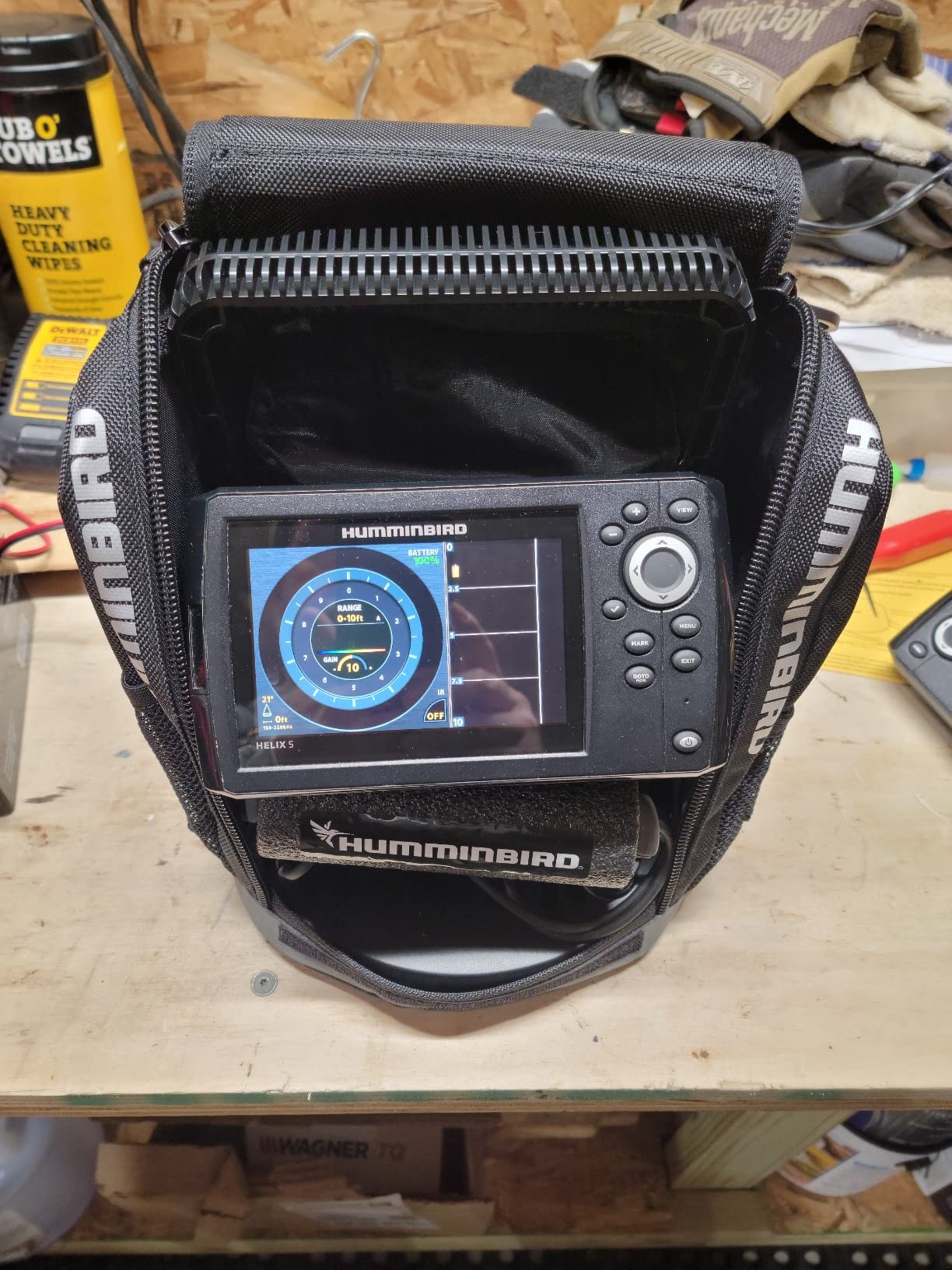
If you do own one, it solves a specific and annoying problem. You get a portable shuttle with a handle, a dual beam ice transducer with a float, gimbal mounting brackets, a power cable and a premium carrying case, all in one bag.
The float is the detail most worth noting. It holds the transducer at depth over the hole instead of letting it swing, which makes the reading steadier while you work a jig.
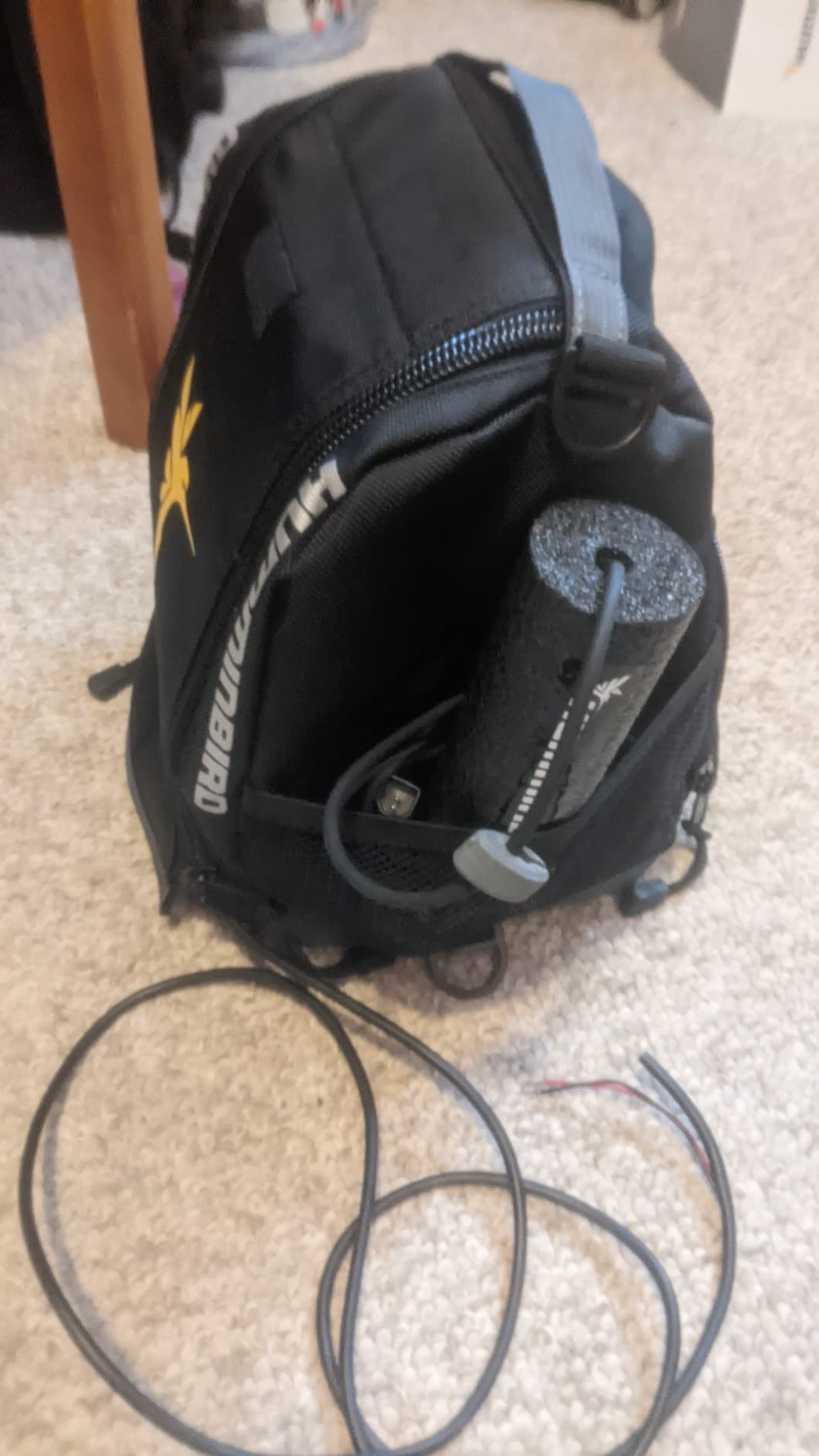
Compatibility is broad. The kit works with the HELIX 7 SONAR G2, the HELIX 7 SONAR GPS, and the HELIX 5 SONAR G2, HELIX 5 SONAR GPS and HELIX 5 SONAR, so it can carry over if you change control heads later.
It is a non-CHIRP kit, and that is the functional difference from the CHIRP bundles in this category. You get less crisp target detail, which matters if you are trying to separate fish from dense structure.
Owners rate it at 4.5, with the satisfaction coming from how neatly it organises an existing setup rather than from any sonar improvement.
Should you buy a dedicated ice transducer or rig a boat transducer?
Buy a dedicated ice transducer. A boat transducer rigged over a hole is the single most common cause of frustration on the ice, which comes up repeatedly in owner discussion of rigging these units yourself.
That frustration is usually about a transducer that cannot hold position, sits at the wrong angle, or has a cable that does not clear the hole edge. An ice transducer with a float and a gimbal bracket solves all three.
Is this the right choice if you are starting from zero?
No. Starting from zero, buy a complete bundle that includes a control head, because you cannot fish anything without the display. This kit only makes sense if a compatible HELIX is already in your gear.
The one-year warranty is worth noting next to the two-year terms offered on some of the complete systems in this roundup.
10. Humminbird ICE 55 Flasher – Best Color Flashing Without a Mapping Screen
Humminbird ICE 55 Flasher Ice Fishing Fish Finder with Transducer & 6-Color Fiber Optic Display
- 6-color fiber optic display
- 200 ft max depth
- Adjustable gain and zoom
- 9Ah battery and charger
Pros
- Six-color display is far easier to read than single-color
- Color coding separates fish from jig and clutter quickly
- Adjustable gain and zoom to lock onto the strike zone
- Transducer 12V battery charger and case included
- Two-year manufacturer warranty
Cons
- Flasher only with no graph history or GPS
- Bulkier shuttle and full battery pack to haul
The ICE 55 is a flasher, not a graph unit, and its argument is color. A six-color fiber optic dial gives you six distinct levels of return intensity on the same vertical band, which means you can tell a fish from your jig from a piece of structure by color alone instead of guessing at brightness.
That solves a specific flasher weakness. On a monochrome dial, a fish and a piece of bottom clutter can return the same strength, and you spend the day guessing. With six colors the question mostly answers itself, especially in the flat light of a cloudy winter afternoon.
It also carries a 200 foot maximum depth, which is deeper than most ice flashers reach and gives you room on big inland lakes.
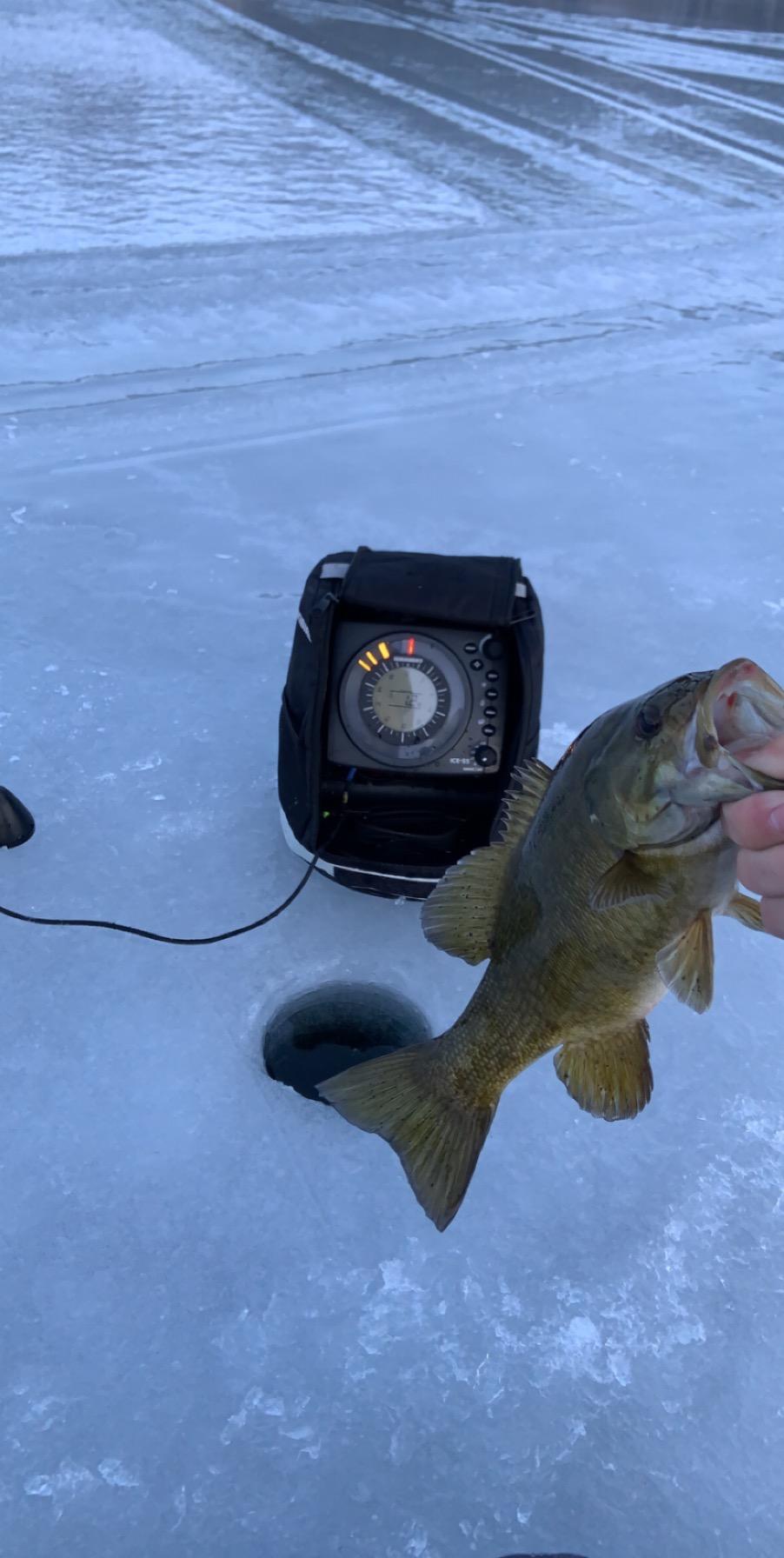
Target separation is tuned to distinguish bait from fish while you jig, and adjustable gain and zoom let you narrow in on the strike zone. In practice that means you can zoom the band to the depth where fish actually hold and ignore everything above it.
The box includes the transducer with an 8 foot cable, a 12V 9 amp hour battery, a charger and a portable case, so it is a complete first setup. The two-year manufacturer warranty matches the longest coverage offered in this roundup.
Owners credit the color dial as the reason to move up from a single-color flasher, and they are candid that the flasher-only format has real limits. There is no graph, no recorded history and no GPS.

Is a color flasher worth the step up from a monochrome one?
Yes, if you have trouble telling targets apart on a single-color dial or if you fish in low light. Color removes the interpretation step, and that is the hardest part of learning flasher fishing.
If you are confident reading a monochrome band, a monochrome flasher gives you more sensitivity per unit spent. The color dial is an interpretation upgrade, not a sensitivity upgrade.
What are you giving up by staying flasher-only?
You give up the ability to look back at a session, mark a productive hole, or scan wide structure. If you want to record a map of a lake for July, this is the wrong category and you want a color graph unit with GPS instead.
Also plan for the haul. A shuttle plus a 12V battery is more to drag across a flat than a wireless handheld, and that weight is a real factor on a long walk.
How to Choose an Ice Fishing Fish Finder (2026)
Choose by readout type first, then by form factor, then by power. Everything else on the spec sheet is secondary. If you get those three right for your fishing, the rest is preference and price tier.
Flasher Mode vs Scrolling Sonar: Which One Ice Needs
A flasher shows the water column directly beneath your hole as a live vertical band, with your jig, the bottom and any approaching fish as instant color signals. A scrolling sonar instead sweeps a moving picture of what passed under the transducer. For vertical jigging over a hole, the flasher is the better readout, because reaction time is what matters.
Scrolling sonar wins for one job: finding structure. It shows you a wide picture of a drop-off or a weed edge, which a flasher cone never will. The units that work best on ice give you both, which is why the Garmin Striker 4 and the Striker Plus 4 bundle both carry a flasher mode alongside scrolling views.
The practical rule is this. If you fish a hole you already know, use a flasher. If you fish a lake you are learning, use scrolling sonar to find the structure and a flasher to work it.
Castable Sonar vs a Rigged Transducer
Castable sonar wins on convenience. A sensor you drop down the hole needs no shuttle, no heavy battery and no arm to hold the transducer off the ice edge, and you can move between holes in under a minute. That is why three of the ten picks here are castable or handheld units.
A rigged transducer wins on steadiness. Parked over a hole with a dedicated ice transducer and float, the reading is stable and sensitive, and your transducer stays at depth while you work. That stability is what a reaction-bite angler is watching for.
Two cold-weather caveats belong with castable sonar. A phone-dependent sonar drains your phone battery in the cold and has no backup display if the screen fails, and cold weather shortens the internal battery life on the sensor itself. A power bank and a warm inside pocket fix both.
Match Max Depth to the Lakes You Fish
Match the depth rating to your deepest lake, not to the biggest number available. Most ice anglers never fish past 150 to 200 feet, so paying for a 600 foot rating is money you do not need. Stated ratings in this roundup run from 120 feet on the Vexilar FL-8se to 1600 feet of freshwater on the Garmin Striker 4, and the mid-range options cover the large majority of lakes.
Where depth rating does matter is on deep clear-water lakes holding lake trout. Below 300 feet, check the rating before you buy. The Deeper PRO+ 2 tops out at 330 feet and the Garmin Striker 4 with Portable Kit is rated to 1600 feet of freshwater, so the answer depends entirely on your lake.
Target separation deserves a second look too. The Deeper PRO+ 2 resolves 0.4 inch targets on its narrow beam, which is what separates a small jig from a fish on screen. Coarser readings merge them into one mark.
Cold-Weather Power and Battery Management
Battery failure is the most cited problem in the whole category, and the fixes are about preparation, not hardware. Keep spare cells in an inside pocket, never in the sled, because a battery sitting in a cold sled is a battery that quits mid-session. This is the single most repeated piece of advice in angler discussion of ice electronics.
Lead-acid batteries are heavy enough to be a real drag across a flat. Lithium packs are lighter, and the common worry is charging them below freezing, which is a genuine concern. Charge indoors overnight and treat the cold pack as a day-of use battery.
There is one more cold-weather habit worth building in. Let a display come to temperature before you trust a reading from it, and keep the unit in your jacket between holes rather than on the snow, where it cools continuously.
Reading the Screen With Gloves On
Screen size is a proxy for something more useful, which is whether you can read it and operate it with gloves on in flat light. A large monochrome flasher can be easier to read than a small color screen, because contrast beats pixel count when the sun is low and the light is grey.
Buttons beat touchscreens, and it is not close. Every unit in this roundup that we would put in a first recommendation uses a keyed or dial interface, because you operate a flasher with one hand while holding a rod with the other. The Garmin Striker Cast, which uses your phone, sidesteps the problem by removing the buttons entirely.
Aim for at least a 4 inch screen if you are sharing a readout in a shelter with another person. For one person, a 3.5 inch screen is plenty.
Garmin vs Humminbird vs Vexilar: Where Each Brand Wins
Garmin wins on ice-bundle completeness and ease of use. Owners repeatedly describe the menus as straightforward and the flasher mode as reliable, and the Striker Plus 4 Ice Bundle is the rare unit that includes an ice transducer in the box. Choose Garmin if you want one purchase to cover ice and the boat.
Humminbird wins on dedicated ICE display modes and screen options. The HELIX5 CHIRP G3 gives you flasher, A-Scope, zoom and interference rejection, and the ICE 55 Flasher brings a six-color fiber optic dial. Choose Humminbird if you fish crowded shacks or want the most viewing options per unit.
Vexilar wins on flasher heritage and simplicity. The FL-8se and the FL-18 packs are long-established over-the-hole designs with dials and switches, and the community treats the FL-8se as the adequate basic model. Choose Vexilar if you only want a flasher and want it to be as simple as possible.
Deeper and LUCKY sit outside the big three. Deeper wins on mapping from shore and on beam choice, and it depends entirely on your phone for a display. LUCKY wins on portability with a real screen of its own, and it gives back some fish-marking accuracy for that convenience.
Ice Fishing Cameras: The Tool That Does What a Flasher Cannot
A camera is the one tool that answers a question no flasher can: what is the fish actually doing down there. A flasher tells you a return is there, and a camera tells you whether it is a walleye, a perch or a bucket.
There are two common formats. Briefcase-style units put a monitor and a battery in a carry case that sits on the sled, and older CRT-monitor units run a larger screen from an ATV or mower battery, which angler discussion still treats as a proven, rugged option. The trade is power draw: a camera runs continuously and needs a real battery, where a flasher runs for days on a small pack.
Where a camera beats a flasher is in clear, weedy water where you need to identify a target before committing. Where a flasher wins is reaction speed, battery life and weight. Most serious setups end up using both, with the camera watching and the flasher telling you when to drop.
Frequently Asked Questions
Is a livescope worth it for ice fishing?
Yes, if you already know your structure and want to hunt specific fish rather than watch a jig. A livescope shows you a live image of the water column, which beats a flasher for identifying what is holding and in what posture. It is the wrong buy for a first season, because the cost of entry is high and a flasher covers the same hole for far less. None of the ten units in our roundup are livescopes.
Which is better for fishing, Vexilar or Livescope?
A Vexilar flasher wins on reaction bites, battery life and simplicity. A livescope wins on seeing structure and identifying fish before you commit to a spot. Anglers jigging a known hole should use a flasher. Anglers hunting structure in clear water get more from a livescope. In practice most serious setups run both side by side.
Is Garmin better than Humminbird?
Neither is better outright. Garmin leads on ease of use and on ice bundles that include an ice transducer, which is why two Garmin units sit near the top of our list. Humminbird leads on dedicated ICE display modes, interference rejection and the six-color flasher dial. Choose Garmin for a simple all-round unit, Humminbird for more viewing options.
Does Garmin Livescope scare fish away?
Live sonar does not consistently scare fish, but running it at full brightness right in the hole is the setup anglers are most wary of. The fix is simple: dial brightness down before you approach the hole and keep the transducer below the fish rather than in the column above them. Reports of spooked fish are uncommon and usually trace back to transducer placement.
What is the best fish camera for ice fishing?
It depends on your screen and your power. Briefcase-style cameras with an integrated monitor and battery are the easiest to run and are the common modern choice, while older CRT-monitor units running off an ATV or mower battery are still regarded as proven and rugged. The camera is the right tool for identifying fish in clear water, and a flasher remains better for reaction bites.
The Best Fish Finders for Ice Fishing: Our Final Verdict
The Garmin Striker 4 with Portable Kit is the best fish finder for ice fishing in 2026 because it puts a flasher, a scrolling sonar and a waypoint map in one box, with a rechargeable battery already inside, and it was built to be carried to the hole and to the boat.
If your situation is different, the branches are clear. Fish alone and want nothing in your hands but a phone and go castable with the Garmin Striker Cast. Want a color screen and a purpose-built ice transducer already in the box and take the Striker Plus 4 Ice Bundle. Want a group setup with the most ICE display modes and a battery shuttle and look at the Humminbird HELIX5 CHIRP G3. Want the simplest flasher there is and pick up the Vexilar FL-8se.
Whatever you choose, budget for the things the box does not include: an ice transducer if the bundled one is boat-style, a shuttle or sled, and a battery plan that keeps spare cells in your jacket rather than in the sled. That last point decides more ice-fishing sessions than any spec on any unit we covered.