
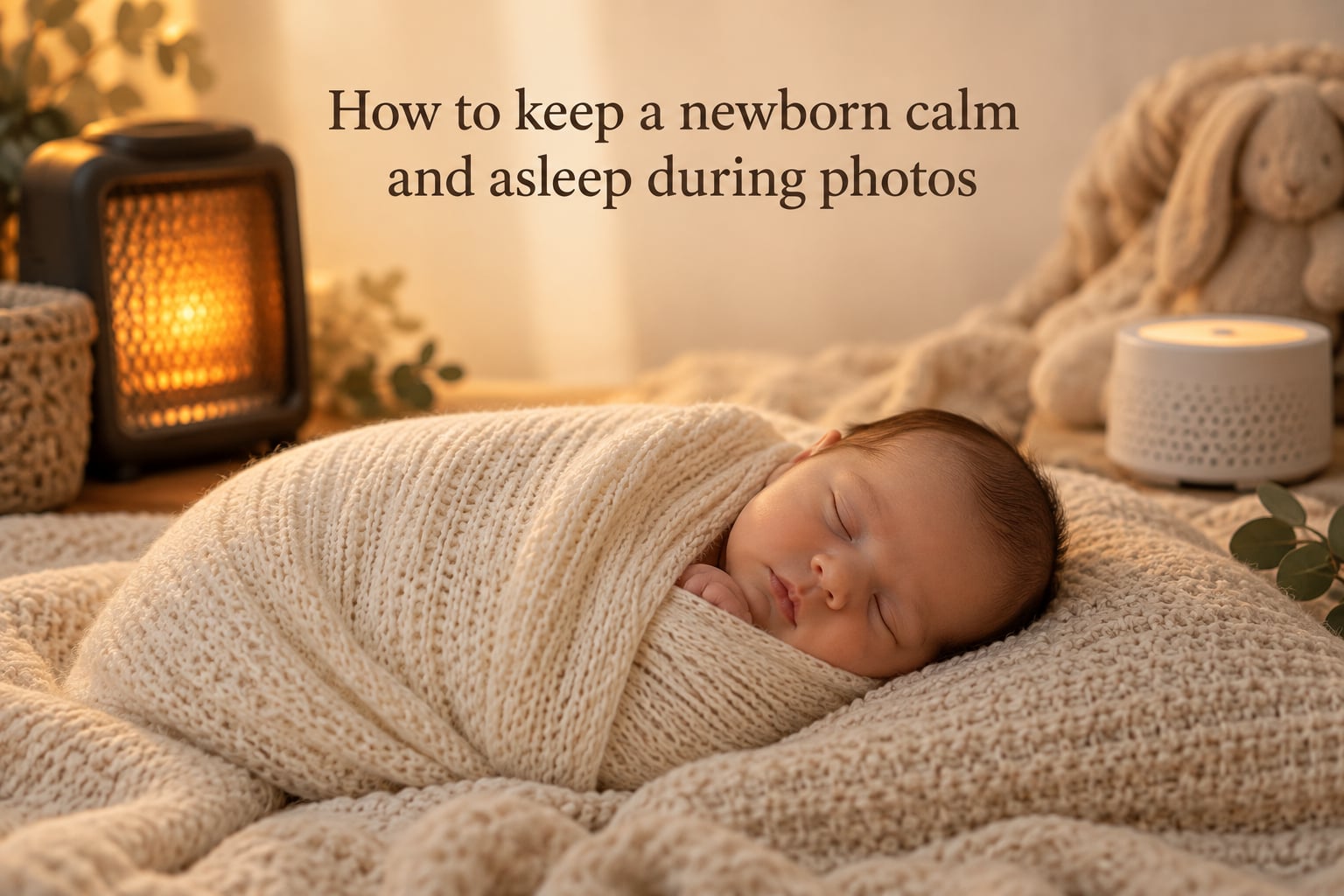
Newborn photo sessions live or die by one thing: a calm, sleepy baby. As a family photographer who has guided hundreds of parents through these sessions at our studio, I can tell you that the techniques we use to keep a newborn calm and asleep during photos are not magic. They are simple, repeatable steps that recreate the womb.
In this guide, I will walk you through exactly what works. You will learn the best age to book, what to do the night before, how to prepare the day of, what we do in the studio, and what to do if your baby simply will not settle. These are the same tips I share with every family walking through our door.
Table of Contents
- Why a Calm Newborn Makes the Difference in Your Photos
- The Best Age for Newborn Photos: Timing Your Session Right
- How to Get a Newborn Ready for a Photoshoot: Before You Arrive
- In-Studio Techniques to Keep Your Newborn Calm and Asleep
- Parent Comfort: What to Wear and How to Stay Calm
- When to Reschedule: Your Backup Plan if Baby Won’t Sleep
- Frequently Asked Questions
- Your Newborn Session Starts Here
Why a Calm Newborn Makes the Difference in Your Photos
A calm newborn produces the curled, peaceful, dreamy portraits that define this stage of life. A fussy baby leads to rushed sessions, fewer keepers, and a stressful experience for everyone involved. That is why every professional photographer you book spends more time on preparation than on posing.
The science behind these techniques is simple. Newborns are hardwired to respond to four conditions they experienced in the womb: warmth (around 98.6°F), continuous shushing sounds (about as loud as a vacuum cleaner), snug pressure (the squeeze of the womb walls), and the soothing reflex triggered by sucking. Combine all four, and you reliably trigger deep sleep.
That is the entire game. Recreate those four conditions and your baby will sleep. Miss any one of them and you will fight fussiness for the whole session.
The Best Age for Newborn Photos: Timing Your Session Right
The sweet spot for newborn photography is between 5 and 14 days old. During this window, babies are still curled from their fetal position, sleep deeply for long stretches, and are less likely to be disturbed by mild handling or position changes.
Is 2 weeks too old for newborn photos? Not at all. Two weeks falls right inside the ideal window. We photograph babies at 14 days regularly and still get beautiful curled poses.
Is 4 weeks old too late for newborn photos? Four weeks is workable but more challenging. Babies at this age are more alert, more prone to gas and witching hour fussiness, and harder to settle into deep sleep. We can still capture gorgeous images, but the style shifts toward awake, eye-open portraits. Parents who book at 4 weeks should plan for a different look than the curled sleepy newborn aesthetic.
If you are past the 2-week mark, do not skip the session. Just adjust expectations. We have photographed 6-week-old and even 8-week-old babies with great results when parents understood we would lean into awake expressions.
How to Get a Newborn Ready for a Photoshoot: Before You Arrive
The work to keep your newborn calm and asleep during photos starts 12 to 24 hours before your session. Here is the prep checklist we share with every Sparkfly family.
The Night Before
- Try to keep baby awake for a slightly longer stretch in the late afternoon. A baby who is pleasantly tired tends to nap harder the next morning.
- Skip heavy lotions or oils on baby’s skin the day before and day of. Slippery skin makes swaddling and posing harder and can irritate sensitive newborn skin.
- Pack your diaper bag the night before so the morning is not chaotic. Include 1.5x the diapers and wipes you think you need, a backup outfit for baby, and an extra pacifier.
The Morning of the Session
- Give baby a sponge bath or gentle wash around the hair area. Newborn hair is full of cradle cap flakes that show up under studio lights.
- Plan a full feeding right before you leave the house. A baby with a full belly and a slight milk-drunk drowsiness is the easiest subject to photograph.
- Bring a backup bottle of pumped milk or formula in case baby wakes hungry on the drive.
- Dress baby in loose, easy-on, easy-off clothing. A zipper sleeper pulls off faster than a snap outfit and keeps baby calmer during undressing.
One important note: do not worry if your baby has been fussy all morning before a session. Parents regularly arrive apologizing, and we reassure them that babies often settle the moment the warm studio, white noise, and snug wrap kick in.
In-Studio Techniques to Keep Your Newborn Calm and Asleep
Once you arrive at our studio, we take over most of the soothing. Here is what happens behind the scenes during a typical Sparkfly newborn session.
The Room Itself
Our studio runs between 80 and 85°F during newborn sessions. That sounds hot, and it is for adults. For a baby who spent nine months at body temperature, it feels like home. We use a space heater pointed away from baby for an extra warm pocket of air right above the posing beanbag. Parents can slip into our cooler back room anytime they need a break.
White Noise and the Baby Shusher
The womb is loud. The whoosh of blood flow is roughly the volume of a vacuum cleaner. To recreate that, we run a white noise machine and a Baby Shusher during the entire session. Continuous sound masks door slams, camera clicks, and the studio lighting fan. It also keeps baby in the drowsy, sleepy state that mimics the womb.
Swaddling and Wrapping
A solid wrap is the single most useful tool in newborn photography. A good swaddle contains the startle reflex (also called the Moro reflex), the involuntary arm fling that wakes sleeping babies when they feel a slight shift in position. We start almost every session with baby wrapped snugly, then transition to unwrapped poses once baby is in deep sleep and unlikely to startle.
Full Feeding on Demand
Even with a full feed before arrival, many babies want to eat again during the session. That is normal. We pause for feeding breaks as often as needed. A baby who is fed on demand stays calmer, sleeps deeper, and produces more keepers. There is no schedule we are trying to keep.
Pacifier Use
Pacifiers are a photographer’s best friend during a session. The sucking reflex is one of the strongest soothing tools newborns have. If you use a pacifier at home, bring it. If you do not normally use one, ask your pediatrician whether one is acceptable for the session. We have a few clean soothie pacifiers on hand if you forget yours. We never push, and we never use one without your okay.
Gentle Pressure and Slow Movement
Every transition we make is slow, supported, and announced. We keep one hand on baby at all times during position changes. When we lift baby from your arms to the beanbag, we use gentle sustained pressure on the back. When we rub between the eyebrows or stroke the cheek, we use the lightest possible touch. Slow, deliberate motion avoids triggering the startle reflex and keeps baby in deep sleep.
Parent Comfort: What to Wear and How to Stay Calm
Almost every guide you find talks about the baby. Few talk about you. And yet, your stress transfers to baby. A frazzled parent holding a newborn during a session often produces a fussy newborn.
Here is what to wear and how to prepare yourself for the warm studio environment:
- Wear layers. The studio runs 80°F. A tank top with a cardigan you can peel off works better than a single heavy layer.
- Wear soft, neutral fabrics. Avoid stiff fabrics, bold logos, or bright patterns that distract from baby.
- Bring a water bottle and a snack. You will be in the studio for 2 to 3 hours.
- Hydrate before you arrive. Postpartum dehydration is real and makes everything feel harder.
- Give yourself permission to step out. Our back room is yours. Hand baby to us, take 10 minutes, and breathe.
The more relaxed you are, the calmer your baby will be. That is not a metaphor. Newborns pick up on cortisol, heart rate, and the pace of your breathing.
When to Reschedule: Your Backup Plan if Baby Won’t Sleep
Sometimes nothing works. Baby has gas, a growth spurt, witching hour, or simply a strong personality that resists all the soothing techniques in the world. That is normal, and that is why every reputable studio offers a reschedule policy.
Here is when we recommend rescheduling versus pushing through:
- Reschedule if: baby has a fever, is congested, has had vaccinations in the last 48 hours, or has been crying inconsolably for more than 3 hours. A sick baby should never be stressed for photos.
- Push through if: baby is fussy but can be soothed with feeding, swaddling, or pacifier. Many fussy babies settle within the first 30 minutes of the session once the warm room and white noise kick in.
- Trust your photographer: if we tell you we can still get beautiful photos with an awake, alert baby, believe us. Some of our favorite portraits are awake baby shots with bright eyes and tiny expressions.
A reschedule is not a failure. It is a tool. Use it without guilt.
Frequently Asked Questions
What is the 5-3-3 rule for babies?
The 5-3-3 rule is a sleep guideline that suggests newborns can comfortably stay awake for about 5 hours total across the day, broken into shorter stretches (often referenced as 3 hours of awake time in the morning, 3 in the afternoon). It is a flexible framework to help prevent overtiredness, which makes babies fussier and harder to settle. For a photo session, this means booking during a natural nap window rather than trying to time the shoot at baby’s longest awake stretch.
Is 2 weeks too old for newborn photos?
No, 2 weeks is not too old. Two weeks falls right inside the ideal 5 to 14 day newborn photography window. Babies at this age are still curled from the fetal position, sleep deeply, and tolerate posing well. You will still get the classic sleepy newborn look at 14 days.
Is 4 weeks old too late for newborn photos?
Four weeks is workable but more challenging. Babies at this age are more alert, more prone to gas and fussiness, and harder to settle into deep sleep. We can still capture beautiful images, but the style shifts toward awake, eye-open portraits rather than the curled sleepy aesthetic. Book the session if you want it, just adjust expectations accordingly.
What should I avoid in newborn photos?
Avoid heavy lotions on baby’s skin before the session, scratchy fabrics or clothing with bold logos and bright patterns, and overhead lighting that creates harsh shadows. Avoid bringing siblings who are loud or unwell, and avoid booking during vaccination recovery or illness. Avoid tight schedules on session day so the family is not rushed.
What to put a newborn in for a photoshoot?
For a newborn photoshoot, dress baby in a simple diaper or plain white or cream onesie before arrival. We provide wraps, swaddle blankets, and diaper covers for the session itself. For parent and family shots, wear soft neutral fabrics in muted tones (cream, beige, soft gray, dusty blue) that complement baby’s skin without pulling focus.
Your Newborn Session Starts Here
Keeping a newborn calm and asleep during photos comes down to recreating the womb: warmth, sound, snug pressure, and a full belly. Add patience, slow movement, and a relaxed parent, and you have everything you need for beautiful images.
If you are preparing for a newborn session with us at Sparkfly Photography, know this: we have done this hundreds of times. Fussy babies do not scare us. We bring the techniques, the warm room, the white noise, the wraps, and the patience. You bring the baby. Together we will get the photos you came for.
Book early. The 5 to 14 day window fills up months in advance. Reach out today to reserve your session.