
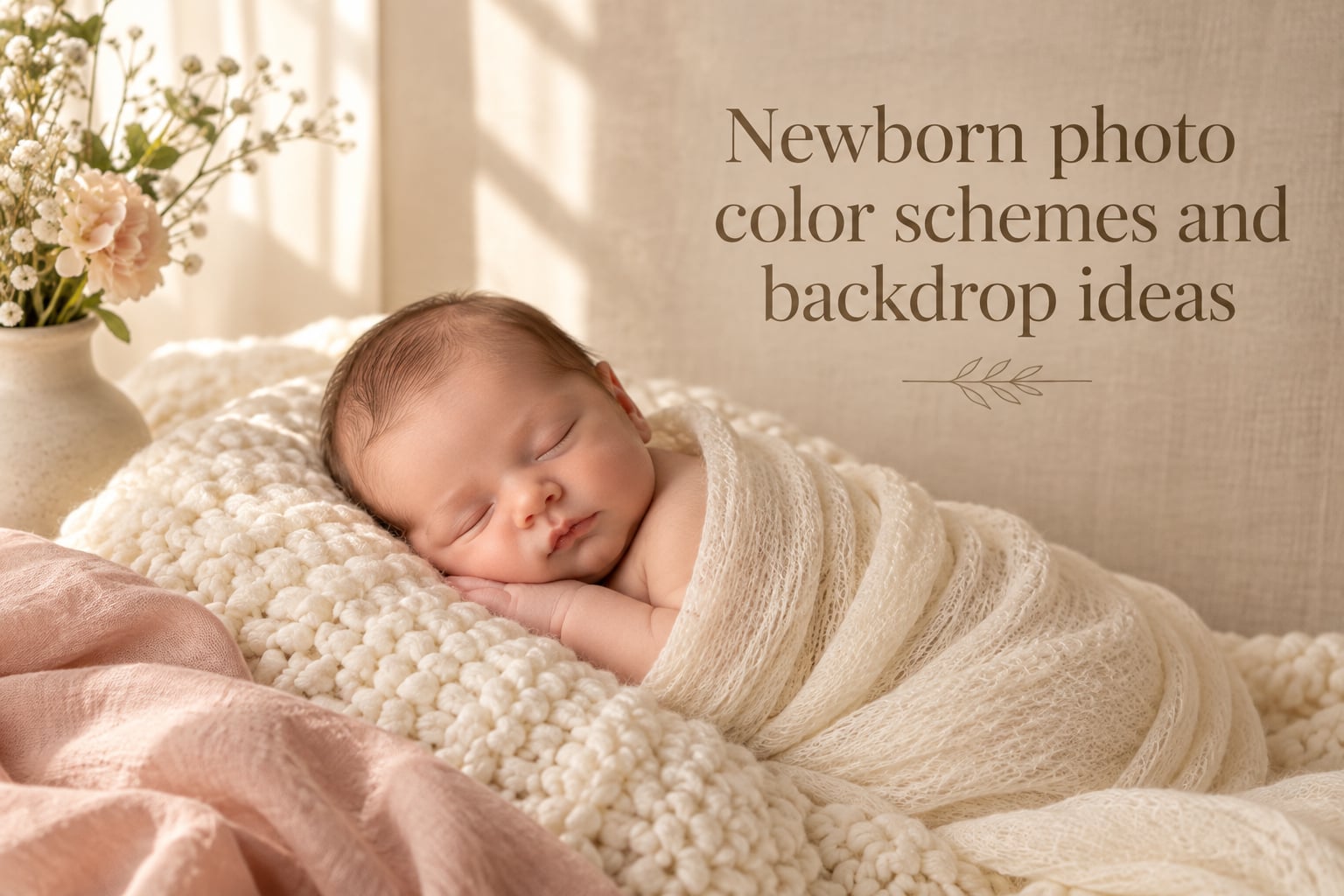
Welcoming a new baby is one of those rare seasons where every detail feels worth saving. I have styled dozens of newborn sessions over the years, and the families who love their galleries the longest are the ones who planned their color palette and backdrop choices before stepping in front of the camera. This guide walks you through newborn photo color schemes and backdrop ideas that photograph beautifully, age well, and feel true to your family.
You will see the most popular newborn color palettes, the backdrop materials I trust most, how to match colors to your skin tone and your nursery, and the trends shaping newborn photography in 2026. I will also flag the colors and outfits to avoid so your gallery feels calm instead of chaotic. If you only have five minutes, jump to the color palette list and the backdrop table – those two answers cover most of what parents ask me.
Table of Contents
- Best Color Schemes for Newborn Photos
- Best Backdrop Materials and Types for Newborn Photography
- How to Choose a Palette That Matches Your Skin Tone and Home
- Newborn Photography Trends for 2026
- Colors and Styles to Avoid in Newborn Photos
- Frequently Asked Questions
- Final Thoughts on Styling Your Newborn Session
Best Color Schemes for Newborn Photos
A newborn photo color scheme is the small, coordinated palette of wraps, blankets, headbands, and outfits you choose for the session. The five most-requested color schemes for newborn photos are neutrals, soft pastels, earth tones, monochromatic, and bold or editorial – each one creates a different mood in the final gallery. Pick one base direction before the shoot, then layer two or three supporting shades so every frame feels cohesive.
When you anchor a session around a single palette, your photographer spends less time editing and more time capturing expressions. Parents in forums like r/photography and r/BabyBumps often mention that they wish they had narrowed their colors earlier. A tighter palette also photographs more timelessly – the cream-and-ivory newborn portraits from ten years ago still look beautiful today, which is why I lean neutral more often than not.
Neutral Palettes (Cream, Ivory, Taupe) for a Timeless Look
Neutral palettes built around cream, ivory, soft taupe, and warm gray are the safest path to a timeless newborn gallery. They photograph cleanly on every skin tone, never clash with nursery decor, and let tiny fingers, toes, and eyelashes become the visual focus. If you are nervous about choosing colors for your first newborn session, neutrals are the answer nearly every photographer will give you.
Build your neutral palette around one warm white (ivory or vanilla), one mid-tone (taupe, mushroom, oatmeal), and one gentle accent (champagne, dusty peach, or soft blush). Skip pure bright white if the baby will be photographed on a white blanket – it can wash out skin. Photographers consistently recommend warm cream over cool white for that reason.
Soft Pastels (Blush, Sage, Baby Blue, Mauve)
Soft pastels like blush pink, muted sage, baby blue, lavender, and dusty mauve add a gentle hint of color without overwhelming a newborn portrait. They are the most popular choice for spring and summer sessions, and they work beautifully for parents who want a touch of personality without going bold. Pastels photograph best when you stay within one hue family – all pinks, or all sages – rather than mixing four pastels at once.
I usually suggest two main pastels and one neutral anchor so the gallery does not feel candy-colored. A blush wrap on ivory, a sage romper on warm gray, a lavender headband on cream – any of those combinations keeps the mood soft and modern.
Earth Tones and Warm Browns for a Cozy Feel
Earth tones – terracotta, rust, warm cocoa, oatmeal, olive, and deep clay – create a warm, cozy newborn gallery that feels grounded and natural. They photograph especially well on wood floors, vintage crates, and basket props, and they flatter every skin tone from fair to deep. If your home leans boho, mid-century, or rustic, an earth-tone palette will match your space without effort.
Try pairing a rust wrap with cream, or an olive romper with warm tan. Avoid combining too many saturated earth tones in one frame; two warm earth shades plus a neutral reads richer than four competing browns.
Monochromatic Styling for a Cohesive Gallery
A monochromatic palette uses different shades, tints, and textures of a single color family across the entire session. The result is a gallery that looks intentional and editorial, with every frame flowing into the next. Soft cream on warm cream on ivory on taupe is one of my favorite combinations because the texture does the visual work – knit, linen, flokati, and gauze layered together.
Monochromatic styling also solves a real parent pain point: matching the gallery to the rest of your home. When the palette is one color family, the photos blend into a modern living room as easily as a nursery gallery wall.
Bold and Editorial Palettes for Modern Families
Bold palettes – deep navy, charcoal, hunter green, mustard, plum, and burgundy – deliver an editorial, magazine-style newborn gallery. They are not for everyone, but the parents who choose bold usually love saturated color at home and want the session to reflect that. Bold palettes work best on simple backdrops (painted paper, plain walls) so the colors stay readable instead of busy.
Limit bold to one anchor color plus one neutral and one accent. A navy wrap on cream, a mustard romper on warm gray, or a hunter green blanket on ivory – each combination stays bold without becoming chaotic.
Seasonal Palette Ideas (Spring, Summer, Autumn, Winter)
Tying your color scheme to the season is an easy way to make the gallery feel rooted in a moment. Spring newborn palettes lean soft florals – blush, butter yellow, fresh sage, and cream. Summer palettes shift to dusty pastels and soft whites – think seafoam, peach, and warm gray. Autumn palettes love rust, terracotta, mustard, and oatmeal. Winter palettes shine in icy blue, evergreen, deep plum, and warm cream.
You do not need to match the season strictly – many parents pick the opposite palette on purpose (a winter baby in spring pastels, for example). Seasonal inspiration simply expands your shortlist when you feel stuck.
Best Backdrop Materials and Types for Newborn Photography
The most popular newborn photography backdrops are knit wraps, flokati rugs, linen and cotton layers, wood floors, painted paper, and plain neutral walls – each one creates a different texture and mood in the final portrait. Texture is what separates a flat snapshot from a newborn portrait that looks like art, so choose a backdrop material that adds depth without competing with the baby.
The right backdrop material also photographs the baby’s skin tone more honestly. Smooth, light-absorbing fabrics like flokati and mohair soften shadows, while hard surfaces like painted paper or wood floors add structure. Most photographers build the session around two or three backdrop textures so the gallery has variety without losing cohesion.
Knit Wraps and Blankets
Knit wraps and chunky knit blankets are the workhorse of newborn photography because they add visible texture and stretch to fit any pose. They come in cream, ivory, blush, sage, gray, and earth tones, so they pair with nearly any palette. Photographers recommend knit layers that are at least 30 inches wide so they fill the frame and wrap around the baby securely.
Pair knit with a smoother fabric (linen, cotton) so the texture does not fight itself. A knit blanket over a linen floor layer is a classic combination for a reason – it photographs warm, soft, and timeless.
Flokati Rugs and Mohair Layers
Flokati rugs and mohair throws create the iconic fluffy, cloud-like newborn look that became a studio staple. They absorb light beautifully, hide small pose adjustments, and feel ethereal in person and on camera. Use a flokati under a knit wrap for the most popular newborn setup, or layer mohair over linen for a moodier, painterly feel.
Flokati and mohair are also the easiest backdrop materials for new parents to source – a single cream flokati rug plus two knit wraps in different tones is enough for a complete gallery.
Linen, Cotton, and Gauze
Linen, cotton, and gauze backdrops give newborn sessions a clean, minimal, fine-art feel. They drape softly, photograph with subtle texture, and blend into modern home decor more easily than chunky knits. A neutral linen blanket on the floor, with the baby posed on top, is one of the most versatile setups a family can recreate at home.
Layer linen with knit or flokati so the texture does not look flat. Linen alone can read as a bedsheet on camera – pairing it with a fluffier layer gives the frame more depth.
Wood Floors and Vintage Crates
Wood floors and vintage wooden crates add warm, natural texture that pairs beautifully with earth tones and neutral colors. They work especially well for lifestyle newborn sessions where the baby is photographed in a basket, on a fur rug, or in a parent’s arms. If your home already has wood floors, you have a free, beautiful backdrop waiting.
Keep the wood tone consistent. Mixing honey wood and gray-washed wood in the same frame can look unintentionally busy. Choose one tone and let your wraps and outfits carry the color story.
Painted Paper and Seamless Backdrops
Painted paper and seamless paper backdrops are the studio standard for clean, editorial newborn portraits. They come in dozens of colors and roll out smooth and wrinkle-free, which matters because wrinkles are the #1 thing that makes a DIY backdrop look amateur. Photographers recommend seamless backdrops that extend at least one foot above the baby’s head and well underneath for full-body poses.
Seamless paper is especially useful for bold or monochromatic palettes because the solid color keeps the focus entirely on the baby.
At-Home DIY Backdrop Ideas
You can build a beautiful newborn backdrop at home with items you already own – a neutral bed sheet pulled tight over a mattress, a soft blanket layered on the floor near a large window, a plain painted wall with natural light, or a woven basket lined with linen. The key is removing wrinkles, choosing one neutral focal point, and using window light as your main source.
Photographers in forums like r/photography and r/NewParents consistently say that natural window light is the single biggest upgrade for at-home newborn photos. Set up near a large window, turn off overhead lights, and let the soft directional light do the work. Avoid mixing window light with warm indoor lamps – the color cast clash shows up immediately on camera.
How to Choose a Palette That Matches Your Skin Tone and Home
The fastest way to pick a newborn color scheme that you will love for years is to choose colors that flatter your own skin tone and that already live in your home. A newborn gallery lives on your walls and in albums long after the session, so anchoring the palette to your space keeps the photos feeling current instead of dated.
Color Choices by Skin Tone
Skin tone matters more than gender when choosing newborn colors. Photographers recommend warm cream, peach, blush, and soft ivory for fair skin; champagne, mauve, dusty rose, and sage for olive skin; and warm gold, ivory, rust, and deep teal for dark or deep skin. The goal is to choose shades that complement the baby’s undertone rather than washing it out.
| Skin Tone | Recommended Palette | Shades to Try |
|---|---|---|
| Fair | Warm cream, blush, peach | Ivory, dusty pink, butter yellow |
| Olive | Champagne, mauve, dusty rose | Sage, soft taupe, warm lavender |
| Dark / Deep | Ivory, warm gold, rust | Deep teal, terracotta, mustard |
If you are unsure which palette fits you best, stand in natural light with two fabrics – one warm-toned and one cool-toned – and compare. The one that makes your skin look even and rested is the right direction.
Matching Your Nursery or Home Decor
Your newborn photos will live in your home for decades, so let your existing decor guide the palette. If your living room is warm cream and natural wood, an earth-tone or neutral newborn session will blend in seamlessly. If your home is cool white and gray, a soft pastel or monochromatic gallery will feel right at home. Picking a palette that already matches your walls means you can print and frame the photos immediately instead of saving them for someday.
Two fabrics in your home are usually enough inspiration. Pull a swatch from a throw pillow or curtain and bring it to your photographer – they will build the rest of the session around it.
Newborn Photography Trends for 2026
The biggest newborn photography trends for 2026 lean toward soft, intentional minimalism – warm neutral palettes, natural fiber backdrops, gentle lifestyle moments with parents in the frame, and a return to texture over color. Parents are asking for galleries that look less posed and more emotional, with a focus on tiny details like eyelashes, fingers, and toes instead of heavy props.
Here is what I am seeing across the photographers I trust in 2026:
- Warm cream and ivory over pure bright white – more forgiving on every skin tone and ages better in print.
- Natural fiber backdrops – linen, cotton, flokati, and woven wool – replacing synthetic props for a more grounded feel.
- Parent-in-frame lifestyle portraits shot near a window, with no heavy posing and wardrobe kept simple and neutral.
- Monochromatic and tonal styling within one color family instead of multi-color setups.
- Macro detail shots of hands, feet, and eyelashes framed on plain linen or wood.
None of these trends are expensive to follow. A cream linen sheet, a knit wrap, and a window are usually enough to capture the mood of 2026 newborn photography.
Colors and Styles to Avoid in Newborn Photos
The colors most photographers warn against in newborn photos are neon green, bright orange, hot pink, saturated red, and any shade that casts a strong color reflection on the baby’s skin. Bold patterns, large logos, and busy prints also distract from the baby and age poorly in albums. Keep the baby’s skin tone the visual hero by choosing low-saturation colors and solid fabrics.
Patterns larger than a coin or with high contrast (black-and-white stripes, loud florals) draw the eye away from the baby. Photographers on r/photography note that solid colors are also easier to edit – logos and text are time-consuming to remove in post. When in doubt, choose a solid, soft, low-saturation fabric over a patterned one.
Outfit Tips for Parents in the Frame
Parents in the frame should wear comfortable, neutral, solid colors – black, cream, warm gray, soft denim, or muted earth tones all work well. Photographers recommend long sleeves because they flatter arms, and solids because they are easier to retouch. Skip logos, screen-printed graphics, neon accents, and busy patterns. A simple crew-neck sweater or a soft cotton dress photographs better than a busy outfit, even if it feels less exciting in person.
Coordinate without matching exactly. If Mom wears cream and Dad wears warm gray, the gallery reads coordinated. If both parents wear identical black shirts, the frame can feel flat. Aim for the same color family with slightly different shades.
Frequently Asked Questions
What is a good backdrop for newborn photography?
The most popular newborn photography backdrops are knit wraps, flokati rugs, linen and cotton layers, wood floors, painted seamless paper, and plain neutral walls. Each material creates a different mood – knit and flokati add cozy texture, linen gives a clean fine-art feel, and painted paper keeps the focus entirely on the baby.
What type of background works best for photos of newborns?
A soft, textured, neutral background works best for photos of newborns because it keeps attention on the baby and avoids harsh color casts on the skin. Cream knit, ivory flokati, warm linen, and natural wood are the most trusted choices for both studio and at-home newborn sessions.
What are the trends in newborn photography for 2026?
The biggest newborn photography trends for 2026 are warm neutral palettes over pure white, natural fiber backdrops like linen and flokati, parent-in-frame lifestyle portraits near a window, monochromatic tonal styling, and macro detail shots of tiny hands, feet, and eyelashes.
What should I avoid in newborn photos?
Avoid neon green, bright orange, hot pink, saturated red, bold patterns, large logos, and busy prints in newborn photos. These shades cast unflattering color on the baby’s skin and distract from the face. Solid, low-saturation fabrics photograph the most timelessly.
What should I wear for a newborn photo session?
Wear comfortable, neutral, solid colors for a newborn photo session – cream, warm gray, soft black, muted denim, or earth tones all work well. Choose long sleeves to flatter arms and skip logos, neon accents, and busy patterns so the editing stays simple and the focus stays on the baby.
Is 2 weeks too late for newborn photos?
Two weeks is not too late for newborn photos. While the classic window is 5 to 14 days when babies sleep deeply and curl naturally, photographers can capture beautiful images at 2, 3, or even 4 weeks with adjusted posing, more awake shots, and a lifestyle focus on feeding, swaddling, and tiny details.
Final Thoughts on Styling Your Newborn Session
Choosing newborn photo color schemes and backdrop ideas does not have to feel overwhelming. Pick one palette direction that flatters your skin tone and matches your home, choose one or two backdrop textures that add depth without distraction, and keep outfits simple and solid. That short list is enough to build a gallery you will frame, print, and love for the next twenty years.
If you are still deciding, start with a warm neutral palette on a knit or linen backdrop – it is the most forgiving combination in newborn photography and photographs beautifully on every baby. From there, layer in one supporting shade and one accent so the gallery feels intentional instead of improvised. Pin a few reference photos, share them with your photographer, and let the styling take shape from there.