
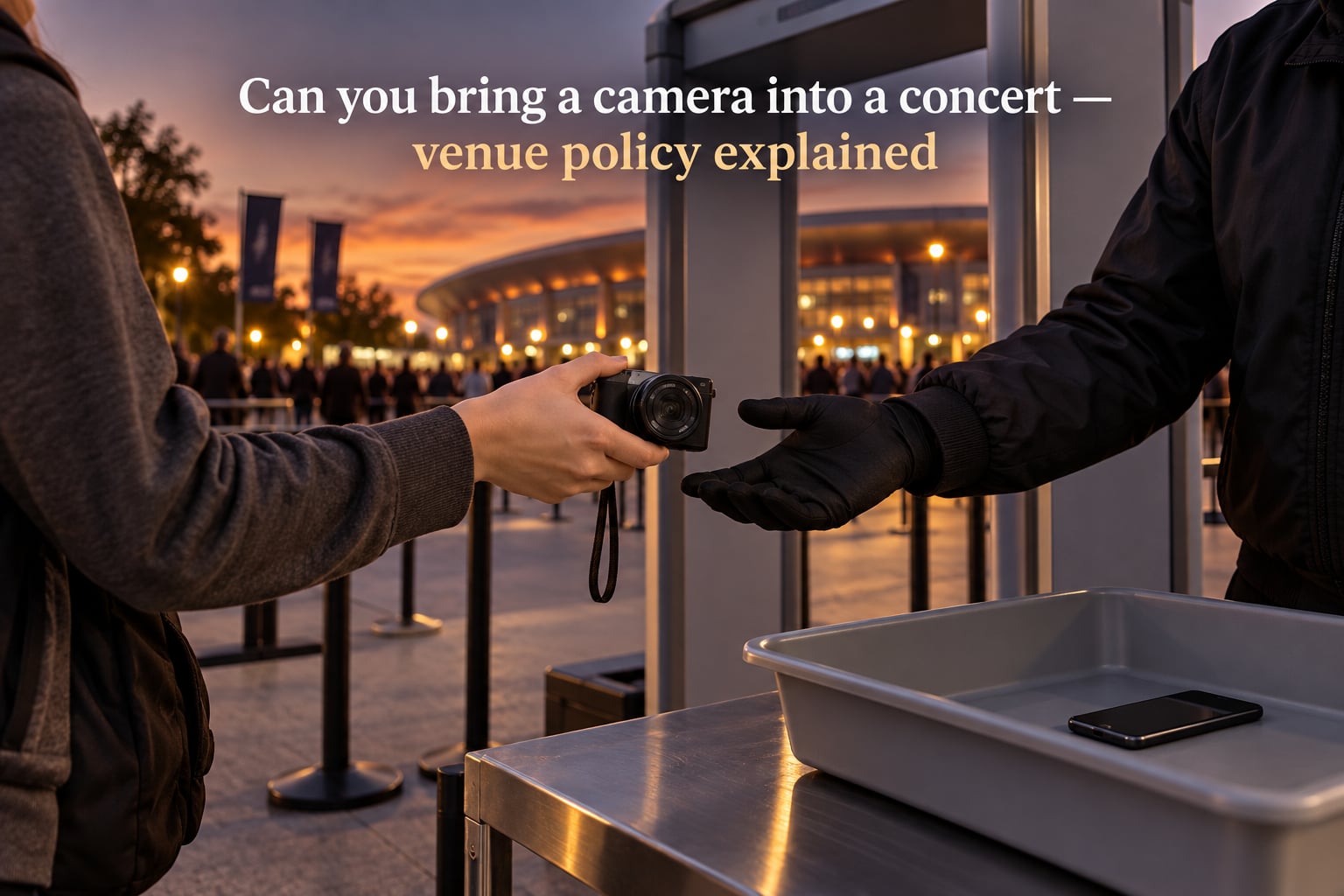
If you’re asking can you bring a camera into a concert, the honest answer is: it depends on what camera and where the show is. Most US and UK venues draw a clear line – phones and small point-and-shoots are fine, while anything with a removable lens is treated as “professional” gear and needs a press pass.
I’ve been shooting concerts for a decade, and I’ve watched this rule stay remarkably consistent across arenas, theaters, and festivals. The trick isn’t memorizing a list of cameras. It’s understanding why the rule exists, what counts as “professional,” and how to check your specific venue’s policy before you queue at the door.
This guide covers everything: the definition venues use, what gear is usually allowed, what isn’t, how policies differ by venue type, and – if you really want to bring your DSLR – how to get a press pass. I’ll also walk you through what to do if security turns you away.
Table of Contents
- Quick Answer: Can You Bring a Camera Into a Concert?
- What Counts as a “Professional Camera” at a Concert?
- Why Venues Restrict Professional Cameras
- Cameras Usually Allowed at Concerts
- Cameras Usually Not Allowed Without a Press Pass
- Camera Policy by Venue Type
- How to Check Your Specific Venue’s Camera Policy
- K-Pop Concerts, Festivals, and Other Special Cases
- How to Get a Press or Photo Pass
- What to Do If Your Camera Is Refused at the Door
- Frequently Asked Questions
- Can you bring a DSLR camera to a concert?
- Can we bring a digital camera to a concert?
- What type of cameras are allowed in concerts?
- Why aren’t professional cameras allowed at concerts?
- Are cameras allowed in concert venues?
- How do I get a press pass for concert photography?
- What is considered a professional camera at a concert?
- Can I bring a film camera or a disposable camera to a concert?
- Final Word: Can You Bring a Camera Into a Concert?
Quick Answer: Can You Bring a Camera Into a Concert?
Yes, you can bring a camera into a concert – in most cases a smartphone or small compact camera is allowed. DSLR and mirrorless cameras with interchangeable lenses are generally prohibited unless you carry a valid press, photo, or media pass issued by the venue or the artist’s tour. The rule hinges on one simple definition: a “professional camera” is any camera with a removable or interchangeable lens.
If you only plan to snap a few keepsake photos, your phone or a basic point-and-shoot is almost always fine. If you’re bringing anything larger, expect a bag check and a conversation at security.
What Counts as a “Professional Camera” at a Concert?
Venues use a working definition that’s simpler than camera enthusiasts like: any camera with a removable or interchangeable lens. That definition captures DSLR bodies, mirrorless bodies, and most “bridge-style” cameras that look like SLRs even if the lens isn’t technically detachable.
Here’s how security typically classifies cameras at the door:
- Removable lens (DSLR, mirrorless): Almost always prohibited without a press pass.
- Fixed-lens compact or point-and-shoot: Almost always allowed.
- Bridge camera (superzoom with non-removable lens): Allowed at some venues, denied at others – depends on how “professional” it looks.
- GoPro, action camera, or 360 camera: Usually denied because they can record video.
- Film camera (35mm or medium format): Allowed at most venues because they can’t record video, but they may still be turned away if they look “pro.”
- Disposable camera: Almost universally allowed.
- Smartphone: Almost universally allowed, though some artists (notably the Rolling Stones) prohibit any recording at all.
The reason the rule is so visual is that security staff at concerts aren’t photographers. They’re working from a heuristic: if it looks like something a working photographer would carry, it probably needs a pass. A bulky DSLR with a 70-200mm telephoto is a clear “no.” A small Sony RX100 in a jacket pocket barely gets a second look.
Why Venues Restrict Professional Cameras
Restrictions aren’t arbitrary. There’s a real chain of reasons behind the rule, and understanding them helps you predict how strict a given venue will be.
Performer rights and copyright. Touring artists and their labels treat live performance as intellectual property. A fan with a DSLR can record video clips, capture high-resolution stills, and – in some cases – stream audio. The Rolling Stones, Adele, and several other major acts explicitly ban all recording, including smartphones, because unauthorized footage can appear on social media within seconds of the encore.
Fan experience. An arena full of raised camera viewfinders blocks sightlines. Venues want the people in the front rows to actually watch the show, not turn around and shoot it for strangers on Instagram. This is also why most press passes limit photographers to the first three songs from the photo pit – after that, they’re out of the audience.
Liability and safety. A long telephoto lens swung around in a packed GA pit is a safety hazard. Insurance carriers and venue operators factor this in. Limiting professional gear reduces the chance of an injury claim.
Artist contract. Many touring contracts include a clause that lets the artist’s representative override the venue’s standard policy. So even if a venue’s website says “small compacts allowed,” the tour can tighten that to “no cameras at all” on a per-show basis. Always check the artist’s tour page too, not just the venue.
Cameras Usually Allowed at Concerts
Across the major US and UK venues I’ve researched and shot at, the following are consistently allowed for ticketed fans without any kind of pass:
- Smartphones. The default. Video is sometimes restricted (no flash, no extended recording) but the phone itself is fine.
- Compact point-and-shoot cameras. The smaller, the better. A camera that fits in a shirt pocket rarely gets questioned.
- Disposable film cameras. Universally allowed because they can’t record video or audio.
- 35mm film cameras with fixed (non-removable) lenses. Usually allowed; a few venues have denied vintage SLRs that look “pro.”
Even when a camera is allowed, flash is almost always prohibited. It annoys the artists, distracts the audience, and ruins your shot anyway. The same goes for selfie sticks, monopods, and tripods – check the venue’s prohibited items list, because they’re typically banned even when cameras are allowed.
Cameras Usually Not Allowed Without a Press Pass
If your camera falls into one of these categories, plan on it being denied at the door unless you have a press, photo, or media pass:
- DSLR cameras with detachable lenses, regardless of body size.
- Mirrorless cameras with interchangeable lenses (Sony Alpha, Canon R-series, Nikon Z, Fujifilm X).
- Telephoto zoom lenses over about 200mm, even on cameras that would otherwise be borderline.
- GoPro, Insta360, and action cameras – banned for their video-recording capability.
- Dedicated video cameras and camcorders.
- DSLR-style rigs with external microphones – audio recording is its own restricted category.
One nuance worth flagging: a few venues allow “bridge” cameras – fixed-lens superzooms like the Sony RX10 or Canon PowerShot SX series – because the lens isn’t removable. Others treat anything that looks like an SLR as “professional.” When in doubt, assume the stricter interpretation and prepare for your camera to be turned away.
Camera Policy by Venue Type
Different venues draw the line in different places. Here’s a breakdown of what to expect by venue category.
Arenas and Stadiums (Madison Square Garden, The O2, State Farm Arena)
Major arenas are the strictest. The default rule is “no professional cameras,” meaning any ILC body, regardless of how small. Phones and small compacts go through bag check without issue. State Farm Arena, Madison Square Garden, The O2 in London, and the Hollywood Bowl all publish policies along these lines, and tour riders often tighten them further. If you’re bringing a fixed-lens compact, expect to show that it has no removable lens.
Theaters and Concert Halls
Theaters tend to follow the artist’s rider rather than publish their own hard rule. Smaller seated venues (think Brooklyn Steel, The Fillmore, the Troubadour) often allow small compacts even when the headline act wouldn’t. The seating arrangement means fewer blocked sightlines, so enforcement is usually lighter – but it still varies by night-of security.
Clubs and Small Venues
Clubs are the most permissive. Many don’t have a published camera policy at all, and small compacts, film cameras, and even compact mirrorless bodies are routinely waved through. That said, the artist can still ask you to stop – especially if you’re shooting video.
Festivals (Coachella, Lollapalooza, Glastonbury)
Festivals split the difference. Most allow phones and small compacts, but the photo pit rules are stricter and the press credentials are tightly controlled by the festival’s media team, not individual artists. Coachella, Lollapalooza, and Reading/Leeds all publish a media accreditation page with their own rules. Day-of-festival general admission typically follows the arena rule: no ILC bodies without a pass.
Outdoor Venues and Amphitheaters
Outdoor venues often have looser enforcement because there’s no “photo pit” in the traditional sense. Still, the underlying policy is usually the same – point-and-shoots in, DSLRs out without a pass.
How to Check Your Specific Venue’s Camera Policy
The single best thing you can do is verify before you travel. Here’s the workflow I use before any show.
- Check the venue’s official website. Look for an “FAQ,” “Know Before You Go,” or “A-Z Guide” page. Most major venues publish their prohibited items list there.
- Check your ticketing platform. Ticketmaster, AXS, and Eventim all have help-center pages that summarize common venue policies.
- Check the artist’s tour page. The tour rider overrides the venue. If the artist’s page says “no recording devices,” assume that includes your phone.
- Call the venue box office. A two-minute phone call answers questions the website leaves ambiguous. Have your camera model ready.
- Check the venue’s social media. Twitter/X and Instagram accounts often post day-of reminders about what’s allowed.
Take a screenshot of the policy on the day of the show. If security gives you trouble at the door, having the policy in your pocket makes the conversation much shorter.
K-Pop Concerts, Festivals, and Other Special Cases
A few trends in 2026 deserve their own callout, because the rules behave a little differently in these settings.
K-pop concerts are a special case. K-pop fans are known for bringing light sticks (official bluetooth sticks that sync with the show), and most venues explicitly allow them. Cameras follow the standard rule – phones and small compacts in, ILC bodies out – but the artist’s agency sometimes tightens recording rules because fan-cam footage circulates within minutes. If you’re heading to a K-pop show, assume video recording of any kind is restricted.
Festivals are the easiest place to get a press pass but the hardest place to use one without one. Festival media teams credential photographers months in advance, and they cap the number of pit spots per publication. Don’t expect to walk up with a portfolio and get a same-day festival pass.
Tribute shows, classical concerts, and orchestras tend to be the most permissive about still photography but the strictest about flash and audio recording. Many classical venues allow non-flash photography throughout the performance.
How to Get a Press or Photo Pass
If you want to shoot a concert with your DSLR or mirrorless, you need a press pass (sometimes called a photo pass or media pass). Here’s the realistic path to getting one.
- Build a portfolio first. You won’t get credentialed off iPhone snapshots. A working portfolio – even 20 strong shots from local shows – is the baseline. Post them on a personal site or Instagram.
- Pitch to publications and outlets. Local blogs, music magazines, and community newspapers accept pitches from freelance photographers. Offer to shoot a show in exchange for the byline and the credential that comes with it.
- Contact the artist’s publicist or tour PR. Most major tours have a press contact listed in their EPK (electronic press kit). Email them 4-8 weeks before the show with your portfolio, outlet, and a one-paragraph pitch.
- Apply through accredited media lists. Many venues and festivals accept applications through accredited media organizations – NPPA, local press associations, or outlet-specific media lists.
- Start small. Your first few passes will be for local club shows. Build from there. Once you have a track record of published work, larger tours and festivals become realistic targets.
Expect that the first three songs from the photo pit is the standard – even accredited photographers are usually asked to leave after that. This is industry-standard, not a sign you’re doing something wrong.
What to Do If Your Camera Is Refused at the Door
It happens to almost everyone who brings the wrong gear. Here’s the playbook.
- Don’t argue. The door security doesn’t make the policy, and arguing won’t change it. The show goes on without your confrontation.
- Ask about coat check or bag drop. Many venues will hold your camera for free or a small fee so you can pick it up after the show.
- Return to your car or hotel. If the venue is nearby, this is the simplest option. Most arenas have long-term parking a short walk away.
- Use your phone instead. Phones are universally allowed; use them for the night and shoot the real thing next time.
- Request the policy in writing after the show. If you were turned away despite the venue website saying cameras were allowed, email the venue box office the next day. Many will clarify or update the policy for future events.
Frequently Asked Questions
Can you bring a DSLR camera to a concert?
Almost always no – any DSLR with a removable or interchangeable lens is treated as a professional camera and requires a press or photo pass. Without a pass, expect security to deny entry or ask you to return the camera to your car.
Can we bring a digital camera to a concert?
Yes, if it is a small point-and-shoot or compact digital camera with a fixed lens. Phones are also allowed. Digital single-lens cameras (DSLR or mirrorless with interchangeable lenses) need a press pass at virtually every major venue.
What type of cameras are allowed in concerts?
Smartphones, compact point-and-shoot cameras, disposable film cameras, and most fixed-lens 35mm cameras. Cameras NOT allowed without a press pass include any DSLR, any mirrorless with interchangeable lenses, GoPros and action cameras, and dedicated video cameras.
Why aren’t professional cameras allowed at concerts?
Venues restrict professional cameras to protect performer rights and copyright, preserve sightlines for other fans, reduce liability from long lenses in crowded pits, and honor artist tour contracts that may ban all recording entirely.
Are cameras allowed in concert venues?
Yes – phones and small compacts are allowed in most venues. Larger cameras with interchangeable lenses require a press pass. Policies vary by venue and by tour, so always check the venue website and the artist’s tour page before the show.
How do I get a press pass for concert photography?
Build a portfolio of strong concert shots, pitch to local blogs and music publications for bylined coverage, contact the artist’s publicist 4-8 weeks before the show with your portfolio and outlet, and start with smaller club shows before targeting arena tours.
What is considered a professional camera at a concert?
Any camera with a removable or interchangeable lens – that includes every DSLR body and every mirrorless body in the Sony, Canon, Nikon, and Fujifilm lineups. The definition is visual: if it looks like a working photographer’s rig, security treats it as professional.
Can I bring a film camera or a disposable camera to a concert?
Yes – disposable cameras are almost universally allowed. 35mm film cameras with fixed lenses are usually allowed. Vintage SLRs with removable lenses may be turned away even though they cannot record video, because they look like professional gear.
Final Word: Can You Bring a Camera Into a Concert?
Yes, you can bring a camera into a concert – a phone or a small fixed-lens compact is the safest choice and will pass through security at virtually any venue. If you want to bring a DSLR or mirrorless body, you need a press or photo pass, and getting one takes weeks of preparation. Before any show, check the venue’s website, the artist’s tour page, and your ticketing platform’s help center; if those don’t answer your question, a two-minute call to the box office will.
Three takeaways to remember: one, the rule hinges on whether your camera has a removable lens – that’s how security defines “professional”; two, the artist’s tour contract can override the venue’s standard policy, so always check both; three, if you’re serious about concert photography, start building your portfolio now and pitch to local outlets – that’s how every working concert photographer I know got started.