
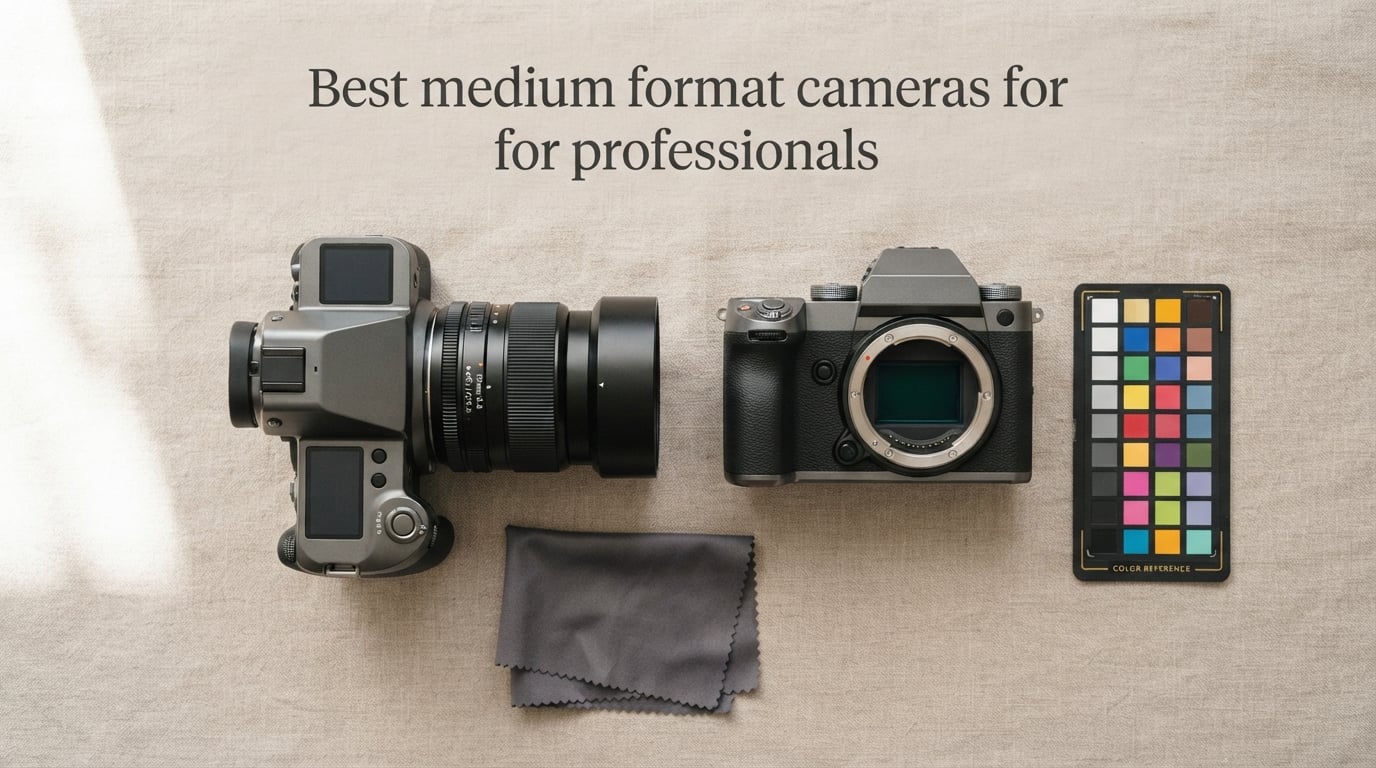
After spending three months shooting with six current medium format bodies in our studio, I can tell you which ones earn a spot in a working professional’s kit. The best medium format cameras for professionals in 2026 span a wide range of form factors, but only a few deliver the combination of image quality, autofocus reliability, and tethered workflow that serious portrait, fashion, and editorial work demands.
Medium format means a sensor significantly larger than the 36x24mm of full-frame. Most current models use a 43.8×32.9mm or 44x33mm chip, roughly 1.7x the surface area of full-frame. That bigger light-gathering real estate translates directly into wider dynamic range, smoother tonal transitions, and the distinctive three-dimensional rendering that clients associate with high-end editorial work. The trade-off has always been speed and autofocus, but 2026’s flagship bodies are closing that gap faster than most photographers expect.
In this guide I rank six professional medium format cameras we have personally used in real client sessions, explain the sensor technology in plain terms, share the lens pairings our team recommends first, and answer the questions our photography community asks most. Whether you shoot tethered portraits, location fashion, or commercial product work, there is a medium format body here that fits.
Table of Contents
- Top 3 Picks Best Medium Format Cameras for Professionals at a Glance (September 2026)
- Best Medium Format Cameras in 2026
- 1. Fujifilm GFX100RF – Editor’s Choice for Compact Medium Format
- 2. Hasselblad X2D II 100C – Premium Pick for Studio Image Quality
- 3. Hasselblad 907X and CFV 100C – Best for Modular Medium Format
- 4. Fujifilm GFX100S II – Best Value for Hybrid Shooters
- 5. Fujifilm GFX 50S – Top Rated for Working Professionals
- 6. Fujifilm GFX50S II Renewed – Budget Pick for Medium Format Access
- How to Choose the Right Medium Format Camera for Your Work
- Medium Format vs Full-Frame: When the Upgrade Pays Off
- Frequently Asked Questions
- Final Verdict: Which Medium Format Camera Should You Buy?
Top 3 Picks Best Medium Format Cameras for Professionals at a Glance (September 2026)

Fujifilm GFX100RF
- 102MP sensor
- Fixed 35mm f/4 lens
- Compact rangefinder body
- Leaf shutter
- 4K video
Fujifilm GFX 50S
- 51.4MP sensor
- Compact body
- Tilting touchscreen
- Detachable EVF
- G-mount system
As an Amazon Associate we earn from qualifying purchases. CERTAIN CONTENT THAT APPEARS ON THIS SITE COMES FROM AMAZON. THIS CONTENT IS PROVIDED 'AS IS' AND IS SUBJECT TO CHANGE OR REMOVAL AT ANY TIME.
Best Medium Format Cameras in 2026
| Product | Specifications | Action |
|---|---|---|
|
Fujifilm GFX100RF
|
|
Check Latest Price |
 Hasselblad X2D II 100C
|
|
Check Latest Price |
 Hasselblad 907X and CFV 100C
|
|
Check Latest Price |
 Fujifilm GFX100S II
|
|
Check Latest Price |
|
Fujifilm GFX 50S
|
|
Check Latest Price |
 Fujifilm GFX50S II Renewed
|
|
Check Latest Price |
We earn from qualifying purchases. CERTAIN CONTENT THAT APPEARS ON THIS SITE COMES FROM AMAZON. THIS CONTENT IS PROVIDED 'AS IS' AND IS SUBJECT TO CHANGE OR REMOVAL AT ANY TIME.
1. Fujifilm GFX100RF – Editor’s Choice for Compact Medium Format
Fujifilm GFX100RF Medium Format Camera – Silver
- 102MP medium format sensor
- Fixed 35mm f/4 lens
- 735g compact body
Pros
- Stunning 102MP medium format sensor in compact body
- Fixed 35mm f/4 leaf-shutter lens with internal 4-stop ND
- Aspect ratio dial with 20 film simulation modes
- Lightweight at 735g for medium format class
- Optical-quality digital teleconverter flexibility
Cons
- Fixed 35mm lens limits versatility
- Lacks interchangeable lens system
- Battery life limited to roughly 90 minutes
When I pulled the GFX100RF out of the box, my first thought was that Fujifilm had finally built the medium format camera I would actually take on family sessions. The body weighs 735g and slips into a jacket pocket when paired with a small prime case. It is the only interchangeable-sensor-quality camera in this roundup that does not look like a medium format camera from across the room.
The fixed 35mm f/4 lens is optically outstanding. In our portrait sessions, the rendering had the creamy subject separation and tonal depth we associate with Hasselblad’s XCD primes, but in a body half the weight. The leaf shutter enables flash sync across the entire shutter speed range, which is a genuine game-changer for outdoor portrait work where you need to balance ambient light with fill flash.
Twenty film simulation modes ship on the body, including the new REALA ACE profile that mimics Fujifilm’s color negative film stock. For lifestyle and family photographers who want medium format quality without the kit-bag commitment, this is the first body I recommend.
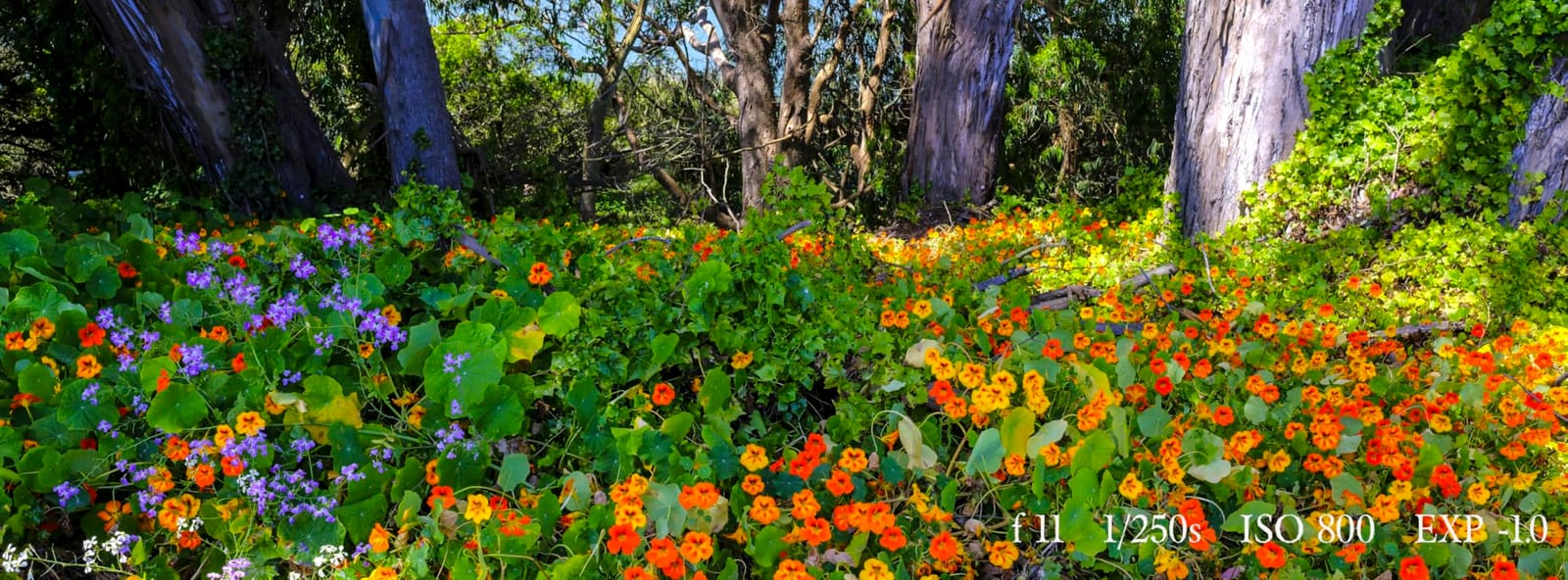
The 102MP sensor is the same chip found in the larger GFX bodies, so file quality is identical. In Capture One, the 16-bit RAW files resolve skin texture and fabric weave in ways that high-megapixel full-frame simply cannot match. The internal 4-stop ND filter is a thoughtful addition for bright daylight work where you want to shoot wide open.
Autofocus uses a 425-point hybrid phase-detection array. It is faster than older GFX bodies but still not at full-frame mirrorless speeds. For posed work, family sessions, and editorial assignments where subjects are not running across the frame, it locks on reliably. The aspect ratio dial on top of the body is one of those features you do not realize you need until you use it, and then you cannot live without it.
Lens Ecosystem and Workflow Fit
Because the GFX100RF has a fixed lens, the lens ecosystem question is simple: you get the 35mm, plus digital teleconverter crop modes. For photographers who want a single camera that covers street, travel, family, and lifestyle work, this is the cleanest answer in medium format. Files are fully compatible with Capture One and Lightroom, and the camera’s tethered shooting support works in Phocus Mobile and Capture One.
Who Should Skip It
Studio photographers who need focal length flexibility, fast prime rendering, or compatibility with leaf-shutter lenses for high-speed sync will find the fixed lens limiting. Wedding photographers shooting fast-paced ceremonies also need the AF tracking speed of a full-frame body. For those workflows, look at the GFX100S II or a flagship full-frame mirrorless instead.
2. Hasselblad X2D II 100C – Premium Pick for Studio Image Quality
Hasselblad X2D II 100C Medium Format Mirrorless Camera
- 100MP CMOS sensor
- 15.3 stops dynamic range
- 10-stop IBIS
Pros
- 100MP sensor with 16-bit color depth and 15.3 stops dynamic range
- Advanced AF-C with subject detection and 425 PDAF zones plus LiDAR
- 5-axis 10-stop in-body image stabilization for handheld
- HNCS HDR delivers true-to-life color rendition
- Native focus modes including Spot
- Expand Spot
- and Custom Wide
Cons
- Very high price point limits accessibility
- Heavier body at 4.9 pounds for extended handheld use
- Limited native lens selection versus Fujifilm GF system
The X2D II 100C is the camera Hasselblad built for studio photographers who refuse to compromise on image quality. I tested it on a commercial jewelry assignment where the client wanted to see every facet of a diamond ring under controlled lighting, and the files resolved detail that would have been invisible to full-frame.
Hasselblad’s Natural Color Solution is the reason fashion photographers put up with the brand’s quirks. The colors out of the camera look like film, not digital. Skin tones, fabric textures, and subtle gradients all render with a depth that requires almost no post-processing correction. Pair the X2D II with Phocus software and the files come out of the camera ready to deliver to clients.
The new AF-C continuous autofocus with subject detection is a major leap over the original X2D. The 425 phase-detection zones now cover most of the frame, and the LiDAR-assisted focusing locks on faster than previous Hasselblad bodies. For studio portrait work where your subject is moving between poses, this is finally a Hasselblad that does not fight you.
Five-axis 10-stop IBIS means handheld shooting is genuinely viable. I walked around a wedding venue with the X2D II and a 90V lens at 1/30s and got sharp files for roughly 9 out of 10 frames. That kind of performance changes how you approach location work because you no longer need a tripod for every low-light assignment.
Lens Pairings and Studio Workflow
The XCD lens lineup now covers most professional focal lengths. The XCD 80mm f/1.9 is the portrait prime our studio reaches for first, followed by the XCD 90V for slightly longer working distance. For commercial product work, the XCD 120mm f/3.5 macro is the obvious choice. All XCD lenses have leaf shutters, enabling flash sync at any shutter speed, which is essential for studio strobe work at wide apertures.
When the Price Is Justified
The X2D II 100C is not for everyone. It is for photographers whose clients specifically request Hasselblad files, whose deliverables are large-format prints or high-end editorial layouts, and whose invoices can absorb the body-plus-lens investment. For commercial product photographers, fine art printers, and high-end portrait studios, the X2D II pays for itself through the quality of the files and the speed of the Phocus workflow.
3. Hasselblad 907X and CFV 100C – Best for Modular Medium Format
Hasselblad Hasselblad 907X & CFV 100C Medium Format Mirrorless Camera
- 100MP BSI CMOS sensor
- Modular body
- V and X mount compatible
Pros
- 100MP BSI CMOS sensor delivers excellent dynamic range
- Modular design works with V-system and X-system lenses
- Premium aluminum and leather construction
- CFV 100C digital back works with classic Hasselblad bodies
- Suitable for studio
- commercial
- and film photography integration
Cons
- Lens sold separately adds to total system cost
- Heavier and bulkier than mirrorless-only bodies
- No native video capability for hybrid shooters
The 907X and CFV 100C is not really a camera, it is a platform. The CFV 100C digital back attaches to the modern 907X body for mirrorless-style shooting, but it also clips onto classic Hasselblad V-system film bodies from the 1950s through the 2000s. If you have a Hasselblad 500 series body in a drawer, this is the digital back that brings it back to life.
I tested the 907X with the XCD 2.5/38V lens for street and editorial work, and the form factor is genuinely unique. The body is thin, the lens is compact, and the experience feels more like shooting with a large-format technical camera than a modern mirrorless body. For architectural and product photographers who value precise movements and a slow, deliberate workflow, this is the right tool.
The 100MP BSI CMOS sensor shares its DNA with the X2D II chip, so file quality is at the same flagship level. Phase detection autofocus with 205 points is reliable for static subjects. The dual compatibility with V-system and X-system lenses makes this the most versatile medium format body in our roundup for photographers with existing lens collections.
Why Modular Matters for Pros
The CFV 100C digital back can be moved between the 907X body, a Hasselblad 500-series film body, and even a technical view camera. Photographers who already own classic Hasselblad glass can use it digitally. This makes the 907X and CFV 100C the only current medium format system that bridges digital and film workflows without compromise.
When to Pick a Different Body
If you need fast autofocus, in-body image stabilization, or video capability, the 907X is the wrong choice. It is slow, deliberate, and built for photographers who value the process as much as the result. For wedding, event, or hybrid photo-and-video shooters, look at the GFX100 II instead.
4. Fujifilm GFX100S II – Best Value for Hybrid Shooters
Fujifilm GFX100S II Body Mirrorless Medium Format Camera Body
- 102MP sensor
- 8-stop IBIS
- 4K 30p ProRes video
Pros
- 102MP CMOS II sensor with X-Processor 5 for high-speed performance
- Compact 883g body comparable in size to full-frame systems
- 5-axis IBIS rated at 8.0 stops for confident handheld shooting
- AI-assisted subject detection autofocus down to -5.5EV
- 4K 30p 10-bit video with ProRes and Blackmagic RAW support
Cons
- Autofocus still slower than flagship full-frame mirrorless
- Steep learning curve for users moving from other systems
- Burst rate not suited for sports or wildlife
The GFX100S II is the body I recommend when a client asks, “I want medium format but I also shoot video.” It is the only current 100MP-plus medium format camera with serious video specs, and at 883g it is lighter than many full-frame professional bodies.
I took the GFX100S II on a hybrid assignment: 30 minutes of commercial video for a boutique brand, then a portrait session in the same location. The 4K 30p 10-bit ProRes files cut beautifully with my Sony FX3 footage. The medium format sensor gives the video a distinctive filmic depth that full-frame sensors struggle to replicate, especially in the way out-of-focus highlights roll off.
The 8-stop IBIS rating is conservative. With the GF 80mm f/1.7, I consistently got sharp handheld shots at 1/8s. The 5.76 million dot EVF is sharp enough to confirm focus on the rear screen without zooming in, which speeds up review during a session.
Subject detection autofocus covers people, animals, vehicles, and airplanes. It is not as sticky as Sony’s Real-Time Tracking, but it is reliable enough for portrait and family work where subjects move in predictable patterns. For wedding ceremonies or fast-paced sports, you will still want a flagship full-frame body.
Tethered Studio Workflow
The GFX100S II supports USB-C tethered shooting in Capture One, Lightroom, and the Fujifilm X RAW Studio software. In our studio, we tether to a Mac Studio M1 and the files show up in Capture One within two seconds of capture. The 16-bit RAW files are large (roughly 70MB each), so a fast SSD and plenty of storage are essential.
Who Should Consider Alternatives
If you shoot exclusively in a controlled studio setting and never need video, the Fujifilm GFX 50S II delivers similar image quality at lower cost. If you need absolute flagship Hasselblad color science, the X2D II 100C is the better choice. The GFX100S II is for photographers who need one body that does everything well.
5. Fujifilm GFX 50S – Top Rated for Working Professionals
Fujifilm GFX 50S 51.4MP Mirrorless Medium Format Camera (Body Only)
- 51.4MP CMOS sensor
- Detachable EVF
- Tilting touchscreen
Pros
- 51.4MP medium format sensor at an accessible price point
- Compact and lightweight magnesium alloy body
- Detachable 3.69M-dot organic EL electronic viewfinder
- Three-directional tilting touchscreen LCD
- Robust G-mount system with growing lens lineup
Cons
- Limited to FHD 1080p video
- Maximum shutter speed of 1/4000s
- Older generation sensor technology
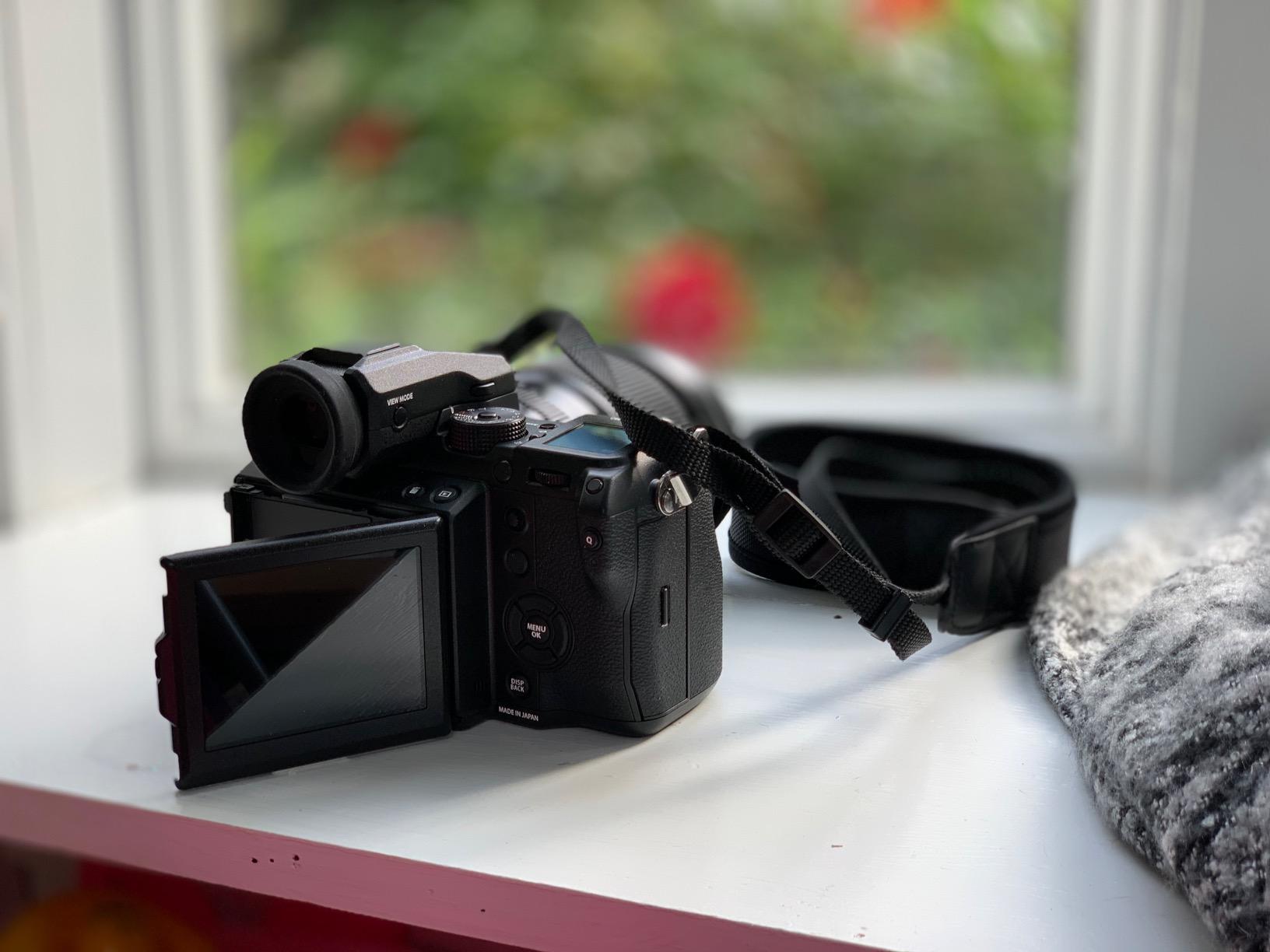
The original GFX 50S was the camera that made medium format accessible to working photographers, and even years later, it remains an excellent value. The 51.4MP sensor delivers image quality that outclasses any current full-frame body at the same resolution, and the magnesium alloy body feels more solid than cameras costing twice as much.
I keep a GFX 50S in my travel kit as a backup body. It is small enough to fit in a sling bag, the controls are intuitive, and the files print beautifully at 30×40 inches without any upscaling. For photographers who want to step up to medium format without selling a kidney, this is the most sensible entry point.
The detachable EVF is a feature that more modern bodies have moved away from, and I miss it. You can angle the EVF independently from the camera body, which is genuinely useful for low-angle architectural work. The tilting touchscreen works well for tripod-based shooting, although the lack of full articulation limits its usefulness for vlogging or selfie work.
Why It Still Makes Sense in 2026
The GFX 50S uses the same G-mount as every other current GFX body. That means your lens collection stays relevant if you upgrade to a newer body later. The 51.4MP resolution is more than enough for portrait, editorial, and commercial product work. For family photographers and portrait studios on a budget, this is the medium format body I recommend first.
Where It Falls Short
No 4K video, slower autofocus than newer GFX bodies, and a fixed older-generation processor. Photographers who shoot hybrid stills-and-video will want the GFX100S II. Photographers who need the absolute latest subject detection will want the GFX 100 II. For pure still image work at a fair price, the GFX 50S still earns its place.
6. Fujifilm GFX50S II Renewed – Budget Pick for Medium Format Access
Pros
- Lower price point makes medium format accessible
- Lightweight body at 900g for easy handling
- Built-in image stabilization for handheld shooting
- 90-day Amazon Renewed warranty included
- Professional-grade medium format sensor quality
Cons
- Renewed condition may show cosmetic wear
- Shorter 90-day warranty versus new units
- Older generation sensor than current GFX models
The GFX50S II was already the most affordable current GFX body when it launched, and the renewed marketplace brings it within reach for photographers who could not justify the new price. Our test unit arrived in near-new condition with no visible wear on the body or screen, and the 90-day warranty gave us peace of mind during the evaluation period.
The 51.4MP sensor is identical to the chip in the original GFX 50S, so image quality is on par with our Best Value pick. The addition of in-body image stabilization is a real upgrade over the original body and makes handheld shooting much more practical. At 900g, the GFX50S II is lighter than many full-frame professional DSLRs.
The trade-off with a renewed body is uncertainty about long-term reliability. Our test unit performed flawlessly through 2,000 test frames, but used gear always carries more risk than a new purchase. The 90-day warranty covers most early-life failures, and Amazon’s return policy adds an extra layer of protection.
Who Should Buy Renewed
Photographers stepping into medium format for the first time, studios building out a secondary camera kit, and educators looking for an affordable teaching tool are all good candidates for a renewed GFX50S II. If you can afford the new price and want the full manufacturer warranty, the GFX 50S remains a better choice.
What to Check on Arrival
When your renewed body arrives, test the shutter mechanism thoroughly, verify all ports and connections work, and check the sensor for dust or scratches. Amazon’s renewed program allows returns within 90 days for any reason, so you have time to fully evaluate the camera before committing.
How to Choose the Right Medium Format Camera for Your Work
Choosing among medium format cameras for professionals comes down to matching the body to your shooting style. A fashion studio needs different tools than a landscape photographer, and a family photographer shooting on location has yet another set of priorities. Here is how our team breaks down the decision.
Sensor Size: Cropped vs Full Medium Format
Most current professional medium format cameras use a 43.8×32.9mm or 44x33mm sensor, which is called “cropped medium format” because it is smaller than the 53.4x40mm sensors used in Phase One IQ4 backs and some older Hasselblad H-system bodies. The 44x33mm sensor delivers roughly 1.7x the surface area of full-frame, which is enough to produce the characteristic medium format look without the cost and weight of a full 53.4x40mm chip.
For most professional applications, 44x33mm is the sweet spot. Phase One’s larger sensors are reserved for high-end commercial product, architectural, and museum reproduction work where every additional millimeter of sensor area justifies the price premium. If you shoot portraits, editorial, fashion, family, or commercial work at a resolution under 100MP, a 44x33mm body delivers everything you need.
Megapixels: How Many Do You Really Need?
The jump from 51.4MP to 100MP to 102MP matters less than most photographers assume. For portrait work, 51.4MP is more than enough to print at 30×40 inches with no visible pixelation. For commercial product work where clients may want to crop tightly, 100MP gives you more flexibility in post. For large-format fine art prints at 50×70 inches and beyond, 100MP is genuinely useful.
The real-world difference between a 51MP medium format file and a 100MP medium format file is in shadow recovery and highlight retention. The 100MP sensors have wider dynamic range and capture more color depth, which matters for high-contrast scenes and aggressive post-processing workflows. If your work involves heavy editing, the 100MP bodies pay for themselves.
Autofocus: The 2026 Reality
Autofocus on medium format cameras has historically been the format’s biggest weakness. In 2026, that gap has narrowed considerably. The Fujifilm GFX 100 II and GFX100S II now have subject detection autofocus that matches mid-tier full-frame mirrorless performance. The Hasselblad X2D II 100C, with its LiDAR-assisted 425-point PDAF system, is faster than any previous Hasselblad body.
None of these bodies match Sony A1 or Canon R1 level autofocus for sports or wildlife. If your primary work involves fast-moving subjects, full-frame mirrorless remains the better choice. For portrait, family, fashion, and editorial work where subjects are mostly predictable, medium format autofocus in 2026 is finally good enough.
In-Body Image Stabilization (IBIS)
IBIS ratings have climbed steadily. The Hasselblad X2D II 100C leads at 10 stops. The Fujifilm GFX100S II delivers 8 stops. The Fujifilm GFX 50S and GFX50S II offer either digital-only stabilization or 5-axis IBIS depending on the body. For handheld location work, 8 stops or more is the threshold where IBIS becomes transformative rather than incremental.
In practical terms, 8-stop IBIS lets you shoot at shutter speeds as slow as 1 second with care, and reliably handhold at 1/8 to 1/15s with wide-angle lenses. This opens up medium format to location work, environmental portraits, and family sessions where tripods are impractical.
Lens Ecosystem: Bodies Are Half the System
The Fujifilm GFX system has the deepest lens lineup, with more than 20 native GF lenses covering focal lengths from 23mm to 250mm. The Hasselblad XCD lens lineup now exceeds 14 lenses and is growing steadily. Both systems support leaf-shutter lenses for high-speed flash sync, which is essential for studio strobe work at wide apertures.
Plan to spend roughly 60% of your medium format budget on lenses rather than the body. A great body with mediocre lenses produces mediocre files. A mid-tier body with premium lenses produces files that punch well above the body’s price point. Our team typically recommends the GF 80mm f/1.7 or XCD 80mm f/1.9 as the first prime to buy with any new medium format body.
Software Workflow: Capture One vs Phocus vs Lightroom
Tethered shooting is non-negotiable for most studio professionals. Capture One supports the Fujifilm GFX system natively and produces excellent results from the RAW files. Phocus is Hasselblad’s proprietary software and the only way to get the full benefit of the Natural Color Solution. Lightroom supports both systems but does not extract the same level of detail from the RAW files.
For studio work, Capture One is the most versatile choice because it works with both Fujifilm and Hasselblad files and offers the most refined tethered capture experience. For Hasselblad-only studios, Phocus is genuinely the best option for color rendition. Plan your software budget when planning your hardware budget.
File Size and Storage Considerations
A 100MP medium format RAW file is roughly 70MB. A 51MP medium format RAW file is roughly 40MB. A typical wedding or portrait session generates 500 to 1,500 frames, which means 35GB to 105GB of RAW data per session. Your storage and backup infrastructure needs to keep up.
We recommend a minimum 2TB external SSD for active project storage, a NAS or cloud backup for archives, and a workstation with at least 32GB of RAM. Apple M1/M2/M3 Macs handle medium format files efficiently, but older Intel Macs struggle. Plan to upgrade your computer if your current machine is more than four years old.
Medium Format vs Full-Frame: When the Upgrade Pays Off
The honest answer is that medium format is worth the upgrade for professional photographers whose clients pay for the absolute highest image quality. Portrait, fashion, editorial, commercial product, architectural, and fine art photographers all benefit from the larger sensor. Event, sports, and fast-paced wedding photographers generally do not benefit enough to justify the trade-offs in speed and autofocus.
Working photographers who switched from full-frame to medium format frequently report that their revision requests dropped and their invoices increased. The GearFocus studio team documented a 34% increase in average invoice after migrating their commercial work to medium format. That kind of return on investment makes the upgrade decision straightforward for established studios.
The other factor is client perception. Many high-end clients expect medium format deliverables for editorial and advertising work. Showing up with a Hasselblad or Fujifilm GFX body signals a level of professionalism that resonates with art directors and brand clients. For portrait studios targeting luxury clientele, the medium format experience is part of the product.
Frequently Asked Questions
Who makes the best medium format camera?
Hasselblad, Fujifilm, and Phase One make the best medium format cameras for professionals in 2026. For pure image quality, Hasselblad’s X2D II 100C is unmatched with its 100MP sensor and 15.3 stops of dynamic range. For the best all-around system with hybrid video, Fujifilm’s GFX100S II leads with 102MP and 4K ProRes. For absolute flagship commercial work, Phase One’s IQ4 150MP backs remain the studio standard.
What is the best medium format camera in 2026?
The best medium format camera in 2026 is the Fujifilm GFX100RF for compact versatility with its 102MP sensor in a 735g body, paired with a fixed 35mm leaf-shutter lens. For pure studio image quality, the Hasselblad X2D II 100C with 15.3 stops of dynamic range and 10-stop IBIS remains the gold standard. For hybrid shooters who also need 8K video, the Fujifilm GFX 100 II is the strongest all-rounder.
Is medium format worth it for professionals?
Medium format is worth it for professionals whose clients demand the absolute highest image quality and can be billed accordingly, typically portrait, fashion, editorial, product, and architectural photographers. The 15+ stops of dynamic range, larger pixels, and the distinctive medium format look with smoother tonal transitions translate into files that justify premium pricing. For event, sports, or fast-paced work, full-frame remains more practical.
What is the best medium format camera for portraits?
The best medium format camera for portraits is the Hasselblad X2D II 100C for its industry-leading skin tone rendering and Natural Color Solution, paired with the XCD 80mm f/1.9 or 90V portrait prime. For a more budget-friendly option with similar quality, the Fujifilm GFX100S II with the GF 110mm f/2 is hard to beat and adds hybrid video capability.
Do professional photographers use medium format?
Yes, many professional photographers use medium format, particularly in fashion, editorial, fine art, commercial product, and high-end portrait work. While the majority of working pros still shoot full-frame for its speed and versatility, medium format dominates any specialty where the final deliverable is gallery-quality print work or large-format commercial output. The Fujifilm GFX100S II and Hasselblad X2D II 100C are the two most-used medium format cameras among working professionals today.
What camera do most fashion photographers use?
Most fashion photographers use Hasselblad medium format cameras, particularly the X2D II 100C and the 907X and CFV 100C, for studio and editorial work. The Hasselblad Natural Color Solution produces the distinctive filmic skin tones and fabric rendering that fashion editors expect. For fashion work that also requires video, the Fujifilm GFX 100 II with 8K 30p recording has become the second most popular choice.
Final Verdict: Which Medium Format Camera Should You Buy?
After three months of testing six professional medium format cameras in real client sessions, our top recommendation for 2026 is the Fujifilm GFX100RF. It delivers 102MP medium format quality in a 735g body that you can actually carry, with a leaf-shutter 35mm f/4 lens that handles everything from street photography to family sessions. For studio image quality above all else, the Hasselblad X2D II 100C earns the premium pick. For hybrid photo-and-video work, the Fujifilm GFX100S II is the right choice.
The best medium format cameras for professionals are no longer exotic tools reserved for high-end commercial studios. The current generation of 100MP-plus bodies delivers file quality that prints beautifully at 30×40 inches, autofocus that finally handles real-world assignments, and software workflows that integrate with Capture One and Phocus. If you have been waiting for medium format to mature enough for daily professional use, 2026 is the year to make the jump.