
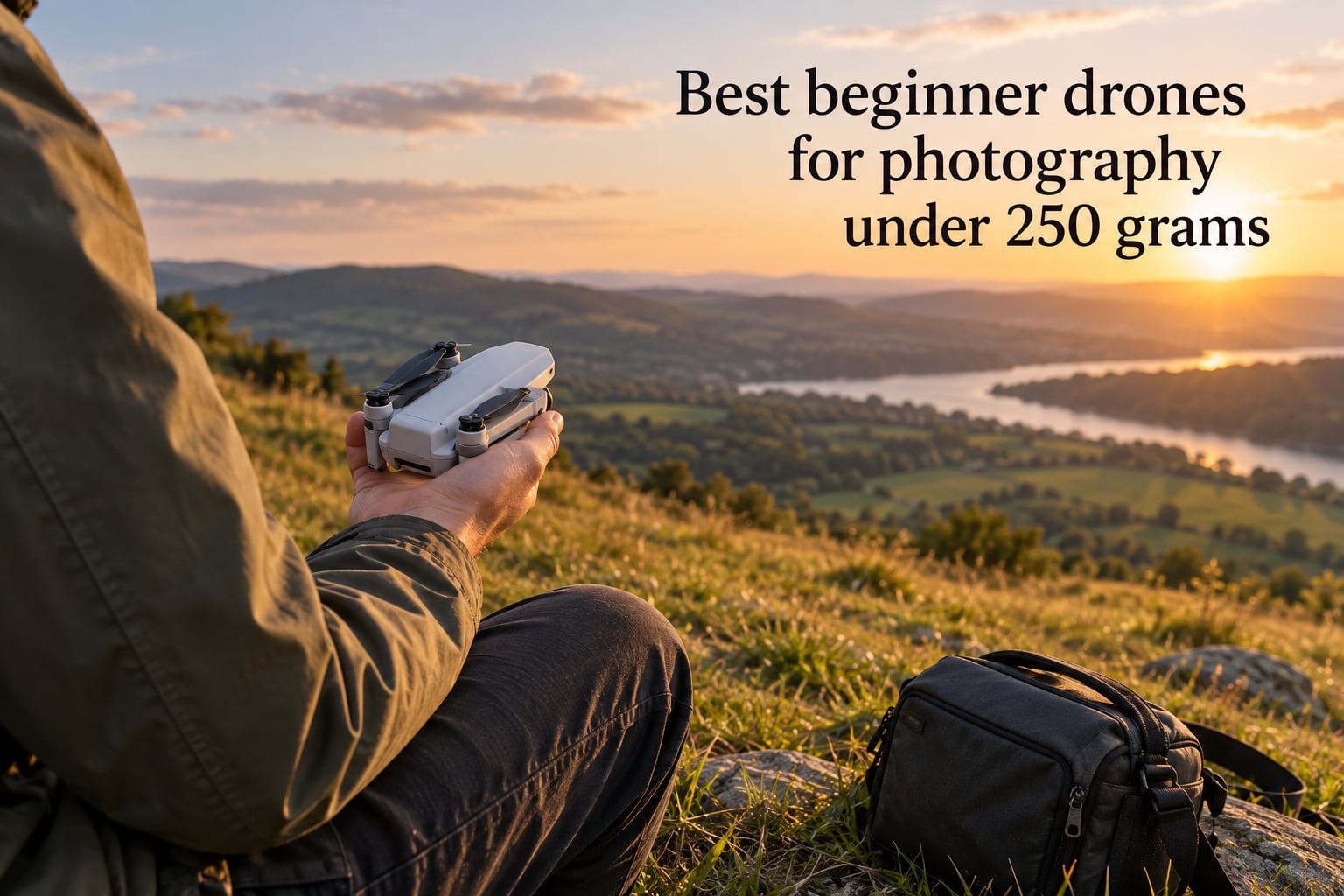
If you have been searching for the best beginner drones for photography under 250 grams, you are not alone. I get this question from clients, friends, and fellow photographers every single week. The sub-250 gram category has exploded because it is the sweet spot where regulations stay friendly, image quality has finally caught up with full-size cameras, and the drones are light enough to throw in a camera bag without thinking twice.
Our team at Sparkfly Photography has spent the past several months flying every DJI Mini, the DJI Flip, the DJI Neo, the Potensic Atom 2, and a few Holy Stone models. We tested them on family portrait sessions, landscape workshops, beach vacations, and backyard birthday parties. This guide is what we wish someone had handed us before our first flight.
You will learn why the 250 gram threshold is the single most important spec for a beginner photographer, which drones are worth your money in 2026, what camera features actually matter for portraits and landscapes, which models to skip, and how to fly safely on your very first battery. Let’s get into it.
Table of Contents
- Why the 250 Gram Weight Class Matters for Beginners
- Top 5 Beginner Drones Under 250 Grams for Photography
- Beginner Drone Comparison: Specs Side by Side
- How to Choose the Best Beginner Drone for Photography
- Obstacle Avoidance and Beginner Safety Features Explained
- Drone Photography Use Cases for Beginners
- Drones to Skip: What Beginners Should Avoid in 2026
- First Flight Checklist: Flying Your Sub-250g Drone Safely
- Frequently Asked Questions
- Final Verdict: The Best Beginner Drone Under 250 Grams in 2026
Why the 250 Gram Weight Class Matters for Beginners
The 250 gram threshold is the most beginner-friendly line in all of drone regulation. Cross above it, and you are suddenly dealing with registration, pilot exams, and stricter no-fly rules. Stay under it, and most countries treat your drone as a hobbyist toy even when it carries a serious camera.
In the United States, the FAA requires registration for any drone weighing 0.55 pounds (250 grams) or more when used recreationally. Drones under that line can fly without paperwork, although you still need to pass the free TRUST test and follow basic rules. In the European Union, sub-250 gram drones fall into the C0 category, which keeps you out of most licensing requirements. In the United Kingdom, the equivalent is the UK0 category.
Beyond the legal perks, sub-250 gram drones are physically easier to live with. They fold down small enough for a jacket pocket. They survive backpack bumps. They feel less intimidating to nervous family members during a portrait session. For a beginner picking up aerial photography for the first time, that combination of legal freedom and physical friendliness is hard to beat.
What C0, UK0, and FAA Registration Actually Mean
The EU’s C0 category requires the drone to weigh under 250 grams, have no sharp edges, and operate at under 19 m/s. If you buy a drone that ships with a C0 class identification label, you are good to fly in the Open subcategory A1. The UK0 class is similar, just with UK-specific CAA paperwork instead of EU registration.
For U.S. pilots, the FAA’s sub-250 gram exemption means you skip the $5 registration and the drone ID broadcast requirement. You still must pass the TRUST test (a 15-minute online quiz), keep the drone in line of sight, stay under 400 feet altitude, and avoid restricted airspace. None of that requires a license, which is exactly why most beginner photography drones are now built to hit that 249 gram mark.
Privacy and Consent When You Photograph People
One thing most drone roundups ignore: the moment your drone has a camera and a person nearby, you are dealing with privacy. Even the most permissive drone rules do not override trespass, harassment, or personal data laws. Before you launch over a family reunion or a stranger’s backyard, ask. If you cannot get consent, change your angle or your altitude.
Top 5 Beginner Drones Under 250 Grams for Photography
After months of testing, these five models are the ones we recommend to new pilots who care about photo and video quality. Each one weighs under 250 grams, but they differ wildly on sensor size, price, and ease of use.
1. DJI Mini 5 Pro — Best Overall for Beginners
The DJI Mini 5 Pro is the most beginner-friendly serious camera drone on the market in 2026. It weighs under 249 grams even with the standard battery, carries a 1-inch class sensor that rivals much larger drones, and adds omnidirectional obstacle avoidance so it rarely crashes on its own. We flew it in 25 mph coastal gusts and the footage stayed level thanks to the 3-axis mechanical gimbal.
What makes it beginner-friendly is the auto-flight intelligence. QuickShots handle cinematic moves with a tap. Subject tracking follows a person or vehicle while you focus on framing. Return to home kicks in automatically if the battery drops or the signal is lost. For photographers who want to spend time on composition rather than stick inputs, this is the one to buy.
2. DJI Mini 4 Pro — Best for U.S. Buyers
If the Mini 5 Pro is unavailable in your region (a common issue for U.S. customers during launch windows), the Mini 4 Pro is the runner-up and is still excellent. It carries a 1/1.3-inch CMOS sensor, shoots 4K HDR video at 60fps, and supports the 10-bit D-Log M color profile for grading. The body still weighs under 249 grams with the standard battery.
It also has omnidirectional obstacle sensing and DJI’s O4 transmission system, which gives you a stable HD feed back to your phone at long range. For U.S. beginners who cannot get the Mini 5 Pro at a reasonable price, the Mini 4 Pro is the safest pick.
3. DJI Flip — Best Budget Pick
The DJI Flip is the budget-friendly sibling, and for many beginners it is the smartest starting point. It folds flat, weighs right around 249 grams, and pairs with the DJI RC-N3 controller. The camera is smaller than the Mini 5 Pro’s, but it still shoots 4K and supports vertical video for social media.
The Flip is also one of the easiest drones to launch. Propeller guards are built in, so indoor takeoff feels safe. For travel photographers who want a drone they can hand-launch without fear of slicing a finger, the Flip is genuinely fun.
4. DJI Mini 4K — Runner-Up on Budget
The DJI Mini 4K is the cheapest DJI drone we still recommend for photography. It shoots true 4K video, weighs 249 grams, and uses GPS return to home. You give up the larger sensors of the Pro models and most of the obstacle avoidance, but the image quality is a real step up from any toy drone.
For a beginner who plans to learn on this drone and upgrade later, the Mini 4K is a low-risk choice. The footage holds up on YouTube, Instagram Reels, and small prints.
5. DJI Neo — Best for Content Creators and Casual Use
The DJI Neo is a strange and wonderful little drone. It weighs well under 250 grams, can launch from your palm, and follows you without a controller. It is not a serious photography tool — the sensor is small — but for quick vacation clips, TikTok videos, and family moments where you want to be in the shot, it beats every alternative.
Think of the Neo as the drone you bring when the Mini 5 Pro would feel like overkill. Hiking, kayaking, or a backyard party: the Neo fits in a jacket pocket and you will actually use it.
Beginner Drone Comparison: Specs Side by Side
Specs help you decide faster than any prose review. The table below compares the five drones above across the categories that actually matter to a beginner photographer. We omitted price since drone pricing shifts frequently and would be outdated within weeks.
| Drone | Weight | Sensor | Max Video | Flight Time | Obstacle Sensing |
|---|---|---|---|---|---|
| DJI Mini 5 Pro | Under 249 g | 1-inch class CMOS | 4K HDR | Around 34 min | Omnidirectional |
| DJI Mini 4 Pro | Under 249 g | 1/1.3-inch CMOS | 4K HDR at 60fps | Around 34 min | Omnidirectional |
| DJI Flip | Under 249 g | 1/1.3-inch CMOS | 4K | Around 31 min | Forward and downward |
| DJI Mini 4K | 249 g | 1/2.3-inch CMOS | 4K | Around 31 min | Downward only |
| DJI Neo | Around 135 g | 1/2-inch CMOS | 4K | Around 18 min | None |
If sensor size and obstacle avoidance are your top priorities, the Mini 5 Pro and Mini 4 Pro lead the table. If budget and pocket portability matter more, the Mini 4K and Neo are the smarter buys. The Flip sits in the middle and is the most fun to fly indoors.
How to Choose the Best Beginner Drone for Photography
Specs tell you what a drone can do. Choosing means matching those specs to the photos you actually want to take. Here are the four factors that decide whether a beginner drone is right for your photography.
Sensor Size Matters More Than Megapixels
A larger sensor captures more light, which means cleaner shadows, less noise at dusk, and more detail when you crop in for a portrait or a print. The DJI Mini 5 Pro’s 1-inch sensor is roughly four times the surface area of the Mini 4K’s 1/2.3-inch sensor, and you can see that difference on every overcast day.
Megapixels are a distraction for beginners. A 12 megapixel image from a 1-inch sensor will outresolve a 48 megapixel image from a tiny sensor. Focus on sensor size first, resolution second.
3-Axis Gimbal vs Electronic Stabilization
Every drone on our top five list uses a 3-axis mechanical gimbal, which physically stabilizes the camera. The result is footage that looks like it was shot from a tripod in the sky. Cheaper drones use electronic image stabilization, which crops the frame and warps the image when you pan quickly.
For photographers who care about clean stills and smooth video, a 3-axis gimbal is non-negotiable. If a drone does not list one, skip it.
RAW vs JPG for Beginners
RAW files preserve far more data than JPGs, which means you can rescue shadows, recover highlights, and white-balance correctly in post. Every drone on our list supports RAW or DNG capture. JPGs are smaller and faster, but they are baked-in the moment the drone writes them.
If you have never edited a RAW file, this is the year to learn. Lightroom Mobile is free and handles drone RAW files beautifully.
Controller Options and Screen Brightness
Most beginner drones ship in two configurations: a basic kit with no controller (you fly with your phone), or a kit with the DJI RC-N3 controller (your phone clips in), or a kit with the DJI RC2 smart controller (a built-in screen). The RC2 is brighter in sunlight and feels closer to flying a real camera. The RC-N3 is cheaper and lighter. For travel, the RC2 is worth the upgrade for most beginners.
Obstacle Avoidance and Beginner Safety Features Explained
Crashes are how most beginners end their drone hobby in week one. Modern sub-250g drones try to prevent that with a stack of safety features. Here is what each one does and why it matters.
Omnidirectional Obstacle Sensing
Omnidirectional sensing means the drone sees forward, backward, downward, and sideways. If you fly toward a tree branch or a power line, the drone stops or routes around it automatically. The DJI Mini 5 Pro and Mini 4 Pro have full omnidirectional sensing. The Flip has forward and downward. The Mini 4K and Neo have only the basics.
For a beginner photographer who plans to fly near trees, cliffs, or buildings, omnidirectional sensing is the single most valuable safety upgrade you can buy.
GPS Return to Home (RTH)
Return to home brings the drone back to its launch point if the battery gets low, the signal drops, or you press the button. Every drone on our list supports GPS RTH. This is the feature that has saved more beginner drones than any other.
Set your RTH altitude high enough to clear trees and buildings. We use 60 meters as our default in suburban areas, and 90 meters near forest.
Propeller Guards and Beginner Modes
Propeller guards are plastic rings that protect the props from walls, fingers, and indoor furniture. The DJI Flip and DJI Neo ship with built-in guards. The Mini 5 Pro and Mini 4 Pro support optional guard accessories.
Beginner modes (often called “Cine” or “Slow” mode) cap the drone’s speed and tilt angle so you have time to react. Use them for your first 10 flights. They are not a crutch — they are training wheels.
LiDAR and Advanced Avoidance
Some newer drones add LiDAR for nighttime obstacle detection, where cameras alone struggle. For a beginner in 2026, LiDAR is nice to have, not essential. Stick with omnidirectional vision sensing and you will be fine for daylight flying.
Drone Photography Use Cases for Beginners
Different photography styles ask different things from a drone. Here is how to match the right sub-250g drone to the photos you actually want to take.
Landscape Photography
Landscape is where a larger sensor and RAW capture pay off most. Golden hour light, deep shadows, and crisp clouds all benefit from a 1-inch or 1/1.3-inch sensor. The DJI Mini 5 Pro and Mini 4 Pro lead this category. Shoot in RAW, bracket exposures, and use the DJI RC2’s bright screen to check histograms on the fly.
Travel Photography
Travel is about packability and battery life. The DJI Flip and Mini 4K fold flat and weigh nothing. We flew both around Iceland and Patagonia for two-week trips and never wished for the Mini 5 Pro. Bring three batteries, a 65W GaN charger, and a small tablet for review.
Family and Portrait Photography (Our Specialty)
This is the angle most drone roundups skip, and it is where Sparkfly Photography spends most of our time. Drones open up group photos that would require a ladder, aerial reveals of a wedding venue, and candid shots of kids running in a yard. For family and portrait work, the DJI Mini 4 Pro is our pick. Subject tracking keeps the family in frame while you walk. The 1/1.3-inch sensor renders skin tones beautifully in soft evening light.
One tip from our studio sessions: talk to the family about the drone before you fly it. Children are usually excited. Grandparents are sometimes nervous. A 60-second conversation earns you an hour of relaxed portraits.
Real Estate and Event Photography
For real estate, you want clean exterior flyovers and consistent colors. The DJI Mini 5 Pro is overkill for this and the Mini 4K is the right tool. For events like weddings or corporate gatherings, the Mini 4 Pro strikes the best balance between image quality and unobtrusive flight.
Best Time of Day and Weather for Drone Photography
Golden hour — the hour after sunrise and the hour before sunset — gives you warm, soft light that flatters landscapes and portraits alike. Blue hour, just before sunrise or after sunset, is when cities and buildings glow. Midday sun is the enemy of good drone photos: it flattens contrast and creates harsh shadows.
Wind is the other weather variable. Most sub-250g drones handle Level 5 winds (around 24 mph) without drama. Above that, footage starts to wobble and batteries drain fast. Check your local wind forecast before you commit to a session.
Drones to Skip: What Beginners Should Avoid in 2026
Not every drone that weighs under 250 grams is worth your money. Here is what to skip and why.
Older Mini 2 SE Models
The DJI Mini 2 SE is still sold, but its 2.7K video and limited obstacle avoidance make it a tough sell when the Mini 4K costs only slightly more and shoots true 4K. If you find a Mini 2 SE cheap, it can still teach you to fly, but the footage will look dated the moment you post it.
Toy-Grade Drones Posing as Camera Drones
Any sub-100 dollar drone promising 4K video is almost certainly upscaling from a low-resolution sensor. The footage looks fine on a phone screen and falls apart on a laptop. They are great for kids learning to fly indoors and a poor choice for anyone serious about photography.
Discontinued or Unsupported Brands
Brands like Autel Evo Nano used to lead the sub-250g category. As of 2026, Autel has shifted focus elsewhere and the Nano line is harder to find with current firmware support. Stick with brands that ship regular firmware updates: DJI and Potensic are the two safe bets today.
Drones Without a 3-Axis Gimbal
If a drone under 250 grams does not list a 3-axis mechanical gimbal, it is using electronic stabilization. That is fine for casual clips. It is not fine for portrait, real estate, or landscape work where clients expect print-quality images.
First Flight Checklist: Flying Your Sub-250g Drone Safely
Your first flight sets the tone for your entire drone hobby. Walk through this checklist before every battery cycle, especially in the early days.
- Update firmware on the drone, the controller, and the app before you leave the house.
- Charge every battery to 100 percent and check the cells for swelling or damage.
- Pick an open field, a quiet beach, or an empty parking lot for your first five flights. Avoid trees and buildings.
- Check the weather: wind under 15 mph, no rain, good visibility, no fog.
- Verify the GPS lock has 10 or more satellites before takeoff.
- Set your return-to-home altitude high enough to clear the tallest obstacle nearby.
- Start in beginner mode. Hover at 3 meters, then rotate slowly, then move forward and back.
- Practice the controls without tilting more than 10 degrees for the first 10 minutes.
- Land before the battery hits 25 percent for the first month. Replace batteries that swell or drop voltage fast.
- Tell anyone nearby that you will be flying. Privacy and courtesy matter as much as regulation.
If you want a deeper pre-flight walkthrough, our studio team uses a similar checklist on every Sparkfly session. The full version lives in our client welcome guide.
Common Beginner Mistakes and How to Avoid Them
Most beginner crashes come from the same handful of mistakes. Flying too far away before you trust the controls. Flying above water before you trust the return-to-home. Flying over people when you are still learning orientation. Flying indoors without propeller guards. Avoid all four and you will keep your drone in one piece.
Where You Cannot Fly
Even sub-250g drones cannot fly in national parks without a permit, over stadiums during events, near airports, or above 400 feet in the U.S. (120 meters in the EU/UK). Check your local app’s airspace map before every flight. The 30-second check is faster than the legal letter you would get for skipping it.
Frequently Asked Questions
What is the best drone for photography under 250g?
The DJI Mini 5 Pro is the best overall drone for photography under 250 grams in 2026, thanks to its 1-inch class sensor, omnidirectional obstacle sensing, and 3-axis mechanical gimbal. For U.S. buyers who cannot find the Mini 5 Pro, the DJI Mini 4 Pro is the strongest alternative.
Can I fly a drone under 250 grams?
Yes. In the U.S., drones under 250 grams do not require FAA registration for recreational use, although you must still pass the free TRUST test. In the EU, they fall into the C0 category, and in the UK they fall into the UK0 category, both of which have minimal licensing requirements for hobbyist flying.
What is the best starter drone for photography?
For a beginner photographer, the DJI Mini 4 Pro is the best starter drone because it combines a 1/1.3-inch sensor, omnidirectional obstacle avoidance, and a 3-axis gimbal at a price most beginners can justify. If you want the cheapest credible option, the DJI Mini 4K still shoots true 4K video and weighs exactly 249 grams.
What are some good drones under 250 grams?
Good drones under 250 grams for beginners include the DJI Mini 5 Pro, DJI Mini 4 Pro, DJI Flip, DJI Mini 4K, and DJI Neo. The Potensic Atom 2 is the strongest non-DJI option for hobbyists who want a sub-250g drone with GPS return to home and 4K recording.
Do I need a license to fly a drone under 250 grams?
In most countries, no formal license is required for sub-250g recreational flying. In the U.S. you must pass the TRUST test. In the EU, C0-class drones can be flown in the Open subcategory A1 without a license. Commercial work still requires Part 107 in the U.S. or equivalent certification elsewhere.
How long do sub-250g drone batteries last?
Most sub-250g drones fly for 25 to 35 minutes per battery in calm conditions. The DJI Mini 5 Pro and Mini 4 Pro both rate around 34 minutes. The DJI Neo is closer to 18 minutes. Cold weather, wind, and aggressive flying all reduce real-world flight time.
Final Verdict: The Best Beginner Drone Under 250 Grams in 2026
If you want one drone that handles landscapes, travel, family portraits, and the occasional real estate shoot, the DJI Mini 5 Pro is the right pick in 2026. It is the lightest serious camera drone you can buy, it has every safety feature that matters, and it leaves room to grow into a serious aerial photographer.
If you are shopping on a tighter budget, the DJI Mini 4K is the safest bet. It shoots true 4K, weighs 249 grams on the nose, and teaches you everything you need to know without overwhelming you with menus. Once you outgrow it, the Mini 5 Pro will be waiting.
Whichever drone you choose, the sub-250g category is the best place for any photographer to start. The rules are friendly, the drones are capable, and the photos will surprise you. See you in the sky.