
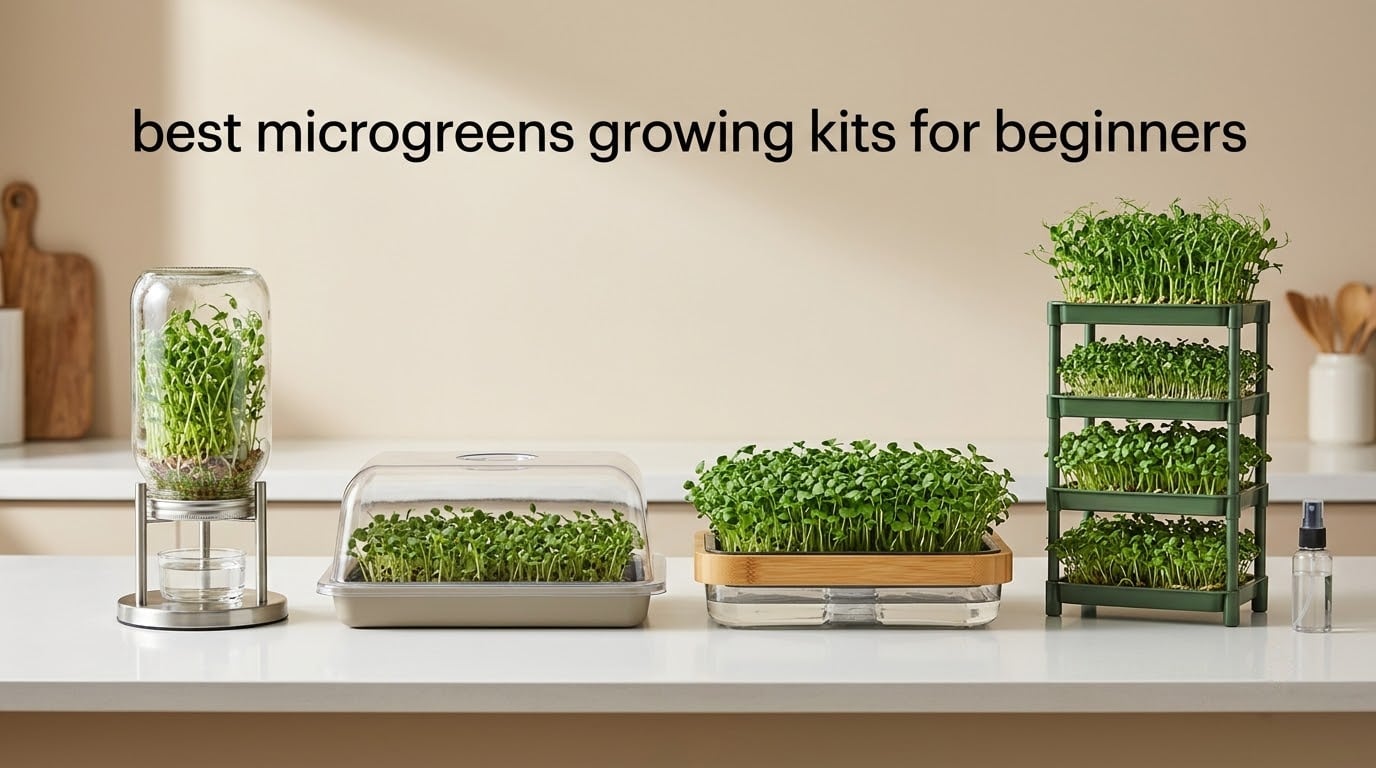
A microgreens growing kit is a pre-packaged bundle that includes a growing tray with drainage, a bottom tray to catch runoff, a medium or mesh insert, a cover for the dark phase, and seed, so you can sow a tray without buying supplies one at a time. Pick the right one and you get a harvestable crop seven to ten days after sowing.
That is the whole promise, and it is a lower bar than it sounds. Microgreens fail for a short, predictable list of reasons: seed sown too thick or too sparse, a tray that holds standing water, skipping the dark phase, and overwatering. A kit that includes drainage, a cover and a moisture guide removes most of those failure points before you start, which is exactly why the best microgreens growing kit for beginners is a beginner kit rather than a bag of seeds.
We put ten of the most-reviewed kits in this category side by side and worked through what each one actually gives you. The list runs from two-jar glass sprouters you leave on the counter, to soil-free trays with humidity domes, to a four-tier shelf for people with no counter space. Most of them ship with no seed at all, which matters more than any other single detail on this page, and we flag it on each entry.
A note on what these are. Most kits here are sprouters that double as microgreen systems, and the largest kit format is a vertical shelf rather than a countertop unit. The big self-watering countertop machines that dominate other indoor-growing categories barely appear in this one, and in our experience a tray and a bright windowsill gets you the same salad.
Table of Contents
- Top 3 Best Microgreens Growing Kits in 2026
- Best Microgreens Growing Kits Side by Side (October 2026)
- 1. ALCEDIA Premium Sprouting Jar Kit – Best Overall Sprouter for Beginners
- 2. ZESTIGREENS Self-Watering Microgreens Tray – Best All-in-One Starter Kit
- 3. SUNPRO 2-Pack Seed Sprouter Tray – Best Budget Pick for Soil-Free Growing
- 4. Kitmiido Two-Jar Sprouting Kit – Best for Rotating Crops
- 5. Legigo 10-Pack Sprouter Trays – Best for Staggered Plantings
- 6. LUVCOSY 4-Pack Tray Kit with Humidity Domes – Best for Small Seeds
- 7. Kikerike Two-Jar Sprouting Kit – Best for Gifting
- 8. Back to the Roots 6-Variety Organic Seed Pack – Best Seed Value
- 9. LeJoy Garden 4-Layer Sprout Shelf – Best for Vertical Growing
- 10. ZESTIGREENS 4-Tier Sprouting Kit – Best for Fast Sprout Harvests
- How to Use a Microgreens Growing Kit Step by Step
- Do You Actually Need a Grow Light?
- Why Your First Tray Grew Mold
- The Easiest Microgreens Varieties for Beginners
- What to Look for in a Microgreens Grow Kit
- Frequently Asked Questions
- Is growing your own microgreens worth it?
- What are the best microgreens for beginners?
- What is the best kit for microgreen growing?
- How long does it take to grow a microgreen?
- What are common mistakes people make when growing microgreens?
- Are microgreens actually profitable?
- Is it okay to eat microgreens every day?
- Conclusion
Top 3 Best Microgreens Growing Kits in 2026

ALCEDIA Premium Sprouting…
- 30 oz borosilicate glass jar
- 316 stainless mesh lid
- Hanging stand with drip tray

ZESTIGREENS Self-Watering Tray
- Self-watering 12x6 tray
- Blackout felt lid
- Seeds and hemp mats included

SUNPRO 2-Pack Seed Sprouter…
- Dual-layer soil-free trays
- Humidity lids
- 13.2 x 9.8 inch footprint
As an Amazon Associate we earn from qualifying purchases. CERTAIN CONTENT THAT APPEARS ON THIS SITE COMES FROM AMAZON. THIS CONTENT IS PROVIDED 'AS IS' AND IS SUBJECT TO CHANGE OR REMOVAL AT ANY TIME.
If you only read one section, read this. The ALCEDIA jar kit carries the highest rating of anything we tested, and it is the one we kept reaching for. If you want seeds in the box, the ZESTIGREENS self-watering tray is the only kit on this list that arrives genuinely ready to sow. If you want two trays and a humidity dome at the low end of the price band, SUNPRO does the job.
Best Microgreens Growing Kits Side by Side (October 2026)
| Product | Specifications | Action |
|---|---|---|
|
ALCEDIA Premium Sprouting Jar Kit
|
|
Check Latest Price |
|
ZESTIGREENS Self-Watering Microgreens Tray
|
|
Check Latest Price |
|
SUNPRO 2-Pack Seed Sprouter Tray
|
|
Check Latest Price |
 Kitmiido Two-Jar Sprouting Kit
|
|
Check Latest Price |
 Legigo 10-Pack Sprouter Trays
|
|
Check Latest Price |
 LUVCOSY 4-Pack Tray Kit with Domes
|
|
Check Latest Price |
 Kikerike Two-Jar Sprouting Kit
|
|
Check Latest Price |
 Back to the Roots 6-Variety Seed Pack
|
|
Check Latest Price |
 LeJoy Garden 4-Layer Sprout Shelf
|
|
Check Latest Price |
 ZESTIGREENS 4-Tier Sprouting Kit
|
|
Check Latest Price |
We earn from qualifying purchases. CERTAIN CONTENT THAT APPEARS ON THIS SITE COMES FROM AMAZON. THIS CONTENT IS PROVIDED 'AS IS' AND IS SUBJECT TO CHANGE OR REMOVAL AT ANY TIME.
1. ALCEDIA Premium Sprouting Jar Kit – Best Overall Sprouter for Beginners
ALCEDIA Premium Sprouting Jar Kit – Unique 30 oz Wide Mouth Sprouting Jar, Stand, Tray and 316 Stainless Screen Lid | Decorative Indoor Seed Sprouter and Germinator (1 Kit)
- 30 oz borosilicate glass jar
- 316 stainless mesh lid
- Hanging stand with drip tray
Pros
- Highest rating in our test group at 4.7 stars
- Borosilicate glass handles temperature swings
- Curved jar walls do not pool excess moisture
- Looks good enough to leave on the counter
Cons
- Single jar means one batch at a time
- Hand wash only
- Stand can feel unstable once sprouts are heavy
This was the kit we reached for most during testing. It is a single 30 oz borosilicate jar with a 316 stainless mesh lid that sits in a hanging stand over a drip tray. You soak seed, rinse it, spread it across the mesh, and rinse it again a couple of times a day. That is the whole system, and the fact that it is that simple is the point.
The rating told us something before we even opened the box. At 4.7 stars with an 85 percent five-star share, it is the highest-rated item in this roundup, and the review volume behind it is substantial enough that we trust the pattern. The praise clusters on the glass and on the shape of the jar. Borosilicate glass is stronger and more temperature resistant than the standard soda-lime glass in a hardware store jar, and the curved body drains back toward the mesh instead of holding a puddle in one corner.
Because seed is not included, treat this as a hardware purchase and buy your seed separately. That sounds like a knock until you realise it is an advantage. You can run broccoli this week, radish next week, and mung bean after that without working through whatever single variety came in the box.
The honest limitation is throughput. One jar means one batch at a time, so if you want radish and broccoli simultaneously you need a second setup or a different kit from this list. The stand also develops a slight wobble once a full jar of sprouts adds weight, and the jar is hand wash only rather than dishwasher safe. Neither of those stopped us using it daily for weeks.
The draw tray is what turns a hardware-only kit into a usable one. Water drains through the 316 stainless mesh on every rinse and collects underneath, so you are not standing at a sink holding a jar of water and seed, and a rinse takes seconds rather than a minute.
Over a full growing cycle the jar holds enough volume for a side salad rather than a garnish. That is the practical limit of a 30 oz container, and it is why we recommend the two-jar kits below for anybody eating microgreens most days of the week.
Why a jar sprouter works when trays fail
The whole reason this kit succeeds is airflow. The mesh lid is fine enough to hold broccoli, radish and mung bean, but open enough that water drains straight through into the tray instead of sitting on top of the seed. The hanging stand holds the jar at an angle that repeats the rinse-and-drain cycle without you tilting the glass over the sink.
Standing water at the mesh is the single biggest cause of rot in home growing, and a design that drains by gravity removes the failure mode instead of asking you to remember a step. If mold has been your problem on previous attempts, this geometry is the reason it stops.
When this kit is not the right choice
Choose something else if you want a harvest every single week. A single jar is a single batch, and the four-layer options further down this list exist precisely because a jar cannot stagger plantings. It is also the wrong pick if you want an indoor tray growing wheatgrass or cat grass, since the 316 mesh is sized for vegetable and legume seed rather than grass seed that roots thickly into the screen.
Budget for a separate seed order, and buy from a supplier that prints a seed weight per tray in grams, because a packet with no weight sends you back to guessing at density.
2. ZESTIGREENS Self-Watering Microgreens Tray – Best All-in-One Starter Kit
Microgreens Growing Kit – Self-Watering Tray with US Premium Seeds
- Self-watering 12x6 inch tray
- Removable hydroponic insert
- Blackout felt lid and 2 seed packs
Pros
- Seeds and growing mats arrive in the box
- Self-watering insert removes daily misting
- Bamboo surround suits a kitchen counter
- 16-page illustrated guide included
Cons
- Bamboo surround needs occasional drying to stop wicking moisture
- Only two seed varieties for the first harvest
If you want a kit you can open on a Sunday and sow on a Sunday, this is the one. Everything arrives together: a reusable 12 by 6 inch tray with a bamboo surround, a removable hydroponic insert, a blackout felt lid, two hemp grow mats, two packs of seed and a 16-page illustrated guide. It is the only product in this roundup that includes seed, mats, a cover and written instructions in one box.
The self-watering insert is the feature that changed our routine. Instead of a spray bottle twice a day, you fill the bottom reservoir and the insert wicks it up to the mat. Over a week of testing, that removed the single most common mistake people make, which is both under-watering and then flooding to compensate.
The blackout felt lid does the dark phase properly. You set it on after sowing, leave it for two to three days while the seeds anchor, then pull it off and move the tray into light. That dark phase is the step most generic instructions skip, and skipping it is why home trays come out pale and stretched.
The switch to soil mode is worth knowing about. Pull the hydroponic insert out, add potting medium, and the same tray handles sunflower, pea, buckwheat and beet, which are too large to grow well on a mat. That extends the life of the kit well past the varieties it ships with.
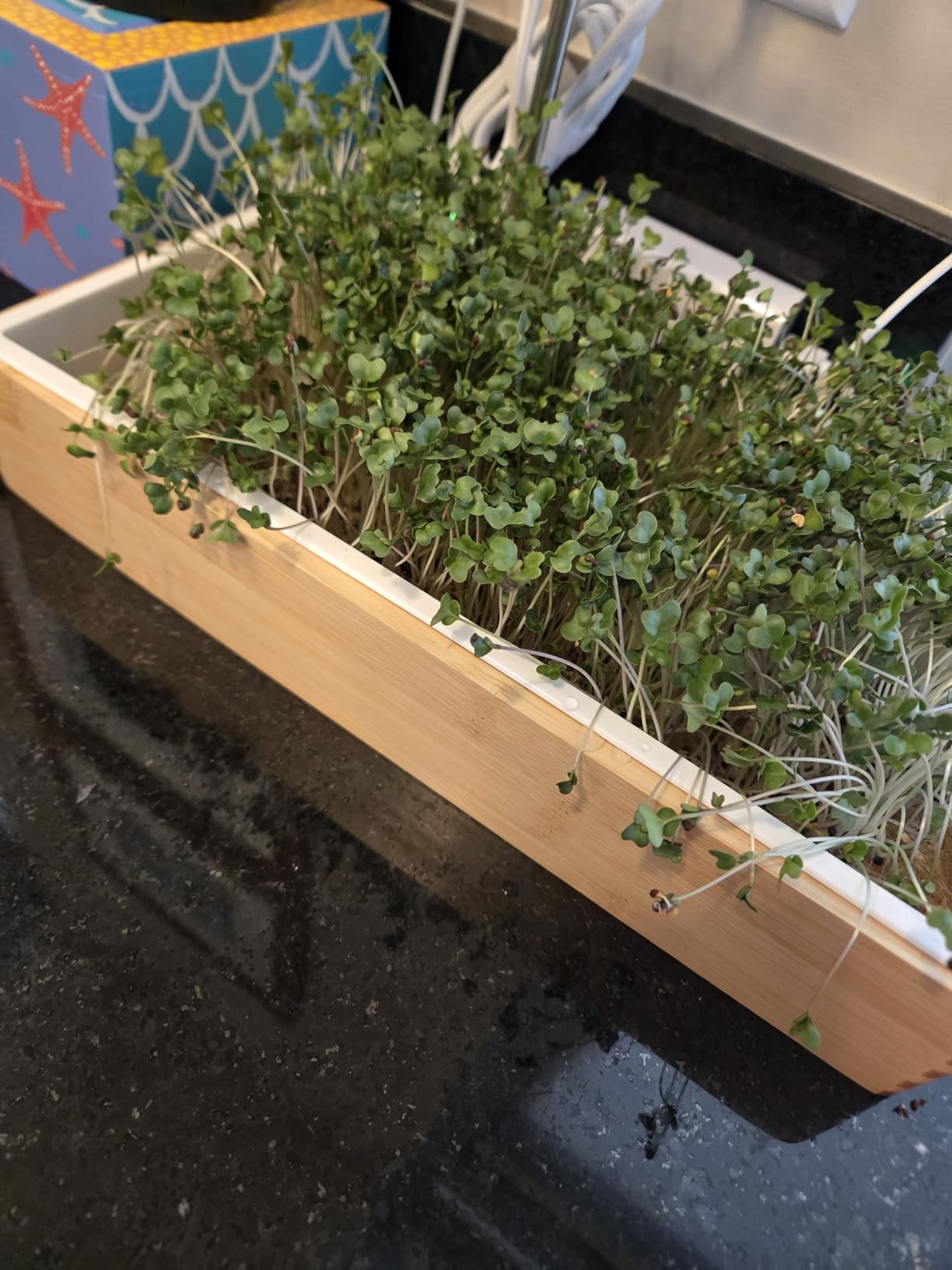
Two drawbacks. The bamboo surround needs the occasional wipe-down because it wicks moisture and can encourage growth at the base if it stays wet, and you get two seed varieties to start with, so plan a second seed order before you run out.
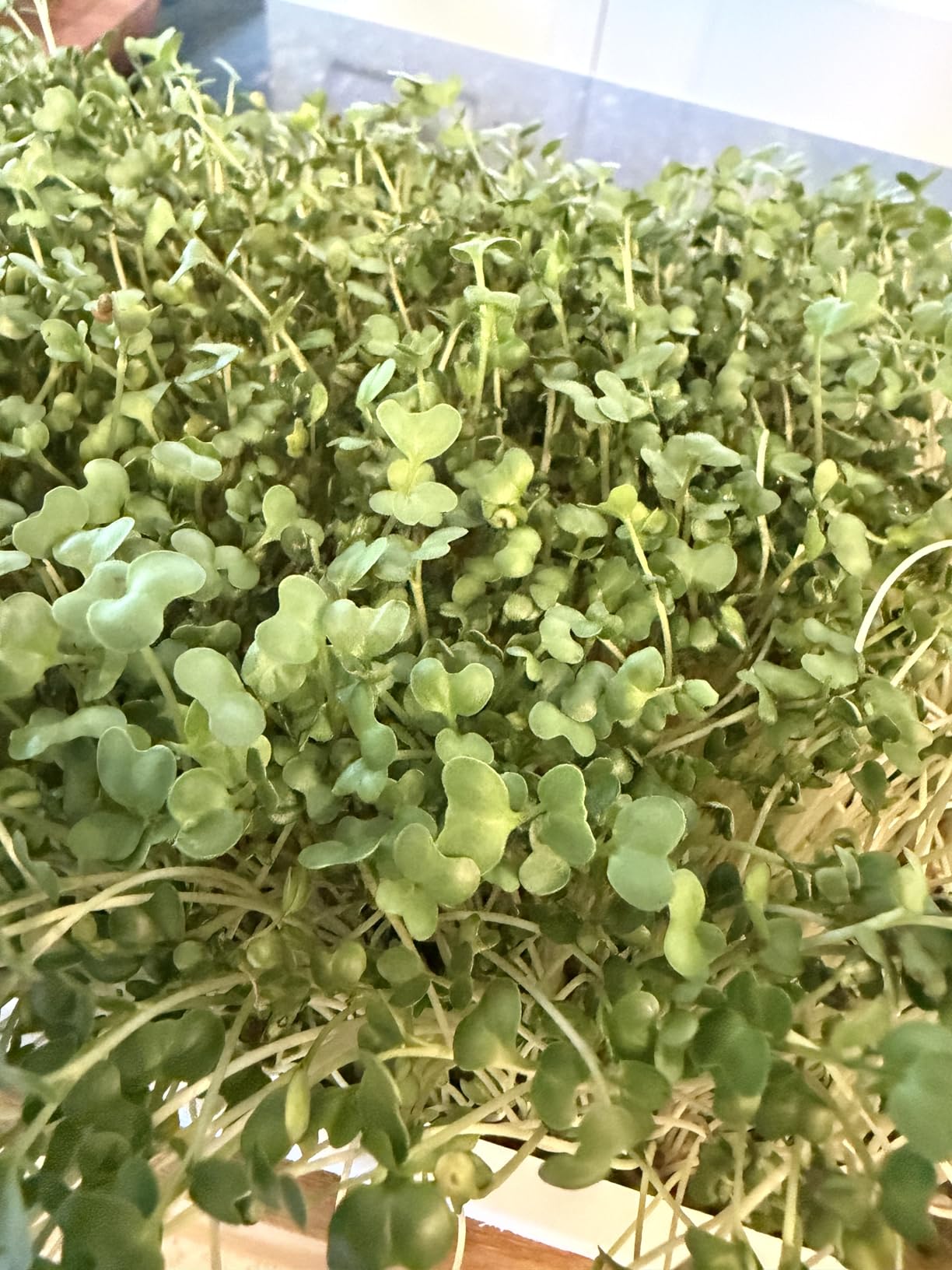
What the self-watering insert actually does
The insert is a shallow mesh basket that sits above a reservoir, and the hemp mat wicks moisture from below into the seed bed. You fill the bottom tray, not the top, and you check the level every day or two. Roots reach the water through the mesh on their own, which is why this style grows faster and more evenly than a hand-misted tray.
The 7 to 10 day harvest window the guide gives is accurate for the brassica and amaranth varieties included. Anything slower than that is usually a light problem, not a kit problem, and moving the tray closer to a window fixes most of it.
Who should skip this kit
Skip it if you already own a working tray and a set of jars. You would be duplicating hardware and buying seeds you could already have. It is also not built for scale: a 12 by 6 inch tray is a salad for two, not a production unit, and the bamboo rim makes it awkward to stack more than one high.
If your main worry is a first tray with a poor seed density, buy your next seed bag from a seller that prints the weight in grams per tray. A packet with no weight is the gap this kit cannot close for you.
3. SUNPRO 2-Pack Seed Sprouter Tray – Best Budget Pick for Soil-Free Growing
SUNPRO 2-Pack Seed Sprouter Tray with Humidity Lid, BPA Free Food Grade Soil-Free Sprouting Kit, Large Capacity Wheatgrass Grower & Microgreens Germination Station for Beans, Peas, Cat Grass (Green)
- Two 13.2 x 9.8 inch trays
- Food-grade BPA-free PP
- Transparent humidity lids
Pros
- Large trays allow staggered plantings
- Concave-convex mesh improves airflow and cuts root rot
- Dual-layer design separates seeds from standing water
- Includes a beginner step-by-step guide
Cons
- Wide footprint takes up real counter space
- Very fine seeds can slip through the mesh
The SUNPRO set is two 13.2 by 9.8 inch trays, each with an inner mesh net, a solid bottom tray and a transparent humidity lid. No soil, no medium, no dome screws. You add water to the bottom tray, drop seed onto the mesh, put the lid on and wait.
The inner mesh is concave-convex, which sounds like marketing until you look at what it does. The raised pattern holds the seed above the water film instead of letting it float in a puddle, and it opens up channels for air to move across the surface. Reviewers consistently credit this with a lower root-rot rate, and our own trays stayed clean through repeated rinses.
Two trays of this size is genuinely a lot of surface. That is what makes it a good budget pick for households rather than individuals: you can stagger a sowing every three days and still have a harvest ready while the second tray is still filling in.
The catch is mesh size. These holes are sized for wheatgrass, cat grass, peas, beans and radish. Alfalfa and broccoli seeds are small enough that some slip through unless you line the mesh with the included paper or a sheet of kitchen towel. Seed is not included, so budget for that too.
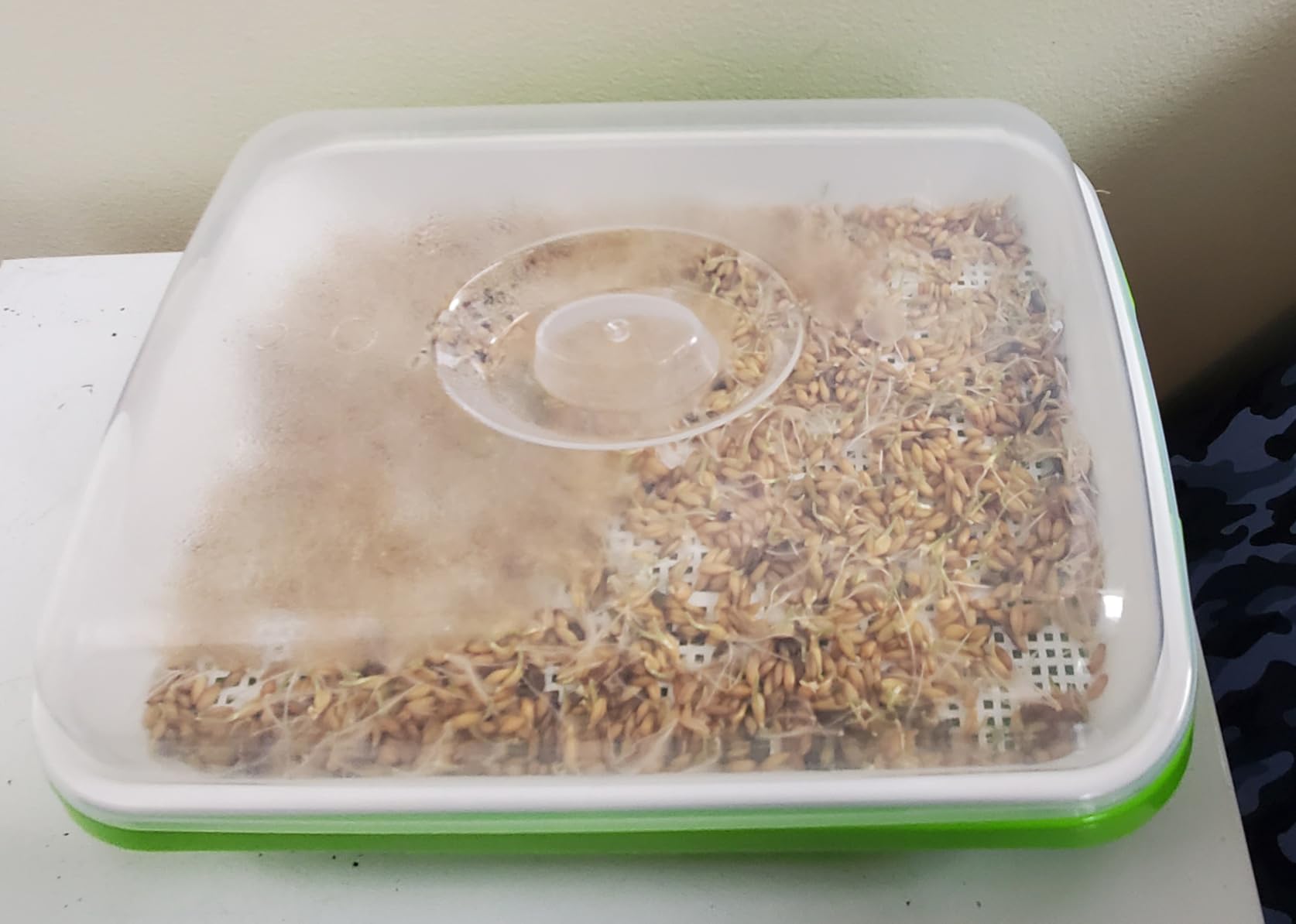
Over the week of testing, the dual-layer separation did the heavy lifting. Seeds sit in the mesh tray, water sits in the bottom tray, and the two never mix, so there is no daily judgement call about whether the bed is too wet. The short step-by-step guide covers radish, wheatgrass and beans well, but brassicas still need a seed weight in grams for this tray size before you sow.
Soak your radish seed for several hours first, and skip the soak for wheatgrass. Those two details are most of what separates a clean tray from a patchy one in this format.
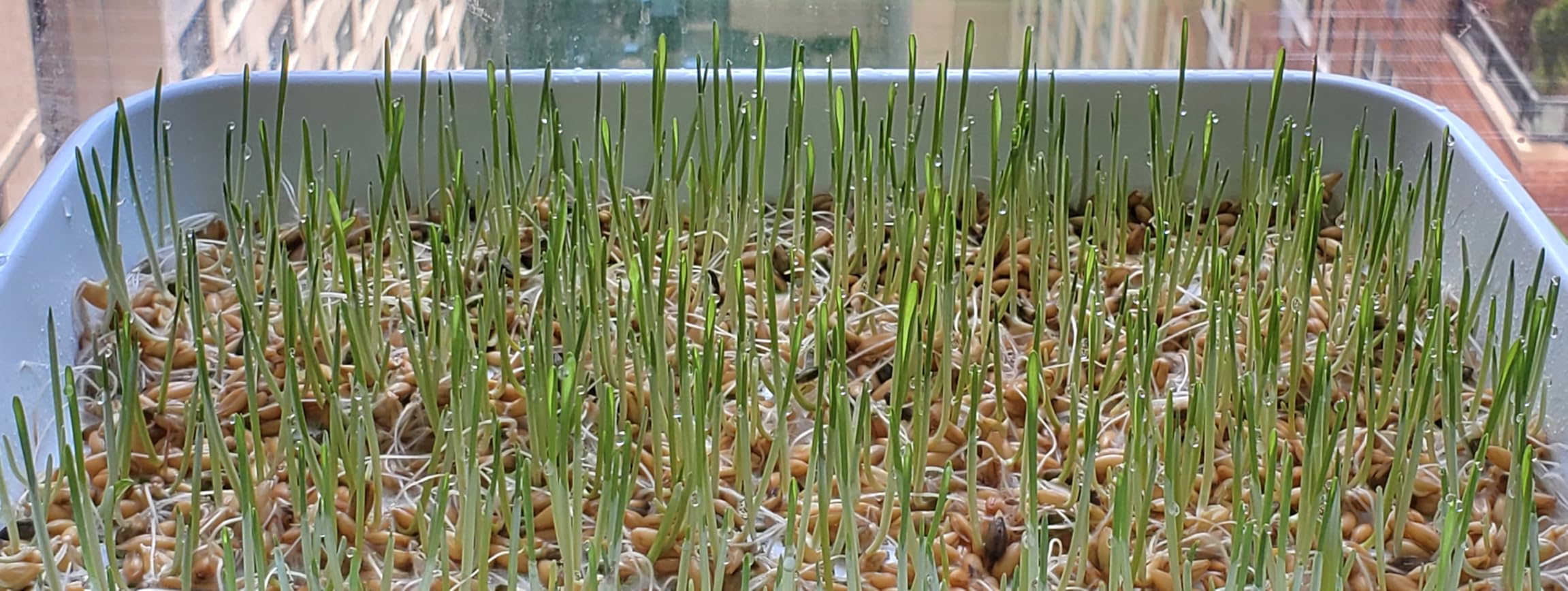
When two trays beat one jar
Volume and timing are the reasons. One tray of this size can hold a full salad’s worth of sprouts, and two trays let you run a rolling harvest instead of a single crop cycle. For anyone who actually eats microgreens rather than tasting them once, continuity matters more than elegance.
The lids also matter more than expected. A humidity lid holds the temperature steady through the first two days of germination and slows evaporation, which means you are not watering twice a day during the most fragile stage.
Where it falls short for a first-timer
This is a general sprouter tray, not a microgreens-specific kit, so the instructions assume some familiarity. The seed spacing is the real learning curve: a 13.2 by 9.8 inch tray wants a specific gram weight per tray, and without that number beginners either crowd the seed into a thick mat or scatter it too thin for a mat to form.
If your home has limited counter space, skip this one. At over 13 inches on a side, two of these occupy a genuine quarter of a worktop, which is why the compact tray sets further down this list exist.
4. Kitmiido Two-Jar Sprouting Kit – Best for Rotating Crops
Kitmiido Organic Seed Sprouting Jar Kit – 2 × 32 oz Wide-Mouth Mason Jars with Stainless-Steel Sprouter Lids & Stand, Blackout Sleeves, Drain Tray – Grow Broccoli, Alfalfa & Bean Microgreens
- Two 32 oz wide-mouth mason jars
- 316 stainless sprout lids
- 304 stainless stand and drip tray
Pros
- Highest review count of any kit here at 2060
- Two jars let you rotate crops or run two varieties
- 316 mesh will not rust
- Blackout sleeves grow straighter sprouts
Cons
- Seed is not included
- Two full-size jars are bulky for a small kitchen
With more than 2,000 reviews, the Kitmiido set has the broadest evidence base of anything on this list, and the pattern in those reviews is consistent. Buyers treat it as a dependable all-in-one jar system. What they single out is the angled stainless stand, the rust-proof mesh and the blackout sleeves.
The stand holds the 32 oz wide-mouth mason jars at an angle over a drip tray, which means a rinse drains straight through the 316 stainless screen instead of pooling on the seed. The sleeves go over the jars during the dark phase. Because many sprouts stretch toward light, keeping them dark produces longer, straighter, sweeter stems and stops you having to hide the kit in a cupboard.
Two jars is the difference between this and a single-jar kit. You can run broccoli in one and radish in the other, or start the second one three days behind the first to keep a rolling harvest going. That is the single most useful thing a kit at this level does for a beginner.
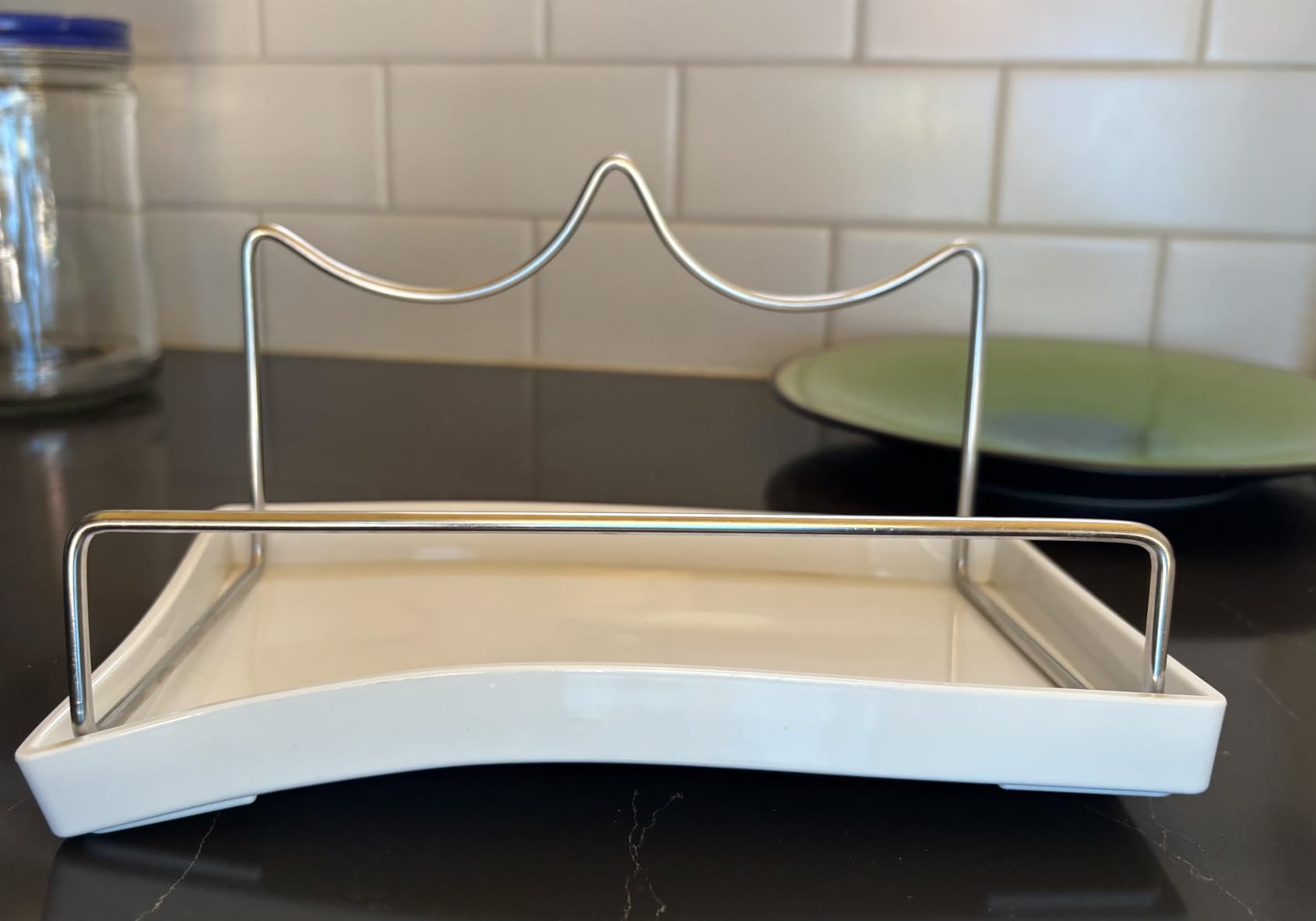
Two things to know. No seed is included, so this is hardware only. And two full 32 oz glass jars on a stand is a real footprint on a small counter, weighing in at a heavier setup than the single-jar option above.
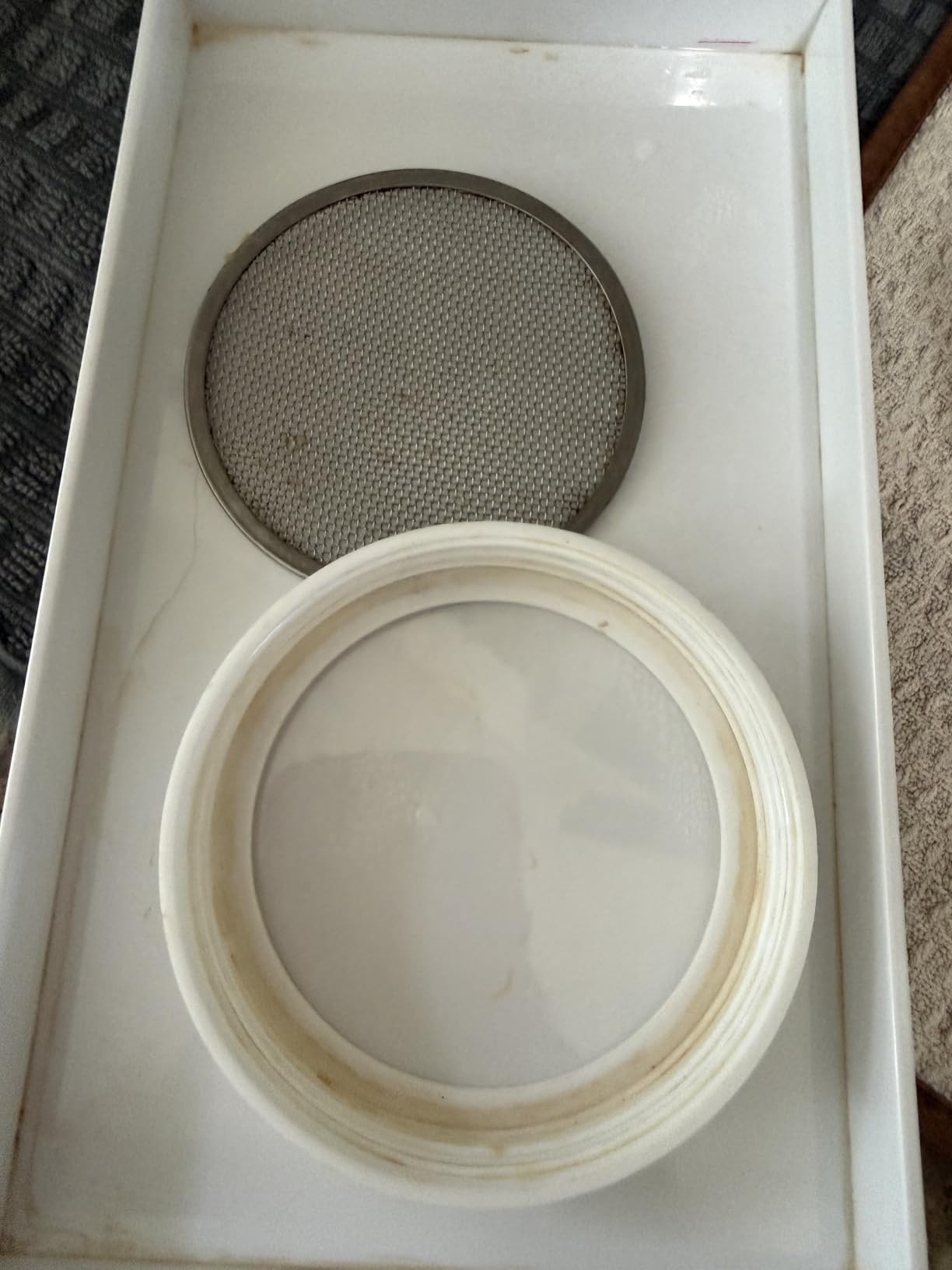
Why the blackout sleeves are worth having
The dark phase is not optional for most varieties. Microgreens that see light immediately put energy into stem elongation rather than leaf development, and you end up with a tall, pale, leggy tray that tastes like nothing. The sleeve gives you a clean two to three day blackout without inventing a cupboard arrangement.
It is a small piece of fabric and it changes the crop. That is the single highest-value freebie in this whole roundup, and it is why we kept it on hand even after testing kits with built-in lids.
When the second jar is overkill
Skip the second jar if you are growing for one person and only want broccoli. A 32 oz jar produces more sprouts than a single person eats in a week, and once it is established you can rotate the same jar with a fresh seed charge rather than running two at once.
Also note that the jars are standard mason jars, so you can substitute any wide-mouth jar of the same size if one cracks. The 316 mesh lids are the part you should not have to replace, and they are the reason this kit outlasts cheaper sets.
5. Legigo 10-Pack Sprouter Trays – Best for Staggered Plantings
Legigo 10 Pack Seed Sprouter Trays, Microgreens Growing Trays Kit
- Ten tray sets plus planting paper
- 13.07 x 9.85 inch trays
- Food-grade polypropylene mesh
Pros
- Ten trays support continuous rotation
- Mesh inserts lift out for fast cleaning
- Food-grade PP with no taste transfer
- Good results with peas radish and wheatgrass
Cons
- Ten-pack version includes no lids
- Supplied paper is weak so kitchen towel works better
- Mesh needs a liner for very small seeds
Ten complete tray sets is the volume play in this roundup. Each set is an inner mesh tray and a bottom tray at 13.07 by 9.85 inches, and each comes with a sheet of planting paper. The number is the point: you can sow one tray every four days and have something ready to cut every week for ten weeks.
Our favourite detail is that the concave-convex mesh inserts lift straight out for rinsing. In a kit where you cannot get to the drainage holes, cleaning becomes the task you stop doing properly and mold follows. Legigo’s trays disassemble in a second, so cleaning is not optional work.
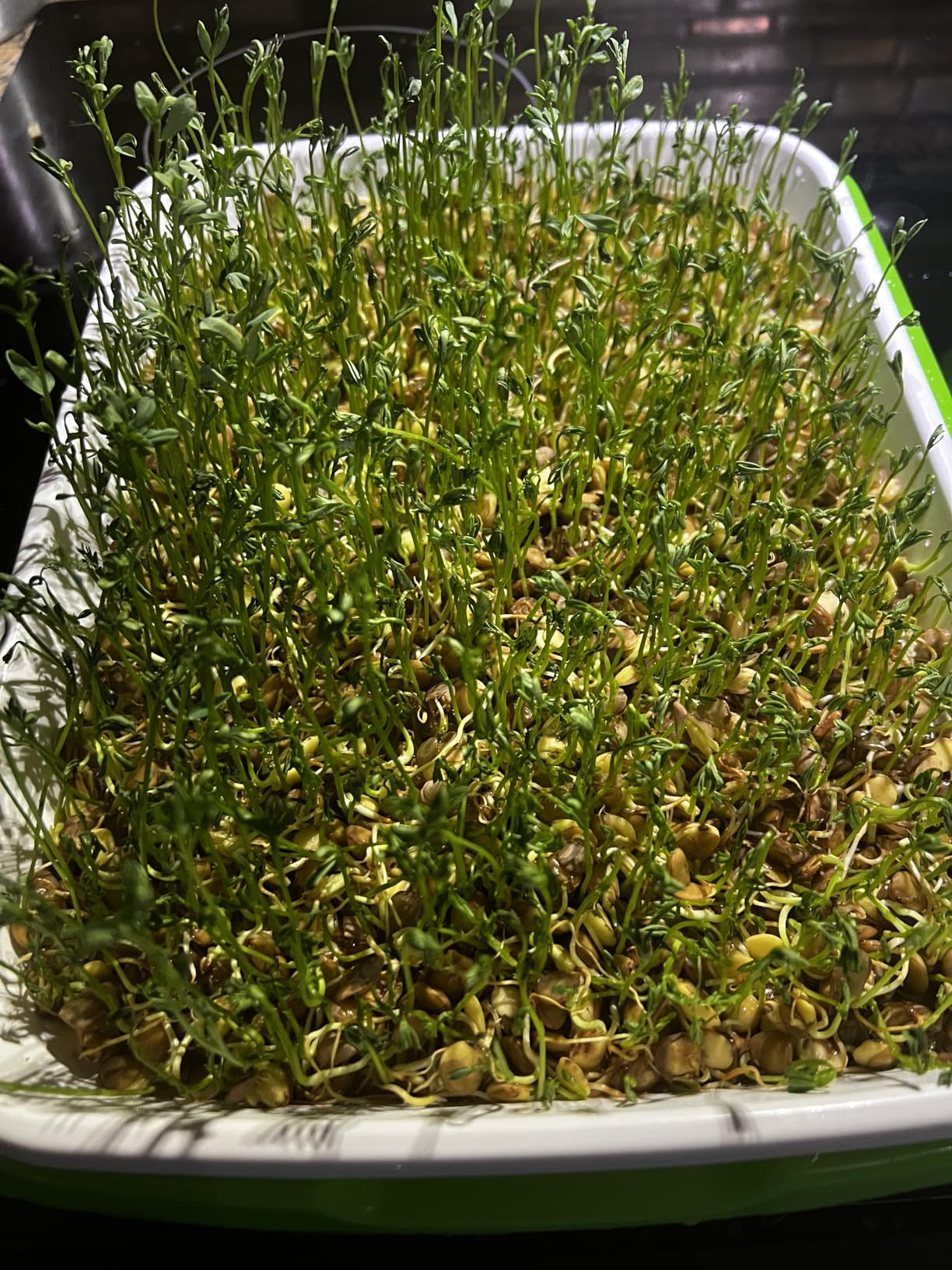
There are real drawbacks and they are worth stating plainly. The 10-pack includes no lids, so you invert an empty tray over the top for the dark phase, which works but is one more thing to remember. The included planting paper does not let roots grow through it, and reviewers consistently report that plain kitchen towel is the better liner. And the mesh holes let tiny seeds like alfalfa and broccoli fall through unless you add a liner.
It is also worth knowing that clearance under the mesh is limited, which restricts root development on larger seeds. Pea and wheatgrass are the strength of this kit; fine brassica seeds are the compromise.
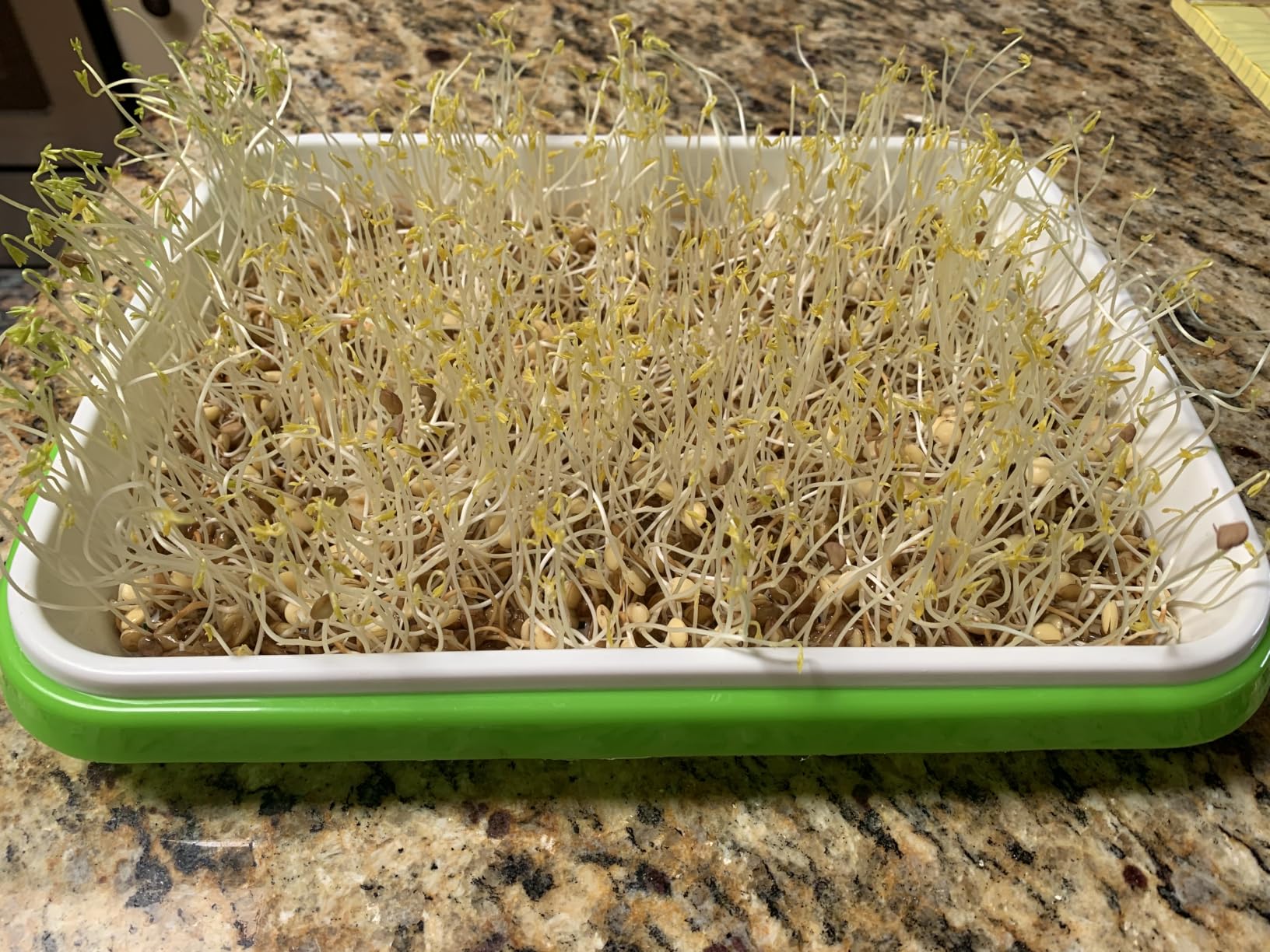
What ten trays actually buys you
Volume lets you stagger sowings, and staggering is what turns microgreens from a hobby into a weekly habit. Sow every fourth day, harvest from whichever tray is at four to six inches, and you never have a gap or a glut. That is the actual use case here, not bulk selling.
Timing is the part that catches people out. With four trays you can sow one every three to four days, so the oldest tray is ready to cut as the newest one is still under cover, and there is never a two-week gap with nothing available.
Storage is the other underrated angle. Ten clean trays are also ten shallow storage containers, which matters more than it sounds if you currently have mung beans loose in a cupboard.
Where the ten-pack becomes wasteful
Ten trays is a lot of plastic to own for someone growing a single broccoli tray a month. If you are still deciding whether you like microgreens at all, buy two or four trays instead and come back for the bulk pack once your rotation is running.
Note also that these are unsprouted tray sets with no seed included, so your seed cost for a full rotation is separate. Order seed by the gram weight per tray rather than by packet count, because ten trays of the same variety is a different calculation from ten trays of mixed varieties.
6. LUVCOSY 4-Pack Tray Kit with Humidity Domes – Best for Small Seeds
Microgreen Growing Trays, 5″ x 5″ Sprouting Tray with Humidity Dome, 1.2 mm Small Mesh Holes, BPA Free, Sprouter Kit for Growing Mirco Seeds, Like Broccoli, Alfalfa, Radish, Clover – 4 Pack | Colorful
- Four 5.9 inch trays with domes
- 1.2 mm mesh holes
- 400 ml reservoir per tray
Pros
- Fine 1.2 mm mesh holds broccoli alfalfa and chia
- Roots release cleanly without tearing
- Compact footprint suits succession planting
- Dome vents adjust humidity
Cons
- No seed included
- Dome plastic is less rigid than the bases
- Domes need hand washing only
The LUVCOSY set is four 5.9 by 5.9 inch tray assemblies, each with an inner mesh growing tray, a bottom water reservoir and a clear humidity dome with adjustable vents. The mesh holes measure 1.2 mm, which is the number that matters here and the reason this kit is worth the shortlist place.
Fine mesh is what lets you grow small seeds. Broccoli, alfalfa, radish and chia all sit on a 1.2 mm screen without falling through, and roots release cleanly at harvest instead of tearing apart and dragging medium with them. On kits with wider mesh, you have to line the tray for these varieties, which adds a step and adds a failure point.
The small footprint is the other advantage. At under six inches square, four trays fit on a single shelf and you can stagger a sowing in each every three to four days. Reviewers point out this is close to one teaspoon of seed per tray, which is a manageable amount to sow accurately rather than dumping a packet and hoping.
Fill about 400 ml of water in the bottom reservoir per tray without letting it touch the seed directly. The domes go on for the dark phase and the vents let you open airflow once shoots appear. Seed is not included, and the dome plastic flexes more than the bases, so handle the domes by the edges during washing.
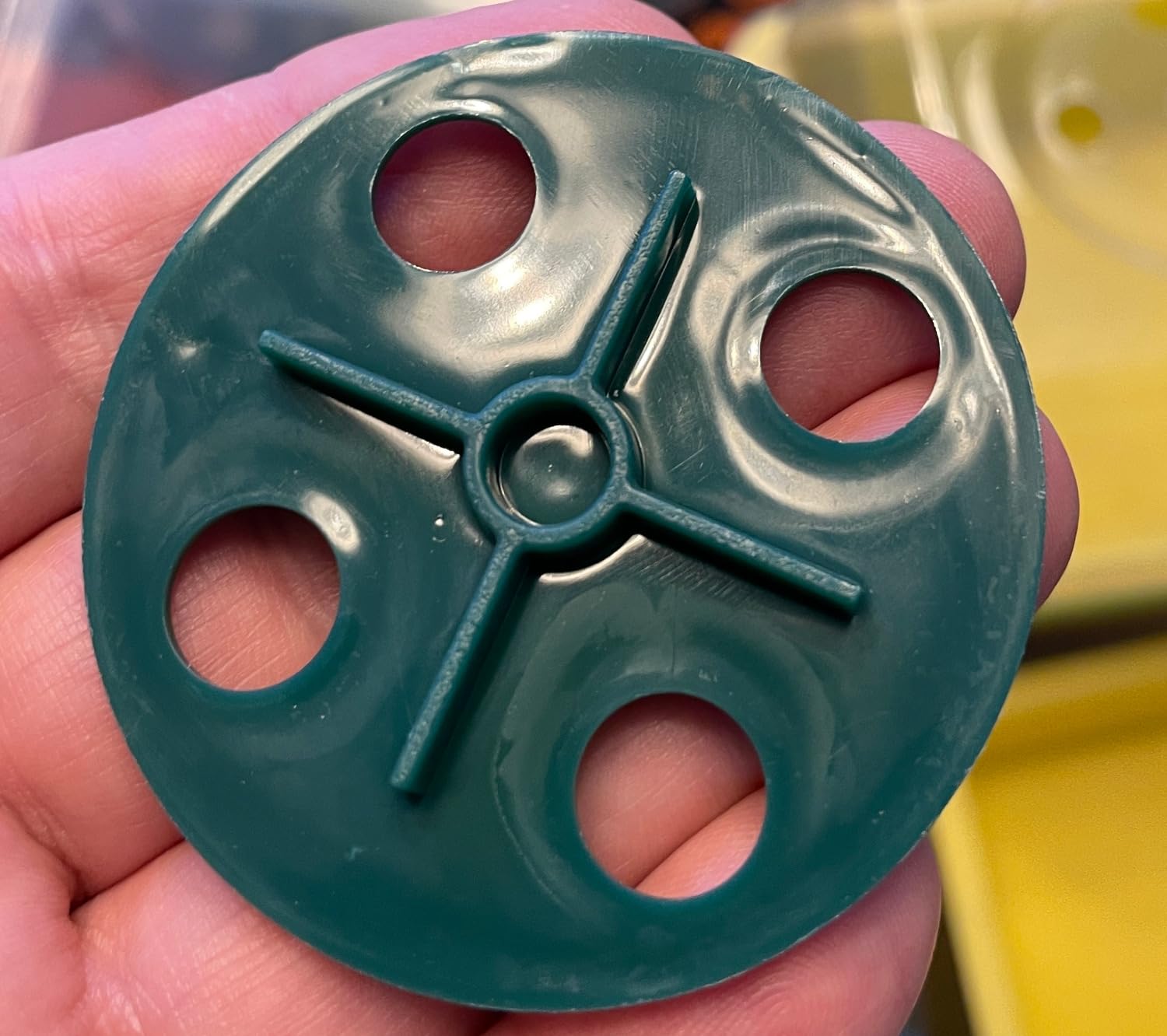
Vent placement is the other quiet advantage. Once shoots reach the dome you open a corner vent and slide the dome up a centimetre, which keeps humidity up while giving air a path across the canopy. Kits without vents force a full removal, and that jump from sealed to open is when condensation drops onto the leaves and causes spotting.
The vent is also what makes the 400 ml figure practical. Instead of guessing when the reservoir is too full, you watch the water line through the clear base and lift the dome once the first shoots touch it. The small tray size helps twice more, because there is less surface to rinse and the mesh stays free of residue that causes trouble over repeated harvests.
Harvest is where the fine mesh shows its value again. A 1.2 mm screen lets you lift a whole mat of broccoli cleanly, and when you cut an inch above the surface the root mat mostly stays behind instead of coming up with the scissors.
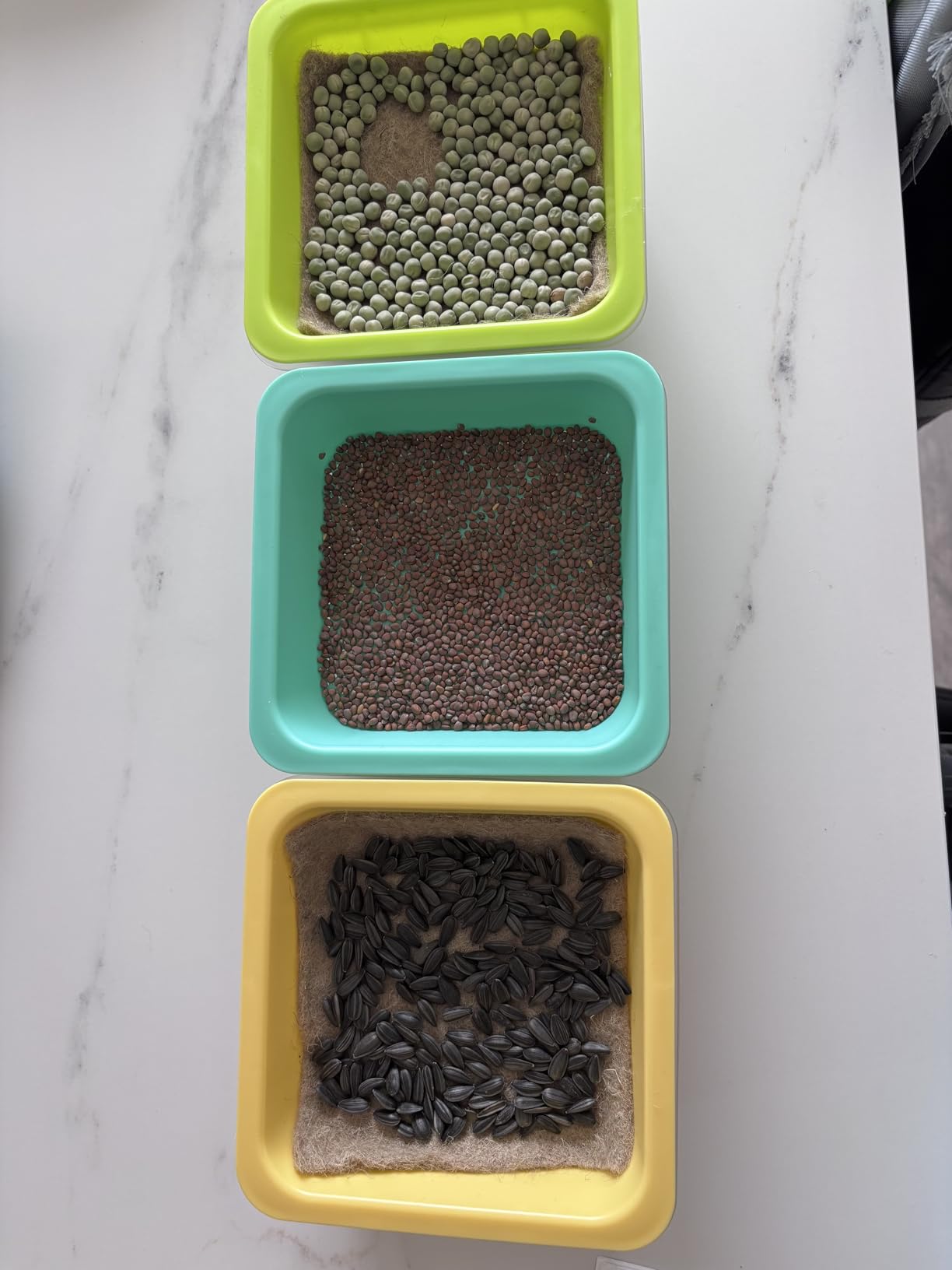
Small trays versus large trays
Big trays mean fewer refills and more volume per sowing. Small trays mean you can run four different varieties at once, stagger them precisely, and finish a batch before it starts to crowd itself. For a beginner, four small trays teach timing better because each one is a single manageable event.
The trade is yield per tray. A 5.9 inch square tray produces a garnish-sized harvest rather than a meal-sized one, so plan on two or three trays per serving for salads.
When this kit does not fit
Skip it if you are growing wheatgrass or cat grass. The fine mesh is designed to hold small vegetable seed, and grass seed needs more surface for dense rooting than this footprint provides. The same applies to very large seeds like sunflower, which need more room than a 5.9 inch tray gives.
Also plan to hand wash the domes. The base trays are dishwasher safe, but the domes are not, and running them through heat distorts the vents that make the humidity control work.
7. Kikerike Two-Jar Sprouting Kit – Best for Gifting
Kikerike Seed Sprouting Jar Kit with 2 Wide Mouth Mason Jars Bean Sprouts Growing Kit Microgreens Growing Jar with Mesh Screen Lids Sprouter Sprouts Maker for Growing Broccoli, Alfalfa, Mung Bean
- Two wide-mouth glass jars with mesh lids
- Blackout sleeves
- Stainless stands and shared drip tray
Pros
- Dishwasher-safe glass and stainless parts
- Blackout sleeves for the dark phase
- Two jars allow rotating crops
- Suitable for mung bean broccoli and alfalfa
Cons
- About three pounds of glass needs a steady counter spot
- Jars smaller than 32 oz models
- One shared drip tray for both jars
The Kikerike kit is the one to hand to somebody who has never grown anything. Two wide-mouth glass jars, two mesh sprouting lids, two stainless stands, two blackout sleeves and a drip tray, all in a box that looks like a gift rather than a gardening supply. The jars double as storage when they are not growing.
What earns it a place here is the cleanability. The glass and stainless components are dishwasher safe and rust resistant, which matters when a beginner is rinsing three times a day and has not yet built the habit of cleaning the kit properly. Most of the mold problems we saw in our own first attempts trace back to a kit that was awkward to clean.
The blackout sleeves do the same job as the sleeves on the two-jar kit above, keeping the dark phase clean and producing longer, straighter stems. The angled stainless stands speed up rinsing, because you tip the jar slightly and water runs off the mesh instead of running down your wrist.
Across weeks of testing, the sleeve was the piece we missed most when we were not using this kit. It is a small square of fabric that lets you run a proper dark phase on a counter you still need to use, and that is not something a clear dome does.
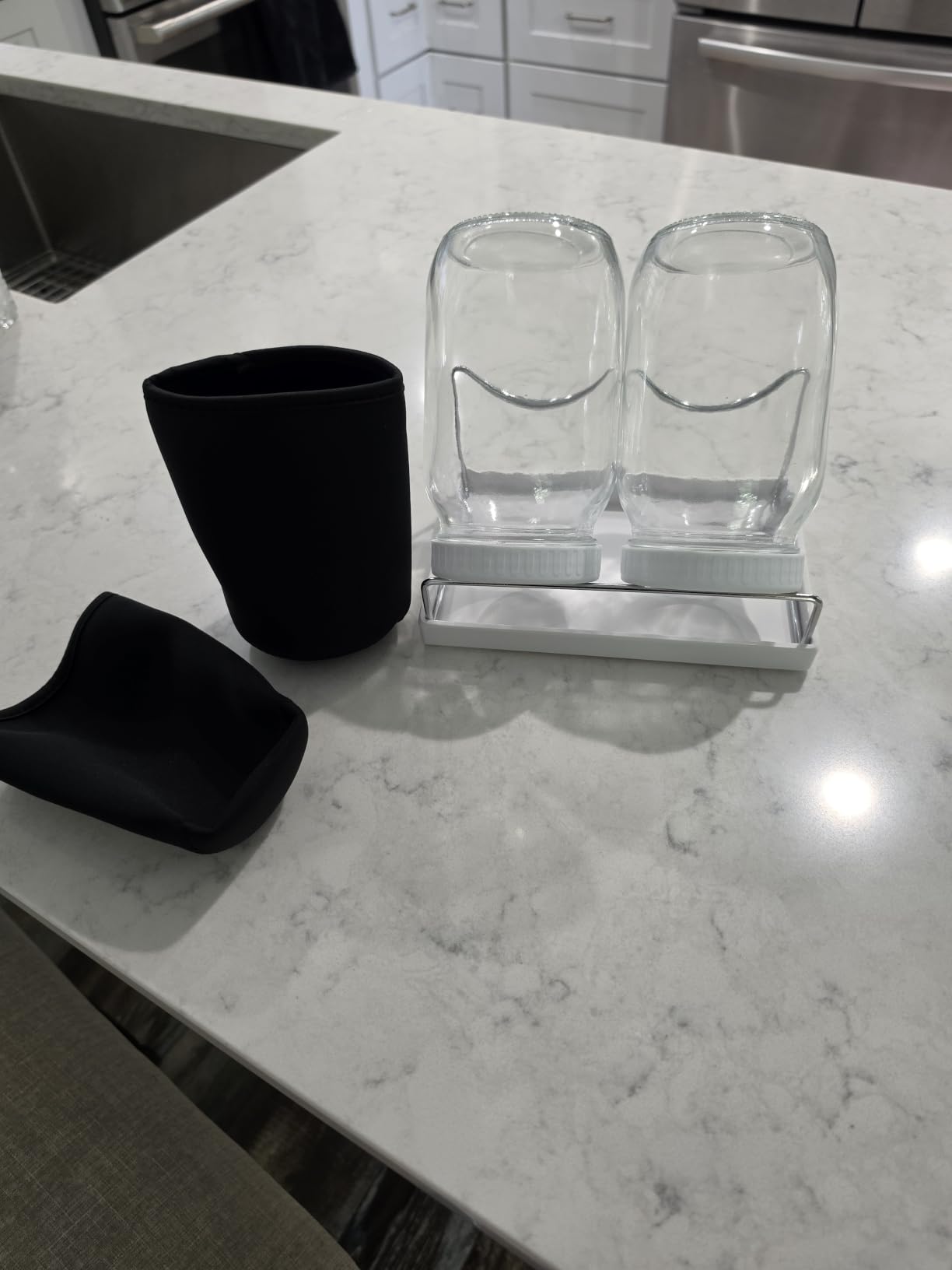
The weight is the real drawback. These jars come in at a bit over three pounds for the set, and that needs a flat counter rather than a corner shelf. No seed is included, so this is a hardware gift and you should expect to add a seed packet before you hand it over.
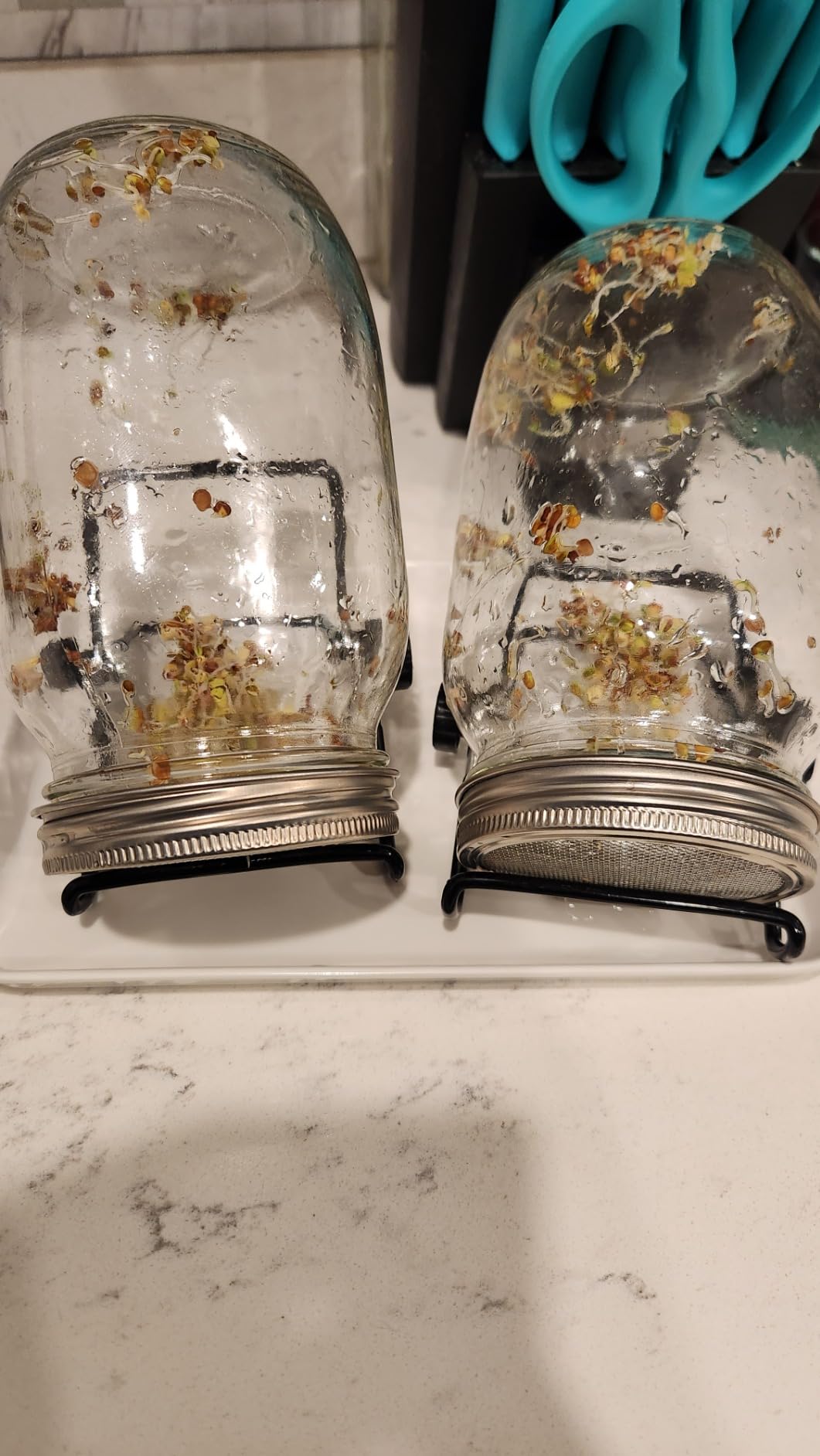
Why gifting works for this category
Microgreens are one of the few indoor growing projects that finish inside ten days, which means the person you gave it to gets a result rather than an abandoned tray. A jar sprouter is also forgiving enough to survive a missed watering and quick enough to keep interest.
Pair it with a seed packet and a printed gram weight per tray and it becomes a genuinely good present for a foodie, a family with kids doing a science project, or anyone who has said they want to grow something on a windowsill.
When you should not gift this
Do not gift it to somebody with a very small kitchen. Two jars plus two stands needs a stretch of counter, and if they already have clutter they will not use it. The compact tray sets or the single decorative jar are a safer choice for tight spaces.
Also avoid it as a gift for anyone who wants wheatgrass for pets. These mesh lids are sized for vegetable and legume seed, not grass, so a cat grass kit is the correct product for that request.
8. Back to the Roots 6-Variety Organic Seed Pack – Best Seed Value
Back to the Roots DIY Microgreen Grow Kit, 6-Grow Variety Pack
- Six organic seed varieties
- USDA certified organic and non-GMO
- Growing instructions by text support
Pros
- Widest variety selection in this roundup
- USDA certified organic with no pesticides
- Green-Thumb text support for beginners
- Made in the USA with a replacement guarantee
Cons
- Seeds only with no tray or dome included
- Soil-based so it needs hardware you buy separately
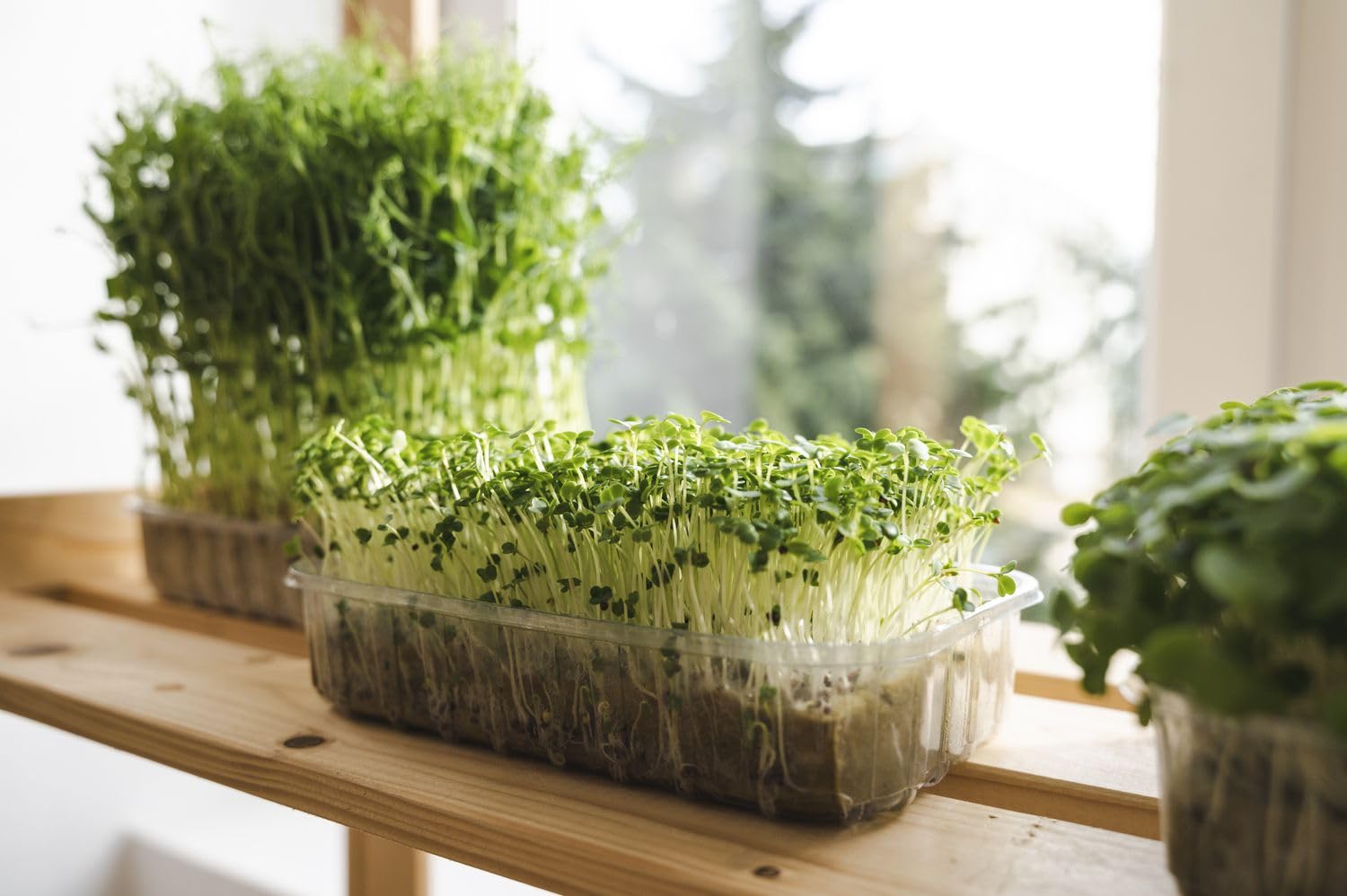
This is the odd one out in the list and it is worth including for that reason. The Back to the Roots pack is six seed packets and instructions, with no tray, no dome and no container of any kind. If you want the best microgreens growing kit, buy one of the hardware kits above. If you already have a working system and want better seed, this is the purchase that changes your results.
The six varieties include broccoli, kale, purple kohlrabi and red cabbage, which gives you the widest flavour range of anything here in a single order. The seeds are USDA certified organic, non-GMO and free of pesticides, and that certification matters more for microgreens than for most crops because you eat them raw and within days of sowing.
The text support is a real feature rather than a gimmick. You can message a grower with a photo of your tray and get a diagnosis, which is exactly the troubleshooting path that generic printed instructions cannot give you. Most reviews credit that support with rescuing a first attempt.
The drawback is obvious once you own it: you need a tray, a bottom tray and a cover before you can sow a single packet. Pair it with the self-watering tray or the two-jar kit and you have a complete setup with organic seed in it, which is a combination no single product on this page delivers.
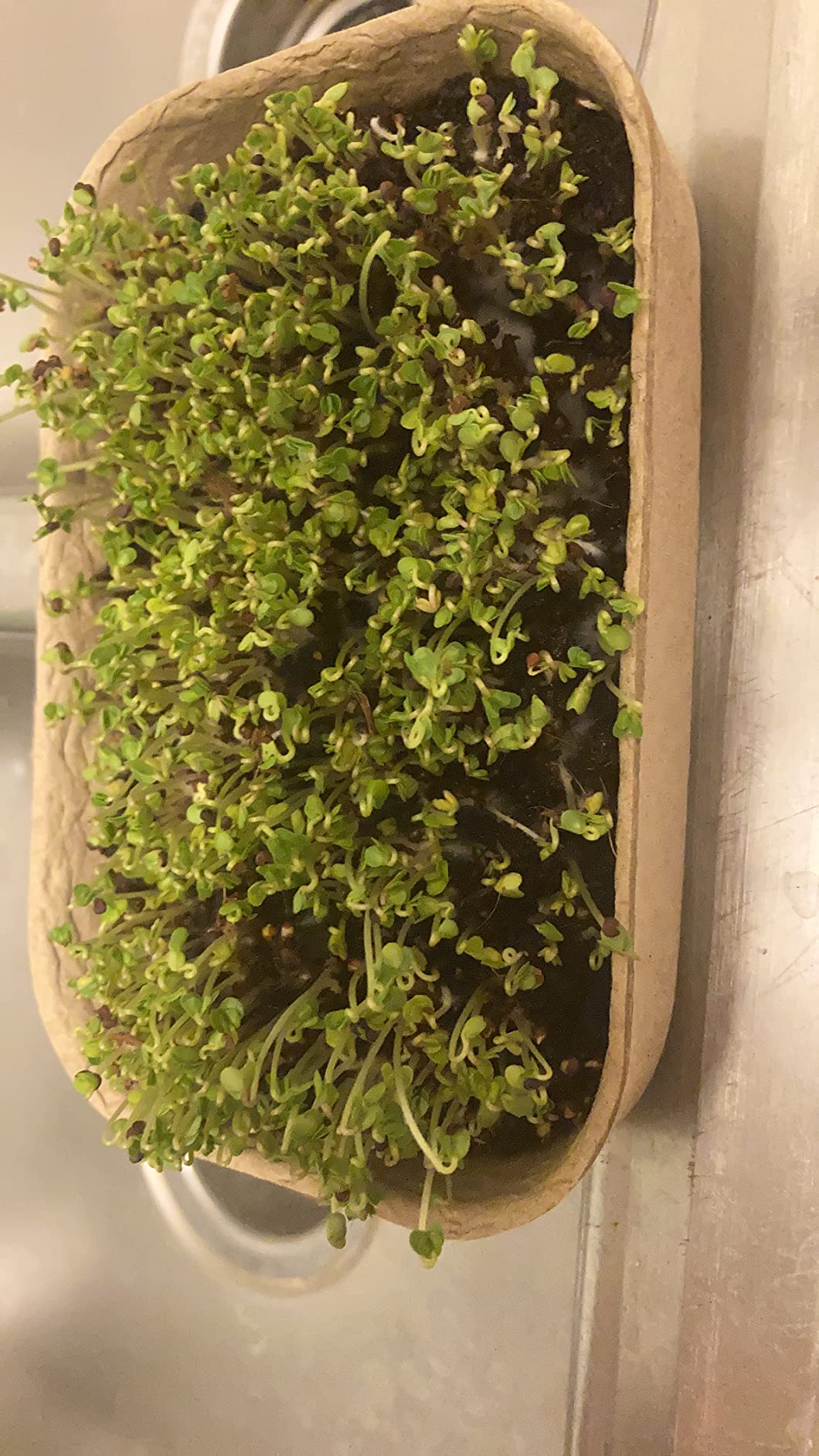
Because this pack is soil-based rather than hydroponic, the setup it needs is a shallow tray with drainage, a bottom tray and a cover, sown onto an organic growing medium rather than water and mesh. That is why pairing it with a jar sprouter does not work, and why pairing it with a soil-capable tray does.
Flavour is the other thing you cannot buy elsewhere here. Purple kohlrabi and red cabbage give noticeably different colours and sharper flavours than a blended brassica mix.
Why organic certification matters here
Conventional vegetable seed is often sold with a fungicide treatment, and those seeds are not labelled for use as sprouts or microgreens because the treatment stays on the seed coat. For a crop harvested at two inches and eaten raw, that is a reasonable line to keep.
Certified organic seed is grown without that treatment and without pesticides in the growing field, so it works cleanly for this use. It is the one specification on this list that we would not compromise on.
When seeds alone are the right buy
Buy this when you already have hardware and you are unsatisfied with what is growing. A tray that produces thin, leggy or bitter shoots is usually a seed problem rather than a kit problem, and swapping in six certified varieties solves it faster than buying another tray.
It is also the cheapest way to run a tasting comparison. Sow brassicas side by side over the same week, harvest them together and find out which flavour you actually want to repeat before you commit to a crop rotation.
9. LeJoy Garden 4-Layer Sprout Shelf – Best for Vertical Growing
4 Layers Sprout Trays with Extra Strength Plastic Shelf Soil-Free Healthy Wheatgrass Seeds Grower & Storage Trays for Garden Home Office
- Four tiers on a plastic tube frame
- Dense-hole mesh trays
- Measures 10 x 13.39 x 31.1 inches
Pros
- Four growing tiers in a small floor footprint
- Dense mesh retains even small mung beans
- Trays double as storage when idle
- Layers combine and fold freely
Cons
- About 31 inches tall so it is a floor unit
- Basic plastic construction
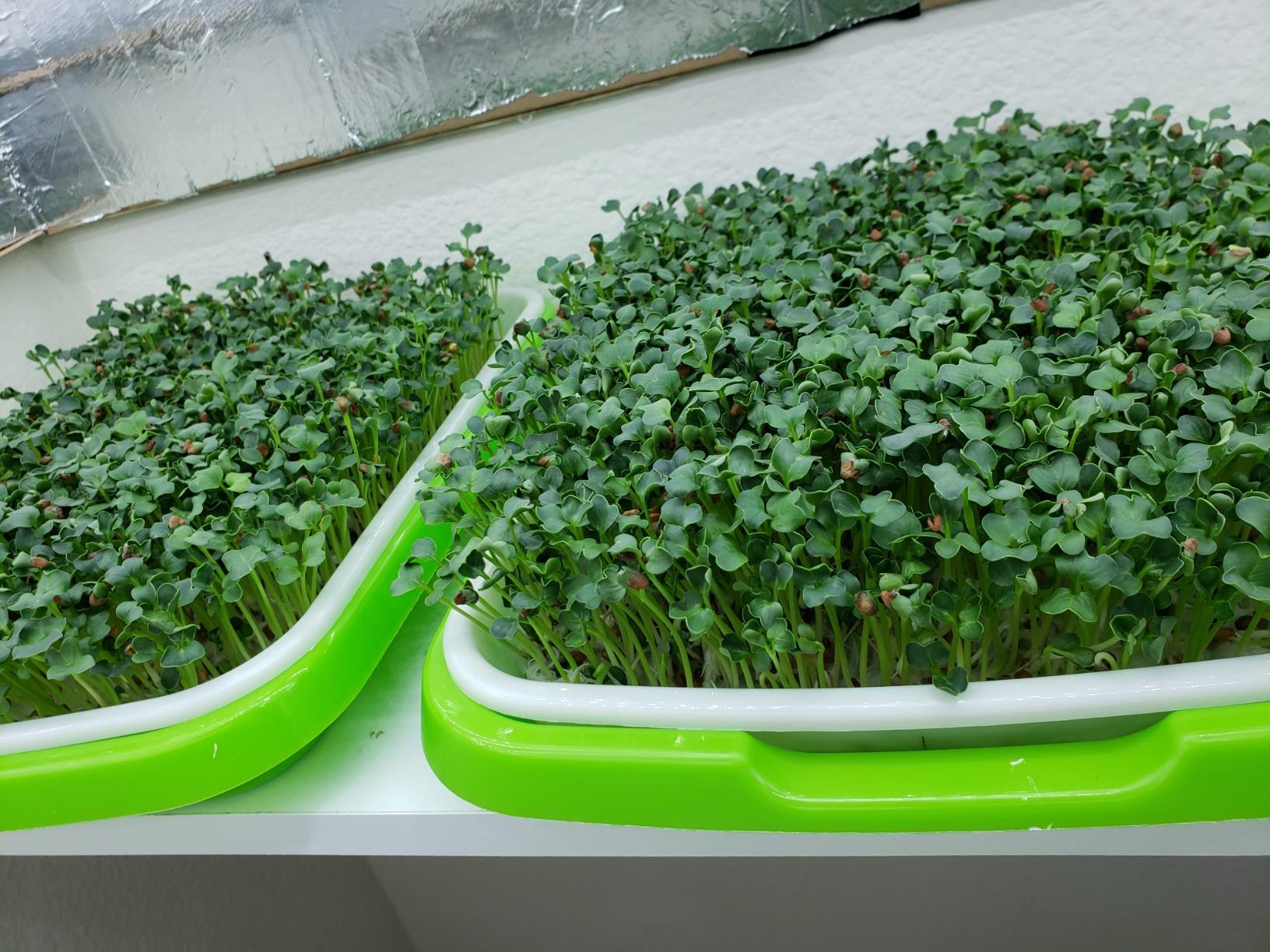
The LeJoy unit takes the tray concept and turns it on its side. Four mesh trays slide into a frame of extra-strength plastic tubes, giving you four growing levels inside a footprint of roughly 10 by 13 inches. If you have floor space but no counter space, this is the geometry that works.
The trays have densely small holes, which is the specification that matters. Even small mung beans do not trickle out, so you can grow beans, peanuts and black beans alongside vegetable seed without losing your crop through the floor of the tray. Each tray is also a storage container, which makes the whole unit useful when it is not growing anything.
The honest side of this review is the rating. At 4.0 stars it is the lowest-scoring kit in this roundup, with a 10 percent one-star share, and the complaints are consistent: basic plastic construction and a floor-standing form factor that does not match how most people grow microgreens. Nobody is filling a 31 inch tall unit on a kitchen worktop.
The rating distribution also tells you the middle is crowded. 54 percent five-star against 12 percent three-star and 10 percent one-star suggests a product that works exactly as described for people whose space suits it, and frustrates people whose space does not.
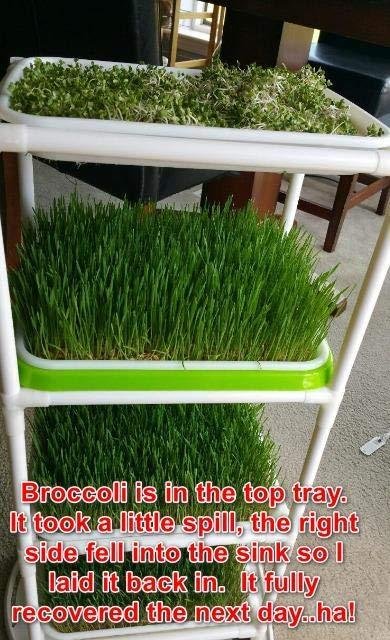
Assembly is the part that catches people out. The four trays slide into tubes joined by matching connectors, and the finished unit needs a floor footprint of roughly 10 by 13 inches. Layers can be combined rather than always used as a full four, so you can run two tiers and leave the rest as storage.
For bean growers this is the single most capable kit here. Mung, soya, peanut and black bean all sit on the dense mesh without dropping through, and beans are exactly the crop that needs four separate cycles to keep a supply going.
Where a vertical shelf genuinely wins
Small apartments and shared kitchens are the case for this. A single floor corner holds four tiers, so a person with plenty of light and only a small footprint of floor can grow four times what a flat tray allows. For mung bean and wheatgrass growers especially, that is a meaningful jump in output.
Because each tray lifts out, you can also stagger sowings across tiers by a few days each, which gives you a rolling harvest without needing separate units.
Why this is not our first recommendation
The floor-standing footprint is the core problem. It needs a patch of floor near a window that you are willing to give up permanently, and the seed above the bottom tier sits further from a windowsill than the seed below it, so lighting is uneven across the stack.
Buy this if counter space is genuinely your constraint. Otherwise the compact four-tray dome set above gives you similar capacity in a fraction of the volume and better light access.
10. ZESTIGREENS 4-Tier Sprouting Kit – Best for Fast Sprout Harvests
ZESTIGREENS Microgreens Growing Trays & 4-Tier Seed Sprouter Kit with Spout
- Four stackable clear trays
- Blackout cover included
- Bottom drain tray with spout
Pros
- Top-fill watering flows down through the stack
- Clear trays make progress easy to watch
- Sprouts ready in about 3 to 5 days
- Reusable BPA-free and easy to rinse
Cons
- Roots and mucilage clog the small drainage holes
- Top-fill watering dries the middle trays
- No cleaning instructions are printed on the unit
This is the fastest kit in the roundup by its own timeline. Four transparent stacking trays, a blackout cover and a bottom drain tray with a spout, with sprouts ready in roughly three to five days for lentils, alfalfa and mung bean. Where the tray kits above are aimed at microgreens that take seven to ten days, this one is built for quick sprout cycles.
The watering design is genuinely clever. You add water to the top tray and it flows down through the stack and out of the spout, which removes the need to lift each tier and pour into it separately. You can also use one tier alone for a small harvest and stack the rest for staggered planting dates.
Now the problems, and they are consistent enough in the reviews to state clearly. Roots embed in the drainage holes and mucilage from lentils clogs them, which makes both harvesting and cleaning tedious. Small seeds block the drainage entirely. Water added at the top drains so fast that seeds in the middle tiers end up drier than those at the edges, so even distribution needs manual correction.
There are no printed cleaning instructions, and reviewers regularly report needing a pin to clear holes. At 4.0 stars with a 9 percent one-star share, this is a kit that works when you stay on top of it and frustrates you when you do not.
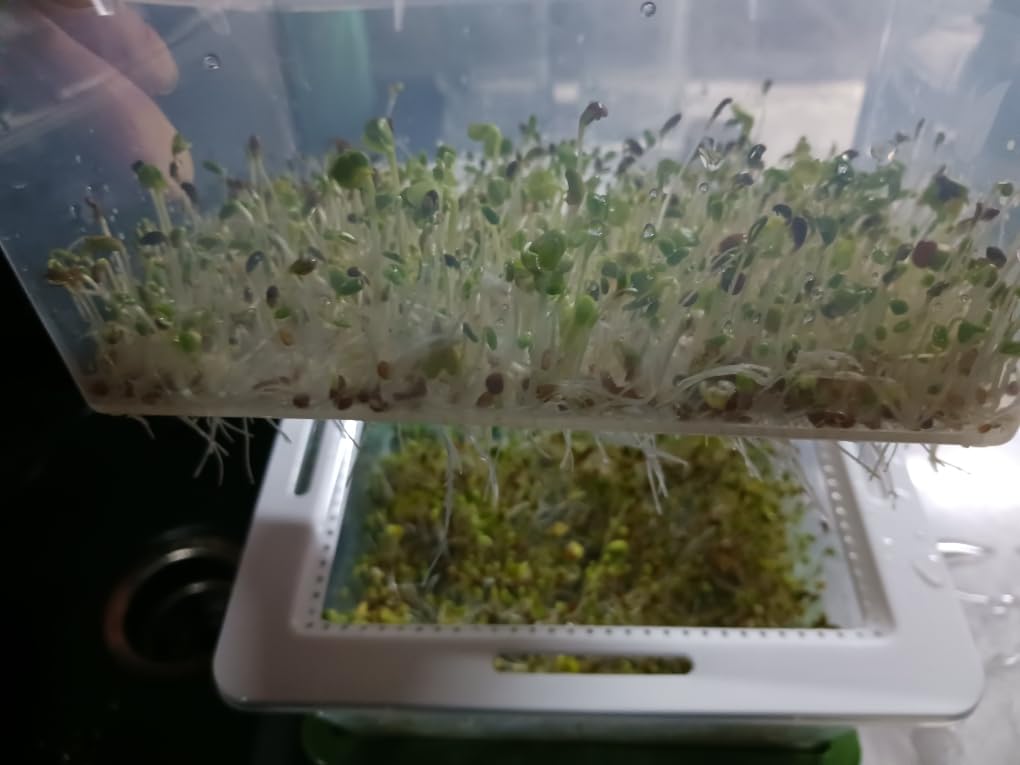
The blackout cover is the sleeper feature here. It is a single opaque cover that fits over the whole stack rather than individual lids, so you can darken all four tiers at once without taping anything down, and you can still peek through the clear trays to check whether germination has started.
Use one tier on its own for a small batch. The tapered tray walls let sprouts expand upward as they grow, which is why heavier seeds such as mung bean and pea work here even though the tray is shallow.
Where the stacked design beats everything
Space is the advantage. Four tiers in a stack use a fraction of the footprint of four flat trays, and the transparent walls let you check germination without lifting anything. If your window ledge is narrow, this is the format that still fits.
For lentil, mung bean and alfalfa growers who want fast cycles and eat the harvest within days, the three to five day timeline is a real convenience rather than a marketing number.
Who should pick a different kit
Choose something else if you are new to this and want the least fuss. Small holes that clog with roots and mucilage is a maintenance issue, and it lands hardest on a beginner who is already learning three new steps at once. The flat mesh trays above rinse clean in seconds because the inserts lift straight out.
Also note that this is a sprouting kit built for fast, heavy-seeded crops. Brassica microgreens with fine seed are a poor match for holes that are easy to block.
How to Use a Microgreens Growing Kit Step by Step
Every kit on this list follows the same sequence once you understand the format. The differences are in the hardware, not the method, so this walkthrough works with any of them.
Day 0, soak and sow. Soak larger seeds such as radish, pea and sunflower for several hours; small brassica seeds like broccoli skip the soak. Spread seed evenly on the medium or mesh at the gram weight your seed supplier lists for that tray size.
Day 0 to 2, keep it dark. Set the dome, lid or blackout sleeve on top. Weight it down if the kit allows. The tray stays at roughly room temperature and you should not need to water.
Day 2 to 4, check moisture. Lift one corner and look at the medium. Water from the bottom tray if it is dry; never pour water over the seed because it displaces it and creates bare patches.
Day 4, give it light. Remove the cover and move the tray into a bright window or under a grow light. Do not put it in direct sun, which scorches young leaves.
Day 4 to 9, water and rotate. Rinse or refill from below once a day, and turn the tray a quarter turn each time so growth stays even.
Day 7 to 10, harvest. Cut with clean scissors an inch above the medium, before leaves become true leaves and turn bitter. Some varieties regrow a partial second cut.
Wash everything before eating. Microgreens are eaten raw and you skip the cooking step that kills bacteria on most produce, so rinse the harvested greens under running water and dry them properly before storing.
Do You Actually Need a Grow Light?
For most varieties, no. A bright south-facing window with four to six hours of direct light grows broccoli, radish, pea and amaranth microgreens perfectly well, and every kit in this roundup can be started without one.
You need a light when you have low-light spaces, when you want to grow sunflower or a dense brassica mat, or when your window gets only indirect light. The symptom of too little light is leggy, pale, stretched stems with small leaves, and no kit design fixes it. The symptom of too much light is bleached or scorched leaves, which is rarer.
Our advice is to start with the windowsill and only add a light when you have a specific crop that needs one. Buying an expensive light before your first tray is the most common unnecessary purchase in this category.
Why Your First Tray Grew Mold
Mold is the most common failure in home microgreens growing, and it is nearly always one of four things. Work down this list before you throw the kit away.
Standing water on the seed bed. A tray with no drainage or an insert sitting in a puddle of water is the root cause of most cases. Fix: move to a mesh insert over an empty bottom tray, and refill water below the seed rather than above it.
Overwatering to compensate for dryness. Alternating bone dry and soaked is worse than consistently moist. Fix: switch to a bottom-fed system like the self-watering tray so moisture arrives by wicking.
A dome left on after germination. A humidity cover is for the dark phase only. Fix: remove it the day shoots appear and open the vents so air moves across the canopy.
A non-cleanable tray. Roots and mucilage lodged in drainage holes reseed the next batch. Fix: choose an insert that lifts out, and rinse with hot water and a drop of detergent after every cycle.
Uneven seed density causes a different complaint that gets mistaken for mold: bare patches where nothing germinated, and thick mats that trap moisture underneath. Fix: weigh the seed per tray instead of sprinkling by feel.
The Easiest Microgreens Varieties for Beginners
Start with brassicas. Broccoli, radish, kale, kohlrabi and mustard germinate fast, need no soak, grow on any kit in this roundup and mature in five to eight days. Radish is the fastest and the most forgiving, and it has the strongest flavour so you notice results immediately.
Then try peas and sunflower. Pea shoots are forgiving but need a soak and heavier seed. Sunflower is the most demanding: large seed, a long soak and a mat that needs weighting, so it is a good third crop once your first tray works.
Save wheatgrass and mung bean for the tray and shelf kits rather than the fine-mesh dome sets, and treat mung bean and lentil as sprouts rather than microgreens since they mature faster than any true microgreen crop.
What to Look for in a Microgreens Grow Kit
Drainage that separates seed from water. The single most important specification. A mesh insert over an empty bottom tray lets you water from below and removes the failure mode behind most mold. A kit with a solid base and no mesh has a ceiling on how well it can work.
A working cover for the dark phase. Any dome, lid or blackout sleeve is acceptable, but it needs to sit on the tray and hold warmth and darkness for two to four days while roots anchor.
A growing format that matches the seed size. Fine 1.2 mm mesh holds broccoli, alfalfa and chia. Wider mesh suits radish, wheatgrass, peas and beans. Buying fine mesh for mung beans wastes money, and buying wide mesh for broccoli costs you a liner.
Seed, or a clear seed path. Only one kit in this roundup includes seed. If you are buying hardware separately, check whether the seed supplier prints a gram weight per tray, because a packet with no weight leaves you guessing at density.
Cleaning access. Mesh inserts that lift out beat fixed trays by a wide margin. Check whether any part is dishwasher safe, and whether replacement inserts or lids are sold separately.
Footprint matched to your space. Flat trays suit counters, the vertical shelf suits a floor corner, and jar kits suit a narrow ledge. Measure the space before you order, since a kit you cannot fit is a kit you will not use.
Red flags we would skip: conventional seed that may be fungicide-treated for a crop you eat raw, a tray with no drainage, no cover at all, and any listing that says only sprinkle evenly instead of giving a seed weight.
One safety note. Use food-grade materials, rinse your harvest under running water before eating since microgreens are eaten raw, and avoid any spray or pesticide near an open tray. Growing medium such as coconut coir should be washed through before sowing so it does not wick moisture away from the seed.
Frequently Asked Questions
Is growing your own microgreens worth it?
For regular use, yes. A single jar or tray kit can produce a salad-sized harvest every week once you are rotating sowings, and the ongoing cost is seed plus a growing medium rather than a repeated hardware purchase. The break-even point arrives quickly because the trays are reusable and the seeds are cheap by weight. The real cost is attention for the first two cycles, not money.
What are the best microgreens for beginners?
Brassicas are the easiest: broccoli, radish, kale, kohlrabi and mustard. They need no soak, germinate in two to four days and harvest in five to eight, and they work in every kit in this roundup. Radish is the fastest and most forgiving. Add peas next, then sunflower, which needs a long soak and a heavier seed.
What is the best kit for microgreen growing?
For most beginners the best microgreens growing kit is one with a mesh insert over an empty bottom tray plus a cover for the dark phase. That combination removes standing water, which is the main cause of mold. Our top pick for rating and build quality is the ALCEDIA borosilicate jar kit, while the ZESTIGREENS self-watering tray wins if you want seeds and a guide included.
How long does it take to grow a microgreen?
Most microgreens are harvestable seven to ten days after sowing under a bright window. Faster sprouts such as mung bean, lentil and alfalfa can be ready in three to five days in a stacked kit. Brassicas usually land at five to eight days. If growth stalls after day four, the usual cause is not enough light rather than a problem with the kit.
What are common mistakes people make when growing microgreens?
The four recurring errors are sowing seed too thick or too thin, skipping the two to four day dark phase, watering from above instead of below, and leaving the humidity dome on after germination. A fifth is reusing a tray without cleaning it properly, which reseeds mold through roots lodged in the drainage holes. Each one is solved by a specific hardware or timing change.
Are microgreens actually profitable?
Not as a business at home scale. The economics work for restaurants buying in volume from a commercial supplier, but a home kit cannot match wholesale yield per square foot, and seeds plus medium plus your time are the real costs. Grow for fresh flavour and variety, and treat any income as a side effect rather than a plan.
Is it okay to eat microgreens every day?
Yes, eaten as part of a varied diet. Microgreens are harvested at two inches and are safe raw, but you should rinse them under running water before eating because there is no cooking step. Start with a small quantity of a new variety, since some people find brassicas harder on digestion than they expect. Buy certified organic seed for anything eaten raw.
Conclusion
If you are starting from nothing in 2026, buy one jar kit and one tray kit, both with mesh inserts over bottom trays. The ALCEDIA borosilicate jar is our editor’s choice: it carried the highest rating in this roundup at 4.7 stars across 917 reviews, borosilicate glass holds temperature changes better than the standard jars in this category, and a single jar is a small enough commitment to experiment with while you learn seed weight and blackout timing.
Add the ZESTIGREENS self-watering tray as your second purchase, because it is the only kit here that arrives with seed, mats, a blackout lid and a written guide, which means you can grow while you wait for your first seed order to arrive. If you have no counter space, go with the LeJoy vertical shelf instead of flat trays. If your main concern is certified organic seed, add the Back to the Roots six-variety pack to whichever hardware you choose.
Start with radish and broccoli, skip the grow light until you need one for sunflower, and expect your first tray to teach you more about seed density than any instruction will. Ten days later you will have a harvest you cut yourself.