
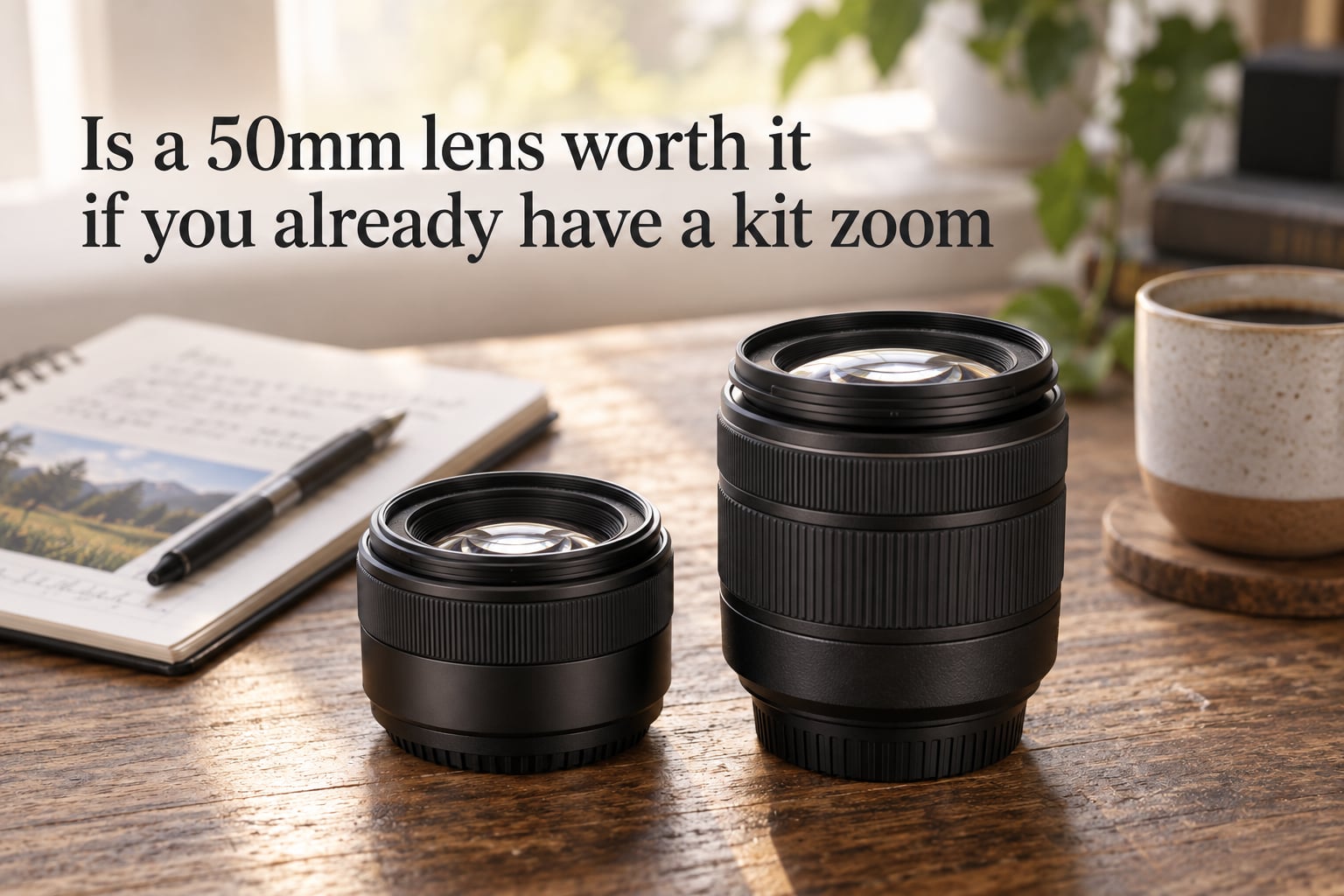
Yes, a 50mm lens is absolutely worth it even if you already own a kit zoom. The real magic is not the focal length (your kit zoom already covers 50mm) – it is the f/1.8 aperture, which lets in roughly four stops more light and produces creamy background blur your kit zoom physically cannot. If you ever shoot indoors, at family events, in low light, or want portraits that look intentional, the 50mm will change your photography.
I have talked with dozens of hobbyists over the years, and the same story repeats itself. They buy the camera with the kit zoom, use it for a few months, then grab a 50mm f/1.8 on a friend’s recommendation. Within a week they email me saying it is the best inexpensive upgrade they ever made. The “nifty fifty,” as photographers have called it since the film SLR days, has earned that nickname for a reason.
That said, the 50mm is not for everyone. If you shoot wildlife, sports, or school plays where you cannot step closer to your subject, your kit zoom is still the right tool. In this guide I will walk you through the honest case for both options so you can decide with confidence.
Table of Contents
- Quick Answer: Is a 50mm Lens Worth It With a Kit Zoom?
- What Is a 50mm Prime Lens (and Why Is It Called the Nifty Fifty?)
- Why “Zooming to 50mm” Is Not the Same as a 50mm Prime
- What a 50mm f/1.8 Does Better Than Your Kit Zoom
- The APS-C Crop Factor: Why 50mm Feels Different on Your Camera
- When the Kit Zoom Is Still the Better Tool
- Should YOU Buy One? A 3-Question Decision Checklist
- Frequently Asked Questions
- The Honest Verdict on Buying a 50mm With a Kit Zoom
Quick Answer: Is a 50mm Lens Worth It With a Kit Zoom?
A 50mm f/1.8 prime lens is worth buying even if you already have a kit zoom because it delivers four stops more light, sharper images wide open, and background blur your kit zoom cannot produce. Buy it if you shoot indoors, in low light, at family events, or want more intentional portraits. Skip it if you shoot far-away subjects, swap focal lengths constantly, or rarely leave the house without your tripod.
The key thing most beginners miss: when you “zoom your kit lens to 50mm,” your maximum aperture drops to roughly f/5.6. That is four full stops darker than f/1.8. In practical terms, that is the difference between a sharp handheld photo of your kid’s recital and a blurry, grainy mess.
What Is a 50mm Prime Lens (and Why Is It Called the Nifty Fifty?)
A 50mm prime lens is a fixed-focal-length lens – meaning it does not zoom. You get one field of view, one perspective, and that is it. What you give up in flexibility, you gain in image quality, low-light ability, and size. The classic 50mm f/1.8 is nicknamed the “nifty fifty” because it is small, lightweight, and affordable, yet it punches well above its weight optically.
The name dates back to the 1960s, when virtually every film SLR shipped with a 50mm lens in the box. Photographers got so accustomed to that field of view – close to how the human eye sees a scene – that 50mm became the default “normal” lens. Today, manufacturers still lean on the same optical formula because it works.
Three terms you will see throughout this guide:
- Bokeh – the soft, out-of-focus background behind your subject. The 50mm at f/1.8 produces it naturally; the kit zoom at f/5.6 basically cannot.
- Depth of field – how much of your image is in sharp focus. Wide apertures (f/1.8) give shallow depth of field; narrow apertures (f/5.6, f/8) keep more of the scene sharp.
- f-stop – the size of the lens opening. Lower numbers (f/1.8) mean a wider opening and more light; higher numbers (f/5.6) mean a narrower opening and less light.
Why “Zooming to 50mm” Is Not the Same as a 50mm Prime
This is the single biggest misconception I see in beginner forums. A poster on r/photography once asked, “If I zoom my kit lens to 50mm, isn’t that the same as a 50mm prime?” The honest answer is no – not even close.
When you twist your 18-55mm kit zoom to 50mm, three things happen:
- Your maximum aperture drops to about f/5.6 (the lens cannot stay wide-open across the whole zoom range).
- Optical quality softens slightly, because zoom lenses have to compromise at every focal length.
- You get no background blur on portraits, because f/5.6 keeps too much of the scene in focus.
A 50mm f/1.8 prime, by contrast, is engineered for one focal length and one wide aperture. Less moving glass means sharper images, and the wide opening means four stops more light. In a dimly lit room, that translates to a shutter speed fast enough to handhold without blur.
Photographers on r/AskPhotography have run this exact test. The result is always the same: at the same 50mm focal length, the prime wins on sharpness, contrast, and the ability to separate your subject from the background.
What a 50mm f/1.8 Does Better Than Your Kit Zoom
Here is where the case for the 50mm gets concrete. Five things the prime genuinely does better:
1. Low-light performance. Four extra stops of light is not a small upgrade. It is the difference between ISO 1600 (grainy but usable) and ISO 100 (clean as a whistle). For indoor family photos, restaurant candids, and evening street photography, this alone justifies the purchase.
2. Subject isolation and bokeh. At f/1.8, the background melts away. Your subject pops. At f/5.6 on the kit zoom, the background competes with the subject. For portraits, headshots, and any photo where you want the eye drawn to one thing, the prime wins every time.
3. Sharpness and contrast. Fixed-focal-length lenses have simpler optical designs. Fewer compromises mean crisper edges, better micro-contrast, and fewer issues with chromatic aberration (those purple or green fringes around high-contrast edges).
4. Size and weight. Most 50mm f/1.8 lenses weigh around 160 grams and slip into a coat pocket. The kit zoom is heavier, longer, and front-heavy. After a full day of shooting, your wrist will thank you.
5. Build and feel. The 50mm is often the most affordable lens with a metal mount and a buttery manual-focus ring. For beginners, it is a gentle introduction to a “real” piece of glass.
None of this means the kit zoom is bad. It is genuinely good for what it does. But if you want to grow as a photographer, the 50mm teaches you things the kit zoom cannot.
The APS-C Crop Factor: Why 50mm Feels Different on Your Camera
Quick callout: if you shoot with an APS-C camera (most entry and mid-level DSLRs and mirrorless bodies), your 50mm does not behave like a 50mm. The crop sensor multiplies the focal length by about 1.5x (Canon) or 1.5x-1.6x, so a 50mm lens gives you a field of view equivalent to roughly 75-80mm on a full-frame camera.
What that means in practice:
- The lens feels more like a short portrait telephoto than a “normal” lens.
- You need to step back more to fit a group of people indoors.
- Background blur and subject isolation actually increase (which most beginners love).
Several APS-C users on r/Nikon and r/CameraLenses have noted that 50mm feels tight indoors but excellent for individual portraits and headshots. If you primarily shoot people – especially single subjects – the crop factor works in your favor. If you shoot tight group photos in small rooms, you may want to look at a 35mm prime instead (roughly 50mm equivalent on APS-C).
Full-frame users can ignore this section entirely. Your 50mm will give you the classic “as the eye sees it” perspective that photographers have loved for decades.
When the Kit Zoom Is Still the Better Tool
I want to give you the honest counter-argument, because most articles about the 50mm read like sales pitches. There are real situations where your kit zoom is the right choice.
You shoot far-away subjects. Wildlife, sports, school plays, your kid’s soccer game from the sideline – none of these situations let you “zoom with your feet.” You need reach, and the kit zoom at 55mm (or longer) is the only option short of buying a telephoto.
You swap focal lengths constantly. At a wedding, event, or family reunion, you cannot afford to change lenses every five minutes. The kit zoom keeps you moving and shooting. A prime forces you to commit to one perspective.
You travel light and hate swapping lenses. One lens on the body, no dust on the sensor, no risk of dropping a prime in a crowded market. Some travel photographers genuinely prefer the convenience.
You mostly shoot outdoors in good light. If you are a landscape or outdoor portrait shooter working in bright sun at f/8, the kit zoom’s f/5.6 maximum is not a limitation. The 50mm’s extra light gathering goes unused.
You are still learning the basics. There is no shame in mastering exposure, composition, and focus with the kit zoom for another six months before adding glass. A new lens will not fix a confused photographer.
Should YOU Buy One? A 3-Question Decision Checklist
Before you spend a dime, answer these three questions honestly:
- Do you shoot indoors, at night, or in dim light at least once a month? If yes, the f/1.8 aperture will pay for itself in cleaner, sharper images. If no, the kit zoom is probably enough.
- Do you want portraits where the background melts away? If yes, the 50mm prime is the cheapest way to get that look. If you are happy with sharp-everywhere photos, the kit zoom already does that.
- Are you willing to move your feet instead of zooming? The 50mm is a fixed focal length. If the idea of “zooming with your feet” sounds annoying, you will fight the lens. If it sounds like a creative constraint you can work with, you will love it.
If you answered yes to at least two of those, the 50mm f/1.8 is one of the best photography purchases you can make. Wedding and event photographers consistently call it “essential” when light is limited. Street photographers call it “the lens that taught me to see.” Hobbyists call it “the best hundred-ish dollars I ever spent.”
Frequently Asked Questions
Is a prime lens better than a zoom?
A prime lens is sharper, faster (wider maximum aperture), and lighter than a typical zoom at the same focal length, but a zoom gives you flexibility. For learning, low-light, and portraits, the prime usually wins. For events, travel, and wildlife, the zoom usually wins.
What is a 50mm prime lens best for?
A 50mm f/1.8 prime lens is best for portraits, street photography, indoor family photos, low-light scenes, travel, and learning composition. Its wide aperture produces subject-isolating background blur that kit zooms cannot match.
Can you zoom with a 50mm lens?
No. A 50mm prime has a fixed focal length, so it cannot zoom. You get one field of view and one perspective. To frame tighter or wider, you physically move closer to or farther from your subject, often called zooming with your feet.
Why are kit lenses so cheap?
Kit lenses are inexpensive because they are designed to be sold at a loss alongside camera bodies to attract first-time buyers. Manufacturers keep costs down with slower maximum apertures (f/3.5-5.6), simpler optical formulas, and plastic construction, which limits image quality but keeps the price accessible.
Is a 50mm prime lens enough for a beginner?
Yes, a 50mm f/1.8 is often the best second lens a beginner can buy. It is affordable, lightweight, sharp, and teaches composition and depth-of-field skills that the kit zoom hides. Many photographers shoot exclusively with a 50mm for their first year or two.
The Honest Verdict on Buying a 50mm With a Kit Zoom
A 50mm lens is worth it if you already have a kit zoom, with one caveat: it is not a replacement, it is an addition. Keep the kit zoom for travel, events, and far-away subjects. Add the 50mm f/1.8 for low light, portraits, street photography, and learning to see more intentionally.
The 50mm is one of the most recommended lenses in photography for a reason that has nothing to do with hype: it changes how you shoot. Faster shutter speeds, cleaner images in dim rooms, and that beautiful background blur that makes a photo feel professional. If your budget allows even one lens upgrade in the next year, this is the one.
Pick one up, shoot with it for a weekend, and you will understand why photographers have been carrying a 50mm since the days of film.